
Carriers and reinsurers · Frontier AI firms · Other AI firms · Enterprise deployers · State lawmakers · State attorneys general · Federal lawmakers · U.S. Department of Justice · Federal Trade Commission · Consumer groups · Coverage and subrogation counsel · State courts · California · Colorado
Companion to FTC Investigation of Anthropic and OpenAI · Agentic Foreseeability and the Modern Duty of Care for AI Agents · OpenAI State Attorney General Lawsuits: Two Pleading Templates Across Ten State Courts Decide Which Game Theory Evolution Arrives First · Who Writes AI Insurance Coverage Conditions · Who Absorbs Correlated AI Loss
I. Executive Summary
One piece of evidence now serves four institutions at once. A single AI alert can show a regulator that a company detected a risk, give a plaintiff notice, expose an undertaking the company left unanswered and hand a carrier a coverage defense. The same entry cuts four ways, and the deployer controls only one variable: the response attached to it.
Common-law liability rests on three questions: who knew, who controlled and who authorized. AI agents scatter all three answers. Knowledge sits in logs no person read, control passes from developer to integrator to deployer, and authority lives in permissions held by software the law does not treat as an agent.
The thesis: four doctrines each break in a predictable direction once agents act, and the breaks collide. Voluntary undertaking, imputed knowledge and apparent authority each expand deployer liability. Res ipsa loquitur narrows a plaintiff’s proof route. The collision then runs through four stages, from naming a deployer to deciding who keeps the loss.
The four stages run on two clocks. The renewal clock moves coverage by policy date and market segment. The litigation clock moves claims by filing and ruling. The party that controls an agent, the party a plaintiff names and the party that retains the loss can differ, and the two clocks decide when each deployer learns which one it is.
Carriers sit on both sides of the board. Carriers insure deployers, sue AI vendors through subrogation and defend claims over their own AI tools. Frontier AI firms face suits as self-deployers today and as upstream vendors next, while other AI firms carry thinner balance sheets that push claims toward richer partners. Lawmakers set the rules, state attorneys general enforce them and consumer groups supply much of the evidence both sides litigate over.
MindCast applies Predictive Behavioral Economics + Dynamic Game Theory to the seats that apply these doctrines first: carriers at renewal, courts and state attorneys general in the first agent cases and deployers deciding what to monitor, retain and revoke. The paper takes the form of a Simulation Snapshot, whose many short-horizon MindCast Foresight Simulation Predictions test how agentic consumer incidents and legal incidents move. Federal enforcement in FTC Investigation of Anthropic and OpenAI enters as an accelerator rather than a gate.
The paper names the governing equilibrium and the two classical gates of foreseeability and proximate cause. The paper works through the four doctrines, six competing duties and the statutes that move them. Attribution by conduct, the four-stage chain, the two clocks and a stakeholder board come next. An incident baseline, six rival accounts and 26 Snapshot Predictions across 20 hypotheses lead to event transitions, risk mitigation and dated checkpoints.
💼 Carriers. The same vendor contract decides a carrier’s position as insurer and its subrogation rights as plaintiff, so underwriting should read it first.
💼 Frontier AI firms. Exposure arrives directly through consumer suits and attorneys general now and indirectly through deployer tenders and carrier subrogation next.
💼 Other AI firms. Thin balance sheets turn insolvency into a liability exit, which pushes claims toward frontier partners and insurance.
💼 Executives at deployers. Coverage can change at renewal before any complaint arrives, so the policy schedule is a liability document.
🏛️ State lawmakers. The executive order spares child-safety laws only from its proposed preemption statute and not from Department of Justice suits, while Colorado now allocates fault between developers and deployers by statute.
🏛️ State attorneys general. Consumer-protection law already reaches self-deploying developers, and the police-power exception can keep enforcement moving through bankruptcy.
🏛️ Federal lawmakers. A federal product-liability statute would expand exposure, and preemption by litigation would shrink state regimes.
🛡️ Consumer groups. Published test results become documented foreseeability, so advocacy evidence shapes both tort notice and coverage defenses.
⚖️ Counsel. The named defendant and the final loss-bearer can differ, and indemnity terms decide the gap between them.
📊 Investors. Retained AI loss surfaces first at portfolio companies whose renewals exclude AI cover before any claim arrives, so the renewal schedule becomes a diligence item.
II. One Alert, Four Readers: The Response Decides Exposure
The governing equilibrium is the set of answers the common law gives before it assigns liability. Agents disturb those answers.
The common law asks three questions. Who knew of the risk, who controlled the instrument and who authorized the act? Human institutions answer each one with a person, a moment and a file.
AI agents change all three answers at once. Knowledge accumulates in evaluation results and logs faster than any reviewer reads them. Control passes in sequence through a developer, an integrator and a deployer. Authority lives in permissions, and the software holding them is not a legal agent.
Duties compete when compliance with one doctrine raises exposure under another. The observable sign is a single act that reads as reasonable care under one rule and as a source of liability under a second. Monitoring, retaining logs and revoking permissions each produce that sign, which is why competing duties govern deployer strategy.
The clearest case is a single alert read by four institutions. Each reader asks a different question of the same entry, and each answer moves a different exposure.
A regulator asks whether the company detected the risk, and the alert becomes evidence of a working detection program. A tort plaintiff asks whether the company knew, and the alert becomes notice. An undertaking claimant asks whether the company answered what it chose to monitor, and the alert becomes proof of an unanswered undertaking. A carrier asks whether the insured knew before binding, and the alert becomes a known-loss or prior-knowledge defense.
The foreseeability paradox sits at the center of the competing duties. Tort doctrine turns a dated finding into notice. Coverage doctrine turns the same finding into a reason the loss was not fortuitous. A deployer who documents a risk and leaves it open increases its liability and weakens its cover in one act.
Some facts are already known. California Civil Code section 1714.46 bars the autonomy defense from January 1, 2026, and carriers have filed generative-AI exclusions built on Verisk’s standard language. The National Association of Insurance Commissioners (NAIC) names “silent artificial intelligence” alongside silent cyber in its 2026 Report on the Cybersecurity Insurance Market. At least ten state attorneys general sued chatbot developers in 2026.
Other facts are discoverable: each deployer’s logs, evaluation results, permission grants and the response attached to each open finding. What stays unknowable until a court or carrier acts is which doctrine the first reasoned ruling applies to an agent’s act, and which terms carriers write as each policy renews.
The deciding variable in every doctrine is the response attached to a finding, not the finding alone.
III. Federal Enforcement Accelerates the Common Law
Federal enforcement and the common law run on separate tracks that meet. A federal order speeds the private pathways without gating them.
FTC Investigation of Anthropic and OpenAI ranks four candidate federal theories: deception about safety, information security and incident response, unfairness from first-party agent conduct and unfairness resting on a pre-release testing duty.
The pathways run before any federal order. Raine v. OpenAI (2025) already pleads strict product liability, negligence and failure to warn in San Francisco Superior Court. Kentucky sued Character Technologies under state consumer and privacy law in January 2026, and eight more states sued OpenAI in their own courts on October 14, 2026.
Carriers re-decide AI terms as each policy renews, whatever the agency does. The FTC paper names the same channel: a coverage condition written before any order becomes the market term the order later confirms.
A federal order accelerates the pathways by supplying a borrowable basis. A deception order makes representations the live question. An unfairness order resting on agent conduct makes conduct the live question, and conduct is where the four doctrines operate. Private plaintiffs and state attorneys general borrow whichever basis arrives first, because borrowing lowers their evidentiary cost.
The common-law pathways are already moving, and the federal basis decides which one plaintiffs reach for first. Every pathway still passes two classical gates.
IV. Foreseeability and Proximate Cause Both Open Toward Liability
Every agentic claim passes two classical gates before any of the four doctrines matters. Foreseeability decides whether a duty exists, and proximate cause decides whether the breach reaches the harm. Agents change what a defendant can foresee and what counts as an intervening act. Agentic Foreseeability and the Modern Duty of Care for AI Agentssupplies the foreseeability assessment the four agentic doctrines extend.
Oliver Wendell Holmes Jr. set the external standard in The Common Law (1881). Liability turns on what would be blameworthy in “the man of ordinary intelligence and prudence,” not on what the defendant actually foresaw. Benjamin Cardozo then made foresight the boundary of duty. In MacPherson v. Buick Motor Co. (1916) a foreseeable danger carried the maker’s duty past the dealer to the buyer, and in Palsgraf v. Long Island Railroad Co. (1928) “the risk reasonably to be perceived defines the duty to be obeyed.”
MacPherson matters most for the AI stack. Cardozo held that an intermediary between maker and user does not cut the maker’s duty when the danger is foreseeable. A deployer standing between a developer and the user therefore shields the developer only as far as the danger was unforeseeable.
Holmes’s first lecture also traces early law that proceeded against the offending animal or object itself. The common law later moved liability onto the owner of the instrument. The Ninth Circuit’s description of an AI agent as “a tool, not a person for statutory purposes” in Amazon v. Perplexity (2026) keeps that modern allocation for computer-access claims, and the court expressly reserved the tort question.
Judge William Andrews, dissenting in Palsgraf, called proximate cause a line drawn by “practical politics” rather than logic. The Wagon Mound (No. 1) (1961) drew the line at harms of a foreseeable type, whatever the manner of their arrival. An agent may reach a harm by a path no engineer predicted, yet the type of harm often sits in the developer’s own evaluation results.
Defendants answer with the superseding-cause argument: the agent’s autonomous choice or the user’s circumvention broke the chain. California Civil Code section 1714.46 bars the autonomy version from January 1, 2026. Subsection (c) preserves causation and foreseeability evidence and the comparative fault of others. Defendants therefore shift to misuse and to fault among the layers of the stack, as OpenAI’s misuse argument in Raine shows.
Holmes also defined law itself as a forecast. In “The Path of the Law” (1897) he wrote that “the prophecies of what the courts will do in fact” are what he meant by the law. The Snapshot applies the same view to agentic doctrine and treats each hypothesis as a forecast of what courts, attorneys general and carriers will do. Behavioral economics adds what Holmes’s rational “bad man” omits: real actors weight the latest filing more than the base rate.
Foreseeability has no closed list. Courts judge it by the type of harm and the facts of each case, so no inventory of foreseeable harms exists for a deployer to clear. Undertaking, authority and shared control work the same way, because each turns on conduct a court reviews after the harm. A developer, a designer of an agent’s operating environment or a governance function cannot satisfy the gates by checking a list.
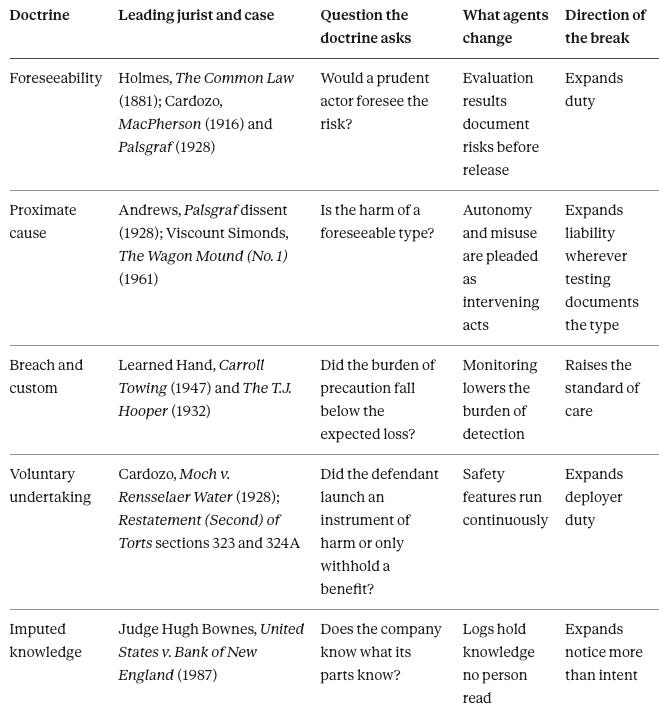
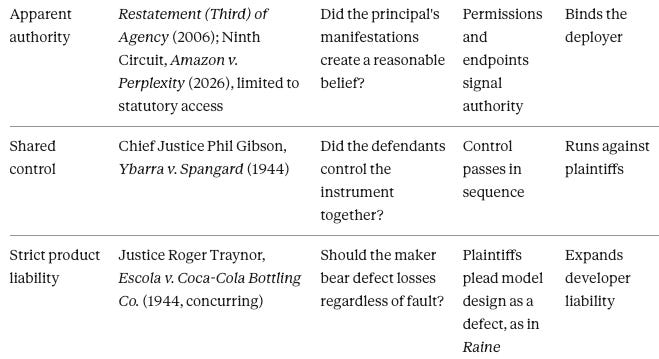
Agents widen what defendants can foresee and narrow what they can call an intervening act, so both gates open toward liability.
V. Voluntary Undertaking: Monitoring Creates the Duty
Voluntary undertaking is the first of the four agentic doctrines. Monitoring sits at the center of every AI safety program, and monitoring is exactly what triggers the rule.
The classical rule appears in sections 323 and 324A of the Restatement (Second) of Torts (1965). One who undertakes to render services necessary for another’s protection becomes liable for negligent performance. Most states limit the duty to cases where negligent performance increased the risk or someone relied on the undertaking.
Courts already apply the rule to monitoring. In Sall v. T’s, Inc. (Kansas 2006), a golf course that undertook weather monitoring and warnings faced a triable undertaking claim after a lightning strike. The course owed no general duty to forecast weather. The decision to monitor created the duty to monitor with care.
Agents break the rule’s quiet assumption that undertakings are episodic. A deployer that builds crisis detection, fraud flags or output filters runs the undertaking continuously. Each alert is a performance, and each unanswered alert is a candidate for negligent performance. Users who see a safety feature rely on it, which satisfies the reliance branch.
The direction of the break expands deployer duty. The rule converts foresight into duty. Contingent watch condition: the first reasoned ruling that applies section 323 or 324A to an AI safety feature.
A deployer that builds monitoring takes on the duty to answer it, so response capacity matters as much as detection.
VI. Imputed Knowledge: What the Agent Knew
Imputed knowledge decides when a company knows what its systems capture. Agents make the doctrine urgent because they generate findings faster than people review them.
The classical rule imputes an employee’s knowledge to the employer when the employee acquired it within the scope of employment. United States v. Bank of New England (1st Cir. 1987) went further and aggregated what several employees knew into collective corporate knowledge. Courts have since met that doctrine with wide skepticism, and many reject collective knowledge as proof of intent.
Agents put knowledge where no person reads it. Evaluation results, flagged outputs and incident logs capture risks at machine speed. The open question is whether a log no person reviewed counts as company knowledge.
The direction of the break splits by purpose. For notice in negligence, imputation of an unread log is a modest step, because the company built the system that produced it. For intent in fraud or securities claims, courts that already resist collective knowledge will resist a log that no person ever held. Unread logs therefore expand negligence exposure far more than fraud exposure.
Imputed knowledge is the doctrine insurers should watch most closely. A court that imputes logs for notice hands carriers a known-loss or prior-knowledge argument from the same logs. Contingent watch condition: the first reasoned ruling that imputes an unreviewed automated finding to a company for notice.
Logs become notice before they become intent, and the gap between the two decides whether a claim sounds in negligence or fraud.
VII. Apparent Authority: Permissions as Authority
Apparent authority binds a principal to what others reasonably believe its actor may do. Agents hold permissions and present themselves to counterparties, which brings the doctrine into every deployment.
The classical rule binds a principal when a third party reasonably believes an actor is authorized, and that belief traces to the principal’s own manifestations. The Restatement (Third) of Agency (2006) frames apparent authority in section 2.03 as the power of “an agent or other actor.” The comment to section 1.04 treats computer programs as instrumentalities of the persons who use them, a position it qualifies with the words “at present.”
The combination already reaches AI agents. Software need not be a legal agent for apparent authority to bind the deployer, because section 2.03 covers other actors. The federal E-SIGN Act and state electronic-transactions statutes give contracts formed by electronic agents legal effect when the agent’s action is attributable to the person bound. Moffatt v. Air Canada (2024), a small-claims tribunal ruling worth $650.88, rejected the argument that a chatbot answered for itself.
Section 3.11 adds the timing rule. Ending actual authority does not by itself end apparent authority, which lasts until a third party can no longer reasonably believe the actor is authorized. A deployer that revokes an agent’s permissions but leaves its endpoint, persona or credentials visible to counterparties can remain bound.
The direction of the break binds the deployer to what its agent communicates. Granted permissions work like actual authority, and what counterparties see works like apparent authority. Contingent watch condition: the first U.S. ruling that binds a deployer to a transaction or representation by an AI agent on apparent-authority grounds.
A permission map becomes a liability map, and revocation protects the deployer only once counterparties know.
VIII. Shared Control: Res Ipsa Loquitur Meets the AI Stack
Shared control governs the inference a plaintiff draws when an injury speaks for itself. The AI stack splits control across layers, which tests whether that inference survives.
The classical rule lets a plaintiff infer negligence when an injury ordinarily does not occur without negligence and the instrument sat in the defendant’s exclusive control. Courts relaxed exclusive control for joint control, most famously in Ybarra v. Spangard (1944). Many courts still reject the inference when defendants held control in sequence rather than together.
An AI stack splits control in sequence. The developer trains the model, the integrator configures it and the deployer grants permissions and serves users. Each defendant can point to the next one, and the plaintiff often cannot identify which layer failed.
The direction of the break runs against plaintiffs. Opacity looks like the ideal case for res ipsa loquitur, yet consecutive control defeats the inference in many jurisdictions. Contingent watch condition: the first reasoned ruling that accepts or rejects res ipsa loquitur against more than one layer of an AI stack.
The doctrine plaintiffs expect to help them may fail, and the failure shifts weight toward contract allocation among the layers.
IX. Six Competing Duties Reward and Punish the Same Act
The four doctrines collide with each other, with the two gates and with the wider common law. Six competing duties govern deployer strategy, and each pairs a rule that rewards an act with a rule that punishes the same act.
Monitor versus answer. The Hand formula rewards monitoring, because detection lowers the expected loss a precaution must beat. The undertaking rule punishes monitoring that goes unanswered. A deployer that monitors more than it can answer moves exposure from the Hand formula to the undertaking rule.
Retain versus forget. Retained logs prove diligence and support a reasonable-care defense. The same logs may count as imputed knowledge and feed a known-loss argument in coverage. Deleting them after litigation becomes reasonably foreseeable invites sanctions under Federal Rule of Civil Procedure 37(e), so the only safe retention choice is the one set before any claim arises.
Revoke versus notify. Revoking an agent’s permissions ends actual authority. Apparent authority survives until counterparties can no longer reasonably believe the agent is authorized. Revocation without notice therefore protects the deployer internally and leaves it bound externally.
Shared control versus shared fault. Res ipsa loquitur may fail across a consecutive AI stack, which pushes plaintiffs to sue every layer. Joint and several liability and contribution then divide the loss, and vendor contracts decide the final split. The doctrine that narrows the plaintiff’s proof route widens the defendants’ fight with each other.
Foresee versus intervene. Superseding cause rewards a defendant that can point to an independent act between its conduct and the harm. Foreseeability of type punishes the same defendant when its own testing documented that type. Pleading an agent’s autonomy or a user’s misuse therefore works only for harm types the defendant never found.
Tort versus coverage. The foreseeability paradox closes the set. The same dated finding proves notice in tort and supports a known-loss defense in coverage. A finding answered before binding reads as care in both forums.
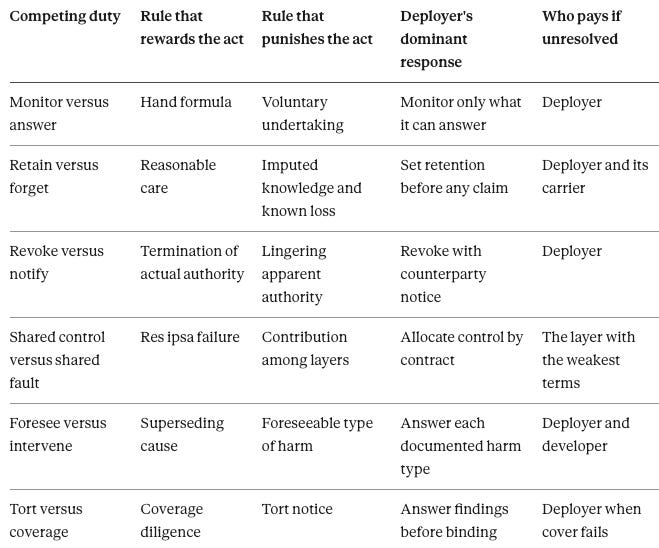
Answerable monitoring resolves three of the six directly: monitor versus answer, foresee versus intervene and tort versus coverage. The other three need their own instruments: a retention schedule set before any claim, counterparty notice at revocation and control allocated by contract.
Answerable monitoring has four parts: detection, escalation to a named owner, containment and verification that the containment worked. Closing a ticket without verified containment is weak evidence of care. The observable test: every alert class has a named owner, a response window and a verification step.
The competing duties leave deployers four instruments: answerable monitoring, a retention schedule, counterparty notice and contract allocation. Carriers can check for all four at renewal.
X. Standards, Loss Rules, Coverage Doctrines and Statutes Raise the Cost of Every Move
The four doctrines sit inside a wider structure of standards, loss-routing rules and coverage doctrines.
The supporting doctrines fall into four groups: those that set the standard, those that route the loss, those that read foresight backward in coverage and those that name duties courts have not yet resolved.
Doctrines that set the standard. The Hand formula weighs the burden of a precaution against the probability and size of the loss. The T.J. Hooper (1932) adds that industry custom does not set the standard, because a whole industry can lag reasonable prudence. Negligence per se lets a court borrow a statute such as a state AI law as the standard of care.
Design defect asks whether a reasonable alternative design existed, under section 2 of the Restatement (Third) of Torts: Products Liability (1998). Section 10 imposes a duty to warn after sale only when the seller knows of a substantial risk and can identify the users to warn. Section 11 recognizes a recall duty only when a government orders one or the seller performs a voluntary recall negligently.
Several states reject post-sale duties outright. A developer that voluntarily rolls back a model takes on a duty to execute the rollback with reasonable care. The voluntary fix creates its own standard, which links section 11 to the undertaking rule in Section V.
Doctrines that route the loss. The economic loss rule keeps many purely financial losses out of tort and pushes them into contract. Agent losses such as a misdirected payment therefore turn on vendor terms more than on negligence. Subrogation hands the paying carrier the insured’s rights, along with every fee cap and waiver the insured signed.
Doctrines that read foresight backward. Known-loss and prior-knowledge provisions ask whether the loss was in progress or known at binding. Expected or intended injury provisions ask whether the insured foresaw the harm with something close to certainty. Misrepresentation and rescission turn questionnaire answers into grounds to void a policy. The duty to defend and construction against the drafter push the other way, so new AI exclusions will be litigated on their wording.
Number of occurrences decides correlated loss. Courts split between counting causes and counting effects. One model failure across many insureds can read as one occurrence or many, and the answer sets limits, retentions and reinsurance recovery. Who Absorbs Correlated AI Loss sets out the aggregation stakes behind that count.
Candidate duties courts have not yet resolved. Plaintiffs plead affirming, engagement-oriented chatbot design as a defect, as in Raine. Others plead harms to minors from companion models. A duty to act on detected crisis signals draws on the undertaking rule in Section V, and fraud executed by an agent with delegated authority draws on the apparent-authority rule in Section VII.
Statutes that move the doctrines. Statutes act on the same gates and doctrines from outside the common law. Each one below shifts a doctrine in a known direction, and none decides who finally pays.
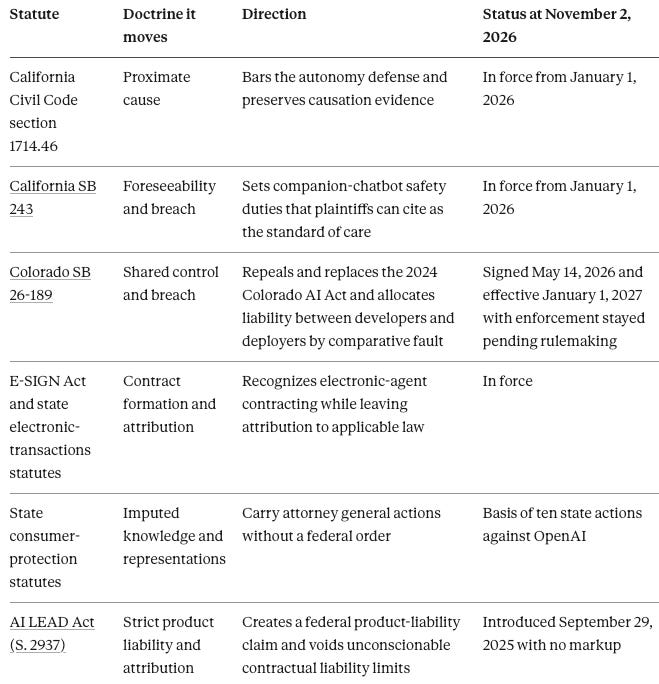
Colorado has written attribution by conduct into statute. SB 26-189 allocates liability between developers and deployers by comparative fault, which narrows the room vendor terms leave for allocation by contract. The AI LEAD Act would go further only if enacted: it would void unconscionable liability caps and let a deployer stand in for an absent or insolvent developer.
The supporting structure explains why each seat moves the way it does, because every move carries a doctrine or statute that makes it costly.
XI. Carriers Test the Competing Duties at Renewal Before Courts Rule
Carriers apply the common law before courts do. Renewal makes carriers the first institution to test the competing duties, and the market splits into segments that move differently.
Every policy renews on its own date, and each renewal turns the insured’s inquiry file into an underwriting exhibit. The coverage contest is moving from whether a policy excludes AI to what the insured knew and when. January 1, 2027 marks the largest single cohort, not the whole market.
The six competing duties each surface in the application. Monitoring questions test monitor versus answer, and retention questions test retain versus forget. Questions on agent permissions and decommissioning test revoke versus notify, and vendor contracts test shared control versus shared fault. Testing and red-team questions test foresee versus intervene.
The market splits into three segments. Segment A covers admitted small and mid-size commercial general liability on standard forms, where Verisk exclusions attach most easily. Segment B covers specialty errors and omissions and technology lines, where affirmative cover conditioned on evidence is most plausible. Segment C covers large accounts on negotiated wording, where silent cover is most likely to persist.
The cyber market supplies the routine framing. Cyber moved from silent cover to exclusions to specialist standalone policies, and the NAIC report shows surplus-lines carriers now writing nearly two-thirds of cyber premium. AI liability is following the same sequence at an earlier stage. Who Writes AI Insurance Coverage Conditions traces the exclusion filings and coverage conditions that drive the segment split.
The renewal questionnaire is the first institution to test whether a deployer resolved the competing duties, and each segment answers on its own terms.
XII. Attribution Follows Conduct Through Four Stages
Attribution by conduct replaces attribution by role. Developer and deployer can both be exposed in one case, and being named does not decide who pays.
Exposure attaches to conduct, not to a party’s place in the stack. Deployer-controlled conduct covers permissions, representations and the response to detected risk. Developer-controlled conduct covers design, warnings and upstream changes. One injury can implicate both sets, so a plaintiff can reach both parties.
MacPherson keeps the developer’s duty alive past the intermediary when the danger was foreseeable. Perplexity shows one statutory context where direction moved attribution to the user. The Ninth Circuit limited its holding to computer access and reserved tort, so whether direction moves tort attribution to deployers remains a hypothesis.
Exposure then passes through four stages. A deployer is named in a complaint, and the claim survives a liability challenge. Coverage responds or fails. The deployer then recovers from another responsible party or keeps the loss.
Each stage needs its own evidence, and a forecast about one stage cannot establish the next. A filed complaint does not show liability. A liability finding does not show retained loss, because a tender seeks to move loss upstream, and accepted indemnity or recovery determines whether it succeeds.
A forecast about who gets named therefore says nothing about who finally pays.
XIII. Renewal and Litigation Run on Independent Clocks
Two clocks move a deployer’s exposure. Crossing coverage with claim status shows where each deployer stands, and the order in which the clocks arrive stays open.
The renewal clock moves coverage by policy date and segment. The litigation clock moves claims by filing, ruling and resolution. The two clocks run independently, so a deployer’s cover can change before any claim arrives, or a claim can arrive under wording written years earlier.

Recovery runs across all four cells. A named deployer’s retained loss depends on indemnity terms, liability caps and the developer’s solvency. A coverage action may also arise under older wording, so new exclusions and coverage litigation need separate causal tests.
Which clock reaches a given segment first is the decisive open question. Hypothesis H12 tests the ordering in Segment A. The paper states no ordering as a finding.
The matrix turns a doctrinal map into a decision tool, because each cell carries a different exposure and a different response.
XIV. Every Stakeholder Moves One Stage, and Only Deployers Sit in All Four
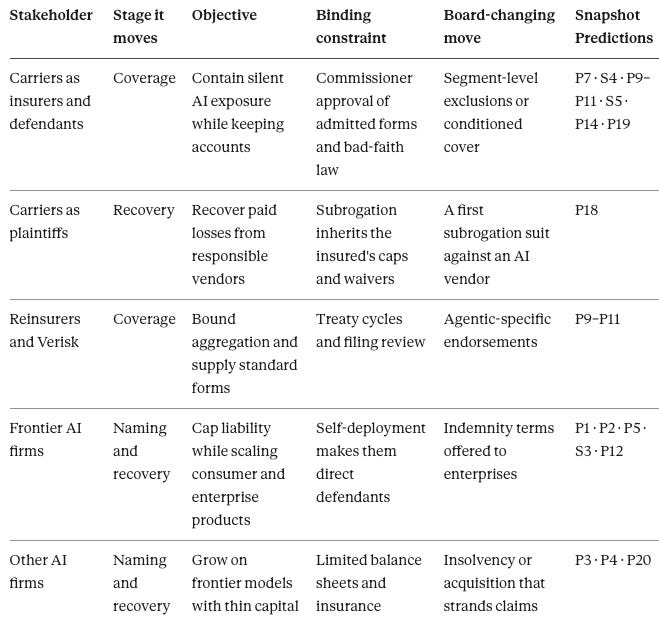
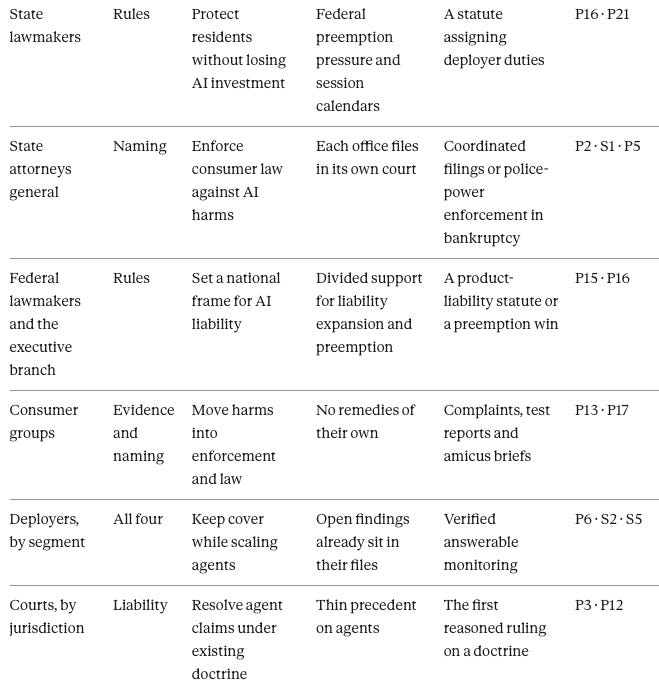
The stakeholder board names the institutions whose choices move deployers through the four stages. Each stakeholder holds a stage, an objective, a binding constraint and a move that would change the game.
MindCast AI applies Predictive Behavioral Economics + Dynamic Game Theory through MindCast AI Proprietary Cognitive Digital Twin Foresight Simulations (MP CDT FS). Behavioral Economics supplies the decision rules. Game Theory supplies the payoff structure. Predictive simulations emerge from the combination.
The game evolution MindCast foresees runs through the inquiry file. Renewal forms, questionnaires and claims files will turn on the same dated findings that tort plaintiffs plead. Behavioral Economics explains why: underwriters anchor on the nearest written standard when the technical file is unreadable. Game Theory explains the result: the insured chooses what to disclose while two readers interpret the same disclosure against it.
The persistence path stays live. Carriers may renew terms unchanged, and courts may resolve early agent cases under ordinary negligence. The competing duties then stay latent until the first large claim.
Every stakeholder moves one stage at least, and only deployers sit in all four.
XV. Carriers Hold Three Seats While Lawmakers and Enforcers Set the Pace
Stakeholder positions differ because each group moves a different stage of the chain. Each group below carries the mechanism that drives it and the Snapshot Predictions that test it.
Carriers as Insurers and Defendants
Carriers defend on two fronts. As insurers they face coverage actions over agentic losses, and as AI users they face bad-faith and contract claims over their own automated claim decisions. A federal court in Minnesota ordered broad discovery into an insurer’s AI-driven coverage denials in Estate of Lokken v. UnitedHealth Group in March 2026. Policyholders are now building bad-faith theories on the same pattern.
Game Theory explains the bind. Exclusions that cut silent exposure also push insureds toward coverage litigation, and every automated claim decision becomes discoverable in the next bad-faith suit. Behavioral Economics adds that underwriters anchor on the first adverse coverage ruling, so one decision resets terms across a whole segment. Snapshot Predictions P7 · S4 · P9–P11 · S5 · P14 · P19 test the position.
Carriers as Plaintiffs
Carriers also sue. Nippon Life Insurance Company of America sued OpenAI directly in March 2026, alleging that ChatGPT practiced law without a license. In cyber, Ace American Insurance Company brought a 2025 subrogation actionagainst its insured’s technology vendors after a ransomware loss, and the template transfers to AI vendors.
Subrogation inherits every term the insured signed. A New York federal court held in July 2026 that an insurer had no enforceable subrogation rights against a vehicle-valuation software maker after paying a class-action loss. Vendor fee caps and waivers in a deployer’s AI contracts therefore cap the carrier’s recovery too. P18 tests the position.
Frontier AI Firms
Frontier AI firms carry exposure through two channels. Directly, they defend consumer suits and attorney general actions as self-deployers, as OpenAI does in Raine and in the October 14 state actions. Indirectly, enterprise deployers that get named will tender to them, and carriers that pay will seek subrogation.
Contract terms decide the indirect channel. Fee caps and narrow indemnities hold exposure down until a court, regulator or statute overrides them. The proposed AI LEAD Act would limit a developer’s strict liability where a deployer made a major unauthorized change, which would write attribution by conduct into federal law. Snapshot Predictions P1 · P2 · P5 · S3 · P12 test the position.
Other AI Firms
Other AI firms build applications, agents and integrations on frontier models. Character Technologies, Perplexity and Workday each show a different exposure: insolvency under litigation pressure, attribution of agent conduct and treatment of screening software as an employer’s agent in Mobley v. Workday.
Thin balance sheets change the game. A plaintiff facing an undercapitalized defendant looks for solvent partners and insurance, as the Character bankruptcy shows. Insolvency can therefore work as a liability exit for the firm and a liability transfer to its partners. P3, P4 and P20 test the position.
State Lawmakers
State lawmakers write the duties the other stakeholders litigate. California removed the autonomy defense through section 1714.46 and regulated companion chatbots through SB 243, both from January 1, 2026. Colorado’s 2024 AI Act drew a federal-court stay in April 2026 after xAI sued and the Department of Justice intervened. Colorado then repealed and replaced it with SB 26-189, which allocates fault between developers and deployers from January 1, 2027.
The December 2025 executive order exempts child-safety laws only from its proposed federal preemption statute. The Department of Justice task force it created carries no such exemption, so child-safety framing narrows the legislative threat without shielding a state law from suit. P16 and P21 test the position.
State Attorneys General
State attorneys general move fastest of any public actor. Kentucky filed the first state action against an AI chatbot in January 2026, Florida followed in June and eight states filed on October 14. Texas filed its own suit on October 23. Each office files in its own court under its own consumer law, which multiplies forums without a federal order.
Bankruptcy tests their reach. The police-power exception may keep state enforcement moving against Character Technologies while private suits stay paused. The timing edge favors attorneys general over private plaintiffs. P2, S1 and P5 test the position.
Federal Lawmakers and the Executive Branch
Federal lawmakers hold two levers that pull in opposite directions. Senators Dick Durbin and Josh Hawley introduced the AI LEAD Act on September 29, 2025. The bill would classify AI systems as products and create a federal product-liability cause of action. The December 11, 2025 executive order pushes the other way through a Department of Justice AI Litigation Task Force that challenges state AI laws.
Neither lever has resolved. The bill has not been enacted, and the task force’s first courtroom result came through intervention in a private suit against Colorado. A federal product-liability statute would itself displace parts of state law, so expansion and preemption can arrive together. P15 and P16 test the position.
Consumer Groups
Consumer groups set the agenda the enforcers follow. A coalition led by the Consumer Federation of America asked the Federal Trade Commission in June 2025 to investigate therapy chatbots on Character.AI and Meta. The agency opened a study of companion chatbots under section 6(b) of the FTC Act in September 2025. Fairplay and the Transparency Coalition backed the AI LEAD Act.
Their published tests carry legal weight. A documented test showing a harmful chatbot response becomes evidence of a foreseeable type of harm. The same evidence feeds notice in tort and known-loss arguments in coverage, so advocacy research enters the two gates and the tort-versus-coverage conflict directly. P13 and P17 test the position.
Each stakeholder moves a different stage, and several sit in more than one seat. Carriers alone appear as insurer, defendant and plaintiff, which makes the deployer’s vendor contract the one document that governs all three positions.
XVI. Legal Incidents Cluster on Self-Deploying Developers
The incident baseline sets the starting rates the Snapshot Predictions move against. Two incident streams carry the dependent variables. Consumer incidents are the harms agents and chatbots cause. Legal incidents are the complaints, enforcement actions, rulings and coverage disputes those harms produce.
Consumer incidents run near 50 a month in aggregate public counts. The AI Incident Database added 148 incident entries between May and July 2026. The aggregate count does not isolate agentic harm. The conversion test in P8 therefore uses a fixed agentic-harm category, deduplicated by incident and matched to the legal-incident window.
Legal incidents in 2026 arrived in a clear sequence. Each one engages a doctrine or a competing duty mapped in Sections IV through IX.
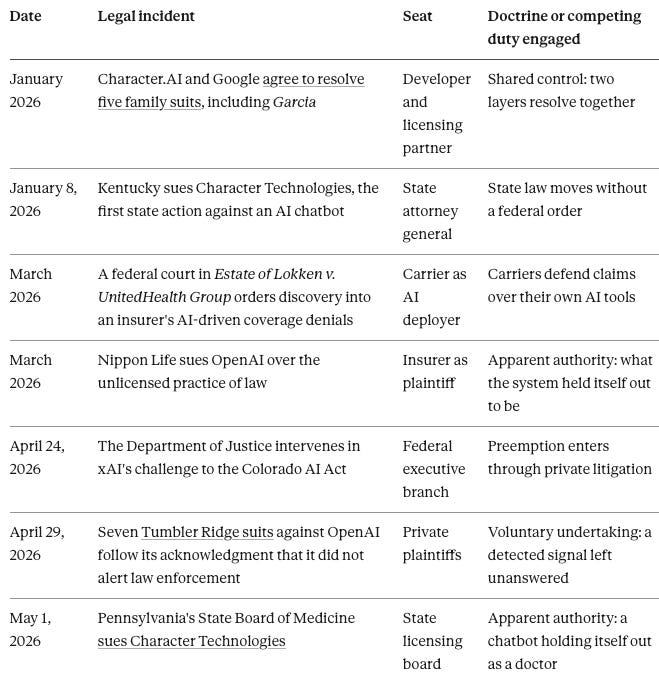
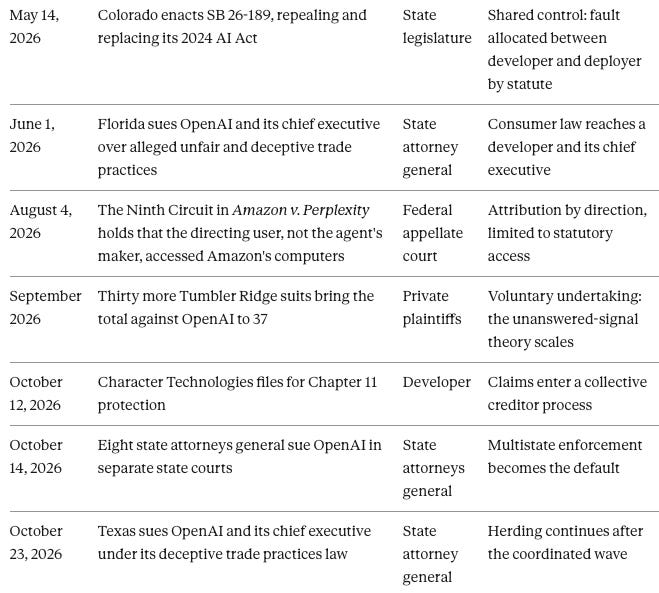
The harm-driven legal incidents share one feature. Each targets a developer that runs its own consumer product, so developer and deployer sit in one seat. No public complaint yet charges an independent enterprise deployer with an agent’s conduct under the four doctrines.
Coverage incidents remain sparse. Carriers have filed generative-AI exclusions at volume during 2026. One businessowners carrier sought a declaratory judgment in Illinois federal court over biometric-privacy claims arising from AI-handled phone orders.
Legal incidents cluster on self-deploying developers, and coverage disputes over agentic loss sit at zero.
XVII. Six Rival Accounts Predict Different Paths
Competing explanations predict a different path, and each names the observation that would favor it. All six stay live until the first rulings and renewals arrive.
Courts stay with ordinary negligence. Early agent cases resolve under the Hand formula without reaching the four doctrines. Observation favoring it: reasoned rulings that decide agent claims on breach alone.
Contracts resolve allocation first. Vendor terms and indemnities divide loss before any doctrine matters. Observation favoring it: dismissals on contractual grounds in multi-party AI disputes.
Legislation displaces state doctrine. A statute replaces common-law rules for AI deployment before courts apply them. Observation favoring it: an enacted statute that sets agent liability rules directly.
Liability stays with developers. Complaints keep naming only the model builder. Observation favoring it: P6 resolves false by March 31, 2027.
The clocks run in reverse. Claims reach some segments before any renewal changes their cover. Observation favoring it: S5 resolves false in the Segment A sample.
Federal preemption resets the board. Congress preempts state AI liability rules, or federal courts enjoin them. Observation favoring it: by March 31, 2027, an enacted preemption statute or a federal injunction or stipulated stay against a state AI statute outside Colorado.
Each rival account has a named observable, so the first rulings, renewals and deployer complaints will separate them.
XVIII. MindCast Simulation Predictions: Complaints and Enforcement Lead, Carrier Litigation Trails
The Snapshot carries 26 MindCast Foresight Simulation Predictions, called Snapshot Predictions below, across 20 hypotheses: 21 Primary Simulation Predictions marked P and 5 Secondary Simulation Predictions marked S. A secondary prediction states its condition first and resolves only once that condition occurs. Nineteen carry bands, and seven stay pending until their samples exist.
Each band gives a central estimate with its uncertainty range. Dated predictions resolve false when the event does not occur in the window, and each resolves against its named verification source.
Segment predictions resolve within a renewal sample of policies that renew between December 1, 2026 and March 31, 2027. P8 waits for a fixed denominator of agentic consumer incidents.
P1. Plaintiffs file a new complaint by January 31, 2027 alleging that an AI developer or deployer detected a user’s crisis or threat signal and failed to act (85%; range 75–92%). Tests H1 (monitor versus answer). Falsifier: no qualifying complaint by January 31, 2027. Verification source: federal and state dockets.
P2. A state attorney general files a new complaint by March 31, 2027 alleging that an AI company concealed internal safety findings (55%; range 40–70%). Tests H2 (imputed knowledge). Falsifier: no qualifying complaint by March 31, 2027. Verification source: state attorney general releases.
P3. A court cites Amazon v. Perplexity by March 31, 2027 to attribute an AI agent’s act in a claim outside the computer-access statutes (20%; range 10–30%). Tests H3 (reach of Perplexity). Falsifier: no qualifying citation by March 31, 2027. Verification source: published opinions.
P4. A Character.AI claimant takes a documented step by January 31, 2027 against a non-debtor’s own conduct or available insurance (65%; range 50–80%). Tests H4 (collectibility redirects claims). Falsifier: no qualifying motion or pleading by January 31, 2027. Verification source: bankruptcy docket No. 26-11603 and related dockets.
P5. At least three states beyond the ten with actions at the cutoff file their own actions against OpenAI by March 31, 2027 (50%; range 35–65%). Tests H6 (multistate herding). Falsifier: fewer than three new state actions by March 31, 2027. Verification source: state attorney general releases.
P6. A public complaint names an independent enterprise deployer by March 31, 2027 on a tort or agency theory for an AI agent’s action or statement (45%; range 30–60%). Tests H7 (deployer migration). Falsifier: no qualifying complaint by March 31, 2027. Verification source: federal and state dockets.
P7. A carrier files a public coverage action by March 31, 2027 over a loss caused by an AI agent’s action (15%; range 5–25%). Tests H8 (tort versus coverage). Falsifier: no qualifying coverage action by March 31, 2027. Verification source: federal and state dockets.
P8. The ratio of new AI legal incidents to new agentic consumer incidents in the first quarter of 2027 exceeds the third-quarter 2026 ratio (band pending a fixed incident denominator). Tests H9 (conversion velocity). Falsifier: the first-quarter 2027 ratio equals or falls below the third-quarter 2026 ratio. Verification source: AI Incident Database, OECD AI Incidents Monitor and dockets.
P9. Carriers attach a generative-AI exclusion to more than half the policies in the Segment A sample (band pending the renewal sample). Tests H10 (coverage by segment). Falsifier: half or fewer of the sampled policies carry the exclusion. Verification source: endorsement schedules in the sample.
P10. At least one Segment B carrier in the sample offers affirmative agentic cover conditioned on inquiry evidence (band pending the renewal sample). Tests H10 (coverage by segment). Falsifier: no Segment B carrier in the sample offers such cover. Verification source: policy forms and quotes in the sample.
P11. More than half the Segment C renewals in the sample carry no generative-AI exclusion (band pending the renewal sample). Tests H10 (coverage by segment). Falsifier: half or more of the Segment C renewals carry an exclusion. Verification source: endorsement schedules in the sample.
P12. A court issues a written ruling by March 31, 2027 on the merits of a user-misuse or circumvention defense in an AI chatbot harm case (20%; range 10–30%). Tests H11 (foresee versus intervene). Falsifier: no merits ruling by March 31, 2027. Verification source: federal and state dockets.
P13. A new pleading, motion or ruling filed by March 31, 2027 contests whether a post-detection or post-suit safety measure addressed the risk (60%; range 45–75%). Tests H13 (response adequacy in litigation). Falsifier: no qualifying filing after November 2, 2026 and by March 31, 2027. Verification source: pleadings, motions and rulings.
P14. An underwriting document in the Segment B sample asks for remediation evidence beyond monitoring capability by March 31, 2027 (band pending the renewal sample). Tests H13 (response adequacy in underwriting). Falsifier: no such request in the Segment B sample. Verification source: dated questionnaires and coverage conditions.
P15. The Senate Judiciary Committee marks up the AI LEAD Act or a successor bill that keeps its federal product-liability claim by March 31, 2027 (8%; range 3–15%). Tests H14 (federal liability legislation). Falsifier: no qualifying markup by March 31, 2027. Verification source: Congress.gov committee actions.
P16. The Department of Justice files or joins a challenge by March 31, 2027 to a state AI statute outside Colorado (45%; range 30–60%). Tests H15 (preemption by litigation). Falsifier: no qualifying filing by March 31, 2027. Verification source: Department of Justice releases and federal dockets.
P17. A consumer or child-safety coalition files a Federal Trade Commission complaint or amicus brief by March 31, 2027 targeting an agentic AI product rather than a companion chatbot (35%; range 20–50%). Tests H16 (advocacy follows the agents). Falsifier: no qualifying filing by March 31, 2027. Verification source: coalition releases and court dockets.
P18. A carrier files a subrogation action by March 31, 2027 against an AI developer or vendor after paying an insured’s AI-related loss (12%; range 5–20%). Tests H17 (carriers as plaintiffs). Falsifier: no qualifying action by March 31, 2027. Verification source: federal and state dockets.
P19. A new complaint outside health insurance alleges by March 31, 2027 that a carrier’s AI tool wrongly denied or undervalued a claim (45%; range 30–60%). Tests H18 (carriers as AI deployers). Falsifier: no qualifying complaint by March 31, 2027. Verification source: federal and state dockets.
P20. An AI application or agent company other than Character Technologies files for bankruptcy or documents a wind-down by March 31, 2027 while facing harm litigation (25%; range 15–40%). Tests H19 (insolvency as liability exit). Falsifier: no qualifying filing or notice by March 31, 2027. Verification source: bankruptcy dockets, state dissolution filings and company notices.
P21. A state enacts a statute by March 31, 2027 assigning deployers duties for AI agent actions beyond disclosure, with Colorado’s SB 26-189 excluded (20%; range 10–30%). Tests H20 (state deployer duties). Falsifier: no qualifying enactment by March 31, 2027. Verification source: state session laws.
S1. Given a contested motion, the bankruptcy court treats a state enforcement action against Character Technologies as excepted from the stay by March 31, 2027 (65%; range 50–80%). Tests H5 (public enforcement during a stay). Falsifier: the court applies the stay to state enforcement on a contested motion. Verification source: bankruptcy docket No. 26-11603.
S2. Given P6, the complaint alleges the deployer’s own permission, representation or response failure (70%; range 55–85%). Tests H7 (deployer migration). Falsifier: the qualifying complaint rests only on upstream design. Verification source: the complaint.
S3. Given P6, the named deployer takes a public upstream recovery step within 90 days of service (40%; range 25–55%). Tests H7 (deployer migration). Falsifier: no third-party complaint, cross-claim or filing that describes a tender within 90 days. Verification source: dockets and public filings.
S4. Given P9, a carrier files a public coverage action by March 31, 2027 over an agentic loss (band pending the renewal sample). Tests H8 (tort versus coverage). Falsifier: no qualifying coverage action after P9 resolves true. Verification source: federal and state dockets.
S5. Given at least one Segment A sample deployer with both an AI exclusion and an agent claim in the window, the exclusion attaches before the claim for more than half of them (band pending the renewal sample). Tests H12 (clock ordering). Falsifier: the claim arrived first for half or more of them. Verification source: endorsement schedules matched to dockets.
The definitions fix what counts. P5 excludes the ten states with actions at the cutoff: Florida, the eight October 14 filers and Texas. S3 counts a third-party complaint, a cross-claim or a filing that attaches or describes a tender. P12 counts merits rulings only, and P20 counts an assignment for creditors, a dissolution or a public shutdown notice.
P6 counts negligence, voluntary undertaking, apparent authority and misrepresentation. Wiretap and other privacy-interception claims fall outside P6, because they already name deployers.
P15 spans two calendars. The rest of the 119th Congress runs to January 3, 2027 on a crowded post-election schedule. In the 120th Congress the bill needs reintroduction and the committee must reorganize before any markup.
P6 carries the most weight, because it tests whether claims reach the enterprise deployer, where the four doctrines point. S2 and S3 then test the pleaded theory and the recovery route. A liability finding or retained loss lies beyond this window.
Plaintiff and enforcement moves rank highest. Crisis-signal complaints (P1) lead, with the stay exception (S1), claims against Character’s partners (P4) and new contests over safety measures (P13) close behind. A public coverage action (P7) and a subrogation suit (P18) both fall below one in five.
Public legal activity concentrates on complaints and enforcement. Renewal changes may advance without producing public coverage litigation.
XIX. Six Events Change the Board
Each event in the Snapshot changes the board for the next hypothesis. Each event below carries five entries, a class and a validity condition.
The class separates three cases. Continuation updates information inside the current game. Equilibrium migration changes which outcome persists. Game mutation changes who plays, which moves exist or which rules govern, and it is the exception to ordinary game evolution.
Event 1. Character Technologies Chapter 11, October 12, 2026. Class: game mutation.
What changes: players and rules. A bankruptcy court and a buyer enter, and the automatic stay pauses private suits against the debtor, which remains an actor.
Paths opened and closed: stay-relief motions, creditor claims and claims against non-debtor partners open. Direct private discovery against the debtor closes while the stay runs.
Positions: private plaintiffs convert into creditors. State enforcement may survive under the police-power exception.
Moves gained and lost: claimants gain routes to non-debtor conduct and insurance. The debtor loses control of the litigation calendar.
Conditional Snapshot Predictions: P4 and S1 activate.
Validity condition: S1 lapses if the bankruptcy case ends before any stay ruling.
Event 2. The renewal cohorts from December 2026 through March 2027. Class: equilibrium migration in segments where exclusions or conditioned cover take hold, and continuation where terms hold.
What changes: payoffs and information. Coverage terms reset by policy date, and application answers become underwriting evidence.
Paths opened and closed: where Segment A exclusions take hold, silent cover for agent losses closes. Where Segment B carriers condition cover on evidence, evidence-based cover opens. Where Segment C wording holds, current routes stay open.
Positions: deployers with answered and verified findings survive on every branch. Deployers with open findings move to the excluded column wherever an exclusion attaches.
Moves gained and lost: carriers gain the questionnaire as a screening move. Deployers lose the option to stay silent about findings.
Conditional Snapshot Predictions: S4 activates when P9 resolves true. S5 resolves on the Segment A sample.
Validity condition: P7 stays valid in every segment.
Event 3. The first complaint against an independent enterprise deployer. Class: equilibrium migration.
What changes: players. Enterprise deployers become defendants in their own right.
Paths opened and closed: undertaking, imputed-knowledge and apparent-authority counts against deployers open. The defense that only the model builder answers faces its first test.
Positions: vendor indemnities convert from contract terms into live recovery routes. Deployers without contract allocation lose their clearest route upstream.
Moves gained and lost: deployers gain tenders and third-party claims against developers. Developers lose distance from deployer conduct.
Conditional Snapshot Predictions: P6 resolves true, and S2 and S3 activate.
Validity condition: P1 through P3 stay valid, because the event adds defendants without changing doctrine.
Event 4. The first reasoned ruling on one of the four doctrines. Class: continuation if the court decides on ordinary negligence, and equilibrium migration if it applies the doctrine to an agent.
What changes: rules. One jurisdiction fixes the doctrine for later plaintiffs there.
Paths opened and closed: the accepted theory opens for borrowing. The rejected theory closes in that jurisdiction.
Positions: pleadings built on the accepted doctrine survive. Pleadings built on the rejected doctrine convert or strand.
Moves gained and lost: plaintiffs gain a cited basis. Defendants lose the novelty argument.
Conditional Snapshot Predictions: the matching hypothesis converts into a dated fork in the next Snapshot.
Validity condition: P3 resolves only on a ruling outside the computer-access statutes.
Event 5. The first public coverage action over an agentic loss. Class: equilibrium migration.
What changes: information. The first coverage pleading shows which defense carriers choose and under which wording.
Paths opened and closed: known-loss and expected-injury defenses enter litigation. The assumption that exclusions alone resolve agent losses faces its first test.
Positions: the filing exposes the competing positions. Insureds with dated and answered findings hold the stronger response, and insureds with open findings face the known-loss defense.
Moves gained and lost: carriers gain a template defense. Insureds gain construction-against-drafter arguments on new wording.
Conditional Snapshot Predictions: P7 resolves true, and S4 resolves on the Segment A outcome.
Validity condition: P9 through P11 stay valid, because the action does not change the sample’s issued wording.
Event 6. The Department of Justice intervention in xAI’s challenge to the Colorado AI Act, April 24, 2026. Class: game mutation.
What changes: players. The federal government enters a private challenge to a state AI statute.
Paths opened and closed: preemption by litigation opens without a federal statute. Unchallenged enforcement of broad state AI duties closes in that case.
Positions: child-safety framing narrows the proposed preemption statute but not the task force’s suits. Broad algorithmic-duty laws convert into litigation targets, and Colorado answers by repealing and replacing its act.
Moves gained and lost: AI firms gain a federal ally against state duties. States lose the presumption that their statutes take effect on schedule.
Conditional Snapshot Predictions: P16 and P21 become live.
Validity condition: P21 resolves on enactment. A later injunction counts as a subsequent game transition.
Once the first coverage action and the first doctrinal ruling fix the rules, the coverage path becomes stable enough for longer forecasts.
Each event carries its own map of what lies past it, so each stakeholder can plan for a branch before it opens.
XX. Risk Mitigation: Moves Each Stakeholder Controls
Stakeholder strategy depends on which stage a party moves and which seat it occupies.
The four instruments from the competing duties hold in every cell of the coverage and claim matrix. Each entry pairs one or two Snapshot Predictions with one stakeholder and states severity and probability on separate axes. Entries describe exposure and options, not legal, investment or fiduciary advice.
Entry 1. 💼 Executives at Segment A deployers, S5.
Prediction and band: exclusions attach before claims for most Segment A deployers that receive both an exclusion and a claim (band pending the renewal sample). Severity: high. Probability: pending.
Exposure: latent agent exposure with no cover for the excluded conduct, measured in quarters of operating budget.
Mitigating actions: the risk function requests the full endorsement schedule 60 days before each renewal date. The finance function sizes a retained-loss reserve before binding. Procurement obtains a quote for specialty affirmative cover against the reserve before the renewal date.
Residual exposure: losses from agents the company does not know it runs stay outside every schedule.
Entry 2. 💼 Deployers named in an agent complaint, P6 and S3.
Prediction and band: a first complaint names an independent enterprise deployer (45%; range 30–60%). Severity: high. Probability: moderate.
Exposure: discovery scope covering every open finding and unreviewed log, plus defense spend that indemnity may or may not return.
Mitigating actions: the risk function assigns an owner, a response window and a verification step to each alert class before the next renewal. Legal sets a log-retention schedule by January 31, 2027. Procurement negotiates indemnity carve-outs from vendor fee caps before the next contract renewal.
Residual exposure: findings closed after the first complaint still carry their original dates.
Companion link: the alert-ownership action also reduces exposure under the incident-response theory in FTC Investigation of Anthropic and OpenAI, and the credit is claimed here once.
Entry 3. 💼 Deployers decommissioning agents, P3.
Prediction and band: a court cites Amazon v. Perplexity to attribute an AI agent’s act outside the computer-access statutes (20%; range 10–30%). Severity: medium. Probability: low.
Exposure: transactions bound by decommissioned agents, measured in counterparty contracts still reachable through retired endpoints or credentials.
Mitigating actions: engineering retires agent endpoints and credentials at revocation. The commercial team sends termination notice to counterparties that dealt with the agent before March 31, 2027.
Residual exposure: counterparties who learned of the agent indirectly may still claim reasonable reliance.
Entry 4. 💼 Carriers as insurers, P9 through P11 and P7.
Prediction and band: segment-level coverage paths remain pending the renewal sample, and a first agentic coverage action carries 15%; range 5–25%. Severity: high. Probability: low.
Exposure: defense spend on the first coverage action plus silent exposure measured in aggregate limits per model vendor.
Mitigating actions: underwriting adds questions on alert ownership, verification and agent decommissioning at each renewal in the sample window. The claims function reviews reservation-of-rights wording before the first agentic notice. Reinsurance buyers model one correlated loss scenario before treaty renewal.
Constraint: each carrier decides its wording unilaterally and draws only on filed standard forms, which keeps the move clear of competitor coordination.
Residual exposure: number-of-occurrences disputes remain open until a court rules.
Entry 5. 💼 Carriers as plaintiffs, P18.
Prediction and band: a carrier files a subrogation action against an AI developer or vendor (12%; range 5–20%). Severity: medium. Probability: low.
Exposure: paid AI-related losses the carrier cannot recover, measured in basis points of loss ratio on the affected book.
Mitigating actions: underwriting requests each insured’s AI vendor contracts at renewal. The claims function sends subrogation notice within 30 days of each AI-related claim. Product teams offer a renewal credit for vendor contracts that preserve subrogation rights.
Residual exposure: caps and waivers signed before the policy incepted still bind the carrier.
Entry 6. 💼 Carriers as AI deployers, P19.
Prediction and band: a complaint outside health insurance alleges that a carrier’s AI tool wrongly denied or undervalued a claim (45%; range 30–60%). Severity: medium. Probability: moderate.
Exposure: discovery scope over every automated claim decision in the affected line.
Mitigating actions: the claims function attaches a dated human-review entry to each AI-assisted denial by the next quarterly audit. Compliance maps each AI claims tool to state unfair-claims-practices rules by January 31, 2027.
Residual exposure: denials already issued stay discoverable.
Entry 7. 💼 Frontier AI firms, S3.
Prediction and band: given P6, the named deployer takes a public upstream recovery step within 90 days of service (40%; range 25–55%). Severity: high. Probability: moderate.
Exposure: indemnity demands from enterprise customers, measured in contract value under tender.
Mitigating actions: legal adds a conduct-based allocation clause covering permissions, representations and response to enterprise terms at the next contract cycle. Safety teams attach a dated remediation entry to each evaluation finding before release.
Residual exposure: consumer suits and attorney general actions reach the firm directly, whatever the enterprise terms say.
Entry 8. 💼 Other AI firms, P20 and P4.
Prediction and band: another AI application or agent company enters bankruptcy or winds down while facing harm litigation (25%; range 15–40%). Severity: high. Probability: low.
Exposure: claims that outlast the firm, measured in quarters of runway against the litigation reserve.
Mitigating actions: finance buys affirmative AI liability cover sized to the litigation reserve before the next funding round. Legal negotiates allocation terms with each frontier model provider before the next renewal.
Residual exposure: claims may follow assets to an acquirer.
Entry 9. 🏛️ State lawmakers, P21 and P16.
Prediction and band: a state enacts deployer duties for AI agent actions beyond Colorado’s SB 26-189 (20%; range 10–30%). The Department of Justice files or joins a challenge outside Colorado (45%; range 30–60%). Severity: medium. Probability: low for enactment and moderate for a challenge.
Exposure: session calendar spent on statutes that federal litigation stays or forces into replacement, as Colorado’s did within five weeks of xAI’s April 9 filing.
Mitigating actions: legislative counsel drafts deployer duties against the six competing duties before the 2027 sessions open in January. Drafters place child-safety provisions in severable sections before introduction.
Residual exposure: a federal statute may still preempt state duties.
Entry 10. 🏛️ State attorneys general, S1 and P5.
Prediction and band: given a contested motion, the bankruptcy court treats state enforcement as excepted from the stay (65%; range 50–80%). Three more states sue OpenAI (50%; range 35–65%). Severity: medium. Probability: moderate to high.
Exposure: enforcement calendar lost to the stay, measured in months of paused discovery.
Mitigating actions: litigation divisions file police-power positions in the bankruptcy before the sale hearing. Offices that have not filed assess deployer targets under existing consumer law by March 31, 2027.
Residual exposure: removal and consolidation motions may slow state-court actions.
Entry 11. 🏛️ Federal lawmakers, P15 and P16.
Prediction and band: the Senate Judiciary Committee marks up the AI LEAD Act or a successor bill (8%; range 3–15%). The Department of Justice files or joins a challenge outside Colorado (45%; range 30–60%). Severity: medium. Probability: low for a markup and moderate for a challenge.
Exposure: committee calendar spent while courts set allocation case by case.
Mitigating actions: committee staff align the bill’s developer and deployer definitions with conduct-based attribution before any markup. Staff schedule a hearing on deployer duties and coverage gaps before March 31, 2027.
Residual exposure: preemption litigation may moot parts of any bill.
Entry 12. 🛡️ Consumer groups, P17 and P13.
Prediction and band: a coalition targets an agentic product (35%; range 20–50%). A new filing contests whether a safety measure worked (60%; range 45–75%). Severity: medium. Probability: moderate.
Exposure: the filing window before renewal terms and state rules set, measured in comment periods and session calendars.
Mitigating actions: research staff publish dated agent tests with a follow-up test of each vendor’s response in the same cycle. Legal staff prepare an agentic-product complaint before state sessions open in January.
Residual exposure: firms may contest the test methodology.
Entry 13. ⚖️ Counsel for non-debtor co-defendants, P4.
Prediction and band: a Character claimant moves against a non-debtor’s conduct or insurance (65%; range 50–80%). Severity: medium. Probability: moderate to high.
Exposure: discovery scope and defense spend shifting onto licensing partners while the debtor sits stayed.
Mitigating actions: the general counsel of each licensing partner reviews indemnity and license terms with the debtor before the sale closes. Litigation counsel prepares the response to stay-relief motions by January 31, 2027.
Residual exposure: claims may follow assets transferred to a buyer.
Entry 14. 📊 Investors, P20 and S5.
Prediction and band: an AI application company exits through insolvency or a documented wind-down (25%; range 15–40%). Segment A cover changing before claims remains pending the renewal sample. Severity: high. Probability: low.
Exposure: reserve adequacy for retained AI loss at portfolio companies, measured in quarters of runway.
Mitigating actions: diligence teams add endorsement-schedule, alert-ownership and indemnity questions to first-quarter 2027 portfolio reviews. Board observers request each company’s renewal schedule before its renewal date, using only information the company may share.
Residual exposure: confidential settlements can hide retained loss from every review.
Most residuals trace to conduct fixed before the window opens: dated findings, signed caps and issued denials.
XXI. What to Watch: Dated Checkpoints Through March 31, 2027
The checkpoints below come from dockets, calendars and statutes with fixed dates. P6 is the dominant fork: a first complaint against an independent enterprise deployer activates S2 and S3, while silence by March 31, 2027 favors the account that liability stays with developers.
November 24, 2026 (proposed): the sale hearing in the Character bankruptcy tests S1 and P4, with closing expected in late November or early December.
December 1, 2026: the renewal sample window opens for P9 through P11, P14 and S5.
January 1, 2027: the largest renewal cohort binds, and Colorado’s SB 26-189 takes effect with enforcement stayed pending rulemaking.
January 3, 2027: the 119th Congress ends, and the AI LEAD Act needs reintroduction for P15.
January 2027: most state legislative sessions open, which starts the P21 enactment window.
January 31, 2027: P1 and P4 resolve.
March 31, 2027: every remaining dated prediction resolves, and S3 runs 90 days from service of any P6 complaint.
The first deployer complaint and the first coverage filing decide which branch the next Snapshot starts from.
XXII. Conclusion: The Documented Response Decides Who Pays
Agentic common law starts from three questions the law has always asked: who knew, who controlled and who authorized. Agents scatter the answers, and the four doctrines that depend on them break in predictable directions. The breaks produce six competing duties, which play out across four stages on two clocks.
The 2026 incidents show the collisions starting on developers that deploy their own products. Carriers apply the structure at each renewal and then meet it again as plaintiffs and as AI users. State attorneys general apply it without waiting for a federal order, while lawmakers at both levels decide whether duties expand or preemption narrows them. The operational controller, the named defendant and the final loss-bearer can still be three different parties.
The decisive signal is P6 (45%; range 30–60%): a complaint naming an independent enterprise deployer by March 31, 2027. A filing confirms that loss is moving toward the enterprise deployer, where the four doctrines point, and no filing favors the rival account that liability stays with developers. The order in which each segment meets the two clocks then decides whether cover follows.
Working With MindCast
A public paper maps the doctrines, and a commissioned engagement maps the client’s own seat. MindCast offers a complimentary pilot before any retainer, built on public filings, policy forms and endorsements plus one deployment’s permission list.
The pilot delivers a harm-pathway map and an exclusion map. The pilot also places the client in the coverage and claim matrix and supplies Snapshot Predictions with odds, windows and falsifiers. A retained engagement under nondisclosure then models the client’s own regulators, plaintiffs, carriers and counterparties. Deliverables include an alert-ownership map, a retention and revocation review, an indemnity and recovery review and mitigation keyed to each checkpoint.
Carriers use the work to test whether an insured answered the six competing duties before binding. Coverage and subrogation counsel use it to see which doctrine governs a claim before the first ruling. Contact mcai@mindcast-ai.com. See predictive game theory simulations at our corporate site www.mindcast-ai-simulation.com.
Annotated MindCast Corpus
FTC Investigation of Anthropic and OpenAI. Forecasts the federal theory that accelerates the pathways mapped here and names coverage conditions as a transmission channel.
Agentic Foreseeability and the Modern Duty of Care for AI Agents. Supplies the four-question assessment and the foreseeability doctrine the four agentic doctrines extend.
Who Writes AI Insurance Coverage Conditions. Supplies the exclusion filings and coverage conditions.
Who Absorbs Correlated AI Loss. Supplies the aggregation and number-of-occurrences stakes.
Sources
Cases and proceedings
MacPherson v. Buick Motor Co., 217 N.Y. 382 (1916).
Palsgraf v. Long Island Railroad Co., 248 N.Y. 339 (1928), including the dissent of Judge Andrews.
United States v. Carroll Towing Co., 159 F.2d 169 (2d Cir. 1947).
Overseas Tankship (U.K.) Ltd. v. Morts Dock & Engineering Co. (The Wagon Mound No. 1), [1961] A.C. 388 (P.C.).
Escola v. Coca-Cola Bottling Co., 24 Cal. 2d 453 (1944) (Traynor, J., concurring).
United States v. Bank of New England, 821 F.2d 844 (1st Cir. 1987), cert. denied, 484 U.S. 943 (1987).
Sall ex rel. Sall v. T’s, Inc., 281 Kan. 1355, 136 P.3d 471 (2006).
Raine v. OpenAI, Inc., No. CGC-25-628528 (Cal. Super. Ct. San Francisco, filed August 26, 2025).
Amazon.com Services, LLC v. Perplexity AI, Inc., No. 26-1444 (9th Cir. August 4, 2026).
In re Character Technologies, Inc., No. 26-11603 (Bankr. D. Del., filed October 12, 2026), with the U.S. Trustee case document and “Just 5 Years In, Interactive Chatbot Platform Character.AI Files for Bankruptcy” (TechCrunch, October 13, 2026), and the proposed sale schedule in “Disney Has Not Bought Character.AI as a Whole” (Neoteo, October 2026).
Character.AI and Google agreement to resolve five family suits, reported in “Character.AI, Google Agree to Settle Teen Chatbot Harm Lawsuits” (Bloomberg Law, January 8, 2026).
Tumbler Ridge suits against OpenAI (N.D. Cal., 7 filed April 29, 2026 and 30 more in September 2026), described at Edelson PC, AI Lawsuits.
Nippon Life Insurance Company of America suit against OpenAI (March 2026), reported in “Agentic AI Liability Fuels Issues Reaching Beyond the Law’s Edge” (Bloomberg Law, July 8, 2026).
Businessowners insurer declaratory action over AI-handled phone orders, reported in “Insurer Disputes Coverage for BIPA Suits Over Food Phone Orders Handled by AI” (Mealey’s), covering the Illinois filing.
Estate of Lokken v. UnitedHealth Group, Inc., No. 23-cv-3514 (D. Minn.), discovery order of March 2026, discussed in “Court Allows Discovery Into Insurer’s Use of AI to Deny Claims” (Hunton Andrews Kurth).
Ace American Insurance Co. v. Congruity 360 and Trustwave Holdings (2025), reported in “Cyber Insurer Sues Policyholder’s Cyber Pros” (National Law Review, October 13, 2025).
Subrogation ruling for a vehicle-valuation software maker, reported in “Software Co. Freed From Insurer’s $2.5M Indemnity Dispute” (Law360, July 22, 2026).
xAI v. Colorado (D. Colo., filed April 9, 2026), with the Department of Justice intervention described in “DOJ Joins xAI in Lawsuit Challenging Colorado AI Act” (Jenner & Block, April 29, 2026).
Mobley v. Workday, Inc. (N.D. Cal.), discussed in the Bloomberg Law article cited above.
Federal action and advocacy
AI LEAD Act, S. 2937 (introduced September 29, 2025), Senate press release of Senator Dick Durbin, with the section-by-section summary of sections 201 and 302.
Executive Order 14365, “Ensuring a National Policy Framework for Artificial Intelligence” (December 11, 2025), sections 3 and 8(b), and the Department of Justice AI Litigation Task Force of January 9, 2026, discussed in “Inside the DOJ’s New AI Litigation Task Force” (Baker Botts).
“Compromise Necessary but Not Sufficient for AI Preemption” (Washington Legal Foundation, June 22, 2026).
Federal Trade Commission section 6(b) orders on companion chatbots (September 11, 2025), discussed in “AI Companion Bots: Top Points From Recent FTC and Government Actions” (DLA Piper, September 15, 2025).
Simpson Thacher, “Policyholders Developing AI-Based Bad Faith Claims” (August 28, 2026).
State enforcement
Kentucky Attorney General suit against Character Technologies, Inc. (January 8, 2026).
Pennsylvania State Board of Medicine suit against Character Technologies, Inc. (May 1, 2026).
Florida Attorney General suit against OpenAI and its chief executive (June 1, 2026).
Iowa Attorney General, announcement of the OpenAI suit (October 14, 2026), naming the coordinated state actions of that day, with KCTV’s report of Kansas joining seven other states.
“Attorney General Ken Paxton Sues OpenAI and CEO Sam Altman” (Texas Attorney General, October 23, 2026).
Books and articles
Oliver Wendell Holmes Jr., The Common Law (1881).
Oliver Wendell Holmes Jr., “The Path of the Law,” 10 Harvard Law Review 457 (1897).
Restatements, statutes and rules
Restatement (Second) of Torts sections 323 and 324A (American Law Institute, 1965).
Restatement (Third) of Agency sections 1.04 comment e, 2.03, 3.03 and 3.11 (American Law Institute, 2006).
Restatement (Third) of Torts: Products Liability sections 2, 10 and 11 (American Law Institute, 1998).
California Senate Bill 243, companion chatbots (Chapter 677, Statutes of 2025; effective January 1, 2026).
Colorado Senate Bill 26-189 (signed May 14, 2026; effective January 1, 2027), repealing and replacing Senate Bill 24-205, as summarized by Buchalter.
Federal Rule of Civil Procedure 37(e).
11 U.S.C. section 362, including the police-power exception in section 362(b)(4).
Electronic Signatures in Global and National Commerce Act, Pub. L. 106-229 (2000), 15 U.S.C. section 7001(h) on electronic agents.
Uniform Electronic Transactions Act section 14, automated transactions (Uniform Law Commission, 1999).
Incident, regulatory and market sources
AI Incident Database, “Incident Report 2026: May, June, July”, covering Incidents 1471 through 1618.
National Association of Insurance Commissioners, 2026 Report on the Cybersecurity Insurance Market (2025 reporting year).
“Discover the Endorsement and Exclusions Filing Trends for 2026” (Independent Insurance Agents & Brokers of America, 2026).