Meta · Bank of America · Financial Crimes Enforcement Network · Office of the Comptroller of the Currency · Rhode Island · New Mexico · Amazon · TD Bank · Starling Bank · Block
Foresight-to-Duty Conversion Series Introduction: Meta Foresight-to-Duty Conversion Across Privacy, Child Safety and Scam Ads · Meta and Bank of America Foresight-to-Duty Conversion: Revenue-Funded Versus Cost-Funded Deferral · Consent Order Remedies at Meta, Boeing, Starling and Wells Fargo: Verified Correction Versus Recurrence
Related Works: Bank of America $1.2 Billion Money Laundering Penalty and the Compliance System That Knew Too Much · The Foresight-to-Duty Conversion — Measured Governance Debt Becomes Evidence When Institutions Keep the Gap They Found
Foundational Works: The Duty to Foresee, AI Deployment Readiness as Prospective Governance, and the Arrival of Agentic Duty of Care · AI Governance Equilibrium · Decision Modeling and Foresight Simulation
Executive Summary
Bank of America and Meta kept gaps their own systems measured for opposite economic reasons. Bank of America avoided an operating expense. Meta allegedly preserved revenue and earned more from the fraud signal itself. The paper tests one hypothesis: the source that funds a deferral decides who controls it, and the controller decides how long it lasts.
Thesis: Both institutions met the same deferral inequality: the expected sanction looked smaller than the cost of correction. Bank of America’s 2022 test showed an unconstrained threshold would surface 85.4% of sampled suspicious activity against 20.2% under the existing rule, and management kept the rule. Meta’s internal documents estimated 15 billion higher-risk scam ads a day and 10.1% of 2024 revenue from scam and banned-goods ads.
Bank of America admitted willfulness in the October 13, 2026 consent order. Meta disputes the allegations against it. The admitted case anchors the mechanism the alleged case tests.
What distinguishes the MindCast approach: Bank of America $1.2 Billion Money Laundering Penalty and the Compliance System That Knew Too Much (2026) identified capacity-calibrated detection: a bank sized what its monitor could see to the investigators it chose to fund. The Foresight-to-Duty Conversion (2026) formalized the deferral inequality that sustains such a gap. The present paper adds the variable both held fixed: the source that funds the deferral, set against the authority that approves it. MindCast AI applies Predictive Behavioral Economics + Dynamic Game Theory through the MindCast AI Proprietary Cognitive Digital Twin Foresight Simulation (MP CDT FS) system, with Behavioral Economics supplying the decision rules and Game Theory the payoff structure.
What the paper does: The paper states the shared inequality and the two funding sources, then places each stall with its controller. It sets aggregation against per-violation scaling as routes to correction and shows how activity metrics hid both gaps. It examines how automation changes review capacity, frames the comparative cases and closes with three Simulation Predictions and a Risk Mitigation Layer.
Simulation Prediction highlights: The forecast set carries three MindCast Foresight Simulation Predictions: one primary and two secondary. The lead entry forecasts that Bank of America’s regulators publicly report effectiveness-tested remediation before Meta publicly discloses a verified change to flagged-advertiser treatment and do so by December 31, 2028 (47-60%). The forecast supports an authority-based reading and does not discriminate the independent effect of funding source.
🏛️ Policymakers: Per-violation statutes can reach revenue-funded deferrals that fixed fines miss. New Mexico’s $25 billion privacy judgment shows the scale such a statute can produce in one state.
💼 Executives: Risk and compliance leaders: the approver’s budget target, not the finding, decides when a correction funds. Revenue owners: a fix authorized against your own results stalls until approval moves outside your line. Boards: a glide path is a scheduled deferral, and its approval is a dated decision.
🤖 AI deployment leaders: Automation can move the deferral from detection to escalation. The budget decision on escalation capacity then becomes the file.
⚖️ Counsel: A surcharge on flagged advertisers turns a fraud signal into an income line. The surcharge adds evidence of incentive to evidence of knowledge.
📊 Investors: A cost-funded deferral ends when the bank funds review capacity. A revenue-funded deferral ends with a revenue reset, so disclosed practice changes carry more information than enforcement totals.
Across audiences the implication is the same. The approver’s position, not the size of the gap, sets when a correction funds.
I Two Institutions Met One Inequality From Opposite Economics
The deferral inequality from the companion paper holds when the discounted expected sanction falls below the per-period cost of correction, which in turn falls below the per-period harm the correction would prevent. Bank of America satisfied it by avoiding an operating expense. Meta allegedly satisfied it by preserving contribution.
The inequality says nothing about who decides. Two institutions can meet the same condition with different controllers, and the controller’s incentive decides how the inequality resolves once a sanction arrives. Funding source is the paper’s candidate for what places the controller.
Four quantities enter the comparison over the same period: the cost of correction, the contribution retained by deferral, the expense avoided by deferral and the expected sanction. A deferral can retain contribution and avoid expense at once, so the paper does not assign each institution wholly to one side.
The October 2026 calendar supplies a useful comparison. FinCEN’s order against Bank of America and Rhode Island’s complaint against Meta arrived nine days apart, so both deferrals face enforcement from nearly the same start date. The instruments still differ: a binding bank order with admitted willfulness against a newly filed platform complaint.
The table sets the two deferrals side by side.
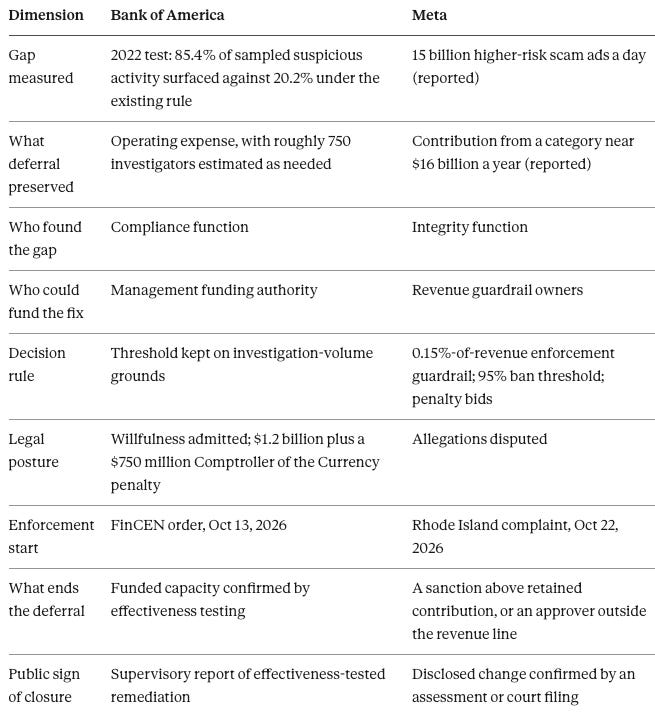
Takeaway: The inequality is shared, and funding source is the variable under test rather than the answer.
II Bank of America Deferred an Operating Expense
The Bank of America paper holds the chronology, and the present paper cites it. The 2022 test compared 85.4% against 20.2%. Management kept the existing threshold on investigation-volume grounds, and a 2024 estimate put the staffing an unconstrained threshold would require at roughly 750 people against roughly 16,000 monthly investigations.
A cost center held the correction. The budget owner would have absorbed the headcount expense, and that owner’s performance metric was spend against plan. A cost center benefits from deferral when its target rewards flat expense, so the behavioral mechanism runs through a target rather than through revenue.
Separating the bank’s compliance function from its funding authority shows where the gap sat. The compliance function measured the gap in 2022 and could size the fix, but it held no budget authority over headcount. The funding authority held the budget, and the order’s independent review now sets the requirement it must meet.
Takeaway: The cost-funded deferral sat with a funding authority whose budget target rewarded it, apart from the function that found the gap.
III Meta Preserved Revenue and Allegedly Monetized the Signal
Meta’s reported internal documents set a glide path for scam and banned-goods advertising from 10.1% of revenue in 2024 to 7.3% by the end of 2025 and 6% by 2026. A glide path is a planned deferral: the firm scheduled the correction over several years and kept the contribution in the interval. Revenue guardrails limited enforcement teams from acting against advertisers whose removal would cost more than 0.15% of total revenue.
Reuters reported a second step. Flagged advertisers paid higher rates through penalty bids rather than losing access, which converted the detection signal into an income line. The relevant quantity is the incremental contribution Meta retained by not blocking, net of what blocking would have cost, which the firm’s own accounts can date.
Takeaway: The revenue-funded deferral earned contribution rather than savings, and the controller’s results depended on it directly.
IV Who Controls the Stall Decides How Long It Lasts
Both institutions wrote their deferral into an approval rule. Meta’s enforcement teams could not act against an advertiser whose removal would cost more than 0.15% of total revenue, about $135 million in the first half of 2025, without clearing the revenue line. Bank of America’s threshold stayed where investigation volume could absorb it, which tied detection to the staffing a budget owner chose to fund.
Behavioral economics reads the two rules as one decision with different salient metrics. At Meta the approver sees lost revenue on every removal above the guardrail. At Bank of America the approver sees added headcount on every threshold change. Neither approver sees the harm the gap allows, so each rule holds until the harm acquires a number on the approver’s own line.
Game theory locates the break point in who signs. A profit-center approver pays the correction out of its own results, so its rule holds until a sanction exceeds the contribution at stake. A cost-center approver pays out of a budget line the firm can reset in one cycle, so its rule can break once an enforcer converts the gap into a mandated requirement.
The guardrail also supplies an observable. A disclosed change in who approves removals above the guardrail would show authority moving. A raised threshold with the same approver would show the rule loosening while authority stays put.
The Simulation Predictions support an authority-based forecast but do not discriminate the independent effect of funding source. A cost center and a profit center may behave alike when one actor holds both the budget target and the approval. The two may diverge when approval sits outside the line that bears the cost.
Takeaway: Both institutions encoded deferral as an approval threshold, and the threshold’s owner sets how long the gap lasts.
V Two Routes Break a Revenue-Funded Deferral
Game theory supplies the first route. Sanctions across channels add until the sum reaches the contribution line, which requires several enforcers and several years. Installment I treats that aggregation.
New Mexico supplies the second route. A per-violation statute multiplies a fixed penalty by affected users, and the user base that funds the revenue also funds the sanction. The October 2026 judgment reached $25 billion on privacy conduct after the state sought $35 billion to $45 billion, while Meta’s documents separately estimated roughly $16 billion a year in revenue from scam and banned-goods ads.
The two figures cover different conduct and different periods. Together they show the scale per-violation exposure can reach in one state, not that the privacy judgment crossed the scam-advertising break point. No Simulation Prediction carries a band on the per-violation route, because the public file does not yet show how an appellate court will treat the counting.
The New Mexico Court of Appeals decides how far the second route extends. An affirmance above $10 billion would make per-violation exposure concrete under New Mexico’s statute and a reference point for states with comparable provisions. A sharp reduction or vacatur would leave multistate aggregation as the main route in New Mexico.
Takeaway: The user base that funds the deferral can also fund the sanction where a per-violation statute applies, and the New Mexico appeal sets the reach of that route.
VI Activity Metrics Hid Both Gaps
Bank of America reported steady case counts driven by referrals. The count measured investigations opened, not suspicious activity detected, and Section II.D of the Bank of America paper shows how a stable activity metric masked a detection rate of roughly one in five.
Meta reported more than 134 million scam ads removed in 2025 and a 58% decline in user reports over 18 months. Both figures measure activity and response. Neither measures prevalence, which the internal estimate of 15 billion higher-risk ads a day did measure.
Activity metrics persist for a behavioral reason. Activity counts rise with effort and fall only when effort falls, so a team that reports them can show progress while the underlying gap widens. Prevalence and detection rates move with the gap itself, which gives an approver the least reason to publish them.
Automation sharpens the asymmetry. Automated review can multiply removal counts at near-zero cost while prevalence stays unmeasured in public. A board that receives activity metrics alone cannot tell whether a correction is working.
Takeaway: Both institutions reported activity while effectiveness stayed internal, so prevalence and detection rates are the metrics a board should demand, and Installment I forecasts whether Meta publishes one.
VII Admitted Willfulness and Alleged Deception Run Through Different Legal Channels
required Bank of America to detect and report, so the 2022 test went directly to the willfulness the consent order admits.
Platforms carry no equivalent statutory duty to detect scam advertising. Rhode Island’s claims run through representation: Meta’s public anti-scam statements against its internal estimates. Section V.F of the Bank of America paper treats the opinion doctrine that governs such claims.
Meta’s likely immunity defense under the federal platform statute reaches the hosting of third-party ads. It does not reach the firm’s own statements or its own alleged role in creating the ads.
The activity metrics from Section VI become the statements at issue. Meta’s public figures on removals and declining user reports sit beside internal estimates of 15 billion higher-risk ads a day, and Rhode Island’s representation claim tests the distance between them. The metric that hid the gap becomes the statement that creates the exposure.
The difference in legal posture also changes what each institution can still contest. Bank of America admitted willfulness, so its remaining choices concern how fast and how visibly it corrects. Meta disputes the allegations, so its choices still include litigating the meaning of its own documents, which lengthens the period before any correction becomes visible.
Takeaway: The representation channel reaches what the platform statute does not, and it turns the activity metrics that hid the gap into the statements a court will test.
VIII Automation Changes the Cost of Review Capacity
Section V.E of the Bank of America paper located the deferral in the cost of review capacity. An unconstrained threshold would have produced findings the funded investigators could not clear, and the bank’s own estimate put the required staffing at roughly 750 people. Automation changes every term in that calculation.
Automated detection raises finding volume at near-zero marginal cost. Three outcomes are possible. Automated triage can clear the backlog and end the deferral. Triage can lower the cost of clearing a finding while raising the false-positive share that reaches a human, which shifts the bottleneck to escalation.
Findings can also expand faster than correction capacity, which enlarges the deferral. Escalation capacity, the number of findings a decision-maker can act on in a period, can expand with investment. Whether it does is a budget decision the same approver makes, and the three outcomes remain competing hypotheses.
Meta’s reported configuration resembles the second outcome. AI ad-creation tools raise the volume of content integrity systems must assess, and the 95% ban threshold functions as an escalation threshold set within revenue guardrails. The public file does not show which outcome holds once capacity is funded at either institution.
Agentic deployments inherit both structures. A pre-deployment evaluation that surfaces more findings than the review queue can clear produces dated knowledge at machine speed, and each scale-up gate renews the deferral. The Foresight-to-Duty companion’s P-2 forecasts whether an enforcer reads such an evaluation as knowledge evidence, and the present paper supplies the capacity economics behind that reading.
Takeaway: Automation can clear, shift or enlarge a deferral, and the budget owner who funds escalation capacity decides which.
IX Comparative Cases Frame the Funding-Source Hypothesis
A comparative test of funding source would measure deferral duration from dated internal measurement to verified closure across revenue-funded and cost-funded cases. The candidate cases appear in Appendix C with the dates the public file supports. Every cost-funded case remains open, and several measurement dates are not public, so no duration comparison is possible yet.
Two confounds would shape any such test. Enforcement structure differs, because banking operates under a statutory detection duty and platforms do not. Industry differs with it, and the two revenue-side cases reached different instruments: Amazon a negotiated order, Meta a contested complaint.
The hypothesis has a clear falsifier. If closed cases show no duration difference between funding sources once authority placement is known, funding source adds nothing independent. A result favoring authority placement over funding source would be a finding in its own right.
Takeaway: The comparative cases define the test for funding source, and the test waits on cases that have not yet closed.
X Three Explanations Compete, and the Forecast Rests on Authority
Three variables could set how long a measured gap stays open: who funds the fix, who approves it and how large the expected sanction is. Each appears below as a hypothesis with its falsifier.
Hypothesis A: funding source sets duration: Revenue-funded deferrals last longer than cost-funded deferrals once enforcement arrives. Falsifier: closed cases show equal durations once authority placement is known.
Hypothesis B: authority placement sets duration: Deferrals end faster when approval sits outside the line that bears the cost, whatever the funding source. Falsifier: relocated approval fails to shorten deferral in closed cases.
Hypothesis C: expected sanction sets duration: Deferrals end when the expected sanction exceeds retained contribution or avoided expense, whatever the controller. Falsifier: a deferral ends while the expected sanction stays below the contribution line.
The Simulation Predictions forecast public evidence of correction under Hypothesis B. Two per-violation hypotheses remain open without bands: that a new state per-violation judgment exceeds the reported annual revenue from the conduct at issue, and that Meta changes a disclosed scam-ad practice within two quarters of an affirmance in New Mexico.
XI MindCast Simulation Predictions
The forecast set carries three Simulation Predictions: one primary (P) and two secondary (S). Verification sources and partial-outcome rules for each entry appear in Appendix B.
P-1 · Bank of America’s regulators publicly report effectiveness-tested remediation before Meta publicly discloses a verified change to flagged-advertiser treatment and do so by December 31, 2028 (47-60%)
The entry forecasts the order of public evidence, not which institution corrected first in operation. Falsifier: Meta’s verified public disclosure arrives first, or no qualifying bank report appears by the deadline.
S-1 · Meta announces it will block rather than surcharge advertisers its systems flag as likely scammers by December 31, 2027 (42-53%)
A change disclosed only in a court or regulatory filing counts. Falsifier: no public disclosure by the deadline.
S-2 · A securities complaint ties Meta’s anti-scam statements to its internal estimates and survives a motion to dismiss on those statements by December 31, 2028 (22-33%)
Survival on unrelated statements does not count. Falsifier: dismissal, or no complaint by the deadline.
The three entries forecast public evidence rather than private correction. P-1 tests whether the bank’s regulators report verified remediation first. S-1 and S-2 test whether Meta’s flagged-advertiser practice and its public statements change under pressure.
Takeaway: The forecasts read the order of public evidence, which is what outside observers can verify.
XII Risk Mitigation Layer
Exposure appears in a unit each stakeholder controls, with severity and probability stated separately.
Platform revenue leadership · P-1 (47-60%), S-1 (42-53%): Severity: high. Exposure: each quarter of deferral adds dated contribution to the discovery file.
Action 1: move approval of flagged-advertiser treatment to an owner outside the revenue line and document the transfer, owner the chief business officer, before the Rhode Island motion-to-dismiss ruling.
Action 2: replace penalty bids with blocking at the current detection threshold and disclose the change, owner the chief business officer, within two quarters.
Residual: the prior surcharge period remains dated knowledge.
Bank compliance and funding leadership · P-1 (47-60%): Severity: high. Exposure: a budget target that rewards flat spend can reproduce the 2022 decision under the order.
Action 1: size the review capacity the independent review requires and escalate the request in writing, owner the chief compliance officer, before the first supervisory follow-up.
Action 2: fund the requested capacity and document the approval, owner the chief financial officer, same deadline.
Residual: an effectiveness-tested follow-up shows operational correction and not durability. The second action also reduces exposure in the Bank of America paper, and credit is claimed once.
AI deployment owners · P-1 (47-60%): Severity: moderate. Exposure: an evaluation whose findings exceed escalation capacity can reproduce the Bank of America threshold decision at each scale-up gate.
Action 1: size escalation capacity to the finding volume the evaluation produced and document the sizing decision with its approver, owner the deployment owner, before each gate.
Action 2: route the funding decision to an approver outside the product line, owner the AI governance lead, same deadline.
Residual: a funded queue clears findings and leaves the pre-funding period as dated knowledge.
Disclosure counsel · S-2 (22-33%): Severity: high. Exposure: each public anti-scam statement measured against the internal prevalence estimate is a candidate misstatement.
Action 1: reconcile each public statement to the internal figure it rests on and retire statements that fail, owner disclosure counsel, before the next quarterly filing.
Action 2: convert removal-count statements to prevalence-rate statements with method, owner disclosure counsel, same deadline.
Residual: the reconciliation documents the gap for the period before it.
Institutional investors · S-2 (22-33%): Severity: moderate. Exposure: a surviving securities complaint opens discovery into the internal estimates behind Meta’s public statements.
Action 1: model securities-claim exposure tied to the anti-scam statements, owner the governance analyst, before the next annual report.
Action 2: submit a disclosure question on how Meta measures scam-ad prevalence, owner the stewardship lead, before the annual meeting.
Residual: discovery outcomes in Rhode Island can change the exposure faster than any model updates.
The actions share one direction. Each separates the decision to fund a correction from the line that bears its cost, and each leaves the pre-correction period on file.
Takeaway: Moving the funding decision is the lever that shortens deferral.
Conclusion
One deferral inequality held at two institutions from opposite economics. Bank of America’s gap sat with a cost center, and a consent order with a $1.2 billion penalty now requires it to fund the correction. Meta’s alleged gap sits with a profit center the practice pays, so the break requires a sanction that reaches the contribution line or an approver outside the line.
Funding source remains a candidate predictor. The comparative cases define how to test it, and the test waits on cases that have not closed. Authority placement carries the forecast in the meantime.
P-1 forecasts the order of public evidence: Bank of America’s regulators publicly report effectiveness-tested remediation before Meta publicly discloses a verified change and do so by December 31, 2028 (47-60%). A hit supports the authority-based reading without measuring which institution corrected first in operation.
What to Watch
Checkpoints fall on January 21, 2027 and on October 23 of 2027 and 2028. The dominant fork is the basis of the first Bank of America supervisory follow-up.
Each signal maps to an entry. The supervisory follow-up and any Meta disclosure on flagged-advertiser treatment resolve P-1. A Meta announcement on penalty bids resolves S-1. The first securities complaint citing the internal estimates opens S-2.
Working With MindCast
Published analysis can set two institutions’ deferrals side by side. It cannot tell a specific institution what its own deferral is worth, who must approve each fix or how long its gap will stay open under its current approval structure. The answers sit in the institution’s budget files, approval chains and testing history, as the series introduction sets out.
MindCast builds Cognitive Digital Twins (CDTs) of an institution’s measurement, authority and verification system. It ingests the testing history and reruns the enforcement environment against the institution’s actual options.
For the question this installment asks, the engagement is a deferral review for risk and finance leaders, funding authorities and business owners. The review compares the expected return to deferral against the cost of each fix, using the institution’s own numbers rather than public estimates. It names the approver whose position must change for each correction to fund.
AI deployment leaders face the same structure at machine speed. A review-capacity simulation tests whether the human review queue can absorb what pre-deployment evaluation surfaces, and it runs before the first agentic precedent lands. The output sizes escalation capacity to the finding volume the evaluation produces.
Commissioned work delivers three outputs. The first is a map of open findings by stage of conversion. The second is a set of exposure scenarios with low, median and high cases. The third is a set of monitoring thresholds keyed to this installment’s Simulation Predictions: the basis of the next supervisory follow-up (P-1), a change in flagged-advertiser treatment (S-1) and the first securities complaint (S-2).
MindCast takes one bounded next step at a time, and no engagement proceeds without a named decision to resolve. Contact mcai@mindcast-ai.com or visit www.mindcast-ai-simulation.com to schedule the diagnostic session.
Takeaway: The installment compares two deferrals from the outside, and a deferral review measures the deferral inside one institution.
Sources
The works below support the facts and frameworks cited above. MindCast works come first, then primary sources, then secondary reporting.
MindCast Works
Bank of America $1.2 Billion Money Laundering Penalty and the Compliance System That Knew Too Much(2026). Supplies capacity-calibrated detection, activity metrics, review capacity and the opinion doctrine.
The Foresight-to-Duty Conversion: Measured Governance Debt Becomes Evidence When Institutions Keep the Gap They Found (2026). Supplies the deferral inequality and the agent-deployer forecast.
Primary Sources
Financial Crimes Enforcement Network, release on the Bank of America consent order, October 13, 2026 ($1.2 billion; Office of the Comptroller of the Currency civil money penalty of $750 million; Office of Foreign Assets Control resolution of $11.6 million).
Bank Secrecy Act, 31 U.S.C. § 5311 et seq.
47 U.S.C. § 230.
Secondary Reporting
State of New Mexico v. Meta Platforms, Inc., judgment of October 21, 2026, as reported by ABC News.
State of Rhode Island v. Meta Platforms, Inc., complaint filed October 22, 2026, as reported by PYMNTS.
Reuters, special report on Meta’s internal scam-advertising documents, November 6, 2025, as summarized by MediaNama.