
Meta · Rhode Island · New Mexico · Federal Trade Commission · UnitedHealth · Block
Foresight-to-Duty Conversion Series Introduction: Meta Foresight-to-Duty Conversion Across Privacy, Child Safety and Scam Ads · Meta and Bank of America Foresight-to-Duty Conversion: Revenue-Funded Versus Cost-Funded Deferral · Consent Order Remedies at Meta, Boeing, Starling and Wells Fargo: Verified Correction Versus Recurrence
Related Works: Bank of America $1.2 Billion Money Laundering Penalty and the Compliance System That Knew Too Much · The Foresight-to-Duty Conversion — Measured Governance Debt Becomes Evidence When Institutions Keep the Gap They Found
Foundational Works: The Duty to Foresee, AI Deployment Readiness as Prospective Governance, and the Arrival of Agentic Duty of Care · AI Governance Equilibrium · Decision Modeling and Foresight Simulation
Executive Summary
Separate fines do not diversify governance risk when one decision architecture produces the failures they punish. Meta now faces that test in three legal channels. A New Mexico jury returned a $375 million child-safety verdict in March 2026. A New Mexico judge ordered a $25 billion privacy penalty on October 21, and Rhode Island sued over scam advertising on October 22.
Thesis: Several legally distinct failures at one firm can share one decision architecture. The architecture has three parts: the actor with authority to fund a correction, the metric that actor’s budget tracks and the loop that verifies closure. Meta’s own files dated its awareness in each channel, while the public file names the corrective recipient in only two.
What distinguishes the MindCast approach: The Foresight-to-Duty Conversion: Measured Governance Debt Becomes Evidence When Institutions Keep the Gap They Found (2026) traced how one measured gap becomes evidence once an institution keeps it. The present paper applies those stages across channels at one firm and asks whether one authority sat behind each stall. MindCast AI applies Predictive Behavioral Economics + Dynamic Game Theory through the MindCast AI Proprietary Cognitive Digital Twin Foresight Simulation (MP CDT FS) system. Behavioral Economics supplies the decision rules, Game Theory supplies the payoff structure, and predictive simulations emerge from the combination.
What the paper does: The paper defines decision architecture and its evidence standard, then dates Meta’s awareness in each channel. It builds an authority map, adds two configurations prior models omit and tests the pattern against two comparators. It forecasts parallel state filings and closes with six Simulation Predictions and a Risk Mitigation Layer.
Simulation Prediction highlights: The forecast set carries six MindCast Foresight Simulation Predictions: two primary and four secondary. The lead entry forecasts that a second state attorney general sues Meta over scam advertising by December 31, 2027 (67-79%). Whether one approver sat behind deferrals in several channels remains an open hypothesis without a band.
🏛️ Policymakers and state enforcers: An order that names who authorized a deferral becomes evidence for the next enforcer in another channel. A file that names no approver leaves each channel to start over.
💼 Executives: Risk and internal audit leaders: an open finding without a dated receipt by a funding authority proves awareness but not authority. Revenue owners: an order in one channel supplies notice in another only where the relevant finding reached a named recipient. Boards: an assessor finding whose recipient is unknown is the gap a plaintiff will fill.
🤖 AI deployment leaders: An evaluation that surfaces more than the review queue can clear produces dated knowledge. The owner who decides what the queue absorbs holds the exposure.
⚖️ Counsel: An enterprise-level claim stands only where one body approved deferrals in several channels. Approval maps therefore decide the scope of liability.
📊 Investors: Meta’s legal exposure behaves as one correlated position rather than three independent matters. A per-violation statute in one state produced a judgment larger than the multistate resolution of the same conduct.
Across audiences the implication is the same. The question that decides Meta’s exposure in each channel is who received the finding and what that recipient could fund.
I One Decision Architecture Can Sit Behind Three Regulatory Channels
Meta’s 2026 enforcement calendar turned three legal channels into one balance-sheet question. Judgments and resolution commitments reached up to roughly $42 billion before Rhode Island’s scam-advertising claim was counted: $25 billion in New Mexico on privacy, $375 million on child safety and up to $17.1 billion in the multistate resolution. Investors and boards see three provisions. The paper asks whether they reflect three decisions or one.
The unit of analysis is therefore the decision architecture, not the violation. A violation names conduct a statute reaches. A decision architecture names the actor who could fund the correction, the metric that actor’s budget tracks and the loop that confirms closure.
The answer changes how the exposure behaves. If one architecture governs all three channels, each enforcer inherits the others’ evidence and the provisions move together. If each channel has its own approver, each matter resolves on its own file.
One evidence standard decides between the two. A claim that Meta was aware of a deficiency requires a dated internal document (Level 2a). A claim that a corrective authority received it requires a named recipient (Level 2b), and a claim of one architecture requires one body that received findings and declined correction in more than one channel (Level 3).
Two kinds of evidence fall short of Level 3. Documents moving between proceedings show evidence reuse, because a plaintiff can reuse another regulator’s exhibit without showing one decision-maker read both. A shared incentive shows that each channel’s approver faced the same metric, not that the approvers were the same body.
Takeaway: Three provisions become one exposure only if one approver sits behind them, and the paper claims shared architecture only on evidence that names that approver.
II Meta’s Own Measurements Dated Its Awareness in Each Channel
Scam advertising produced the most precise file. The figures below are reported allegations, not adjudicated findings. Internal documents reported by Reuters on November 6, 2025 estimated 15 billion higher-risk scam ads a day and placed scam and banned-goods advertising at 10.1% of 2024 revenue, roughly $16 billion.
The same documents projected regulatory fines of up to $1 billion against roughly $3.5 billion earned every six months from high-risk scam ads. Rhode Island’s complaint in Providence Superior Court pleads the daily estimate and the revenue share under the state’s Deceptive Trade Practices Act.
Privacy produced the longest file. The Federal Trade Commission’s 2012 order and 2019 settlement each delivered findings in writing. On October 21, 2026, Judge Francis Mathew of New Mexico’s First Judicial District entered a $25 billion judgment after a jury found more than 43 million violations of state consumer protection law. New Mexico sued alone on the Cambridge Analytica conduct, and Meta has said it will appeal.
Child safety produced the file a jury read. Internal teen-safety research documented harms the product design sustained. The New Mexico jury found Meta liable for $375 million, and a judge was left to decide public-nuisance remedies in a later phase. On August 26, 2026 a coalition of 47 states and four other jurisdictions announced a resolution worth up to $17.1 billion of youth-safety and Cambridge Analytica privacy claims, with an independent auditor to assess implementation and efficacy.
Each channel holds a dated file, so awareness sits at Level 2a in all three. Receipt by a corrective authority reaches Level 2b in the scam-ad and privacy channels and remains open in child safety. MindCast’s prior twelve-entry forecast set on the teen-harm trial stands at one validated and none missed. The mid-trial resolution mooted four entries, two matched the outcome without a resolvable event and five remain open, as MCAI Lex Vision: Meta $16.68 Billion Settlement Validates MindCast Simulation Predictions — The Platform Design Liability Scorecard on the Mid-Trial Exit (2026) reports. A negotiated outcome removed the event the flagship entry targeted.
Takeaway: Awareness is established in each channel, so the contest turns on authority rather than awareness.
III Salience and Payoffs Explain the Shared Deferral
appears on every budget line a product owner tracks, while scam losses land on users and privacy harms land on no quarter’s results. Harm stays diffuse until an enforcer surfaces it, and a diffuse harm loses to a salient metric in each budget cycle.
Game theory supplies the payoff structure. In the scam-ad channel, Meta’s own documents projected fines of up to $1 billion against roughly $3.5 billion earned every six months. Comparable contribution figures are not public for privacy or child safety, so the payoff comparison rests on the scam-ad estimates alone.
The relevant comparison is not gross revenue against penalty totals. The comparison is the contribution Meta retained by keeping the practice, net of the correction’s cost, against the expected sanction discounted by the probability that an enforcer proves knowledge from the file. The deferral holds until a sanction reaches that contribution line, an authority outside the benefiting function takes the decision, or another route out of deferral opens.
The ratio is stark even before any discount. The documents put high-risk scam-ad revenue near $7 billion a year against fines of up to $1 billion, a gap of roughly seven to one. Discounting the fine by the odds that an enforcer proves knowledge widens the gap further.
Takeaway: In the one channel with public numbers, the expected sanction sat below the retained contribution.
IV The First Order Becomes the Next Measurement
The 2019 Federal Trade Commission settlement did more than fine Meta $5 billion. It required an independent assessor and routed privacy findings to a board committee. The board became the only body the public file shows receiving findings through a formal instrument.
The routing matters for the architecture question in Section V. Scam-ad findings reached the owners of revenue guardrails, and child-safety research reached recipients the public file does not name. If a shared approver exists, the board is the one body with documented receipt in at least one channel and authority over all three.
The Federal Trade Commission’s 2023 modification filing relied on the assessor’s findings, so the privacy reports already serve as evidence of what the committee received. Discovery showing the same committee or the full board receiving scam-ad or teen-safety findings would carry the paper’s claim from Level 2b to Level 3. Discovery showing those findings stopped below the board would confine each channel to its own approver.
Board-level receipt also changes the directors’ exposure. Bingle found no oversight liability where findings never reached the board, and an order that routes findings to the board removes that defense for the channel it covers. Meta’s directors hold documented receipt for privacy and an open question for the other two channels.
Takeaway: The privacy order made the board the body to watch, because it is the one recipient that could connect all three channels.
V The Authority Map Separates Shared Architecture From Shared Incentive
The authority map sets each channel’s enforcement event beside its internal finding and the recipient the public file names. The last column states the evidence that would raise the proof level. Unknown recipients stay unknown.
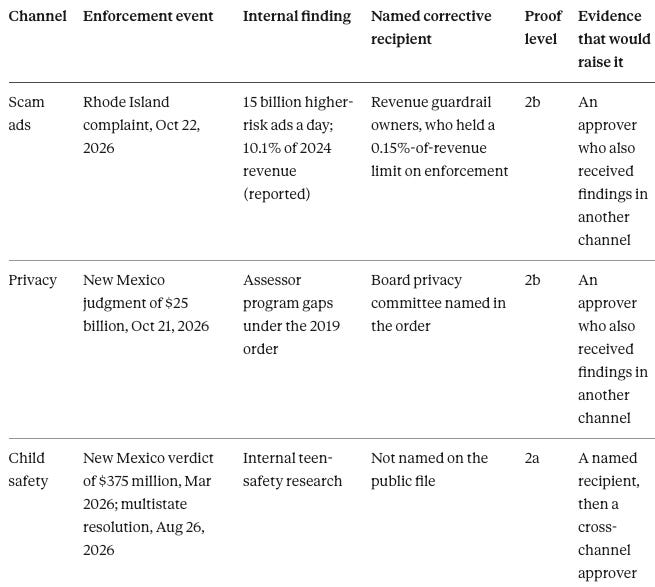
Three explanations compete for what the table shows. One decision rule may have governed all three channels through one approving body. Separate decision-makers may have responded to one shared incentive without a common approver. Independent technical and organizational failures may have produced similar outcomes at scale.
Awareness is established at Level 2a in each channel, and receipt at Level 2b in two. Shared incentive is an inference the mechanism supports, not a proof level. Shared architecture reaches Level 3 only if the Rhode Island discovery file or the New Mexico appellate file names one body that received findings from two or more channels and declined correction in two or more.
Two gaps separate what exists from what the public file can show. Confidential discovery or an early resolution can prevent observation of a shared approver without disproving one, and an appeal may add no new discovery. Construction Industry Laborers Pension Fund v. Bingle (Del. Ch. 2022) caps any enterprise-level claim that stops short of a named recipient.
A disclosed relocation of integrity approval outside the revenue line would establish a change in corrective authority. Level 3 would still require evidence that one body received findings and declined correction in multiple channels.
Takeaway: Shared architecture requires a named shared approver, and a relocation of approval would show changed authority without proving shared control.
VI Monetized Measurement and the Generator-Detector Conflict
Meta adds two configurations neither companion paper models. The first is monetized measurement. Reuters reported that advertisers Meta’s systems flagged as likely scammers paid higher rates through penalty bids rather than losing access. Whether the Rhode Island complaint pleads that practice remains open on the public file.
If substantiated, the practice turns the fraud signal into an income line. A declined measurement dates knowledge. A monetized measurement dates knowledge and the decision to profit from it.
The second is the generator-detector conflict. Rhode Island alleges that Meta’s systems helped create or optimize scam campaigns, and Meta’s AI ad-creation tools produce content its own detection must catch. Section VIII of the companion paper names four agentic failure shapes: alert suppression, the verification bottleneck, documentation outpacing performance and correlated blind spots.
The present configuration would add a fifth: an institution’s AI generates the load its review capacity must absorb. The fifth shape requires one fact the public file has not supplied, namely that the generation tools and the integrity function report to the same budget owner. The common reporting line remains a hypothesis, not established architecture.
Takeaway: Monetized measurement and generator-detector conflict each add evidence of incentive to evidence of knowledge, and each names an approval a plaintiff can date once discovery reaches it.
VII Two Comparators Test Whether the Pattern Is Meta’s Alone
UnitedHealth supplies a non-platform test. The February 2024 Change Healthcare cyberattack began on a server that lacked multifactor authentication, and the parent’s chief executive told Congress the company was still determining why. A November 2023 lawsuit alleged that more than 90% of coverage denials from the nH Predict algorithm were overturned on appeal. The two matters arose in separate units under separate law, and the parent held the budget to unify their controls.
Block supplies the fintech test. State regulators ordered Block to pay $80 million for anti-money-laundering failures on January 15, 2025, and the Consumer Financial Protection Bureau ordered $175 million the next day over fraud handling at Cash App. Both findings named one product, so correction authority over both sat inside one business.
A pattern shared by a health insurer and a payments firm points to incentive structure rather than business model. Neither comparator establishes a shared approver, so the comparison supports the behavioral mechanism and leaves the architectural claim to Meta’s own discovery file.
Takeaway: Shared incentive appears outside platforms, which supports the mechanism without proving shared control at Meta.
VIII States Will File in Parallel Rather Than Jointly
The solo route now shows a higher ceiling than the coalition route. New Mexico sued alone on Cambridge Analytica and holds a $25 billion judgment pending appeal. The 51-jurisdiction resolution of the same conduct and the youth-safety claims reached up to $17.1 billion, and Rhode Island’s share ran between $49.4 million and $64.5 million.
A headline judgment is not an expected payoff. The solo route bears appellate reduction risk, collection delay, litigation expense and a narrower remedy set. The coalition route delivered certain money, product changes and an independent efficacy auditor, so the comparison turns on the appellate outcome.
How State Attorney General Coalitions Form, Grow, and Hold (2026) supplies the formation conditions: lead-state fixed costs, portable evidence, compatible remedies and a coordination channel. The June 11, 2025 letter from 42 attorneys general on investment scam ads supplies the channel. Portable evidence now exists in Meta’s reported internal estimates, and Meta’s statement that Rhode Island retained an out-of-state firm shows how outside counsel lowers a state’s fixed cost.
The 14 separate TikTok suits of October 8, 2024 show the topology parallel filing produces. States coordinated on evidence and theory and filed in their own courts under their own statutes. Breadth appeared as a count of filings rather than a caption.
Parallel filing and joinder give states alternative responses under either appellate outcome in New Mexico. Meta’s litigation position depends more heavily on that single result. The 2025 letter therefore works as a coordination channel without producing a joint caption.
Takeaway: Enforcement breadth against Meta will appear as a filing count, because states can adjust their response to the appellate outcome while Meta’s position depends on it.
IX The Public File Favors Shared Incentive but Cannot Yet Show One Approver
Three explanations fit the evidence in the sections above, and each predicts a different discovery file. Each appears below with the evidence that would disprove it, before any forecast prints.
Hypothesis A: one approver: One body received findings in two or more channels and declined correction in two or more. Falsifier: public filings name separate approvers for each channel.
Hypothesis B: shared incentive, separate approvers: Each channel’s approver responded to the same revenue metric without common control. Falsifier: discovery names one approver across channels, or a channel’s approver funded correction against the revenue metric.
Hypothesis C: independent failures: Technical and organizational failures produced similar outcomes without a common incentive. Falsifier: internal documents show revenue guardrails bounding correction in more than one channel.
The public file supports Hypothesis B over C and cannot yet discriminate A from B. Hypothesis A therefore stays open without a band, and the Simulation Predictions below test propagation, disclosure and the evidence a court will accept.
X MindCast Simulation Predictions
The forecast set carries six Simulation Predictions: two primary (P) and four secondary (S). Two secondary entries are conditional and print as P(A given B). Verification sources and partial-outcome rules for each entry appear in Appendix B.
P-1 · A second U.S. state attorney general sues Meta over scam advertising by December 31, 2027 (67-79%)
A county, territory or private filing does not count. Falsifier: no second state files by the deadline.
P-2 · Meta publishes a scam-ad prevalence rate with its method by December 31, 2027 (30-43%)
Removal counts alone do not count, and a regulator-compelled figure does. Falsifier: no published prevalence rate by the deadline.
S-1 · Given P-1, the new filer sues on its own complaint rather than joining Rhode Island’s (74-86% given P-1)
A joint complaint among new states counts as a hit. Falsifier: the new filer joins or amends Rhode Island’s complaint.
S-2 · Given a ruling by December 31, 2027, the Rhode Island court denies Meta’s motion to dismiss the representation claims in whole or in part (60-76% given a ruling)
Falsifier: dismissal of the representation claims.
S-3 · A court ruling against Meta in one channel relies on an order, verdict or assessor finding from another channel as evidence of knowledge by December 31, 2028 (31-43%)
A filing that only cites such a document does not count. Falsifier: no ruling so relies by the deadline.
S-4 · The Rhode Island action resolves in full by negotiated judgment before a summary-judgment or trial ruling on liability by December 31, 2028 (29-42%)
A negotiated judgment after a motion-to-dismiss denial counts. Falsifier: a liability ruling, a litigated dismissal of all claims or no resolution by the deadline. The band is wide because Rhode Island’s per-violation ceiling is not yet public.
The six entries share one mechanism: evidence moves across forums faster than Meta’s approval structure changes. P-1 and S-1 test that propagation. P-2 and S-3 test disclosure and judicial reliance, while S-2 and S-4 trace the Rhode Island case.
Takeaway: The forecasts follow the evidence across forums, and the shared-approver question stays open until a named approver appears.
XI Risk Mitigation Layer
Exposure appears in a unit each stakeholder controls, with severity and probability stated separately. Entries sit together in one section, which keeps each audience’s actions in one place at the cost of distance from the register.
Platform integrity leads · P-2 (30-43%): Severity: high. Exposure: removal counts without prevalence rates become the plaintiff’s exhibit in discovery.
Action 1: publish a prevalence measure with its sampling method, owner the integrity lead with approval from the executive who holds enforcement guardrails, before the Rhode Island motion-to-dismiss ruling.
Action 2: file the method with the board committee that oversees integrity, owner the integrity lead, same deadline.
Residual: a published prevalence figure dates the gap it measures.
Platform general counsel · S-3 (31-43%): Severity: high. Exposure: a ruling that relies on another channel’s findings widens discovery scope in every channel.
Action 1: map approvals by body and channel for every open finding, owner the general counsel, within one quarter.
Action 2: document which approver received each assessor finding, owner the chief legal officer, before discovery closes in Rhode Island.
Residual: the map itself becomes discoverable.
State attorney general offices · P-1 (67-79%), S-1 (74-86% given P-1), S-4 (29-42%): Severity: moderate. Exposure: a coalition caption forgoes a per-violation ceiling, while a solo filing forgoes certain recovery and shared remedies.
Action 1: plead the state statute individually and sign a common-interest agreement for evidence, owner the consumer protection chief, before the New Mexico appellate ruling.
Action 2: evaluate the contingency arrangement against expected collectible recovery under both appellate outcomes, owner the attorney general, same deadline.
Residual: an appellate reduction in New Mexico lowers the solo ceiling for every later filer.
Internal audit and insiders · S-3 (31-43%): Severity: high. Exposure: a finding that never reached an empowered approver proves awareness and not authority.
Action 1: document each finding’s recipient and that recipient’s corrective power at delivery, owner the chief audit executive, each audit cycle.
Action 2: escalate any finding whose recipient lacks funding authority to the committee that holds it, owner the chief audit executive, within the cycle.
Residual: the escalation file dates knowledge at the top of the firm.
Institutional investors · S-2 (60-76% given a ruling), S-4 (29-42%): Severity: moderate. Exposure: three matters modeled as independent are one correlated position.
Action 1: model Meta’s legal exposure as one correlated position across channels, owner the governance analyst, before the next annual report.
Action 2: submit a disclosure question on approval authority for integrity enforcement, owner the stewardship lead, before the annual meeting.
Residual: a denied motion to dismiss opens discovery whose contents no model captures in advance.
The actions share one direction. Each moves approval or documentation to a body that can act on the finding, and each leaves residual exposure because earlier measurements stay on file.
Takeaway: Mitigation narrows future exposure without erasing what the file already shows.
Conclusion
Meta’s 2026 judgments and filings test whether legal diversification diversifies governance risk. The answer turns on authority rather than motive. Where one body approved deferral in several channels, each enforcer inherits the last one’s evidence and the three matters become one exposure.
The evidence establishes dated awareness in each channel and receipt by a corrective authority in two. Discovery in Rhode Island and the New Mexico appellate file will show whether one approver sat behind each deferral. A shared approver supports the architectural claim, while separate approvers narrow the finding to a shared incentive.
P-1 tests propagation: a second state attorney general sues Meta over scam advertising by December 31, 2027 (67-79%). The architectural claim stays at Level 2a across channels and Level 2b in two until a named approver appears in more than one.
What to Watch
Checkpoints fall on January 21, 2027 and on October 23 of 2027 and 2028. The dominant fork is the Rhode Island motion-to-dismiss ruling.
Each signal maps to an entry. The Rhode Island ruling resolves S-2 and moves S-4. A second state filing resolves P-1 and S-1. Meta’s next integrity report resolves P-2, and the first ruling that relies on another channel’s findings resolves S-3.
Working With MindCast
Published analysis can map Meta’s three channels from the public file. It cannot tell a specific institution which of its own open findings reached an approver with power to fund the fix, or whether one approver sits behind deferrals in several channels. The answers sit in the institution’s measurement files, approval chains and board minutes, as the series introduction sets out.
MindCast builds Cognitive Digital Twins (CDTs) of an institution’s measurement, authority and verification system. It ingests the testing history and reruns the enforcement environment against the institution’s actual options.
For the question this installment asks, the engagement is an authority audit for boards, internal audit leaders and general counsel. The audit traces each open finding to its recipient and notes what that recipient could fund. It flags any approver who appears in more than one channel, which is the fact that converts separate matters into one exposure.
Commissioned work delivers three outputs. The first is a map of open findings by stage of conversion, from measurement to verified closure. The second is a set of exposure scenarios with low, median and high cases, and the third is a set of monitoring thresholds that show which scenario has begun.
The thresholds key to this installment’s Simulation Predictions. A second state filing (P-1), the Rhode Island motion-to-dismiss ruling (S-2) and the first ruling that relies on another channel’s findings (S-3) each mark a scenario shift. State enforcement teams can commission the same map from outside the firm, built on the public file and discovery.
MindCast takes one bounded next step at a time, and no engagement proceeds without a named decision to resolve. Contact mcai@mindcast-ai.com or visit www.mindcast-ai-simulation.com to schedule the diagnostic session.
Takeaway: The installment maps the public file, and an authority audit maps the institution’s own approval chain before a plaintiff does.
Sources
The works below support the facts and frameworks cited above. MindCast works come first, then primary sources, then secondary reporting.
MindCast Works
The Foresight-to-Duty Conversion: Measured Governance Debt Becomes Evidence When Institutions Keep the Gap They Found (2026). Supplies the stages, the second interval and the four agentic failure shapes.
How State Attorney General Coalitions Form, Grow, and Hold (2026). Supplies the coalition formation conditions.
Meta on Trial for Teen Social Media Harm: Twenty-Nine States, One Judge, and the Future of Platform Design Liability (2026). The prior forecast set on the teen-harm trial.
Meta $16.68 Billion Settlement Validates MindCast Simulation Predictions — The Platform Design Liability Scorecard on the Mid-Trial Exit (2026). Assesses that set against the August 26, 2026 resolution.
Primary Sources
Federal Trade Commission, In re Facebook, Inc. case page: 2012 Decision and Order; 2019 stipulated order; 2023 Order to Show Cause; July 30, 2025 stay of the show-cause proceeding.
Rhode Island Office of the Attorney General, coalition resolution announcement, August 26, 2026.
National Association of Attorneys General, letter of 42 attorneys general on investment scam ads, June 11, 2025.
Construction Industry Laborers Pension Fund v. Bingle, C.A. No. 2021-0940-SG (Del. Ch. Sept. 6, 2022).
Consumer Financial Protection Bureau, order against Block over Cash App fraud handling, January 16, 2025.
Secondary Reporting
State of New Mexico v. Meta Platforms, Inc., First Judicial District, judgment of October 21, 2026, as reported by ABC News.
State of Rhode Island v. Meta Platforms, Inc., Providence Superior Court, complaint filed October 22, 2026, as reported by PYMNTS.
Reuters, special report on Meta’s internal scam-advertising documents, November 6, 2025, as summarized by MediaNama.
New Mexico child-safety verdict, March 2026, as reported by NPR.
Change Healthcare cyberattack testimony, May 1, 2024, as reported by the Associated Press via NY1.
nH Predict lawsuit against UnitedHealth, November 2023, as reported by Healthcare Dive.
Fourteen state suits against TikTok, October 8, 2024, as reported by ABC7.