
Companion to The Kalshi Vehicle Contest — New Jersey Puts Prediction-Market Sports Betting Before the Supreme Court and Kalshi At The Supreme Court — 39 State Attorneys General, Tribal Gaming Authority And Prediction-Market IPO Risk
Thesis. Kalshi now faces two separate fights over its sports contracts. The Supreme Court decides which government regulates them. The NFL is pressing a second fight over which contracts, traders and data practices those markets must accept, and that fight continues whichever government wins.
Why Now. The NFL, former Senator Christopher Dodd and former Commodity Futures Trading Commission (CFTC)Chairman Gary Gensler filed briefs supporting New Jersey’s petition in October, and Kalshi’s response is due November 9. State officials and operators face a decision before that date, as do sports leagues, counsel and investors.
Executive Summary
A Kalshi win at the Supreme Court would decide who regulates sports contracts on federal exchanges without deciding what safeguards those contracts carry. The NFL has told the Court it will take its integrity demands to the CFTC, Congress and the exchanges if Kalshi wins. The contest over Kalshi’s largest product line therefore outlasts the Court’s answer.
The NFL’s October 8, 2026 brief reports that NFL games accounted for $1.8 billion of the $3.3 billion traded on prediction markets on the first Sunday of the season. The league says the CFTC and Kalshi have resisted its requests for basic safeguards. Former Senator Christopher Dodd, who introduced the bill that became the Dodd-Frank Wall Street Reform and Consumer Protection Act (Dodd-Frank), and Gensler filed companion briefs. Gensler quotes Kalshi’s own November 2024 statement that contracts on games are “unlikely to serve any ‘commercial or hedging interest.’”
The Thesis. Kalshi’s response to the three briefs follows its incentive to delay Supreme Court review. Kalshi’s earlier statements constrain how it defends sports contracts but not when it fights. The NFL’s demands create a separate regulatory and commercial contest on a longer timeline that runs toward the 2027 season.
What Distinguishes the MindCast Approach. Doctrinal commentary reports what the briefs argue.
MindCast AI applies Predictive Behavioral Economics + Dynamic Game Theory through MindCast AI Proprietary Cognitive Digital Twin Foresight Simulations (MP CDT FS). Behavioral Economics supplies the decision rules. Game Theory supplies the payoff structure. Predictive simulations emerge from the combination.
Earlier Simulation Predictions. Confirmed (75–88%): fifteen or more states filed a certiorari-stage brief supporting New Jersey, and 39 states signed Ohio’s brief on October 7. Not met (70–82%): the circuit-configuration entry tied to the Sixth Circuit ruling missed, because the count stood two-to-one and the Fourth Circuit has not ruled.
Simulation Prediction Highlights. The paper carries eleven Simulation Predictions: four primary (P) and seven secondary (S).
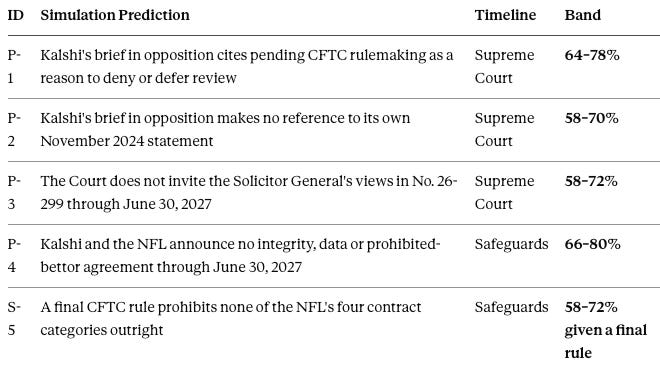
What the Paper Does. Section I sets out the three briefs and the split among sports bodies. Section II explains the mechanism and the competing explanations. Section III carries the eleven Simulation Predictions, Section IV the stakeholder moves and Section V what the findings mean for each audience. Section VI lists what to watch.
Stakeholder Callouts.
🏛️ Policymakers. A federal win would leave the NFL’s safeguards to CFTC rulemaking, where the simulation finds categorical bans unlikely (S-5).
💼 Executives. League demands follow the contracts into any forum the Court chooses (P-4).
⚖️ Counsel. Kalshi’s opposition will lead with delay and leave its own 2024 statement for the merits stage (P-1, P-2).
📊 Investors. Kalshi’s sports business carries one risk from the Court and a second from the safeguards fight after it (P-3, P-4).
I. Three Briefs Bring the Statute’s Sponsor, the Agency’s Former Chairman and the NFL Against Kalshi
New Jersey’s petition sits on a three-circuit conflict, and the October amicus briefs add three voices Kalshi did not face below. The Third Circuit held that Kalshi’s sports contracts are likely swaps and that federal law displaces New Jersey’s gambling law. The Ninth Circuit in KalshiEX, LLC v. Assad held the opposite on classification, and the Sixth Circuit in KalshiEX LLC v. Schuler held that no preemption follows even if the contracts are swaps.
The Supreme Court docket in No. 26-299 shows briefs supporting New Jersey from the National Council of Legislators from Gaming States, the International Association of Gaming Regulators, the Cabazon Band of Cahuilla Indians and Ohio with 38 other states and the District of Columbia. The NFL, Dodd and Gensler briefs followed. The docket shows Kalshi’s response due November 9 after an extension from October 8.
The Kalshi Vehicle Contest paper treats the petition as a fight over which case the Court takes and when. The Kalshi At The Supreme Court paper shows how state and tribal coalitions form around separate legal questions, and its forecasts stand unchanged here.
The Former Officials Agree That Sports Bets Are Not Swaps and Differ on Preemption
Dodd and Gensler converge on classification. Both argue that the Third Circuit’s reading produces results Congress never intended, and four arguments carry their case.
Purpose. Dodd-Frank responded to the 2008 financial crisis and targeted the over-the-counter derivatives market. Sports betting played no part in either.
The Senate floor in 2010. On July 15, 2010, Senator Blanche Lincoln told the Senate that “Chairman Dodd and I maintained this provision” to “prevent gambling through futures markets.” She warned that an event contract on the Super Bowl or the Kentucky Derby “would not serve any real commercial purpose.”
Section 2(e). The statute makes off-exchange swaps unlawful for ordinary retail customers. If sports bets were swaps, every casino and sportsbook wager since October 2012 would have been illegal, including Nevada betting under the Professional and Amateur Sports Protection Act and tribal gaming under the Indian Gaming Regulatory Act (IGRA).
Express preemption elsewhere. Section 16(e)(2) preempts state gaming law only for listed transactions, and Section 16(h) bars states from regulating swaps as insurance. Congress wrote no comparable gaming provision for sports contracts.
Dodd goes further on preemption. He argues that Section 2(a)(1)(A) gives the CFTC jurisdiction over the market but neither occupies the field nor shields exchange-listed contracts from state or tribal gaming law. His brief also notes his work with Connecticut’s Mohegan Tribe and Mashantucket Pequot Tribal Nation.
Gensler adds the agency’s own history. The CFTC adopted Rule 40.11 unanimously in July 2011 while he was Chairman, and the rule bars listing “any” contract involving gaming. He reports that the CFTC never required a sportsbook to register as a swap dealer despite more than $165 billion in 2025 sports-betting handle.
⚖️ Counsel. Dodd’s distinction between market jurisdiction and displacement gives states a fallback on preemption.
Takeaway: the former officials agree on classification, and Dodd develops the broader independent argument against preemption while Gensler reinforces the same conclusion through legislative and regulatory history.
The NFL Says Federal Oversight Lacks the Rules and Staff to Protect Its Games
The NFL’s brief asks whether federal oversight protects the games at all. The league calls game integrity its “highest priority” and reports that the CFTC and Kalshi have resisted the safeguards it requested in comment letters of May 15 and July 27, 2026.
The league asks for four categories of contracts to be barred.
Contracts one person can manipulate, such as whether a kicker misses a field goal.
Inherently objectionable contracts, such as those on player injuries or misconduct.
Officiating contracts, such as the number or timing of penalties.
Contracts knowable in advance, such as whether the first play is a run or a pass.
The brief adds two more requests. State regulators generally set a minimum betting age of 21, while the CFTC allows 18-year-olds to trade. The NFL also says Kalshi’s insider-trading rules cannot work without league-specific lists of prohibited bettors, and that Kalshi “has not engaged with the NFL” to obtain them.
The league disputes the CFTC’s capacity. The agency has 543 employees for the whole country, while Nevada’s and Pennsylvania’s gaming regulators have close to 400 each. Daily average event contracts on one market rose from 1,600 in April 2025 to 162,000 in April 2026. The CFTC’s proposed rule gives the agency ten days to begin reviewing each one.
🏛️ Policymakers. The NFL’s four categories and the 21-year age limit give state drafters a template that the largest league already supports.
Takeaway: the NFL argues that the federal regime lacks both the rules and the staff to protect the games.
The NFL Puts Safeguards Ahead of Forum
The NFL backs the Sixth and Ninth Circuits on classification. In the league’s account, swaps hedge preexisting risk while sports contracts “create risk” where none existed. Most NFL contracts are multi-leg parlays with no hedging function, and a sportsbook’s hedge is no answer because the sportsbook “artificially creates its risk.”
The brief adds two constitutional arguments in the vocabulary of the Court’s majority. A reading that forces all sports betting onto federal exchanges raises Commerce Clause questions under United States v. Lopez. Federalizing a state-regulated industry through one definition also raises a major question under West Virginia v. EPA.
The NFL states its position on the forum conditionally. If the CFTC adopted state-equivalent safeguards, the jurisdiction question would become “largely an arcane issue.” If the Court sided with the Third Circuit, the league would “redouble” its efforts with the CFTC, the exchanges and Congress before the 2027 season.
💼 Executives. The league has named its next forums in advance of the ruling, so operators can plan for the same demands in every outcome.
Takeaway: the NFL cares about safeguards first and forum second, and it has told the Court where it will go if it loses.
Sports Bodies Split Between Integrity Advocacy and Partnership
The NFL does not speak for every sports body. National Collegiate Athletic Association (NCAA) President Charlie Baker urged the CFTC in January 2026 to shut down college sports markets until further guidelines were set, according to Covers. The NCAA also demanded in February 2026 that Kalshi stop using its trademarks.
Other properties chose partnership. The National Hockey League (NHL) holds partnerships with Kalshi and Polymarket, and the Ultimate Fighting Championship (UFC) holds one with Polymarket, according to Front Office Sports. The NHL and UFC deals sit in the commercial layer of sponsorship, advertising and exclusivity that sports properties control, which MindCast’s Fourth Layer paper analyzes.
📊 Investors. League partnerships and league opposition now sit side by side in Kalshi’s business, so revenue by league carries different exposure.
Takeaway: the NFL and the NCAA lead the integrity side, while the NHL and the UFC have chosen partnership.
The Briefs Divide the Work Among Filers and Put Kalshi’s Own Words on the Docket
New Jersey built its petition on text and structure and held the drafting history in reserve. The amici now place that history and the integrity evidence before the Court without costing New Jersey a page.
The NFL contests the evidence the Third Circuit relied on. The Third Circuit reasoned that sports outcomes can be associated with financial consequences for leagues and franchises, and the largest league now tells the Court that the contracts hedge nothing for it.
The NFL brief also widens the amicus side’s political base. Former Attorney General William Barr, who served in the President’s first term, appears on the brief. The brief cites the CFTC’s own Ninth Circuit amicus filing as a claim of “unheralded power” over sports betting.
Kalshi’s own words now appear twice. The Sixth Circuit quoted a Kalshi concession that sports-event contracts “carry no [preexisting] economic risks,” and Gensler quotes the 2024 D.C. Circuit statement. The Dodd and Gensler briefs share counsel and overlap in argument, so they function as one coordinated presentation.
⚖️ Counsel. Two Kalshi statements now sit before the Court, and both remain available to New Jersey at the merits stage.
Takeaway: the briefs split the work among filers, and the NFL contests the Third Circuit’s evidence while widening the amicus side’s political base.
II. Delay Governs Kalshi’s Supreme Court Conduct While the NFL Controls the Safeguards Contest
The simulation asks one question: how do the parties and the federal government change their conduct once the drafters, the league and Kalshi’s own statements enter the docket? The horizon runs from Kalshi’s November 9 opposition through the Court’s action on the petition, extending to June 30, 2027 where stated. The merits outcome and tribal claims under IGRA fall outside scope, and the simulation tests conduct rather than intent.
Behavioral Economics Explains Kalshi’s Silence on Its Own Statements
Loss aversion makes a party weigh the cost of repeating a damaging quotation above the benefit of rebutting it. Salience works in the same direction, because every rebuttal puts the quotation in front of the reader again.
Reference points explain why Kalshi has resisted the NFL. Kalshi measures any safeguard against a fast-growing business in which sports make up about 80% of volume, according to the Pew analysis the NFL cites. Adopting one league’s list of prohibited contracts would read as a loss and would set terms every other league could demand.
The CFTC measures outcomes against the jurisdiction it holds today. A loss limited to sports contracts costs the agency less than a holding that narrows its authority across derivatives.
Game Theory Explains Why a Court Win No Longer Ends the Contest
Each filing changes the next party’s options. Kalshi’s opposition sets the agenda for New Jersey’s reply, and the reply sets the agenda for the Court’s conference.
The NFL’s conditional statement works as a commitment. By declaring that safeguards matter more than forum, the league tells Kalshi that a win in the Court will not end the contest. Kalshi’s payoff from a federal victory falls, because the league will carry the same demands to the CFTC and Congress.
The payoff structure also separates two allies. Kalshi gains from a broad reading of the swap definition in every forum. The CFTC gains from preserving its exclusive jurisdiction even if sports contracts fall outside it.
Nine Actors Enter the Simulation
The simulation models nine actors as Cognitive Digital Twins (CDTs), each carrying an objective, its constraints and the event that would change its behavior. Kalshi, New Jersey and the Supreme Court drive the Supreme Court timeline. The CFTC, the Solicitor General and the NFL shape the federal and safeguards paths.
Kalshi. Objective: hold the Third Circuit win and protect its sports business before a planned 2027 initial public offering (IPO). Changes course on: the reply, a call for federal views or a final CFTC rule.
New Jersey. Objective: review and reversal on a text-built petition. Changes course on: Kalshi’s opposition.
Supreme Court. Objective: resolve the conflict through a suitable vehicle. Changes course on: the opposition and any federal filing.
CFTC. Objective: preserve exclusive jurisdiction over derivatives. Changes course on: a call for federal views or a final rule.
Solicitor General. Objective: a federal position that survives beyond the current administration. Changes course on: an invitation from the Court.
NFL. Objective: game integrity in any forum. Changes course on: the Court’s action or a final CFTC rule.
Dodd and Gensler, the state coalition and tribal governments enter through defined interactions. Other sports bodies form a group whose responses the simulation tests.
Five Explanations Compete
Each explanation predicts different conduct and carries its own falsifier.
Delay Governs Kalshi’s Supreme Court Conduct. Kalshi gains from every month the Court waits, so its opposition leads with posture and pending rulemaking. Falsifier: Kalshi files a merits-led opposition that asks for review.
Kalshi’s Statements Govern How It Treats Them. Rebuttal repeats the quotation, so Kalshi stays silent at this stage and saves its distinction for the merits. Falsifier: the opposition quotes or rebuts the 2024 statement.
Safeguards Come Before Forum. The NFL’s demands survive any jurisdictional outcome and move to the CFTC, Congress and the exchanges. Falsifier: the NFL drops its integrity demands after a Kalshi win.
The Federal Side Breaks From Kalshi Early. The CFTC or the Solicitor General narrows its position before the Court acts to protect jurisdiction outside sports. Falsifier: no federal filing narrows before the Court’s first action.
The Briefs Change Nothing. Every actor had committed before the briefs arrived, so conduct follows the September 2 forecasts with no new movement. Falsifier: New Jersey’s reply cites the former officials or Kalshi changes its argument to answer the NFL.
The simulation finds that the first three explanations govern and the last two do not.
Takeaway: delay governs the Supreme Court timeline, and the league’s demands govern the safeguards timeline.
III. MindCast Simulation Predictions
The paper carries eleven Simulation Predictions: four primary (P, Primary Simulation Prediction) and seven secondary (S, Secondary Simulation Prediction). Four secondary entries apply only if a stated event occurs first, and three entries from the September 2 paper carry forward unchanged.
Prediction date: October 8, 2026 · Verification sources: the Supreme Court docket in No. 26-299, Supreme Court order lists, the Federal Register and public announcements by Kalshi and the NFL
Earlier Simulation Predictions
Six earlier entries from two MindCast papers have reached outcomes: five confirmed and one not met. The Kalshi At The Supreme Court paper states each in full.
Confirmed. “A certiorari-stage amicus brief supporting the petition is filed by fifteen or more states” (75–88%). Ohio and 38 other states filed on October 7.
Confirmed. “Kalshi seeks rehearing in the Ninth Circuit before the window closes” (66–80%). Kalshi petitioned on September 9.
Confirmed. “Conditional on a rehearing petition, the circuit filing precedes any Supreme Court filing” (75–86%). September 9 preceded September 18.
Confirmed. “Kalshi seeks an extension of its opposition deadline.” The Clerk extended the deadline to November 9.
Confirmed. “At least one Fourth or Sixth Circuit merits decision deepens the conflict by June 30, 2027” (74–86%). The Sixth Circuit ruled for the states on September 25.
Not met. The circuit-configuration entry tied to the Sixth Circuit ruling (70–82%). The count stood two-to-one, and the Fourth Circuit has not ruled.
Delay Shapes the Opposition and the NFL Shapes What Follows
On the Supreme Court timeline, the delay explanation prevails. A short opposition built on posture and pending rulemaking costs Kalshi nothing on the merits.
Kalshi’s own statements govern a narrower question: how Kalshi treats them. Rebuttal would repeat the quotations, so silence is the better move at the certiorari stage. The statements constrain Kalshi’s merits argument later, not its timing now.
On the safeguards timeline, the league’s control of integrity information governs. The NFL holds league-specific prohibited-bettor lists, a material compliance resource Kalshi lacks, and each side gains from distance while the Court decides. The federal side holds its alignment with Kalshi, because the CFTC’s commitment to exclusive jurisdiction outweighs the narrower loss of sports.
Four Routes Through the Next Eight Months
Base route. Kalshi leads with posture and pending rulemaking and leaves its statements unaddressed. New Jersey’s reply cites the amici and the Section 2(e) consequence. The Court acts without inviting federal views, and the federal side stays aligned.
Federal-views route. The Court invites the Solicitor General’s views. The federal government then chooses between Kalshi’s full theory and a narrower position that protects CFTC jurisdiction outside sports.
Rule-first route. A final CFTC rule issues before the Court acts. The Supreme Court contest becomes a challenge to the rule, and the NFL’s categories remain open.
Post-judgment route. Kalshi wins on jurisdiction. The NFL then carries its categories, the age limit and its data demands to the CFTC, Congress and operator negotiations before the 2027 season.
Primary Simulation Predictions
P-1. Kalshi’s November 9 brief in opposition cites pending CFTC rulemaking as a reason to deny or defer review (64–78%). Falsifier: the opposition makes no rulemaking argument. Delay governs Kalshi’s conduct, and a pending rule gives the Court a reason to wait without any concession on the merits. Gensler’s footnote 5 argues that a rule change “would have no effect on the preemption question presented,” so the entry tests whether the delay argument survives that answer.
P-2. Kalshi’s November 9 brief in opposition makes no reference to the statement Gensler quotes from Kalshi’s November 15, 2024 D.C. Circuit brief (58–70%). Falsifier: the opposition quotes, paraphrases or cites the statement or page 45 of that brief. Loss aversion and salience make rebuttal costlier than silence at the certiorari stage, which leaves New Jersey a merits-stage argument.
P-3. The Supreme Court does not invite the Solicitor General to file a brief expressing the views of the United States in No. 26-299 through June 30, 2027 (58–72%). Falsifier: an invitation appears on the docket within the window. The entry resolves as confirmed if no invitation issues by June 30, 2027, whether or not the Court has otherwise acted. The CFTC’s suits against states and its Ninth Circuit amicus filing already show the federal position, and the NFL’s plea for clarity “before another NFL season goes by” gives the Court reason to move.
P-4. Kalshi and the NFL announce no integrity, data or prohibited-bettor agreement through June 30, 2027 (66–80%). Falsifier: either party announces such an agreement in the window. Each side’s litigation position rewards distance until the Court acts, and negotiating safeguards imposes costs on both parties while the jurisdictional decision remains pending. The entry measures accommodation, not whether talks took place.
Secondary Simulation Predictions
S-1. New Jersey’s reply brief cites the Dodd brief or the Gensler brief, given a reply filed before the Court acts (70–82% given a reply). Falsifier: the reply cites neither. The amici let New Jersey borrow authority while keeping its own argument textual.
S-2. New Jersey’s reply brief invokes the Section 2(e) consequence for off-exchange sports wagers, given a reply filed before the Court acts (75–86% given a reply). Falsifier: the reply omits it. Both former officials and the NFL lead with the consequence, and the reply can use it in one paragraph.
S-3. Kalshi’s November 9 brief in opposition relies on economic effects on leagues, sponsors, broadcasters or franchises to defend the swap classification (55–68%). Falsifier: the opposition defends the classification without that evidence. The Third Circuit’s reasoning invites the argument, while the NFL’s brief makes league effects costly to cite.
S-4. No brief filed by the Solicitor General or the CFTC in No. 26-299 before the Court’s first action on the petition places sports event contracts outside the swap definition (86–94%). Falsifier: such a federal brief is filed in the window. The CFTC’s commitment to exclusive jurisdiction holds its alignment with Kalshi.
S-5. A final CFTC event-contracts rule published before June 30, 2027 prohibits none of the NFL’s four categories outright (58–72% given a final rule). Falsifier: the final rule prohibits every contract in at least one category. Contract-specific bans, case-by-case review and restrictions short of a categorical prohibition confirm the entry. The CFTC’s June 2026 proposal already omitted the “knowable in advance” category.
S-6. A state or tribal government filing in No. 26-299 or any prediction-market case cites the NFL’s brief or comment letters before June 30, 2027 (73–85%). Falsifier: no such filing in the window. The largest league’s integrity evidence supports the states’ police-power argument.
S-7. The NCAA or another major professional league files a merits-stage amicus brief supporting New Jersey, given a grant of review in No. 26-299 (56–70% given a grant). Falsifier: the merits amicus deadline passes with no such brief. The NCAA has already asked the CFTC to shut down college markets, and a merits brief carries the same position to the forum that decides jurisdiction.
Carried From the September 2 Paper. “The opposition materially emphasizes interlocutory posture, prematurity, or further appellate development (78–88%)” and “leads with posture as its first argument (70–82%).” “The Commission does not finalize RIN 3038-AF65 before the Court’s first action on the petition (68–80%).” Source: The Kalshi Vehicle Contest.
Questions Without a Forecast Yet
Three questions carry no forecast until a named event occurs.
The Solicitor General’s position. MindCast forecasts it once the Court issues an invitation.
Unilateral safeguards by prediction-market platforms. MindCast forecasts it once a platform addresses the NFL’s categories or a 21-year age limit.
Further former officials at the merits stage. MindCast forecasts it once any former Dodd-Frank official beyond Dodd, Gensler and Barr states a position.
Events That Would Replace the Contest
Three events would change every entry. A final CFTC rule before November 9 would turn the Supreme Court contest into a challenge to the rule. A negotiated resolution between Kalshi and New Jersey would end the vehicle. An integrity incident on an exchange tied to an NFL game would accelerate the safeguards contest.
Takeaway: the four primary entries test four different mechanisms: delay, consistency with prior statements, the Court’s selection of a process and commercial accommodation across a legal dispute.
IV. Stakeholder Moves Before Kalshi Responds and Before the 2027 Season
Each audience has a move available now, a move tied to a named event and a risk that remains after both. The exposure column states the risk in the unit each audience controls.
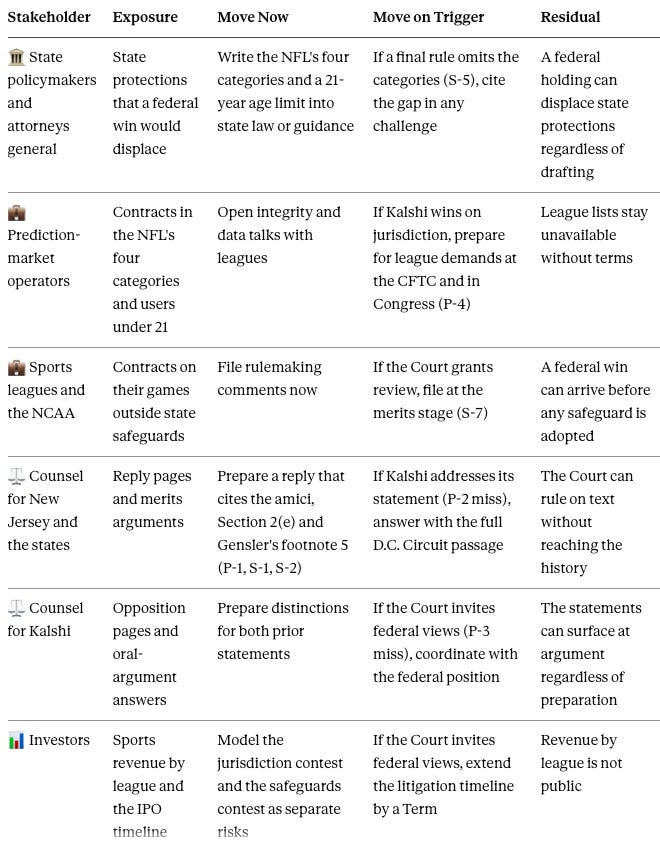
Moves by Time Window
Now to 30 days. Risk: an opposition or reply drafted without both Kalshi statements in view. Move: both sides obtain Kalshi’s D.C. Circuit brief and the Sixth Circuit’s quotation. Residual: Kalshi controls whether its opposition engages either one.
30 to 90 days. Risk: a call for federal views. Move: investors and operators model a one-Term extension. Residual: the Court sets its own calendar.
3 to 12 months. Risk: a final CFTC rule that omits the NFL’s categories. Move: leagues and states prepare comments and challenges, and operators negotiate integrity terms. Residual: a rule takes effect while challenges proceed.
Beyond 12 months. Risk: the 2027 NFL season opens with no agreed safeguards. Move: leagues take their demands to Congress, and investors model the product under league opposition. Residual: Congress sets its own agenda.
Takeaway: every audience can act before November 9, and every audience carries a residual risk that only the Court or Congress can remove.
V. What the Findings Mean for Each Stakeholder
The same docket places a different consequence before each audience.
🏛️ Policymakers. The CFTC’s Rule 40.11(a) still bars listing gaming contracts, and the NFL’s template has the largest league’s support. A final federal rule would draw the state challenge that the October 7 paper forecasts.
💼 Executives. Operators face a league that holds information it calls necessary for effective insider-trading controls. A Kalshi win in the Court would move the NFL’s demands to the CFTC, Congress and operator negotiations (P-4), and operators with integrity terms in place would face less pressure in that round.
💼 Sports Leagues. A grant of review gives integrity-focused bodies a merits forum, while partner leagues gain from a Kalshi win (S-7). Leagues that comment on the rule shape it before the Court rules on jurisdiction.
⚖️ Counsel. Kalshi’s rulemaking argument (P-1) invites New Jersey to answer with Gensler’s footnote 5. Kalshi’s silence on its statement (P-2) leaves New Jersey free to raise it in reply or hold it for the merits.
📊 Investors. Sports make up about 80% of Kalshi’s volume, and the NFL drives the largest share. A call for federal views would add months to the Supreme Court timeline (P-3), and a Kalshi win would leave the product exposed on the safeguards timeline (P-4, S-5).
Authority Moves Without Ending the Contest
The briefs strengthen the classification route without changing any rule. If the Court holds that sports contracts are not swaps, the CFTC keeps its jurisdiction over derivatives and loses only sports. If the Court holds that they are swaps, Dodd’s distinction between market jurisdiction and displacement becomes the states’ fallback.
A Kalshi win would make the CFTC the regulator of sports wagering on exchanges. The NFL has already told the Court that the agency lacks the rules and staff for that role. The agency would inherit the league’s demands along with the jurisdiction (S-5).
The NFL’s Leverage Runs Outside the Courtroom
Kalshi’s reliance on league and sponsor effects (S-3) invites a reply quoting the largest league’s own brief. A sponsorship deal does not turn a wager into a hedge, and the NFL says so in its brief.
The NFL says Kalshi cannot police insider trading without league lists. The simulation finds Kalshi’s strongest response is a set of unilateral safeguards that meets part of the demand without an agreement. Tribal governments gain from Dodd’s brief, which ties the swap question to IGRA and to two Connecticut tribes.
What Each Miss Would Mean
A miss on P-1 would mean Kalshi chose a merits-led opposition over delay and contested classification directly at the certiorari stage. A miss on P-2 would mean Kalshi confronted its statement early, moving the merits contest toward its distinction between games and outcome contracts.
A miss on P-3 would mean the Court invited federal views, and the litigation timetable would lengthen to allow additional briefing. A miss on P-4 would mean Kalshi and the NFL announced an agreement by June 30, 2027, and its scope and timing would show whether either side moved its litigation or regulatory position.
Takeaway: the Court’s action decides which government regulates Kalshi’s sports contracts, and the safeguards contest decides which of those contracts Kalshi can keep offering.
VI. What to Watch
The dominant fork is whether the Court acts on the petition before the CFTC finalizes its event-contracts rule. A rule first moves the contest to a challenge to the rule. The Court first keeps the contest on the briefs and the petition.
October 14 and 15. Nevada’s responses to the Crypto.com and Robinhood petitions fall due unless extended, as the October 7 paper reports.
November 9. Kalshi’s brief in opposition resolves P-1, P-2 and S-3 and the carried posture entries.
After November 9. New Jersey’s reply resolves S-1 and S-2.
November 16. Nevada’s requested date for its Crypto.com response.
After distribution for conference. Order lists show any invitation to the Solicitor General, which would falsify P-3, and the Court’s first action closes the window for S-4. Without an invitation, P-3 resolves on June 30, 2027.
Undated. A final CFTC rule resolves S-5 and the carried rule entry. Kalshi, NFL and NCAA announcements and filings resolve P-4, S-6 and S-7.
September 2027. The 2027 NFL season opens, the date the NFL names for its safeguards push.
Takeaway: Kalshi’s November 9 opposition resolves three entries at once and is the first signal to watch.
Conclusion
On the first Sunday of the 2026 season, NFL games accounted for more than half of all prediction-market trading. The league now tells the Supreme Court that the federal regime lacks the rules and staff to protect those games. Dodd-Frank’s sponsor and its implementing chairman add that the statute never reached sports bets, and Gensler adds Kalshi’s own words.
The simulation finds that Kalshi’s response follows its incentive to delay. Kalshi cites pending rulemaking (P-1) and leaves its 2024 statement unaddressed (P-2), and the Court acts without asking for federal views (P-3). On the safeguards timeline, Kalshi and the NFL reach no integrity agreement while the Court decides (P-4).
The decisive near-term signal is Kalshi’s November 9 opposition, and the decisive later signal is the CFTC’s final rule.
Working With MindCast
Commissioned work applies the simulation to a client’s own counterparties, options and exposure. MindCast builds CDTs for the actors that matter to the client’s decision and reruns the contest against the client’s choices.
Counsel for states or Kalshi: reply and opposition modules, keyed to P-1, P-2, S-1 and S-2.
Prediction-market operators: an integrity-terms assessment by league and contract category, keyed to P-4 and S-5.
Sports leagues and the NCAA: a rulemaking and merits-participation assessment, keyed to S-5 and S-7.
State attorneys general and regulators: a drafting assessment against Rule 40.11 and the NFL’s categories, keyed to S-5 and S-6.
Investors: a two-timeline exposure model by league against a 2027 IPO calendar, keyed to P-3 and P-4.
Clients receive full probability distributions, scenario trees for each route and monitoring keyed to the docket and the rulemaking. Contact mcai@mindcast-ai.com to scope a diagnostic before November 9.
Appendix A: MindCast Works
The Kalshi Vehicle Contest — New Jersey Puts Prediction-Market Sports Betting Before the Supreme Court. Source of the three carried Simulation Predictions and four of the confirmed earlier entries.
Kalshi At The Supreme Court — 39 State Attorneys General, Tribal Gaming Authority And Prediction-Market IPO Risk. Maps the state and tribal coalitions whose forecasts this paper leaves in place.
The Fourth Layer Of Prediction-Market Control — How The Kalshi Deal Put Sponsorship, Advertising, And Exclusivity Beyond The Reach Of Courts. Explains the commercial layer where leagues now sit on both sides.
The Kalshi Circuit Split — The Ninth Circuit Defines the Prediction-Market Gaming Boundary the CFTC Would Not. Source of the confirmed circuit-conflict entry and the circuit-count entry not met.
Appendix B: Sources
Court Filings
Supreme Court docket, Flaherty v. KalshiEX, LLC, No. 26-299. Filing sequence, amicus roster and the November 9 response date.
Petition for a Writ of Certiorari, No. 26-299 (Sept. 2, 2026). New Jersey’s question presented.
Brief of Ohio, 38 Other States and the District of Columbia, No. 26-299 (Oct. 7, 2026). Confirms the fifteen-state entry.
Brief of Amicus Curiae National Football League in Support of Petitioners, No. 26-299 (Oct. 8, 2026). Integrity categories, CFTC capacity and the conditional forum statement.
Brief of Former Senator Christopher J. Dodd as Amicus Curiae in Support of Petitioners, No. 26-299. Drafting purpose and the preemption argument.
Brief of Former CFTC Chairman Gary Gensler as Amicus Curiae in Support of Petitioners, No. 26-299. Rule 40.11 history and Kalshi’s 2024 statement.
Appellee’s Brief, KalshiEX LLC v. CFTC, No. 24-5205 (D.C. Cir. Nov. 15, 2024), at 45. Source of Kalshi’s 2024 statement.
KalshiEX, LLC v. Assad (9th Cir. Aug. 28, 2026); KalshiEX LLC v. Schuler (6th Cir. Sept. 25, 2026); KalshiEX, LLC v. Flaherty (3d Cir. Apr. 6, 2026). The three-circuit conflict.
Statutes, Rules and Legislative History
7 U.S.C. §§ 2(a)(1)(A), 2(e), 7a-2(c)(5)(C), 16(e)(2), 16(h).
17 C.F.R. §§ 40.2, 40.11; 76 Fed. Reg. 44776 (July 27, 2011); 91 Fed. Reg. 35,806 (June 12, 2026).
156 Cong. Rec. S5906–S5907 (daily ed. July 15, 2010) (colloquy of Senators Lincoln and Feinstein).
Reporting and Comment Letters
NFL, Comment Letters on Prediction Markets (May 15 and July 27, 2026). The integrity requests the CFTC has not adopted.
“IAGR and NAGRA File Amicus Brief Seeking Supreme Court Review in Flaherty v. KalshiEX,” SCCG Management (2026). Regulator associations supporting review.
“Dispute Raised by NCAA Over Kalshi Using ‘March Madness’ Brand,” Covers (Feb. 23, 2026). NCAA request to the CFTC and trademark demand.
“NFL, NCAA Rail Against Prediction Markets,” Front Office Sports. NHL and UFC partnerships.