
Thesis. The Protect College Sports Act is more likely to expire on January 3 than to become law. House leadership’s choice of vehicle decides which bloc controls the outcome. Any House amendment sends the bill back to a Senate with little time left to act.
Why now. The House returns November 9 with five weeks left in the 119th Congress, and the majority leader has already said the Senate bill needs changes. Six audiences face decisions tied to the route the House takes, from members and university presidents to investors and athlete representatives.
I. Executive Summary: Expiry Is the Most Likely Outcome, and Leadership’s Vehicle Choice Decides the Rest
The Protect College Sports Act is more likely to die in the House than to become law. The MindCast simulation puts enactment by January 3 at 24-38%, and its single most likely route is expiry without any House floor vote. The Senate passed the bill 77-22 on September 28 (ESPN), but the House does not return until November 9.
The vehicle decision carries more of the outcome than the floor vote. Under a standard rule, a handful of Republican holdouts control the result. Under suspension of the rules, House Democrats control it. Leadership picks the vehicle, and the vehicle picks the pivotal bloc.
Amendment pressure arrived within days of Senate passage. On October 1, Majority Leader Steve Scalise said the Senate bill has problems “that would need to be fixed” (The Washington Sun). On October 2, 21 House members asked leadership to rewrite the conference-realignment rules (Rep. Dunn letter). Each House change requires renewed Senate action inside a calendar that may not hold it.
The House cannot satisfy its critics with one set of changes. Republican chairs want explicit language that athletes are not employees, while the player unions backing the Senate text depend on its neutrality on that question. Florida and Carolina members want looser realignment rules, which a person close to the bill’s authors says lawmakers will not pass. The NAACP ties its opposition to voting rights, and the Congressional Black Caucus shares its position.
MindCast AI applies Predictive Behavioral Economics + Dynamic Game Theory through MindCast AI Proprietary Cognitive Digital Twin Foresight Simulations (MP CDT FS). Behavioral Economics supplies the decision rules. Game Theory supplies the payoff structure. Predictive simulations emerge from the combination.
The simulation models ten Cognitive Digital Twins (CDTs) across two linked contests. A congressional contest decides vehicle and text. An economic contest decides who gains from the Senate text, from the National Collegiate Athletic Association (NCAA) and its conferences to investors and agents.
The full paper maps the four House coalitions and their incompatible demands, weights four routes through the lame duck, and states each prediction with its trigger and falsifier. The paper closes with exposure tables for six stakeholder groups and a dated watch list running through June 30, 2027.
Six Simulation Predictions: two Primary (P) and four Secondary (S).
P-1. Any House floor vote on S. 4668 before January 3 occurs on the unamended Senate text, or no vote occurs (78-90%).
P-2. If leadership schedules floor action, it uses suspension or a year-end package rather than a standalone rule (52-68%).
S-1. The NFLPA and NBPA publicly oppose any House version declaring athletes non-employees within 10 days of its release (68-82%).
S-2. Walberg or Guthrie conditions support on employment language by December 17, and neither the NCAA nor any power conference joins the demand (52-68%).
S-3. If the bill expires, a power conference or member university announces a new operating-level capital deal by June 30, 2027 (62-78%).
S-4. S. 4668 becomes law by January 3, 2027 (24-38%).
🏛️ Policymakers. The first scheduling decision after November 9 decides which bloc holds the votes, which makes vehicle strategy the main lever.
🎓 University leaders. Each amendment campaign keeps the doubled pay cap and antitrust protection exposed to the calendar. Four ACC members have already broken with their conference on realignment, and expiry would remove the federal limits they oppose.
⚖️ Counsel. NIL and rights agreements need to work under the Senate text as enacted and under a restart in the 120th Congress.
📊 Investors. Enactment closes conference acquisitions and breakaway leagues. Operating-level deals stay open under either outcome.
🏈 Athlete representatives. Player-union support for the Senate text rests on its neutrality on employee status, the provision House Republicans most want to change.
💼 Executives. Certification of rights firms and agents becomes a legal requirement only if the bill becomes law.
The bill’s fate turns on the scheduling decision, and the full paper shows which signals reveal that decision first.
II. Senate Passage Leaves the House Three Choices
The House spent two years writing its own college sports bill and failed to pass it. Senate passage changed the House’s job from drafting a framework to accepting, changing or abandoning one someone else built. The change in role explains most of what follows.
A. Senate Passage Left the Bill One Chamber and Five Weeks From Law
The Senate passed the bill 77-22 after nearly six hours of debate and votes on seven amendments (CBS Sports). The bill codifies athletes’ right to earn from name, image and likeness (NIL) and sets a hard cap on athlete pay. Schools could pay athletes from three pools: the $21.6 million revenue-sharing cap, a new $22.5 million retention fund and $5 million for women’s and Olympic sports (CBS Sports).
The bill also caps agent fees at 5% and gives the NCAA and conferences a limited antitrust exemption. On whether athletes are employees, the bill stays neutral.
The House’s own bill, the SCORE Act, collapsed twice. Leadership pulled it in December 2025 after a procedural vote survived 210-209, and again in May after the Congressional Black Caucus (CBC) opposed it (CBS Sports). The Senate bill stalled until the Big Ten and the SEC endorsed a revised version in August (Senate Commerce Committee).
Twenty Democrats and two Republicans voted no (CBS News). All four Black Democrats in the Senate opposed the bill (Fox Sports). Senators Ashley Moody and Richard Blumenthal won a voice-vote amendment raising the conference membership cap from 19 to 20 (CBS Sports).
The calendar now governs. The House is not scheduled back until November 9, and if the bill does not clear the House before the new Congress is seated in January, the process starts over (Yahoo Sports). House Republicans hold a narrow majority, and at least five of their members are public critics of the bill.
The Senate delivered a large majority and a divided Democratic caucus. The House received a narrow majority and a calendar that ends before the next Congress can act.
B. The Question: Who Gains From the Senate Text, and Who Gains From Reopening It
The decisive question concerns incentives rather than head counts. Which House actors gain from the Senate text as written, which gain from reopening it, and which can reach their preferred outcome through delay rather than defeat?
The horizon runs from September 28 through January 3, 2027. One economic forecast extends to June 30, 2027. The forum is the House floor and its committees, with the Senate as the return forum for any amended text. Post-enactment litigation and the design of a successor bill lie outside scope.
Bounding the question to one chamber and one calendar keeps every forecast checkable against House floor action.
C. Behavioral Economics Explains Why the Same Bill Reads as a Gain to One Actor and a Loss to Another
Narrative coverage treats the House as a vote count. Behavioral economics adds the decision rules behind each vote. The committee chairs wrote the bill that failed, and the simulation tests whether that prior bill serves as a reference point that makes lost authorship weigh more than policy content.
Declared goals and actual effects can diverge. Amendments advocated as athlete protections also raise the chance of expiry, because each one requires renewed Senate action. Supporters accepted a consolidation ban that the Congressional Budget Office (CBO) values at potentially hundreds of millions of dollars per year in forgone acquisitions (CBO).
Economic actors measure the bill against different baselines. Investors compare it with the acquisition and league-formation routes they pursued through 2025. Rights firms and agents compare certification and fee caps with a market that currently has neither. Athlete organizations compare it with collective bargaining, which the bill defers to a study commission.
Different baselines produce different verdicts on identical text, which is why the House cannot satisfy every critic with one set of changes.
D. Game Theory Explains Why the Vehicle Decides the Outcome
The game changed on September 28. Before Senate passage, the House drafted and the Senate followed. After it, the Senate text anchors every negotiation, and every House change carries the cost of a return trip.
The game changes again on November 3. A Democratic House majority arriving in January gives outgoing Republican leadership a reason to act now and gives incoming Democrats a reason to wait. A Republican hold lets the chairs defer to their own bill in 2027.
Leadership controls the choice among a standalone rule, suspension and a year-end package, and outside actors cannot see which one is coming. Each vehicle makes different votes pivotal. Actors facing that uncertainty have reason to seek amendments that serve them under any route.
The economic contest runs on substitution. Federal law changes the relative appeal of acquisition and lending. The same holds for school commercial entities, rights businesses and sponsorship infrastructure. Capital and intermediaries choose among those structures under enactment or expiry.
Payoffs shift at two known dates, and the vehicle choice sits between them. Equilibrium selection in this game happens at the scheduling decision rather than at the vote.
E. Ten Actors Drive the House Decision
Ten Cognitive Digital Twins carry the simulation, split across the congressional and economic contests. The analysis tests whether outcomes emerge from each actor’s stated commitments and incentives, and it attributes no private intent to any of them.
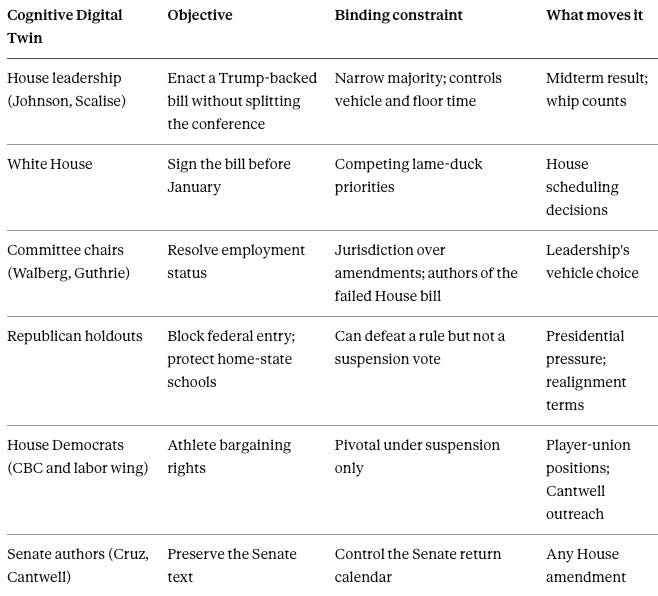
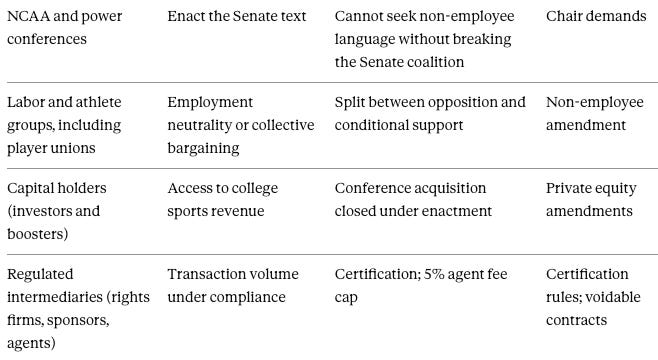
Two actors sit at the center of the table. Leadership chooses the vehicle, and the chairs choose whether to fight for amendments that require a Senate return.
F. The House Has Four Incompatible Answers to the Senate Bill
The House does not have one alternative to the Senate bill. The chamber has several incompatible ones, and each solves one coalition’s objection while worsening another’s.
The clearest signal came from the majority leader. Steve Scalise told The Washington Sun that committee chairs see problems in the Senate bill “that would need to be fixed,” adding: “we’ve got our own process” (The Washington Sun). In June he had told Politico that the House must “prevent employment status of the student athletes” before taking anything up (The Washington Sun).
🏛️ Institutional-control coalition. Walberg and Guthrie said in May that Congress “cannot deliver real stability, consistency, or certainty” while leaving employment status unresolved (AP via WSLS). Walberg and Senator Jon Husted introduced the TEAM USA Act, which caps international athletes at 20% of each varsity roster (Front Office Sports).
🗺️ Realignment coalition. Representatives Neal Dunn and Mario Díaz-Balart led 21 members in an October 2 letter asking leadership to amend the conference provisions before final passage (Rep. Dunn letter). The presidents of Florida State, Miami, Clemson and North Carolina asked for a 22-school cap and no independence period (Tomahawk Nation).
✊ Athlete-power coalition. Minority Leader Hakeem Jeffries said he will follow the position of the CBC and the NAACP on college sports legislation (The Washington Times). Labor groups and athlete organizations seek collective bargaining and narrower institutional immunity.
🤝 Clean-text coalition. The NCAA and most conference leadership back the Senate version, as do the White House and the Senate authors. Representative Michael Baumgartner introduced the House companion and predicted the bill has “a better than 50% chance in the House” (The Washington Times).
The demands point in opposite directions. Representative Lori Trahan has argued that international athletes are denied the NIL rights their teammates hold (House Energy and Commerce Democrats), while Walberg seeks to cap their roster spots.
Several Republican amendments would make Democratic votes harder to assemble. Explicit non-employee language is the clearest case, because it conflicts with the employment neutrality that secured labor support for the Senate compromise. Realignment changes face a separate barrier: a person close to the bill’s authors told reporters that lawmakers “won’t pass language to blow up the ACC” (On3).
CBC opposition cannot be modeled as a sports-policy bargaining problem alone. The NAACP links its opposition to voting rights and argues the bill rewards institutions without requiring them to address attacks on Black voting rights in their states (NAACP). Amendments on pay or rosters may not resolve an objection grounded outside college sports.
Two Democrats offer an observed test of coalition conversion. Representatives Janelle Bynum and Shomari Figures cosponsored the earlier House bill and withdrew support after the NAACP and CBC opposed it in May (Fox Sports). Their positions on the Senate text will show whether Democratic support can survive CBC opposition.
Conferences and their own members have begun to diverge. ACC commissioner Jim Phillips pledged support for all 18 member schools (Yahoo Sports), while four of them asked the House to make leaving the conference easier.
Every amendment that wins one coalition risks losing another, and leadership must choose which coalition to risk.
🏛️ Policymakers: each amendment on the table puts a different voting bloc at risk. 🎓 University leaders: member schools and their conferences no longer speak with one voice on realignment.
III. MindCast Simulation Predictions: Expiry Without a Vote Is the Most Likely Outcome
Six MindCast Foresight Simulation Predictions follow: two Primary Simulation Predictions (P) and four Secondary Simulation Predictions (S). Each carries a band and a window along with a trigger and a falsifier. Prediction date: September 29, 2026.
What Drives the Forecasts
🧭 Mechanism. Coordination under a compressed window. Substantive amendment sharply increases expiry risk because it requires renewed Senate action inside the year-end calendar.
🏛️ Governing condition. The Senate text anchors the game, and leadership’s vehicle choice decides which bloc is pivotal before any vote.
🔁 What would change the game. A Democratic House majority elected November 3; a year-end must-pass package carrying the bill; rapid Senate acceptance of House changes.
⚖️ Behavioral pattern. Supporters generally benefit from preserving the Senate text. Dissatisfied actors pursue amendment, delay or expiry through different House pathways.
🗳️ Vote math. The House can pass the text under suspension only with a large Democratic bloc, or under a rule only with near-unanimous Republicans.
🏈 Most coherent actor. The NCAA and power conferences hold one text and one goal, and they keep the same text preference across every vehicle.
The forecasts assume a Senate text that nobody in the House can change without a return trip, and a leadership that picks the pivotal bloc before the vote.
Four Routes Through the Lame Duck
Expiry without a floor vote (50%). Leadership schedules nothing. The chairs’ amendment demands and holdout resistance make a rule unattractive, and no suspension count reaches two-thirds. Signal: no scheduling announcement by December 10.
Clean vote under suspension or in a year-end package (30%). Leadership brings the Senate text under suspension or attaches it to a must-pass bill. Player-union support and Cantwell’s outreach deliver Democratic votes, and enactment follows if the vote passes. Signal: a suspension listing or package text carrying S. 4668.
Amendment and return (15%). The chairs win a version with employment language or a roster cap. The House passes it and sends it to a Senate that does not take it up. Signal: a Rules Committee print with substantive changes.
Clean rule (5%). Trump names individual holdouts, and a standalone rule passes with fewer than four Republican defections. Signal: presidential pressure on named members.
Expiry without a vote is the single most likely result, and enactment requires the second or fourth route.
Primary Simulation Predictions
The two Primary Simulation Predictions cover the form of House action and the vehicle that carries it.
P-1. Any House floor vote on S. 4668 before January 3, 2027 occurs on the Senate-passed text without substantive amendment, or no floor vote occurs (78-90%).
📅 Window: November 9, 2026 through January 3, 2027
⚡ Trigger: a Rules Committee print or suspension listing
❌ Falsifier: a House floor vote on a version with substantive textual change. Substantive changes include employment language, roster caps and a private equity ban, along with fee-cap or realignment changes. Technical corrections do not count.
🔎 Verified against: House Clerk roll calls and Rules Committee prints
👥 Who gains: the conferences and the NCAA under clean passage; amendment advocates only if the Senate acts again
P-2. If leadership brings S. 4668 to the floor, it uses suspension of the rules or a year-end legislative package rather than a standalone rule (52-68%).
📅 Window: any floor action before January 3, 2027
⚡ Trigger: the first House leadership scheduling announcement for S. 4668
❌ Falsifier: a standalone rule providing for consideration of S. 4668 passes the House
🔎 Verified against: House Clerk roll calls
👥 Who gains: Democrats become pivotal under suspension; Republican holdouts become pivotal under a rule
The House is more likely to leave the text alone than to change it. If leadership schedules floor action, the simulation favors suspension or a year-end package over a standalone rule.
Secondary Simulation Predictions
The four Secondary Simulation Predictions test the coalition mechanism, capital substitution and the final outcome.
S-1. If House text adds language declaring college athletes are not employees, the NFLPA and NBPA publicly oppose that version within 10 days (68-82%).
📅 Before January 3, 2027 · ⚡ Trigger: a non-employee print · ❌ Falsifier: neutral, supportive or no statements from both unions within 10 days
S-2. Walberg or Guthrie publicly conditions support on athlete-employment language by December 17, and neither the NCAA nor any power conference joins that condition (52-68%).
📅 Through December 17, 2026 · ⚡ Trigger: any chair statement after Senate passage · ❌ Falsifier: a chair endorses the Senate text without condition, or the NCAA or a power conference publicly backs employment language
S-3. If S. 4668 expires on January 3, at least one power conference or member university announces a new operating-level capital transaction by June 30, 2027 (62-78%).
📅 January 3 through June 30, 2027 · ⚡ Trigger: expiry · ❌ Falsifier: no such announcement in the window
📝 Qualifying transactions include a credit facility, a revenue-participation agreement or equity in a school commercial entity. A qualifying deal shows capital still flows at the institution level; it does not by itself show that expiry caused it.
S-4. S. 4668 is signed into law on or before January 3, 2027 (24-38%).
📅 Through January 3, 2027 · ⚡ Trigger: House passage of the Senate text · ❌ Falsifier: no enactment by January 3
Forecasts Held Until November 3
Two forecasts depend on the midterm result and stay unpublished until it is known: the vehicle under a Democratic House majority, and the shape of a successor bill in the 120th Congress. An early recall of the House before November 9 is a watch item rather than a forecast, since it would require a shock outside the modeled conditions.
Both held forecasts publish once the November 3 result is known.
Conditions That Would Change the Game
Two developments would replace the governing mechanism rather than shift weight between routes. Rapid Senate acceptance of a substantively amended House text would remove the coordination constraint behind P-1. A court ruling that changes athlete employment status before House action would replace the game entirely.
Absent either development, the four routes above carry the outcome.
📊 Investors: S-3 is the only forecast that tests capital behavior directly. ⚖️ Counsel: P-1 and S-4 together define the two regimes contracts must survive.
IV. Exposure and Decision Triggers by Stakeholder
Each stakeholder’s exposure follows from the vehicle decision. Each also holds a different lever, from votes and contract terms to deal structure and compliance investment. The consequences come first, followed by the trigger that changes each one.
Consequences by Stakeholder
🏛️ Policymakers. A rule makes Republican holdouts pivotal and invites a repeat of the 210-209 fight. Suspension makes Democrats pivotal and depends on player-union and Cantwell support. Delay past November 9 favors the actors who prefer expiry (P-1, P-2).
🎓 University leaders. The Senate text delivers the doubled pay cap, the antitrust protection and the retention fund. Each amendment campaign extends the time the whole package spends exposed to the calendar (P-1). The chairs’ employment demand forces a choice about whether to join it (S-2).
⚖️ Counsel. The bill lets athletes void existing NIL agreements that lack required terms (CBO). Under expiry, a successor bill may carry similar terms.
📊 Investors. Enactment closes conference acquisitions and breakaway leagues while leaving credit lines and school commercial entities open. Expiry keeps the wider set of structures along with the litigation exposure (S-3).
🏈 Athlete representatives. Player-union support rests on employment neutrality, so a non-employee amendment would test whether the NFLPA and NBPA move to opposition (S-1). Groups that want an amended bill are betting the Senate can process it before January 3.
💼 Executives at conferences and rights firms. Certification under the bill comes with a standardized national market in return. Incumbents with compliance capacity stand to gain relative to new entrants.
Exposure, Trigger and Consequence
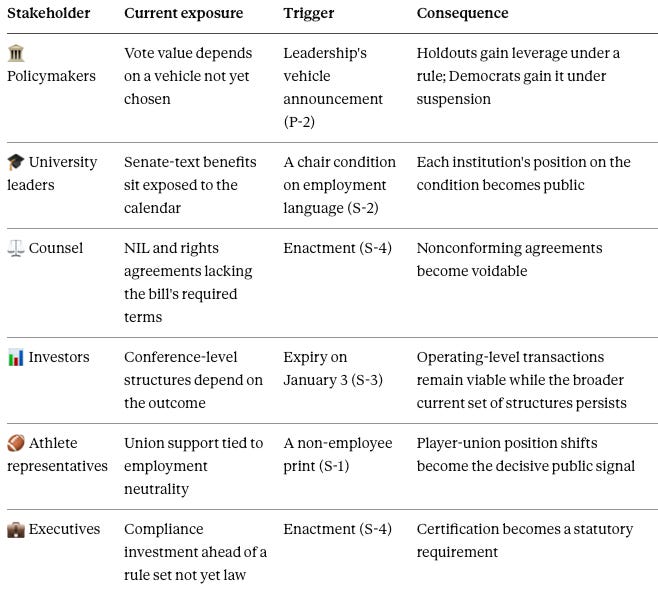
The vehicle announcement and the first Rules Committee print trigger most of the consequences above.
V. Implications: The House Decides Which Institution Governs College Sports in 2027
The House is choosing more than whether a bill passes. The route it takes decides whether the NCAA and conferences, the courts or a future Congress set the rules for college sports next year.
Institutional Impact
Senate passage confines the House to three roles: ratify the Senate framework, reopen it, or let it expire. The most likely route leaves the framework unresolved rather than replacing it with a House design. Under clean passage (S-4), the NCAA and conferences gain a limited antitrust shield for rules on pay, eligibility and transfers.
Under expiry, litigation and the House v. NCAA court agreement remain the central governing constraints.
The revenue-sharing cap stays enforceable only through that agreement, without federal antitrust protection, and state NIL laws keep governing alongside it. A successor bill in the 120th Congress starts again at committee in both chambers, and the 77-vote Senate coalition would have to reassemble under new membership.
Strategic Interaction
Every lever works on one vehicle and fails on another. Presidential pressure can move leadership to schedule the bill and can move named holdouts on a rule, but it does not reach the Democrats who are pivotal under suspension. Explicit non-employee language would activate S-1 and threaten one source of Democratic support under suspension.
The employment demand would likely make Democratic coalition assembly under suspension harder.
Distribution
Clean passage and expiry spread gains differently across conferences, athlete groups, agents and capital providers. Conferences and the NCAA gain under clean passage. Operating-level capital continues under either outcome (S-3), which is why the economic contest does not reduce to support or opposition.
The actors with the most to lose from expiry are the ones least able to force a vote.
Expiry has winners as well. The realignment coalition gets its goal without a vote, since no federal limit on conference size or exit would apply. Athlete organizations keep the employment question open for courts and labor regulators.
🏈 Athlete representatives: expiry returns the governing question to the courts and to the next Congress. 💼 Executives: enactment converts litigation risk into compliance cost.
What to Watch
The dominant fork is clean text against amended text. The dated signals below show which side the House takes.
October 1, 2026 (observed): Majority Leader Scalise said House changes would be needed. The statement raises pressure toward the amendment route, but a decision not to schedule a vote also satisfies P-1.
October 2, 2026 (observed): Twenty-one House members and four ACC presidents asked leadership to change the realignment provisions. Only a House floor vote on substantively amended text falsifies P-1.
November 3, 2026: Midterm elections. The result decides which held forecasts publish.
November 9, 2026: The House returns. Watch the first leadership statement on the bill’s vehicle.
Any date after November 9: A Rules Committee print. A clean print supports P-1; a print with substantive changes activates its falsifier test.
December 10, 2026: No scheduling by this date signals the expiry route.
December 17, 2026: Scheduled end of the lame duck and the S-2 deadline.
January 3, 2027: The 119th Congress ends. P-1, P-2 and S-4 resolve.
June 30, 2027: S-3 resolves if the bill expired.
Statements from Bynum and Figures and any public Democratic whip count will test Democratic availability (P-2). Statements from Walberg and Guthrie map to S-2, and union statements map to S-1.
The vehicle announcement after November 9 is the single signal that moves the most forecasts at once.
Conclusion: The Scheduling Decision Comes First
The Senate passed S. 4668 by 77-22 and sent it to a House that is not in session. The House holds three formal options, and the calendar narrows them toward two. Any amendment requires Senate action the year-end schedule may not hold, so improving the bill and ending it can become the same route.
The simulation places expiry without a vote at even odds and clean-text floor action across roughly one-third of routes. Enactment sits at roughly three in ten. The decisive signal is the first scheduling decision after November 9, because the vehicle decides who is pivotal before anyone votes.
Working With MindCast
Organizations exposed to the House decision face different consequences depending on their contracts, capital structure and regulatory position. The public analysis models ten actors from their public commitments; it cannot model any one organization’s terms.
A commissioned simulation builds the relevant actors from an organization’s own decision history and reruns the House routes against its actual options. Engagements map to the forecasts above. Policy clients test vehicle exposure (P-2) and counsel tests contract exposure (P-1, S-4). Investors and conferences test capital-structure exposure (S-3).
The bounded next step is a diagnostic session before November 9. Contact MindCast AI at mindcast-ai.com.
Appendix: Sources
Primary sources
U.S. Senate Committee on Commerce, Science, and Transportation, Protect College Sports Act. Bill text history and the committee’s account of the August revisions.
Congressional Budget Office, S. 4668, Protect College Sports Act of 2026. Cost estimate and mandate analysis, including the consolidation ban and voidable NIL agreements.
Rep. Neal Dunn et al., letter to Speaker Johnson, Majority Leader Scalise and Majority Whip Emmer, October 2, 2026. The realignment coalition’s amendment request.
NAACP, “NAACP Opposes the so-called Protect College Sports Act”, August 2026. The voting-rights basis of CBC-aligned opposition.
Rep. Lori Trahan, statement to the House Energy and Commerce Committee, June 12, 2025. The Democratic position on international athletes’ NIL rights.
Press
ESPN, “U.S. Senate votes 77-22 to pass Protect College Sports Act”, September 28, 2026. Final vote and amendment outcomes.
CBS Sports, “Protect College Sports Act passes Senate”, September 28, 2026. Bill contents, the House bill’s history and the conference-cap amendment.
CBS News, “Senate approves sweeping bill to regulate college sports”, September 28, 2026. Vote breakdown by party.
Fox Sports, “Senate Overwhelmingly Passes College Sports Bill”, September 2026. Opposition of the four Black Democratic senators.
Fox Sports, “Now that it has passed the Senate, what comes next?”, September 2026. Bynum and Figures withdrawing SCORE Act support.
Yahoo Sports, “Protect College Sports Act passed the Senate. Here’s how it voted.”, September 2026. House calendar and Republican critics.
AP via WSLS, “Senate nears vote on college sports bill”, September 28, 2026. The Walberg-Guthrie statement on employment status.
Front Office Sports, “How House Republicans Could Make or Break College Sports Bill”, September 2026. House Republican concerns and the TEAM USA Act.
The Washington Times, “House not likely to take up Senate-approved rules for college sports compensation before election”, September 29, 2026. Baumgartner and Jeffries positions.
The Washington Sun, “Ted Cruz’s Bid to Pass His College Sports Bill Soon Is Falling Short”, October 2026. Scalise’s statement on House changes.
Tomahawk Nation, “FSU, Miami, Clemson, UNC ask Congress to change realignment rules”, October 2026. The four presidents’ letter.
On3, “Presidents from Clemson, Florida State, Miami, UNC request House make changes to PCSA”, October 2026. The authors’ position on ACC-breaking language.
Yahoo Sports, “Report: Presidents from Clemson, Florida State, Miami, UNC request House make changes”, October 2026. ACC commissioner’s statement.