

🏈 MindCast AI NFL Vision: Seahawks vs. Colts — Week 15 (2025)
NFL AI Foresight Simulation | Team Cognitive Digital Twins + Behavioral Economics + Game Theory

MindCast AI builds Cognitive Digital Twins (CDTs) of teams, players, and coaches to simulate how communication, trust, and adaptation hold under stress. Simulations convert human and systemic behavior into dynamic probability bands, continuously updating as structure, clarity, and fatigue evolve in real time.
Where traditional analytics measure what happened, the MCAI foresight system measures when structure breaks—quantifying lag in protection language, timing drift between receivers and quarterbacks, and coherence decay during long drives. The output isn’t a static prediction; it’s a living probability field that moves with communication efficiency and resilience under pressure. See MCAI Football Vision: Betting AI vs. Foresight AI: MindCast AI Comparative Analysis With NFL Models (Sep 2025).
I. System State Entering Week 15
Every NFL game begins before kickoff — in the structural condition of each team’s decision-making architecture. Week 15 presents a stark asymmetry: one team operating near peak coherence, the other experiencing cascading system failures. This section maps where each franchise stands as a functional unit before contact.
Seattle Seahawks enter Week 15 as a high-coherence adaptive system. Prior foresight simulations against the Steelers, Jaguars, Texans, and Rams establish a stable baseline: Seattle wins when communication integrity holds and loses only when opponent rigidity compresses timing before adjustments take effect. The Seahawks have not allowed a touchdown in eight consecutive quarters. Their defensive identity has crystallized into sustained pressure accumulation rather than early-game dominance.
Indianapolis Colts enter Week 15 as a constraint-driven system under acute stress. Daniel Jones’ torn Achilles — suffered while already playing through a fractured fibula — has collapsed the quarterback room. Riley Leonard nurses a PCL sprain. Anthony Richardson remains on injured reserve with an orbital fracture. The emergency solution: 44-year-old Philip Rivers, who hasn’t taken an NFL snap in nearly five years. Recent performance profiles indicate early-script dependence and weak recovery once disruption occurs.
The Colts began 7–1. They arrive at Lumen Field at 8–5, having lost four of their last five. Seattle arrives at 10–3, winners of three straight.
Insight: System state is not roster talent — it is operational readiness under stress. Indianapolis possesses talent; it no longer possesses structure.
II. Prior Foresight Simulation Validation
MindCast AI’s foresight methodology has been tested against live NFL outcomes throughout the 2025 season. The following table documents prediction accuracy against opponents relevant to this Week 15 simulation — teams that both Seattle and Indianapolis have faced. Shared-opponent analysis provides causal signal integrity for comparative system-state assessment.
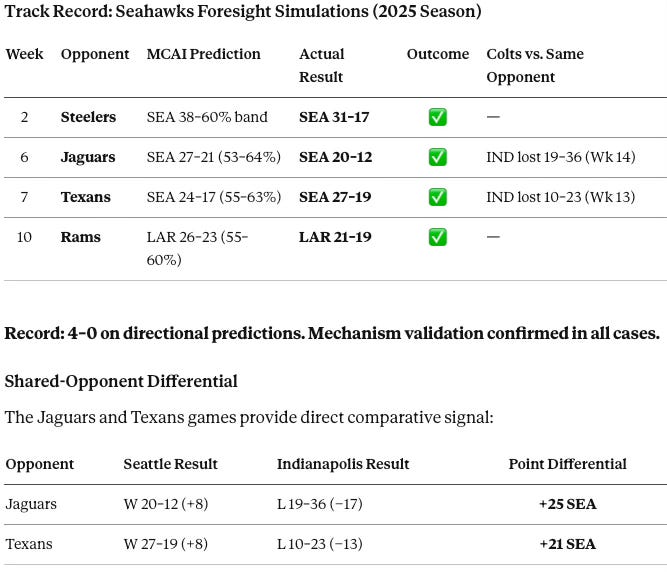
Against shared opponents, Seattle outperformed Indianapolis by an average of +23 points per game. This differential validates the system-state characterization: Seattle’s adaptive architecture produces consistent results; Indianapolis’ constraint-driven architecture produces inconsistent results that have worsened as structural stress has accumulated.
Mechanism Validation Notes
Each prior simulation identified specific operational triggers. Post-game analysis confirmed mechanism accuracy:
Week 2 (Steelers): Simulation flagged C–RG corridor protection as decisive. Result: OL coherence held; Seattle dominated.
Week 6 (Jaguars): Simulation projected defensive pressure would collapse Jacksonville’s timing. Result: Seattle recorded 7 sacks.
Week 7 (Texans): Simulation predicted Houston’s “firewall” defense would crack against Seattle’s multi-layered trust loops. Result: Protection clarity held at 93%; Seattle sustained rhythm throughout.
Week 10 (Rams): Simulation predicted Seattle would lose if turnovers elevated. Result: Darnold threw 4 interceptions; Rams won by 2.
The Week 10 loss prediction is particularly significant — it demonstrates the model operates on structural logic rather than team bias.
Insight: Foresight simulation is not prediction theater. It is falsifiable, timestamped methodology. The track record earns the confidence to project decisively in Week 15.
Contact mcai@mindcast-ai.com to partner with us on sports foresight simulations.
III. Matchup Architecture
Football matchups are often framed as position battles — receiver versus cornerback, pass rusher versus tackle. Foresight simulation operates at a different level: system architecture versus system architecture. This section defines how each team’s operational design creates advantages and vulnerabilities.
Seattle Seahawks Architecture
Adaptive offense with layered contingency routing
Defensive identity built on pressure accumulation, not early dominance
High Action–Language Integrity (ALI) and Cognitive–Motor Fidelity (CMF) relative to league baseline
Protection language consistency above 90% in recent wins
Indianapolis Colts Architecture
Script-dependent offense with narrow tolerance for disruption
Protection language degrades rapidly under simulated pressure
Elevated Behavioral Drift Factor (BDF) once behind schedule
Quarterback room in triage mode with uncertain starter designation
The architectural mismatch favors the system that adapts faster rather than the system that executes perfectly. Seattle’s network bends without breaking. Indianapolis’ structure requires precise execution from a unit that cannot currently provide it.
Insight: When adaptive systems face rigid systems under stress, rigidity fractures first. The question is not whether Indianapolis breaks — it is when.
IV. Drive-by-Drive Foresight Simulation
Static predictions assign a number and walk away. Foresight simulation maps how probability evolves across game phases as each system’s architecture encounters resistance. This section projects the structural narrative quarter by quarter.
First Quarter
Colts open with scripted efficiency: short passes, controlled tempo, designed to minimize cognitive load on whichever quarterback takes the field. Seattle’s defense probes tendencies without urgency, gathering signal rather than forcing early disruption. Relational Integrity Score (RIS) for Seattle receivers stabilizes above threshold by the second drive as Darnold and his targets synchronize timing.
Projected state: Colts competitive early; Seattle gathering signal.
Second Quarter (Inflection Window)
Seattle introduces simulated pressure packages and post-snap disguise. Colts’ protection calls show first degradation in Action–Language Integrity (ALI) as communication lags compound under crowd noise. One stalled drive or turnover likely as Cognitive Load Coefficient (CLC) rises for Indianapolis. Seattle converts field position into points through intermediate passing, exploiting the windows that open when protection language fractures.
Projected state: Seattle establishes control before halftime.
Third Quarter
Colts are forced off-script; Behavioral Drift Factor (BDF) increases as play-calling deviates from preparation. Seattle’s defense tightens red-zone responses under Coherence–Generative–Recursive (CGR) dynamics — reading formations faster, disguising later, executing with accumulated confidence. Seattle’s offense maintains rhythm rather than accelerating tempo, avoiding the errors that accompany aggression.
Projected state: Margin widens through efficiency, not explosiveness.
Fourth Quarter
Colts increase risk tolerance out of necessity; interception or short-field scenario becomes likely. Seattle remains aggressive but disciplined, avoiding clock-only conservatism that invites collapse. No systemic breakdown detected for Seattle unless multiple early offensive line communication failures occur — a low-probability scenario given recent performance.
Projected state: Seattle closes without drama.
Insight: The simulation projects control, not dominance. Seattle wins by absorbing early noise, identifying structural weaknesses, and applying sustained pressure until Indianapolis’ execution-dependent architecture degrades beyond recovery.
V. Vision Function Metric Snapshots
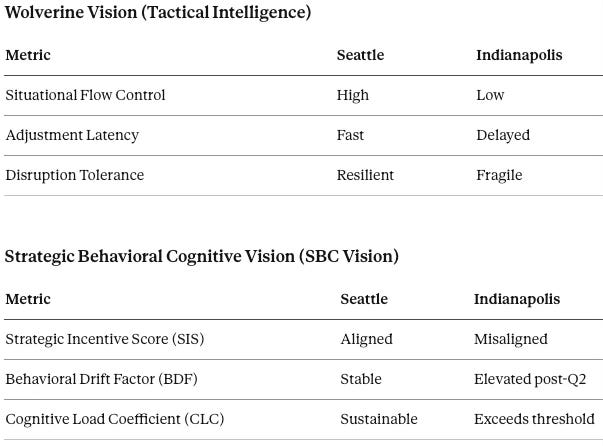
MindCast AI’s Cognitive Digital Twin system operates through five integrated vision functions, each capturing a distinct dimension of team behavior under stress. This section provides metric snapshots that quantify the architectural asymmetry identified above. For technical readers, these metrics represent the operational layer beneath traditional statistics.
Causation Vision
Causal Signal Integrity (CSI) confirms quarterback instability and shared-opponent performance gaps as primary causal drivers of Indianapolis’ decline
Seattle’s causal structure shows no degradation vectors
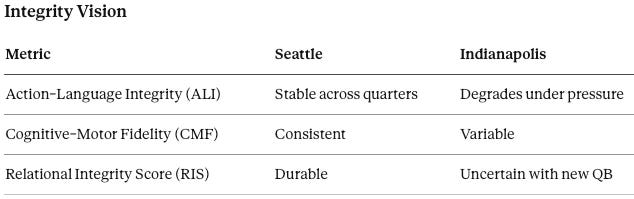
The metrics converge on a single conclusion: Seattle’s system maintains structural integrity under conditions that would degrade Indianapolis’ system. This is not a talent gap — it is an operational coherence gap.
Insight: Traditional statistics measure what happened. Vision Function metrics measure why it will happen again — or why it won’t.
VI. Outcome Bands
Foresight simulation does not produce a single number. It produces probability bands that reflect the range of outcomes consistent with each team’s structural condition. This section translates architectural analysis into quantified expectations.
Win Probability
Seattle: 78–83% if early offensive line coherence holds
Indianapolis: Competitive only through first-quarter scripts; probability collapses once forced to adapt
Projected Score Band
Seattle: 27–34 points
Indianapolis: 13–20 points
Conditional Triggers
If Seattle allows fewer than 3 sacks: win probability rises to 85%+
If Indianapolis commits 2+ turnovers: Seattle win probability exceeds 88%
If Philip Rivers starts and completes fewer than 55% of passes: Indianapolis ceiling drops to 17 points
The bands reflect structural reality: Seattle’s floor is higher than Indianapolis’ ceiling under current conditions.
Insight: Indianapolis can win this game. But doing so requires Seattle to malfunction — not Indianapolis to excel. That is not a path to victory; it is a prayer for variance.
VII. Foresight Simulation Conclusion
MindCast AI’s week 15 predictive simulation projects how two systems interact over sixty minutes of football. One system has spent the season building coherence, trust loops, and adaptive capacity. The other has spent the past month watching its operational foundation collapse. The outcome follows from the architecture.
Seattle’s adaptive system absorbs early noise, identifies structural weaknesses, and applies sustained pressure until Indianapolis’ execution-dependent architecture degrades. The Colts possess the talent to compete in the first quarter. They lack the structural integrity to compete in the fourth.
Foresight Outcome: Seattle wins by coherence, not spectacle.
Final Projection: Seattle 28 – Indianapolis 16
Previous MCAI NFL and NCAA Vision Publications:
MCAI NFL Vision: Seahawks vs. Rams, Week 16 2025
MCAI NFL Vision: Seahawks vs. Texans, Week 7 2025
MCAI NFL Vision: Seahawks vs. Jaguars, Week 6 2025
MCAI NFL Vision: Seahawks vs. Buccaneers, Week 5 2025
MCAI NFL Vision: Seahawks vs. Cardinals, Week 4 2025
MCAI NFL Vision: Seahawks vs. Saints, Week 3 2025
MCAI NCAA Vision: 2025 Apple Cup, Washington v. Washington State
MCAI NFL Vision: Seahawks vs. Steelers, Week 2 2025
MCAI NFL Vision: Seahawks vs. 49ers, Week 1 2025
MCAI NFL Vision: Breaking the Cycle- A Simulation of the Seahawks Offensive Line (2024–2025), Commentary on Seattle Times Seahawks Analysis (Apr 2025)
MCAI NFL Vision: Too Much, Too Fast, Simulating Cognitive Breakdown in the Seahawks’ 2024 Defensive System (Apr 2025)
MCAI Sports Vision: Seahawks #80 Steve Largent, Quiet Excellence in Motion, A Simulation-Foresight Study in Multi Tier Intelligence and Civic Legacy (May 2025)