Game theory is easier to understand on a diagram than in a description. A written explanation asks readers to keep a tree of rival moves in their heads, and most lose track after the first branch. MindCast built two three-minute tests that draw the tree for the reader instead. Readers answer questions about their own decision, and a live war gaming board fills in with each answer.
I. What Each Test Checks
A MindCast simulation needs two things before it can forecast. First, the matter needs dated decisions, actors whose moves affect one another and outcomes that a public source will confirm. Second, MindCast needs enough of a record to model how the key people make decisions. The two tests check for these two requirements.
Whether Predictive Game Theory Simulation is Suitable For Your Innovation Economics Matter, Decided by a Three Minute Ripeness Test checks the first requirement. Ten rounds on one coffee shop pricing decision test whether the matter has a deadline, a sequence of moves, outcomes that can be confirmed and governing rules. The verdict places the matter in one of three tiers: drawable, worth simulating or playable. Each tier maps to a MindCast product.
Whether Predictive Game Theory Simulation is Suitable For Your Succession or Legacy Matter, Decided by a Three Minute Legacy Innovation Test checks the second requirement. Nine rounds on one founder-led enterprise ask which of the founder’s habits already run without the founder, whether a dated decision is coming and who else has a say. A Cognitive Digital Twin (CDT) records the founder’s judgment so the enterprise keeps it after the founder steps back. Founder covers the person who started the enterprise and any long-tenured leader whose judgment the enterprise depends on, such as a second-generation family head.
Takeaway. The Ripeness Test decides whether a business decision can be simulated, and the Legacy Innovation Test decides whether a founder’s judgment can be modeled.
II. How the Two Tests Work Together
Both tests build the same board. Four boxes beneath it track time, sequence, probability and rules. The questions in one test have direct counterparts in the other.
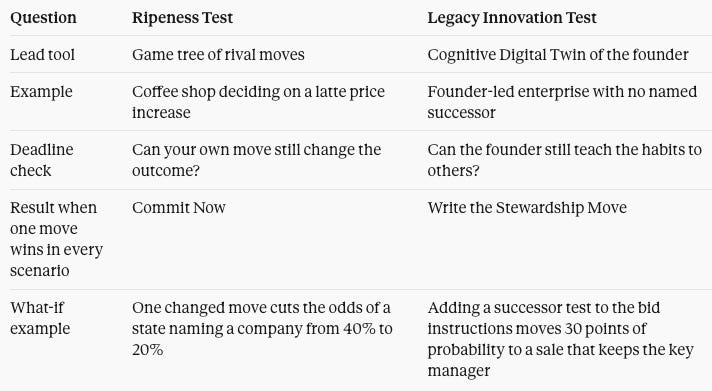
A dated decision connects the two tests. The legacy enterprise starts with no deadline, so it gets a written model of the founder’s judgment and no odds. The family then opens a sale with a final bid date six months away. Bidders, a lender and a public closing date turn the succession question into a game with odds, and the matter moves to the Ripeness Test’s methods.
Takeaway. Families use the Legacy Innovation Test before any deadline exists, and the Ripeness Test applies once a sale, vote or filing sets a date.
III. Why the Series Relies on Visuals
Each answer adds a piece to the board. Round 1 draws the main line of the decision, later rounds add the other parties, and a branch appears when a dated event is entered. Changing a single answer changes the verdict, so readers see directly which features make a matter suitable for simulation. Three minutes with the board teaches more than a written explanation of game theory.
🏛 Policymakers. Estate deadlines, change-of-control rules and agency calendars decide when a matter can be forecast.
💼 Executives and families. When one move wins in every scenario, the right step is to commit to it rather than run a simulation.
⚖ Counsel. Both tests check whether a client’s conduct or a founder’s teaching can still change the outcome. The answer sets how deep the advice should go.
📊 Investors. The sale board shows a 60% chance that the key manager leaves after a sale with no retention terms. The purchase price does not reflect that risk.
IV. Forward Lock
Both tests make falsifiable claims about their own questions for formal MindCast runs completed by December 31, 2027. The pairing adds one claim of its own. A matter the Legacy Innovation Test marks Two Products should reach Worth Simulating or Playable on the Ripeness Test once its dated decision arrives. One such matter whose parties turn out not to affect one another’s moves would disprove the claim.
Working With MindCast
MindCast AI applies Predictive Behavioral Economics + Dynamic Game Theory through MindCast AI Proprietary Cognitive Digital Twin Foresight Simulations (MP CDT FS). Behavioral Economics supplies the decision rules. Game Theory supplies the payoff structure. Predictive simulations emerge from the combination.
Take the Ripeness Test ▶ · Take the Legacy Innovation Test ▶ · mcai@mindcast-ai.com · www.mindcast-ai-simulation.com