Series introduction Two Three-Minute Tests Decide Whether Dynamic Predictive Game Theory Simulation Fits Your Matter, The Ripeness Test Checks Whether a Business Decision Can Be Simulated, the Legacy Innovation Test Checks Whether a Founder’s Judgment Can Be Modeled, and a Dated Decision Connects Them
Companion to Whether Predictive Game Theory Simulation is Suitable For Your Innovation Economics Matter, Decided by a Three Minute Ripeness Test, Ten Rounds on One Coffee Shop Decision Show How MindCast Maps Successor States, Bands Every Branch and Tests the Counterfactual
Executive Summary
A succession plan can protect only what a family can name. Before any Cognitive Digital Twin (CDT) runs, a family needs three answers: which of the founder’s habits run without the founder, whether a dated decision is coming and who else holds a seat. In this paper, founder means the person who started the enterprise or any long-tenured leader whose judgment the enterprise depends on.
A founder’s most valuable asset is the judgment that built the enterprise, and that judgment does not transfer with title. A Cognitive Digital Twin captures it. Predictive game theory forecasts what happens when a sale, a vote or a deadline puts parties who answer one another at the table.
The Legacy Innovation Test checks in nine short rounds whether a matter needs a Cognitive Digital Twin, a simulation or both. A live board fills in as the reader answers, and each of five results maps to a MindCast product. MindCast models how an institution decides from its documented decisions under pressure, and it separates the habits that run without the founder from the ones that left with the founder.
One illustrative enterprise answers every round below and lands on a Legacy Read, with no date and no odds. A sale process then gives the same enterprise a date, bidders and a public closing, and the board runs as a simulation with illustrative odds. Writing the successor test into the bid instructions moves those odds, and the difference measures the term.
🏛 Policymakers. Round 2 shows that estate deadlines and change-of-control rules decide when a family matter becomes forecastable.
💼 Executives and families. Round 6 shows that a move that wins whatever happens needs writing down, not forecasting.
⚖ Counsel. Round 4 checks the transmission clock, meaning the time left to capture a founder’s judgment while the founder can still teach it.
📊 Investors. The sale board shows a successor test in the bid instructions moving 30 points from a no-covenant close to a covenant close, the branch where the key manager stays.
I. The Test Comes Before the Plan
Every MindCast engagement starts with a structural question. The question applies to family enterprises, family offices and cultural institutions alike. The test asks whether the matter turns on the founder's judgment, on a dated decision or on both. A second-generation family head or a long-serving chief executive with no written succession plan counts as the founder for the test.
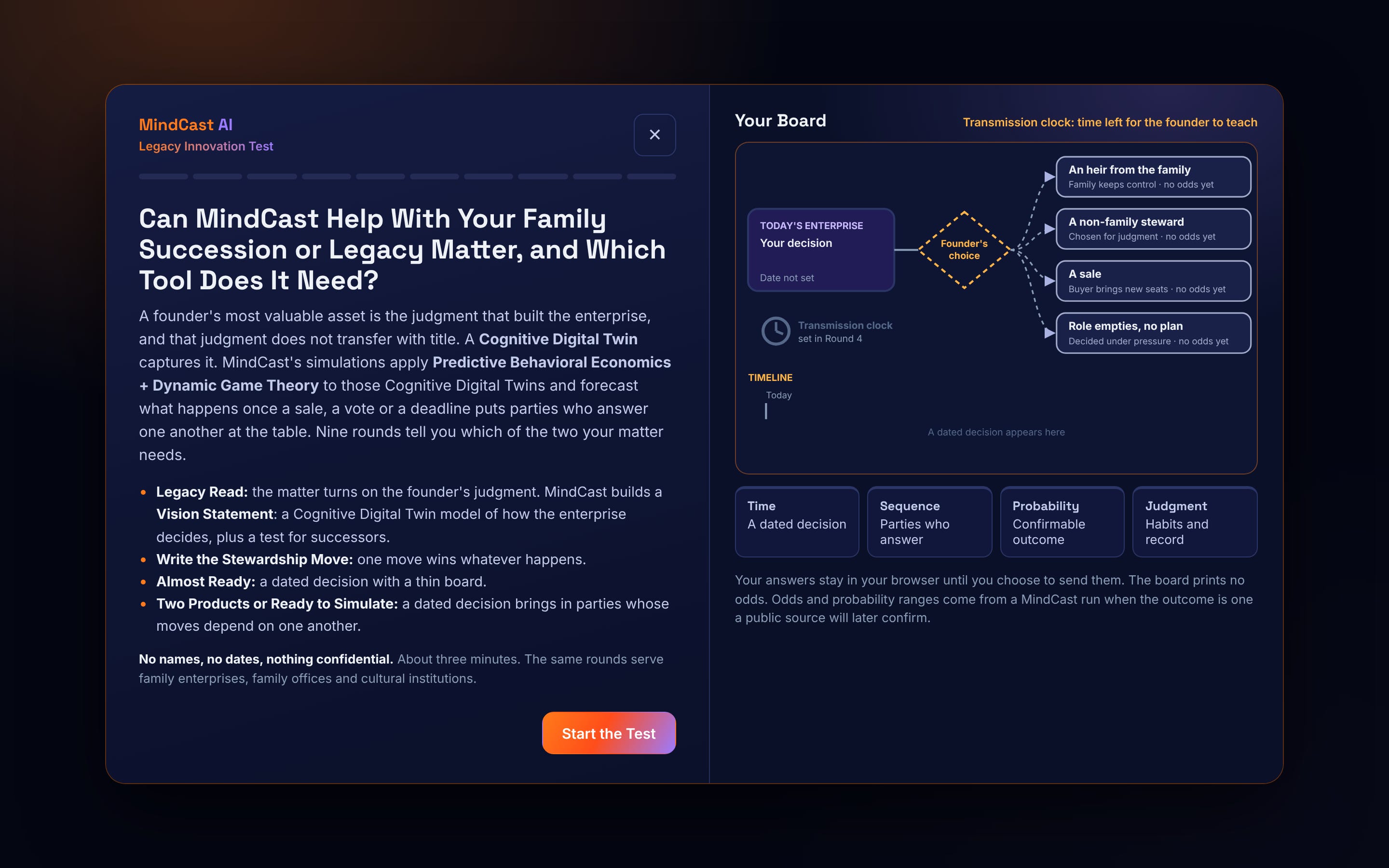
Two tools answer the two halves. A Cognitive Digital Twin models how an institution decides, and it helps before anything is scheduled. Predictive game theory enters once a dated decision brings in parties whose best moves depend on one another.
The board starts empty. Four boxes beneath it track time, sequence, probability and rules. Each answer adds a piece.
The walkthrough uses an illustrative founder-led enterprise with no named successor. Section XIV later opens a sale for the same enterprise and runs its board with odds. An heir runs operations, and a long-serving non-family manager runs the floor.
Takeaway. Suitability is a property of the matter, not of the family's size or wealth.
II. Round 1 Asks What You Are Deciding
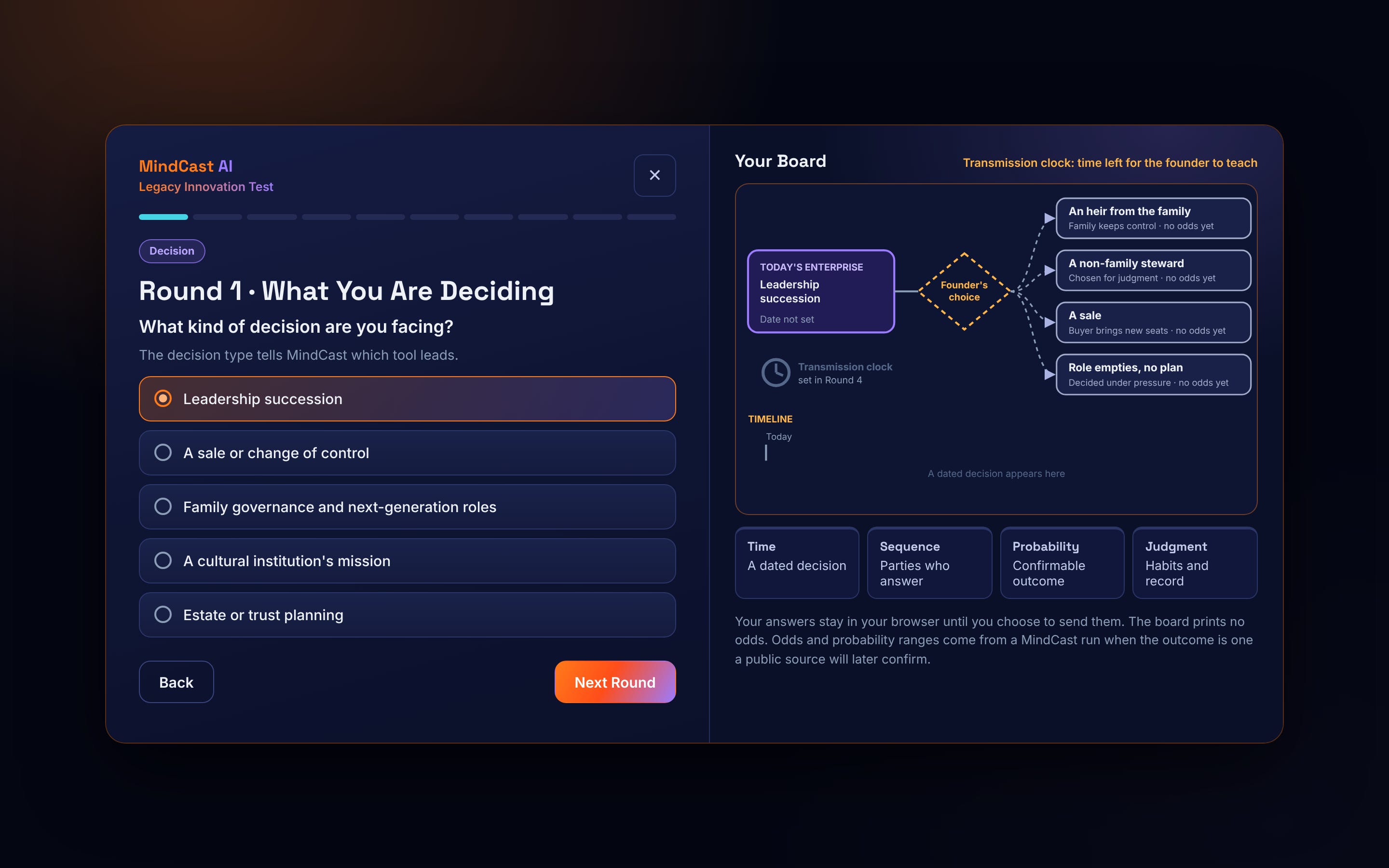
The decision type tells MindCast which tool leads. Succession, a sale and estate planning run on different clocks and seat different parties, so the type decides whether the Cognitive Digital Twin or the game tree comes first. Readers choose among five types, from leadership succession and a sale to family governance, an institution's mission and estate planning. The example picks leadership succession, and the board draws its trunk.
Takeaway. The decision type tells MindCast where to look first.
III. Round 2 Asks Whether a Date Is Coming
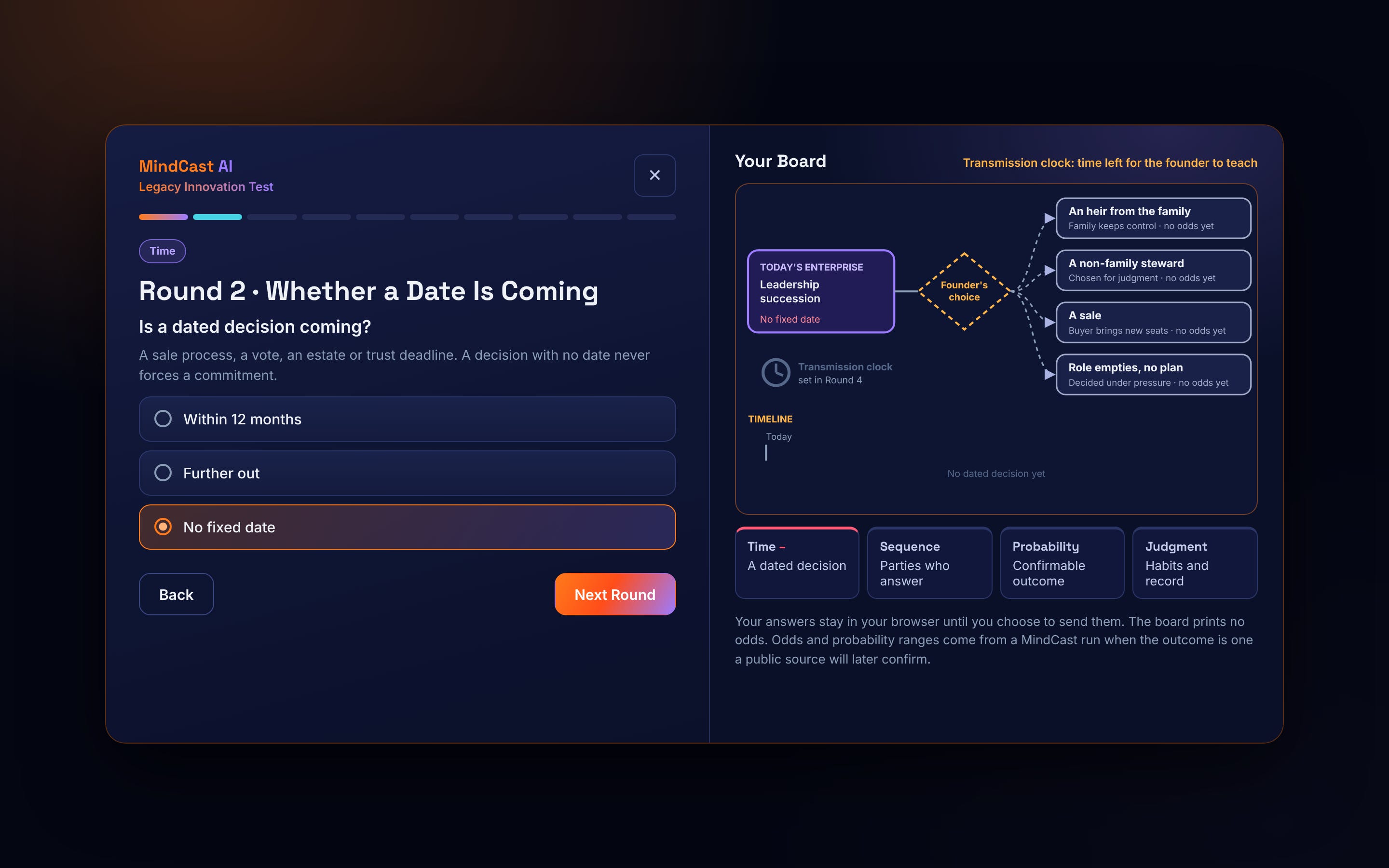
A forecast needs a deadline, and a decision with no date never forces a commitment. A date also tells every other party when to act, which turns a family question into a game. The example has no fixed date. The timeline appears without a red commit marker.
Takeaway. Without a date, the matter stays with the founder's judgment.
IV. Round 3 Asks Who Else Holds a Seat
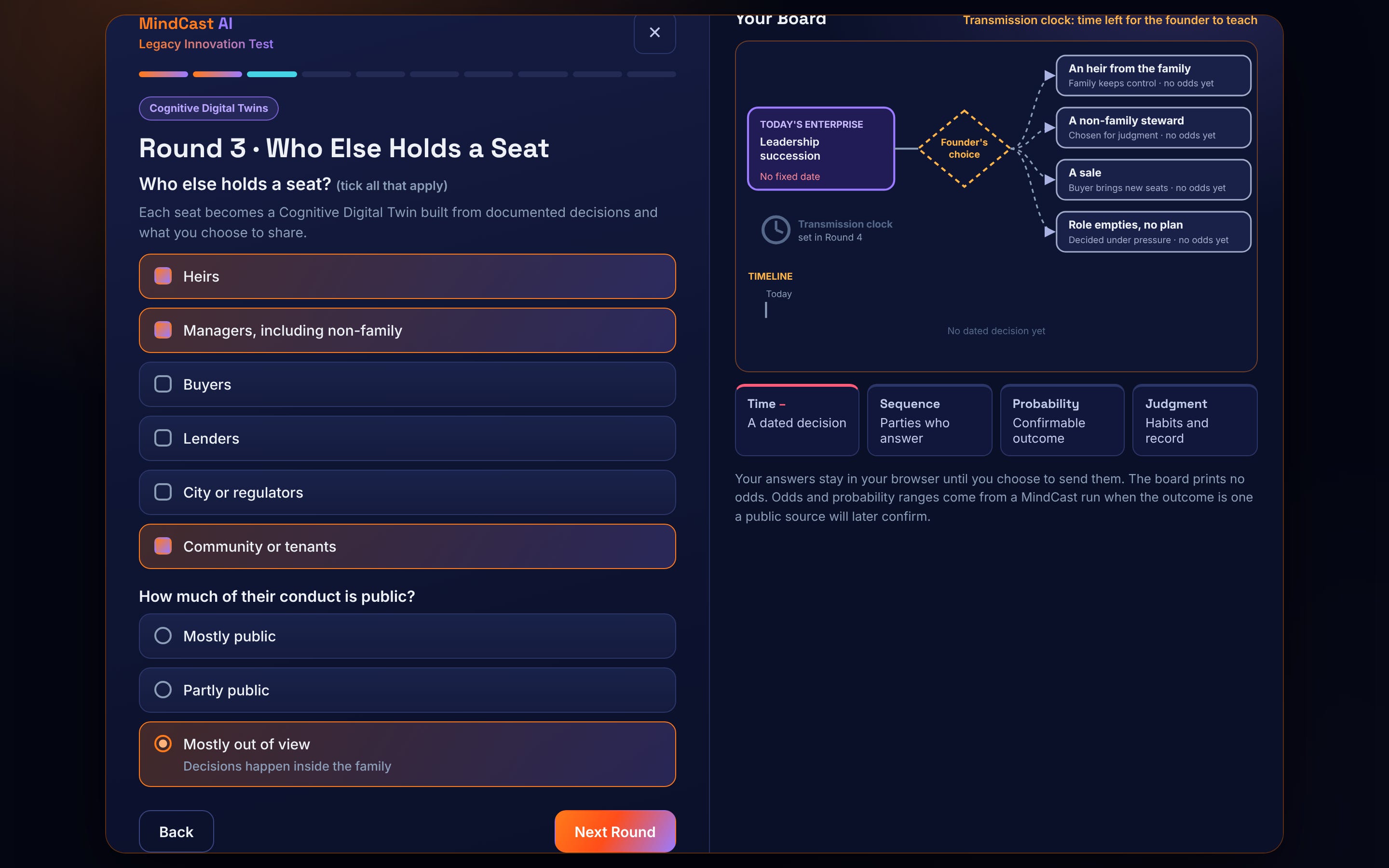
Every seat becomes a Cognitive Digital Twin built from conduct, and conduct out of view models poorly. A seat matters because each party's move changes what the others can safely do. The example's seats are heirs, the manager and the community. The family decides in private, so the example answers "mostly out of view." The board shows those seats in grey.
Takeaway. Family seats are real seats, even when their conduct stays private.
V. Round 4 Asks Whether the Founder's Habits Run Without the Founder
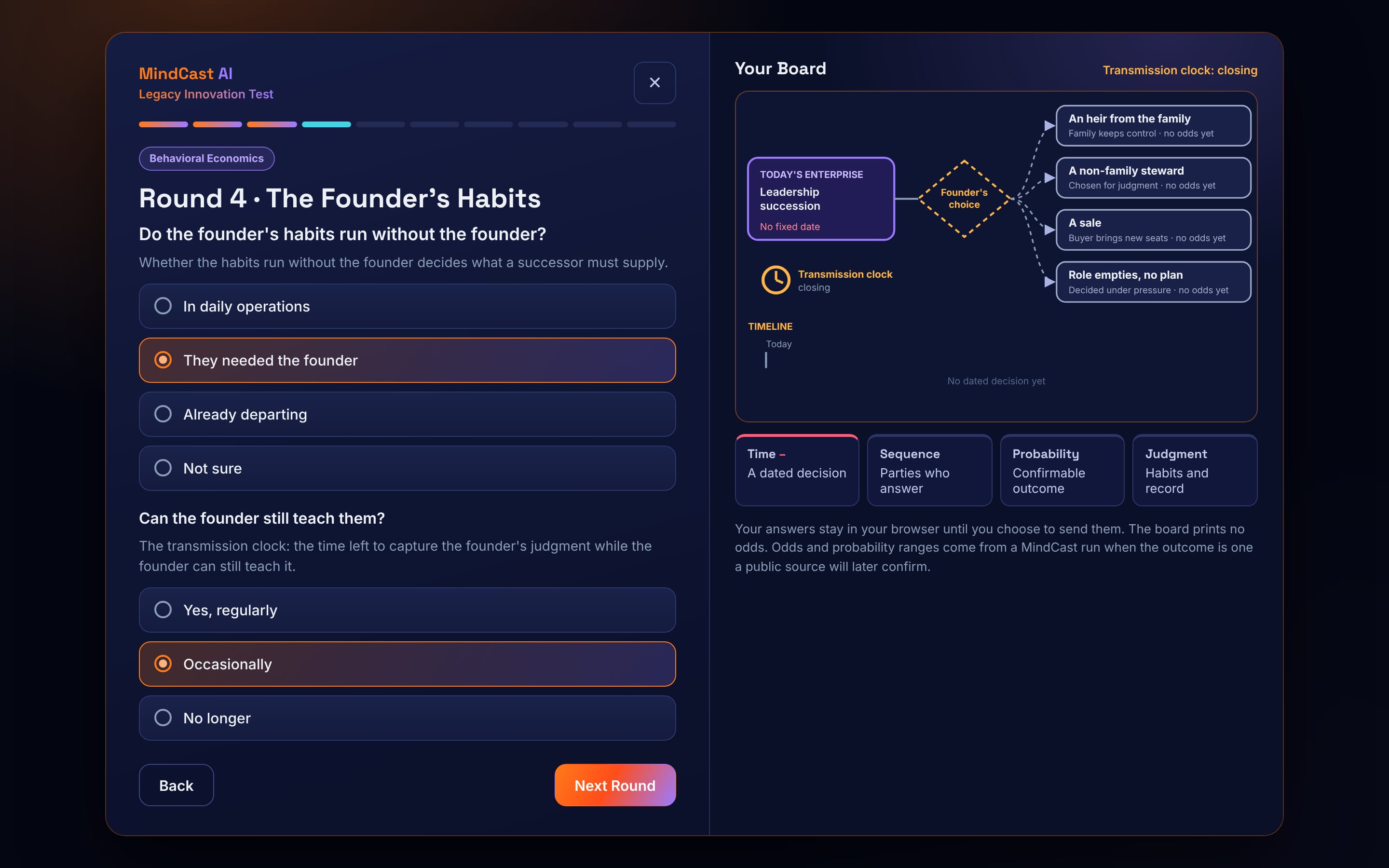
Whether the habits run without the founder decides what a successor must supply: a habit runs in daily operations, needed the founder or has started departing. A follow-up asks whether the founder can still teach the habits, which sets the transmission clock. Identity explains why families hold some habits for decades, as George Akerlof and Rachel Kranton show in Identity Economics.
The example's habits split between routine and the founder, and the founder now teaches only occasionally. The board marks each habit and turns the clock amber.
Takeaway. Where the habits sit shows what will outlast the founder, and the clock shows how long the family has to capture the rest.
VI. Round 5 Asks Whether a Record of Past Decisions Exists
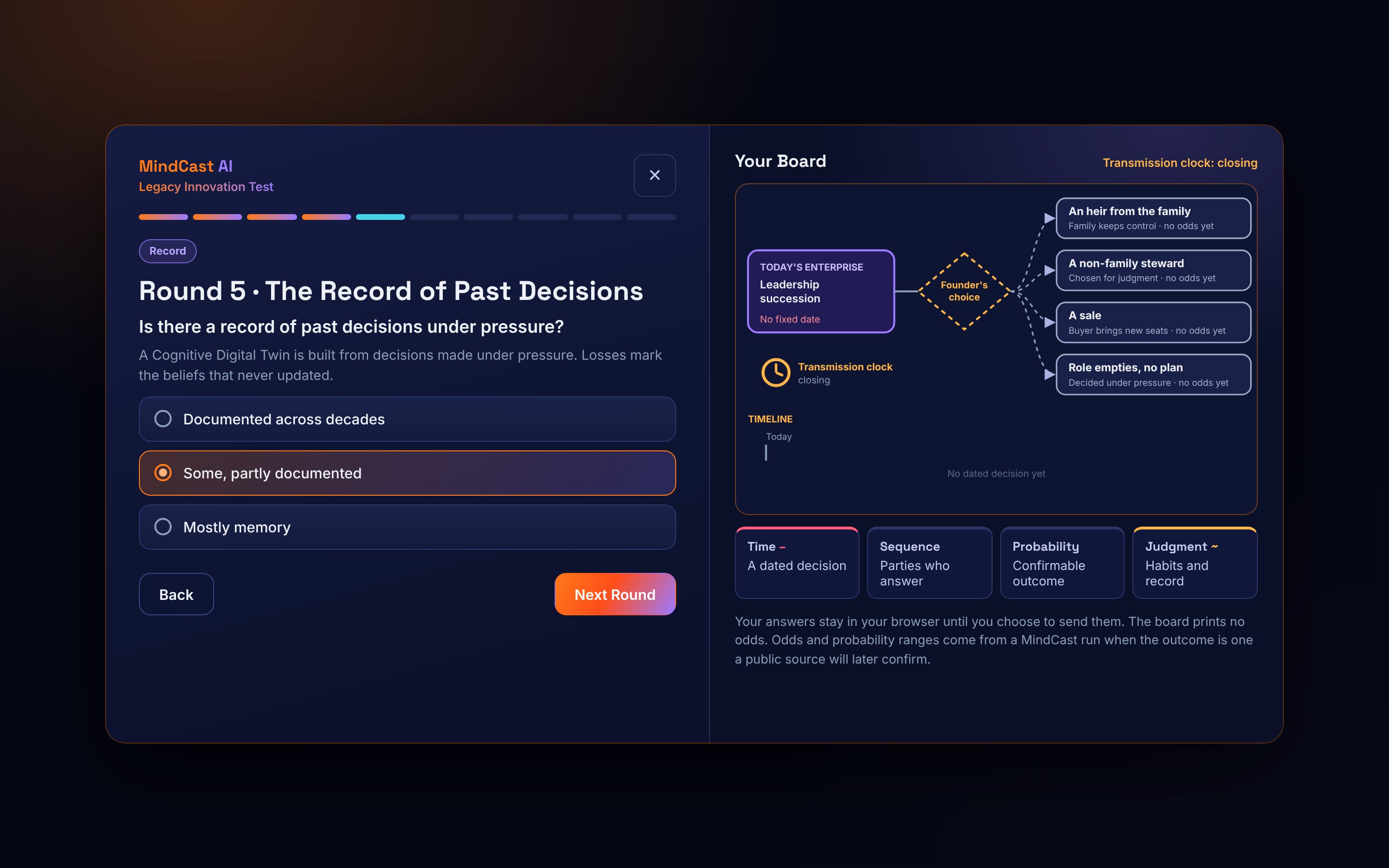
A Cognitive Digital Twin is built from decisions made under pressure, and losses mark the beliefs that never updated. Gary Becker and Nigel Tomes show how families pass advantage across generations, and the record is where that transmission shows. The example's record is partly documented, so the board draws a stress-test strip with gaps.
Takeaway. The thinner the record, the more the model rests on the people who worked beside the founder.
VII. Round 6 Asks Whether One Move Wins Whatever Happens
A move that wins on every path needs commitment, not simulation. A simulation earns its keep only when the right move differs by path; when it does not, the family should act now and skip the forecast. A yes earns Write the Stewardship Move, the legacy counterpart of the Ripeness Test's Commit Now, with or without a date. The example answers "not sure."
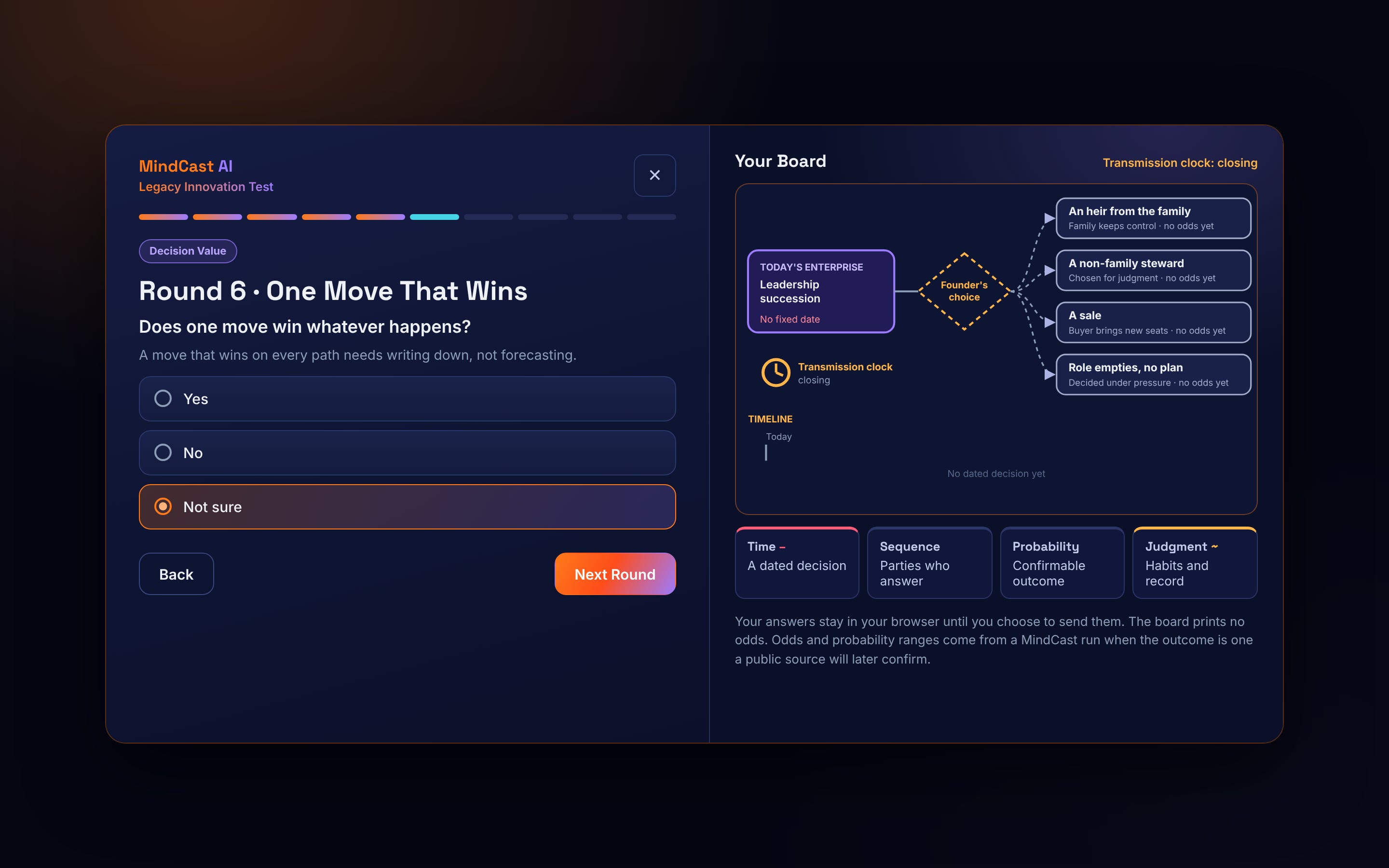
Takeaway. A move that wins everywhere needs writing down, not forecasting.
VIII. Round 7 Asks Whether Outsiders' Moves Change Your Best Move
Game theory applies only when best moves depend on one another. Albert Hirschman's exit and voice fits the family case: heirs who stay, sell a stake or contest decide who plays the next game. The example has no outside seat yet, so it answers no.
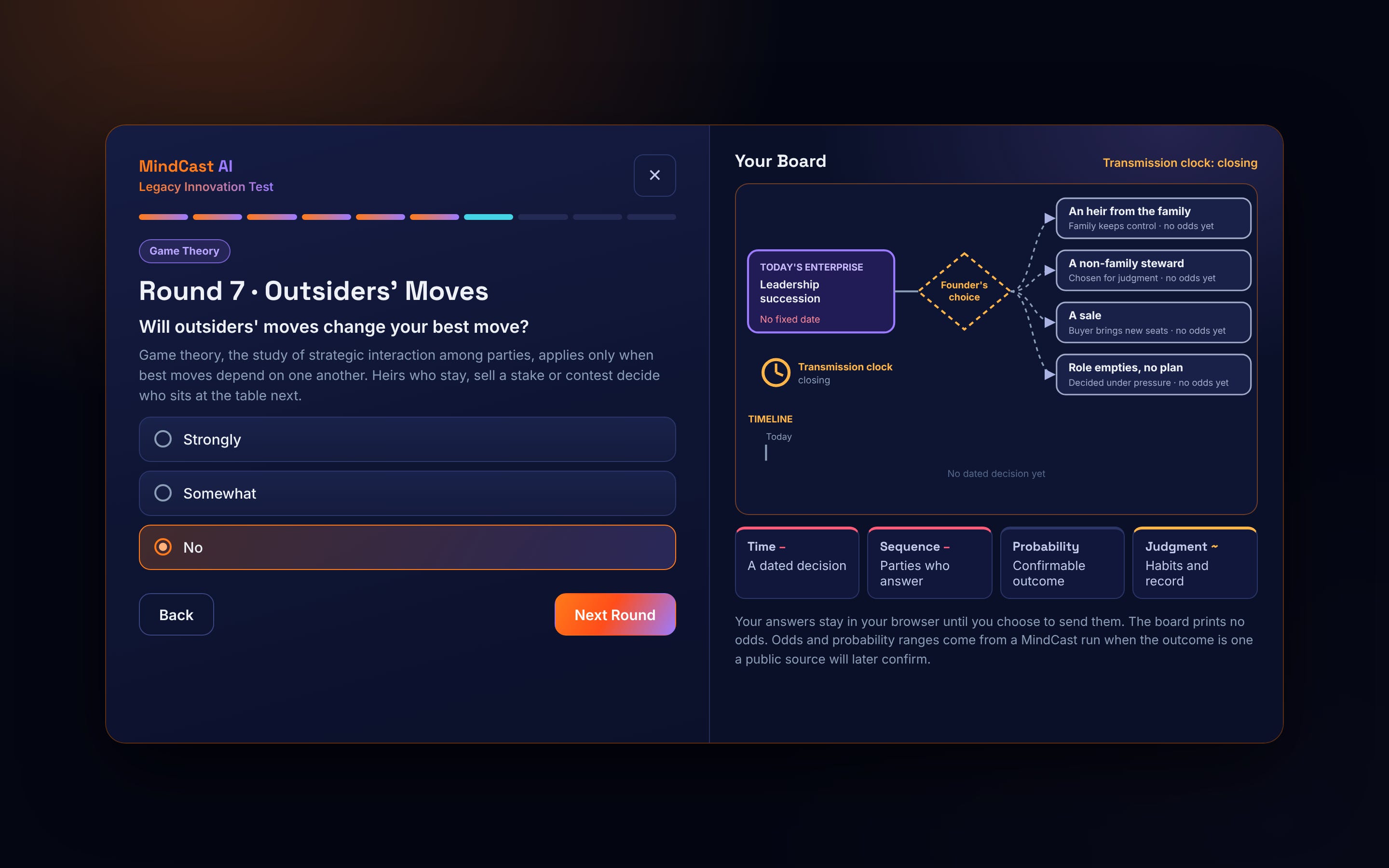
Takeaway. Parties who answer one another make a game, and a family deciding alone makes a plan.
IX. Round 8 Asks How You Will Know It Worked
A probability needs a referee, meaning a public source that confirms the outcome on a known date. Without a referee, no one can tell a good forecast from a lucky one. A filing, a vote or a closing qualifies. The example's outcome will show only in culture and stewardship.
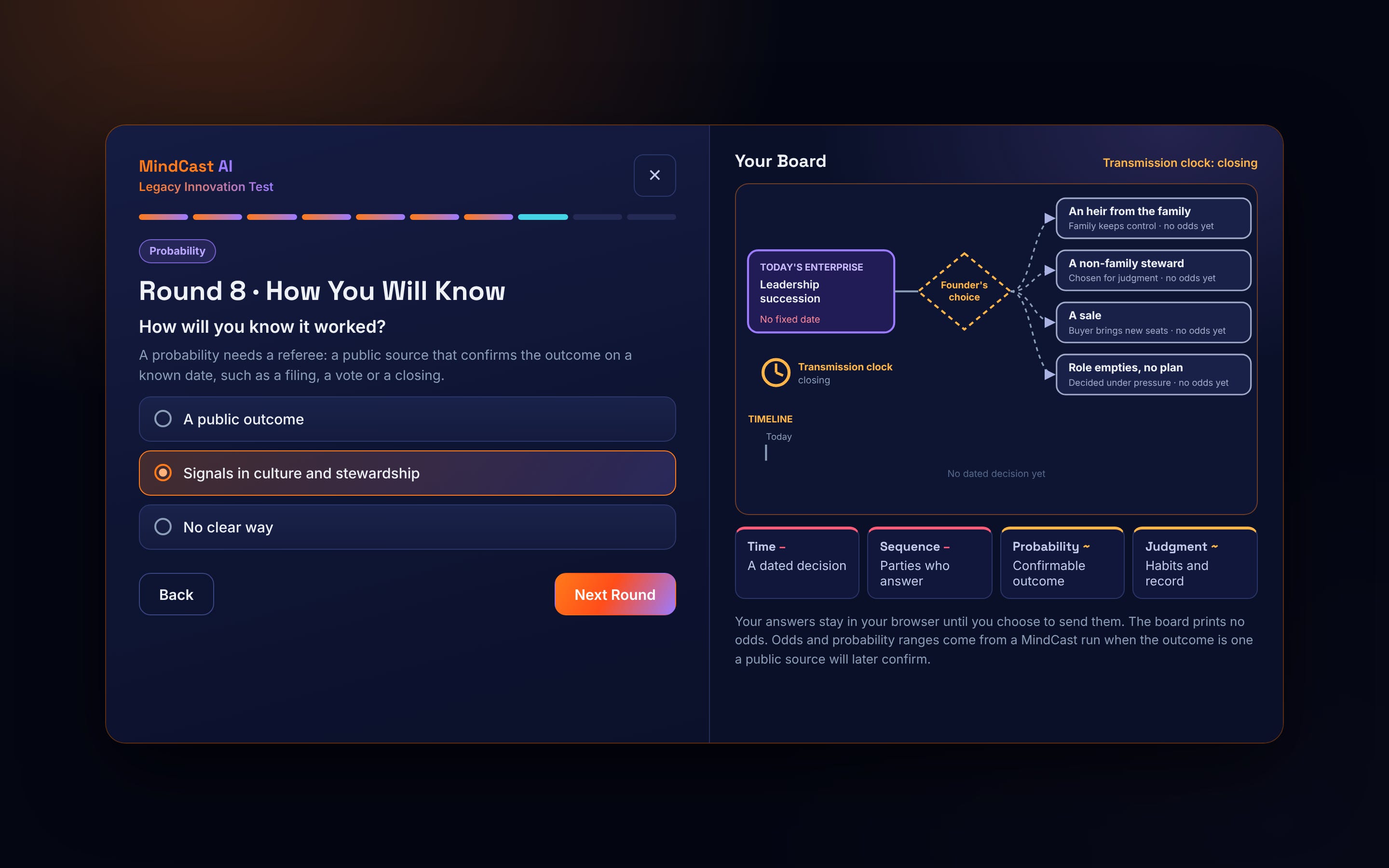
Takeaway. Outcomes that no public source confirms carry no odds.
X. Round 9 Asks Which Signals Apply
The optional final round lists six signals, and each ticked signal adds a note without changing the result. Two matter most for legacy work: no named successor, and a stated plan the conduct does not match, such as a founder who announces retirement but keeps deciding. The example ticks both.
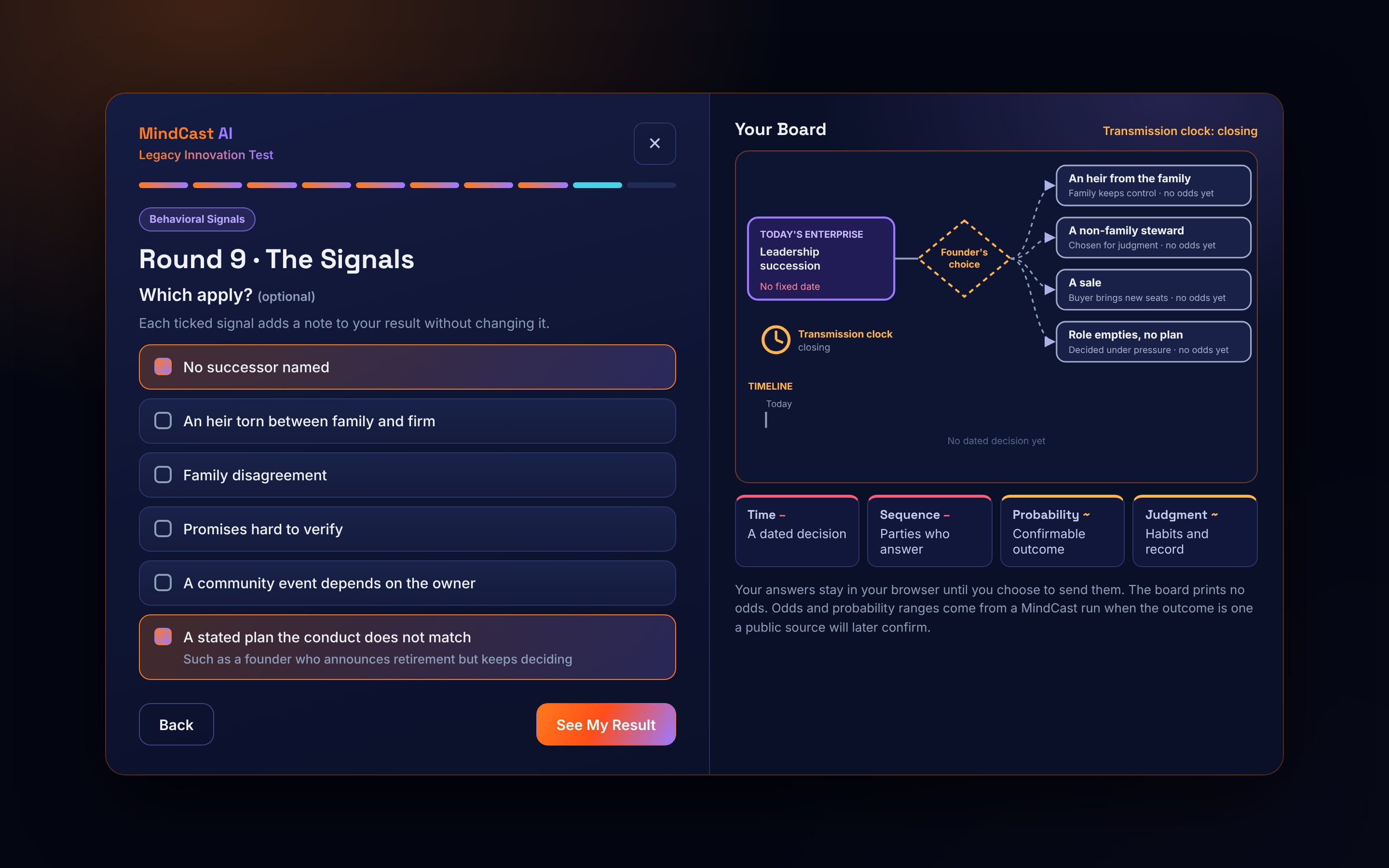
Takeaway. The signals tell MindCast where to look hardest.
XI. The Result Names the Product
The example receives Legacy Read · Clock Closing. A Legacy Read means the matter turns on the founder's judgment and gets a Vision Statement with the enterprise's Cognitive Digital Twin and a test for any successor. The Clock Closing tag marks that Vision Statement urgent, because the founder teaches only occasionally.
The test's other results follow the same logic. Almost Ready means a date exists but the seats are private or the record is mostly memory, and it earns a diagnostic session. Two Products pairs a Vision Statement with a Strategy and Risk Simulation Snapshot when a dated decision meets an open stewardship question. Ready to Simulate earns a Snapshot, with war gaming where moves remain open.
Each product has a defined output. A Vision Statement is a written model of how the enterprise decides, built from its record and the people who worked beside the founder, plus a test any successor candidate can be run against. A Strategy and Risk Simulation Snapshot maps the next states of a dated decision, puts a band on each and names the move that changes them. A diagnostic session identifies which missing input (a date, a public seat or a record) would make the matter simulatable.
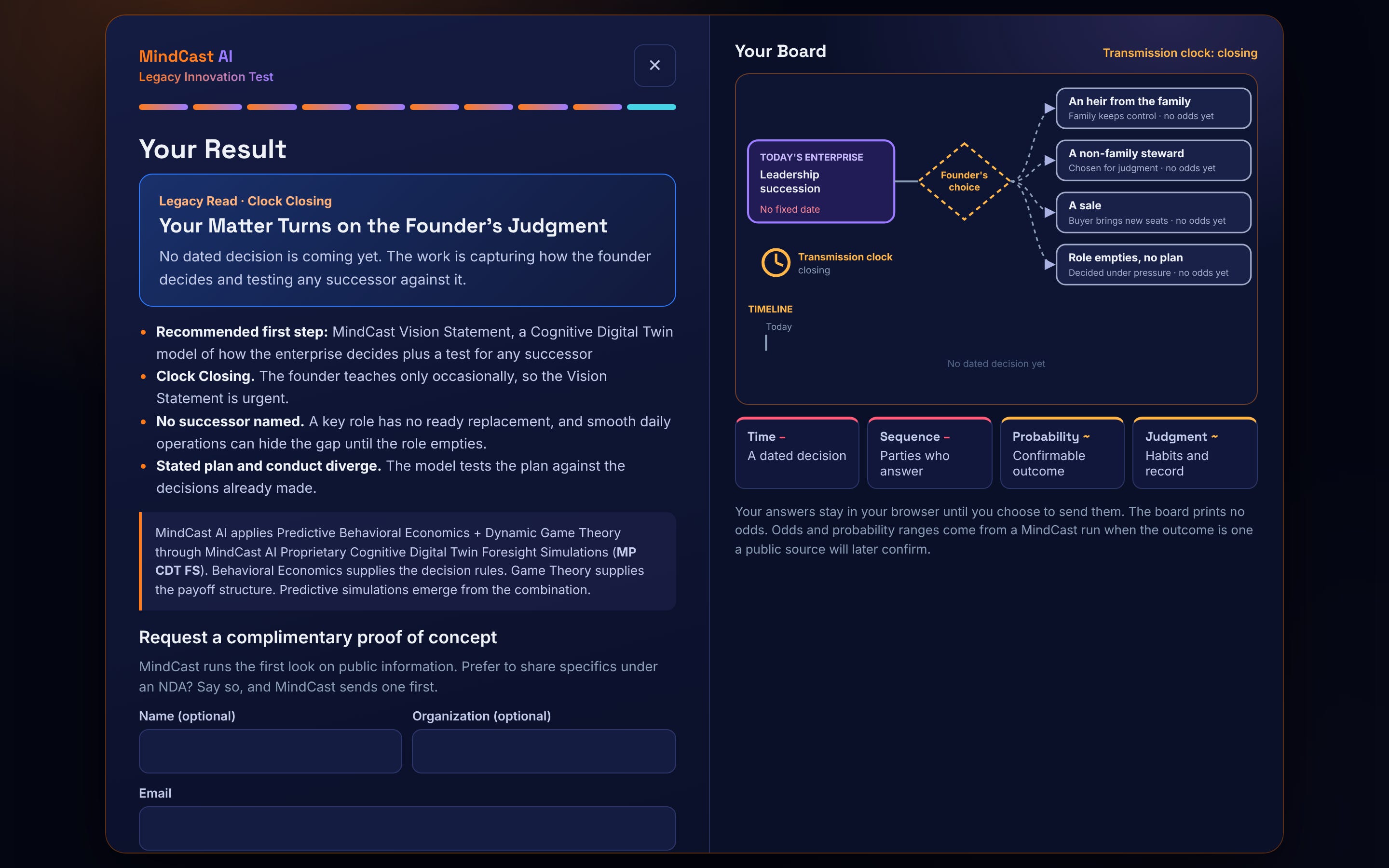
Takeaway. No result is a rejection, and each names the product the matter can support.
XII. The Board Tells the Family What to Prepare
Even without a date, the board points to three moves.
Write down the founder's judgment while the clock is open.
Test every successor candidate against the habits, including a non-family manager. Mukoyōshi, the Japanese practice of adopting an heir chosen for judgment rather than bloodline, sets the precedent for that test. From Mukoyōshi to MindCast AI LLC reads it as an early form of legacy innovation.
Name the dated decision that would force the choice, so the family recognizes it when it arrives.
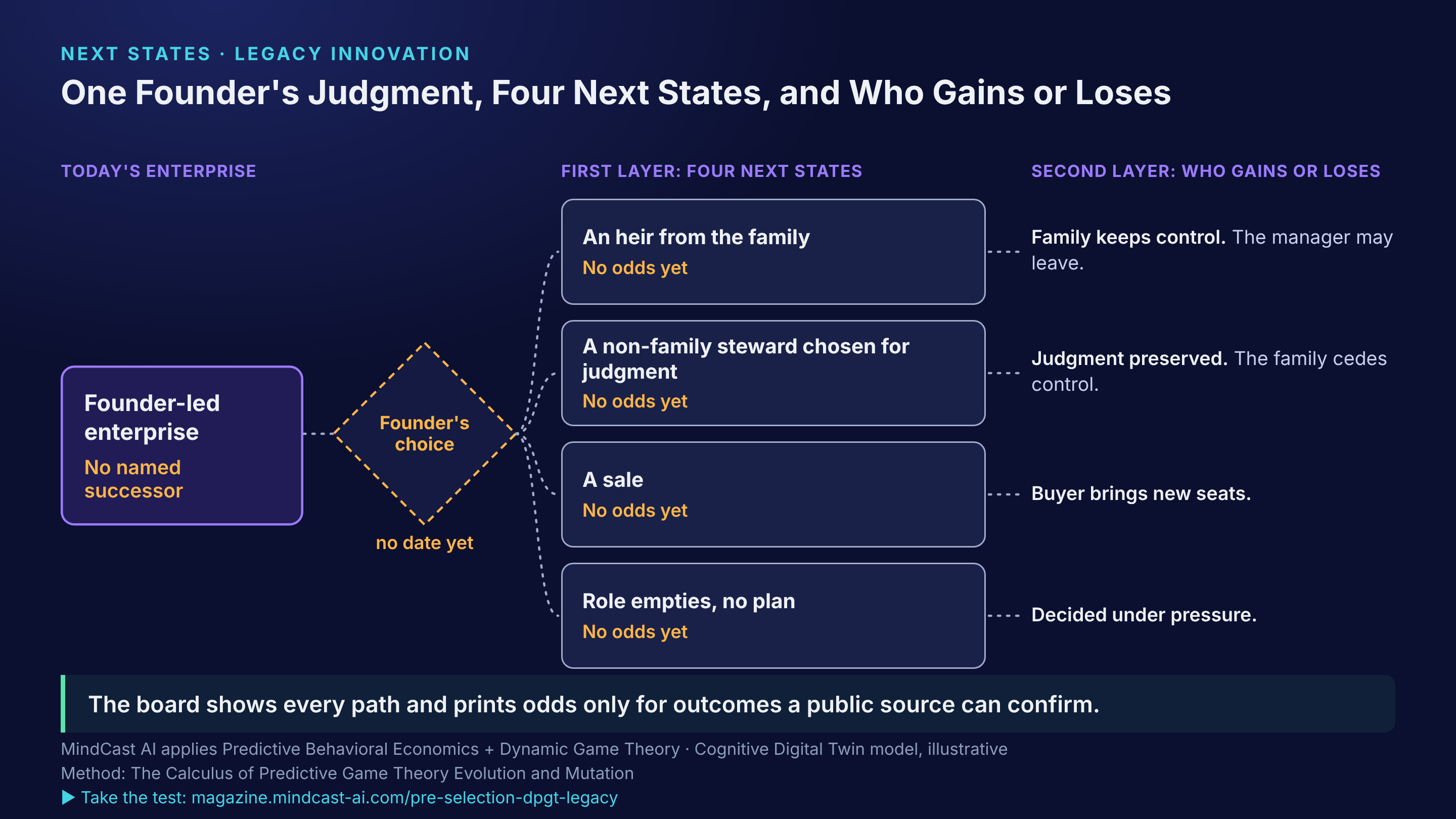
Takeaway. The board turns an open question into three moves a family can make this year.
XIII. Change One Answer and the Result Moves
The board shows four next states. An heir from the family or a non-family steward can take over, the family can sell, or no decision comes until the role empties. The board prints no odds until a dated decision supplies a public source that can confirm the outcome.
Each replay below changes one input and holds everything else fixed. One input can be a single event that moves several answers at once.
Round 6 changes to yes. The result becomes Write the Stewardship Move, whether or not a date exists.
A sale process with bid rounds opens. The event gives the matter a date and buyers and lenders whose conduct is partly public. Bidders and heirs now answer one another, and a public source will confirm the closing. The habits still depend on the founder, so the result becomes Two Products.
A successor then absorbs the founder's habits. The habits now run in daily operations, and the result becomes Ready to Simulate.
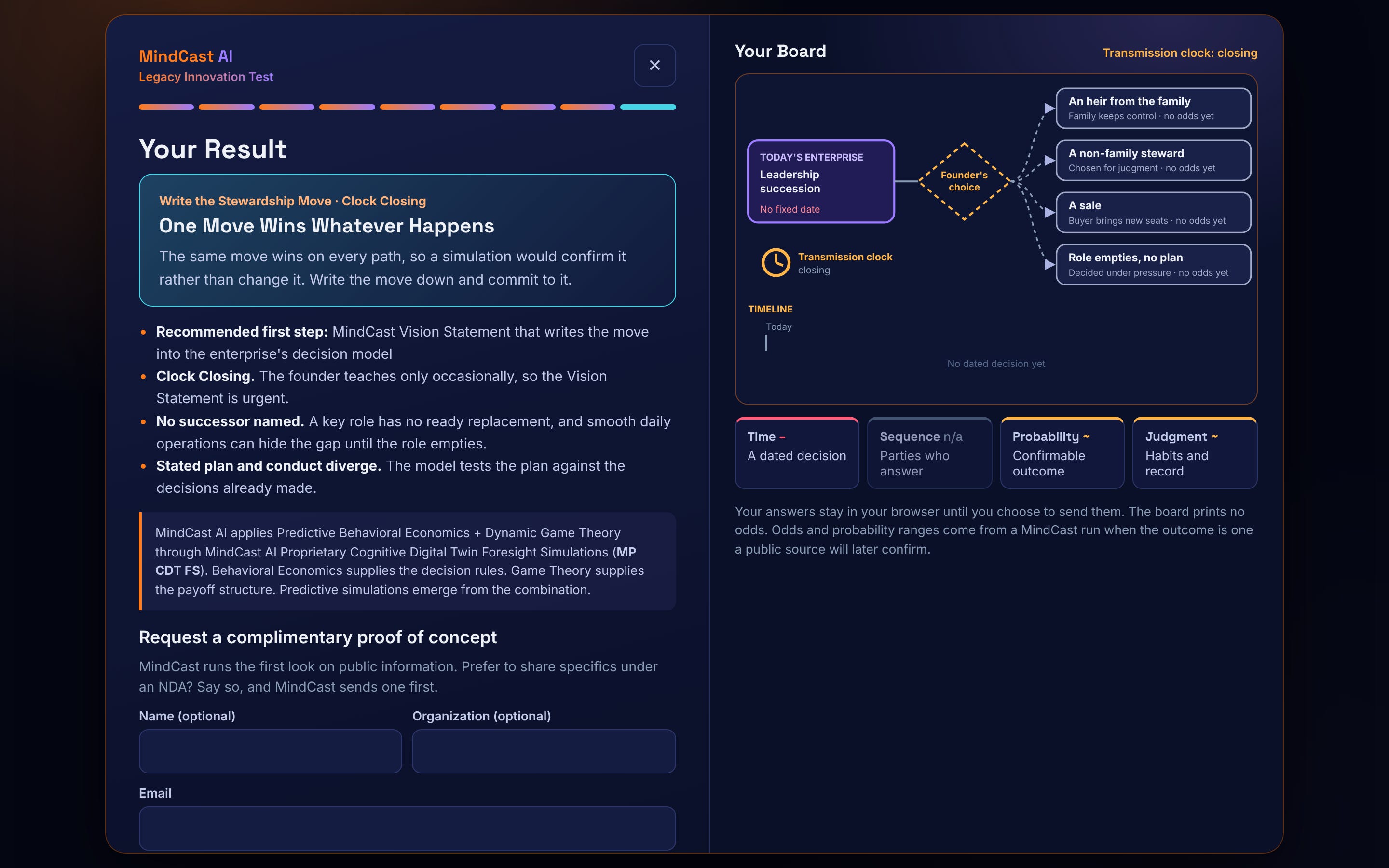
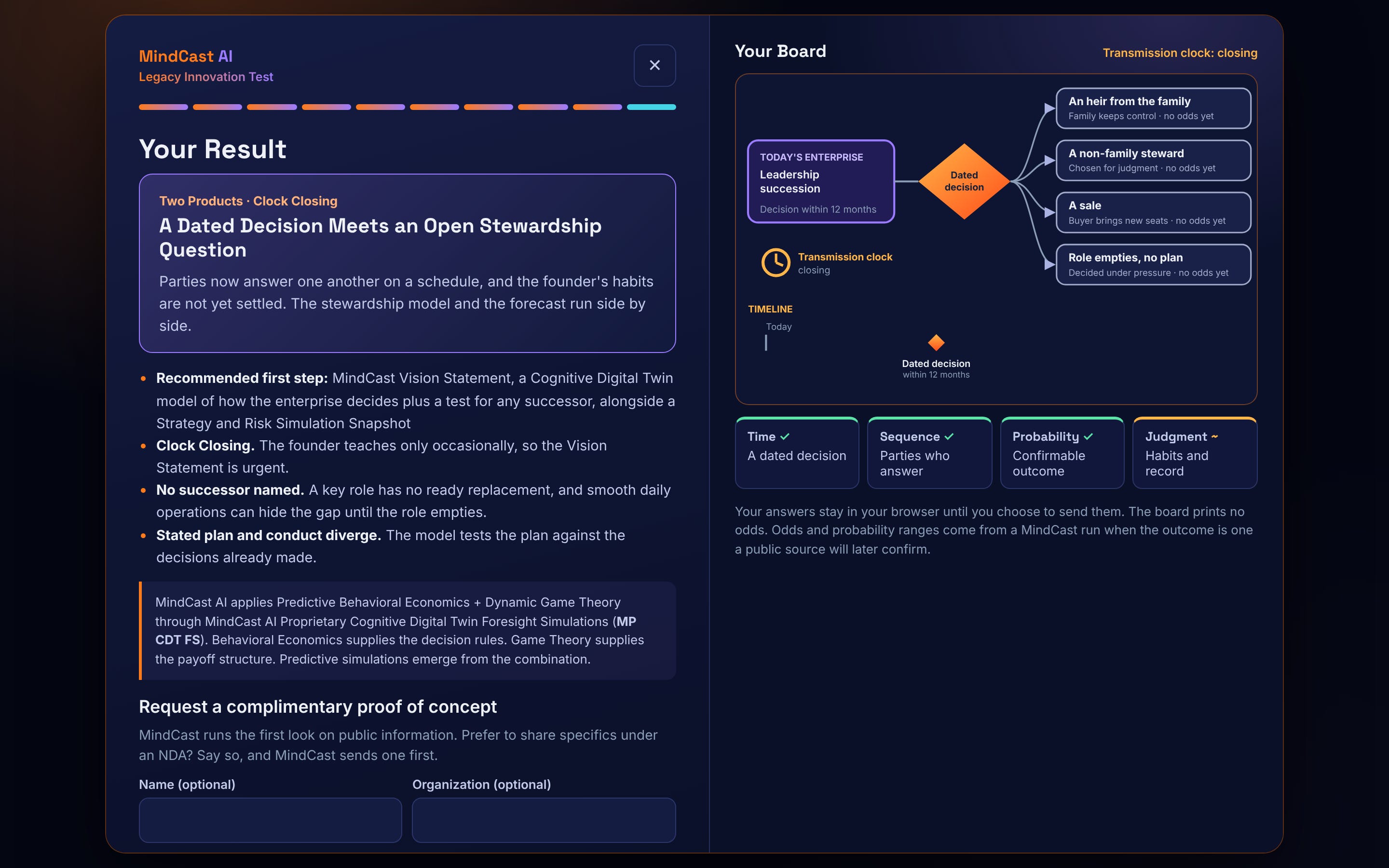
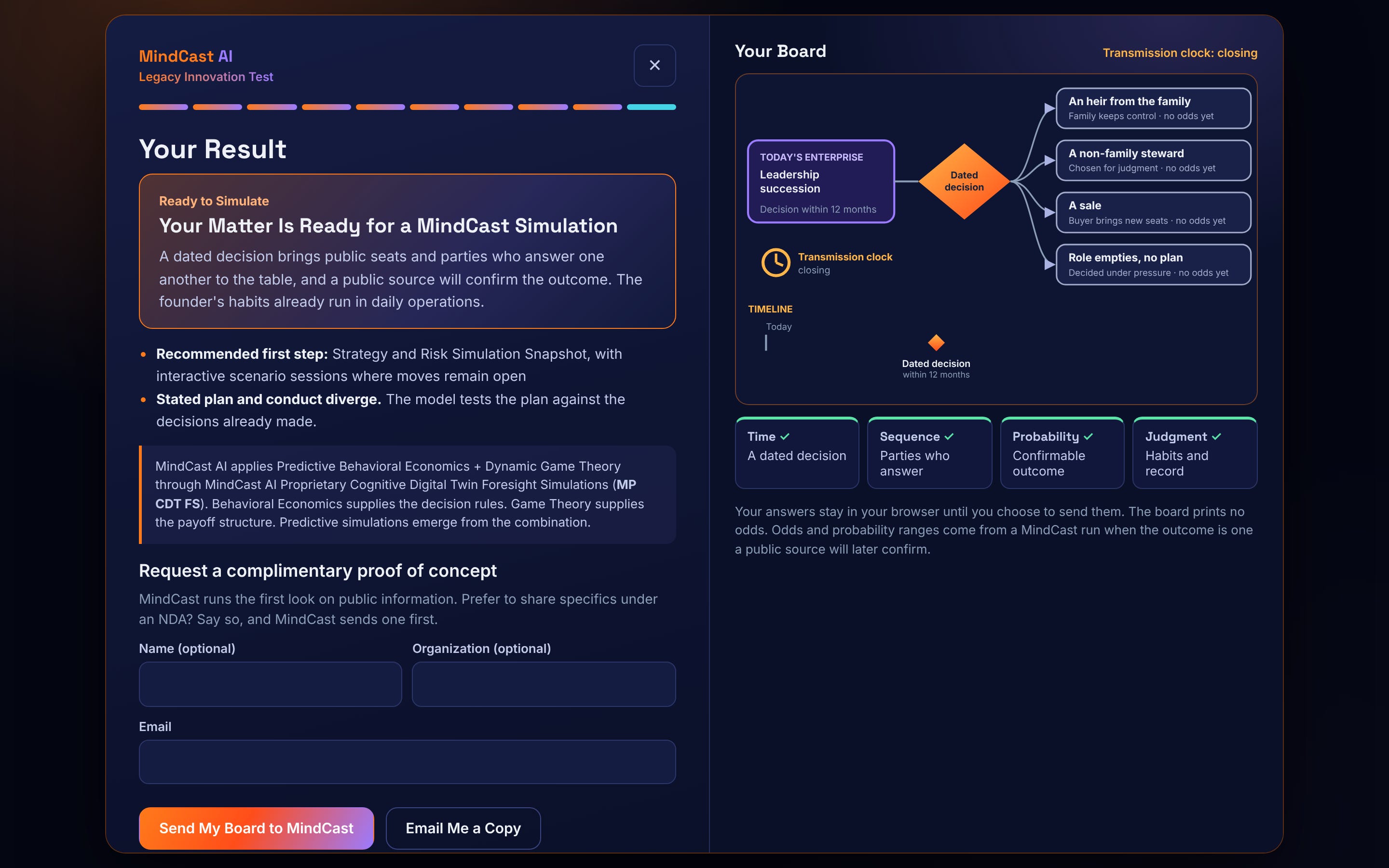
The sale replay is the one that crosses into simulation. The next three sections run it as a board with illustrative odds.
Takeaway. The result follows the structure of the matter, not its size.
XIV. A Sale Process Makes the Matter Simulatable
A dated sale turns the founder's open question into a game. The family announces a sale process with a final bid date six months out. Bidders, a lender and the heirs now move in sequence, and the closing documents will confirm the outcome on a known date.
Five seats sit at the table. The family side holds the founder, the heir who runs operations and the long-serving non-family manager. The buyer side holds the lead bidder and its lender. The founder still moves first, because the bid instructions decide what bidders are asked to keep.
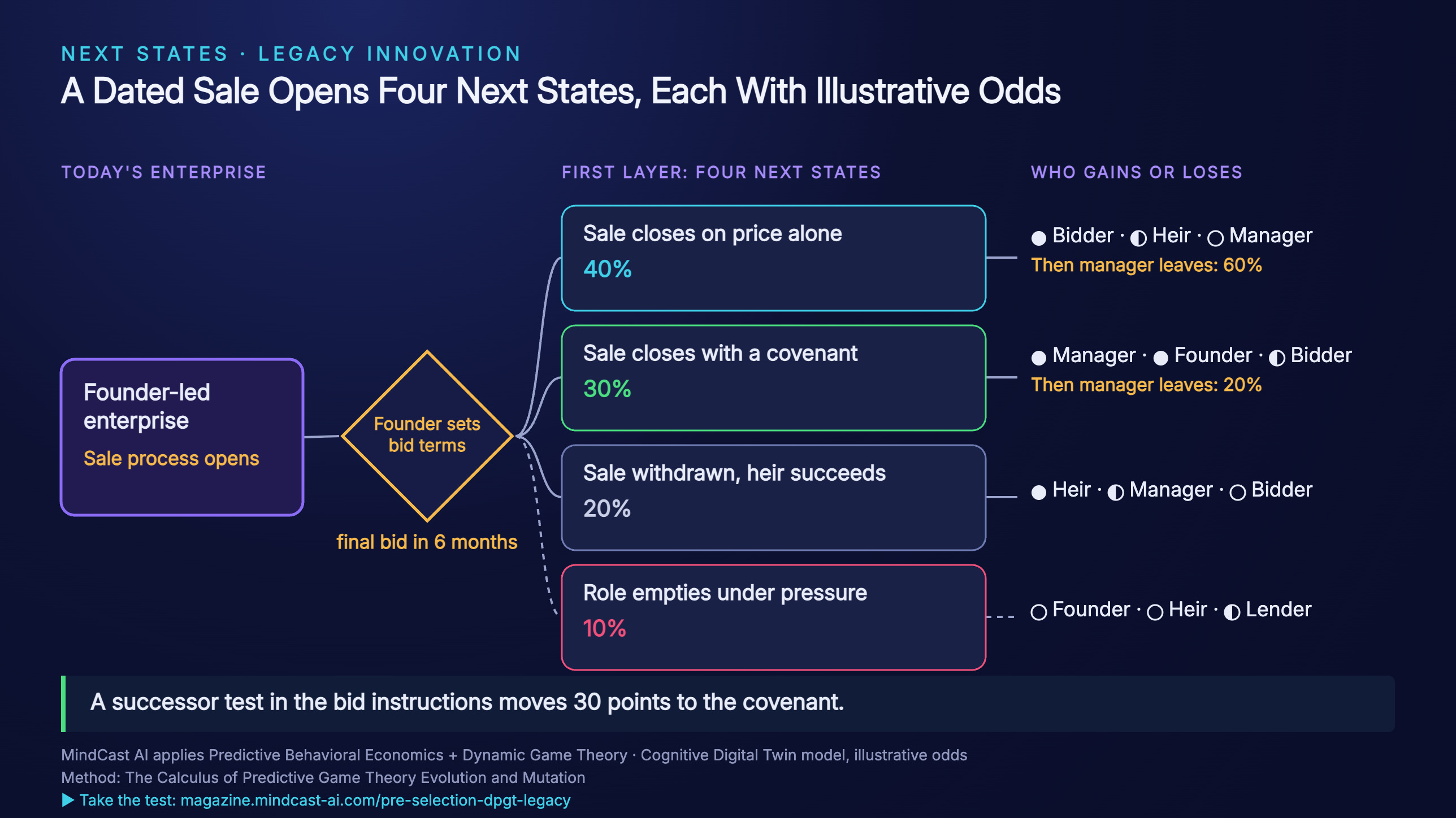
The odds below are illustrative, set to teach the method rather than drawn from a MindCast run. The final bid lands inside the decision window, so the board follows the short-horizon rule. Odds sit at the first fork and round to the nearest 10%, with conditional odds one step deeper only where a named seat moves next. Symbols mark each seat: ● holds · ◐ adapts · ○ loses.
Sale closes on price alone: 40%. ● Bidder · ◐ Heir · ○ Manager.
Sale closes with a stewardship covenant: 30%. ● Manager · ● Founder · ◐ Bidder.
Family withdraws the sale and an heir succeeds: 20%. ● Heir · ◐ Manager · ○ Bidder.
Sale fails and the role empties under pressure: 10%. ○ Founder · ○ Heir · ◐ Lender.
The second layer follows the manager, the one seat whose next move is named. The manager leaves within a year at 60% after a no-covenant close and at 20% after a covenant close. A buyer who loses the manager loses the person carrying most of the founder's daily judgment, so the no-covenant branch carries a value risk the price does not show.
How the Game Branches
The baseline is a no-covenant close at 40%, followed by the manager's departure at 60% given that close. The dominant fork is the bid instructions, and the founder is the mover. A third bidder entering late stays unbanded, because no named seat drives that entry.
The stewardship covenant is the state that breaks the baseline. Once one bidder accepts a manager-retention term, the others must match it or bid down, and the covenant becomes the new reference point for price.
Takeaway. A date, a public closing and parties who answer one another turn a legacy question into a game with odds.
XV. Bands Make the Counterfactual Measurable
Layered odds let a family test one move against unchanged opponents. Every seat keeps its decision rules, and only the bid instructions change. The changed move writes the successor test and a manager-retention term into the instructions before the first bid round.
No-covenant instructions. No-covenant close 40% · covenant close 30% · withdrawal 20% · failed sale 10%. Manager departure: 60% after a no-covenant close, 20% after a covenant close.
Successor test in the instructions. Covenant close 60% · no-covenant close 20% · withdrawal 10% · failed sale 10%. Manager departure: unchanged at 60% after a no-covenant close and 20% after a covenant close.
The difference between the two trees measures the term itself, because the opponents never changed. Writing the test before the first round moves 30 points from a no-covenant close to a covenant close. The departure rates stay fixed because the manager's decision rules never changed; the term works by moving the family onto the branch where the manager stays. Mukoyōshi made a similar trade, giving up bloodline to keep judgment; the covenant trades some bidding freedom to keep the manager.
Takeaway. Bands on both trees turn a deal term into a measured shift.
XVI. The Board Tells the Family When to Act
The sale board changes the family's decision in three ways. The Vision Statement has to exist before the first bid round, because bidders weigh judgment risk from what they can read. The manager-retention term protects the family on its most dangerous branch, the no-covenant close with a 60% chance of losing the manager. The role-empties branch at 10% justifies a named interim successor and nothing more.
Without the board, the family faces one question: sell or hold. With the board, it gets a timing rule, a hedge and a sense of proportion. All three rest on illustrative odds.
Takeaway. Foresight pays by telling a family when to move, what to protect and what to leave alone.
XVII. Forward Lock
The test makes a falsifiable claim about its own gates, covering formal MindCast runs completed by December 31, 2027. A matter marked Two Products should show at least one next state whose band moves 10 points or more when a successor test enters the deal terms. One formal run that finds no such state falsifies the Round 4 gate.
A matter marked Ready to Simulate whose Round 7 answer was "strongly" should show at least one path on which an outside party's move reverses the family's best move. One formal run that finds none falsifies the Round 7 gate.
Working With MindCast
MindCast AI is a predictive game theory simulation firm in innovation economics. A complimentary proof of concept runs on public information: the snapshot, the next states and the second branches.
MindCast AI applies Predictive Behavioral Economics + Dynamic Game Theory through MindCast AI Proprietary Cognitive Digital Twin Foresight Simulations (MP CDT FS). Behavioral Economics supplies the decision rules. Game Theory supplies the payoff structure. Predictive simulations emerge from the combination.
MindCast's 90% hit rate on material forecasts covers complex litigation and regulatory and geopolitical matters as of November 20, 2026. The count stands at 47 hits and 5 misses, with 9 partials set aside. MindCast work is listed in Stanford Law School media coverage and published in CPI Antitrust Chronicle.
Contact: mcai@mindcast-ai.com · www.mindcast-ai-simulation.com · All war gaming: Live-Fire Intelligence · Take the Legacy Innovation Test at magazine.mindcast-ai.com/pre-selection-dpgt-legacy
Appendix A. Selected MindCast Works
Whether Predictive Game Theory Simulation is Suitable For Your Innovation Economics Matter, Decided by a Three Minute Ripeness Test. The companion paper and the source of the result names.
What Is Legacy Innovation?. The founding definition of the vertical.
From Mukoyōshi to MindCast AI LLC. The Cognitive Digital Twin as a carrier of a founder's reasoning.
Legacy Innovation in Asian Cultures. Succession chosen for judgment.
Legacy and Recognition Architecture. What a family transmits.
Institutional Legacy Innovation and Artificial Intelligence. Legacy work for cultural institutions.
MindCast Prediction Scorecard. Source of the track record.
Appendix B. External Sources
Albert O. Hirschman, Exit, Voice, and Loyalty (1970).
Gary S. Becker and Nigel Tomes, "Human Capital and the Rise and Fall of Families" (1986).
George A. Akerlof and Rachel E. Kranton, Identity Economics (2010).
The enterprise in the walkthrough is illustrative.