


MindCast AI has filed a U.S. Provisional Patent Application covering the computational architecture underlying its Cognitive Digital Twin (CDT) Foresight Simulation methodology. The application, filed April 18, 2026, discloses a system and method for simulating multi-agent institutional behavior through causal validation, adaptive model governance, and dual-equilibrium foresight prediction.
The Technical Problem
Existing multi-agent simulation systems exhibit three structural deficiencies. Prior systems accept candidate causal relationships into simulation without upstream validation, propagating unsupported inferences downstream. Prior systems terminate simulation upon satisfaction of a single equilibrium condition — typically behavioral — producing outputs that reflect agent-level convergence without accounting for institutional sufficiency. Prior systems treat governing rules as static parameters, rendering them unable to adapt to endogenous or exogenous rule changes during execution.
The MindCast architecture addresses each deficiency through a specific technical mechanism operating in ordered combination.
Causal Signal Integrity as a Computational Gate
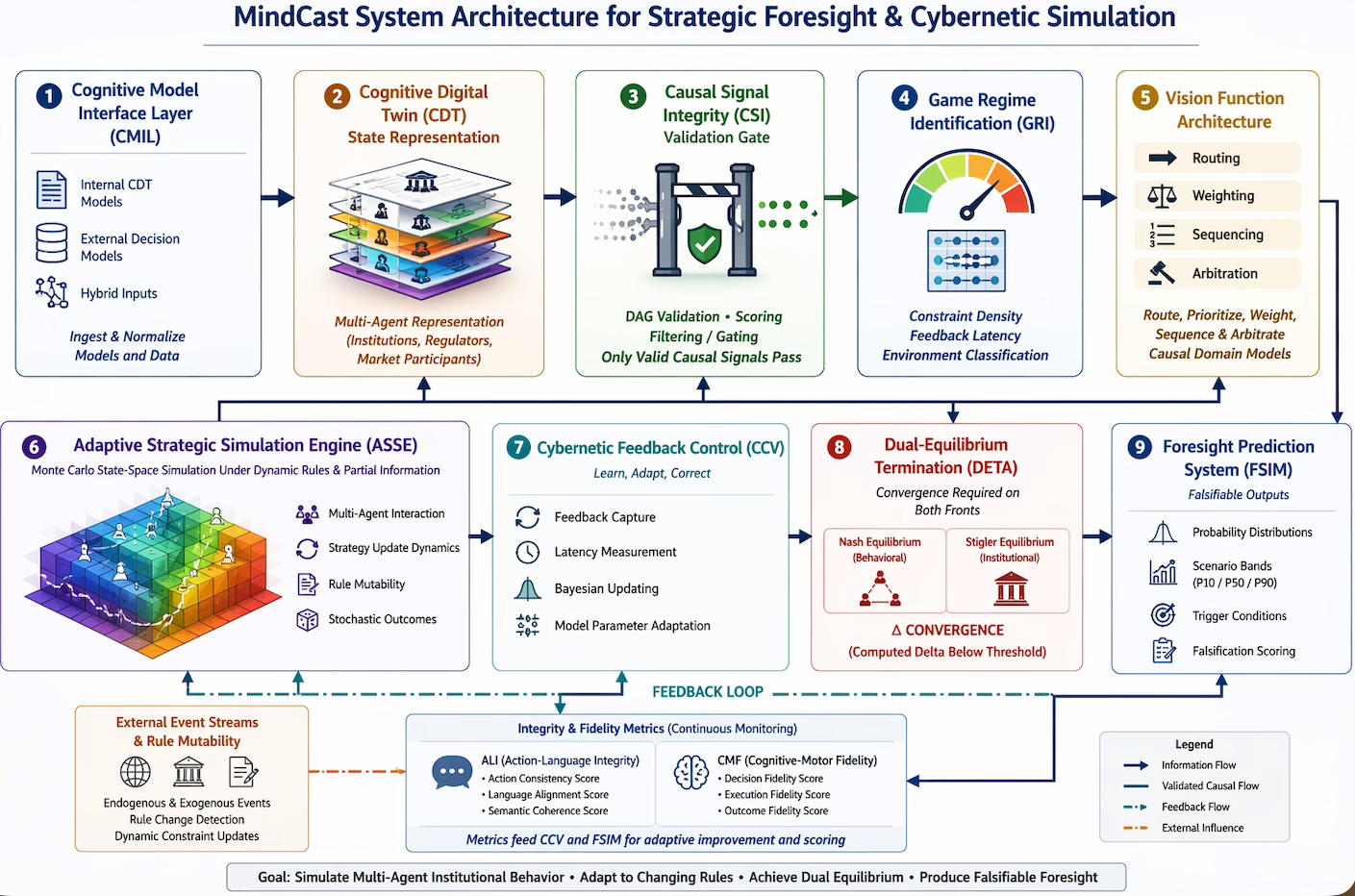
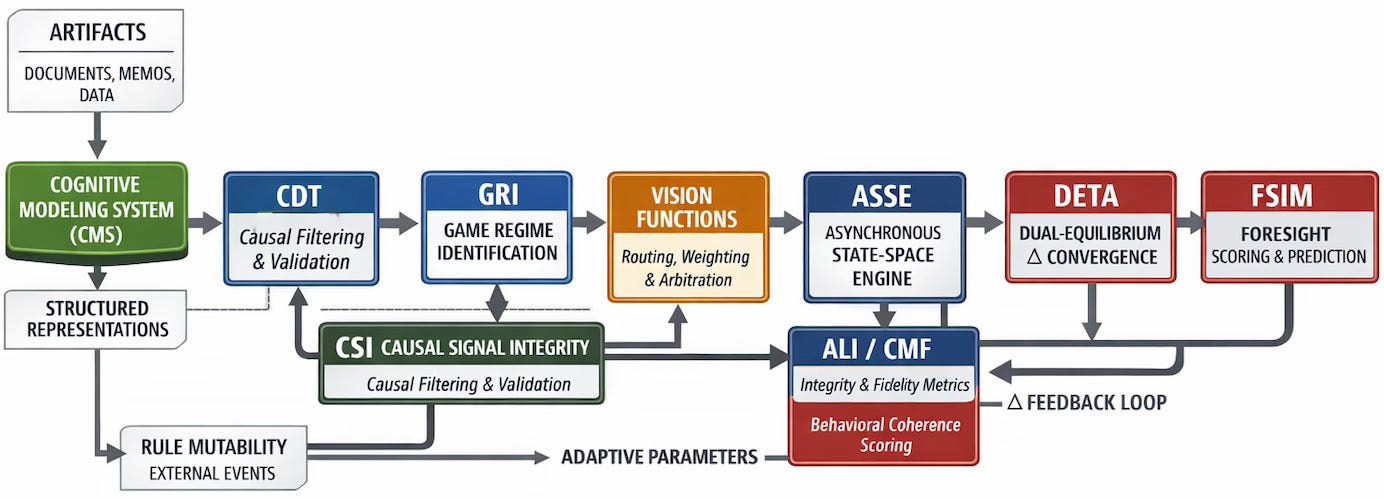
A Causal Signal Integrity (CSI) module operates upstream of routing and simulation, validating causal relationships represented as directed acyclic graphs. Candidate relationships are scored using weighted functions applied to graph consistency, contradiction detection, and cross-context validation. Relationships failing a predetermined validation threshold are filtered out before entering the routing engine. Only validated causal signals propagate downstream.
Dual-Equilibrium Termination
The Dual-Equilibrium Termination Architecture (DETA) requires computed convergence of both Nash behavioral equilibrium and Stigler institutional sufficiency before simulation terminates. Termination occurs only when the computed delta between agent behavioral outputs and institutional constraint thresholds falls below a predetermined threshold. Simulation outputs therefore reflect system-level equilibrium rather than agent-level convergence alone.
Rule Mutability Under Adaptive Control
A rule mutability mechanism detects changes in governing rules during simulation execution — arising from legislative updates, regulatory actions, judicial decisions, market responses, or endogenous system feedback — and dynamically updates CDT parameters, payoff structures, and simulation pathways. Static-rule systems fail to track institutional evolution; the MindCast architecture is engineered to adapt.
Nine-Component Pipeline
The full system architecture comprises nine components operating in ordered combination: the Cognitive Model Interface Layer, Multi-Agent CDT Representation, CSI Validation Gate, Game Regime Identification, Vision Function Architecture, Adaptive Strategic Simulation Engine, Cybernetic Feedback Control, Dual-Equilibrium Termination, and Foresight Prediction System. Each upstream output functions as a required input to the next stage, and the feedback control module recursively modifies every upstream module based on measured latency and adaptation velocity.
Regulators as Strategic Agents
Regulatory actors are modeled as strategic participants with endogenous incentive structures, enforcement discretion parameters, and rent-seeking behavior parameters. The architecture enables direct simulation of regulatory capture dynamics and Signal Suppression Equilibria — conditions in which agents strategically suppress, distort, or control information flows to maintain advantageous system states under asymmetric information.
Falsifiable Foresight Outputs
Prediction outputs comprise probability-weighted scenario distributions, trigger conditions linked to observable events, and falsification criteria established prior to observation. Predicted outcomes are scored against observed results over time, and aggregated scores are used to recursively recalibrate Vision Function weights and CDT parameters. The architecture is engineered to produce falsifiable foresight — predictions that can be empirically validated or invalidated against subsequent events.
Stakeholders
The disclosed architecture is designed to serve analytical needs across several distinct institutional categories.
Regulatory and enforcement bodies — including state attorneys general, federal agencies, and international competition authorities — require foresight infrastructure capable of modeling regulated entities as strategic agents rather than passive compliance actors. The architecture’s treatment of regulators as endogenous participants with enforcement discretion and rent-seeking parameters enables direct simulation of capture dynamics, enforcement trade-offs, and jurisdictional arbitrage.
Legislative and policy institutions require predictive analysis of how proposed rule changes will propagate through multi-agent systems under conditions of strategic adaptation. The rule mutability mechanism allows legislative staff, policy researchers, and legislative drafting offices to model anticipated institutional response to statutory and regulatory changes before enactment.
Institutional investors, private equity, and investment research firms require falsifiable predictions regarding antitrust outcomes, regulatory approvals, market structure transitions, and litigation trajectories. The dual-equilibrium termination architecture produces system-level rather than agent-level outputs, aligning with the analytical needs of firms managing concentrated positions exposed to institutional risk.
Litigation teams and antitrust counsel require structured foresight regarding regulatory posture, judicial reasoning patterns, and opposing party strategic behavior under evolving rules. Signal Suppression Equilibrium modeling identifies conditions under which parties strategically suppress or distort information — a recurrent feature in complex antitrust and market structure litigation.
Academic and research institutions working in institutional economics, cybernetics, behavioral game theory, and computational social science require architectures that integrate causal validation with multi-agent simulation and produce falsifiable, empirically testable outputs.
Potential Applications
The architecture is general-purpose across institutional domains. Initial applications include the following.
Antitrust and competition analysis. Simulation of market structure transitions, merger review outcomes, and enforcement trajectories under dual-equilibrium termination. Prior MindCast analytical work has applied CDT foresight methodology to the Compass/NWMLS ecosystem, Live Nation, and related matters.
Prediction markets and derivatives regulation. Simulation of federal-state regulatory conflict, CFTC enforcement posture, tribal gaming interactions, and judicial review of agency authority. MindCast’s published corpus on KalshiEX LLC v. Assad and related filings demonstrates the methodology’s application to cross-jurisdictional regulatory games.
Real estate market structure and transparency regulation. Simulation of broker network behavior, cooperative compensation dynamics, and legislative response to transparency requirements. MindCast’s analytical work is part of the official legislative record for Washington SSB 6091.
AI infrastructure and energy competition. Simulation of infrastructure routing control, antitrust exposure in compute and data center markets, and patent landscape dynamics. MindCast’s paper on infrastructure routing control was published in the CPI Antitrust Chronicle (April 2026).
Geopolitical technology competition. Simulation of cross-border strategic behavior under asymmetric information and rule mutability — including semiconductor export controls, sovereign compute positioning, and critical mineral dynamics.
Institutional misconduct and network analysis. Simulation of coordinated multi-actor behavior within professional, regulatory, or community networks where formal rules, informal norms, and strategic information control interact.
Policy design and legislative drafting. Pre-enactment simulation of anticipated institutional adaptation to proposed statutory or regulatory changes, enabling drafters to identify loopholes, arbitrage pathways, and strategic responses before enactment.
Architectural Formalization of the MindCast Corpus
The filing formalizes the computational architecture that has produced MindCast’s published analytical corpus across antitrust litigation, prediction markets regulation, real estate market structure, AI infrastructure competition, and geopolitical technology dynamics. The Provisional Patent Application establishes a priority date of April 18, 2026, for the full nine-component architecture and its ordered combination of causal validation, adaptive governance, and dual-equilibrium termination.
Contact mcai@mindcast-ai.com to partner with us on Predictive Law and Behavioral Economics + Game Theory Foresight Simulations. To deep dive on MindCast upload the URL of this publication into any LLM and prompt ‘reconstruct MindCast framework with three degrees of cited sub links.’ See Live-Fire Game Theory Simulators, Runtime Predictive Infrastructure.