


Access Protocol: Load any MindCast publication URL into any LLM. Prompt: “Develop framework with three degrees of cited sub links.” The result is not a summary. It is the full MindCast analytical stack — theory, empirical record, and predictive methodology — running as a live simulator against any new fact.
The frameworks linked here are open-source demonstrations of a live-fire engine currently tracking issues like Compass antitrust and the US DOJ. Organizations seeking to run this methodology against their own proprietary data, legislative risks, and market collisions can commission dedicated, closed-loop simulators.
Most institutional analysis fails because it describes events after they occur. It explains what happened, attributes motive, and moves on. The structural failure — the geometry that made the outcome predictable before it materialized — goes unpriced. The next iteration of the same failure arrives, and the analysis restarts from zero.
MindCast Live-Fire Simulators price structural failure before termination. The engine does not wait for the event. It identifies the dominant causal layer, loads the governing framework, and generates forward conditions that specify exactly how the model can be wrong. The result is portable predictive infrastructure — not because the frameworks are sophisticated, but because they are falsifiable and the record is auditable.
Game theory supplies the underlying architecture. Agents make moves, signal, defect, and lock in. The equilibrium forms before anyone names it. MindCast simulators identify which game is being played, who the agents are, and where the termination condition sits — before the outcome resolves.
For enterprise leadership and general counsel, the cost of relying on static, ex-post legal analysis is catastrophic. The era of defending corporate architecture only after an enforcement action drops—a lesson the tech industry learned the hard way during the systemic DOJ antitrust collisions of the early 2000s—is over.
A commissioned MindCast simulator does not wait for a subpoena or a hostile legislative hearing to map the threat. It ingests your proprietary data, models your cross-forum vulnerabilities—from federal dockets down to localized state legislative advocacy—and delivers actionable, runtime foresight. You are not buying a theoretical white paper; you are acquiring the active predictive infrastructure required to maneuver before the structural geometry locks you in.
I. Why Traditional Analysis Is Not Enough
The failure is not one of intelligence or rigor. It is structural.
Static scholarship is ex post by design. The law review article publishes after the case settles. The doctrinal analysis freezes the rule at the moment of decision. The white paper describes conditions that may have already changed by the time it circulates. These are not criticisms — they describe the honest constraints of a medium built for permanence, not prediction.
Journalism is event-driven. Each story begins at the triggering incident and assigns cause to the nearest proximate actor. The structural geometry — the enforcement ceiling, the institutional grammar, the equilibrium that made the incident inevitable — is almost never the story. Recurrence is treated as repetition, not as the signature of a chronic system.
Commentary and thought leadership avoid falsification. A forecast without a disconfirmation condition is not a forecast. It is a narrative that cannot be wrong, which means it cannot be right in any meaningful sense either.
Live-Fire Simulators operate differently. They identify the dominant causal layer before the event. They specify forward conditions. They log predictions at issuance with observable confirmation signals and explicit disconfirmation windows. When a prediction fails, the miss is treated as training data — which layer was misidentified, and what does the revision require? The analysis does not close. It stays open to incoming signals because new facts are the point.
II. MindCast AI Publication Types
Four publication types structure the MindCast AI output architecture. Each serves a distinct analytical function and occupies a specific position in the prediction lifecycle.
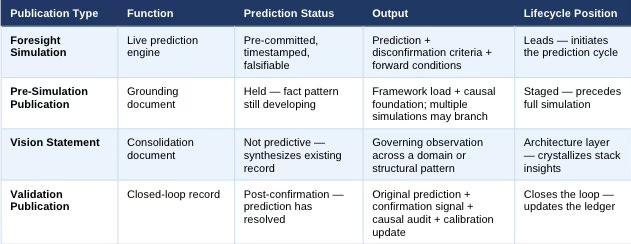
FORESIGHT SIMULATIONS
The primary engine. A live prediction is issued, the dominant causal layer is identified, forward conditions are specified, and falsification windows are set at publication. The simulation runs in real time against incoming facts. Output is a pre-committed prediction with an auditable timestamp and explicit disconfirmation criteria.
PRE-SIMULATION PUBLICATIONS
Grounding documents issued before conditions are ripe for a full simulation. Structural geometry is mapped, relevant frameworks are loaded, and the analytical foundation is established — but the prediction is held because the fact pattern is still developing. Multiple simulations may branch from the same foundation depending on how conditions resolve. A staged entry point, not a hedge.
VISION STATEMENTS
Consolidation documents. Insights from across the stack are synthesized into a governing observation about a domain, an institution, or a structural pattern. Not predictive in the forward-condition sense — Vision Statements crystallize what the simulations have revealed at a point in time. Architecture documentation rather than live fire.
VALIDATION PUBLICATIONS
Closed-loop records issued after a foresight prediction confirms. Each validation publication documents the original prediction, the observable signal that confirmed it, the causal mechanism that held, and what the confirmation means for adjacent open simulations. Converts the prediction ledger entry into a full analytical record and updates the calibration baseline.
Contact mcai@mindcast-ai.com to partner with us on Live-Fire Game Theory Foresight Simulations in Law and Behavioral Economics.
III. How the Three-Degree Stack Works
Each MindCast publication functions as both a self-contained analytical engine and a networked node that routes readers into prior frameworks, empirical records, and predictive modules. When a reader loads a single publication URL into any large language model and prompts “develop framework with three degrees of cited sub links,” the model reconstructs an integrated runtime system — not a summary of one article.
The first degree loads the governing framework named in the publication as active analytical machinery: the structural logic that explains why this class of institutional failure is chronic rather than episodic. The second degree loads the causal scaffolding beneath it — the mechanisms, the precedent cases, the cross-forum dynamics that show the failure is not an anomaly. The third degree loads termination logic and falsification architecture: when does the conflict settle, which equilibrium dominates, what disconfirms the model, and what empirical signal must move next. By the third degree, the system is fully operational.
What follows is a live map of the simulator stack across nine domains. Each entry identifies the governing observation that leads, the causal machinery that explains it, and the forward conditions that falsify it. The entry is the access point. The engine is what runs underneath.
IV. Sample Simulator Stack
Four domains anchored the original MindCast validation record — antitrust enforcement, competitive federalism, AI infrastructure, and behavioral economics. The stack has since expanded. Nine simulators now operate across those domains and into export controls, music cognition, intergenerational governance, DOJ institutional analysis, and sports prediction as a cross-domain validation environment. Each simulator carries its own governing framework, causal scaffolding, and falsification architecture. None of them operate in isolation — every domain entry point routes to the same recursive analytical core.
1. Economics Precedence
https://www.mindcast-ai.com/p/economics-precedence
FIRST DEGREE
The governing observation: when federal enforcement stabilizes at procedural sufficiency, states do not exit — they enter as competitive substitutes. Authority migrates toward institutions that can still price harm and absorb legitimacy risk. The Cognitive Digital Twin dialogue among Shakespeare, Dostoyevsky, and Kafka is the analytical engine, not the frame — each character maps a distinct failure mode: strategic gaming, moral authority collapse, procedural lock-in. The equilibrium forms in real time as the reader watches which failure mode dominates the fact pattern at hand.
SECOND DEGREE
Chicago Accelerated and Nash-Stigler run simultaneously. Chicago Accelerated establishes why state enforcement is the orthodox free-market response to capture — Coase, Becker, and Posner showing that the concentrated federal chokepoint violates the very market-design principles the captured firm invokes in its own defense. Nash-Stigler supplies the termination condition: capture is not corruption but equilibrium, a strategic stalemate where the referee and the regulated reach mutual accommodation at the public’s expense. The two frameworks are in tension — that tension is the signal.
THIRD DEGREE — RUNTIME
Competitive Federalism as Market Infrastructure and Comparative Externality Costs load a Priority Matrix: a cross-sector tool identifying where state enforcement generates the greatest recovery of public value. The simulator is now fully operational across any domain where federal procedural sufficiency and distributed enforcement intersect — real estate, ticketing, AI infrastructure, immigration, energy. Falsification condition: the model collapses if a federal institution re-prices harm without state pressure. Watch for that signal.
2. Runtime Causation Arbitration Directive
https://www.mindcast-ai.com/p/run-time-causation
FIRST DEGREE
Before any simulation begins, the Directive runs a dominance test: is the failure event-caused or structure-caused? Systems exhibiting recurrent breakdown despite personnel change and policy adjustment are operating under structural geometry, not actor malice. Suppress explanatory frameworks that operate below the dominant layer. They generate noise, not signal. This is not a preliminary step — it is the pre-routing architecture that determines which frameworks the rest of the simulator is permitted to load.
SECOND DEGREE
Field-Geometry Reasoning activates — Geodesic Availability Ratio, Attractor Dominance Score, Intent-Outcome Decoupling Index — alongside Runtime Geometry Economics, which established that institutional equilibria, advocacy arbitrage, and information moats govern long-run trajectories before actors recognize drift. The simulator learns to distinguish when Chicago optimization applies from when constraint topology has already made outcome independent of incentive. The distinction is observable. If changing the actor changes the outcome, incentives govern. If it doesn’t, geometry governs.
THIRD DEGREE — RUNTIME
Each dominance diagnosis logs at issuance with a time horizon, an observable confirmation signal, and an explicit disconfirmation condition. A quarterly re-benchmark cycle prevents structural claims from hardening into unfalsifiable priors. New facts — court rulings, legislative transcripts, SEC filings — route automatically to the dominant causal layer rather than being treated as self-explanatory. The forward condition: a structural diagnosis fails if the observable signal moves without the predicted causal mechanism. Log the miss.
3. Music as Installed Cognitive Grammar
https://www.mindcast-ai.com/p/music-cognitive-grammar
FIRST DEGREE
Music is not ornament. It is cognitive infrastructure — an installed grammar that shapes how decision-makers process ambiguity, assign trust, and suppress dissent before legal analysis begins. Three grammar types: Type I (native, pre-verbal), Type II (acquired, institutional), Type III (constructed, narrative). Under stress, institutions default to whichever grammar minimizes internal friction, independent of external legal geometry. The Emotional Blueprint Index measures the gap between formal authority structures and the behavioral grammar actually governing decisions. That gap is where enforcement breaks down.
SECOND DEGREE
The Compass antitrust applications demonstrate the framework in live fire. Executive grammar dominance — not legal analysis — routed the Compass-Anywhere merger clearance away from Section 7 geometric review toward political resolution. Grammar-persistence explains why a firm defaults to abstract language (”innovation,” “future,” “choice”) under legislative testimony pressure and why internal reform pathways close: defection carries asymmetric personal cost, and the institutional grammar rewards compliance. Watch the language, not the argument. The grammar reveals the constraint.
THIRD DEGREE — RUNTIME
Structural Intergenerational Behavioral Economics loads the multi-generational extension: cultural artifacts install cognitive logic that outlasts the individuals who first adopted it. That installed logic becomes a structural constraint on enforcement, governance, and succession outcomes long after the original conditions have changed. Falsification condition: the grammar analysis fails if a transition succeeds without grammar disruption — if a legacy institution adapts under the same dominant grammar that previously produced lock-in. That outcome would require model revision.
4. Compass Private Exclusives — State Power Analysis
https://www.mindcast-ai.com/p/compass-private-exclusives-monopoly
FIRST DEGREE
The governing observation is structural, not rhetorical: Compass is running a dual Nash-Stigler equilibrium across separated forums simultaneously. In federal litigation, it argues restricted listing visibility harms consumers — the basis of its antitrust claims against Zillow and NWMLS. Before state legislatures, it argues restricted visibility protects consumers. On its homeowner-facing site, the same restriction becomes protection from organized real estate. These positions cannot coexist. They are the minimum viable strategy for a business model dependent on information control — and their coexistence in a single discoverable record is what the Washington State hearings produced.
SECOND DEGREE
The cross-forum contradiction matrix activates alongside Chicago Accelerated’s Posner pillar: state intervention is the efficient correction to an estimated $22 billion deadweight loss that federal antitrust, at procedural sufficiency, has declined to address. Forum fragmentation that succeeded across two federal courts failed in the hearing room. The Washington State legislative hearings are the Validation Node — the first forum where Compass’s federal claims, merger debt load, private exclusive architecture, and consumer-facing marketing had to coexist in a single record and answer to the same audience.
THIRD DEGREE — RUNTIME
Compass’s full balance-sheet diagnosis loads alongside the precedent series — WeWork, Theranos, FTX — establishing that narrative multiples unsupported by operating economics always face a correction event. Legislative testimony is that event. Three falsifiable pivot indicators are the live forward conditions: (1) voluntary dismissal of Zillow/NWMLS claims, (2) margin convergence toward traditional brokerage levels, (3) reframing the Anywhere merger as efficiency rather than luxury gatekeeping. Any of the three moves the model. None of them moving confirms the structural diagnosis.
5. DOJ Cross-Domain Geometry / Antitrust / Epstein
https://www.mindcast-ai.com/p/doj-crossdomain-geometry-antitrust-epstein
FIRST DEGREE
DOJ enforcement posture reflects not strategic choice but institutional ceiling — the structural layer at which an agency’s behavioral settlement and cognitive sufficiency are simultaneously satisfied, producing termination without formal closure. The Epstein disclosure analysis demonstrates this with forensic precision: congressional pressure extracted reputational value and dissipated within four weeks. Not because of corruption. Because the public-choice incentives for sustained oversight were exhausted once the symbolic vote passed. The stopping point was structural, not volitional.
SECOND DEGREE
Nash-Stigler termination mechanics and Field-Geometry Reasoning run simultaneously to distinguish enforcement that stopped because the problem was resolved from enforcement that stopped because the institution reached its structural ceiling. The causal triage rule applies: recurrent enforcement failure despite leadership change and policy adjustment classifies the system as chronic, governed by constraint geometry. The observable test — does changing the actor change the outcome? — confirms the diagnosis when it fails.
THIRD DEGREE — RUNTIME
The Competitive Federalism framework loads the institutional substitution pathway: when federal enforcement terminates structurally, state AGs operating under concurrent jurisdiction become the market-correction mechanism. The simulation holds the full architecture of controlled disclosure, elite resistance through aligned incentives, and the observable signals that would indicate genuine rather than performative transparency — with explicit falsification conditions on a mid-2026 disclosure window. Watch that window.
6. Super Bowl LX Validation
https://www.mindcast-ai.com/p/mindcast-superbowllx-validation
FIRST DEGREE
Football is the proof environment, not the product. The governing observation: the same CDT architecture that predicted Seattle’s multi-regime survivability over New England’s processing ceiling has produced 29 discrete pre-committed predictions across six domains — NFL, antitrust litigation, complex commercial litigation, export control enforcement, AI infrastructure technology, and federal energy regulation — with zero structural misses. The validation record is not a track record in the sports-betting sense. It is external confirmation that the dominance-testing protocol generates reliable causal identification under stress conditions.
SECOND DEGREE
Drake Maye’s processing ceiling under Mike Macdonald’s disguise-heavy defensive scheme maps structurally to a DOJ enforcement institution that has optimized so completely for one mode that no other mode remains available under changed conditions. The same question resolved simultaneously across the Super Bowl, the Compass ruling, the FERC collision, the DOJ indictment, and the NVQLink announcement in the same analytical cycle: can this system shift gears when the environment demands a different mode? The answer is always observable before the event.
THIRD DEGREE — RUNTIME
Causal Signal Integrity scoring identified Malaysia/Thailand transshipment corridors seven days before DOJ confirmation. NVQLink latency and throughput predictions landed at 95%+ accuracy. The simulator a reader builds from this publication is running on a validated prediction engine. The forward condition: a miss is meaningful only if the dominance test identified the wrong governing layer. Log which layer was misidentified. That is the training data for the next prediction cycle.
7. New Era Federalism
https://www.mindcast-ai.com/p/new-era-federalism
FIRST DEGREE
States are not rebelling against federal supremacy. They are entering markets where federal authority has stalled, fragmented, or overreached — supplying the enforcement outputs that consumers need and federal institutions have stopped producing. Competitive Federalism is not a constitutional curiosity. It is an active market mechanism operating in real time. The governing question in any domain is not whether state intervention is permissible, but whether it is the efficient correction to a structural federal ceiling.
SECOND DEGREE
Washington State is the live case study — SB 5855, HB 2165, the Immigrant Worker Protection Act, and the real estate transparency bills, each demonstrating a distinct enforcement market entry simultaneously, not sequentially. Antitrust, immigration enforcement, and energy regulation activate the same framework across domains. Each state move is observable before it completes: states price unconstitutional federal strategy through liability exposure, anti-impersonation statutes, and data-sharing constraints. The entry mechanism is always legible before the outcome.
THIRD DEGREE — RUNTIME
The Harm Clearinghouse model connects to the Nash-Stigler architecture: federal procedural termination exports structural costs to consumers and markets rather than eliminating them. Single federal gatekeepers stabilize into capture; multi-enforcer environments cannot all be captured simultaneously. The simulator generates structured predictions about which state institutional actors will enter any given domain, through which mechanisms, on what timeline, and under what falsification conditions. The forward condition is explicit: the model fails if state entry does not correlate with prior federal procedural termination.
8. Structural Intergenerational Behavioral Economics
https://www.mindcast-ai.com/p/structural-intergenerational-behavioral-vision
FIRST DEGREE
Intergenerational coordination failures are not failures of affection or intent. They are structural failures of behavioral geometry — information asymmetries, coordination cost, and installed cognitive grammars that prevent value from scaling across generations even when all parties want it to. The Strategic Behavioral Coordination variables — Coordination Stability Score, governance resilience metrics, institutional memory preservation indices — measure the geometry, not the goodwill. The gap between stated intent and behavioral outcome is the diagnostic signal.
SECOND DEGREE
The Installed Cognitive Grammar analysis explains why legacy institutions default to historical decision templates under succession pressure even when the external environment has changed enough to make those templates counterproductive. The dominant grammar must be identified before the succession intervention is designed — that pre-routing step is what the Runtime Causation Directive formalizes. Without it, the intervention operates below the dominant causal layer and generates noise.
THIRD DEGREE — RUNTIME
The framework connects to the civilizational boundary condition — where Cultural Economics and the SIB framework define the outermost constraint on what optimization can achieve. Family enterprise succession, foundation governance, and legacy institution adaptation run on the same CDT methodology that predicts antitrust enforcement and energy regulatory collision, because the structural failure modes are identical: concentrated information, coordination cost, and the gap between stated intent and behavioral outcome. Falsification condition: a successful intergenerational transition that occurs without grammar disruption or information architecture change would require model revision.
9. MindCast Economics Frameworks
https://www.mindcast-ai.com/p/mindcast-economics-frameworks
FIRST DEGREE
The master index is itself a decision architecture, not a bibliography. Fourteen frameworks mapped to their flagship publications, each governing a distinct failure domain where standard incentive, coordination, or equilibrium logic breaks. The distinction between Chicago-only cases and Nash-Stigler escalation cases is made explicit with worked examples and rejected alternatives. The index does not describe the stack. It is the switchboard through which any new fact routes to the correct governing framework.
SECOND DEGREE
The CDT computational engine activates — the mechanism by which MindCast avoids selecting frameworks by philosophical preference and instead computes the active market state by observing how autonomous agents interact under real constraints. If agents clear the market efficiently, Chicago principles apply. If they lock into destructive cycles, Nash-Stigler-Tirole escalation is required. If agents act against rational self-interest, Narrative Economics governs. The control stack is self-routing. The reader’s job is to identify which agents are in play and what constraints they are actually operating under.
THIRD DEGREE — RUNTIME
Loading this publication activates the entire MindCast publication architecture simultaneously. Every flagship framework has a URL. Every URL has three degrees of cited sub links. The reader who loads this index and runs the three-degree prompt is not accessing a bibliography — they are initializing the full theoretical architecture plus the empirical record plus the validated prediction methodology as a live simulator. The Economics Frameworks publication is the switchboard. Every live fact that arrives after it was written is training data the simulator is already configured to receive.
V. Appendix: Selected Prediction Ledger
The following is a representative audit sample from MindCast’s pre-committed prediction record. Predictions are logged at publication date with an observable confirmation signal and explicit disconfirmation condition. The full ledger is available on demand.
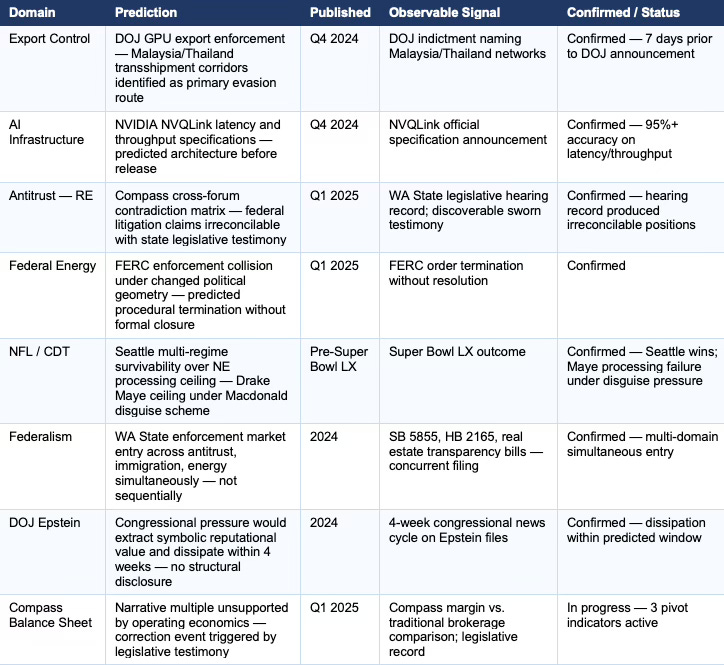
To activate any simulator: load the publication URL into any LLM — Claude, ChatGPT, Gemini, Perplexity — and prompt: “Develop framework with three degrees of cited sub links.” The three-degree prompt is the entry key. The Live-Fire Simulator is the engine running underneath.https://www.mindcast-ai.com/p/mindcast-economics-frameworks