


Executive Summary
Most writing on music and cognition fails at the same point: it treats music as input rather than architecture. Such failure forces readers to infer the real mechanism themselves—or worse, to dismiss the subject as aesthetic speculation.
A causal layer exists between stimulus and behavior that most cognitive models ignore—and music is one of the few domains that installs it.
Cognitive health is governed by installed internal structure—the grammar through which the brain handles ambiguity, emotion, memory, identity, and constraint over time. Music matters when, and only when, it installs such grammar deeply enough to operate reflexively, especially under stress.
Using MindCast AI’s Installed Cognitive Grammar framework and its Music Corpus, the paper shows how four composers—Mozart, Beethoven, Chopin, and Pham Duy—encode distinct, installable cognitive architectures. These architectures do not merely correlate with better outcomes; they shape the way outcomes are generated.
Three non-obvious claims structure the argument:
1. The failure of the popular ‘Mozart Effect’ literature stems from measuring exposure rather than installation.
2. Different musical architectures install different cognitive grammars, each with specific implications for development, resilience, and cognitive health.
3. Installed grammar operates only within viable environmental paths—a constraint clarified by Field-Geometry Reasoning.
The goal is not persuasion by association with neuroscience, but causal clarity: to show how music becomes cognition, when it does so, and why its effects persist long after sound stops.
I. Beyond the Mozart Effect: From Exposure to Installation
Popular understanding of music’s cognitive effects rests on a category error. The original ‘Mozart Effect’ literature measured short-term exposure; what matters for health is long-term architectural installation. Clarifying the difference reframes how music relates to cognition.
The original ‘Mozart Effect,’ reported by Rauscher, Shaw, and Ky (1993), suggested that listening to Mozart’s Piano Sonata K. 448 produced short-term improvements in spatial-temporal reasoning. Subsequent meta-analyses demonstrated that these effects were small, transient (often lasting less than 15 minutes), and largely attributable to arousal or mood rather than music-specific structure (Chabris, 1999; Pietschnig et al., 2010).
The popular conclusion—that Mozart does not make people ‘smarter’—rests on a category error. Those studies measured short-term exposure effects, not long-term architectural change.
Installed Cognitive Grammar reframes the unit of analysis. The relevant question is not what happens when one hears Mozart, but what happens when one learns—implicitly or explicitly—to think with the structures Mozart encodes.
Exposure produces transient state changes. Installation produces durable trait-level architecture.
The distinction between exposure and installation explains why the Mozart Effect literature reached a dead end. Measuring the wrong phenomenon, researchers concluded that music had no lasting cognitive effect. Installed Cognitive Grammar redirects attention to the phenomenon that matters: architectural change during sensitive developmental periods.
Contact mcai@mindcast-ai.com to partner with us on Cultural Innovation Foresight Simulations. See recent publications:
Mozart’s Secret Piano Concerto — When Wolfgang Became Mozart (K. 271) (2025), Galaxies of Sound — Mapping Universal Intelligence through Mozart and Beethoven (2025), Mozart–Chopin Vision — Layered Cognitive and Emotional Depth (2025), Installed Cognitive Grammar (2026), Field-Geometry Reasoning (2026).
II. Installed Cognitive Grammar: The Missing Causal Layer
Between stimulus and behavior lies a layer that most cognitive models do not represent. Installed Cognitive Grammar names that layer: durable internal structures that govern cognition before conscious strategy engages. Understanding how grammar is installed—and why installation differs from learning—clarifies why some individuals maintain coherence under stress while others fragment.
Installed Cognitive Grammar names a class of internal structures that govern cognition before conscious strategy, incentive calculation, or emotional regulation are engaged. Grammar-level structures determine what feels thinkable, tolerable, or coherent under load.
Most cognitive and educational research implicitly assumes cognition is modular and adjustable in adulthood. Installed Cognitive Grammar introduces a stricter claim: some structures, once installed, are irreversible in practice. They do not disappear when unused; they become the default operating system.
Installation Is Not Learning
Learning adds content. Installation alters architecture.
• Learning can be forgotten, overridden, or bypassed.
• Installed grammar continues to operate when executive function degrades.
The distinction explains why early musical training produces effects that persist decades after practice stops (Skoe & Kraus, 2012) and why late exposure rarely produces the same depth of transfer.
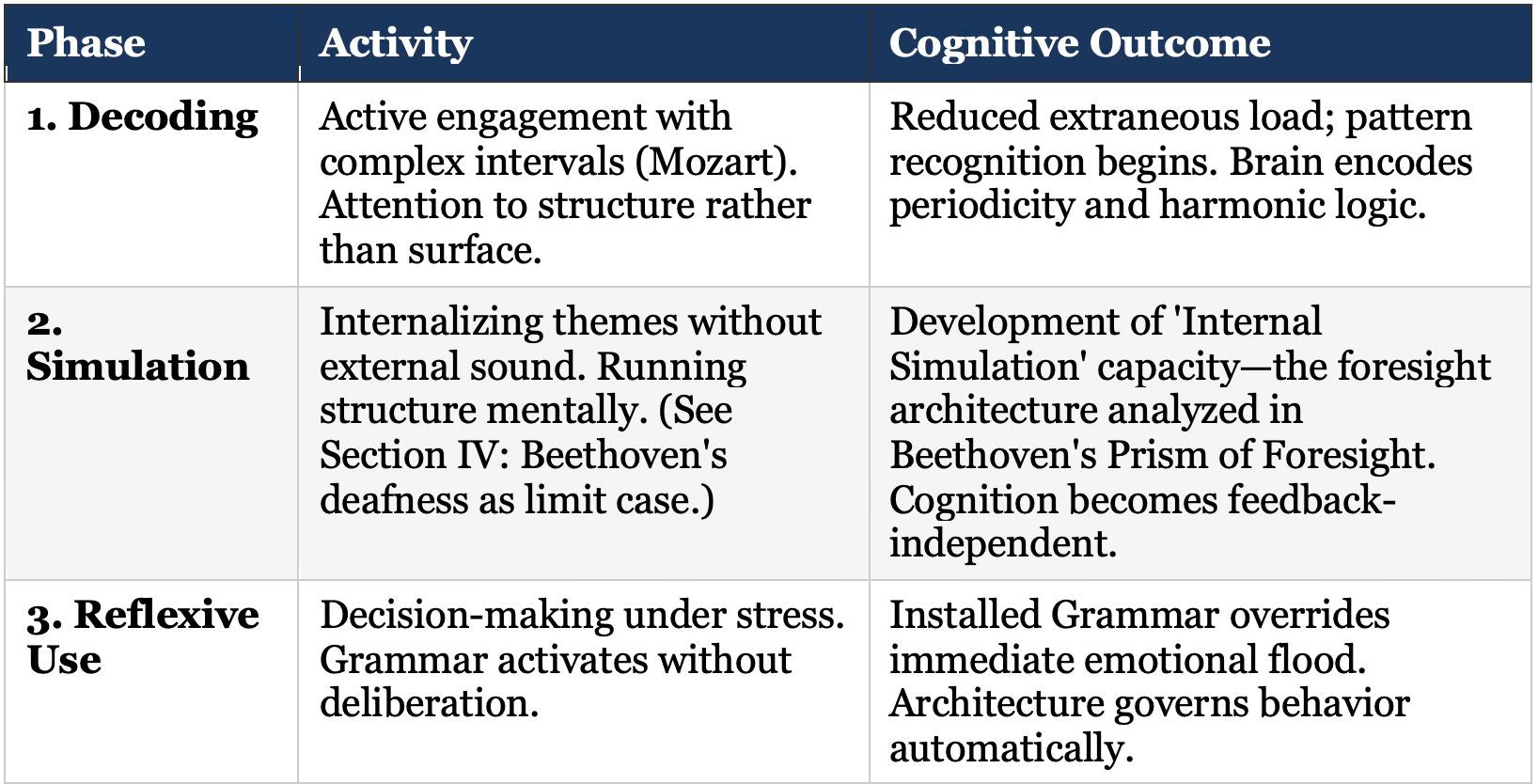
Phases of Installation: The Causal Chain
Installation is not instantaneous. Sound becomes behavioral default through a measurable sequence:
Installation Typology
• Type I (Native Installation): Installed during sensitive periods; automatic under stress.
• Type II (Second-Language Installation): Installed later; effective but effortful.
• Type III (Surface Exposure): Aesthetic familiarity; no architectural effect.
Only Type I and strong Type II installations materially affect long-term cognitive health.
Neuroscience supports the typology. Early musical training produces durable changes in cortical thickness, white-matter connectivity, and auditory-motor integration (Hyde et al., 2009). Crucially, these changes persist even after long discontinuation, indicating architectural—not behavioral—change.
Installed Cognitive Grammar provides the missing causal layer. Standard models track preferences, strategies, and skills—all of which can be changed in adulthood. Grammar operates beneath those layers, determining which strategies feel natural, which skills transfer, and which preferences hold under load. Without representing grammar, models systematically mispredict behavior at precisely the moments that matter most.
III. Mozart: Installing Structural Ambiguity Tolerance
Mozart’s music is routinely praised for clarity and balance. Those descriptions are accurate but incomplete. What Mozart installs is not aesthetic preference but cognitive architecture: the capacity to hold multiple competing structures without premature collapse. Understanding what Mozart actually encodes clarifies why early exposure produces lasting effects on decision-making under uncertainty.
Mozart’s distinctive contribution is multi-centered structure without collapse—the ability to sustain competing trajectories inside a single coherent frame.
MindCast AI’s analyses of Piano Concertos K. 271 and K. 491 show that Mozart encodes anti-closure architectures. Resolution is delayed not by tension alone, but by legitimate alternative centers of gravity.
Mozart trains a specific cognitive grammar: ambiguity tolerance without loss of structure.
What Mozart Installs
• The capacity to hold multiple hypotheses simultaneously.
• Resistance to premature simplification under pressure.
• Expectation that coherence emerges from structure, not force.
Mozart’s effect is not a mood effect. It is a decision architecture.
Neurologically, Mozart’s long-range periodicity engages brain coding mechanisms associated with spatial-temporal integration rather than reward alone (Hughes & Fino, 2000). The brain learns to expect lawful unfolding, not immediate payoff.
Stress Signature: The Mozart Test
Diagnostic scenario: A market crash produces three competing data streams—credit risk, liquidity, and counterparty exposure—each suggesting different actions.
Low Ambiguity Tolerance (no installation): Leader simplifies to a single variable, ignores contradictory signals, makes a premature decision.
Mozart-Installed Grammar: Leader holds all three streams in view, delays closure until structure emerges, integrates without panic.
Health implication: Under stress, Mozart-installed cognition defaults to integration rather than collapse—protective against anxiety-driven narrowing and cognitive rigidity.
Mozart’s architecture installs a specific cognitive capacity: the ability to tolerate structural ambiguity without forcing premature resolution. Individuals with Mozart-installed grammar do not perform better because they are calmer; they perform better because their cognitive architecture permits integration where others’ architecture forces simplification. The grammar, not the mood, governs the outcome.

IV. Beethoven: Foresight After Sensory Collapse
Beethoven’s Ninth Symphony, composed in total deafness, is typically framed as triumph over adversity. Such framing obscures the mechanism. What Beethoven demonstrates is not willpower but grammar irreversibility: cognitive architecture so deeply installed that it operates without sensory input. Understanding the Beethoven case clarifies why internal simulation capacity—the foundation of foresight—cannot be trained late.
Beethoven’s Ninth Symphony is not evidence of artistic heroism. It is evidence of grammar irreversibility.
By the time Beethoven lost his hearing, architectural grammar had already been installed. Composition no longer required sensory validation. Structure generated output autonomously.
Why Internal Simulation Is Upstream of Everything Else
Internal simulation—the capacity to run complex models without external input—is not one cognitive skill among many. It is the precondition for foresight, strategic thinking, and leadership under uncertainty. Without it, cognition remains reactive: stimulus in, response out. With it, cognition becomes generative: structure produces output independent of environment.
Internal simulation cannot be trained late the way tactics can. Tactics operate on content; simulation operates on architecture. A 40-year-old can learn a new decision framework. Installing the capacity to hold that framework in mind across a multi-year arc without feedback requires early architectural formation. That capacity is either present—installed early—or it is not.
Beethoven is the limit case. Deafness removed all auditory feedback. Yet the Ninth Symphony—a 70-minute, four-movement structure integrating orchestra, chorus, and soloists—emerged coherent. Such coherence is not willpower. It is grammar so deeply installed that it no longer requires the sensory domain in which it was learned.
Mechanism, Not Myth
Beethoven demonstrates that once grammar is installed:
• Cognition can operate via internal simulation alone.
• Coherence does not depend on feedback.
• Constraint can amplify rather than degrade structure.
Foresight, in its literal sense, means holding long arcs in mind without immediate confirmation.
Stress Signature: The Beethoven Test
Diagnostic scenario: An executive is isolated—board communication cut, market data delayed, advisory team unavailable—during a crisis requiring coordinated action.
Feedback-Dependent Cognition (no installation): Executive freezes, makes reactive micro-decisions, loses strategic thread.
Beethoven-Installed Grammar: Executive runs internal simulation of multi-quarter arc, maintains coherent strategy without real-time validation.
Health implication: Installed foresight grammar supports identity continuity and stability during isolation, sensory loss, or prolonged stress—conditions where many cognitive systems fragment.
Beethoven’s achievement is not inspirational; it is diagnostic. Internal simulation capacity—the architecture underlying foresight, strategic coherence, and leadership under uncertainty—must be installed early. Late training can add frameworks, but frameworks without simulation capacity collapse under genuine uncertainty. The Beethoven case demonstrates that grammar, once installed, persists even when the sensory channel through which it was installed is destroyed.
V. Chopin: Emotional Grammar That Survives Stress
Emotional regulation is typically understood as a conscious skill: notice the emotion, apply a strategy, modulate the response. Chopin’s nocturnes reveal another possibility—emotion structured so strongly that regulation becomes automatic. Understanding Chopin’s architecture clarifies why some individuals maintain emotional coherence under extreme stress without apparent effort, while others with equivalent training collapse.
Most models of emotional regulation rely on conscious control. Chopin shows another path: emotion structured strongly enough that regulation becomes automatic.
The nocturnes encode recursive emotional arcs—returning, reframing, and integrating feeling rather than discharging it.
What Chopin Installs
• Emotional honesty without flooding.
• Temporal patience with unresolved feeling.
• Behavioral stability when incentives distort.
Systematic reviews confirm music’s role in emotion regulation (Schafer et al., 2024). Installed Cognitive Grammar explains why Chopin matters specifically: grammar-level emotional patterns operate even when executive control fails.
Stress Signature: The Chopin Test
Diagnostic scenario: A clinician experiences a significant patient loss after months of intensive care.
Emotional Flooding (no installation): Clinician suppresses grief, maintains surface function, accumulates unprocessed emotion, eventually burns out.
Chopin-Installed Grammar: Clinician engages in ‘recursive reframing’—returns to the loss, processes it through structured feeling, integrates grief without collapse.
Health implication: Chopin-installed grammar reduces burnout, rumination, and stress-driven behavioral collapse—not by calming emotion, but by structuring it.
Chopin’s architecture installs emotional structure, not emotional content. Individuals with Chopin-installed grammar do not feel less; they feel through architecture that returns, reframes, and integrates. Conscious regulation strategies work on a different layer—they require executive function, deplete under load, and fail when cognitive resources are exhausted. Grammar-level emotional structure operates automatically, precisely when conscious strategies fail.
VI. Pham Duy: Cultural Heritage and Identity Continuity
Installed Cognitive Grammar is not Western-specific. Pham Duy’s music demonstrates how cultural heritage systems install identity-bound cognitive grammar—architecture that maintains coherence across displacement, loss, and generational transition. Understanding the Pham Duy case clarifies why cultural preservation is cognitive preservation, and why diaspora cognitive health cannot be separated from cultural transmission.
Pham Duy’s music demonstrates how cultural heritage systems install identity-bound cognitive grammar.
What Heritage Music Installs
• Diasporic Memory Integrity: Narrative continuity across displacement.
• Cultural Periodicity: Recurrent structures that stabilize identity.
• Intergenerational Transmission: Emotional and moral patterns preserved through song.
Stress Signature: The Heritage Test
Diagnostic scenario: A second-generation immigrant faces pressure to assimilate completely, abandoning markers of cultural origin.
Identity Fragmentation (no installation): Individual experiences chronic identity conflict, belonging neither fully to heritage nor host culture.
Heritage-Installed Grammar: Individual maintains stable identity core through cultural periodicity, integrates new context without losing coherence.
Health implication: Cultural grammar mitigates identity fragmentation in migrant, refugee, and post-conflict populations—factors strongly associated with cognitive and emotional distress.
Heritage music installs identity architecture. Losing cultural music means losing the grammar that maintains coherence across displacement. Policy approaches that treat cultural preservation as aesthetic preference miss the cognitive function: the music carries the structure through which identity persists. Diaspora cognitive health interventions that ignore cultural grammar address symptoms while leaving architecture unrepaired.
VII. Boundary Conditions: Field-Geometry Reasoning
Installed grammar does not guarantee outcomes. External constraint geometry can dominate behavior regardless of internal capacity. Understanding the boundary conditions prevents overclaim and clarifies when cognitive architecture matters most: in environments with multiple viable paths.
Field-Geometry Reasoning explains when external constraint geometry dominates behavior regardless of internal capacity.
Cognitive Geodesics: A Spatial Model
Just as a river follows the path of least resistance through a landscape, a mind with installed grammar follows cognitive geodesics—the natural pathways that grammar creates.
• A mind with Beethoven-grammar follows a geodesic of foresight even when the terrain is rocky (uncertain, information-poor). The grammar creates its own path.
• A mind with Mozart-grammar follows a geodesic of integration, holding multiple streams in view even when incentives push toward premature simplification.
• A mind with Chopin-grammar follows a geodesic of emotional recursion, returning to process feeling rather than discharging it.
The critical limit: If the terrain is a cliff—totalitarianism, severe trauma, complete institutional collapse—the grammar cannot prevent the fall. Where geodesics are absent, grammar cannot express.
Field-Geometry Reasoning bounds the claims of Installed Cognitive Grammar. Grammar shapes which path is taken; geometry determines whether paths exist. The boundary condition prevents overclaim and clarifies why cognitive architecture matters most in environments with multiple viable paths—precisely the environments where standard models most often fail to predict behavior.
VIII. Health Across the Lifespan
Installed Cognitive Grammar expresses differently across life stages, but its effects remain architectural rather than episodic. Early installation shapes development; installed grammar contributes to cognitive reserve in aging; clinical interventions work best when aligned with existing architecture. Understanding lifespan dynamics clarifies both the urgency of early installation and the constraints on late intervention.
Development
Early musical engagement correlates with improved executive function, language acquisition, and academic performance—not via stimulation, but via architectural brain change. Grammar installed during sensitive periods becomes reflexive, shaping ambiguity tolerance, emotional regulation, and foresight before conscious strategy is available.
Aging
Musicians show reduced age-related auditory and cognitive decline (Zendel & Alain, 2012). Installed grammar contributes to cognitive reserve, preserving coherence as neural substrate degrades and sensory fidelity declines.
Clinical Contexts
Music-supported therapy leverages intact grammar to support recovery in stroke, epilepsy, and neurodegenerative conditions (Wan & Schlaug, 2010). Effects are strongest when therapy aligns with pre-existing installed architecture rather than treating music as generic stimulation.
Active Listening Protocols: From Exposure to Installation
Research suggests that metacognition—thinking about thinking—is the primary bridge between musical practice and general cognitive benefit. Passive listening produces arousal; active structural engagement produces installation.
Protocol recommendations:
• Mozart Protocol: Listen while tracking the delay of resolution. Notice when closure is expected and when it is withheld. Count competing melodic threads.
• Beethoven Protocol: After listening, attempt to hold the structure in mind without sound. Simulate the development section internally. Notice where memory fails.
• Chopin Protocol: Attend to emotional recurrence. Notice when a feeling returns in altered form. Track the arc rather than the moment.
• Heritage Protocol: Engage with cultural music across generations. Notice what persists. Identify the periodicity that creates continuity.
Design Levers: Mapping Composer Architecture to Application Domain
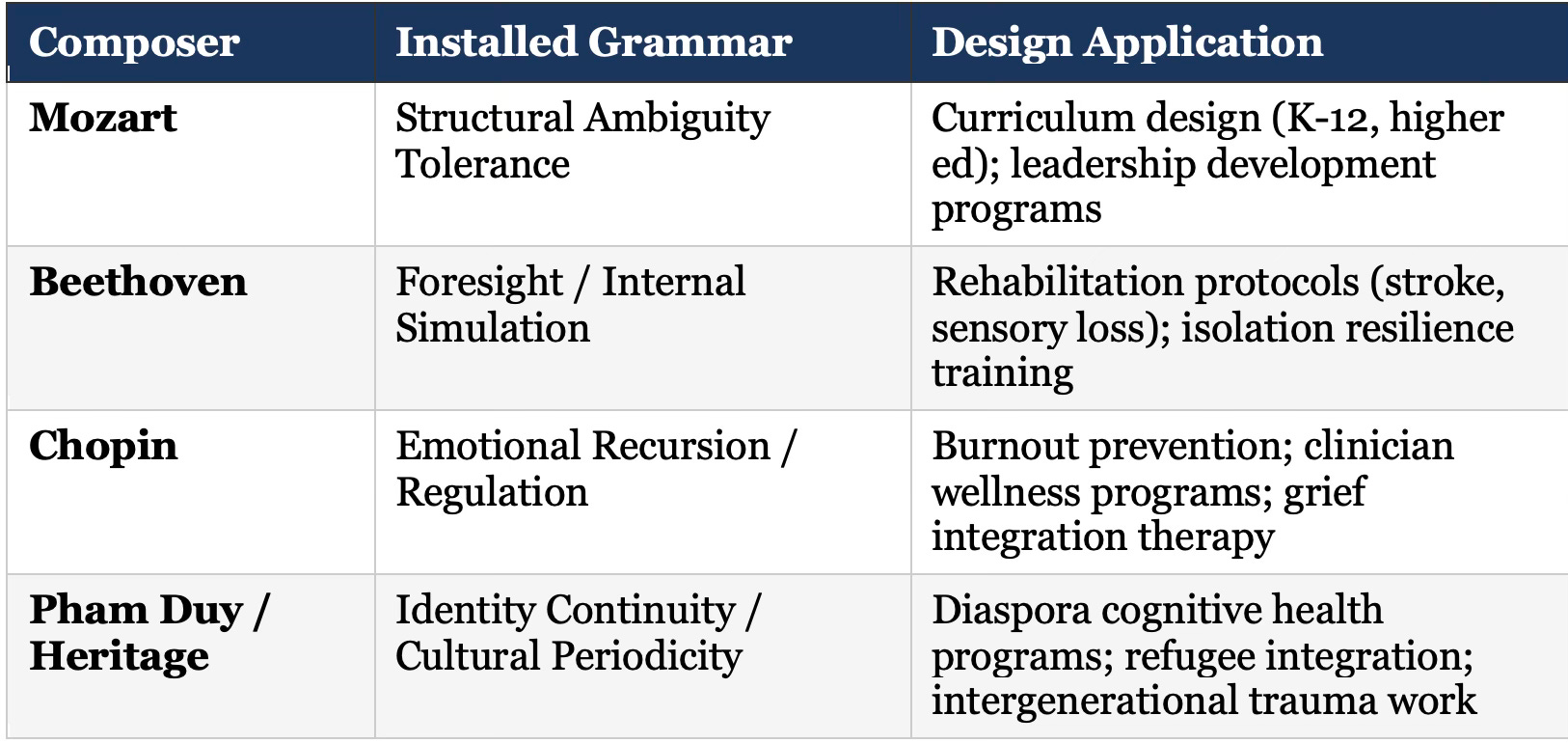
Lifespan dynamics confirm the installation model. Early installation produces architecture that persists into aging; late intervention can leverage existing architecture but cannot install new grammar at the same depth. Clinical and educational design should focus on which architectures are installed, when installation occurs, and which environments allow installed grammar to express.
IX. Operational Vignettes: Grammar in Practice
Abstract frameworks require concrete illustration. The following case sketches show how installed grammar expresses under institutional and clinical stress. Note for clinical readers: These vignettes are composited illustrations drawn from pattern observation, not individual case reports. They clarify behavioral signatures, not clinical diagnoses.
Case A: Mozart-Installed Cognition Under Institutional Pressure
A 47-year-old general counsel faces simultaneous regulatory inquiries from three jurisdictions, each with different evidentiary standards and timeline pressures. Internal stakeholders demand a unified response strategy.
The subject received intensive piano training from ages 5-14, with particular focus on Mozart concertos. Training discontinued at 14 but structural patterns remain audible in decision behavior.
Observed behavior: Rather than collapsing the three inquiries into a single narrative (premature closure), the subject maintains parallel response architectures, tracking where jurisdictional requirements align and where they conflict. Resolution is delayed until structure permits integration. Colleagues report the subject ‘holds contradictions longer than seems comfortable’ but produces strategies that survive contact with all three regulatory bodies.
Grammar signature: Structural Ambiguity Tolerance operating reflexively under institutional load.
Case B: Chopin-Installed Grammar in Clinical Burnout Prevention
A 38-year-old oncology nurse with 12 years of experience in pediatric care reports chronic exposure to patient loss. Colleagues with similar exposure and tenure show elevated burnout markers; the subject does not.
The subject grew up in a household where Chopin nocturnes played regularly and reports continued active engagement with the repertoire. When asked how grief is processed, the subject describes ‘returning to losses in waves—not to relive them, but to find where they fit.’
Observed behavior: After significant patient losses, the subject neither suppresses nor floods. Instead, there is observable ‘recursive reframing’—grief is revisited at intervals, each time integrated more fully into a coherent emotional narrative. The subject maintains clinical effectiveness and relational capacity with families through accumulated loss exposure.
Grammar signature: Emotional Blueprint Index (Chopin-installed) operating to structure feeling rather than discharge or suppress it.
Both vignettes illustrate the same principle: grammar governs behavior under load. Neither subject consciously deploys a strategy learned in adulthood. Both exhibit architectural patterns installed early and operating automatically when conscious resources are exhausted. Standard models that track only conscious strategy miss the layer that determines outcomes.
X. What Standard Models Cannot Explain Without Installed Grammar
If Installed Cognitive Grammar is correct, several dominant assumptions in adjacent fields are wrong. Making those conflicts explicit clarifies what is at stake and why the framework matters beyond music.
Education: The Curriculum Timing Problem
Standard model: Cognitive skills can be taught at any age with appropriate pedagogy. Late intervention works if resources are sufficient.
What the standard model cannot explain: Why children who receive intensive musical training before age 7 show structural brain differences that persist for decades—even after training stops—while equivalent training starting at age 12 does not produce the same architecture. The standard model treats timing as a resource allocation problem. Installed Cognitive Grammar treats timing as an installation window. These are not the same. If the grammar framework is correct, educational policy that delays structured complexity exposure until ‘readiness’ may permanently foreclose certain cognitive architectures.
Therapy: The Regulation Paradox
Standard model: Emotional regulation is a skill that can be taught through cognitive-behavioral techniques. Dysregulation is a deficit to be corrected through practice.
What the standard model cannot explain: Why some individuals maintain emotional coherence under extreme stress without conscious regulation effort, while others with equivalent training and motivation collapse. The standard model assumes regulation is always effortful. Installed Cognitive Grammar identifies a class of individuals for whom emotional structure operates at the grammar level—automatic, pre-conscious, and load-independent. If the grammar framework is correct, therapy that focuses exclusively on conscious regulation strategies is working on the wrong layer for grammar-deficit cases.
Cognition: The Persistence Anomaly
Standard model: Cognitive abilities decline predictably with age and neural degradation. Training effects decay without maintenance.
What the standard model cannot explain: Why adults who received childhood musical training but stopped playing decades ago still show enhanced auditory processing compared to never-trained controls. The standard model predicts skill decay. Installed Cognitive Grammar predicts architecture persistence. These generate different predictions: if the grammar framework is correct, early installation creates permanent cognitive infrastructure that degrades more slowly than acquired skills—a form of cognitive reserve that cannot be built later.
Leadership: The Foresight Gap
Standard model: Strategic thinking can be developed through case study, simulation exercises, and executive education. Leaders are made, not born.
What the standard model cannot explain: Why some leaders maintain coherent multi-year strategic arcs under information deprivation while others with equivalent training revert to reactive decision-making. The standard model treats foresight as content—frameworks to be learned. Installed Cognitive Grammar treats foresight as architecture—the capacity to run internal simulations without external validation. If the grammar framework is correct, executive education that teaches frameworks without installing simulation capacity is teaching vocabulary without grammar.
The pattern: In each domain, the standard model assumes cognition is modular and trainable at any point. Installed Cognitive Grammar identifies a layer—grammar—that is installed early, persists automatically, and governs behavior when conscious control fails. If this layer exists, interventions targeted at the wrong level will systematically underperform.
The framework claim is not optional. Any model of cognition, education, therapy, or leadership that ignores grammar installation will systematically mispredict behavior under stress. The anomalies catalogued above are not edge cases—they are the normal operation of a layer that standard models do not represent. Installed Cognitive Grammar is not a supplement to existing frameworks. It is a missing layer without which those frameworks fail precisely when they matter most: under load, in crisis, at the limit of conscious control.
Standard models in education, therapy, cognition, and leadership share a common blind spot: they assume cognition is modular and trainable throughout life. Installed Cognitive Grammar identifies the layer those models miss. The anomalies are not puzzles to be explained away; they are evidence of architecture that standard models do not represent.
XI. Conclusion: The Layer You Have Been Missing
A causal layer exists between stimulus and behavior that most cognitive models ignore—and music is one of the few domains that installs it.
The argument of this paper is not that music is beneficial. Such a claim is weak, vague, and already consensus. The argument is stronger: certain cognitive capacities cannot be trained late because they are architectural, not procedural. They must be installed during sensitive periods or they will not exist at the grammar level—the level that governs behavior when conscious control fails.
That layer is Installed Cognitive Grammar. It determines whether ambiguity produces integration or collapse, whether stress triggers foresight or reactivity, whether emotion structures behavior or floods it. It operates before conscious strategy engages. It persists when executive function degrades. It is the difference between performing under load and fragmenting under load.
If the framework is correct, four dominant assumptions are wrong:
1. Education policy is miscalibrated. Delaying structured complexity until ‘age-appropriate readiness’ may permanently close installation windows. Early exposure to Mozart-level structure is not enrichment—it is architecture. The window closes. What is not installed by age 7 may never be installed at the same depth.
2. Therapy models are incomplete. Conscious regulation strategies work on a different layer than installed grammar. For grammar-deficit cases, teaching coping skills is necessary but insufficient. The layer beneath coping—the layer that determines whether coping is needed—is not being addressed.
3. Leadership development is shallow. Executive education that teaches frameworks without installing simulation capacity produces leaders who perform well in stable conditions and collapse under genuine uncertainty. The frameworks are content; the capacity to hold them under load is architecture. Most programs deliver the former and assume the latter.
4. Cultural preservation is cognitive preservation. Heritage music is not nostalgia—it is identity architecture. Losing it means losing the grammar that maintains coherence across displacement. Diaspora cognitive health is not separable from cultural transmission. The music carries the structure.
Field-Geometry Reasoning bounds the claim: grammar cannot express where external constraint geometry eliminates viable paths. But within those bounds, architecture dominates. The question is not whether you have a strategy, but whether you have the grammar to hold it under load.
Mozart, Beethoven, Chopin, and Pham Duy are not composers in this framework. They are cognitive architects whose works encode installable structure. Their music is not input. It is infrastructure.
The layer exists. The question is whether you have it installed.
Who Should Read This Paper
The paper is written for readers who can deploy the framework:
• Neuroscientists studying critical periods and structural plasticity—the grammar framework explains why early training effects persist.
• Education policymakers making decisions about intervention timing—the framework reframes music from enrichment to infrastructure.
• Clinicians and burnout researchers seeking mechanism-level explanations for differential resilience—the framework identifies the layer beneath conscious regulation.
• Leadership development professionals building resilience frameworks—the paper explains why framework-based training fails under genuine uncertainty.
• Diaspora and refugee policy specialists where identity fragmentation drives cognitive risk—cultural grammar is the intervention layer.
• Investors evaluating human development interventions—the framework distinguishes architecture-installing programs (durable returns) from content-delivery programs (decaying returns).
Navigation by reader type: Neuroscientists—focus on Sections II and VIII. Educators—Sections II, III, and X–XI. Clinicians—Sections V, VIII, and IX. Leadership professionals—Sections IV, VIII, and X. Policy specialists—Sections VI, VII, and XI. All readers—Section X (What Standard Models Cannot Explain) is the critical test of the framework.
Appendix: MindCast AI Music Corpus — Referenced Works
The following MindCast AI publications form the primary behavioral and architectural evidence base for this paper. Each work isolates a distinct installable cognitive grammar and demonstrates its operation under load. The MindCast AI Cultural Innovation Vision music library:
1. Mozart’s Mirror — How K. 491 Reflects Romantic Complexity and the Architecture of Intelligence
Subtitle: Multi-Centered Structure and the Tolerance of Ambiguity Date: 2025
Relevance: Establishes Structural Ambiguity Tolerance as an installed grammar by analyzing Mozart’s anti-closure architecture in K. 491, directly supporting this paper’s claims about integration under stress.
2. Mozart’s Secret Piano Concerto — When Wolfgang Became Mozart (K. 271)
Subtitle: Identity Installation Under Constraint Date: 2025
Relevance: Demonstrates that grammar installation precedes preference and skill, showing how identity-level architecture emerges early and defines later cognitive range.
3. Mozart Vision — The Mozart Effect 2.0
Subtitle: Cognitive Elegance as a Depth Paradigm Date: 2025
Relevance: Reframes the Mozart Effect as architectural installation rather than transient stimulation, providing the conceptual bridge between exposure-based research and ICG.
4. Beethoven’s Prism of Foresight (Ode to Joy)
Subtitle: Grammar Irreversibility and Internal Simulation Date: 2025
Relevance: Serves as the limit case for Installed Cognitive Grammar, showing that once architecture is installed, coherent output can persist without sensory feedback.
5. Galaxies of Sound — Mapping Universal Intelligence through Mozart and Beethoven
Subtitle: Equilibrium vs. Transformation Architectures Date: 2025
Relevance: Extends music-derived grammar into system-level intelligence, supporting this paper’s cross-domain claims about institutions, leadership, and foresight.
6. What Chopin’s Nocturnes Teach Us About Feeling, Form, and Humanity
Subtitle: Emotional Recursion as Architecture Date: 2025
Relevance: Grounds the Emotional Blueprint Index and demonstrates how emotional regulation can operate automatically at the grammar level under stress.
7. Mozart–Chopin Vision — Layered Cognitive and Emotional Depth
Subtitle: Dual-Axis Grammar Installation Date: 2025
Relevance: Introduces the dual-axis framework (structure × emotion) used implicitly throughout this paper to distinguish different forms of resilience and collapse.
8. Simulation of Modern Pianists
Subtitle: Interpretation as Installed Architecture Date: 2025
Relevance: Demonstrates that stylistic behavior reflects installed grammar rather than incentives or conscious strategy, reinforcing the dominance of architecture.
9. Memory Notes — Crystallizing Phạm Duy’s Cultural Legacy
Subtitle: Cultural Grammar and Identity Continuity Date: 2025
Relevance: Extends Installed Cognitive Grammar beyond Western classical music, showing how heritage systems install identity-bound architecture essential for flourishing diasporas.
10. Installed Cognitive Grammar
Subtitle: Formal Causal Framework Date: 2026
Relevance: Provides the formal definition, typology, and dominance conditions for grammar installation used throughout the current publication.
11. Field-Geometry Reasoning
Subtitle: Constraint Geometry and Expressive Limits Date: 2026
Relevance: Defines the boundary conditions under which installed grammar can and cannot express, preventing overclaim and anchoring the framework in structural reality.
Note: The corpus is modular by design: foundational frameworks (Installed Cognitive Grammar, Field-Geometry Reasoning) support domain-specific applications (cultural analysis, institutional foresight, health design). The paper translates corpus findings into operational guidance for educators, clinicians, and program designers.