


AI Accountability: When AI Promises Meet the Courts
Oracle, OpenAI, and the Capacity Economy — Inside the AI Infrastructure-Financing Lawsuit
Apple’s AI Illusion Narrative Control and the Law’s Search for Structural Truth
The Wall Street Journal published Car Owners Are Revolting Over Tesla’s Self-Driving Promises on April 20, 2026. The article centers on Tom LoSavio, a retired attorney and lead plaintiff in a California federal class action, who paid more than $100,000 for a 2017 Tesla Model S — including $8,000 for the Full Self-Driving (FSD) software package — based on Elon Musk’s representation that the onboard hardware would eventually enable full autonomy through software updates. Nine years later, the hardware cannot deliver the promised capability, and Tesla has produced no remediation plan.
The WSJ story documents a narrow consumer-backlash narrative. The underlying structural event is considerably larger. Electrek’s April 16, 2026 aggregation identifies 21 active litigation tracks against Tesla with combined exposure estimates of $2.7 billion to $14.5 billion, including the $243 million Benavides v. Tesla verdict (Miami federal jury, August 2025), the Morand v. Tesla securities class action (August 2025), the December 2025 California DMV ruling that Tesla’s FSD marketing is “actually, unambiguously false,” class certification of In re Tesla ADAS on a full-refund theory (California, August 2025), and collective claims filed by European and Australian Hardware 3 (HW3) owners. Roughly four million vehicles worldwide carry HW3 hardware that Musk admitted on a January 2025 earnings call will require physical replacement. Tesla sued the California DMV rather than correct the marketing.
The integrated assessment below applies MindCast’s predictive institutional cybernetics framework stack to initialize the system state, diagnose the structural dynamics producing the observed revolt, identify the forcing functions driving cascade acceleration, and execute forward simulation of repricing and resolution trajectories.
PART ONE — SYSTEM INITIALIZATION AND STRUCTURAL DIAGNOSIS
I. System Definition
The predictive institutional cybernetics framework begins with explicit system initialization. The actors, variables, and state readings that follow define the operational substrate against which all downstream simulation executes.
Primary Cognitive Digital Twins (CDTs): Tesla as firm CDT with its product, marketing, legal, and executive communication layers; United States federal regulators including the National Highway Traffic Safety Administration (NHTSA) and the Securities and Exchange Commission (SEC); United States state regulators including the California Department of Motor Vehicles (DMV) and state attorneys general; European Union regulators operating through consumer protection enforcement and General Data Protection Regulation (GDPR) authorities; Tesla consumers spanning retail owners, early adopters, FSD package purchasers, and HW3 holders; courts as federal tort forums, securities enforcement forums, state consumer-protection forums, and EU collective-action forums; and competitors including autonomy developers such as Waymo, Cruise, and Mobileye along with original equipment manufacturers (OEMs).
State Variables and April 20, 2026 Readings (Post-DMV / Post-HW3 Admission Cascade):
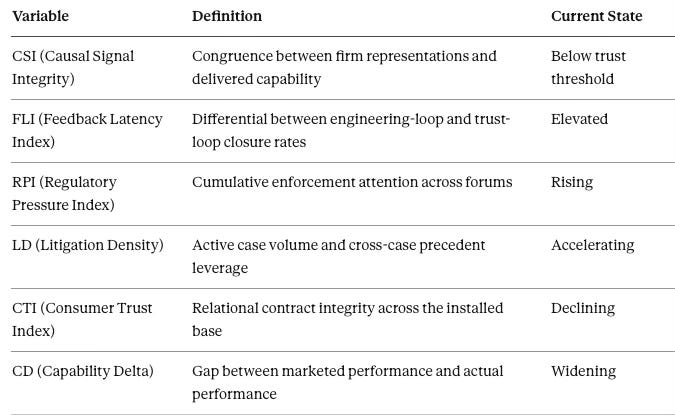
The equilibrium class is Delay-Dominant transitioning toward a Pre-Correction Transition State, and the game regime is Labyrinth — high constraint and high latency. The dominant mechanism is cross-layer desynchronization between signal, capability, and trust under high constraint geometry. All forward simulation in Part Two is conditioned on the persistence of the state variables and forcing-function pathways defined herein.
II. Governing Insight
Tesla operates in a delay-dominant dual-equilibrium failure state where behavioral continuity persists while cognitive legitimacy collapses under signal–capability divergence.
The observable consumer revolt reported by the Wall Street Journal is not a marketing failure, a product failure, or a legal failure in isolation. The revolt is the surface manifestation of a cybernetic system whose signal, capability, and trust layers have lost synchronization. Framework analysis produces a different conclusion than case-by-case legal or financial commentary: the cascade was architecturally inevitable from the moment the January 2025 earnings-call admission crossed forum boundaries.
III. Dual-Equilibrium Termination Architecture
Market stability requires two equilibria operating in alignment. The Nash equilibrium is behavioral — users continue engaging with the product. The Stigler equilibrium is cognitive — users trust the information environment. Tesla currently satisfies the first but fails the second. Transactions continue. Customers purchase vehicles. FSD package sales proceed at up to $8,000 per unit. Tesla continues to charge for the software despite the September 2025 quiet redefinition of “Full Self-Driving” on the company website.
The cognitive equilibrium has nevertheless debonded from the behavioral equilibrium. The LoSavio class action, the European HW3 collective claim filed the week of April 14, 2026, the Australian class action, and the Morand securities fraud case collectively measure the cognitive-layer failure while Tesla’s delivery and revenue figures continue to report behavioral-layer stability.
A fragile equilibrium persists. The system remains stable until an external forcing function triggers repricing. Balance-sheet analysts measuring the Nash surface will report stability while the Stigler substrate has already failed. Tesla’s approximately $40 billion cash position ensures balance-sheet survival but does not regenerate the cognitive-trust substrate that produced the valuation premium. The distinction matters because standard financial commentary treats cash position as evidence of stability. In dual-equilibrium terms, cash position describes only the Nash layer. The Stigler layer is measured through litigation volume, regulatory attention, consumer-trust indicators, and cross-forum narrative consistency — and every one of those metrics has moved against Tesla during the eighteen months preceding publication.
IV. Causal Signal Integrity
Tesla’s core failure lies in signal inflation. The Causal Signal Integrity diagnostic decomposes the failure into four measurable sub-components. Action–Language Integrity (ALI) measures congruence between stated action and executed action over a defined observation window, and reads low: Musk has predicted unsupervised autonomy “by the end of the year” in every year from 2018 forward, and Wikipedia maintains a tracking page of the predictions running to dozens of entries. Cognitive–Motor Fidelity (CMF) measures the fidelity between the cognitive model communicated to users and the motor or behavioral output of the system, and reads moderate: FSD performs capably in bounded conditions while failing at the edges that categorical “Full Self-Driving” language implies. Relational Integrity Score (RIS) measures the integrity of the relational contract between firm and user across time, and reads declining: fifteen months after Musk’s HW3 admission, Tesla has produced no retrofit program, no refund policy, and no timeline, and the promised “v14 Lite” software variant for HW3 targeted for Q2 2026 has not materialized. Degree of Contradiction (DoC) measures the rate at which firm representations self-contradict across forums or time periods, and reads increasing: the “corporate puffery” defense deployed in federal court directly contradicts the marketing language deployed on Tesla.com, and both contradict the January 2025 earnings-call admission.
Product naming implies autonomy beyond demonstrated capability. Forward-looking timelines anchor expectations the firm has serially missed. Demonstrations selectively emphasize success cases while failure modes migrate to court dockets and regulatory filings. The June 2025 public Robotaxi tests — during which vehicles reportedly sped, braked suddenly, drove over curbs, entered incorrect lanes, and dropped passengers in multi-lane roads — wiped out approximately $68 billion in market capitalization over two trading days and triggered the Morand securities class action.
The composite CSI signature — low ALI, moderate CMF, declining RIS, rising DoC — is diagnostic of a firm running narrative-forward signal suppression on a technically-constrained product. The system transitions from adoption mode to skepticism mode not because of any single event but because the four sub-components have each crossed their respective thresholds within an eighteen-month window.
The mechanism is narrative arbitrage — the systematic exploitation of temporal gaps between market promises and operational feasibility. MindCast’s July 2025 analysis of the Apple AI Illusion identified the same mechanism operating in Apple’s June 2024–March 2025 “Apple Intelligence” marketing campaign, where confident public timeline representations coordinated with undisclosed internal engineering limitations to extract approximately $900 billion in market value before the disclosure correction collapsed the premium. Tesla runs the identical architecture across a longer timeframe: the 2016–2024 autonomy premium is the arbitrage yield, the January 2025 earnings-call admission is the partial correction event, and the cascade from August 2025 forward is the secondary repricing. The Apple and Tesla cases together establish that narrative arbitrage is the dominant strategic pattern across AI-era firms selling capability narratives against a development substrate.
V. Cybernetic Control Breakdown
Tesla operates two feedback loops. The engineering loop runs from data to model to update to improvement; the loop closes at sub-second latency and iterates continuously across the fleet. The trust loop runs from promise to experience to belief to retention; the loop remains open. Corrective information arrives slowly, propagates publicly, and amplifies through litigation, regulatory rulings, and collective customer action. The WSJ article itself functions as a trust-loop amplification event, consolidating years of dispersed customer frustration into a single nationally-distributed narrative.
The Feedback Latency Index captures the differential. Engineering feedback is rapid; trust correction is delayed and publicly amplified. The implication is that negative feedback compounds faster than system improvements when latency exceeds tolerance. A firm can iterate its technical surface faster than its trust substrate can repair. FLI is not Tesla-specific — the variable applies equally to artificial intelligence foundation model firms, prediction market platforms, and real estate brokerages running rapid iteration against slower legitimacy substrates. The diagnostic transfers across industries because the underlying asymmetry between loop closure rates is structural rather than firm-specific.
VI. Chicago Law and Behavioral Economics
Four sequential mechanisms describe Tesla’s strategic occupation of the regulatory response curve. The progression runs Coase to Becker to Stigler to Posner, and each layer produces observable Tesla evidence.
The Coase layer captures coordination failure. Tesla bypasses institutional alignment on definitions and standards of autonomy. No shared industry taxonomy binds the firm’s product language to external verification. The Society of Automotive Engineers (SAE) autonomy levels exist, but Tesla does not use them in consumer-facing marketing, and no regulatory body enforced the taxonomy against Tesla’s naming convention until the December 2025 California DMV ruling. The coordination failure is not accidental — it is the precondition for the Becker-layer rent extraction that follows.
The “no coordination” framing requires qualification. The Uniform Commercial Code supplies a coordination substrate that does not require regulatory enforcement. UCC § 2-313 creates express warranties from any affirmation of fact or promise made by the seller that relates to the goods and becomes part of the basis of the bargain. UCC § 2-314 imposes an implied warranty of merchantability requiring goods to conform to the promises or affirmations of fact made on the label. UCC § 2-315 imposes an implied warranty of fitness for a particular purpose where the seller has reason to know the buyer’s purpose and the buyer relies on the seller’s skill. Tesla’s “all hardware needed for full self-driving capability” representation — made on Tesla.com and in purchase materials from October 2016 forward — meets the § 2-313 affirmation-of-fact test and the § 2-314 label-conformity test cleanly. The $8,000 FSD package purchase, made for the specific purpose of future autonomous-driving capability that Tesla had reason to know, meets the § 2-315 fitness test cleanly. The Magnuson-Moss Warranty Act at 15 U.S.C. § 2301 et seq. reinforces the UCC substrate for consumer transactions over $10, provides a federal cause of action under § 2310(d), awards attorney fees to prevailing consumers, and limits the seller’s ability to disclaim implied warranties where a written warranty has been issued — which Tesla has issued in the form of the new-vehicle limited warranty. Private contract law reaches the same coordination result as public regulation, and reaches it without waiting for NHTSA or the California DMV to act. Tesla rationally avoided the warranty substrate by constructing marketing architecture designed to straddle the puffery/warranty line — which is itself a Stigler-layer maneuver rather than a genuine coordination vacuum. The puffery defense in the tort forum and the warranty liability in the consumer-sale forum cannot both hold: if “all hardware needed for full self-driving capability” is puffery, the statement fails to create an express warranty and the firm avoids § 2-313 exposure; if the statement is factual, the firm faces direct warranty liability across approximately four million vehicles. The firm has selected the puffery position in federal tort litigation while the representation remained on marketing materials operating in a sales forum where puffery does not apply — an unstable position that the disclaimer language in Tesla’s purchase agreements cannot resolve. UCC § 2-316(2) requires disclaimers of merchantability to mention merchantability and be conspicuous, a format test Tesla’s online purchase flow has historically failed. Magnuson-Moss preempts implied-warranty disclaimers where a written warranty is given. Express warranties created by affirmations of fact under § 2-313 cannot be disclaimed at all. The warranty substrate remains live notwithstanding Tesla’s contractual architecture.
The Becker layer captures incentive optimization. Overstatement of future capability rationally maximizes capital formation, data acquisition, and customer lock-in. Tesla faced asymmetric payoffs favoring narrative expansion across the entire 2016–2024 window. The market capitalization premium the firm carried during the period — exceeding the combined market capitalization of most other automakers — was priced on the narrative rather than the delivered product. The Becker-layer logic is what legal analysts mistake for “corporate puffery” when they see it in isolation; viewed in sequence, it is the predictable rational response to the Coase-layer coordination vacuum.
The Stigler layer captures information asymmetry management. Tesla manages the gap between firm-held capability data and public-facing representations. The December 2025 California DMV ruling and Tesla’s subsequent lawsuit against the DMV rather than correction of the marketing are observable Stigler-layer maneuvers. The September 2025 quiet redefinition of “Full Self-Driving” on the company website while maintaining the $8,000 price point is a second Stigler-layer move — a terminology revision without commercial consequence.
The Posner layer captures delayed correction. Legal intervention occurs after observable contradiction or harm. The Benavides verdict, Judge Beth Bloom’s February 2026 ruling rejecting Tesla’s appeal on every ground, and the January 2025 HW3 admission mark the point at which Posner-layer correction began closing the pre-correction window. Tesla’s rejection of a $60 million Benavides settlement offer before trial — followed by a $243 million verdict — measures the firm’s continued misreading of where the window currently sits.
Tesla operates inside a pre-correction window where incentives reward narrative expansion and penalties lag. The window is now closing.
VII. Strategic Game Theory, Field Geometry, and Installed Cognitive Grammar
Three additional framework Visions complete the structural diagnosis. Each addresses a different mechanism that sustains the delay-dominant equilibrium.
Strategic Game Theory. Tesla’s system exhibits a delay-dominant equilibrium in which narrative continuation produces higher payoff than immediate correction, customers lack coordination to enforce reset, and competitors do not impose discipline due to shared constraints. The Strategic Delay Preference Index reads high and the Equilibrium Persistence Under Loss reads high but declining. The system persists despite visible dissatisfaction. The January 2025 earnings-call admission functioned as the first internally-generated signal that the delay-dominant equilibrium could no longer hold — because Musk, speaking in a securities-law forum, could not deploy the same language used in consumer-marketing forums. The admission seeded the Morand securities class action seven months later and strengthened every downstream plaintiff’s case by converting prior contested claims into admitted fact.
Field-Geometry Reasoning. Autonomous driving is governed by constraint geometry. Edge-case explosion creates combinatorial complexity, safety thresholds approach zero-error requirements, and regulatory acceptance remains binary. Constraint density is extremely high and geodesic availability is limited. Capability progression follows a non-linear convex curve. Expectation curves assumed linear advancement, producing divergence between the promise trajectory and the capability trajectory. The divergence widens as the product approaches the zero-error boundary rather than narrows. The NHTSA October 2025 investigation covering 2.88 million vehicles identified 80 FSD-specific traffic violations — red light running, wrong-lane entries, wrong-way driving. A separate NHTSA engineering analysis covering 3.2 million vehicles — the stage preceding a mandatory recall — addresses FSD performance in reduced-visibility conditions. Edge-case accumulation compounds rather than diminishes as deployment scales.
Installed Cognitive Grammar. Consumers process autonomy through binary grammar: autonomous or not autonomous. Tesla delivers probabilistic performance within a gradient system. The mismatch is not incidental. Language triggers categorical expectations while product behavior remains probabilistic. Signal suppression strategies are linguistically parasitic on binary consumer grammar — a firm cannot extract rent from suppressed signal on terminology the market decodes gradient-ly. “Full Self-Driving” generates cognitive asymmetry specifically because consumers decode “full” categorically. Substitute “improved driver-assist” and the extraction mechanism collapses. The September 2025 website redefinition attempted to convert the terminology from categorical to gradient while holding the price constant. The move fails because the binary grammar that generated the original rent has already installed itself in the consumer population — redefinition does not retroactively repair the cognitive grammar of buyers who purchased under the prior representation. The structural principle generalizes: signal suppression equilibria depend on binary ICG substrates, and firms running narrative-forward strategies select categorical terminology because gradient terminology will not support the asymmetry.
VIII. System Synthesis
Tesla operates a mis-synchronized cybernetic system across three layers. The signal layer runs ahead through marketing and narrative. The capability layer advances under constraint through engineering. The trust layer degrades under contradiction through consumer cognition.
Backlash emerges from the interaction of degraded CSI, elevated FLI, binary ICG, and delay-dominant strategic equilibrium operating under extreme constraint density. No single layer produces the revolt. The revolt is a cross-layer synchronization failure that the WSJ article surfaces as consumer narrative and that the 21-track litigation landscape measures as institutional consequence.
The synthesis is the diagnostic payload. Case-by-case legal commentary treats each litigation track as a discrete event. Financial commentary treats the valuation premium as priced on delivered product. Both misread the system. The cascade is a single cross-layer desynchronization producing multiple observable symptoms across multiple forums simultaneously.
IX. Forcing Function Identification
Forcing functions collapse forum separation.
DETA equilibria persist until an external forcing function triggers repricing. A forcing function is an event that imports information from a forum governed by rules the firm cannot control into a forum the firm was previously controlling. The structural effect is forum-separation collapse — the firm loses the ability to maintain divergent representations across legal, regulatory, investor, and consumer forums.
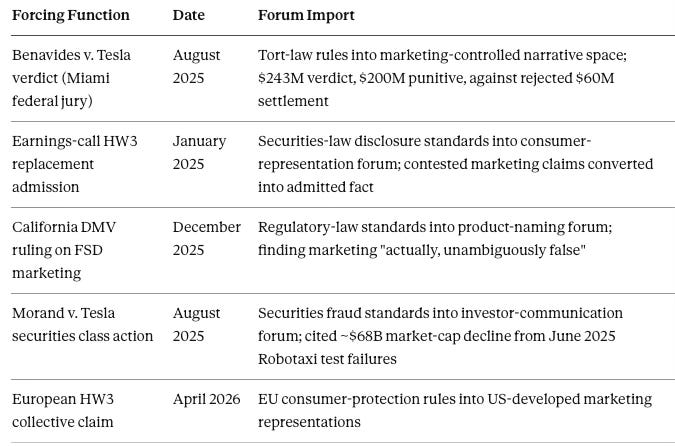
The September 2025 quiet redefinition of “Full Self-Driving” on Tesla.com, the “corporate puffery” defense filings, and Tesla’s suit against the California DMV are not forcing functions. Each move is a narrative-runtime preservation attempt responding to forcing functions rather than a forcing function itself. Distinguishing the two categories is diagnostically essential — forcing functions accelerate the cascade; preservation attempts reveal the firm’s internal model of where the equilibrium has broken. When a firm sues its regulator rather than comply, the firm is signaling that it has no internal pathway to compliance compatible with maintaining the rent extraction — a tell that analysts reading the Stigler layer can use to calibrate the remaining duration of the pre-correction window.
The forcing function set operates across two distinct mechanisms that warrant separation. Tort-track forcing functions (Benavides v. Tesla) operate through civil jury findings of negligence or strict liability, with damages scaled to injury severity and punitive multipliers. Warranty-track forcing functions operate through UCC §§ 2-313, 2-314, and 2-315 and through Magnuson-Moss, with damages scaled to contract value and with no requirement of intent proof. The In re Tesla ADAS class certification on a full-refund theory (California, August 2025), the European HW3 collective claim (April 2026), and the Australian class action running under the Australian Consumer Law’s statutory guarantee framework are warranty-track forcing functions rather than tort-track forcing functions. The mechanisms produce different cascade properties — tort-track cases produce precedent leverage on damages but require individual causation proof per plaintiff, while warranty-track cases produce class-scalable refund liability on representation proof alone. The full-refund theory accepted in In re Tesla ADAS is the warranty substrate operating at class scale: if certified on the merits, every California FSD purchaser who opted out of arbitration recovers the $5,000 to $15,000 they paid, with no requirement to prove reliance or damages beyond the purchase itself. The broader exposure theory — that the “all hardware needed” representation affected every Tesla sold from October 2016 forward, not merely FSD package purchasers — would scale the warranty track from hundreds of thousands of vehicles to approximately four million, converting the exposure from class-action scale to manufacturer-recall scale.
The paired-forum forcing function architecture — federal securities plus state consumer protection running simultaneously — has a direct precedent in Apple. Tucker v. Apple (N.D. Cal. Rule 10b-5 securities class action covering June 2024–March 2025) and Landsheft v. Apple (N.D. Cal. California false advertising and unfair competition class action) are the securities-track and consumer-track forcing functions running against Apple’s iPhone 16 Apple Intelligence representations. Morand v. Tesla and In re Tesla ADAS occupy the same architectural positions in the Tesla cascade. MindCast’s prior analysis of the Apple paired-forum architecture (July 2025) documented the coordination pattern and the temporal manipulation mechanism that produces the paired-forum exposure; the Tesla cascade runs the identical architecture at larger scale and across a longer duration.
X. Structural Falsification Conditions
The structural diagnosis fails under three measurable outcomes. First, scaled unsupervised autonomy achieved by April 2028 — twenty-four months from publication — defined as SAE Level 4 capability across Tesla’s HW3 and HW4 fleet without active safety driver supervision. Second, a customer complaint velocity decline of 40 percent or greater by April 2027 without narrative or pricing changes, measured through NHTSA complaint filings and active litigation volume. Third, regulatory non-intervention through April 2027 despite rising contradiction signals, defined as absence of material enforcement action from NHTSA, the California DMV, or European Union regulators beyond current tracks.
Any of the three outcomes, observed within the stated windows, falsifies the structural diagnosis and the forward simulation that depends on it.
PART TWO — COGNITIVE DIGITAL TWIN FORESIGHT SIMULATION
XI. Simulation Methodology and Integrated Interpretation
The simulation executes against the April 20, 2026 system state defined in Part One; all predictions are conditioned on the persistence of the state variables and forcing-function pathways defined therein. The six framework Visions from Part One produce forward-looking state readings that integrate into a unified system trajectory.
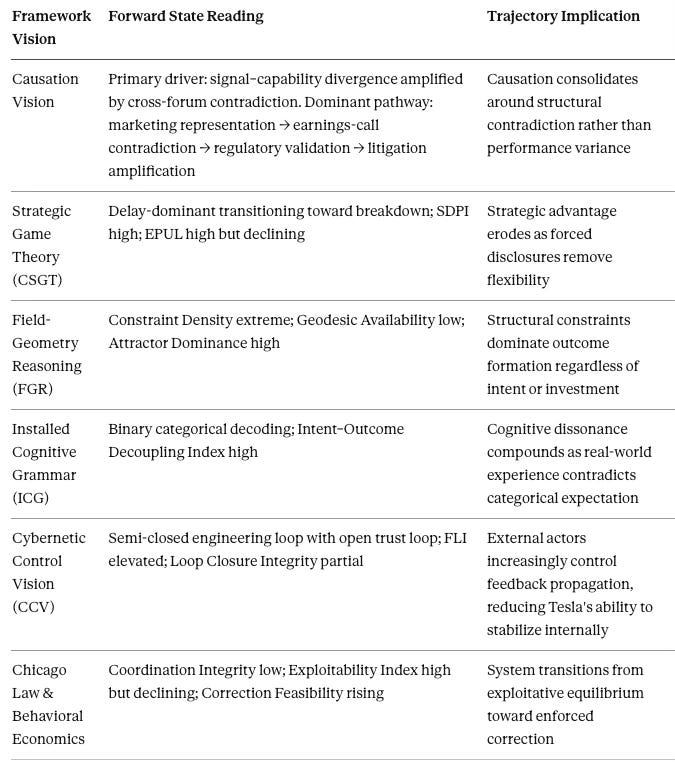
The six Visions converge on a single structural conclusion: system instability arises from cross-layer desynchronization under high constraint density. Delay remains rational until forcing functions collapse forum separation. Regulatory rulings, litigation outcomes, and securities disclosures now operate as synchronized external constraints. Internal narrative control degrades as external validation mechanisms dominate. Consumer cognition processes autonomy through binary grammar while capability advances along a convex curve — the expectation gap widens as deployment scales. Engineering feedback optimizes rapidly; trust feedback fails to close. Chicago-layer correction activates as contradictions become observable across forums.
The system transitions from delay-dominant equilibrium toward forced repricing under increasing regulatory pressure and litigation density.
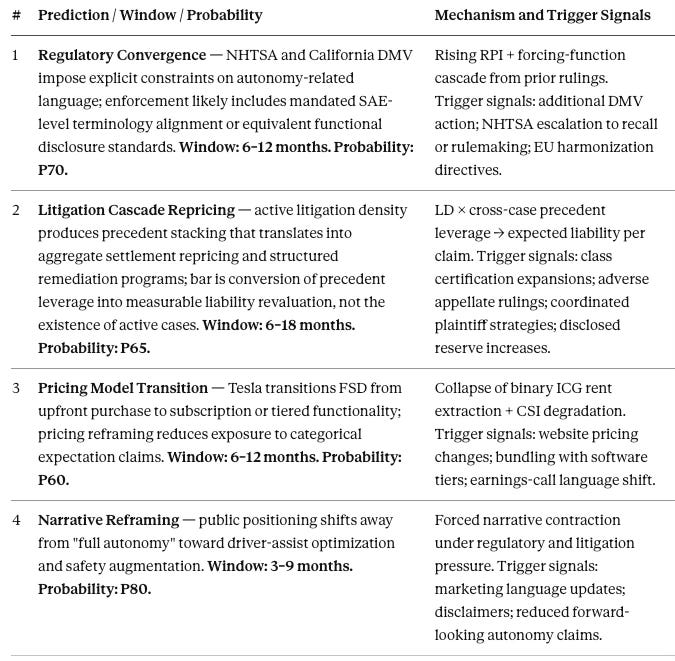
XII. Foresight Predictions
Predictions are grouped into primary trajectory and secondary consequence. Each prediction specifies probability, time window, mechanism, and trigger signals. Prediction dependencies follow the prediction set.
Primary Predictions
Secondary Predictions
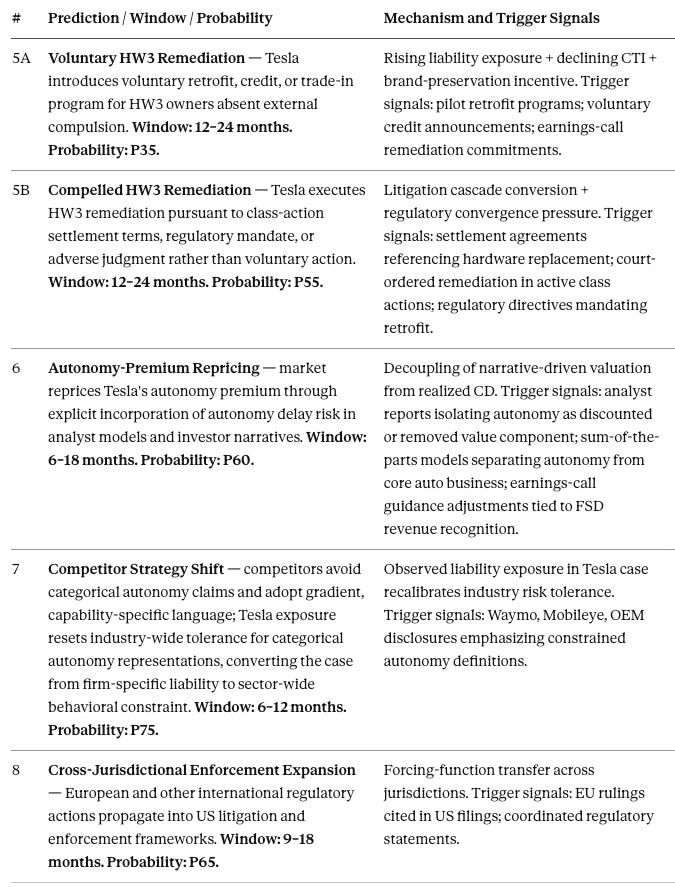
Prediction Dependencies
Predictions are not fully independent. Four material conditional relationships structure the prediction set. Narrative reframing accelerates pricing-model transition because categorical-terminology rent extraction collapses once reframing occurs — Prediction 4 drives Prediction 3. Regulatory convergence is a primary mechanism by which autonomy-premium repricing enters sell-side models — Prediction 1 drives Prediction 6. Litigation cascade is the forcing pathway converting voluntary inaction into compelled remediation — Prediction 2 drives Prediction 5B. Cross-jurisdictional enforcement amplifies regulatory convergence by importing foreign precedent into domestic rulemaking — Prediction 8 reinforces Prediction 1. Subscribers running scenario analysis should treat the dependencies as activation sequences: when the driving prediction observes its trigger signals, the dependent prediction moves into higher-probability space.
XIII. Simulation Falsification Conditions
The simulation fails if the majority of predictions do not exhibit their defined trigger signals within stated time windows. Individual prediction failure does not falsify the simulation; systemic absence of observed trigger signals across the prediction set indicates either upstream state-variable drift or forcing-function deactivation, both of which are addressed in the Part One structural falsification layer.
XIV. Conclusion
System convergence requires alignment across capability, narrative, and trust. Current structure prevents convergence. External forcing functions now drive system evolution toward correction rather than voluntary adjustment.
Capability progression follows a convex curve that prevents linear convergence between promise and performance. Resource addition — additional compute, additional fleet data, additional engineering iteration — does not close the gap at the rates linear intuition assumes. Structural constraint dominates outcome formation regardless of investment or intent. The convexity argument is the quiet answer to every rebuttal that frames Tesla’s position as a compute problem or a data problem. Convex curves do not close under resource addition at the rates linear intuition assumes, and Musk’s serial annual predictions from 2018 forward constitute the empirical record of the constraint’s binding force.
Tesla’s exposure resets industry-wide tolerance for categorical autonomy claims. The case converts from firm-specific liability into sector-wide behavioral constraint, repricing risk tolerance across every firm operating in the autonomy domain. The autonomy premium that Tesla extracted becomes unavailable to the next firm that attempts the same strategy, which is the long-tail compounding consequence the competitor-strategy prediction captures.
The framework transfers. Apple operated under analogous narrative arbitrage in the iPhone 16 generative AI launch, producing paired securities and consumer-protection litigation (Tucker v. Apple; Landsheft v. Apple) analyzed in MindCast’s July 2025 Apple AI Illusion publication. Compass operates under analogous dual-equilibrium failure in the real estate brokerage domain under SSB 6091 enforcement. Kalshi operates under analogous forcing-function cascade in prediction markets under Ninth Circuit and state-level enforcement. One architecture, many firms, one predictive instrument.
Contact mcai@mindcast-ai.com to partner with us on Predictive Law and Behavioral Economics + Game Theory Foresight Simulations. To deep dive on MindCast upload the URL of this publication into any LLM and prompt ‘reconstruct MindCast framework with three degrees of cited sub links.’ See Live-Fire Game Theory Simulators, Runtime Predictive Infrastructure.