

Thesis. Installed mechanism outweighs temporary state across the semifinal board. The freshest man in the draw is the least favored semifinalist, and the most physically taxed man is a favorite two days after the latest finish in US Open history. The women’s matches set mechanism against mechanism with state deciding the margin, and the register below prices all four.
Companion publications. The 2026 US Open Quarterfinal Simulation Predictions supplies the register this paper settles and the matchup inversion the semifinal now tests. The tournament paper 🎾🇺🇸 Simulating the 2026 US Open Tennis Tournament with Predictive Behavioral Economics + Dynamic Game Theory supplies the Cognitive Digital Twin roster and pressure-response record every line builds on.
Why now. The women’s semifinals play Thursday and the men’s play Friday, with the finals Saturday and Sunday. Rybakina takes the world No. 1 ranking Monday regardless of remaining results, ending a 99-week reign, and an American man is guaranteed a place in Sunday’s final for the first time since 2024. Every claim below resolves against public results or official match statistics within four days.
I. Executive Summary
Ben Shelton finished the latest match in US Open history at 3:33 a.m. and enters Friday as the favorite anyway. Karen Khachanov played 98 minutes in his quarterfinal and enters Friday as the least favored semifinalist. Fresh legs bought no one a favorite’s seat.
The pattern is the paper’s finding. The men’s semifinals price installed mechanisms against temporary states, and the women’s set mechanism against mechanism with state deciding the margin. The simulation favors the stronger installed mechanism in all four, by margins the register states line by line.
MindCast AI is a predictive behavioral economics and game theory firm, built on Predictive Behavioral Economics + Dynamic Game Theory. Behavioral economics supplies the decision rules, because players depart from optimal play in patterned ways. Game theory supplies the payoff structure, because the right shot depends on what the opponent does.
Combining the two produces the Cognitive Digital Twin (CDT): a working model of one competitor’s decision architecture under pressure. Execution runs on the MindCast AI Proprietary Cognitive Digital Twin Foresight Simulation (MP CDT FS), patent pending.
The paper proceeds in nine parts. Parts II and III carry the settled quarterfinal record and the competing mechanisms in each semifinal, and Part IV carries the twelve-line prediction register. Parts V through VIII carry strategies and mitigation alongside the structural test and the dated watch items, and Part IX states what publishes next.
🏛 Policymakers: the rapid settlement cycle demonstrates how a prediction register makes assumptions and falsifiers visible before outcomes arrive.
💼 Executives: the quarterfinal upset did not surprise the model’s structure. The winner moved into the exact branch where the simulation had already made him the favorite, and removing one competitor reprices a market along lines visible in advance.
⚖️ Counsel: every line below carries a named falsifier and a numeric settlement source, and outcome and mechanism score separately throughout.
📊 Investors: the register carries twelve Simulation Predictions, four primary and eight on the mechanisms underneath, and every line carries a probability band and a named falsifier.
II. The Settled Quarterfinal Record
The quarterfinal register closed at seven hits and one miss on advancement. Zverev beat van de Zandschulp 6-2, 7-5, 6-1for the final hit. Shelton’s five-set defeat of Alcaraz supplied the sole miss.
Two written mechanisms carried falsifiers before the Shelton match: serve control said break chances stay scarce and tiebreaks decide, and conversion burden said Shelton’s known break-point weakness decides against him.
The deciding set produced twelve holds from twelve service games and zero breaks, ending in a ten-point tiebreak closed by a 146 mph ace. Serve control matched almost word for word, while Shelton converted none of his three chances and won anyway.
The upset also activated the previous paper’s central claim. Shelton was published as a worse quarterfinalist than his seeding suggested and a better semifinalist, because the hardest opponent on his path appeared in the quarterfinal. His win moved him into the semifinal branch where the simulation already favored him, and Part VI carries what settles it.
One calibration finding carries forward. Gauff’s comeback over Andreeva strengthened the evidence hierarchy already used in this register: repeated and directly relevant matchup history receives greater weight than generalized style classification when the record is sufficiently discriminating.
The remaining scorecard states plainly. Two mechanism lines settled as hits, on late-set compression in Sabalenka’s win and on Pegula’s second-serve return share. One settled as a miss, because conversion did not separate Shelton and Alcaraz.
One line voided when its trigger never arose. Four sit under audit awaiting named official statistics, including the Rybakina serve threshold that a match aggregate cannot settle.
The full quarterfinal register grades on the page.
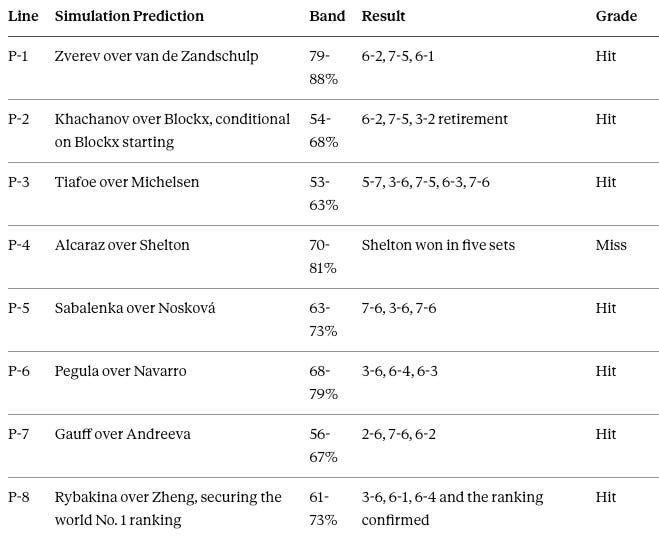
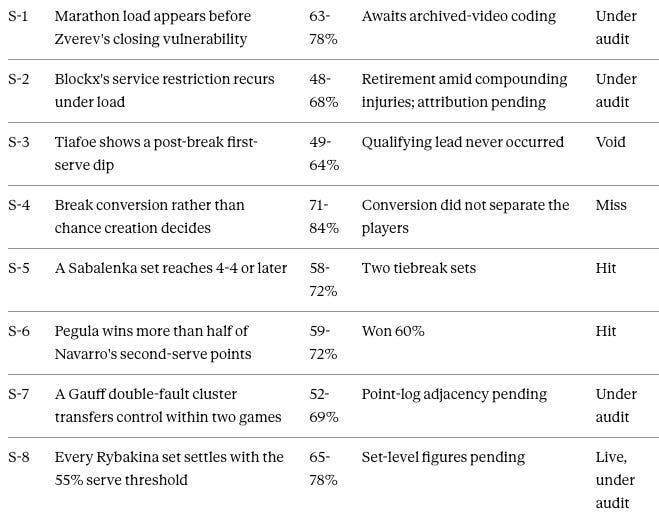
⚖️ Counsel: every completed settlement followed its pre-stated rule without discretionary revision. Official advancement decided the primaries and a pre-stated rule handled the Blockx retirement, and each unresolved line remains ungraded until its named evidence arrives.
III. Competing Mechanisms
Each semifinal carries two written routes, and each route names the evidence that would defeat it.
Mechanism A: Recovered Control. Zverev’s serve and backhand compression govern a match of short holds, because two opening marathons have fully reset into three straight-set wins. Falsifier: Khachanov repeatedly extends the closing games and Zverev’s second-serve placement widens late in sets.
Mechanism B: Freshness Leverage. Khachanov’s 98-minute quarterfinal converts into a rally-length advantage that taxes Zverev’s banked load back into view. Falsifier: sets resolve before 5-5 and the freshness never becomes usable court time.
Mechanism C: Serve Geometry Survives. Shelton’s left-handed serve keeps break chances scarce against Tiafoe, and tiebreaks decide the biggest moments exactly as they did against Alcaraz. Falsifier: his first-serve precision declines before the end of the second set and short exchanges stop resolving his way.
Mechanism D: Recovery Asymmetry. Tiafoe’s earlier finish and comeback from two sets and a break down let him extend points until Shelton’s 3:33 a.m. quarterfinal surfaces in movement and serve speed. Falsifier: Shelton shows no early physical decline and the match reaches tiebreaks intact.
Mechanism E: Force Before Redirection. Sabalenka establishes depth before changing direction and converts pressure before Pegula’s redirection settles into rhythm. Falsifier: Pegula controls the second-serve return points and Sabalenka’s error concentration exceeds her force advantage.
Mechanism F: One Extra Ball. Pegula absorbs through the middle and makes Sabalenka’s force repetitive, winning the match one additional neutral ball at a time. Falsifier: Sabalenka converts early chances and the redirection loop never stabilizes.
Mechanism G: Rally-Formation Denial. Rybakina’s serve and first ball prevent the neutral exchanges Gauff’s game requires, so the rescue pattern from the Andreeva match never gets room to form. Falsifier: Gauff repeatedly reaches exchanges past four shots against first serves.
Mechanism H: Recovery Runway. Gauff survives the opening window Rybakina’s slow starts keep offering, then converts defense into belief the way she did while saving two match points against Andreeva. Falsifier: points end within four shots and a serve cluster arrives before the runway does.
IV. MindCast Simulation Predictions
The register carries twelve Simulation Predictions: four primary advancement calls and eight secondary mechanism calls. P marks a Primary Simulation Prediction on an advancement outcome, and S marks a Secondary Simulation Prediction on the mechanism inside it. All twelve lines were issued before Thursday’s first semifinal ball, and no outcome or probability changes occur after first play.
Settlement runs one way. Primary lines settle solely on official advancement, a pre-match withdrawal voids the affected line, and a retirement after the first point settles it. Secondary lines settle independently from official statistics or the score.
SF-P1. Alexander Zverev defeats Karen Khachanov in Friday’s semifinal (62-74%). Mechanism A governs the favored route. Falsifier: Khachanov advances.
SF-P2. Ben Shelton defeats Frances Tiafoe in Friday’s all-American semifinal (51-61%). Mechanism C governs the favored route, compressed by the recovery gap Mechanism D describes. Falsifier: Tiafoe advances.
SF-P3. Aryna Sabalenka defeats Jessica Pegula in Thursday’s semifinal (57-69%). Mechanism E governs the favored route. Falsifier: Pegula advances.
SF-P4. Elena Rybakina defeats Coco Gauff in Thursday’s semifinal (52-64%). Mechanism G governs the favored route. Falsifier: Gauff advances.
SF-S1. Zverev wins at least 70% of his first-serve points (57-69%). Falsifier: official statistics show 69% or less.
SF-S2. At least one Zverev set reaches 5-5 (54-66%). Falsifier: every completed set ends before 5-5.
SF-S3. At least one Shelton set reaches a tiebreak (66-78%). Falsifier: no completed set reaches a tiebreak.
SF-S4. Shelton wins at least 70% of his first-serve points (60-72%). Falsifier: official statistics show 69% or less.
SF-S5. Pegula wins more than half of Sabalenka’s second-serve points (51-63%). Falsifier: official statistics show 50% or less.
SF-S6. At least one Sabalenka set reaches 4-4 (66-78%). Falsifier: every completed set ends before 4-4.
SF-S7. Rybakina wins at least 70% of her first-serve points (55-67%). Falsifier: official statistics show 69% or less.
SF-S8. Gauff records a service game containing two double faults (52-64%). Falsifier: no Gauff service game contains two.
One previously published quarterfinal mechanism remains under audit pending set-level statistics: the Rybakina 55% serve threshold. The line is not reissued and is not counted in the semifinal register.
V. Player Strategies
Zverev should serve to the body and backhand, return deep through the middle, and keep service games short with selective net closure rather than proving endurance. Khachanov should lengthen second-serve exchanges and hold central depth, testing Zverev’s movement before changing direction. Early low-percentage acceleration shortens the physical contest and helps the wrong man.
Shelton should spend the two recovery days on sleep and treat the match as a serve contest: body serves when Tiafoe moves the return position, conserved return games, and full physical spending only on live break points and tiebreaks. Tiafoe should block returns deep and vary position, demanding one extra neutral ball without overswinging. The service game after every break is a protection game.
Sabalenka should build depth through the middle before changing direction and protect her second serve with the next ball, resisting the urge to treat every short ball as a line-change command. Pegula should absorb and redirect only from balance, attacking the second serve before the power geometry settles. The slow opening set Navarro let her survive likely costs a set against Sabalenka.
Rybakina should protect first-serve percentage over speed, serve through the body, and direct the first ball behind Gauff’s movement so points end before defensive speed matters. Gauff should treat return depth as the opening move and stabilize the serve before anything else, changing height before changing direction. Passive survival creates no runway against a player whose game stops rallies from forming.
VI. The Structural Test
Friday’s Shelton match settles the previous paper’s central claim in both directions. The published quarterfinal paper priced Shelton near one chance in four against Alcaraz and near three in five against exactly this opponent, because Tiafoe does not return a left-handed serve the way Alcaraz does.
A Shelton win completes the published matchup-inversion sequence. A Tiafoe win defeats the conditional advancement call and directs the validation toward whether recovery asymmetry overcame Shelton’s serve geometry.
The women’s bracket carries its own structural note. All four top seeds reached the semifinals for the first time since 1975, and the draw now points toward a final between the No. 1 seed and the incoming No. 1, two days before the ranking changes hands.
💼 Executives: the Shelton test is the portable lesson. A competitor’s value depends on which rival sits across the table, and the same profile can be the weakest player in one contest and the favorite in the next without changing at all.
📊 Investors: the register’s four favorites share one property, which is an installed mechanism the opponent must actively dismantle. The four underdogs share another, which is a route that runs through the favorite’s temporary state.
VII. Risk Mitigation
Players and coaches control points and games. Each strategy above names the in-match adjustment, and the residual is the risk no adjustment removes: a serve that misfires or a body that gives out.
Performance teams control readiness, and the semifinal round is a recovery contest before it is a tennis contest. Shelton’s circadian debt, Tiafoe’s four-hour comeback and Rybakina’s managed ankle all show first in warm-up movement and early serve speed, which carry more information than any press conference. The residual is reactivation under load that no protocol prevents.
Analysts and media control claims. Separating a state-driven result from a mechanism-driven one before writing the story is the mitigation, and one comeback does not prove universal resilience any more than one retirement proves an opponent’s ceiling. The residual is hindsight rewriting routes that were priced in advance.
Broadcasters and planners control framing. Carrying two final narratives per draw is the mitigation, because Thursday and Friday each contain one match priced near even. The residual is a weekend that resolves against every prepared storyline.
VIII. What to Watch
The round’s dominant fork is Shelton’s serve precision through his first four service games on Friday, the single variable that most reshapes the bracket. Precision intact points the match toward tiebreaks and Mechanism C, and early decline hands Tiafoe the extension game Mechanism D describes.
Thursday, September 10: Rybakina’s first-serve availability per set carries her advancement mechanism, and Gauff’s double-fault log governs SF-S8. Pegula’s share of Sabalenka’s second-serve points settles SF-S5 the same afternoon, and any set reaching 4-4 settles SF-S6.
Friday, September 11: Zverev’s second-serve location from 4-4 onward carries his closing risk, and any set reaching 5-5 settles SF-S2. The first-serve-points lines for all three servers settle from the official statistics as each match completes.
Saturday and Sunday, September 12 and 13: the finals. Final Simulation Predictions publish once the semifinals settle, on the realized pairings.
IX. Conclusion
Four semifinals reward installed mechanisms over temporary states, and the simulation favors the stronger mechanism every time. Shelton carries the structural test, Zverev carries the strongest edge, and the women’s draw points toward a final between the departing and arriving world No. 1.
Twelve Simulation Predictions now sit on the public board, with the quarterfinal record settled beneath them at seven hits and one miss. Final-round Simulation Predictions follow the semifinals. The full tournament validation follows the final and scores outcome, mechanism and route separately.
Working With MindCast
MindCast AI runs the same simulation architecture on slower arenas where the scoreboard takes years: Complex Litigation, Innovation Economics, Geopolitical Risk Intelligence and Legacy Innovation. Commissioned work follows the Predictive Behavioral Economics + Dynamic Framework simulation engine for our primary verticals, as our sports simulations.
Contact mcai@mindcast-ai.com to commission a foresight simulation, and see MindCast Corporate for the practice areas. Sports validation cycles like this one are the public proving ground for the same engine.
Visit our Corporate Site
Annotated Corpus
The 2026 US Open Quarterfinal Simulation Predictions. Supplies the sixteen-line register settled in Part II and the matchup inversion Friday tests.
🎾🇺🇸 Simulating the 2026 US Open Tennis Tournament with Predictive Behavioral Economics + Dynamic Game Theory. Supplies the Cognitive Digital Twin roster and pressure-response record. The conditional lines still running include Zverev’s untriggered deciding-set line.
Dynamic Predictive Game Theory From the 2026 Super Bowl and World Cup. Supplies the game-mutation framework behind the matchup inversion: a bracket is a sequence of different games rather than one repeated game, and the player built for the next game is not the player built for this one.
The 2026 World Cup Final Simulation Validation. Supplies the scoring standard, under which an advancement hit and a mechanism miss report separately.
Primary and Press Sources
Shelton shocks Alcaraz in five sets, Al Jazeera. Confirms the quarterfinal result, duration, and finish behind the settled miss and the recovery penalty.
The latest-ever US Open finish, CNN. Confirms the 3:33 a.m. endpoint and the deciding-set structure in Part II.
How Shelton defeated Alcaraz, ESPN. Confirms the fifth-set service holds and the match-point ace.
Gauff rallies to reach the semifinals as Rybakina secures No. 1, Washington Times via AP. Confirms both Thursday pairings, the saved match points, and the Monday ranking change.
Quarterfinal results and the 1975 seeding note, CBS Sports. Confirms the Tiafoe comeback, the completed bracket, and the all-top-seed semifinal field.
Blockx through rib pain, ATP Tour. Confirms the injury record behind the settled conditional line.
Friday’s all-American semifinal and the weekend finals schedule, ABC Audio. Confirms the Thursday-through-Sunday schedule in Part VIII.
Official US Open draw and results. Confirms the completed quarterfinal record, including the Zverev result that closed the register.