

MindCast 2026 FIFA World Cup series: FIFA World Cup Final Foresight Simulation — Spain vs Argentina — Spain Owns Recurrence, Argentina Owns Recovery 🇪🇸 🇦🇷 | World Cup Final Prediction Methodology Matrix — Dynamic Predictive Game Theory + Behavioral Economics Against Opta, Kalshi, Polymarket, EA Sports FC 26 and the Sportsbooks 🇪🇸 🇦🇷 | Dynamic Predictive Game Theory + Behavioral Economics Cognitive Digital Twin Foresight Simulations in the World Cup | The World Cup Is the First Mass-Market Stress Test for Prediction Markets
I. ⚡ The Verdict, Up Front
MindCast called Spain to win, and named the reason: Recursive Pressure — relentless distributed control that keeps rebuilding Spain’s game until it converts. Spain won 1–0, through exactly that mechanism, on a substitute’s goal in extra time. Predicted winner, predicted cause, same result.
The forecast also named Argentina’s only path — late recovery — and gave it real weight after Argentina’s tournament of comebacks. The recovery never fired. Argentina managed zero shots through all 90 minutes of regulation. Compression appeared. Acceleration did not.
So the honest grade is one hit and one miss, both causal, both published the same night. MindCast was right about how Spain would win and wrong to fear an Argentine recovery that never arrived — an error the report traces to a specific, fixable place in the model.
One line separates this from every other forecast on the final: every venue picked Spain, and Spain won, so the winner proves nothing. MindCast is the only one that predicted the mechanism, and the only one that can be graded on anything beyond the coin flip everybody called.
Every venue in the Comparative Methodology Matrix — 2026 World Cup Final picked Spain, and Spain won, so the champion column settles nothing. The other five columns are where the field goes blank.
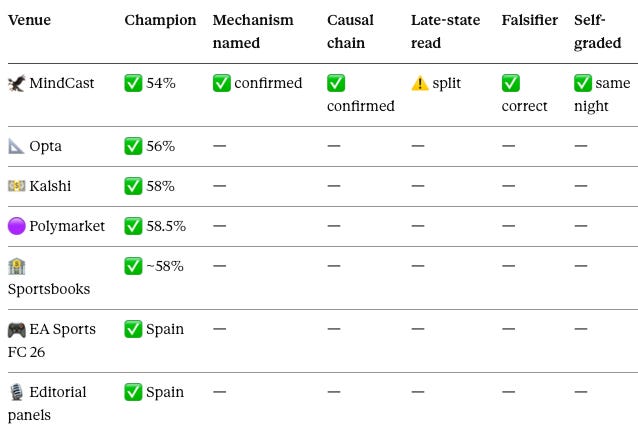
A dash marks a claim the venue never published. Among the seven venues in the frozen comparison, MindCast is the only one with anything to grade beyond the champion — and Section VIII grades every one of those calls, hits and miss alike.
II. 🎯 The Grading Object
MindCast does not bank on a final score. The forecast unit is the predicted winner plus the mechanism expected to produce that winner. Scoreline and decision period are observed readouts of the mechanism, not separate bets to be graded against a sportsbook framework.
So the causal scorecard runs three tests, and only these three:
Did the predicted mechanism activate?
Did it survive the competing mechanism?
Did it produce the predicted winner?
Spain won 1–0 in extra time. The three tests are scored below.
III. 🧩 What MindCast Predicted
The forecast ran on the MindCast AI Proprietary Cognitive Digital Twin Foresight Simulation (MP CDT FS), patent pending, documented in the Provisional Patent Application on Multi-Agent Institutional Simulation Architecture. The engine models two Cognitive Digital Twins, the mechanism available to each, and the interaction that decides which mechanism survives.
For this final, the FIFA World Cup Final Foresight Simulation — Spain vs Argentina built one twin per side.
Spain’s CDT was Recursive Pressure: distributed control that keeps rebuilding Spain’s preferred game until accumulation converts. Spain needs no fast start and no signature goal — it needs the match to stay Spanish long enough that control turns into a goal.
Argentina’s CDT was Tempo Governance: compress the event volume, absorb the ordinary game, then choose the acceleration and win the chase through late recovery.
MindCast favored Spain at 54% because recurrence governed more of the match. Argentina stayed close because recovery could govern the state in which the final was ultimately decided. The forecast made one causal commitment: Spain wins if Recursive Pressure keeps reproducing the game faster than Argentina can turn survival into recovery.
IV. ✅ Spain’s Mechanism Activated and Won (Causal Tests 1 & 3)
Recursive Pressure fired from cause to outcome. Spain owned the ordinary game and kept recreating it: roughly two-thirds of possession, Argentina held to zero shots across all 90 minutes of regulation, and a shot count that finished overwhelmingly Spanish. Argentina’s first attempt did not arrive until deep in extra time.
Possession share and a shot drought are mechanism evidence, not box-score decoration. Recursive Pressure predicted Spain would recover failed entries, restore territorial control, and choke off Argentina’s central escape route — and the match delivered exactly that. Messi finished with 54 touches and a single shot, his midfield overrun. Spain’s advantage never depended on one carrier, one transition, or one early goal. The system stayed available for the full 120 minutes.
The winning goal completed the mechanism rather than sitting outside it. Ferran Torres, a second-half substitute, scored at 106’ by finishing a Nico Williams header into the space in front of goal.
The base mechanism kept the game Spanish long enough for the replacement tree to introduce fresh terminal channels, with Williams and Torres entering as new options and control never surrendered. The substitute scored, and the system built the conditions in which a substitute could decide the match. A second Torres finish was ruled offside by a shoulder margin late in extra time — Spain were the only side creating clear scoring situations.
Predicted winner, observed winning mechanism, and causal path align. Recursive Pressure was the center of the forecast, and Recursive Pressure held.
Contact mcai@mindcast-ai.com to partner with us on Predictive Game Theory AI in Law and Behavioral Economics. We specialize in predictive simulations for Complex Litigation, Innovation Economics and Geopolitical Risk Intelligence.
To test our predictive simulation AI system, in 2026 we simulated the Super Bowl and the World Cup. See Super Bowl LX — AI Simulation vs. Reality | Susquehanna Is Building the Institutional Market the CFTC Does Not Require — but Still Needs
To deep dive on MindCast works upload the URL of this publication into any LLM (preferably Google AI mode) and prompt ‘reconstruct MindCast framework with three degrees of cited sub links.’ See Live-Fire Game Theory Simulators, Runtime Predictive Infrastructure.
V. ❌ Argentina’s Mechanism Failed the Survival Test (Causal Test 2)
Argentina reached the precondition of Tempo Governance and never reached its terminal mechanism, and the distinction is the whole point.
Argentina did compress. La Albiceleste absorbed the ordinary game and stayed coherent enough to keep the final scoreless through regulation, so compression was real and it appeared. But absorption is the setup, not the winning phase. The CDT’s path to victory required Argentina to choose the acceleration, generate a late channel, and convert the chase. None of those behaviors appeared. Argentina recorded no shot in regulation and did not threaten until late in extra time, by which point it was chasing a goal, not producing one.
Compression appeared. Acceleration did not. The precondition survived; the winning mechanism never activated.MindCast gave real weight to a late-recovery capability that never became operational against Spain’s suppression.
VI. ⚡ The Red Card — Logged as Shock, Not Cause
Enzo Fernández was sent off at 90+3 for a second yellow, a challenge that flipped Pau Cubarsí to the ground. Argentina played all 30 minutes of extra time a man down. Torres scored at 106’, with Argentina reduced to ten.
The published framework named a dismissal as shock evidence and a route falsifier, so the red card is logged as exactly that, never swapped in for the mechanism. The dismissal changed the conversion environment.
The dismissal did not create Spain’s territorial control, Argentina’s absence of shots, or the recursive game state, all of which had already persisted through 90 minutes with eleven men on each side. Dynamic Predictive Game Theory records the shock and leaves the causal mechanism standing, because the mechanism was already active and dominant before the shock arrived.
VII. 🧭 What Dynamic Predictive Game Theory Learned
The model was right about the winning CDT and wrong about the weight assigned to the competing CDT. The correction lives inside the interaction between the two twins, not in any clock, score-state, or market layer.
Argentina’s recovery capability was real. Its availability against Spain’s suppression was over-weighted.
Three causal changes follow:
Separate recovery capability from recovery availability. Argentina’s earlier comebacks proved the CDT can recover, not that recovery stays available against an opponent permitting no generative channel.
Make the recovery weight relational. Recovery weight must equal the chaser’s capability interacting with the opponent’s suppression and replacement structure. A strong historical ceiling cannot be imported unchanged into every opponent state.
Require the mechanism’s own activation evidence. The clock does not cause Tempo Governance. The CDT must display the behaviors that constitute acceleration — a secondary channel, repeated high-value access, a coherent shift from compression to attack — before the mechanism is credited as live.
Spain’s winning sequence validated the replacement-tree logic and needs no correction: replacement is not a separate event prediction, it is how a renewable mechanism keeps acting through new carriers.
VIII. 📊 MindCast’s Scorecard, Call by Call
The comparison table in Section I shows six venues with nothing to grade past the champion. MindCast published five further calls, and each one resolved on the field. Here is how every call graded.
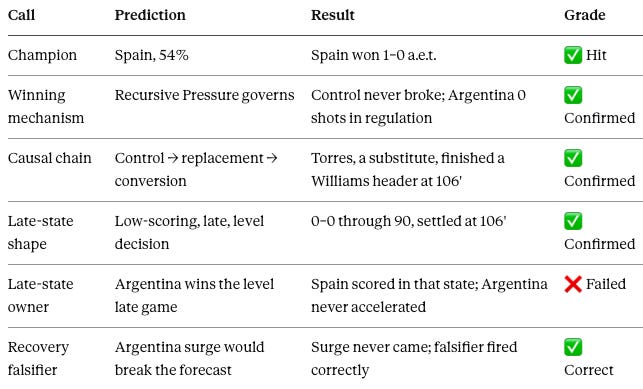
Four mechanism calls confirmed, one falsifier fired as designed, one call failed — the prediction that Argentina would own the late, level state it was built to win. The miss sits in a single, nameable place: the weight assigned to a recovery that never activated. Section VII carries the correction.
MindCast grades the miss at the same size as the hits, on the same night, on a record anyone can check. No other venue in the frozen comparison published a second call to grade at all.
IX. 📒 The Record
MindCast predicted Spain would win because Recursive Pressure would govern more of the match than Argentina’s recovery mechanism. Spain controlled the game, kept recreating pressure, introduced fresh terminal channels through the replacement tree, and converted through a substitute. Argentina’s recovery never reached acceleration. Predicted winner, observed winning mechanism, and causal path to the outcome aligned.
The correction is equally causal, and it is not a hedge: Argentina’s historical recovery capability was real, but its availability against Spain’s total suppression was over-weighted. Future runs price recovery as an interaction between twins — not as a clock effect, not as a market signal.
Every mechanism and falsifier was published in advance, and both grade the same night, the winning read and the missed read at the same size. 🇪🇸 Spain are world champions through exactly the mechanism MindCast named. 🦅 MindCast called how they would win, over-weighted the mechanism that might have stopped them, and records both on the ledger before the confetti settled.
Championship note: Spain, called at 54%, won. The 54% expressed uncertainty over which mechanism would convert first, not a calibrated market price, and one match cannot establish its calibration. The center of this validation is causal alignment, not the winner probability.
Match record verified against Associated Press, ESPN, NBC, and The National, July 19, 2026. Scored against the simulation and the matrix linked above.