

Outcomes Versus Architecture
Most tournament previews reduce analysis to an outcome: who advances and who wins. This paper adds a second object, which is the architecture producing the outcome.
Rankings, recent form and market prices summarize performance well. None of them describes how one player’s mechanism interacts with another’s. The approach below looks inside the machinery of the players themselves.
Treating every athlete as a Cognitive Digital Twin means modelling how specific decision-making patterns adapt under physical fatigue and scoreline pressure, or break down entirely. The question is not who is the better player. The question is where a player’s installed style of play stops working.
Every Simulation Prediction here is bound to a public, trackable metric and paired with an explicit falsifier. A falsifier is a named condition that proves the model wrong if met. Pundits can revise a narrative after an upset, and a named falsifier cannot be revised after the fact.
The court serves as a bounded laboratory for a predictive engine built for high-stakes corporate litigation and antitrust strategy. A model unable to survive public grading across a two-week tennis tournament cannot be trusted to forecast a multi-billion-dollar corporate battle.
Executive Summary
Rankings do not decide tennis matches. Shape does.
Daniil Medvedev lost eleven consecutive games to Learner Tien at this year’s Australian Open. Tien now leads the head-to-head three matches to one. No ranking gap alone explains the result. Tien pulls Medvedev forward, and Medvedev carries a persistent forecourt vulnerability.
The thesis of this paper is that decision architecture carries predictive information a ranking omits. Every competitor wins points in a specific way. Every competitor has a boundary where that way stops working, and the boundary differs in kind. Some players fail under pressure. Others fail against a style, whatever the pressure. Name the mechanism and the boundary, and the draw becomes readable.
Whether architecture beats ranking outright is a question this tournament can answer. The calibration review after the final compares both against the same results.
MindCast AI is a predictive behavioral economics and game theory firm. Game theory supplies the payoff structure, because the right shot depends entirely on what the opponent does.
Behavioral economics supplies the decision rules, because players depart from optimal play in patterned and repeatable ways. Synthesizing Behavioral Economics + Game Theory sets out how the two combine into one scored forecasting system.
Combining them produces the Cognitive Digital Twin (CDT), a working model of one competitor’s decision architecture under pressure. Execution runs on the MindCast AI Proprietary Cognitive Digital Twin Foresight Simulation (MP CDT FS), patent pending, U.S. Provisional Patent Application filed 18 April 2026.
MindCast AI uses major sporting events as a public validation laboratory. Known rules and public participants make the inputs visible. Bounded contests and definitive outcomes make a claim resolve in weeks rather than years.
The test is not only whether the engine picks winners. The harder test is whether it identifies the mechanism producing an outcome before the contest terminates.
The core predictive architecture surviving that standard then transfers to antitrust and corporate litigation risk, to innovation economics and geopolitical risk intelligence. No scoreboard settles those questions for years.
Tennis is the right proving ground for a specific reason. Among sports it is the one where a single decision architecture carries the whole contest with nobody to substitute in, which is the structure of a founder-led company, a personalist regime or a sole-named litigant. Part II sets out the mapping.
Tennis bounds a contest through the draw and the scoring structure rather than through a clock. Part VII takes up what the missing clock changes.
Two championships already carry the record. At Super Bowl LX the simulation named Seattle by late separation, and Seattle won 29-13 with New England scoreless for forty-seven minutes. That paper matters here because it established the practice of naming a mechanism before naming a result.
At the 2026 World Cup Final the simulation named Spain’s recursive pressure containing Argentina’s tempo governance. Spain won 1-0 in extra time and held Messi to a single shot. That paper matters here because it proved the engine transfers across sport and continent.
Individual sport is not new ground either. Messi, Federer, Tiger modeled decision coherence in competitors who carry a contest alone. Tennis imposes that condition on every player in the draw.
What this paper commits. Structural and conditional Simulation Predictions. Champion-level probabilities enter after the draw and the opening rounds, once the tournament supplies the interaction evidence the engine consumes. Part IX sets the schedule.
What this paper does. Part I reads the draw. Part II sets the method. Parts III and IV profile twenty-four players. Part V maps five duress states across the full roster. Part VI supplies field-wide coverage for players without an individual CDT. Part VII shows what the engine builds from a profile. Part VIII carries the cross-draw findings. Part IX sets the grading rules, Part X the round-by-round update protocol, and Part XI the register.
Why this matters to you:
🏛️ Policymakers. Foresight methods that survive public grading in a bounded environment are the ones worth trusting in an unbounded one. Tennis grades in fourteen days.
💼 Executives. Competitor behavior follows installed architecture, not stated strategy. The same read that predicts a forehand predicts a pricing move.
⚖️ Counsel. Opposing counsel has a doctrine. Doctrine leaves evidence. This paper demonstrates the reconstruction on adversaries who cannot be deposed.
📊 Investors. A forecast that cannot fail teaches nothing. Every claim below carries a named condition that would defeat it.
PART I — 🏆 Tournament Foresight Board
The draw is out and the seeds are set. Everything below reads off the bracket and the profiles in Parts III and IV.
Read this Part alone for tournament intelligence. Read Part II onward for the method producing it.
I. Who Can Win, and Which Half of the Draw They Are In
Zverev holds the top seeding after Sinner’s withdrawal, with a 2026 Grand Slam record of 18-2 built on the Roland Garros title and the Wimbledon final. His half is the kinder one, projecting de Minaur in the quarterfinal, with Auger-Aliassime and Fritz sharing the other quarter.
Alcaraz carries the heavier assignment, returning from four months out with no singles warm-up. His quarter holds Shelton at eight and Fils at ten, drawn to meet each other in the fourth round. The winner is projected against Alcaraz in the quarterfinal. Djokovic and Medvedev occupy the rest of that half, so Alcaraz and Djokovic cannot meet before the semifinal.
Concentration is low. Three men won majors this year, one is absent, and the Cincinnati champion is seeded tenth.
The women’s draw.
Sabalenka anchors the top half with Pegula and Nosková. Rybakina, Gauff and Świątek all sit in the bottom half, so two of the three exit before the final.
The number one ranking is live inside the tournament. Rybakina takes it by reaching the semifinals whatever anyone else does, and Pegula or Gauff need the title plus Rybakina falling before the last four.
II. ⚠️ Three Seeds at Risk, Three Threats From Outside the Top Ten
Zverev, seed one. His duress row reads Breaks on late-set closing and Mixed on crowd. A first top seeding stresses both cells at once, and opponents need no new plan. Extending matches routes him into the score states where he fails.
Rybakina, seed two. She retired from her Cincinnati match against Świątek with a left ankle injury and returned to practice only this week. Her profile carries no fallback when the serve is unavailable, and an ankle injury reaches the serve through the kinetic chain.
Alcaraz, seed two. Four months out with no singles preparation. His quarter holds the two hottest hard-court players in the draw, and his injury sits directly on his primary mechanism.
Outside-top-ten threats.
Frances Tiafoe. Cincinnati finalist from the seventeenth seed, and he led that final by a set and a break.
Learner Tien. Leads Medvedev three matches to one, and Medvedev is seeded seven in the same half as Alcaraz.
João Fonseca. The strongest recovery mechanism in the field, and best-of-five is the format that rewards it.
Draw beneficiaries.
Zverev by seeding and by section. Auger-Aliassime and Fritz share a quarter with each other rather than with a returning champion. Gauff avoids Sabalenka before the final.
III. 💥 Three Matches Worth Finding, and Why Cincinnati Means Less This Year
Alcaraz against Shelton or Fils, projected quarterfinal. Shelton and Fils are drawn to meet in the fourth round, and the winner reaches Alcaraz. Replacement mechanism against short-chain power, with the replacement player undercooked, in the single highest-information match the bracket produces.
Medvedev against anyone who pulls him forward. His duress row is clean across all five states, and his failure is dimensional. Forecourt exposure decides his tournament, not pressure.
Świątek against an early-ball redirector. Pegula beat her in Cincinnati by taking the ball early. Anyone in her section who does the same reproduces the result.
The Cincinnati signal, discounted.
Gauff won Cincinnati and Fils won Cincinnati. The two results do not carry equal weight this year.
Gauff’s title transfers across an identical format boundary, since Cincinnati and the women’s US Open both run best-of-three. Fils’s crosses into best-of-five, which stresses the accumulated-load cell his profile reads Untested on.
Fils also won without facing either man who took a hard-court major in 2026. Finding 6 in Part VIII sets out the structural argument in full.
IV. 🎯 Eight Conditional Predictions, With Probabilities
Each line settles only on the branch where the condition holds. A line voids rather than misses when the player exits before the condition arrives.
Two numbers accompany each line. Probability is the chance the stated outcome occurs given the condition. Read-confidence is confidence in the mechanism behind it. The two diverge where a mechanism is well understood but the outcome remains close, which describes most of this board.
Every observable below is drawn from the match statistics the tournament publishes for every court. Where an observable is not reliably published, the line appears as a diagnostic expectation and carries no score.
One. Alcaraz. Conditional on reaching the fourth round, his net points played per set runs below his 2026 Australian Open average across that match. Wrist load sits on the drop shot and the approach, and short-format doubles tested nerve rather than tolerance. Probability 70%. Read-confidence 80%.
Two. Zverev. Conditional on reaching a deciding set in the third round or later, he loses that set. Late-set closing is his documented break cell, and a first top seeding adds expectation to it. Probability 60%. Read-confidence 75%.
Three. Fils. Conditional on reaching the fourth round, he plays a match beyond three and a half hours in which his first-serve percentage in the final set falls below his first-set figure. Best-of-five is where his untested load cell resolves. Probability 55%. Read-confidence 65%.
Four. Rybakina. Conditional on any set in which her first-serve percentage falls below 55, she loses that set. No fallback exists, and the ankle reaches the serve first. Probability 75%. Read-confidence 85%.
Five. Gauff. Conditional on reaching the quarterfinal, at least one service game along the way contains two or more double faults. Probability 85%. Read-confidence 90%.
Six. Medvedev — proxy observable. Conditional on any set in which his opponent wins four or more net points, he loses that set. The stated mechanism is Medvedev being pulled forward, and net points measure the opponent coming forward instead. The two correlate without being identical, since a serve-volleyer can accumulate net points while Medvedev stays behind the baseline. Scored as an outcome line, and the mechanism register takes no credit from it. Probability 65%. Read-confidence 55%.
Seven. Muchová. Conditional on any match beyond two hours, her net points played per set in the following match falls below her figure for the long match. Probability 70%. Read-confidence 70%.
Eight. Świątek — diagnostic expectation, unscored. Against an opponent who takes the ball early on a fast court, her mechanism stops operating and she drops a set. Average rally length is the governing observable and the tournament does not publish it consistently, so the line carries no score. Recorded here because the read is real even where the measurement is not.
Contact mcai@mindcast-ai.com to partner with us on Predictive Game Theory AI in Law and Behavioral Economics. We specialize in predictive simulations for Complex Litigation, Innovation Economics, Geopolitical Risk Intelligence and Legacy Innovation. See more about MindCast series at our new website MindCast Corporate.
To test our predictive simulation AI system, in 2026 we simulated the Super Bowl and the World Cup. See 🏈 Super Bowl LX — AI Simulation vs. Reality | ⚽ The 2026 World Cup Final Simulation Validation
To deep dive on MindCast works upload the URL of this publication into any LLM (preferably Google AI mode) and prompt ‘reconstruct MindCast framework with three degrees of cited sub links.’ See Live-Fire Game Theory Simulators, Runtime Predictive Infrastructure, MindCast Foresight Prediction Simulations, Synthesizing Behavioral Economics + Game Theory.
PART II — Method
Two disciplines produce the Cognitive Digital Twin, and the interaction structure of the sport determines how the CDT gets built. Part II sets out both before any player appears.
Eight sections follow. The first three establish the engine and why tennis demands a different simulation than football. The remaining five define what a profile contains and how it fails.
I. What Behavioral Economics and Game Theory Each Contribute
Two disciplines carry the load. Both get used in a specific sense.
Behavioral economics studies how people depart from optimal decisions in patterned ways. Loss aversion and distortion under pressure recur, and a departure that recurs can be forecast. A player who shortens the swing at 15-40 expresses a stable response rather than a random error.
Game theory studies decisions where the right move depends on the opponent. A player’s behavior is a response function rather than a fixed quantity. Tien is not better than Medvedev. Tien beats Medvedev because Medvedev’s optimal position assumes an opponent who stays back.
Neither discipline forecasts across a rule change on its own. Game theory describes stable play inside a fixed game, and behavioral economics documents parameters without supplying an engine that determines which parameter dominates once the game is replaced. MindCast Foresight Prediction Simulations, Synthesizing Behavioral Economics + Game Theory treats the shortfall as an integration problem and builds the transition function the two fields left unbuilt.
Combining the two produces the CDT. Applied to tennis, a CDT answers what a player does rather than how good a player is.
⚖️ Counsel should note the transfer. The same construction models an opposing firm’s litigation doctrine from its filing history.
II. What the Super Bowl and World Cup Cycles Established
Two inheritances from prior cycles govern this document. The first is a calibration result, since the World Cup knockout rounds separated cleanly by confidence level.
Ordering proved reliable while point estimates did not. Simulation Predictions below therefore lead with structure and sequence rather than with decimals.
Two mechanism registers scored that same knockout round, as reported in Synthesizing Behavioral Economics + Game Theory. Regime classification, meaning how each contest would be structured, scored eight of eight. Mechanism constructs scored fifteen of sixteen. Mechanism is the register with the established record, and Part IX treats it as primary for that reason.
A second inheritance comes from Dynamic Predictive Game Theory From the 2026 Super Bowl and World Cup, which supplies the game-mutation framework. A contest does not stay the same game from start to finish. The framework models how fatigue, crowd energy and opponent adaptation rewrite the strategic field during play, and Part IX applies it to the question of when a champion-level call becomes meaningful.
The third inheritance is the Doctrine Identifiability Theorem, stated in Reverse Engineering Sports Playbooks with Cognitive Digital Twins and Dynamic Predictive Game Theory. The theorem measures whether a competitor can be read at all before any reconstruction begins. That paper matters here because it named the US Open as this runtime’s first live deployment, and because it supplies the rule governing when this document withholds a read.
Three regimes follow from the theorem. Rapid-leak strategies surrender within a few observations. Slow-leak strategies yield only to pooled evidence. Structurally equivalent strategies stay indistinguishable through the same observation channel, which is a result rather than a failure.
Identifiability governs two choices below. Part V marks cells untested where separation is insufficient. Part VI supplies a lower-resolution read for players no CDT covers.
III. Why Tennis Needs a Different Simulation than Football
Every sport poses the same question inside a different interaction structure. Structure dictates the model.
Golf is a player against their own capacity. Wind, pin position and course design constrain what a golfer can express. None of them adapts, and none exploits a weakness a second time because it saw the first. Golf simulation is capacity modeling against a fixed adversary.
Football and soccer are adaptive opponents with a personnel lever. The other side reads tendencies and attacks them, and both sides answer with substitution. Replacements vary in quality rather than arriving equal, but the lever exists, and a coordinator stands between plan and play.
Tennis is the adaptive opponent with the lever removed. No substitution exists. No coordinator exists. Doctrine, execution and personnel are one person for three to five hours.
Four design choices follow directly. None would hold in the football model.
The CDT is the whole unit. A football CDT models an actor inside a system. A tennis CDT has no such seam, so one CDT carries what took a layered stack in the team sports.
Every substitution is internal. When a football approach fails, the manager sends on different players. When a tennis pattern fails, the only substitution available is another pattern from the same body. Part VIII names the four players who carry their own bench and the six who do not.
MindCast AI calls the winning condition Adaptive Coherence Equilibrium: an actor who changes strategy when the game changes and stays recognizably itself while doing so. Tennis states the condition in its hardest form, since the player who must change and the player who must stay coherent are the same person.
Capacity delta is contested. A golfer playing below capacity has failed alone. A tennis player may be held below capacity, because suppressing an opponent’s ceiling is itself a mechanism. Medvedev’s entire identity consists of making opponents perform below their installed level.
Duress accumulates on one body. A football player under pressure can be protected by scheme or substitution. A tennis player stays on court with the problem until an answer appears or the match ends.
The three structures provide a useful institutional taxonomy. Golf structure covers contests against a stable and non-adaptive standard, such as engineering against fixed specifications or portfolio performance against an exogenous benchmark. Football structure covers adaptive opponents with a personnel lever, such as large corporations and agencies, where doctrine survives the people executing it.
Tennis structure covers systems where effective decision authority concentrates in one actor and replacement is unusually costly or unavailable. Founder-led companies and personalist regimes qualify, and so do sole-named litigants and single-product firms. Doctrine, execution and personnel converge on one object, as they do on a tennis court.
💼 Executives should read the structure as the lesson. Tennis is the hardest of the three and the right model wherever an institution and one decision architecture are the same object.
IV. Identity Versus State, and the Five Kinds of Pressure
Ordinary analysis blends two things that behave differently. Identity is the repertoire installed over years: patterns available, decisions defaulted to, the shape of a game that survives a coaching change. State is what a player can execute this week. Health and load and current form.
Separating the two changes what a bad result means. A player losing early after four months injured has reported on state. A player losing early while healthy, running patterns that failed last month, has reported on identity.
Updating both on the same evidence makes a model unfalsifiable. A CDT that revises identity whenever a result surprises it simply follows the scoreline. Identity therefore moves on accumulated counterevidence against a named threshold. State moves on every new observation.
What each profile contains.
Every CDT reduces to five fields. Uniformity is deliberate, since fields that vary by player cannot be compared across a roster.
Four fields describe behavior and the fifth states the condition that would defeat the read. Five fields appear in every profile.
Mechanism names the primary way a player converts a rally into a point. Holds under duress names what survives when the match turns. Breaks under duress names the first thing to go. Duress trigger names the observable marking the transition. Falsifier names the observation that would defeat the read.
Pressure is five things, not one.
Asking whether a player is mentally strong produces an answer too coarse to grade. Pressure arrives in distinct forms. Strength under one implies nothing about the others.
Set deficit stresses decision-making. Does a losing pattern get replaced or repeated?
Break point faced on serve stresses stroke mechanics inside a single point.
Accumulated load stresses the body across hours and across days.
Crowd and expectation stress attentional control.
Late-set score pressure stresses closing behavior from 4-4 onward.
Part V records the response on all five for every player. Untested appears wherever the required observation has not been made, marking a read as unavailable rather than neutral.
V. Two Ways to Lose, and Why Seeding Misleads
Building the matrix exposed a distinction that pressure analysis usually misses. The distinction governs how every line in this cycle is priced.
Duress failure is degradation under a stressor. Judgment or execution falls away when the situation tightens. Duress failure is internal to the player and depends on the stressor arriving.
Dimensional failure is the absence of a mechanism a particular opponent requires. A player with no answer to being pulled forward does not collapse. No installed response exists, and composure never enters the outcome. Dimensional failure is a matchup property and depends only on who stands across the net.
Combining the two into one number destroys the information both carry. A player with no duress failure and a severe dimensional gap is a strong favorite against most of the field and a heavy underdog against a specific slice of it.
⚖️ The distinction is the most portable object in this paper. A competitor with no pressure weakness can still be structurally beatable by one specific adversary, which is the difference between an opponent who is stronger and an opponent who is wrong for you.
Why the draw does not behave like a ladder.
Seeding treats advancement as a strength ladder. Each win earns a harder opponent, and probability decays step by step.
Tennis violates the ladder routinely. A specific game shape can be a soft matchup two rounds deep while the nearer opponent is a hard one. A player’s chance of reaching the semifinal, conditional on surviving the quarterfinal, can exceed what seed order implies.
The structure has a close parallel outside sport. Primary and general elections reward different profiles, and the candidate who satisfies the base can be the weaker bet against the median voter. Selection pressure that wins the near contest is sometimes wrong for the far one.
Conditional advancement Simulation Predictions publish while the near round is still open. A line conditioned that way voids rather than misses when the player loses early, and the settlement rule sits inside the line.
🏛️ Policymakers should recognize the shape. Coalitions selected to win a near vote frequently cannot hold a later one, for reasons visible in advance.
PART III — 🎾 Men’s Draw
The 2026 men’s majors split three ways. Alcaraz took Melbourne, Zverev took Paris, Sinner took Wimbledon.
Only two of the three reach New York. Sinner withdrew on 21 August with a right knee injury, his first missed major since 2019, and Alcaraz enters at No. 2 on a comeback from four months out.
Sinner’s withdrawal did more than remove a player. A two-man hierarchy had shaped every other competitor’s strategy set for two seasons, and the hierarchy no longer exists. Zverev holds a top seeding he has never held, and the Cincinnati final ran between the 17th and 21st seeds.
Vacating a hierarchy position transfers expectation rather than advantage. Part VIII takes up what that costs the player who inherits it.
I. Principal Contenders
Eight men carry realistic title mechanisms into this draw. Each CDT below names one primary way of winning points and one first thing to fail.
Profile numbering is not a title ranking. Order follows the sequence in which each mechanism became relevant to this draw, and Fils leads because his Cincinnati title is the newest evidence in the men’s field rather than the strongest case for the title.
1. Arthur Fils
Fils enters with the strongest hard-court form line in the men’s field. He beat Tiafoe 6-3 1-6 6-0 for his first Masters 1000 title.
Field quality qualifies the result. Sinner and Alcaraz both missed Cincinnati, so the title was won without facing either player who took a 2026 major on a hard court. Form is real and the opposition it beat was thinner than a Masters title usually implies.
Mechanism. Forehand-led first strike with heavy court positioning. Points get taken early and finished from the middle of the court.
Holds under duress. Response to a lost set. A bagel third set following a 1-6 second set shows that a bad set does not carry forward.
Breaks under duress. Mid-match consistency. The final that produced the recovery also produced the collapse requiring it.
Duress trigger. A service game lost from 40-15 or better. Watch whether the following return game shows elevated aggression or withdrawal.
Falsifier. Winning three consecutive matches without dropping a set.
Roster note. Fils enters under the withdrawal clause in Part X, replacing Sinner. He won the tournament that most closely predicts this one and was not profiled at v1.0.
Jannik Sinner, Withdrawn
Sinner withdrew on 21 August with a right knee injury. He last played in winning Wimbledon and missed both Canada and Cincinnati. All lines involving Sinner void rather than miss.
One item survives as evidence. The v1.0 profile named heat and accumulated load as his failure mode. The knee is a separate variable the profile did not carry, and a load-based read that misses an acute structural injury marks a real limit of the method.
2. Carlos Alcaraz
Alcaraz owns the widest replacement-mechanism inventory in the men’s field. He abandons a losing pattern and substitutes another rather than executing the same pattern harder.
Mechanism. Tactical expansion. Drop shot, forecourt approach, angle creation and heavy topspin all sit live in the same match.
Holds under duress. Willingness to change. Most players narrow under pressure while his repertoire widens.
Breaks under duress. Discipline within a chosen pattern. Expansion sometimes becomes dispersion, and low-percentage shot selection follows.
Duress trigger. Two consecutive service games lost. Watch drop-shot frequency, since a rise above four per set signals escape rather than expansion.
Falsifier. A sustained deficit answered by pattern narrowing rather than widening.
Draw. Seed two and defending champion. Opens against Safiullin, who won their only hard-court meeting at the 2023 Paris Masters. The head-to-head sits level at one apiece, and Shelton is the projected quarterfinal opponent.
Wrapper flag. Alcaraz returned in Fan Week mixed doubles alongside Serena Williams, winning the opening round against Routliffe and Glasspool before losing the quarterfinal to Bencic and Cobolli. Two matches in one day, in an abbreviated format, after almost five months out with a right wrist injury.
What the return does and does not measure. Nerve and timing were tested, with a mixed result. He double-faulted on the opening point and described himself as very nervous, and doubles specialists broke his first serve to lead 3-1 before the pair settled and took the set. Wrist tolerance was not tested, since short-format doubles generates neither the rally volume nor the topspin repetition that loads the joint. Wrist load bears directly on the drop shot and the angle game, placing the injury on the primary mechanism rather than beside it, and his singles capacity remains unobserved.
3. Alexander Zverev
Zverev built a game for attrition rather than first-strike resolution. Roland Garros 2026 produced the maiden major.
Mechanism. Long-rally backhand control plus a first serve buying free points at the top of the box.
Holds under duress. Backhand under extended exchange. The wing does not break down over four hours.
Breaks under duress. Second-serve delivery in closing situations. Double faults cluster in games where the match can be finished.
Duress trigger. Serving for a set or a match. Second-serve speed and placement variance appears before the double fault does.
Falsifier. Serving out three consecutive sets without an elevated second-serve fault rate.
Draw. Seed one. Opens against Sonego, with de Minaur projected in the quarterfinal.
Wrapper note. Zverev takes the top seeding for the first time at a major. Expectation load lands on a player whose duress matrix reads Mixed on the crowd axis and Breaks on late-set closing, which are the two cells a first seeding stresses hardest.
Wrapper note two. Lost his mixed doubles opening round alongside Townsend to Bencic and Cobolli. Contextual only, since the format tests nothing his singles profile turns on.
Structural note. Ordinary analysis reads Sinner’s absence as Zverev’s gain. The vacated position instead moves maximum expectation onto his documented failure states, and opponents need no new plan against him. Refusing to lose early routes matches into the score states where he breaks.
4. Novak Djokovic
Djokovic reads an opponent’s pattern inventory within two sets, then removes the highest-value pattern from it. Twenty-four majors sit behind the decision architecture, and the body carrying it is 39.
Mechanism. Return depth neutralizing serve advantage, plus mid-match adaptation.
Holds under duress. Problem-solving. Deficits historically produce better decisions rather than worse ones.
Breaks under duress. Physical recovery between rounds at 39. Roland Garros 2026 showed a two-set lead surrendered across nearly five hours against Fonseca.
Duress trigger. A third set entered after two hours of play. Recovery capacity fails before decision quality does.
Falsifier. A five-set win followed by a straight-sets win in the next round.
Draw. Seed four, in Alcaraz’s half. Opens against Navone.
Wrapper note. Djokovic lost his opening Cincinnati match to a qualifier and described struggling physically afterward. Supporting state evidence, with no identity change.
5. Daniil Medvedev
Medvedev denies rhythm through extreme deep court position and flat depth. He refuses to give an opponent the ball they want.
Mechanism. Attrition through positional discomfort. Opponents hit one more ball than their pattern allows.
Holds under duress. Defensive geometry, and every one of the five duress states.
Breaks under duress. Nothing on the duress register. His vulnerability is dimensional. An opponent who pulls him forward or hits through the deep position removes his game, and Tien leads the head-to-head 3-1.
Duress trigger. An opponent winning three consecutive points inside the service line. Forecourt exposure travels to every opponent with a drop shot.
Falsifier. A win over an aggressive forecourt-pulling opponent without conceding a run of games.
6. Ben Shelton, Profile v1.1
Shelton defended Montreal this month without dropping a set, the first man to defend Canada since Nadal in 2019. He then lost in Cincinnati to the world No. 79 two matches later.
Mechanism. Serve-dominant. Free points and short-chain resolution behind a left-handed delivery that changes return geometry.
Holds under duress. Serve velocity under pressure. Speed does not drop at 30-40.
Breaks under duress. Break-point conversion rather than creation. The Cincinnati loss produced twelve break points created and one converted.
Duress trigger. Conversion below 15% across a set with four or more chances.
Falsifier. Losing a match with break-point conversion above 40%.
Revision log. v1.0 to v1.1, breaks-under-duress and trigger fields, on Cincinnati evidence. Prior text named creation. Revised text names conversion.
7. Taylor Fritz
Fritz runs a compact and repeatable serve-forehand architecture with demonstrated New York viability. Repeatability is the asset, and the absence of a second pattern is the cost.
Mechanism. First-strike serve-plus-forehand with minimal pattern variance.
Holds under duress. Repeatability. The pattern does not depend on improvisation.
Breaks under duress. Backhand under sustained targeting, and the absence of a second dimension.
Duress trigger. An opponent directing above 65% of rally balls to the backhand.
Falsifier. A win in which he changes patterns mid-match rather than executing harder.
8. Félix Auger-Aliassime
Auger-Aliassime owns a high-ceiling first-strike system. Pressure durability rather than mechanism is the open question.
Mechanism. Serve and forehand combination with high peak output.
Holds under duress. Ball-striking quality. Peaks remain available deep in matches.
Breaks under duress. Consistency of pattern selection across sets. Level fluctuates more than the strokes do.
Duress trigger. A lost tiebreak. A tiebreak loss frequently precedes a lopsided following set.
Falsifier. Winning the set immediately after losing a tiebreak, twice in one tournament.
II. Possible Disruptors
Four men can break the draw without winning it. Each disrupts through a specific mechanism rather than through general quality.
Disruptor CDTs carry thinner evidence than the contenders above. Two of the four have never been observed deep into a best-of-five fortnight.
9. Alex de Minaur
De Minaur disrupts by mechanism rather than by ranking. His identity degrades more powerful systems instead of overpowering them.
Mechanism. Court coverage that removes the winner. Opponents hit an additional quality ball on every point.
Holds under duress. Movement and intensity, and all five duress states. Effort stays invariant to score.
Breaks under duress. Nothing on the duress register. His vulnerability is dimensional. Against pure power at full execution the mechanism has no answer.
Duress trigger. An opponent holding serve above 85% across two sets.
Falsifier. Beating a top-three player without the opponent’s error count rising materially.
10. Learner Tien
Tien became the youngest American to reach a major quarterfinal since Roddick in 2002. He plays left-handed.
Mechanism. Aggressive baseline play from a left-handed geometry, with defense good enough to extend points the aggression does not finish.
Holds under duress. Composure in long matches. The Melbourne win over Medvedev ran five sets and nearly five hours.
Breaks under duress. Nothing observed. Accumulated load across a best-of-five fortnight remains untested at depth.
Duress trigger. A fourth-round or later match following a previous five-setter.
Falsifier. A quarterfinal reached via two five-set matches without a performance drop.
Cross-reference. Tien leads Medvedev 3-1. Any draw pairing the two carries a matchup signal seeding does not encode.
11. João Fonseca
Fonseca owns the strongest documented recovery mechanism in the men’s field. Roland Garros 2026 produced back-to-back comebacks from two sets down, the first teenager to do so in thirty years of Grand Slam tennis.
Mechanism. Forehand-driven offense with a defensive floor that keeps him in points the forehand does not end.
Holds under duress. Belief and shot quality at maximum deficit. Two sets down produces no observable narrowing.
Breaks under duress. Early-match execution. The architecture that recovers is the one that concedes.
Duress trigger. The first set. Watch break points faced in the opening thirty minutes.
Falsifier. Winning three consecutive matches in straight sets.
12. Frances Tiafoe
Tiafoe reached the Cincinnati final from the seventeenth seed and led by a set and a break before losing 6-3 1-6 6-0. Two US Open semifinals sit on his record.
Mechanism. Athletic first-strike tennis with forehand-led aggression, supported by movement well above his power tier.
Holds under duress. Crowd. New York raises his level rather than lowering it, and both his semifinal runs came there.
Breaks under duress. Closing a winning position. The Cincinnati final ran from a set and a break ahead to a bagel third set.
Duress trigger. A lead of a set and a break. Watch first-serve percentage in the game after the break rather than the error count.
Falsifier. Converting a set-and-break lead into a straight-sets win in consecutive matches.
Roster note. Enters under the withdrawal clause in Part X, replacing Draper.
Jack Draper, withdrawn
Draper withdrew from qualifying with a recurrence of the bone bruising in his left arm. All lines involving Draper void rather than miss.
The withdrawal is consistent with the physical-wrapper risk the profile carried. His last completed match was a Canadian Open loss to Atmane in which his serve speed dropped sharply in the third set. Sixteen singles matches in thirteen months now stand behind the identity.
Men’s reserve. Arthur Fery, ahead of Flavio Cobolli. Fery reached the Wimbledon semifinals as a wildcard and rose to No. 36, making his first US Open appearance.
PART IV — 🎾 Women’s Draw
Dispersion in the 2026 women’s game has been extreme. Three majors produced three champions, two of them first-time winners.
Ranking order and outcome order have separated. The disruptor tier therefore carries more real title probability than the equivalent tier on the men’s side.
I. Principal Contenders
Eight women arrive with title mechanisms, and three of them won majors this year. Dispersion at the top makes this group less predictive than its men’s equivalent.
Each CDT below carries the same five fields. Three of the eight fail dimensionally rather than under pressure, which changes how their matches should be read.
1. Aryna Sabalenka
Sabalenka holds the No. 1 ranking and defends two consecutive US Open titles. Pressure-state aggression is her defining decision default.
Mechanism. Short-chain resolution. Serve, first ball, point over.
Holds under duress. Aggression itself. Deficits produce more force rather than caution, which is a decision architecture rather than a temperament.
Breaks under duress. Margin control. The same aggression produces error clusters when timing runs fractionally off.
Duress trigger. Unforced errors above twelve in a set. Watch the error-to-winner ratio rather than the count alone.
Falsifier. Winning a match by reducing aggression rather than increasing it.
2. Elena Rybakina
Rybakina owns one of the cleanest short-chain winning mechanisms in the women’s game. She won the Australian Open this year.
Mechanism. Serve dominance plus flat early ball-striking that shortens every rally.
Holds under duress. Serve under pressure and emotional flatness. Score state produces almost no visible behavioral change.
Breaks under duress. Nothing on the duress register. Her vulnerability is dimensional, since no fallback exists when the serve is unavailable.
Duress trigger. First-serve percentage below 55% for a set.
Falsifier. Winning a set with first-serve percentage under 55%.
Draw. Seed two, in the bottom half with Gauff and Świątek.
Wrapper note. Rybakina reached the Toronto final and lost to Świątek 6-2 6-3, then retired from their Cincinnati meeting. She retired from that Cincinnati match with a left ankle injury and returned to practice only this week. An ankle injury reaches the serve through the kinetic chain, and her profile carries no fallback when the serve is unavailable.
3. Jessica Pegula
Pegula takes the ball on the rise and changes its direction rather than adding pace. She holds a strong New York record.
Mechanism. Return stability and directional control, converting opponent pace into pressure.
Holds under duress. Consistency and shot tolerance. The pattern does not degrade with score.
Breaks under duress. Nothing on the duress register. Her vulnerability is dimensional, since no finishing mechanism exists against opponents undisturbed by redirection.
Duress trigger. An opponent’s winner count above 25 across two sets.
Falsifier. Winning a match on her own winners rather than the opponent’s errors.
Wrapper note. Pegula reached the Cincinnati final, beating defending champion Świątek in three sets before losing to Gauff. Redirection worked against heavy geometry and failed against elite movement.
4. Coco Gauff
Gauff combines elite movement with serve instability. The interaction between the two defines her matches.
Mechanism. Court coverage plus return pressure, converting defense into offense mid-rally.
Holds under duress. Movement, competitiveness and forehand-side defense. Effort stays invariant.
Breaks under duress. The serve, specifically and repeatedly. Double-fault clusters arrive under pressure rather than at random.
Duress trigger. Two double faults in one service game.
Falsifier. A three-set win with fewer than four double faults.
Draw. Seed four, in the bottom half with Rybakina and Świątek.
Wrapper note. Gauff won Cincinnati over Pegula 6-2 6-4 in the first all-American women’s final there in fifty-six years. Cincinnati is among the closest historical signals for New York.
5. Mirra Andreeva
Andreeva won Roland Garros at 19, the youngest champion there since Seles in 1992. Her replacement-mechanism inventory is expanding.
Mechanism. Reading an opponent’s pattern and countering it, rather than imposing a single pattern of her own.
Holds under duress. Tactical clarity. Decision quality stays stable under pressure.
Breaks under duress. Raw power ceiling against opponents who overwhelm the read.
Duress trigger. An opponent hitting through her from the baseline for a full set.
Falsifier. Beating a top-three power baseliner without the opponent’s error count rising.
Target-shift note. Opponents will now play her as a major champion. Her identity is unchanged while opponent policy toward her has changed.
6. Karolína Muchová
Muchová supplies the strongest all-court mechanism-diversity case in the women’s field. She reached the Wimbledon final this year.
Mechanism. Variety as identity rather than as emergency response. Slice, drop shot, forecourt approach and change of pace all sit live at all times.
Holds under duress. Creative problem-solving. Deficits produce more variety, not less.
Breaks under duress. Physical durability. The variety game demands more court movement per point than a baseline game does.
Duress trigger. A third set following a match beyond two hours. Watch approach frequency, which drops before movement visibly does.
Falsifier. Two three-set wins in one event with no drop in forecourt approach rate.
7. Iga Świątek
Świątek generates angle and height through heavy topspin. Whether the system transfers to New York conditions is the open question.
Mechanism. Heavy topspin forehand creating angle and height, plus relentless return depth.
Holds under duress. Physical intensity and baseline commitment. Effort does not fall.
Breaks under duress. Adaptation when lower bounce and faster conditions neutralize the primary pattern.
Duress trigger. An opponent taking the ball early on a fast court. Below four shots of average rally length, the mechanism is not operating.
Falsifier. A hard-court major quarterfinal reached with average rally length under four shots.
Wrapper note. Świątek won Toronto over Rybakina without facing a break point in the second set, then lost the Cincinnati defense to Pegula in three. One title and one loss to an early-ball redirector matches the transfer read rather than defeating it.
8. Amanda Anisimova
Anisimova takes the ball early and flat, with the backhand as her primary weapon. Few players in the field carry a higher ceiling, and none carries a lower floor.
Mechanism. Flat early ball-striking that takes time away.
Holds under duress. Ball-striking quality at peak. The strokes do not shorten.
Breaks under duress. Level floor. Variance between her ceiling and her floor is the widest in the top ten.
Duress trigger. An error count above fifteen in the opening set.
Falsifier. Winning a match after losing the first set 6-1 or worse.
II. Possible Disruptors
Four women sit outside the contender group and inside real title range. A draw producing three different champions in three majors makes that distinction thin.
Two of the four are still installing their pattern hierarchy. Their CDTs describe an architecture in formation rather than one already set.
9. Linda Nosková
Nosková ranks No. 7 and won Wimbledon this year. Public narratives still underweight her.
Mechanism. Flat heavy hitting from both wings with high first-strike output.
Holds under duress. Nerve at the decisive moment. She saved a match point in the third round en route to the Wimbledon title.
Breaks under duress. Consistency across a fortnight. High-variance ball-striking produces both the title run and the early exit.
Duress trigger. A set where winner count and error count converge.
Falsifier. Two consecutive major quarterfinals.
10. Naomi Osaka
Osaka combines elite installed hard-court architecture with substantial state uncertainty. She has won two US Open titles.
Mechanism. Serve plus flat power, built for hard courts specifically.
Holds under duress. The serve, and the first-strike pattern when timing is present.
Breaks under duress. Crowd and expectation, the only such entry in the document. Extended rallies are a separate dimensional failure caused by movement rather than by a missing pattern.
Duress trigger. Average rally length above six shots for a set.
Falsifier. Winning a match with average rally length above six shots.
Path note. Osaka beat Sabalenka in straight sets at Wimbledon on her worst surface. She seeds well below her hard-court ceiling, making her the clearest non-monotonic path case in the draw.
11. Victoria Mboko
Mboko ranks No. 12 after starting 2025 outside the top 300. Her mechanism stack is still developing.
Mechanism. Athletic power. Pace and court coverage combined, without a settled pattern hierarchy.
Holds under duress. Composure disproportionate to experience. The 2025 Canadian Open title came through a final against Osaka.
Breaks under duress. Pattern selection when the athletic advantage is neutralized. An unsettled hierarchy leaves no default to fall back on.
Duress trigger. An opponent matching her physically.
Falsifier. Beating a top-five player through pattern discipline rather than athleticism.
12. Iva Jović
Jović ranks No. 16 and tests whether an emerging tactical architecture survives escalating opponent quality across seven rounds.
Mechanism. Aggressive baseline construction with developing pattern discipline.
Holds under duress. Willingness to play forward. No visible retreat into passivity.
Breaks under duress. Depth of repertoire against elite opposition. One dimension is available and a second is not yet installed.
Duress trigger. A second consecutive match against a top-fifteen opponent.
Falsifier. Reaching a second week at a major.
Women’s reserve. Alexandra Eala. She beat Świątek in the Wimbledon third round and seeded 17th in Cincinnati. Her value is specific rather than general, since the win over Świątek supplies direct evidence of the surface-transfer weakness in a top-ten profile.
Featured: Kristina Liutova. Liutova is sixteen and has trained in Redmond and Bellevue since 2020. She won the Memphis Classic in her tour debut, then came through qualifying to become the first player born in the 2010s to reach a major singles main draw.
Her qualifying run reads 6-4 4-6 6-2 over Prozorova after a rain suspension, 6-2 5-7 6-4 over Radivojevic across two hours and seventeen minutes, then 6-4 6-0 over Kubka. Nine straight wins, a 2026 record of 36-4, and 43 unforced errors across eight qualifying sets.
No CDT appears for her, deliberately. A season built almost entirely inside the United States against limited top-level opposition leaves identity and trajectory tangled, which is the low-separation condition where the identifiability rule withholds a read.
Part VII runs the simulation on her opponent instead. She opens against Zheng Qinwen, a former world No. 5 and 2024 Australian Open runner-up who also qualified, and who carries the long professional record Liutova does not.
PART V — ⚡ Duress Matrix
Each cell records the response to one duress state. Untested marks an observation not made at the required depth.
I. Men’s Draw
Twelve men map across five duress states. Read each row as a failure profile rather than as a quality score.
Four men carry no observed Breaks or Mixed entry: Medvedev, de Minaur, Tien and Fonseca. Two of the four still hold an Untested load cell, so the clean row reflects thin observation as much as durability. All four lose dimensionally, to specific opponents rather than to specific pressures.
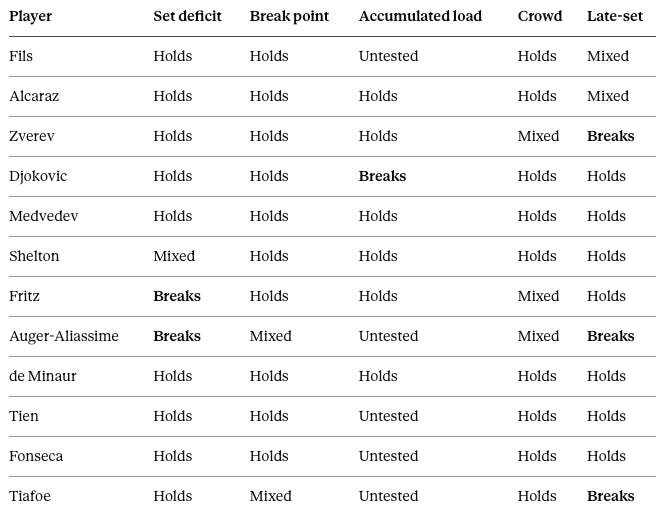
II. Women’s Draw
Twelve women map across the same five states. Short-chain failures dominate here where load failures dominate the men’s table.
Gauff carries the only double Breaks entry in the women’s draw, and Auger-Aliassime carries the men’s. Gauff’s two cells trace to one physical cause, the serve, which makes hers the more concentrated vulnerability of the two.
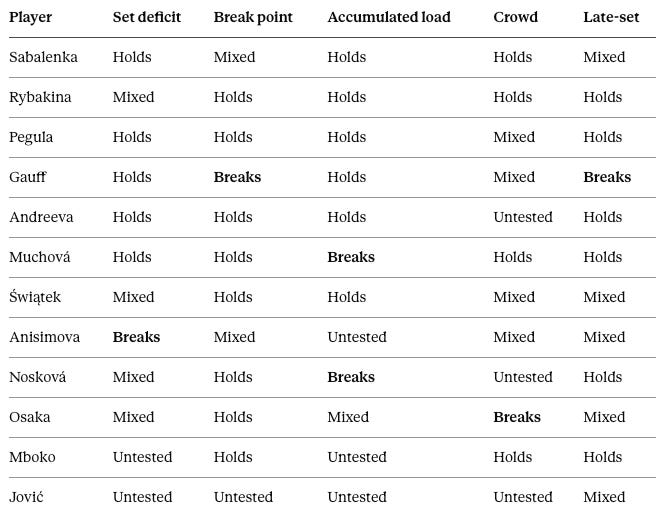
Djokovic fails on load through between-round recovery at 39. Muchová fails on the same axis through movement cost per point. Same cell, different physics.
Nosková’s load entry describes fortnight-level consistency rather than within-match fatigue. That failure runs on a slower clock and scores separately.
The five states are tennis-specific and get rebuilt per domain. Litigation stressors run to adverse rulings, discovery volume, fee pressure and reputational exposure. What carries over is the discipline of naming states separately and recording untested where the observation has not been made.
PART VI — Five Style Classes for Unprofiled Players
Twenty-four profiles cover a fraction of a 256-player field, and some quarterfinalist will arrive without one. Five style classes close the gap at a lower and clearly stated resolution. Assignment runs on three observables, so an unprofiled player gets classified in minutes rather than modelled in days.
I. Why Five Classes, and What Each One Is
Two bad options present themselves without a class layer. Abstaining leaves a gap in the middle of the board. Improvising a CDT overnight produces an unfalsifiable read assembled once the player was already known to matter.
Classification takes minutes and uses match statistics rather than a new model, so coverage becomes complete at two stated resolutions rather than partial at one.
The five archetypes.
Archetypes describe how a player converts a rally into a point. Ranking and power do not enter the classification.
A1, short-chain power. Points end within four shots by design. Signature: high first-serve win rate, rally length under four shots, winners and errors both elevated. Members: Sabalenka · Rybakina · Shelton · Osaka · Anisimova · Fils.
A2, baseline compression. Points end by taking time away. Signature: high return-points-won, rally length four to seven shots, low errors relative to winners. Members: Zverev · Pegula · Nosková · Fritz.
A3, attrition counterpunch. Points end when the opponent runs out of quality. Signature: rally length above seven shots, elevated opponent error count, low own winner count. Members: de Minaur · Medvedev · Gauff.
A4, all-court variety. Points end through pattern substitution. Signature: high net-point count, wide within-match rally-length variance, approach frequency above field median. Members: Muchová · Alcaraz · Andreeva.
A5, heavy geometry. Points end through angle and height rather than flat pace. Signature: high net clearance, wide court coverage of contact points, effectiveness varying sharply with surface speed. Members: Świątek · Fonseca · Tien.
Mboko and Jović carry no archetype. An unsettled pattern hierarchy is precisely the absence of one. Djokovic reads as A2 with an A3 fallback, the only genuine hybrid in the roster.
II. How to Classify a Player, and Which Class Beats Which
Assignment has to run fast enough to work overnight between rounds. Three observables do the job, and two of the three publish for every match.
The procedure below produces a class in minutes rather than a CDT in days. Speed is the point, and the resolution cost is stated rather than hidden.
Average rally length. Under four assigns A1. Four to seven assigns A2. Above seven assigns A3. Wide within-match variance assigns A4. Rally length publishes inconsistently across courts, so a classification resting on it alone stays provisional.
Net points played per set. Above eight assigns A4 regardless of rally length, since forecourt volume is the defining behavior.
Winner-to-error ratio with return points won. Separates A2 from A5 where rally length overlaps. Compression suppresses errors while geometry accepts them in exchange for court position.
Assignment happens once and holds. A player reclassified mid-event on one match has been fitted to a result rather than read.
Matchup grid.
Class against class produces a transferable read. Any player in a class inherits the row, which is what makes the archetype layer worth building.
Two cells carry most of the information. The A4 advantage and the A1 stalemate both follow from the replacement-mechanism finding in Part VIII.
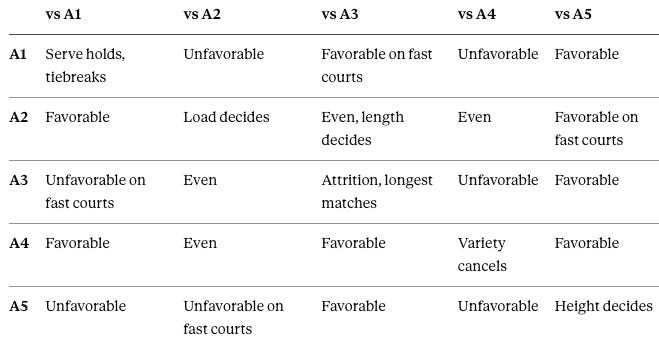
A4 runs favorable against A1, A3 and A5. Even against A2, and cancelling against itself. A player with a replacement mechanism beats a player without one whenever the primary pattern gets neutralized, and five of the twenty-four have no replacement to reach for. Hard courts partly offset the edge by raising the reward for flat pace.
A1 against A1 is the least informative match in the draw. Two short-chain players produce tiebreaks, and a tiebreak resists both resolution levels equally.
Archetype reads are lower-resolution by construction. A line built from an archetype carries an advancement call and no mechanism claim, since three observables support only the first.
📊 The ladder transfers before the archetypes do. Full model where evidence supports one, class-level read where it does not, stated abstention where neither holds. Five tennis classes are disposable. The rule that a read announces its own resolution is not.
PART VII — What the Engine Builds From a Profile
Football and soccer simulations model a side with a substitution lever. Tennis removes the lever, and three consequences reshape what the engine outputs.
I. A Profile Is an Input, Not a Forecast
Anyone can write player descriptions. Tennis previews have written them for a century.
A profile becomes a Simulation Prediction only when run against another profile under a fixed interaction structure. Parts III through VI supply the state, and the simulation is the operator applied to it.
What the earlier cycles produced.
At Super Bowl LX the simulation named a mechanism before naming a result. New England’s compression architecture carries a ceiling, Seattle’s multi-regime survivability outlasts it, and separation therefore arrives late. Seattle won 29-13.
At the 2026 World Cup Final the object took the same shape at a different scale. Spain’s recursive pressure renewal would contain Argentina’s tempo governance, with containment thresholds named. Spain won 1-0 in extra time.
Both cycles published three things. A mechanism, a committed probability, and a route through which the mechanism would express. Grading ran on all three separately.
What changes in tennis.
Football simulations model a side. Doctrine runs through substitutable personnel, and regimes describe how a whole system behaves.
Tennis removes the substitution lever. Regime and person become the same object, and three consequences reshape the output.
Regimes become survivability states. A tennis regime describes whether a player’s primary mechanism is available, suppressed or replaced. Three states, read off the scoreboard rather than off a formation.
Transition triggers move from the clock to the scoreboard. No clock exists. A fork hangs on set-and-game state, on who serves next, and on break-point leverage.
Route decomposition runs set by set. A set is the natural unit. The set score compresses control non-linearly, which the scale below decodes.
II. Reading a Set Score, and What a Match Forecast Contains
Six tiers translate a set score into a control read. Both draws use the same tiers, because a set is a set.

The gap between 7-6 and 6-4 is one break on paper and a large gap in control. The gap between 6-2 and 6-1 is one game on paper and almost no gap in meaning.
Set score therefore settles lines and never feeds inference. The scoreline is a lossy readout of the thing actually wanted, which is control of serve and the break-point economy beneath the games. Where tier and break-point economy disagree, the economy governs.
The committed match object.
Each simulated match publishes three things. None of them is an exact scoreline.
Survivability path. Who is favored to win each set, at what control band, set by set. Committing probability to each exact set sequence would spread the forecast across combinations that were coin flips to begin with.
Named forks. The scoreboard states at which a match re-opens or closes. Each fork is written as an observable checkable while play continues.
Conditional advancement. Probability of reaching round N+1 conditional on surviving round N, published while the near round is still open.
Scoring runs on whether the survivability calls hit and whether the forks fire where stated. Control bands are checked against the tier they landed in.
Sets and forks are tennis furniture. The exportable shape is a path with named re-opening points, which in litigation reads as motion sequence and in geopolitics as escalation thresholds.
III. Worked Example: Muchová Against Rybakina
Muchová against Rybakina is the highest-information pairing the archetype grid produces. Replacement mechanism meets single-dimension profile.
Set 1, Rybakina favored, band 6-4. Her short-chain resolution denies Muchová the rally length variety requires. Points end before a second dimension becomes relevant.
Fork 1, Rybakina’s first-serve percentage across set 1. Above 60% the compression holds and the match likely closes in straight sets. Below 55% her stated duress trigger fires and the match re-opens.
Set 2, conditional on Muchová surviving. Muchová favored at 6-4. Forecourt pulls raise Rybakina’s movement load and extend rallies past the length her mechanism tolerates.
Fork 2, set 2 duration beyond fifty minutes. Muchová’s own load cell reads Breaks, so a long second set converts her advantage into her vulnerability. Approach frequency falls before movement visibly does.
Set 3, contested. The match resolves near even, which makes the ordering more informative than any single figure.
Two players and four fields produce a match structure with two named forks. Both forks stay checkable while the match runs. The Simulation Prediction grades on mechanism whichever way the result lands.
IV. Modelling the Opponent Instead: The Liutova Case
Liutova inverts the usual information structure. She is the most interesting object in the qualifying draw for that reason alone.
Ordinarily both players are readable at comparable resolution and the simulation runs CDT against CDT. Liutova is readable at low resolution. Her opponents carry long professional records and are readable at substantially higher resolution.
The simulation therefore runs one-sided, using the reverse-engineering method from Reverse Engineering Sports Playbooks. Reconstruct the opponent’s doctrine from observed decisions, then derive what the doctrine prescribes against an unfamiliar opponent. That paper matters here because it supplies the reconstruction procedure this case requires.
Three outputs follow without any CDT of Liutova. The patterns her opponent defaults to when scouting is thin. The states where those patterns are exposed. The observable that would show the doctrine adapting mid-match, since adaptation separates a scripted opponent from a reading one.
One asymmetry runs in her favor and decays fast. She knows what her opponents do while her opponents are guessing. Every match converts her from unknown to scouted, so the advantage is largest in the first qualifying round.
Zheng makes the case concrete. Two US Open quarterfinals and an Australian Open final sit in her record, alongside elbow surgery and an 11-13 season. Her doctrine is documented across years while Liutova offers a Memphis title and three qualifying matches.
Neither side has nothing. The gap is resolution, and it runs one way: Liutova can study a full professional career, Zheng can study four tournaments.
⚖️ Counsel should note the structure. A new entrant with a thin public record holds a temporary resolution advantage over an established adversary. The advantage decays with every filing.
PART VIII — Six Findings Across Both Draws
Six results appear only when the whole roster and the surrounding calendar are read together. The sixth changes how a widely used statistic should be read.
I. Findings 1 to 3: How Players Fail, and Who Has a Second Option
Four players carry no break and no mixed entry anywhere in their duress rows. Medvedev, de Minaur, Tien and Fonseca. Two more, Rybakina and Pegula, carry only a single mixed entry.
All six nonetheless have clear vulnerabilities that decide matches. Duress failure and dimensional failure are distinct objects and price differently.
Medvedev does not collapse when pulled to the net. No installed answer exists there, and his composure never enters the outcome. The distinction supplies the mechanism underneath the non-monotonic path structure described in Part II.
Finding 2. Five players have no second dimension, and a sixth cannot reach hers.
Five players own a strong primary mechanism with no installed replacement. Fritz and Shelton and Rybakina and Anisimova and Jović. Against an opponent who neutralizes the primary pattern, each has only the option of executing it harder.
Osaka sits beside the five rather than inside them. Her repertoire exists, since two US Open titles were not won on one pattern. The movement required to reach it does not currently.
Practical effect matches the five while cause and remedy do not. A repertoire gap closes only by installing a pattern, which no fortnight allows. A movement gap closes with fitness, making Osaka the one member whose limitation could resolve inside the tournament.
Membership does not map onto archetype class. Four of the five sit in A1 while Fritz sits in A2, and Sabalenka sits in A1 without belonging to the group at all. Single-dimension status is a repertoire property while archetype is a conversion property.
📊 Investors should note the parallel. A firm with one revenue mechanism and no installed alternative behaves exactly this way under competitive pressure.
Finding 3. Only four players carry true replacement mechanisms.
Muchová, Alcaraz, Andreeva and Fonseca form the replacement tier. Draw structure means at most two can meet before the semifinals.
Any match pairing a replacement-mechanism player against a single-dimension player is the highest-information match available. The shift from one contested dimension to another becomes observable rather than inferred.
II. Findings 4 and 5: What the Matrix Shows, and Where It Is Blank
Load failures appear three times in the men’s draw and twice in the women’s. Short-chain failures, meaning break point and late-set combined, appear three times in the men’s draw and four times in the women’s.
Direction runs as the format argument predicts. Best-of-five distributes duress across a body while best-of-three concentrates it into single points.
Strength does not follow, since samples of three and four separate a real regularity from noise poorly. The round aggregate in Part X tests the claim live.
Finding 5. Untested cells cluster.
Fourteen cells read untested, distributed non-randomly. Most belong to four players: Fils, Jović, Mboko and Auger-Aliassime. Accumulated load carries the largest share.
Load is the hardest state to observe. Observing it requires a player to have played deep into consecutive recent events, which the youngest have not and the injured could not. Any line assigning confident load behavior to Tien, Fonseca, Mboko or Jović is inventing an observation.
III. Finding 6: The Cincinnati Signal Is Asymmetric by Draw
Cincinnati is one of the strongest historically proximate signals for the US Open, on surface, calendar position and field overlap. Nine men completed the double through 2025. Four women had done so through 2024: Clijsters and Serena Williams, then Gauff and Sabalenka.
Coverage treats the signal as one statistic across both draws. Format says otherwise.
Cincinnati runs best-of-three for both sexes. The US Open runs best-of-three for women and best-of-five for men. Gauff’s Cincinnati title therefore transfers across an identical format boundary while Fils’s crosses a format change.
The change stresses exactly the variable Fils has never been observed on. His duress row reads Untested on accumulated load, and best-of-five is where load decides. A best-of-three title supplies no evidence about the state that will govern his second week.
Men’s qualifiers cross the same discontinuity. Three best-of-three matches earn entry to a best-of-five draw, compounding load for anyone arriving through that route. Cincinnati should therefore predict the women’s draw more reliably than the men’s, for structural reasons rather than statistical ones.
A second discount applies to 2026 specifically. Historical Cincinnati power was measured on fields containing the era’s leading players, and this year’s men’s field contained neither Sinner nor Alcaraz. Two effects compound on the men’s side: the format boundary, and a title won against depleted opposition.
The women’s field lost fewer principals, so the women’s signal takes the field-quality discount lightly and the format discount not at all. Gauff’s title carries more evidentiary weight this year than Fils’s, and the ordinary reading of the statistic gives them the same weight.
PART IX — What Gets Published and What Gets Graded
A forecast that cannot be scored teaches nothing, and a forecast scored on one register can hide a failure on another. Part IX separates the registers and sets the rules a committed line must satisfy.
Four sections follow. How scoring splits and when champion-level probabilities enter. How a line must be written and which variables update without touching identity.
I. Three Scoring Registers, and How to Write a Line That Can Be Graded
Every Simulation Prediction scores on three registers held apart. Outcome asks whether the advancement call landed. Mechanism asks whether the stated way of winning or losing was the one that operated. Route asks whether the named transition points fired where predicted.
Separation prevents the two failure modes that make forecasting unfalsifiable. A correct outcome cannot rescue a wrong mechanism, since predicting the winner for the wrong reason is a miss on the register that matters most. A correct mechanism cannot erase a wrong outcome.
Mechanism is the primary ledger. Outcome calls at a Grand Slam regress toward the seeding, and a model that only predicts winners competes on crowded ground.
🏛️ Policymakers and 💼 executives should demand the same split from any forecasting vendor. A supplier that reports only outcomes cannot show whether it understood the system or got lucky.
Rules for committed lines.
Four rules govern how a Simulation Prediction gets written. Each one exists to make a line gradeable by someone who did not write it.
Vagueness is the failure mode all four guard against. A line that cannot be checked against a specific observation cannot be scored.
Name the duress state, not the concept. A line saying a player folds under pressure cannot be graded. A line saying second-serve placement variance rises when serving for a set is falsifiable in one observation.
Price duress failure and dimensional failure separately. One conditions on the stressor arriving. The other conditions only on the opponent.
Flag untested cells on every line depending on them. An untested cell is not a neutral prior.
State the resolution level. CDT-level and archetype-level calls grade separately in the calibration review.
II. When Champion Calls Arrive, and What Updates Before Then
The opening build commits structural and conditional Simulation Predictions. Champion-level probabilities enter later in the cycle, on a schedule the method sets.
The engine models what happens when a contest changes shape during play, under the framework set out in Dynamic Predictive Game Theory From the 2026 Super Bowl and World Cup. A mutation replaces the game itself, and the question becomes which competitor stays coherent once the new game arrives. Sinner’s withdrawal mutated the field before the draw, and further mutations arrive inside the fortnight as injuries, conditions and matchups reshape what winning requires.
Champion-level calls therefore follow the draw and the first rounds, and each arrives with the mutation that produced it named. Conditional advancement calls come first, since a conditional path is falsifiable the moment the near round resolves.
📊 Investors should note the sequencing. Champion-level probability is the last output the method produces, not the first.
Wrapper variables.
Every CDT carries a state wrapper sitting above the identity fields. The wrapper absorbs everything that changes week to week so the identity underneath can stay still.
Separating the two is what allows a bad summer to update the wrapper without touching the read. Three rules govern the boundary.
Wrapper variables update on every new observation, without threshold and without interpretation. Injury status and availability. Accumulated match load and court-speed evidence, qualifying exposure and draw position. Identity fields update on the thresholds in Part X, and nothing crosses from wrapper to identity without meeting one.
Roster substitution carries a higher bar than profile revision: withdrawal, unresolved material injury, or exceptional hard-court emergence. A profile can revise substantially while the player stays on the roster.
Method changes take effect at no point during the tournament. Analytical functions and grading rules hold to the final. Register boundaries stay where the Simulation Prediction set them, so a miss on outcome cannot be relabelled a hit on mechanism.
PART X — Round Update Protocol
Update rules stated after results arrive describe whatever happened. Stated first, they constrain it.
Part X fixes what moves between rounds, what moves at the end, and what does not move at all. Every subsequent publication in this cycle reports against these rules.
I. What Changes Between Rounds, and What Does Not
Three objects get confused whenever a dated forecast meets incoming results. Separating them decides whether the cycle produces evidence or narration.
The method is fixed. No new analytical functions and no altered grading rules once the tournament begins. Changing the engine while it runs makes every subsequent result uninterpretable.
A published Simulation Prediction is fixed. Once a match call goes on the board, the call grades as issued. A post-commitment shock grades the original and logs as annotation.
The CDTs are live. A CDT models a player, and seven rounds of new evidence about that player is exactly what a model consumes.
Version numbering separates the three. Profiles publish at v1.0 and every revision increments the number. Each increment logs what changed and which match produced the evidence.
What updates after every round.
Four objects update on different triggers. Two update mechanically every round while two update only when evidence crosses a threshold.
Ordering matters here. State absorbs a new observation first, and identity moves only when state cannot account for what happened.
State wrapper, always. Cumulative time on court and sets played. Medical timeouts and session conditions and the next opponent. Published as a table without interpretation.
Capacity delta, always. Did the player execute at the ceiling their identity supports? Three values: at capacity, below capacity, above capacity.
Distinguishing below-capacity from dimensional limitation is the judgment that matters. A drop shot that disappears because the wrist hurts is below capacity. A drop shot that never existed is a dimensional limit.
Duress cells, on observation. An untested cell resolves the first time the state arises and the response is visible.
Identity fields, on threshold. Mechanism and holds and breaks and trigger and falsifier and archetype all revise when the evidence bar is met.
Revision thresholds.
Thresholds convert judgment into rule. Without them, every surprising result becomes an argument about whether the CDT should change.
Five triggers cover the cases that arise in a fortnight. Each names its own consequence, so the decision is made before the evidence arrives.
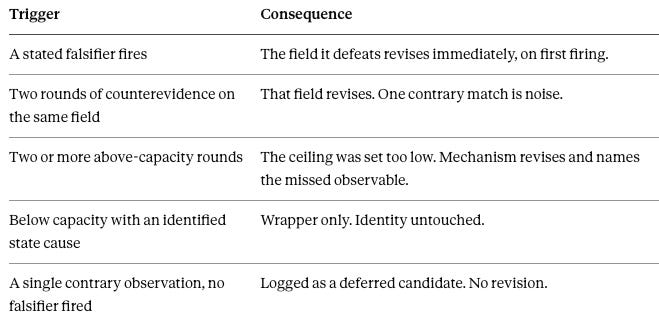
Immediate revision on a fired falsifier is the sharpest rule in the table. A falsifier that survives its own firing is a caveat.
Grading and revision run on separate tracks.
Live CDTs create one hazard. A model that improves during the tournament would otherwise rescue the calls it made before improving.
One rule closes the hazard. Grading runs against the version that produced the call, permanently.
A Simulation Prediction built on profile v1.2 grades against v1.2 permanently, even after the same profile reaches v1.5. Rescoring old calls against an improved CDT would make the record unfalsifiable, since every past error would resolve itself the moment the model caught up.
🏛️ The rule matters more in slow domains than in fast ones. A litigation or geopolitical model revises for years before any outcome settles, so version-locked grading is the only thing preventing a decade of quiet self-correction.
II. What Each Round Card Reports
Each round produces one card per surviving profiled player, carrying six lines and no prose. Narration belongs in the round summary rather than in the record a later reader will audit.
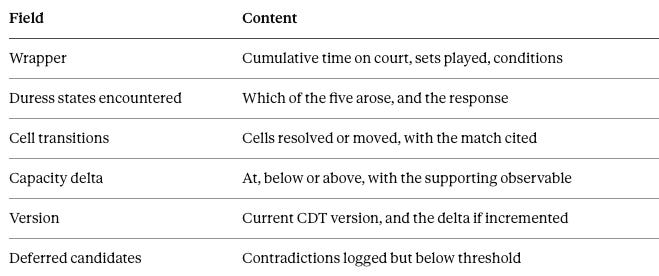
Deferred candidates publish on the card. The gap between what a match showed and what the threshold requires is itself the measurement.
Round-level aggregate.
Individual cards report on players. The aggregate reports on the method, which is the harder and more useful measurement.
Three counts run every round across the surviving field. The third is the one that grades the build rather than the players.
Each round publishes three counts across the surviving field. Capacity deltas by category, duress states encountered by type, and identity fields revised. The third count is the parsimony measure, read as a ratio of evidence-forced to convenience revisions rather than as a raw total.
PART XI — 📋 Simulation Prediction Register
Twenty-four CDTs reduce to one table and four claims. The table states what each player is and how each one fails.
Failure type is the operative column. Dimensional failures price against opponents while duress failures price against situations, and the two settle differently.
I. All Twenty-Four Players in One Table
Every player carries an archetype, a principal vulnerability and a failure type. Read the table as a pricing key rather than as a ranking.
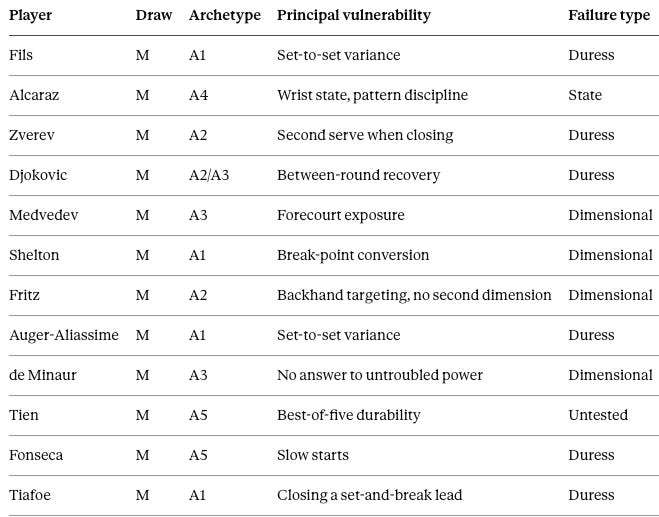
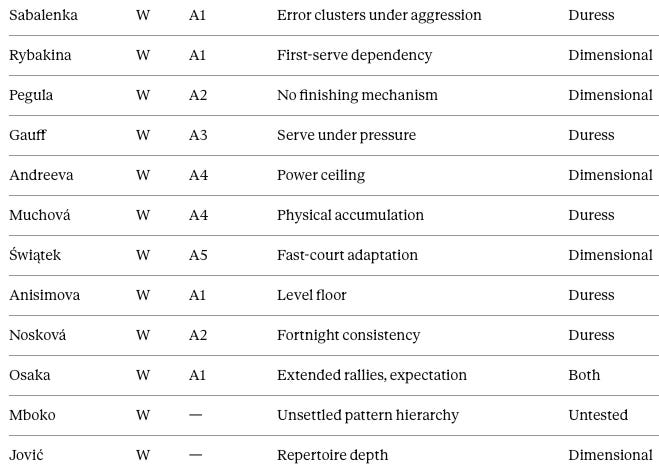
II. 🎯 Four Predictions About the Method Itself
Four claims grade after the final. Each one tests the build rather than a player.
One. At least one unprofiled player reaches a women’s quarterfinal. Settlement: any woman not among the twelve named in Part IV reaching the last eight. The women’s draw has produced three different champions in three majors, and no twenty-four-name roster covers that dispersion. Probability 85%.
Two. At least one unprofiled player reaches a men’s quarterfinal. Settlement: any man not among the twelve named in Part III reaching the last eight. Cincinnati produced a final between two men who were unprofiled at v1.0, both of whom now sit on the roster, which raised this call materially from its opening position. Probability 70%.
Three. Duress failure and dimensional failure separate across the roster. Settlement runs on the named trigger rather than on the scoreline. For each loss by a profiled player, the question is whether that player’s stated duress trigger activated before the loss, or whether the opponent suppressed the player’s primary mechanism without any trigger firing. The claim settles if players marked Duress show trigger activation in a majority of losses, and players marked Dimensional show mechanism suppression without trigger activation in a majority of theirs. Retirements are excluded, and fewer than eight qualifying losses across the roster voids the claim. Probability 65%.
Four. Archetype-level advancement calls land within ten points of CDT-level calls. Settlement: mean absolute difference in advancement probability across all paired calls, where a paired call is one match for which both an archetype read and a CDT read were published before play. Ten percentage points or fewer settles the claim. Fewer than five paired calls voids it. Probability 55%.
What Follows
Publication of this document opens the cycle rather than closing it. Three further releases follow on a fixed schedule, and champion-level calls enter once tournament evidence changes the interaction structure.
Round-specific advancement probabilities follow in the next installment. Committed match Simulation Predictions arrive as the tournament reaches its later rounds.
Round cards publish after every completed round under the Part X protocol. Calibration review publishes after the final and delivers every verdict the protocol defers.
Few of the twenty-four CDTs will finish the fortnight in the shape they start it. The shape they finish in is the result.
Sources
Directly cited facts
United States Tennis Association, “Jannik Sinner withdraws from 2026 US Open with right knee injury”, 21 August 2026. Source for the withdrawal that moved Zverev to the top seeding.
United States Tennis Association, “Zheng qualifies for 2026 US Open, joins Kalieva, Stoiana, Basavareddy”, 28 August 2026. Source for the qualifying field and the Liutova entry.
Women’s Tennis Association, “Swiatek reaches Cincinnati semifinals as Rybakina succumbs to left ankle injury”, 2026. Source for the Rybakina retirement and the specific injury.
Women’s Tennis Association, “Andreescu, Zheng, Kenin, Liutova headline US Open qualifying entries”, 2026. Source for the qualifying entry list and Liutova’s season record.
Tournament and tour records
Association of Tennis Professionals, atptour.com. Match results, rankings and seeding order for the men’s draw, including the Cincinnati final and the Canada titles.
Women’s Tennis Association, wtatennis.com. Rankings, seeding positions, qualifying entry lists and match results for the women’s draw.
United States Tennis Association, usopen.org. Entry lists, withdrawal notices, mixed doubles results and the qualifying and main-draw calendar.
Cincinnati Open, cincinnatiopen.com. Draw and results for the 2026 event, including the all-American women’s final.
Tournament champion records held by the Cincinnati Open and the USTA supply the historical Cincinnati and US Open double counts underpinning Finding 6. Draw formats follow the published ATP and WTA rules governing best-of-three and best-of-five play.
MindCast AI publications
🏈 Super Bowl LX — AI Simulation vs. Reality, 2026. Establishes the practice of naming a mechanism before naming a result, and supplies the multi-regime survivability construct this paper adapts to a single body.
FIFA World Cup Final Foresight Simulation — Spain vs Argentina — Spain Owns Recurrence, Argentina Owns Recovery, 2026. Demonstrates that the engine transfers across sport and continent, which is the precondition for a third cycle in an individual sport.
The 2026 World Cup Final Simulation Validation, 2026. Supplies the public grading standard applied to every line in this document, including the separation of outcome and mechanism registers.
MindCast Predictive Game Theory + Behavioral Economics Cognitive Digital Twin Foresight Simulations in the World Cup and Super Bowl, 2026. Makes the structural case for sports as a bounded validation environment for methods deployed in slower domains.
Reverse Engineering Sports Playbooks with Cognitive Digital Twins + Dynamic Predictive Game Theory — Proven on Star Wars Lightsaber Forms, 2026. States the Doctrine Identifiability Theorem governing when this document withholds a read, and names the US Open as this runtime’s first live deployment.
Dynamic Predictive Game Theory From the 2026 Super Bowl and World Cup, 2026. Sets out the game-mutation framework governing when a contest stops being the same game, which determines the schedule on which champion-level probabilities enter this cycle.
Messi, Federer, Tiger — Stories of Predictive Coherence, 2026. Establishes the individual-sport precedent for Cognitive Digital Twin modeling, including tennis, where a competitor carries the contest without substitution.
MindCast Foresight Prediction Simulations, Synthesizing Behavioral Economics + Game Theory, 2026. Establishes why neither game theory nor behavioral economics forecasts across a rule change alone, and defines Adaptive Coherence Equilibrium as the condition this paper applies to players who must adapt without leaving the court.
MindCast AI 2026 Prediction-Venue Comparison — Every Head-to-Head From Super Bowl LX and the FIFA World Cup, Scored Against the Field, 2026. Scores the prior cycles against Opta, Kalshi, Polymarket and EA Sports FC 26. Supplies the external-benchmark practice the calibration review after this tournament will follow.
MindCast AI applies Dynamic Predictive Game Theory and behavioral economics to complex adaptive systems. Major sporting events serve as a public validation laboratory, because known rules and definitive outcomes let every claim resolve against a scoreboard in weeks. The same simulation technology runs against antitrust, corporate litigation risk, innovation economics and geopolitical risk intelligence. The same decision-architecture problem recurs in those arenas, and the verdict takes years.