
Companion publications: The Grid-Anchored Clean Power Bargain · The Clean Compute Match · AI Data Center Veto Points · The Lowest-Exposure AI Data Center Approval Route for Developers, Hyperscalers and Investors
Thesis: Grid rules now reward data centers that agree to cut power use during grid stress, but state and local approval has no route keyed to how much burden a project imposes. Small low-burden projects fall between the two, and uniform rules favor hyperscalers.
Why now: Texas halted data center permits and California signed seven data center bills on September 21, 2026. The 2027 legislative sessions will write the next rules. Policymakers, executives, counsel and investors each face that window.
I. Executive Summary
Communities across the United States are resisting AI data centers over electricity bills, water use and secrecy. States are answering with permit freezes and new rules that charge data centers for the grid upgrades they require.
Grid regulators have taken a different path. Grid rules now offer faster power connections to data centers that agree to cut electricity use during grid stress, a practice called curtailment. State and local approval offers no comparable route for small projects that impose little burden on their communities.
Small low-burden projects can therefore fall between the two systems. Uniform approval conditions meanwhile favor the hyperscalers, the largest cloud operators, which can self-fund infrastructure and absorb delay.
Texas and California acted on the same day, September 21, 2026. Texas Governor Greg Abbott directed the state environmental agency to halt all permits sought by data centers until the state grid operator completes an audit of data center power demand. California Governor Gavin Newsom signed seven bills on electricity costs, water use and local oversight. Neither measure gives lower-burden projects a distinct approval route.
MindCast’s thesis is that approval should turn on measured burden: the size of the power increment, water draw, enforceable curtailment and reuse of an existing site. Modular construction, factory-built data center units delivered in blocks of a few megawatts, makes low-burden projects buildable. Burden rather than construction form should still decide the route.
MindCast AI applies Behavioral Economics + Dynamic Predictive Game Theory through MindCast AI Proprietary Cognitive Digital Twin Foresight Simulations (MP CDT FS). Game theory supplies the payoff structure and the equilibrium the contest reaches. Behavioral economics supplies the decision rules, including the salience of scale that makes every data center look alike to voters and hearing rooms.
The paper maps the three layers of rules that now govern approval: grid tariffs, state law and county ordinances. The paper then shows where small modular projects fall between grid rules and state law. A MindCast simulation tests which layer creates a route for them first.
MindCast AI’s founder has testified before the Washington State Legislature, whose 2026 session produced one of the incentive changes this paper examines.
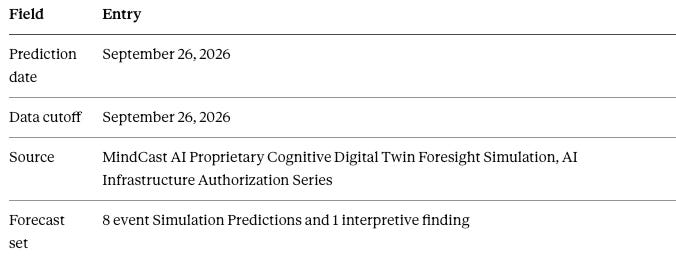
The simulation produces nine forecasts: two Primary Simulation Predictions (P), six Secondary Simulation Predictions (S) and one interpretive finding (IF). The table below lists all nine, and Section III carries each in detail.
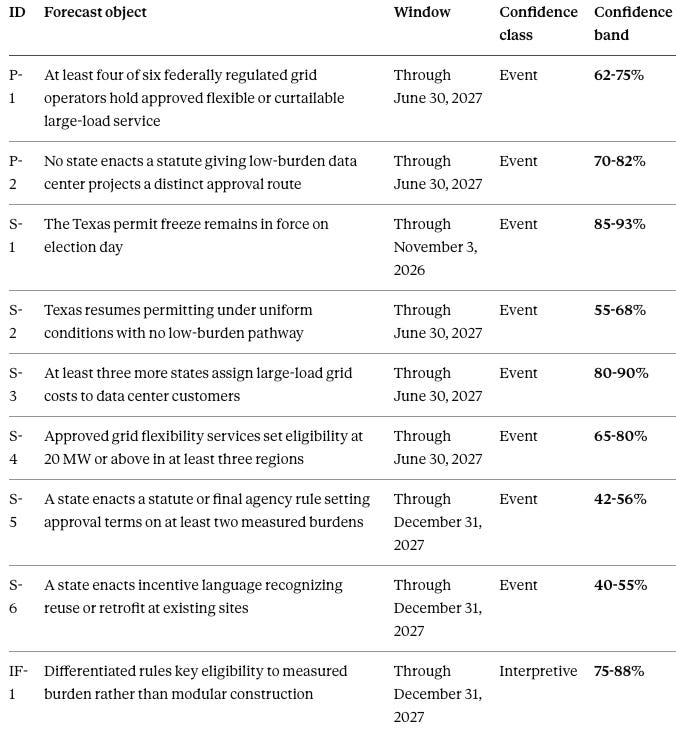
Three forecasts together show where small projects fall through. Grid flexibility spreads (P-1), state statutes create no burden-based route (P-2), and small projects fall below tariff size thresholds (S-4). Agency rules and incentive reform after the 2027 sessions offer the first openings (S-5, S-6).
🏛️ Policymakers. Freezes and cost rules that ignore burden push investment toward the largest self-funding campuses (P-2).
💼 Executives. Small modular projects sit below grid flexibility thresholds, so uniform state conditions favor operators that self-fund infrastructure (S-4).
⚖️ Counsel. Existing data center use does not protect an expansion, because added load, cooling equipment and generators can each trigger approvals (S-2).
📊 Investors. Modular form alone confers no authorization advantage, and uniform conditions consolidate the market toward hyperscalers (P-2, IF-1).
The gap between grid rules and state approval is the decision point for every stakeholder. The next step is to connect measured burden to state and local approval.
II. Small Projects Fall Between Grid Tariffs and State Law
Data center approval now turns on three layers of rules and three community objections. Small projects fall where the two meet.
A. Three Layers Now Govern Data Center Approval
Grid tariffs, state law and county ordinances each decide part of whether a data center gets built. Grid tariffs are the rules that set terms for connecting to the power system. The three layers moved at different speeds in 2026, and grid rules moved first.
The Federal Energy Regulatory Commission (FERC) issued orders on June 18, 2026 to all six regional grid operators it regulates, the organizations that run high-voltage power systems across multistate regions. The orders push each region toward interim, firm, and non-firm contract demand services for large loads. FERC had already approved the Southwest Power Pool’s large-load framework in January 2026, which delivers interconnection agreements within 90 days for qualifying loads.
Utility tariffs, the rate schedules of individual power companies, are moving the same way. One quarter of tracked large-load tariffs and service rules now include a concrete flexibility or curtailment pathway. The grid layer therefore already distinguishes flexible load from firm load.
State law moved on September 21 without separating flexible projects from the rest. Texas froze all air and water permits for infrastructure directly supporting data centers until the audit ends. California shifted infrastructure costs from residential customers to operators and required water and resource disclosure.
Texas and California share more than their headlines suggest. Texas had already ordered data centers in June to fully fund the electric infrastructure serving them. The states differ on freeze versus disclosure, and other states can combine all of these tools.
Grid rules and state rules now run out of step. Grid rules sort load by flexibility, while state and county rules sort projects by the label “data center.”
B. Three Grievances Drive the Backlash
Community opposition centers on money and trust more than on building size. An industry survey found that higher local electricity prices, water consumption, and grid reliability rank as the concerns most likely to shape projects. Secrecy compounds each one. The Two-Ledger Data Center Bargain frames community consent as a test of local net benefit, and secrecy prevents residents from running that test.
In Bessemer, Alabama, the mayor and senior staff signed nondisclosure agreements requiring destruction of communications the developer considered confidential. The mayor was forced into a runoff. California’s disclosure laws respond directly to that pattern.
Voters carry the opposition into elections. An NBC News poll found 64% of Americans less likely to vote for a candidatewho supports building local data centers. Small projects draw the same scrutiny, as a Wisconsin county committee showed when it questioned a 2 MW modular proposal on water, noise and zoning.
Electricity costs and water use each point to a burden a regulator can measure, and emissions complete the three burdens this paper tracks. Measured burden gives regulators a basis for separating projects.
C. Three Instruments Reduce Each Burden
Each of the three burdens has an instrument that reduces it. None eliminates the objection, and the table names what each leaves unresolved.
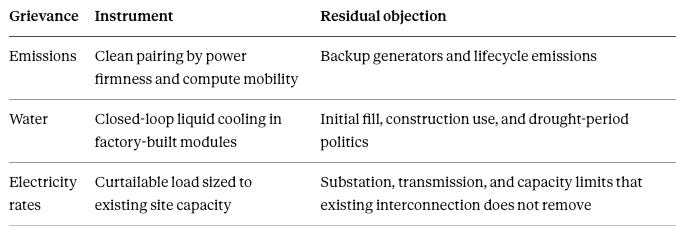
Clean pairing, the emissions instrument, comes from two earlier MindCast papers in this series. The Grid-Anchored Clean Power Bargain (2026) shows that moving flexible compute toward abundant energy raises the firm-power need of the load left behind. The Clean Compute Match (2026) sorts compute and clean generation into matched pairs and names the fossil residual the pairing leaves. Together they give an operator a clean-supply plan that avoids proposing on-site turbines. ued for moving compute to power rather than power to compute.
Closed-loop cooling, the water instrument, recirculates the same fluid instead of evaporating water. A 2 MW modular proposal in Wisconsin’s Dunn County uses a closed-loop glycol system with an initial fill of 3,000 to 4,000 gallons, far below the annual draw of evaporative campuses. Construction water and drought-period scrutiny remain.
Curtailable load, the rate instrument, depends on spare grid capacity. Existing interconnection does not guarantee spare substation, transmission, or capacity headroom. The Grid-Anchored Clean Power Bargain states the rule directly: interconnection, deliverable energy and accredited capacity are separate products, and the weakest governs.
Curtailment reduces the peak load a utility must plan around. Lower household rates do not follow automatically, because substation and transmission costs remain.
D. Burden, Not Modular Form, Governs Authorization
Rules keyed to burden work without modular construction, because flexible grid service and cost rules already exist without it. Modular construction without burden-keyed rules earns no approval advantage.
Modular construction makes low-burden projects possible but does not earn them an approval route. Four measures define the burden a route should turn on: the size of the power increment, water draw, enforceable curtailment and reuse of an existing site. Each measure can be verified in a filing.
Keying rules to burden rather than construction form also protects the policy from gaming. A rule keyed to construction form rewards a label, while a rule keyed to burden rewards the outcome communities care about.
E. Existing Sites Can Host Small Liquid-Cooled Additions
Existing data centers offer a second path to low burden, one hall or power block at a time. Each such addition is an increment of capacity inside a site that already has approvals. Operators should ask which halls, rows and power blocks can support which compute. A site that cannot convert fully to AI may still host a valuable liquid-cooled block.
Physical limits come first. High-density AI racks can weigh up to 1.5 metric tons, and floor loading constrains retrofits in multi-story buildings. Electrical distribution, chilled-water capacity and piping routes set the rest of the envelope.
Brownfield deployment, building inside an existing site, reduces approvals only when it reduces burden. Added load, cooling equipment, generators and noise can each trigger review at an existing site. Reuse lowers the number of approvals needed when the increment stays small and flexible.
F. Small Projects Fall Below Grid Flexibility Thresholds
Grid flexibility pathways start at large sizes. Forty-five percent of large-load tariffs and service rules in the national tariff database kept by the Smart Electric Power Alliance and the NC Clean Energy Technology Center set a threshold of at least 50 MW, counting approved and proposed rules together. FERC recommended the same 50 MW figure as part of its large-load definition in the June show-cause orders on transmission-level interconnection. Flexibility offers follow the pattern: Pennsylvania’s model tariff offers interruptible service to loads of 50 MW or more, and Xcel Energy’s Minnesota interruptible rate starts at 100 MW.
Size thresholds leave small projects outside grid flexibility programs. A 2 MW or 10 MW module can be built to curtail on command, yet it falls below most of these thresholds. Nearly three-quarters of tracked large-load tariffs target loads above 20 MW, and retail exceptions such as a Montana-Dakota Utilities interruptible rate open at 10 MW stay uncommon. The module still faces state freezes and county approvals written for campuses. AI Data Center Veto Points maps each stage where a state or county can stop a project, and a small module passes through the same stages.
Texas already collects data on the mid-size projects those thresholds miss. The Electric Reliability Council of Texas (ERCOT), the state’s grid operator, has sent requests to utilities covering about 157 medium data center and crypto facilities totaling almost 8,800 MW. The dataset gives Texas the information a size-tiered exit would need.
Small flexible projects therefore fall between grid rules and state approval. Tariffs do not reach them, and state law does not distinguish them.
G. Uniform Conditions Favor Hyperscalers
Uniform approval conditions reward the companies best able to meet them. Hyperscalers can self-fund grid infrastructure and absorb new disclosure regimes. The Texas governor’s campaign said his directive prompted Amazon, Google, and Microsoft to embrace his standards.
Modular vendors and smaller operators cannot absorb a statewide freeze in the same way. Their letters of intent with generation owners, such as the agreements PowerBank and SkyVolt signed with Nodiac, wait on approvals they cannot accelerate.
Uniform rules therefore concentrate the market. Rules written to restrain the industry end up favoring its largest members.
H. State Incentive Law Rewards Greenfield Builds
State incentive statutes favor large new construction. r incentive statutes across all 50 states. Michigan adopted a 2024 law exempting large enterprise data centers from state sales and use taxes. Washington State passed Engrossed Substitute Senate Bill (ESSB) 6231 in 2026, and from July 1 its exemptions no longer cover data centers that qualify through refurbishment while new construction keeps them.
Washington’s change penalizes expansion inside existing sites. An operator adding a liquid-cooled block inside an existing Washington facility loses the exemption a greenfield campus retains. Incentive reform keyed to burden would correct the tilt without abandoning large projects.
I. The Simulation Asks Which Layer Opens a Low-Burden Route First
MindCast’s simulation answers one question: which layer of rules gives low-burden data centers a distinct route first, and will Texas create one when it lifts its permit freeze? The horizon runs through June 30, 2027. The window covers the Texas legislative session that convenes January 12, 2027 and most 2027 state sessions.
Federal preemption and export-control policy fall outside scope. Anchored frontier training also falls outside scope. Modular construction can assemble large campuses, but it does not remove the need for 0.5 to 2 GW of contiguous synchronized power at one site, so such campuses cannot qualify as low-burden increments.
J. Behavioral Economics Explains Why Scale Hides Burden
Voters and hearing rooms judge data centers by salient features rather than by load profile. A container beside an ethanol plant triggers the same scripts as a two-square-mile campus. Behavioral Economics explains why burden vanishes from the debate unless a rule makes it visible.
Loss aversion, the tendency to weigh losses more heavily than equal gains, sharpens local opposition. Residents weigh a concentrated local cost against a diffuse regional benefit. Elected officials facing an election favor uniform rules because uniform rules are easy to defend, and carve-outs read as loopholes.
K. Dynamic Predictive Game Theory Explains Why Uniform Rules Spread
Data center rules change while states, grid operators and companies react to one another. Each state that assigns costs to operators raises the payoff for neighbors to follow, and each grid operator’s tariff becomes a model for the next. Dynamic Predictive Game Theory tracks two races at once: flexibility across grid operators and uniform approval rules across states.
Hyperscalers also adjust to what rivals and regulators do. Public compliance with uniform standards gives hyperscalers an exit rivals cannot match. A static estimate misses how one actor’s compliance reshapes the payoff for the others.
L. Eight Actors Write and Apply the Rules
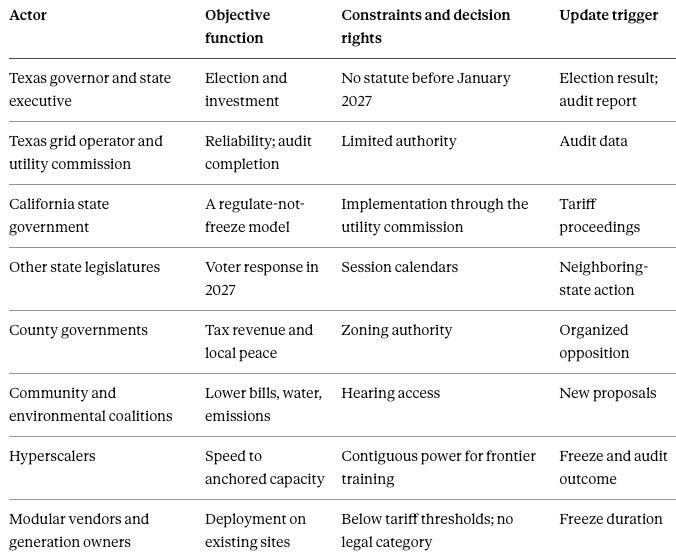
The simulation modeled eight actors as Cognitive Digital Twins (CDTs). Each carries an objective, constraints and a trigger that updates its behavior. The Cognitive Digital Twins played against each other across seven rounds of move and countermove.
Four competing explanations could account for how small projects are treated.
Template choice. A state’s policy template decides what happens to low-burden compute. The explanation fails if states with different templates give low-burden projects the same treatment.
Tariffs alone. Grid tariffs decide low-burden outcomes regardless of state law. The explanation fails if projects eligible for flexible grid service still stall at state or county approval.
Layer mismatch. Tariffs carry flexibility for large loads while state and local approval lacks a route keyed to burden, so small projects fall between the layers. The explanation fails if a state opens a burden-keyed route before grid flexibility spreads, or if tariffs open flexibility to loads below 20 MW.
No differentiation. Every layer ignores burden and no design choice changes outcomes. The explanation fails if any layer separates projects by burden.
The layer mismatch, the third explanation, best fits the evidence. Texas and California chose different templates yet gave low-burden projects the same treatment. The grid layer already separates flexible load, which rules out the no-differentiation case, and the Texas freeze stops projects regardless of grid eligibility.
The simulation modeled authorization cost at each layer and the authority of each regulator. The model also traced transaction costs between layers and belief shifts among voters and officials. A tipping analysis modeled how rules spread across states and grid operators.
The simulation centered on the officials and companies who write and apply the rules. The layer mismatch emerged from their interaction rather than from any single actor’s plan.
III. MindCast Simulation Predictions
MindCast forecasts nine outcomes: two Primary Simulation Predictions (P), six Secondary Simulation Predictions (S) and one interpretive finding (IF). The mechanism and paths come first, and the forecasts follow.
The mechanism behind the forecasts runs as follows.
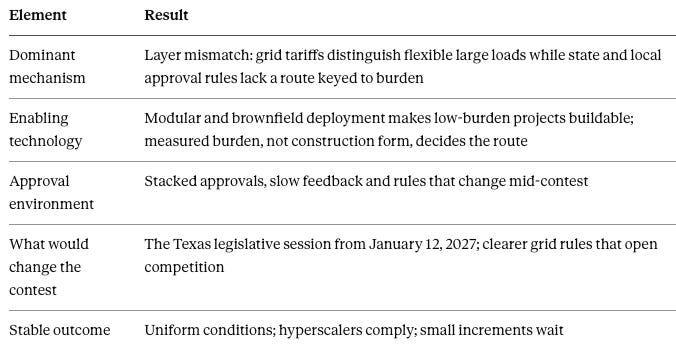
The most likely path runs through a Texas exit on uniform conditions, cost allocation spreading across states, and flexibility spreading across grid operators. The second path runs through agency rules after the 2027 sessions, where cost pressure produces burden-based approval terms that statutes did not. The low-probability path is a grid emergency, drought, or salient rate increase that pushes more states toward blanket freezes even where lower-burden projects exist.
A. Grid Tariffs Move While State Statutes Stall
The two primary forecasts test each side of the mismatch between grid rules and state approval. P-1 measures the grid layer and P-2 measures state statutes.
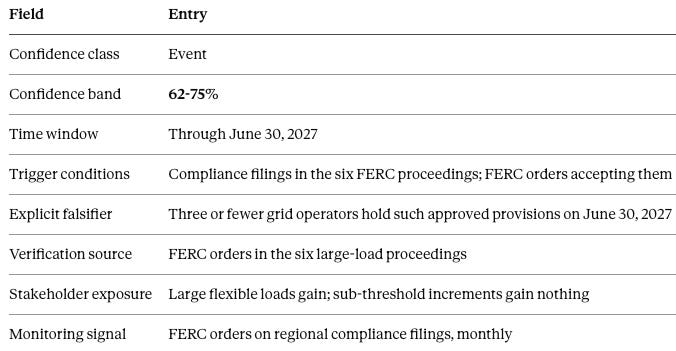
P-1 | At Least Four of Six Regional Grid Operators Win Approval for Curtailable Large-Load Service by June 30, 2027 (62-75%)
Forecast statement: By June 30, 2027, at least four of the six FERC-regulated regional grid operators hold approved tariff provisions that offer large loads non-firm or curtailable interconnection service on faster terms than firm service.
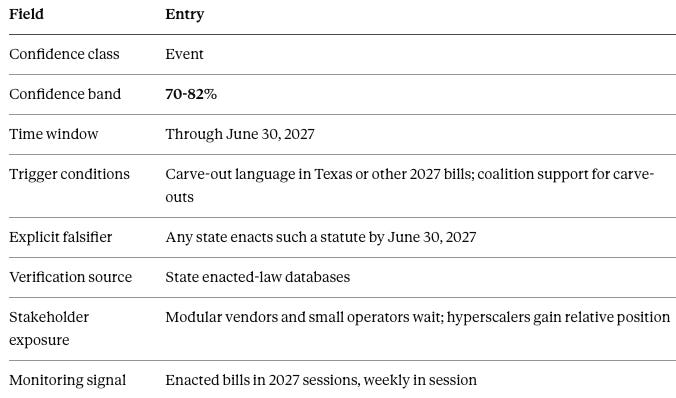
P-2 | No State Enacts a Statute Giving Low-Burden Data Center Projects a Distinct Approval Route by June 30, 2027 (70-82%)
Forecast statement: By June 30, 2027, no state enacts a statute that expedites or exempts data center projects based on low measured burden while stricter terms still apply to other data center projects. Low measured burden means curtailability, reuse of an existing site or a small power increment.
B. Texas, Cost Rules and Tariff Thresholds Carry the Mechanism
The six secondary forecasts test the steps beneath each primary forecast. S-1 through S-4 run through June 30, 2027, and S-5 and S-6 extend the test through the end of 2027.
S-1 | Texas Keeps Its Data Center Permit Freeze in Force on November 3, 2026 (85-93%)
Tests P-2. Election-year pressure sustains the freeze. A lifted freeze before election day falsifies the forecast.
S-2 | Texas Resumes Permitting by June 30, 2027 Under Uniform Conditions With No Low-Burden Pathway (55-68%)
Tests P-2. The audit report and 2027 session bills drive the exit. A Texas statute or agency rule creating a distinct low-burden pathway falsifies the forecast.
S-3 | At Least Three More States Assign Large-Load Grid Costs to Data Center Customers Between October 1, 2026 and June 30, 2027 (80-90%)
Tests P-2. Statutes and utility commission orders count, and Texas and California do not. Two or fewer such enactments falsify the forecast.
S-4 | Approved Grid Flexibility Services Set Eligibility at 20 MW or Above in At Least Three Regions by June 30, 2027 (65-80%)
Tests P-1. Regional compliance filings set the thresholds. Three or more regions opening flexibility services to loads below 20 MW falsify the forecast.
S-5 | At Least One State Sets Different Data Center Approval Terms Using Two or More Measured Burdens by December 31, 2027 (42-56%)
Tests P-2. A statute or final agency rule counts, and agency rulemaking after the 2027 sessions drives the forecast. No such statute or final rule by December 31, 2027 falsifies it.
S-6 | At Least One State Enacts Incentive Language Recognizing Reuse or Retrofit at Existing Sites Between October 1, 2026 and December 31, 2027 (40-55%)
Tests P-2. Language covering reuse, retrofit, refurbishment or incremental load at an existing site counts. No such enacted incentive language in the window falsifies the forecast.
S-4 identifies where small projects fall through. If S-4 resolves as forecast, small modular projects depend entirely on state and retail pathways that P-2 expects to stay closed.
S-5 counts five measured burdens. Curtailable load and incremental grid requirement lead the list, followed by water profile, clean-supply obligation and reuse of an existing site. Final agency rules can move after legislatures adjourn, so S-5 tests whether cost pressure produces through agencies what statutes do not.
C. Burden Measures Will Decide Differentiated Rules
One interpretive finding completes the set. The finding assesses a structural pattern rather than a single observable event.
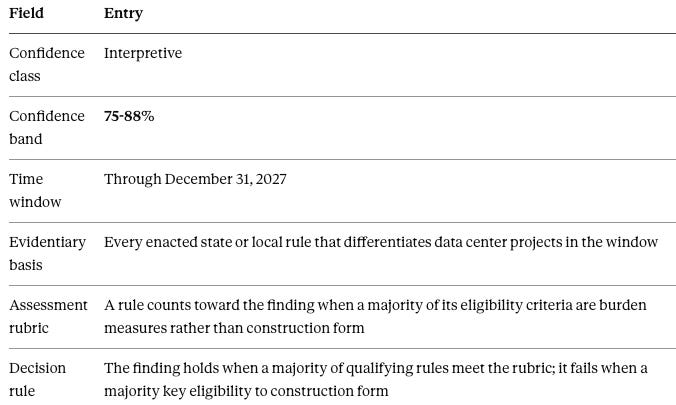
IF-1 | Differentiated Rules Key Eligibility to Measured Burden, Not Modular Construction (75-88%)
Where governments differentiate data center projects, eligibility turns primarily on measured burden rather than on factory-built or modular construction. Measured burden covers power and water use, cost, emissions and flexibility.
D. A Size-Tiered Texas Exit Remains a Watch Condition
A size-tiered Texas exit remains a watch condition rather than a Simulation Prediction. The grid operator’s medium-load dataset gives Texas the information to build one. The audit report due to the governor on December 1 is the gating event.
E. Three Events Would Break the Forecasts
Three break conditions would invalidate these Simulation Predictions. The first is a federal preemption order on state data center rules. The second is a court injunction against the Texas directive or the California package, and the third is a Texas grid emergency before June 30, 2027.
Two further claims remain unproven. Curtailment has not established household rate relief, and coordination failure among separate sellers of power, sites and hardware has not established itself as a primary cause.
IV. Stakeholder Moves Before Texas Lifts Its Freeze and the 2027 Sessions Begin
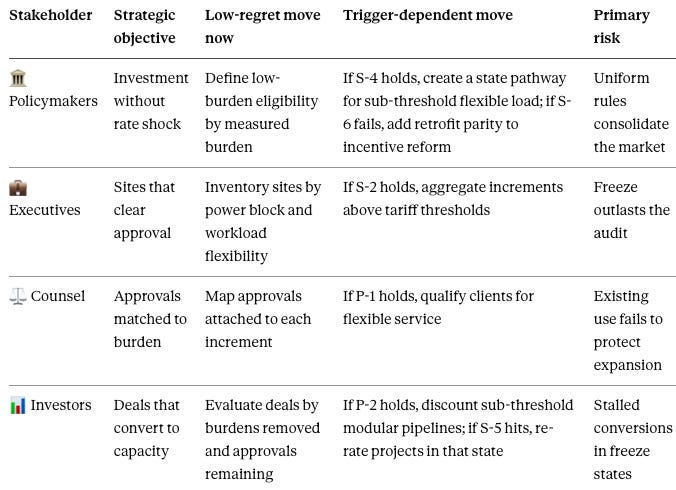
Each stakeholder move below keys to a Simulation Prediction.
A. Policymakers Hold the Instruments That Close the Gap
🏛️ Lawmakers and state agencies hold the instruments that close the gap between grid rules and state approval. A state pathway keyed to the four burden measures would reach increments below tariff thresholds (S-4). Agencies can act after sessions adjourn (S-5), and The Model AI Infrastructure Authorization Code offers a drafting vehicle for both.
B. Executives Should Sort Sites by Burden First
💼 Operators should sort sites by burden before choosing between greenfield and brownfield builds. Where S-2 holds, aggregating increments above tariff thresholds opens the grid pathway P-1 expects to spread. The Lowest-Exposure AI Data Center Approval Route for Developers, Hyperscalers and Investors sets out the filing order that clears state and county approvals with the least exposure to a stop.
C. Counsel Should Map Approvals Increment by Increment
⚖️ Counsel should map approvals increment by increment. Texas’s freeze reaches air and water permits for supporting infrastructure, so equipment additions at existing sites face the same pause.
D. Investors Should Trace Each Deal Through Three Layers
📊 Diligence should trace each modular deal through tariff eligibility, state permits and local zoning. Pipelines below tariff thresholds carry the most exposure under P-2 and S-4.
Each stakeholder faces risks on four time horizons.
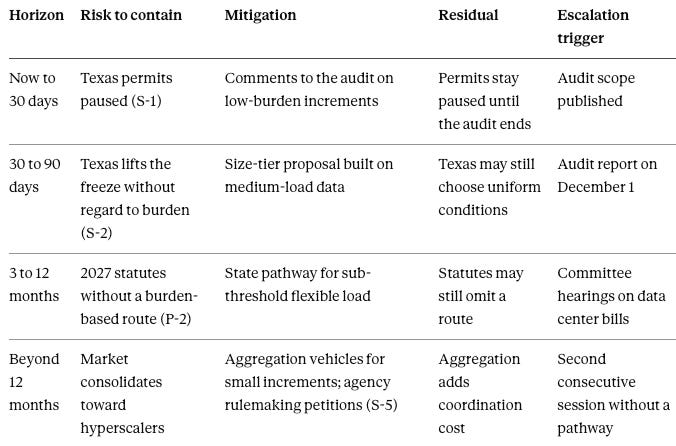
Every stakeholder faces the same deadline: the end of the Texas freeze and the 2027 legislative sessions. Early entry costs little, and late entry inherits whatever rules others write.
V. Uniform Rules Concentrate Data Center Capacity
The forecasts carry four consequences for authority, strategy, value and stakeholder effort.
A. Authority Over Small Flexible Load Splits Across Layers
Authority over low-burden compute splits across layers that do not coordinate (P-1, P-2). FERC and grid operators decide tariff eligibility, while states and counties decide permits. The split leaves no single forum responsible for small flexible load.
Shared definitions of burden would solve the coordination problem. Standard definitions used in tariffs, contracts and permits would let each layer recognize the same project (IF-1). Agency rules offer the first venue where that alignment can happen (S-5).
B. Hyperscaler Compliance Stabilizes Uniform Rules
The simulation’s stable outcome pairs hyperscaler compliance with coalition acceptance and leaves small operators outside (S-2). Hyperscalers comply with uniform rules, coalitions accept compliance as proof of control, and carve-outs lose support from both. Modular vendors lack the coalition to break the arrangement.
C. Uniform Conditions Shift Value to Self-Funding Operators
Uniform conditions shift value toward self-funding operators and away from generation owners hosting small modules (S-2, S-3). Households gain cost protection from cost allocation. Small operators absorb the delay.
D. A Missed Forecast Would Redirect Stakeholder Effort
A distinct low-burden statute would falsify P-2 and open the route this paper recommends. Stakeholders should then shift from advocacy to qualification. If P-1 fails, flexible compute loses its grid pathway and the case for burden-based state treatment weakens with it.
A miss on IF-1 would matter most for vendors. Rules keyed to modular construction would reward form over outcome and invite projects built to the label rather than to low burden.
All four consequences trace to the same gap. The gap between grid rules and state approval persists until a state connects measured burden to approval.
What to Watch: The End of the Texas Freeze and the 2027 Sessions
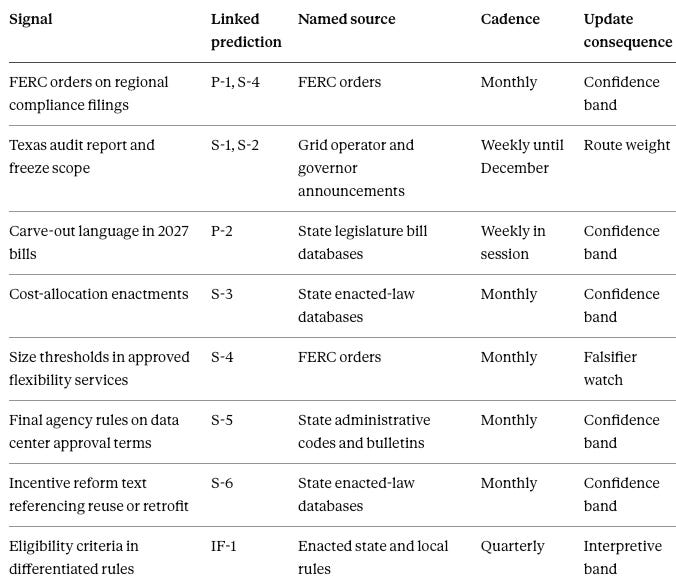
The key uncertainty is whether Texas lifts its permit freeze under one rule for all projects or under rules that vary by project size. Three dated events move that fork: the Texas election on November 3, the audit report on December 1 and the Texas session opening January 12, 2027. The table names each signal, its source and its cadence.
Conclusion
Grid regulators now give flexible data centers a faster route to power, while state and local approval has no route for small projects that impose little burden. Small modular projects can fall between the two: too small for grid flexibility programs and unrecognized by state approval. Uniform conditions meanwhile favor the hyperscalers best able to meet them.
Policymakers should act first, because a statute or agency rule keyed to measured burden reaches the gap directly. The decisive signal is the Texas audit report on December 1 and whether the exit it informs separates projects by burden.
Working With MindCast: Authorization Route Models
Published analysis cannot tell a specific operator which of its sites and workloads qualify for which route. The answer depends on the operator’s workload mix, site envelopes, and target jurisdictions.
MindCast builds an Authorization Route Model for each operator. The model runs in sequence from workload flexibility to module size and then to tariff eligibility. Brownfield capacity and remaining permits follow, and the sequence ends at the authorization route. Cognitive Digital Twins of the operator’s utilities and target governments test each step against likely countermoves.
Commissioned work adds complete probability distributions and full scenario trees. Organization-specific trigger dashboards and red-team tests of each filing complete the scope.
Operators and generation owners can start with an Authorization Route Model for three target sites before Texas lifts its permit freeze (S-2). Investors and lenders can commission a pipeline screen against the tariff thresholds in S-4. Reach MindCast at mcai@mindcast-ai.com. Visit our Corporate Site at https://www.mindcast-ai-simulation.com.
Appendix A: Selected MindCast Works
Frameworks and Methods
The Grid-Anchored Clean Power Bargain (2026). Supplies the firmness rule that separates interconnection from deliverable energy and accredited capacity.
The Clean Compute Match (2026). Supplies the pairing of compute classes with clean generation and the fossil residual this paper targets.
The Model AI Infrastructure Authorization Code (2026). Provides the drafting vehicle for a burden-based state pathway.
Related Analysis
AI Data Center Veto Points (2026). Maps the stages where state and local bodies can stop a project, which a burden-based pathway would change.
The Lowest-Exposure AI Data Center Approval Route for Developers, Hyperscalers and Investors (2026). Sets out the approval path a low-burden filing would follow.
The Two-Ledger Data Center Bargain (2026). Frames the local net-benefit test that decides community consent.
The Data Center Authorization Market: A 50-State Regulatory Atlas (2026). Supplies the state-by-state baseline for the incentive statutes discussed here.
AI Datacenter Edge Computing: Ship the Workload Not the Power (2025). Originates the principle of moving compute to power rather than power to compute.
Appendix B: External Sources
Primary government sources
Office of the Texas Governor. Governor Abbott Directs TCEQ to Halt Data Center Permits. September 21, 2026. The directive behind S-1 and S-2.
Office of the California Governor. Governor Newsom Signs Most Comprehensive Data Center Laws in the Nation. September 21, 2026. The cost, water and disclosure package that anchors S-3.
Washington State Legislature. ESSB 6231 (signed April 1, 2026), as reported in the US Data Center Policy Tracker. August 2026. The refurbishment carve-out behind S-6.
Grid and tariff sources
Utility Dive. 6 Takeaways From FERC’s Data Center Interconnection Decision. June 22, 2026. The FERC orders behind P-1.
Avanza Energy. The 60-Day Clock. July 24, 2026. The Southwest Power Pool 90-day framework.
CoBank. The State of Large Load Rate Design: Insights From the DELTa Database. April 30, 2026. The share of tariffs targeting loads above 20 MW.
DSIRE Insight. Stretching the Possibilities: Where Large-Load Tariffs Fit in the Future of Data Center Flexibility. September 1, 2026. The Pennsylvania and Xcel Energy interruptible thresholds.
Smart Electric Power Alliance. Stretching the Possibilities: Where Large-Load Tariffs Fit in the Future of Data Center Flexibility. August 25, 2026. The 50 MW threshold share and the FERC large-load definition behind S-4.
Utility Dive. ERCOT Aims to Complete Texas Governor’s Data Center Audit by December. August 21, 2026. The medium-facility dataset behind the watch condition.
Press and policy analysis
Houston Public Media. Gov. Abbott Orders TCEQ to Pause Environmental Permits for Data Centers Until Audit Is Complete. September 21, 2026. The scope of the Texas permit pause.
CalMatters. New California Laws on Data Centers. September 2026. The cost shift from residential customers to operators.
Data Center Frontier. Texas Tightens Oversight of Data Center Development. August 10, 2026. The June self-funding directive and the 2027 session date.
Austin American-Statesman. State Lawmakers Press Data Center Developers on Water, Power Use. August 20, 2026. The December 1 audit deadline.
Denton Record-Chronicle. Texas Governor’s Data Center Moratorium Prompts Calls for Special Legislative Session. August 6, 2026. The hyperscaler compliance claim.
CNBC. Texas Gov. Abbott Orders Data Center Permit Halt Weeks After Issuing Moratorium. September 21, 2026. The NBC News voter poll.
Oregon Public Broadcasting and NPR. The Data Center Backlash Is Reshaping American Politics, One Community at a Time. September 21, 2026. The Bessemer secrecy episode.
Data Center Knowledge. Can Growing Community Backlash Quiet the AI Data Center Boom? July 9, 2026. The industry survey of community concerns.
Data Center Knowledge. AI Demands Stretch the Limits of Data Center Retrofits. May 18, 2026. The floor-loading limits on retrofits.
Smart Electric Power Alliance. Innovative Utility Tariffs Pave the Way for Flexible, Carbon-Free Data Centers. January 26, 2026. The Montana-Dakota Utilities 10 MW interruptible rate.
Citizen Portal. Proposed 2 MW Modular Data Center Prompts County Questions on Water, Noise and Zoning. July 24, 2026. The Dunn County, Wisconsin modular proposal.
PR Newswire. PowerBank Signs LOI with Modular Data Center Company Nodiac.ai. April 8, 2026. The generation-owner agreements waiting on approval.
Citizens Research Council of Michigan. Local Government Considerations in Hyperscale Data Center Development. September 2026. The Michigan sales and use tax exemption.