
Parent installment: The Grid-Anchored Clean Power Bargain (2026). The firmness inversion that paper proved becomes the mechanism beneath the match modeled here; The Authorization Market — Standardized Bargaining, Rationed Power, and the Competition to Build America’s AI Infrastructure, AI Data Center Authorization Bargaining Power, AI Datacenter Edge Computing: Ship the Workload Not the Power
Critical references: The Model AI Infrastructure Authorization Code · The Data Center Authorization Market: A 50-State Regulatory Atlas
Executive Summary
A data center does not pass one approval. Every project moves through a series of veto points where an institution can stop it, such as a zoning decision or a grid connection. Clearing one veto point can shift the remaining risk to whoever controls the next one.
MindCast’s Veto Roadmap identifies ten such veto points, called nodes. A state or locality can give a node full power, limit what it can block or leave it empty.
Jurisdictions differ in how they connect those nodes. Some nodes exist in one state and not another, and the institution holding a node varies. Some states let approvals proceed side by side, while others make one approval wait on another. Government can also change these connections while a project is underway.
A node’s importance depends on how many later approvals wait on it.
Most permitting guides list approvals in sequence. MindCast builds behavioral models of the institutions that hold each node, called Cognitive Digital Twins (CDTs), and applies Behavioral Economics + Dynamic Predictive Game Theory to trace where opposition moves next. Game theory supplies the payoff structure, because pressure flows toward venues where a stop costs less. Behavioral economics supplies the decision rules, because a surprise announcement makes a project salient and loss aversion hardens opposition before any benefit arrives.
The paper opens with the national moratorium pattern and its clearest current instance: Cle Elum, Washington State, where a moratorium arrived three days after an announcement and may never reach that project. The paper then defines the ten nodes and the five settings that make them behave differently from state to state.
Later sections separate a cleared node from a vested one and map four states. The analysis sets out how opposition may migrate and when state action amplifies a local veto. The paper closes with a node-by-node developer map, five tests of the migration mechanism and seven MindCast Simulation Predictions with risk mitigation for each.
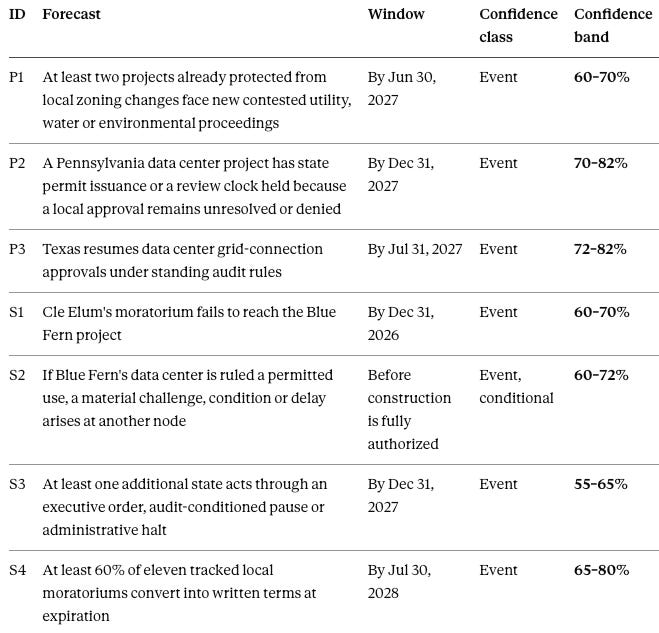
MindCast carries seven Simulation Predictions on data center veto points: three primary (P) and four secondary (S). Five carry forward from earlier MindCast publications.
🏛️ Policymakers: A moratorium adopted after an announcement can miss the project that provoked it. Rules written before a project arrives reach more projects than pauses written after.
💼 Executives: Treat “approved” as a claim to audit. Ask which right the approval secured and which institution controls the next open node.
⚖️ Counsel: Vesting rules decide whether a clearance survives the next rule change. Identify the vesting trigger at every node before advising that a project is safe.
📊 Investors: A project’s risk sits in its open nodes. Project review should follow the residual exposure rather than the list of approvals already won.
The first checkpoint arrives on December 31, 2026, when S1 resolves in Cle Elum. Developers who map vesting and downstream dependencies before an announcement keep more options than developers who map them after a moratorium arrives.
I. Local Moratoriums, the Vesting Gap and the Cle Elum Case
Local moratoriums have become the most common response to data center proposals across the United States. MindCast’s 50-State Authorization Price Atlas verified more than 100 local pauses by mid-2026. The Atlas also cites Data Center Watch’s count of at least 75 projects worth about $130 billion blocked or delayed in the first quarter of 2026 alone.
The Atlas finds that the major 2026 pauses followed a disclosure shock. A pause adopted after an announcement arrives after the project’s rules may already have vested. The vesting gap is the interval between the date a project’s rules vest and the date a jurisdiction adopts a pause. Any project inside the gap can escape the pause it provoked.
Cle Elum, Washington State, is the clearest current instance. Blue Fern Development unveiled a 20-megawatt data center near Interstate 90 in late July 2026. Three days later the city council passed an emergency six-month moratorium on new facilities.
The council acted at a special meeting on July 31 and took no public comment before the vote. Councilmember Steven Harper told residents the moratorium was “not a magical Band-Aid.” He warned that the pause would not reach agreements already in place.
The site sits inside Bullfrog Flats, a master-planned community governed by a development agreement dated October 30, 2002. The agreement fixes the rules that applied when the city approved it.
Vesting fixes a rule set but does not resolve how that rule set is read. The live question is whether a data center counts as a permitted use. The city’s business park district does not name data centers but permits research, financial or information processing offices.
Other institutions moved around the city. Kittitas County adopted its own six-month moratorium on August 10. Puget Sound Energy said it could serve the load, with the customer funding the upgrades.
Cle Elum was not a permissive jurisdiction. The city was institutionally unfinished, meaning its code had not yet met the project that would force it to write a rule. In Cle Elum the missing rule arrived as a moratorium three days after the first proposal.
Takeaway: vesting and grandfathering rules create the vesting gap across jurisdictions, although the trigger and protection differ by state. Cle Elum shows a council that controls future projects while its current project turns on rules fixed decades earlier.
II. The Ten Potential Veto Nodes in Data Center Authorization
A veto node is any decision point at which an institution or private party can stop, pause or materially shrink a project. A node also exists wherever a party can deny a resource the project needs to operate. The table below lists the ten potential nodes. A jurisdiction can give each node full power, limit it or leave it empty.
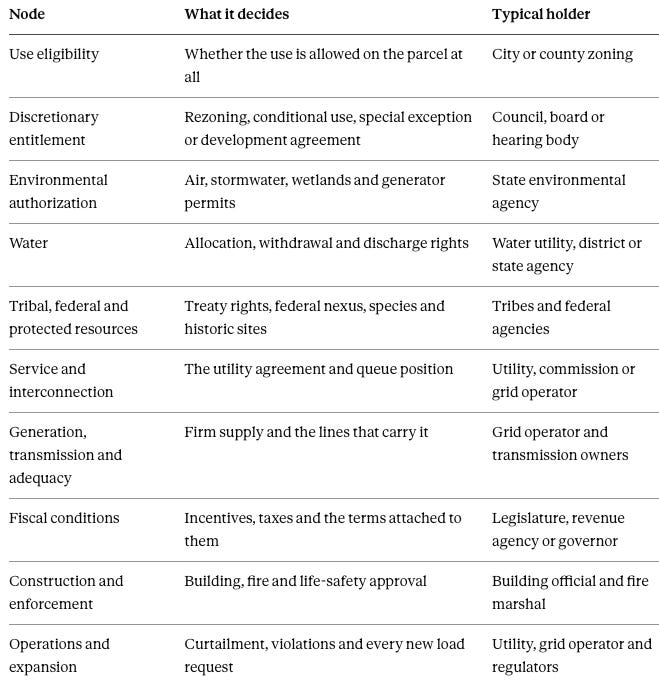
Each node is defined by its function, never by its legal vehicle. The rule follows the Model Data Center Authorization Code, which evaluates any data center provision by function whether it arrives as statute, tariff or ordinance. A county zoning denial, a Houston deed restriction and a Texas watershed statute all sit at the same land-use node. An executive order that holds permits sits at the permit node it holds.
Onsite generation often trades one power node for others. A project that bypasses the grid can move its exposure to air permits and fuel supply. The fiscal node rarely prohibits construction, but losing an incentive can end a project’s economics as surely as a denial.
Takeaway: ten potential nodes cover the ways a data center can be stopped, and engineering bypasses often substitute one exposure for another.
III. Five Settings That Make the Same Nodes Behave Differently in Each State
Jurisdictions differ in how they connect the ten potential nodes. Five settings describe those connections. Each setting answers one question a developer must resolve before committing capital.
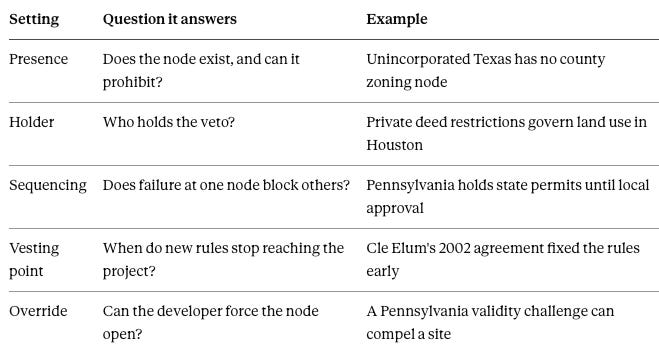
Two jurisdictions with identical nodes can present opposite risks. An empty node can shift the fight upward to the state. A chained node can turn one local denial into a statewide stop.
Takeaway: developers should learn how a state connects its nodes before they read the list of approvals.
IV. Cleared Is Not Vested
A cleared node and a vested node are different legal positions. A cleared node means the project holds an approval today. A vested node means later rule changes cannot reach that approval, to the extent the governing vesting rule allows.
Every node carries a status. The status runs from open or conditional to cleared, vested or reopened. Appeals, expirations, load changes and expansions can all reopen a cleared node. An operating campus that requests new load re-enters the network at several nodes at once.
Two clocks run against every open node. The project clock measures how close the project is to vesting. The regulatory clock measures how close the jurisdiction is to changing the rules.
Cle Elum’s moratorium started the regulatory clock after the site’s rules may already have vested. The use determination then becomes the node that matters.
What the Gap Between Cleared and Vested Means for Each Party
The distinction matters most to the parties who commit money or write rules on the strength of an approval. Each party reads the same approval differently.
📊 Investors and lenders. A list of approvals overstates a project’s position when those approvals remain unvested. Capital committed between clearance and vesting sits inside the vesting gap, where a rule change can still reach the project. Expansion value depends on whether later phases reopen nodes that the first phase cleared.
💼 Developers and hyperscalers. Schedule risk concentrates in the interval between each clearance and its vesting date. A campus that plans a second phase re-enters several nodes at once, so today’s approvals do not cover the full site.
⚖️ Counsel. A permit in hand answers a different question than a vested right. An opinion that describes a project as approved needs to state which rights have vested and which remain open to appeal or rule change.
🏛️ Policymakers. A new rule reaches projects that have cleared a node but not vested at it. The timing of an ordinance decides how many pending projects it governs.
⚡ Utilities and grid operators. Queue positions tied to unvested approvals can disappear when local rules change. Load forecasts built on cleared projects rather than vested ones overstate future demand.
🏘️ Communities. Residents hold the most leverage between a project’s clearance and its vesting. Once a right vests, opposition must work through appeals or other open nodes.
Each party carries a different exposure to the same gap, and none can read its position from the approval list alone.
Takeaway: clearing a node reduces exposure at that node but transfers control of the project’s residual exposure to the institutions governing the nodes that remain open.
V. How Washington State, Texas, Pennsylvania and New York Arrange the Same Nodes
Four states arrange the same ten nodes in four different ways.
Washington State keeps strong local nodes with early vesting. Texas leaves local nodes empty and fills them from the state. Pennsylvania chains state permits to local approval. New York concentrates its veto at the state environmental node.
Washington State Pairs Active Local Nodes With Early Vesting
Washington State localities hold real land-use authority and use it. Seattle and Spokane adopted pauses in 2026, followed by Cle Elum and Kittitas County, as the Atlas documents. Early vesting limits what those pauses reach. Cle Elum shows a strong local node whose reach depends on how the city reads rules vested two decades earlier.
Washington State’s local nodes are strong, but vesting decides which projects they reach.
Texas Fills Empty Local Nodes From the State
Texas counties hold no zoning authority unless the legislature grants it under Chapter 231 of the Local Government Code. Hood County holds the only broad county land-use authority, granted by the legislature in 1999. Hill County tried a one-year pause in May 2026, and the county rescinded it in early June after a developer sued for $100 million.
The state then filled the empty node. On August 3 Governor Abbott ordered an audit of every data center in the grid interconnection queue. The grid operator could halt only loads of 75 megawatts or more. On September 21 the governor directed the state environmental agency to issue no data center permits until the audits finish.
The grid operator aims to deliver its audit report by December 10.
Texas shows that an empty local node moves the veto to the governor and state agencies.
Pennsylvania Chains Approvals and Limits Local Bans
Pennsylvania municipalities must provide for every legitimate land use somewhere within their borders. A developer who wins a validity challenge can ask the court to approve the proposed development at the chosen site, and the court holds broad discretion to grant it. Slate Belt Holdings filed exactly that challenge in Northampton County. East Brandywine responded by defining data centers as a conditional use in one district.
On August 18 Governor Shapiro signed Executive Order 2026-05 for projects above 25 megawatts. Developers who accept the state’s conditions get rolling review, but no final state environmental permit issues until local approvals are obtained. Developers who decline wait for local approvals before state review begins and lose the sales tax exemption. The order imposes no moratorium.
Pennsylvania law keeps townships from banning data centers outright, while the executive order makes their approval the gate for every state permit.
New York Places Its Veto at the State Environmental Node
New York placed its veto at the state environmental node. Executive Order 62 holds applications for facilities of 50 megawatts or more in abeyance while the state builds an environmental review framework. Applications the state had already found complete before July 14 fall outside the hold, and so do local permits.
New York’s veto therefore sits with state regulators rather than with localities.
The Four Arrangements Side by Side
The table below summarizes the four arrangements.
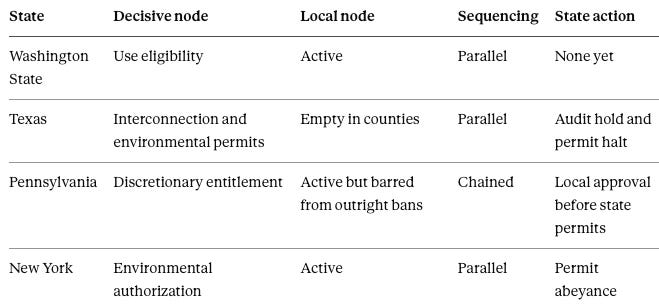
Each state places its decisive node at a different level of government.
Takeaway: the same ten nodes produce four different decisive nodes, so a developer must identify the decisive node before choosing the state.
VI. Where Opposition Goes After a Node Clears
Clearing one node can redirect residual opposition toward another open node. MindCast’s model tests whether that migration occurs systematically or whether most projects meet independent constraints. Game theory predicts pressure toward venues where stopping or delaying the project carries lower expected cost.
Behavioral economics accounts for the intensity. A surprise announcement makes the project salient all at once. Residents weigh losses in power, water and noise more heavily than promised jobs, so opposition organizes before any benefit becomes credible.
The Atlas documents the Seattle sequence. Disclosure of 369 megawatts drew more than 54,000 letters and two developer withdrawals before the city adopted its moratorium.
The model tests three directions of migration. Upward migration runs toward the state when local nodes are empty, as Texas suggests. Sideways migration runs toward environmental review and appeals when a local node is vested. Engineering migration follows a grid bypass, because onsite generation needs air permits that the Texas permit halt now covers.
Takeaway: a developer who clears a node should plan for the fight to reappear at open nodes where a stop costs less to obtain.
VII. When State Action Amplifies a Local Veto
State intervention can strengthen a local veto or weaken it. The outcome depends on sequencing. State action amplifies a local veto only when the state makes its own approval contingent on local clearance.
Pennsylvania shows amplification. Under Executive Order 2026-05 a township denial blocks the state permits that follow. Local strategy becomes the critical path for every state approval.
Texas shows the opposite. A statewide permit halt makes local approval insufficient. A city approval in Texas no longer moves a project toward operation while the audits run.
The broader finding concerns leverage. A node matters less for the authority exercised there than for how many downstream nodes wait on its clearance. A township with modest legal power becomes decisive once state permits depend on its approval.
Takeaway: centralization does not automatically weaken local power, and a chained state gives townships more leverage than they held alone.
VIII. The First Move Developers Should Make at Each Node
Each node calls for a different first move. The map below pairs every node with the action that reduces exposure there. The actions assume the developer already knows how the jurisdiction arranges its nodes.
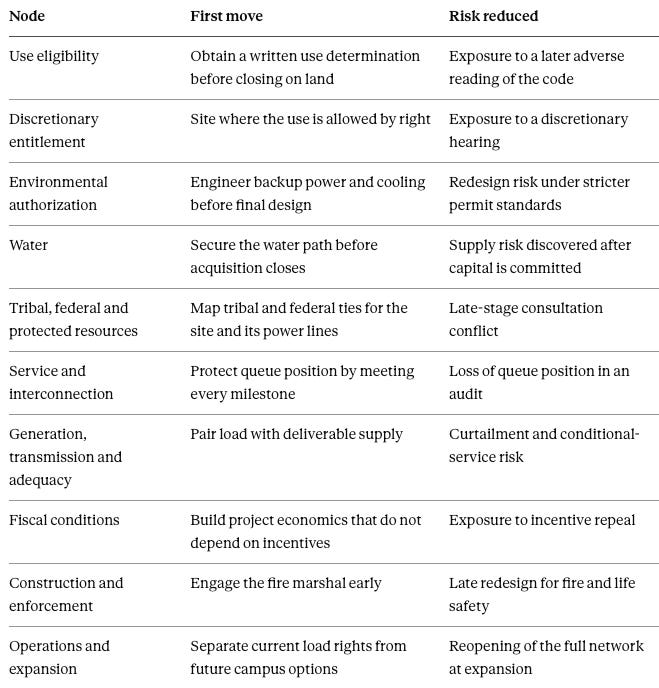
Engineering bypasses deserve caution. Some bypasses remove a dependency outright, but many relocate it. Onsite generation trades an interconnection node for air, fuel and reliability nodes.
Takeaway: the right question is never whether the project is approved but which right each approval secured and which node remains open.
IX. Cognitive Digital Twins Trace Opposition Across the Network
MindCast models the institutions that hold the nodes as Cognitive Digital Twins. The table below lists the system-level CDTs. Named case actors such as Blue Fern, the Cle Elum council and Puget Sound Energy populate each case.
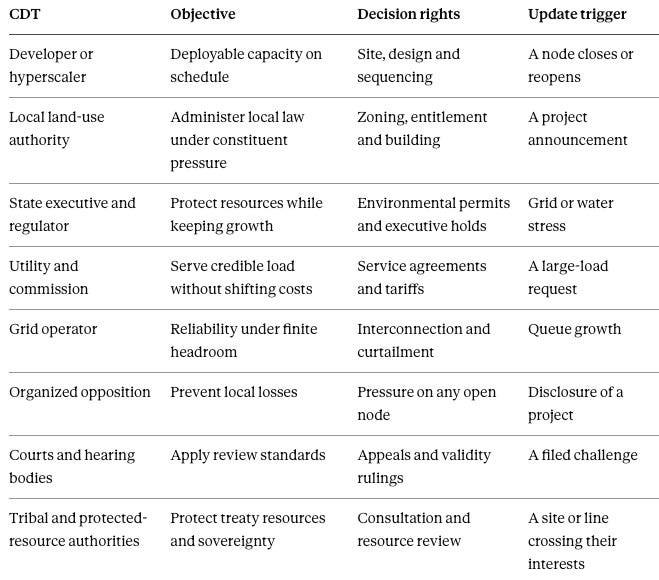
MindCast asks four questions of the twins.
Where can a project move when a node closes? When does delay help either side? Which institution gains control after each approval? When does a state change the rules mid-project?
The model tests migration against two plain alternatives. Under attrition, projects die at whichever node they hit with no movement of opposition. Under independent constraint, an unrelated downstream bottleneck stops a project that opposition never reached.
Takeaway: the model traces opposition across nodes and tests that account against the two simplest explanations available.
X. Five Observations That Test Veto Migration
Four structural mechanisms carry the model, and Cle Elum adds a live test. Each one names the observation that would refute it.
Veto migration. Stopped projects that previously cleared a node should show opposition reappearing at a later open node. Failure at one node with no prior clearance would favor attrition. A stop at a downstream bottleneck that opposition never targeted would favor independent constraint.
Empty-node substitution. Jurisdictions with empty local nodes should see stops at state or grid nodes more often than jurisdictions with active local nodes. No difference would defeat the claim.
Chained critical paths. Chained jurisdictions should show fewer but more consequential stops than parallel jurisdictions. No relationship between sequencing and stop severity would defeat the claim.
Bypass as substitution. Projects that bypass the grid or water supply should acquire exposure at air, fuel or transmission nodes. Bypasses that remove the dependency without opening a new node would defeat the claim.
The Cle Elum test. If the city finds the data center a permitted use and opposition files no formal challenge at any open node, migration fails in its anchor case.
Takeaway: four structural mechanisms face general tests, and Cle Elum supplies the live anchor test.
XI. MindCast Simulation Predictions on Where Authorization Risk Moves Next
MindCast issues seven Simulation Predictions on data center veto points. P marks a Primary Simulation Prediction, which tests a core mechanism of the paper. S marks a Secondary Simulation Prediction, which tests a specific case or pattern.
Five entries carry forward from AI Data Center Moratoriums Are Forecastable — and They End in Pricing Rules, Not Bans and the Atlas. Each keeps its original band and deadline, and each notes its original label.
Primary Simulation Predictions
The three primary predictions test veto migration, sequencing leverage and state rule changes.
P1 (60–70%): At least two data center projects already protected from local zoning changes face new contested utility, water or environmental proceedings by June 30, 2027. Falsifier: fewer than two qualifying projects by the deadline. Verification source: utility commission, water agency and environmental agency dockets. Originally MC-ATX-P7.
P2 (70–82%): At least one Pennsylvania data center project has state permit issuance or a state permit review clock held because a required local approval remains unresolved or denied by December 31, 2027. Falsifier: no qualifying project by the deadline. Verification source: the Department of Environmental Protection project map and permit files.
P3 (72–82%): Texas resumes data center grid-connection approvals under standing audit rules by July 31, 2027.Qualifying rules come from the Public Utility Commission of Texas, the grid operator known as the Electric Reliability Council of Texas (ERCOT) or 2027 legislation. Falsifier: the pause extends past July 31, 2027 without standing rules, or approvals resume under the old process. Originally Atlas Prediction 17.
The primary set turns on one question: whether authorization risk moves to a new institution after a project clears a node.
Secondary Simulation Predictions
The four secondary predictions test the Cle Elum case, executive action by states and the national moratorium pattern.
S1 (60–70%): Cle Elum’s moratorium fails to reach the Blue Fern project by December 31, 2026 through a city concession or an adverse ruling. Falsifier: the city applies the moratorium to Blue Fern and the application stands at the deadline. Verification source: city council actions and court records. Originally MC-ATX-P3.
S2 (60–72%, conditional): If Cle Elum rules that Blue Fern’s data center is a permitted use, a material challenge or delay arises at another node before construction is fully authorized. A material challenge includes an administrative appeal, an appeal under the State Environmental Policy Act (SEPA) or a petition under the Land Use Petition Act (LUPA). Falsifier: no qualifying challenge, condition or delay through the applicable challenge and permit windows. Verification source: city files, state permit records and the Kittitas County Superior Court docket.
S3 (55–65%): At least one additional state acts through an executive order, an audit-conditioned pause or an administrative halt with operative effect by December 31, 2027. Falsifier: no additional state takes qualifying executive action by the deadline. Verification source: state executive orders and agency directives. Originally MC-ATX-P5.
S4 (65–80%): At least 60% of eleven tracked local moratoriums convert into written ordinances, host agreements or conditional approvals at expiration by July 30, 2028. The tracked set covers eleven jurisdictions from Seattle to Reno, listed in the Atlas. Falsifier: fewer than 60% of the set convert. Originally Atlas Prediction 9.
The secondary set shows how the primary mechanisms play out in named places.
Contingent Watch Condition
One further claim awaits its band and carries no number. At least two data center projects that redesign to onsite generation after a grid interconnection limit face a contested air permit proceeding or a fuel-supply condition by December 31, 2027. The claim joins the numbered set once its band is released.
Takeaway: the primary predictions test the paper’s mechanisms, and the secondary predictions test them in Cle Elum, in state capitals and across tracked moratoriums.
XII. Risk Mitigation for Each Audience Before the Predictions Resolve
Each prediction creates a loss for someone who takes no action. The matrix below lists every entry with its band and a separate severity rating, so a low-probability entry with high severity stays visible. The detailed entries follow, written for the audiences each prediction binds. The actions are analytic options for each audience, not recommendations to any specific party.
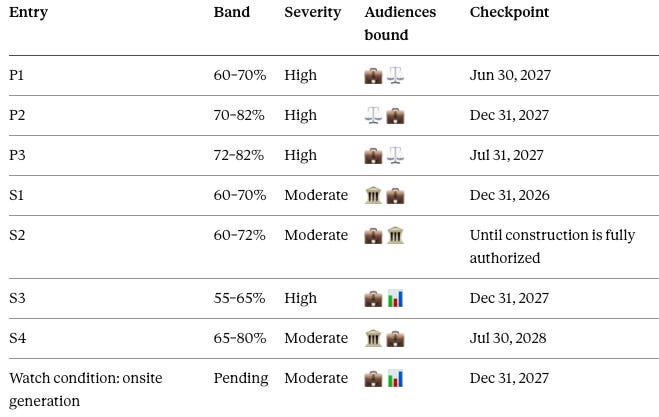
Land-Use Clearance Followed by New Contested Proceedings
Prediction: P1 (60–70%). Severity: high.
💼 Executives. Exposure: a project that treats land-use approval as the finish line loses quarters of commissioning at a utility, water or environmental node.
Actions:
The development lead builds a ten-node status map for every active site before March 31, 2027.
Engineering files air and water applications against the strictest standard in force before March 31, 2027.
Utility relations executes a service agreement with documented milestones before the June 30, 2027 checkpoint.
Residual: a party with standing can still contest a proceeding, and the agency decides the outcome.
⚖️ Counsel. Exposure: advice that land-use approval ends authorization risk leaves intervention and appeal windows unmapped.
Actions:
Counsel maps every intervention window in utility, water and environmental proceedings for each client site before December 31, 2026.
Counsel builds each environmental application file to withstand challenge before filing.
Residual: an agency can still condition or deny on grounds outside the file.
Pennsylvania Local Denials Hold State Permits
Prediction: P2 (70–82%). Severity: high.
⚖️ Counsel. Exposure: a township denial holds final state environmental permits and delays state review clocks. The unit is months of state permit delay.
Actions:
Counsel maps every local approval across each municipality a project touches before the first state filing.
Counsel prepares a comprehensive plan consistency analysis for each municipality before the first state filing.
Residual: township discretion remains, and a validity challenge takes months to resolve.
💼 Executives. Exposure: the choice between the state’s two review tracks sets the permit schedule for the whole project.
Actions:
The permitting lead decides the review track before the next state submission.
The project team sequences construction commitments behind documented local approval.
Residual: a local denial still stops the state process on either track.
Texas Converts the Audit Into Standing Rules
Prediction: P3 (72–82%). Severity: high.
💼 Executives. Exposure: projects in the ERCOT queue face verification rules not yet written. The unit is months in queue and the cost of new disclosures.
Actions:
The interconnection lead answers every ERCOT audit request in full by each stated deadline.
Engineering prepares water-use and generation disclosures before ERCOT’s December 10, 2026 audit filing.
Counsel reviews change-in-law and termination provisions in project agreements before December 31, 2026.
Residual: the standing rules will add conditions that no current filing can anticipate.
⚖️ Counsel. Exposure: agreements drafted around the old interconnection schedule misallocate delay risk between the parties.
Actions:
Counsel amends milestone and termination provisions in new agreements to reference the audit before signing.
Counsel documents each client’s audit compliance history for use in later disputes.
Residual: agreements already signed carry the old allocation.
The Cle Elum Moratorium and the Vested Project
Prediction: S1 (60–70%). Severity: moderate.
🏛️ Policymakers. Exposure: the city spends six months of moratorium without reaching the project that prompted it. The pause expires around January 31, 2027 with the ordinance unwritten.
Actions:
City planning staff publishes written criteria for “information processing offices” before December 31, 2026.
The council adopts a data center ordinance for new applications before the moratorium expires, so the pause converts rather than lapses.
The city attorney inventories every development agreement in the city that carries commercial or industrial vested uses before December 31, 2026.
Residual: the 2002 agreement still governs Bullfrog Flats, and any new ordinance reaches only projects outside it.
💼 Executives. Exposure: a developer holding an older agreement loses months of schedule if a council reads the vested uses narrowly.
Actions:
Development counsel obtains a written use determination before any public announcement.
The project team documents the completeness date of every application filed under the agreement before December 31, 2026.
The community relations lead delivers an enforceable community benefit instrument before the first public hearing.
Residual: interpretation risk persists until a determination issues, and opposition can move to other nodes. The migration exposure is handled under P1 and S2 and is not counted here.
A Challenge Follows a Permitted-Use Finding in Cle Elum
Prediction: S2 (60–72%, conditional on a permitted-use ruling). Severity: moderate.
💼 Executives. Exposure: a favorable use determination leaves challenge, condition and delay exposure at other open nodes until construction is fully authorized. The unit is days of appeal exposure before construction can proceed.
Actions:
Development counsel prepares the record for a SEPA review before the determination issues.
The project team schedules construction mobilization after the appeal windows close.
Residual: a timely challenge still delays the project regardless of its merit.
🏛️ Policymakers. Exposure: a determination issued without published criteria invites a challenge on procedure.
Actions:
City planning staff publishes the criteria behind the determination on the day it issues.
Residual: parties can still appeal on the merits.
A Further State Acts Through the Executive Branch
Prediction: S3 (55–65%). Severity: high.
💼 Executives. Exposure: an executive order can hold permits statewide without new legislation. The loss is measured in megawatts of pipeline caught under a single hold.
Actions:
The site selection lead spreads new site commitments across states with different node arrangements before the next site decision.
The permitting lead files complete state applications at the earliest lawful date for each active site.
The project finance lead ties construction commitments to state permit milestones rather than to local approval alone.
Residual: no developer action prevents an executive order, so exposure falls only in megawatts committed ahead of state permits.
📊 Investors. Exposure: capital committed before state permits issue can sit idle for quarters under a statewide hold.
Actions:
The investment committee requires a ten-node status map before releasing construction capital.
Deal teams stage capital release against state permit milestones.
Residual: projects already under construction when an order issues carry the full delay.
Local Moratoriums Convert Into Written Terms
Prediction: S4 (65–80%). Severity: moderate.
🏛️ Policymakers. Exposure: a moratorium that expires without an ordinance returns the jurisdiction to silence. The unit is months of pause remaining against months of drafting required.
Actions:
Planning staff publishes a draft ordinance at least 90 days before each moratorium expires.
The governing body schedules the adoption hearing inside the moratorium period.
Residual: an ordinance can still be challenged, and adoption can slip past expiration.
💼 Executives. Exposure: a developer who waits for expiration without a compliant application loses the first-mover slot under the new ordinance.
Actions:
The development lead prepares an application that meets the published draft before each expiration date.
The development lead submits technical comments on each draft ordinance during its comment period.
Residual: the adopted ordinance can impose stricter terms than the draft.
Onsite Generation Opens Air and Fuel Nodes
Watch condition: onsite generation substitution (band pending). Severity: moderate.
💼 Executives. Exposure: a grid bypass adds an air permit and a fuel supply dependency. The unit is months to air permit issuance and the term of the fuel contract.
Actions:
Engineering models the air permit path for onsite generation before selecting the bypass.
Procurement secures a fuel supply agreement before final design.
Residual: air permit standards can tighten after filing, as the Texas permit halt shows.
📊 Investors. Exposure: a bypass sold as risk removal can carry a new permit node that delays commissioning.
Actions:
The investment committee requires the air permit path for any onsite generation plan before approving capital.
Residual: fuel and emissions rules can change over the plant’s life.
Takeaway: every action above reduces a named loss in a unit its owner controls, and every entry leaves a residual that no single party can remove.
Conclusion
Cle Elum’s council paused data centers three days after Blue Fern’s announcement. The rules governing Blue Fern’s site may have vested in 2002, and the nodes still open belong to other institutions. The same gap appears wherever vesting or grandfathering rules protect a project from later changes. Developers who map every open node can identify where residual authorization risk concentrates before committing further capital.
MindCast AI builds Cognitive Digital Twins of the institutions that authorize AI infrastructure and simulates how they respond to one another. Contact: mcai@mindcast-ai.com · www.mindcast-ai-simulation.com
Related MindCast Work
Four MindCast publications supply the frameworks and carried predictions behind this paper.
The Data Center Authorization Price. The paper establishes what authorization costs in each state, which the Roadmap extends to where authorization can fail.
The 50-State Authorization Price Atlas. The Atlas supplies the state-by-state instruments and moratorium tracker behind Section V.
AI Data Center Moratoriums Are Forecastable — and They End in Pricing Rules, Not Bans. The paper explains why local pauses resolve into written terms, the pattern Cle Elum now tests.
The Model Data Center Authorization Code. The Code evaluates provision strictness across twelve families, and the Roadmap’s ten nodes map onto those families.
Sources
External sources appear below in order of first citation.
Seattle Times via Spokesman-Review, “Cle Elum passed a data center ban. One might be built there anyway” (2026)
Daily Record, “Cle Elum calls timeout on development applications for data centers” (2026)
City of Cle Elum, Staff Recommendation PMU-2026-001 (2026)
City of Cle Elum, Municipal Code Title 17, Zoning (as amended 2022)
Skagit Valley Herald, “Kittitas County may extend data center moratorium” (2026)
Public Citizen, “Texas Data Center Policy Guide” (2026)
Texas Tribune, “Texas county pauses data center construction in rural areas” (2026)
MultiState, “The Local Fight Over Data Centers: A Texas Case Study” (2026)
Troutman Pepper Locke, “Texas Hits Pause on Data Center Grid Connections” (2026)
KERA News, “Gov. Abbott orders TCEQ to pause environmental permits for data centers” (2026)
Office of the Texas Governor, “Governor Abbott Directs TCEQ To Halt Data Center Permits” (2026)
Utility Dive, “ERCOT aims to complete Texas governor’s data center audit by December” (2026)
Pennsylvania Municipal League, “Data Centers and Gas-Fired Power Plants” (2026)
The Center Square, “Township authority over data center plans uncertain in Northampton County” (2026)
East Brandywine Township, “Update on Data Center Ordinance and Validity Challenges” (2026)
National Law Review, “Pennsylvania’s New Data Center Executive Order: Two Tracks, One Choice” (2026)
Texas Tribune, “San Marcos bans data centers, testing its local control” (2026)
Delta County, Texas, “Data Center Development FAQ” (2026)
Commonwealth of Pennsylvania, Executive Order 2026-05, “Protecting Pennsylvania Consumers from Data Center Impacts” (2026)
Greenberg Traurig, “Gov. Shapiro Issues Executive Order 2026-05 Imposing New Requirements on Pennsylvania Data Center Projects” (2026)
Office of the Governor of New York, Executive Order No. 62 (2026)
Pennsylvania Municipalities Planning Code, 53 P.S. § 11006-A, Judicial relief
Working With MindCast
Developers, hyperscalers, investors and public agencies facing data center authorization decisions use MindCast before they commit capital or announce a project. The work maps a candidate site against the ten veto nodes and identifies which approvals have vested and which remain open. MindCast then builds Cognitive Digital Twins of the institutions that hold each open node and simulates where opposition moves as the project advances. A commissioned Veto Profile covers one site or a portfolio of candidate sites, with Simulation Predictions tied to the dates that matter for the decision. Contact mcai@mindcast-ai.com or visit www.mindcast-ai-simulation.com.