
Related installment: AI Data Center Veto Points Show Where Projects Get Stopped and How Authorization Risk Moves(2026). The parent paper mapped the ten points where a data center can be stopped, and the present paper turns that map into a route. Series installments: The Grid-Anchored Clean Power Bargain · The Clean Compute Match · The Authorization Market — Standardized Bargaining, Rationed Power, and the Competition to Build America’s AI Infrastructure · AI Data Center Authorization Bargaining Power · AI Datacenter Edge Computing: Ship the Workload Not the Power
Critical references: The Model AI Infrastructure Authorization Code · The Data Center Authorization Market: A 50-State Regulatory Atlas
Thesis. AI data center projects fail when capital becomes irreversible before the approval that decides the project becomes durable. A route that resolves the decisive approvals first and funds only the exposure needed to keep the project alive cuts that risk.
Why now. Reuters reported on September 24, 2026 in “Oracle Cites ‘Force Majeure’ to Shield Itself on Controversial Data Center, Bloomberg Reports” that Oracle had sent a force majeure notice on Project Jupiter. Six regional grid operators are due to file substantive responses on large-load rules by November 16, 2026. Texas, Pennsylvania and New York have halted or conditioned data center permits since July. Developers, hyperscalers, lenders and utilities now commit capital under rules that change mid-project.
Executive Summary
Data center capital strands when it becomes irreversible before the approval that matters most becomes durable. The number of approvals a project holds says little about its safety.
The lowest-exposure route carries the lowest avoidable exposure consistent with keeping a viable project alive. Some capital must go at risk early to hold a grid position, a site or a scarce equipment slot. The route funds that necessary exposure, keeps every other commitment reversible until the decisive approvals become durable and runs independent work in parallel.
Approval routes divide first by the kind of approval that decides the project. Where a resource such as power or water decides viability, the route is a problem of structural bottlenecks. Where a discretionary local land-use vote decides viability, the route is a problem of strategic timing. The same model runs differently in each.
Most permitting guides list approvals in sequence. MindCast builds behavioral models of the institutions and opponents that hold each approval, called Cognitive Digital Twins (CDTs), and applies Predictive Behavioral Economics + Dynamic Game Theory to the route itself. Predictive Behavioral Economics supplies the decision rules, because an announcement makes a project salient and loss aversion mobilizes opposition before any benefit arrives. Dynamic Game Theory supplies the payoff structure, because each institution responds to the commitments a developer makes and the timing of its moves.
The paper opens with Project Jupiter and the gap between approval count and durability. Later sections define the Critical Veto Path and the two route regimes, separate necessary from avoidable exposure and work a route for a 600 megawatt campus. The paper then sets out current routes for nine state archetypes, the parties that hold the levers to optimize a route and a capital release schedule. Five MindCast Simulation Predictions follow with risk mitigation for each audience and dated events to watch.
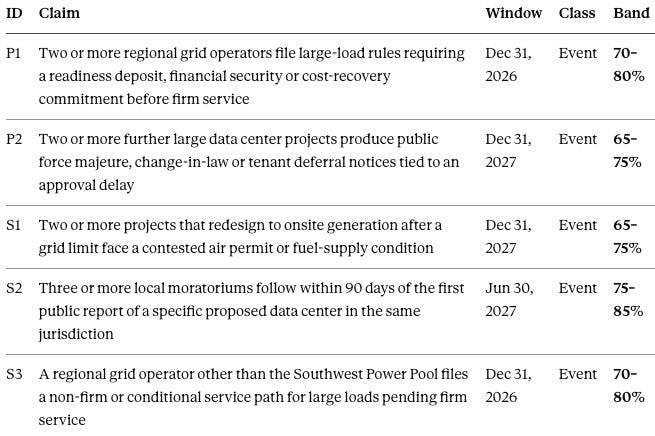
MindCast carries five Simulation Predictions on AI data center approval routes: two primary (P) and three secondary (S).
🏛️ Policymakers: Developers commit capital early because no public process tells them which approval decides the project. Binding early determinations and refundable grid security shrink avoidable exposure without weakening any review.
💼 Executives: Identify whether a resource or a local vote decides each site. Order approvals by the damage each could cause and hold land and equipment in reversible form until the decisive approvals become durable.
⚖️ Counsel: A cleared approval and a durable approval are different positions. Define durability node by node and tie every contract milestone to the durable form.
📊 Investors: Fund necessary exposure that buys or holds a defined right. Refuse avoidable exposure that buys nothing and release construction capital only against durable decisive approvals.
The route model converts open-ended authorization uncertainty into named decision points. Each audience gains a date and a trigger for its next commitment.
I. Why Approval Count Misleads Developers and Investors
Approval count misleads because approvals differ in how much they can stop and how long they last. Project Jupiter in New Mexico shows the difference at full scale.
Project Jupiter holds its county approvals and could cost up to $165 billion. The campus depends on gas-powered fuel cells, so its decisive approval sits with whoever controls the fuel route. The New Mexico State Land Office rejected pipeline rights-of-way in March and again in July.
The air permit for the fuel-cell plant remains unresolved. Reuters reported on September 24, 2026 in “Oracle Cites ‘Force Majeure’ to Shield Itself on Controversial Data Center, Bloomberg Reports” that Oracle had sent a force majeure notice to the developer. The notice seeks the right to defer payments if the campus misses its 2028 opening.
Jupiter did not lack approvals. Capital moved ahead of the fuel and air approvals that decide whether the campus can run. Authorization risk then moved from a state land office into a tenant contract and onto the developer and its investors.
Takeaway: a project’s exposure sits in its open decisive approvals, and Jupiter shows how an open approval can shift costs to the tenant, developer and investors before any denial becomes final.
II. The Critical Veto Path Identifies the Approvals That Decide a Project
The Critical Veto Path is the set of open approvals that can stop a specific project and that other commitments depend on. The parent paper identified ten points, called nodes, where an institution can stop a data center. Only some of those nodes decide any given project.
Three properties make a node decisive. Stopping power measures whether a denial ends the project or only conditions it. Dependence counts how many later approvals and commitments wait on the node. Exposure measures how much capital sits at risk while the node stays open.
Project design changes the path. A grid-connected campus puts the power node on the path. A campus on onsite generation swaps it for air and fuel nodes, as Jupiter shows. A water-cooled design puts the water node on the path, while an air-cooled design can remove it.
Jurisdiction changes the path as well. Pennsylvania currently chains state permits to local approval, so the township sits on every Pennsylvania path. Texas counties hold no general zoning power, so the current Texas path runs through the grid operator and the governor.
Takeaway: the Critical Veto Path differs by design and by state, and a developer who cannot name it cannot sequence against it.
III. Two Route Regimes Decide How the Model Works
AI data center approval routes divide first by what kind of node decides viability. The division matters because the route model works differently in each regime.
In the resource regime a physical resource such as power, water or fuel decides whether the project can operate. Structural bottlenecks govern the route. The developer’s task is to resolve the bottleneck early and to commit only the capital that holds its place in line.
In the local-discretion regime, a discretionary land-use vote decides the project. Strategic timing governs the route. The order of disclosure, application and community agreement changes whether the local body pauses, conditions or approves the project.
State executive action cuts across both regimes. A governor’s permit halt or a statewide hold can freeze every in-state route at once, whatever node would otherwise decide the project. The route model treats such action as a shock that no single-site sequence controls.
Takeaway: a developer should first identify the regime each site falls into, because the regime determines which part of the route model governs the next decision.
IV. Durable Approvals Carry Capital and Cleared Approvals Do Not
A cleared approval exists today. A durable approval survives the changes most likely to reach it. Capital should advance only as decisive approvals become durable enough for the capital they support.
Durability takes a different form at each node. Land use becomes durable when rights vest under state law. Power becomes durable when a utility executes a service agreement with defined milestones. Water becomes durable through a reservation or a permit with a stated term.
Procedure forms part of durability. Prince William County approved the Digital Gateway rezonings in December 2023. The Virginia Court of Appeals affirmed their voiding on March 31, 2026 over defective public notice, and the county then withdrew from the appeals.
Two clocks run against every open node. The project clock measures how close the project is to durability. The regulatory clock measures how close the jurisdiction is to changing the rules.
Takeaway: capital follows durability, and durability includes procedural validity and the term of every reservation.
V. Necessary Exposure Keeps a Route Alive and Avoidable Exposure Buys Nothing
Not every early commitment is a sequencing error. Necessary exposure is the capital a project must commit to acquire or keep the next decisive right. Avoidable exposure is capital committed ahead of durability that buys no right at all.
Grid access now creates necessary exposure. On June 18, 2026, the Federal Energy Regulatory Commission (FERC)issued show cause orders to all six regional grid operators on large-load integration. The reforms include cost recovery agreements that place transmission cost risk on the large load.
The amount of that exposure remains open. All six operators asked for roughly 90 more days, moving substantive filings to on or before November 16, 2026. Developers signing load-serving agreements before then carry the tariff risk themselves.
Generator rules show the readiness terms that large-load filings are likely to adopt, as P1 states. PJM’s approved expedited track for new generators requires full site control, a state siting schedule commitment and a $15,000 per megawatt readiness deposit. The track governs generators rather than large loads, and its grid approval already depends on a state siting commitment.
Non-firm service can shrink necessary exposure. The Southwest Power Pool already offers non-firm service for large loads for up to seven years. New York’s grid operator has proposed splitting large loads into firm and non-firm service. A project that energizes on non-firm service can defer firm security until more of its route becomes durable.
State utility commissions set necessary exposure directly in much of the country. Virginia, Ohio and Georgia already require long contracts with minimum charges from large loads, as Section IX sets out. P1 tracks the federal grid filings, while these state tariffs already bind projects outside the six grid operators’ regions.
Delay enlarges necessary exposure, because holding costs and option payments grow with every month a decisive node stays open. The route model therefore evaluates necessary exposure under each tariff design and each delay scenario rather than reading it from a schedule.
Takeaway: the route model minimizes avoidable exposure and accepts the smallest necessary exposure that keeps a viable route alive.
VI. How the Route Model Chooses the Next Approval
The route model ranks open nodes by their resolution priority. Resolution priority weighs the downstream exposure a node’s resolution would protect and the options it would keep open. The model subtracts the commitment required and the delay cost of resolving the node now.
A node can deserve early resolution even when denial looks unlikely. A use determination that controls billions in downstream commitments ranks high because its failure would strand the most capital. A node likely to fail can wait if its failure costs little and the developer can substitute another design.
Four route strategies show why the ranking matters. The table below compares them.
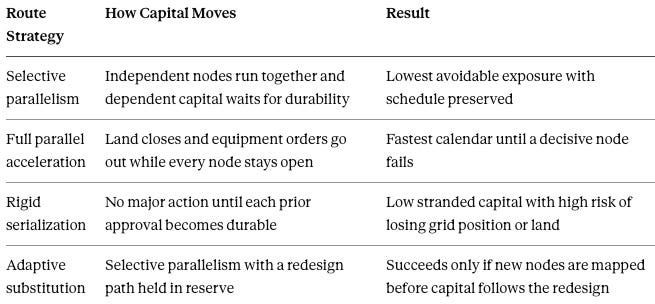
Full parallel acceleration compounds exposure, because several contracts depend on the same unresolved node. Rigid serialization loses the scarce rights that necessary exposure exists to protect. Selective parallelism with adaptive substitution in reserve survives the widest range of rule and design changes.
Disclosure can change the odds at another node. Cle Elum’s council passed an emergency moratorium three days after a developer unveiled its project. In the local-discretion regime the model treats disclosure timing as a decision with its own exposure.
Takeaway: the model optimizes the order of uncertainty resolution rather than the order of permits, and it pauses only the commitments that could strand capital.
VII. A Worked Route Shows the Model Choosing for a 600 Megawatt Campus
A worked example shows the model choosing. Consider a 600 megawatt campus proposed for a grid-connected site in a state where local land use requires a discretionary approval.
The table below rates each node on the three properties that decide its priority.
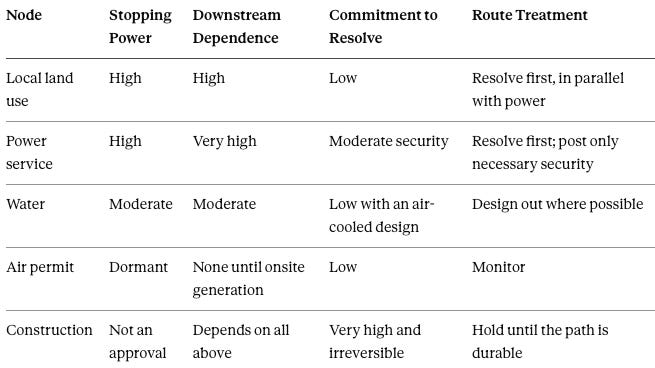
The initial route runs the land-use determination and utility feasibility together. The developer holds the land under option and posts a refundable study deposit. A readiness deposit set at PJM’s generator rate of $15,000 per megawatt would come to $9 million on 600 megawatts, which counts as necessary exposure if it holds a defined queue right.
The developer seeks a written use determination before any public announcement where state law and the project’s profile make that course appropriate. Land purchase, equipment orders and construction stay reversible or deferred.
The route then meets a mutation. The utility’s service date slips past the tenant’s delivery window, and the developer considers onsite gas generation. Air and fuel nodes now enter the Critical Veto Path.
The model recalculates before any generation capital moves. Air modeling and a firm fuel contract become the next decisive nodes, and the developer weighs them against a non-firm grid path if one is offered. Capital follows whichever route shows the lower avoidable exposure.
Takeaway: the worked route shows the model resolving land use and power together, funding only necessary exposure and recalculating the path before a redesign draws capital.
VIII. Opponents and Institutions Respond to the Route Itself
A route is not a schedule set against fixed odds. Opponents and institutions observe the route and respond to it. MindCast’s Cognitive Digital Twins model those responses.
The table below lists the Cognitive Digital Twins the route model runs against each project.
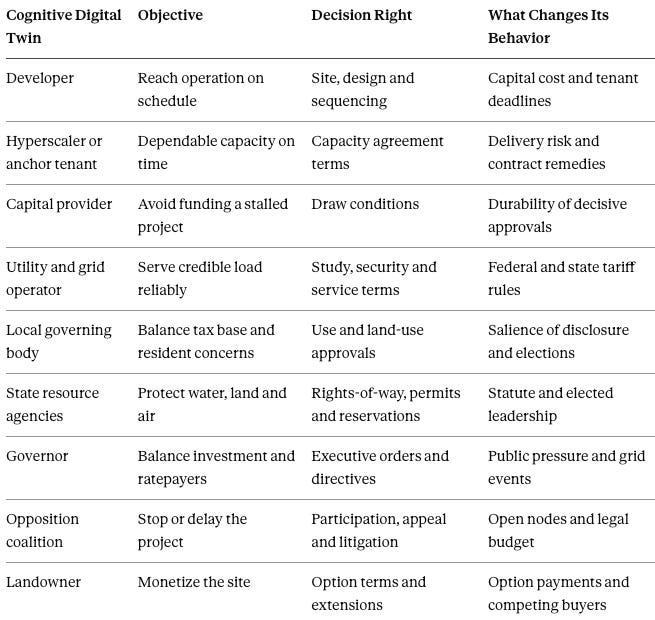
Predictive Behavioral Economics explains when opposition forms. An announcement makes a project salient in a single day. Residents weigh losses in power, water and noise more heavily than promised jobs, so opposition organizes before benefits become credible.
Dynamic Game Theory explains where the next contest arises. Once a node closes, the next contest arises at an open node that offers stopping leverage relative to cost, standing and available remedies. In the twenty-project set, all seven projects that cleared an early approval met a new contest at a different node.
Institutions respond as well. Texas Governor Greg Abbott directed the state environmental agency to halt data center permits until grid audits finish. Pennsylvania’s Executive Order 2026-05 holds final state environmental permits until local approvals are obtained. Each order changed the Critical Veto Path of every project in its state.
MindCast models capital providers as adapting more slowly than developers or tenants.
Takeaway: the route model simulates how opponents and institutions react to each move, which a static permitting schedule cannot do.
IX. Nine State Archetypes Call for Nine Different First Moves
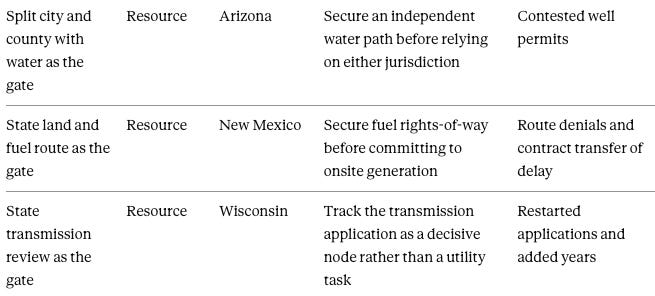
Current state rules and observed projects produce at least nine recurring authorization archetypes. Each places a different node on the Critical Veto Path and calls for a different first move. The example states reflect rules in force as of September 25, 2026, and each route needs rechecking when those rules change.
The table below pairs each archetype with its regime, a current example and its first move.
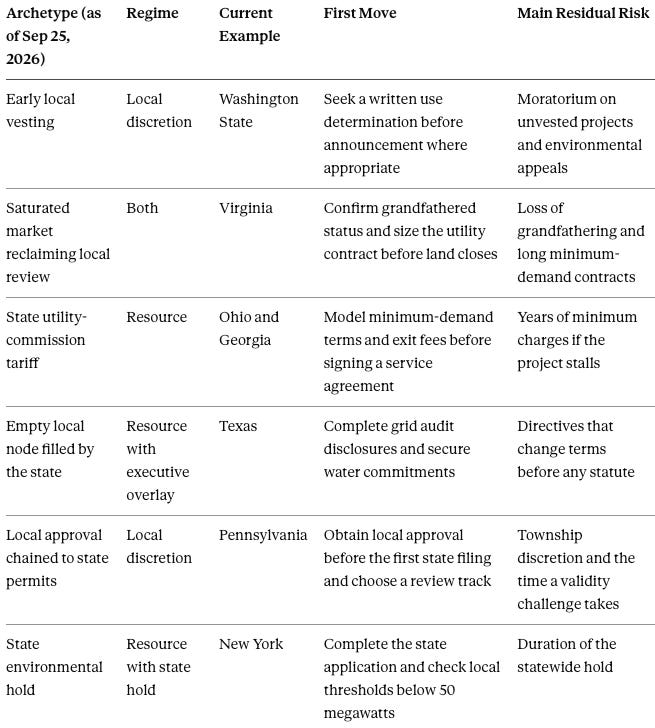
Washington State rewards early durability. Cle Elum’s pause meets a project governed by a development agreement dated 2002. A durable local position can protect a project from a later moratorium where state law preserves the earlier right.
Virginia shows a saturated market pulling local review back in. Loudoun County ended by-right data center development in March 2025 and now requires a special exception with public hearings. Applications already in review kept the old process under a grandfathering resolution, and two supervisors moved in August 2026 to end those exceptions. The grandfathered pipeline now sits inside the same vesting question as Cle Elum.
Virginia’s power node sets necessary exposure through the state regulator. The State Corporation Commission created a new rate class for customers of 25 megawatts or more, effective January 1, 2027. Customers in the class sign 14-year contracts with minimum charges of 85% of transmission and distribution demand and 60% of generation demand.
Ohio and Georgia show the utility commission as the gate. Ohio regulators approved AEP Ohio’s data center tariff requiring new data centers above 25 megawatts to pay for at least 85% of subscribed capacity for up to 12 years. Georgia’s commission allowed Georgia Power to bill customers above 100 megawatts under separate terms, with contracts of up to 15 years and minimum billing.
Texas rewards readiness for the state. Diode withdrew from Henderson County after the governor set new standards that were still recommendations. The current Texas route treats the governor’s directives as terms to meet before filing.
Pennsylvania rewards local-first sequencing under its current executive order. New York rewards completeness, because applications the state found complete before July 14 fall outside Executive Order 62.
Arizona, New Mexico and Wisconsin each put a resource holder at the gate. Project Blue moved from city to county and from city water to private wells. Jupiter’s decisive node sits with the state land office, and the Port Washington campus waits on a restarted state transmission application.
Takeaway: nine recurring archetypes place different nodes on the Critical Veto Path, and the first move differs in each.
X. Four Parties Hold the Levers That Optimize the Route
No single party controls a data center’s whole approval route. Four parties each control a different lever, and each lever leaves the others untouched. The table below sets out what each can optimize and what lies outside its reach.
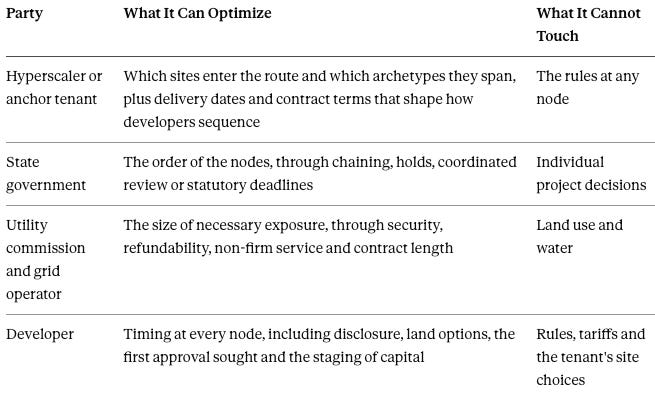
The anchor tenant is best placed among private parties because it alone moves across archetypes. A developer optimizes one site’s route inside one state’s rules. A hyperscaler holding options in several archetypes can concentrate capital on whichever route becomes durable first, and its contracts already decide who carries delay, as Oracle’s notice on Project Jupiter shows.
The state holds the most structural power. A state can reorder the Critical Veto Path for every project at once, as Pennsylvania did by chaining state permits to local approval. State actions in 2026 have mostly added holds and conditions rather than binding early determinations or coordinated calendars.
The utility commission sets how much capital must go at risk before power becomes durable. Virginia, Ohio and Georgia fixed that amount through contract length and minimum charges. The November grid filings will set it in six more regions.
The developer holds the only lever that touches every node. Disclosure timing, land options and the order of applications all sit with the developer, but every one of those choices operates inside rules and tariffs set by others.
Equipment suppliers hold a fifth lever that is easy to miss. Long-lead equipment is the capital class that most often forces commitment ahead of durability. A supplier that offers transferable production slots or refundable reservations turns avoidable exposure into necessary exposure for every customer at once.
Opponents optimize as well. Section VIII sets out how coalitions contest open nodes and time their moves to disclosure, and the route model runs their Cognitive Digital Twins alongside the lever-holders.
Takeaway: the approval route is a coordination problem that no single party owns, and each lever-holder can lower exposure only within its own slice.
XI. Site Portfolios Spread Risk at an Added Cost
A single-site route cannot control a governor’s order or a statewide hold. A portfolio of candidate sites can turn part of that uncertainty into a choice. The developer holds options at several sites and concentrates capital on the first site whose decisive approvals become durable.
The hedge has a cost. Each site in the portfolio requires its own necessary exposure, such as option payments, study deposits and grid security. Three sites held open cost roughly three times the necessary exposure of one.
Whether a portfolio lowers total exposure depends on that added cost. Sites under different statewide rule structures face different executive shocks, because one order rarely reaches them all. The route model evaluates each portfolio against its added necessary exposure before recommending it.
Developers also move between jurisdictions. Pima County approved Project Blue’s rezoning on unincorporated land a month before Tucson rejected the project. When the city cut off city water, the developer turned to air cooling and its own wells, and the campus reached construction.
Takeaway: a portfolio can hedge executive and statewide risk, and its value depends on whether that hedge outweighs the necessary exposure it adds.
XII. Design and Rule Changes Force the Route to Recalculate
A route set at site selection can become wrong within months. The model recalculates whenever the project’s design, the rules or the approving majority changes. Three triggers matter most.
A design change can relocate risk rather than remove it. VoltaGrid planned fourteen gas generators to serve a Quincy data center campus, and the plan was canceled after public comments reached the state. Jupiter’s grid bypass created its fuel and air nodes.
A rule change can reorder the path. The Texas permit halt moved the decisive node from local and grid approvals to the governor and the environmental agency. The November 2026 grid filings will reset the power node in six regions at once.
Some stops arrive from constraints that opposition did not create. The developer of a proposed Tonawanda campus paused because the state grid operator would not reach its request for some time. The town adopted its moratorium afterward.
Takeaway: the route recalculates on every material change, and each engineering bypass enters the route only after its new nodes are mapped.
XIII. Twenty Stopped Projects Show Where the Absence of a Route Costs the Most
MindCast tested the ten nodes against twenty stopped, delayed, withdrawn or held projects in nine states. The results show where the absence of a route costs the most. Data Center Watch counted at least 75 projects worth about $130 billion blocked or delayed in the first quarter of 2026 as the national backdrop.
Eleven projects held no durable approval and stopped at the first binding node they reached. San Marcos denied a $1.5 billion campus at the land-use node. A route model would have tested that node before other spending.
Seven projects cleared at least one approval and then met a new contest at a different node. The group includes the largest projects in the set, such as Jupiter, the Digital Gateway and the Stream campus at Genesee County’s STAMP site. The large projects met consequential contests after earlier approvals had cleared, when far more project value was already exposed.
Every engineering bypass in the set opened a new node. Jupiter met fuel and air nodes, VoltaGrid met an air node and Project Blue met a well-permit node. Project Blue alone cleared its new node, because the developer controlled the water it drew.
Takeaway: small projects in the set stopped at an untested first node, and large projects met their decisive contests after earlier approvals had cleared, which are the two patterns the route model addresses.
XIV. A Capital Release Schedule Ties Each Commitment to a Durable Approval
The route model ends in a capital release schedule. Each class of capital stays in reversible form until the approval that decides it becomes durable. The table below pairs each class with its reversible form and its release trigger.
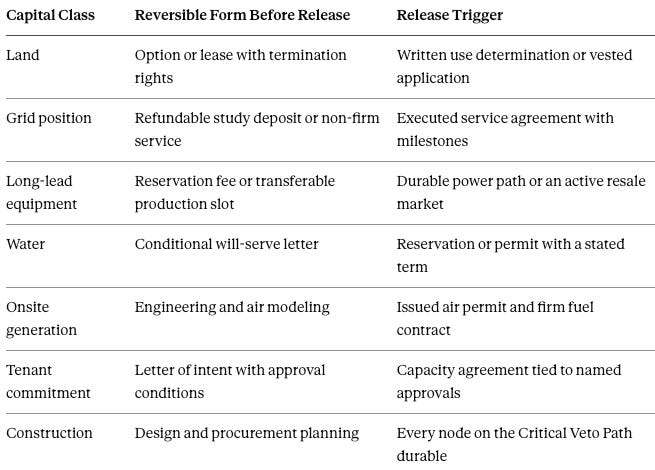
Some classes cannot wait. Grid security under large-load rules comes due before the power node becomes durable. The schedule treats that security as necessary exposure and caps it at the value of the right it protects.
Takeaway: the schedule turns the route into dated capital decisions, which lets lenders and tenants tie commitments to durability rather than approval counts.
XV. MindCast Simulation Predictions on Data Center Approval Routes
MindCast issues five Simulation Predictions on AI data center approval routes. P marks a Primary Simulation Prediction, which tests a core mechanism of the paper. S marks a Secondary Simulation Prediction, which tests a specific pattern.
Primary Simulation Predictions
The two primary predictions test necessary exposure at the grid and the transfer of authorization delay through contracts.
P1 (70–80%): At least two of the six FERC-jurisdictional regional grid operators file large-load tariff revisions that require a readiness deposit, financial security or cost-recovery commitment before firm service by December 31, 2026. Falsifier: fewer than two qualifying filings by the deadline. Verification source: FERC dockets EL26-67 through EL26-72.
P2 (65–75%): At least two further large data center projects produce public force majeure, change-in-law or tenant deferral notices tied to an approval delay by December 31, 2027. Falsifier: fewer than two qualifying notices by the deadline. Verification source: securities filings and published reporting that names the notice.
The primary set tests whether grid rules raise necessary exposure and whether authorization delay travels from institutions into contracts.
Secondary Simulation Predictions
The three secondary predictions test engineering bypass, disclosure timing and the non-firm route option.
S1 (65–75%): At least two data center projects that redesign to onsite generation after a grid interconnection limit face a contested air permit proceeding or fuel-supply condition by December 31, 2027. Falsifier: fewer than two qualifying projects by the deadline. Verification source: state air permit dockets and fuel supply filings.
S2 (75–85%): At least three local data center moratoriums adopted between October 1, 2026 and June 30, 2027 follow within 90 days of the first public report of a specific proposed data center in the same jurisdiction. Falsifier: fewer than three qualifying moratoriums. Verification source: municipal ordinances and minutes with dated local reporting of the project’s first public identification.
S3 (70–80%): At least one FERC-jurisdictional regional grid operator other than the Southwest Power Pool files a large-load framework offering a non-firm or conditional service path pending firm service by December 31, 2026.Falsifier: no qualifying filing by the deadline. Verification source: FERC dockets EL26-67 through EL26-72.
The secondary set tests the triggers that force re-routing and the tools that lower necessary exposure.
Takeaway: the five predictions test the route model against grid filings, contracts, engineering redesigns and local responses to disclosure through 2027.
XVI. Risk Mitigation for Each Audience Before the Predictions Resolve
Each prediction carries a loss for a party that takes no action. The matrix below lists every prediction with its band and a separate severity rating, so a lower-probability entry with high severity stays visible. The detailed entries follow, written for the audiences each prediction binds. The actions are analytic options for each audience, not recommendations to any specific party.
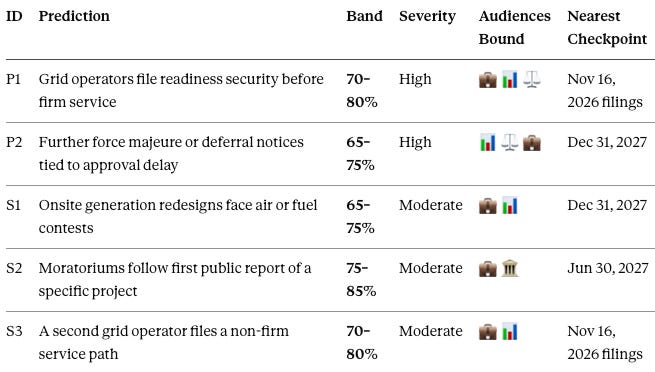
Severity and probability run on separate axes. P2 carries a lower band than P1 but a comparable severity, because a single deferral notice can suspend a year of tenant revenue.
Grid Readiness Security Before Firm Service
Prediction: P1 (70–80%). Severity: high.
💼 Executives. Exposure: readiness security posted per megawatt of queued load before the power node becomes durable. A project that declines to post loses months of queue position.
The project finance lead models security at three per-megawatt levels for every queued site before November 16, 2026.
The development lead converts pending land purchases into options or leases with termination rights before December 31, 2026.
The interconnection lead prepares service requests that can be filed on the day each new tariff takes effect.
Residual: tariff terms set the security amount, and posted security can be forfeited if the project withdraws.
📊 Investors. Exposure: capital committed per megawatt in grid security before any service agreement exists.
The investment committee sizes grid security exposure for each portfolio site before December 31, 2026.
Deal teams tie funding of grid security to the right it holds, such as a queue position or study slot.
Residual: security remains at risk until the service agreement executes.
⚖️ Counsel. Exposure: load-serving agreements signed before the filings allocate tariff-change risk to the client.
Counsel adds tariff-change reopeners to every load-serving agreement signed before November 16, 2026.
Counsel reviews deposit forfeiture terms against each client’s withdrawal scenarios before December 31, 2026.
Residual: agreements already signed carry their original allocation.
Authorization Delay Moving Into Tenant Contracts
Prediction: P2 (65–75%). Severity: high.
📊 Investors. Exposure: months of deferred rent per project and the yield lost across the deferral period.
The asset management lead reviews force majeure and change-in-law scope in every tenant agreement before March 31, 2027.
The investment committee requires a list of open decisive approvals for each project before the next capital call.
Residual: tenant-favorable clauses already signed remain enforceable.
⚖️ Counsel. Exposure: disputes over whether an authorization delay qualifies as force majeure, measured in months of deferred payment.
Counsel defines authorization-delay events and names the decisive approvals in every new tenant agreement.
Counsel maps notice deadlines and cure periods for every open decisive approval before March 31, 2027.
Residual: a court may read a clause differently from its drafters.
💼 Executives. Exposure: months of rent deferral when a delivery date passes before a decisive approval becomes durable.
The development lead sets tenant delivery dates after the expected durability date of each decisive approval.
Residual: approvals can slip past even a conservative delivery date.
Onsite Generation Opening Air and Fuel Contests
Prediction: S1 (65–75%). Severity: moderate.
💼 Executives. Exposure: months to an air permit and the term of the fuel contract a bypass requires.
Engineering models the air permit path before the bypass is selected.
Procurement secures fuel route rights before final design.
The development lead holds generation equipment orders until the air permit issues.
Residual: a party with standing can contest the air permit, and the agency decides the outcome.
📊 Investors. Exposure: generation capital committed before the air and fuel approvals become durable.
The investment committee requires the air permit path and fuel route for any onsite generation plan before approving capital.
Residual: fuel and emissions rules can change over the plant’s life.
Moratoriums Following the First Public Report of a Project
Prediction: S2 (75–85%). Severity: moderate.
💼 Executives. Exposure: six to twelve months of pause on a site whose local approval has not yet become durable.
Development counsel files a complete application or obtains a written use determination before the project’s first public identification where state law permits.
The community relations lead prepares enforceable community terms before any announcement.
Residual: a moratorium can still delay related approvals the project has not yet filed. Confidentiality with public officials can conflict with open-records law, so the constrained version limits early disclosure to the application itself.
🏛️ Policymakers. Exposure: months of pause spent without written rules, plus litigation cost if a pause exceeds local authority.
Planning staff drafts a data center ordinance before the first application arrives.
The city attorney confirms the jurisdiction’s authority to adopt a pause before any vote.
Residual: an adopted ordinance can still face challenge.
A Non-Firm Service Path for Large Loads
Prediction: S3 (70–80%). Severity: moderate.
💼 Executives. Exposure: months of schedule lost to competitors that energize early on non-firm service.
Engineering designs each campus to tolerate curtailment before November 16, 2026.
The interconnection lead prepares a non-firm service request ready to file when a qualifying tariff takes effect.
Residual: non-firm service carries curtailment risk the operator cannot control.
📊 Investors. Exposure: underwriting that assumes firm service misstates revenue reliability for projects that energize on non-firm terms.
Deal teams underwrite curtailment scenarios for every project that plans non-firm service.
Residual: curtailment frequency depends on grid conditions outside the project.
The S2 use-determination step also bears on the Cle Elum predictions in the parent paper. The credit for that action stays with S2 here.
Takeaway: every action above reduces a named loss in a unit its owner controls, and every entry leaves a residual that no single party can remove.
XVII. What to Watch Through 2027
Seven dated events will show which way the route model’s mechanisms move. The dominant fork is whether the November grid filings pair readiness security with refundable terms and non-firm paths or impose firm-only security. The first path lowers necessary exposure, and the second raises it.
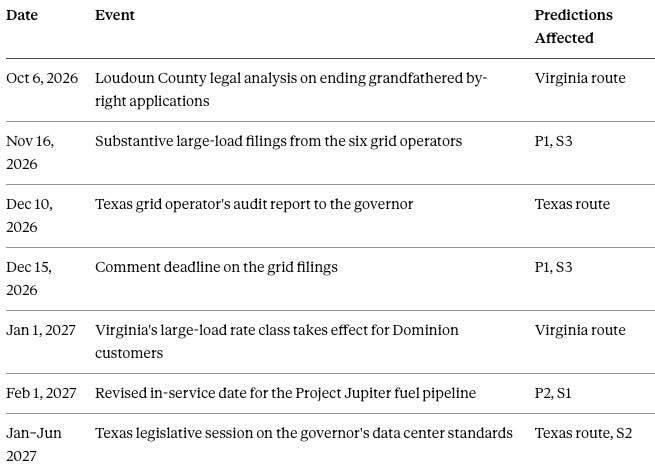
The parent paper’s seven Simulation Predictions remain open, and the first resolves on December 31, 2026 in Cle Elum.
Takeaway: the November filings decide whether necessary exposure rises or falls, and the remaining dates test the other routes.
XVIII. What the Model Means for Each Audience
The route model changes what each audience should expect from an approval. The consequences below follow from the model, and the mitigating actions sit in Section XV.
🏛️ Policymakers. Developers commit capital early because no public process tells them which approval decides the project. Binding early determinations would shift that exposure from avoidable to necessary.
💼 Developers and hyperscalers. A site’s regime sets which part of the route governs. Resource-decided sites turn on the grid filings, and discretion-decided sites turn on disclosure timing.
⚖️ Counsel. Durability differs by node, so a contract milestone tied to “all permits” misstates the client’s position. Force majeure disputes will turn on which approval was decisive.
📊 Investors and lenders. Approval counts overstate project safety. Capital at risk concentrates wherever a decisive approval remains open.
⚡ Utilities and grid operators. Refundable security and non-firm paths decide how much capital developers must commit before service. The November filings set that amount for six regions.
🏘️ Communities. A local vote decides discretion-governed projects. For resource-governed projects the leverage sits in state dockets and utility proceedings.
Takeaway: the model moves each audience’s attention from the number of approvals to the durability of the approval that decides the project.
Conclusion
Project Jupiter holds its county approvals and still faces a tenant notice over an open fuel route. The campus shows the cost of committing capital ahead of the approval that decides it. A route that identifies its regime and names the Critical Veto Path turns open-ended uncertainty into dated decisions. Funding only necessary exposure and recalculating on every change keep those decisions sound for developers, hyperscalers and investors.
MindCast AI builds Cognitive Digital Twins of the institutions that authorize AI infrastructure and simulates how they respond to one another. Contact: mcai@mindcast-ai.com · www.mindcast-ai-simulation.com
Related MindCast Work
Ten MindCast publications supply the maps, costs and carried predictions behind the route model.
AI Data Center Veto Points Show Where Projects Get Stopped and How Authorization Risk Moves. The parent paper defines the ten nodes and the four state arrangements that anchor the archetypes in Section IX.
The Data Center Authorization Price. The paper establishes what authorization costs in each state, which sets the stakes of each commitment the route stages.
The Data Center Authorization Market: A 50-State Regulatory Atlas. The Atlas supplies the state instruments that set each state’s current route.
AI Data Center Moratoriums Are Forecastable — and They End in Pricing Rules, Not Bans. The paper explains how local pauses follow disclosure and resolve into written terms, the pattern S2 tests.
The Model AI Infrastructure Authorization Code. The Code supplies the rule that places any order, tariff or ordinance at the node it governs.
The Grid-Anchored Clean Power Bargain. The paper shows that moving flexible compute toward abundant energy raises the firm-power intensity of the load that stays, which deepens necessary exposure at the power node.
The Clean Compute Match. The paper pairs each class of compute with a class of clean power, which determines whether a project falls in the resource regime.
The Authorization Market — Standardized Bargaining, Rationed Power, and the Competition to Build America’s AI Infrastructure. The paper frames authorization as a market for rationed power, which the grid readiness terms in Section V now formalize.
AI Data Center Authorization Bargaining Power. The paper examines who holds leverage in authorization bargaining, the question behind the opposition and institution responses in Section VIII.
AI Datacenter Edge Computing: Ship the Workload Not the Power. The paper sets out the alternative of moving workloads rather than power, a design choice that changes which nodes sit on the Critical Veto Path.
Sources
External sources appear below in order of first citation, each with its role in the paper.
The Next Web, “Oracle cites force majeure on Project Jupiter data centre” (2026). Jupiter cost estimate and the land office route denials.
El Paso Matters, “Oracle could defer Project Jupiter rent payments over power supply delays” (2026). Status of the Jupiter air permit and fuel pipeline.
Reuters, “Oracle Cites ‘Force Majeure’ to Shield Itself on Controversial Data Center, Bloomberg Reports” (2026). Oracle’s force majeure notice to the Jupiter developer and the news event that opens the paper.
Prince William Times, “Digital Gateway suffers another blow in court” (2026). Appellate ruling voiding the Digital Gateway rezonings.
Rappahannock News, “Prince William County withdraws from Digital Gateway lawsuit” (2026). Prince William County’s withdrawal from the appeals.
Day Pitney, “FERC Issues Show Cause Orders to Six RTOs/ISOs on Large Load Integration” (2026). FERC’s June 18 show cause orders to all six grid operators.
Sheppard Mullin via Mondaq, “FERC Orders Six RTOs To Address Specific Reforms To Effectuate Speed To Power” (2026). Cost recovery agreements among the FERC reform areas.
mgrid, “All Six Grid Operators Ask FERC for 90 More Days on Large-Load Rules, Pushing Filings to November 16” (2026). The grid operators’ 90-day extension to November 16.
Orrick, “FERC Show Cause Orders Signal Broad Reform to Large Load Interconnection Policies” (2026). PJM’s generator readiness terms and SPP’s non-firm large-load service.
Zero Emission Grid, “NYISO TPAS 2026 RNA & FERC Large Load Order: Updates” (2026). New York’s proposed firm and non-firm split for large loads.
Seattle Times via Spokesman-Review, “Cle Elum passed a data center ban. One might be built there anyway” (2026). Cle Elum’s emergency moratorium three days after disclosure.
Office of the Texas Governor, “Governor Abbott Directs TCEQ To Halt Data Center Permits” (2026). Texas halt on data center environmental permits.
Barley Snyder, “Governor Shapiro Issues Executive Order Imposing New Requirements On Data Center Development” (2026). Pennsylvania’s chaining of state permits to local approval.
Texas Tribune, “Data center company decides not to build in East Texas” (2026). Diode’s withdrawal under the governor’s standards.
Office of the Governor of New York, Executive Order No. 62 (2026). New York’s statewide hold and its completeness carve-out.
KJZZ, “1 year after approving Project Blue, Pima County releases data center health impact study” (2026). Pima County’s rezoning of Project Blue before Tucson’s rejection.
Tucson Sentinel, “Project Blue’s 2 new Tucson wells could draw up to 31 million gallons of water annually” (2026). Project Blue’s shift to private wells after the city cut off water.
KUOW, “Controversial Central WA gas power plant for data centers canceled amid activist backlash” (2026). Cancellation of the Quincy onsite gas plant.
WGRZ, “Conflicting statements on status of data center proposed for Tonawanda Coke site” (2026). Tonawanda developer’s pause for the state grid queue.
Newsweek, “Data Center Projects Face ‘Unprecedented Surge’ in Blocks and Delays” (2026). National count of blocked and delayed projects in early 2026.
KUT, “San Marcos City Council blocks proposed data center” (2026). San Marcos denial of a $1.5 billion campus.
Working With MindCast
Developers, hyperscalers, investors, equipment suppliers and public agencies facing data center authorization decisions use MindCast before they commit capital or announce a project. The work identifies each candidate site's regime, names its Critical Veto Path and separates necessary from avoidable exposure. MindCast then simulates how the institutions and opponents at each open node respond to the route. A commissioned Veto Profile covers one site or a portfolio, with a capital release schedule and Simulation Predictions tied to the dates that matter for the decision.
Contact mcai@mindcast-ai.com or visit www.mindcast-ai-simulation.com.