


Executive Summary
The US patent system fails not because patents are too strong or too weak, but because coordination collapses faster than institutions can learn—converting intellectual property into arbitrage capital. Every section that follows tests, quantifies, and derives predictions this thesis.
Policy debate cycles between ‘patents block innovation’ and ‘patents are too easily invalidated.’ Both framings miss the structural problem. The failure is temporal: coordination degrades at technology speed while doctrine updates at litigation speed. Rational actors fill the gap with strategies that extract value from uncertainty rather than from invention. A system results that processes patents efficiently while failing to coordinate investment, licensing, or innovation.
AI Infrastructure Application. AI infrastructure patents operate within a vertically integrated coordination system where focal-point instability at any layer amplifies exploitation incentives at adjacent layers. Compute-layer patent concentration shapes licensing dynamics for every layer above it. Eligibility uncertainty in AI methods patents leaves the innovation layer legally unbounded. The stack is coupled; coordination failure propagates.
Equilibrium Classification. Locked-in exploitative equilibrium with episodic corrective shocks. Absent coordination-first reforms, exploitation persists and migrates across stack layers.
Scope. The analysis presented here is a system-level Cognitive Digital Twin (CDT). Named companies appear as examples of structural positions—compute incumbent, platform integrator, fabless entrant—not as subjects of actor-specific analysis. Readers should not infer conclusions about any named company’s strategy or exposure. Actor-specific CDT runs are available through commissioned engagement and are explicitly not contained here.
Section Roadmap
Section I establishes the Chicago School Accelerated framework and defines the Vision Functions applied throughout.
Section II profiles the institutional players within the U.S. patent system and their roles in AI infrastructure patent adjudication.
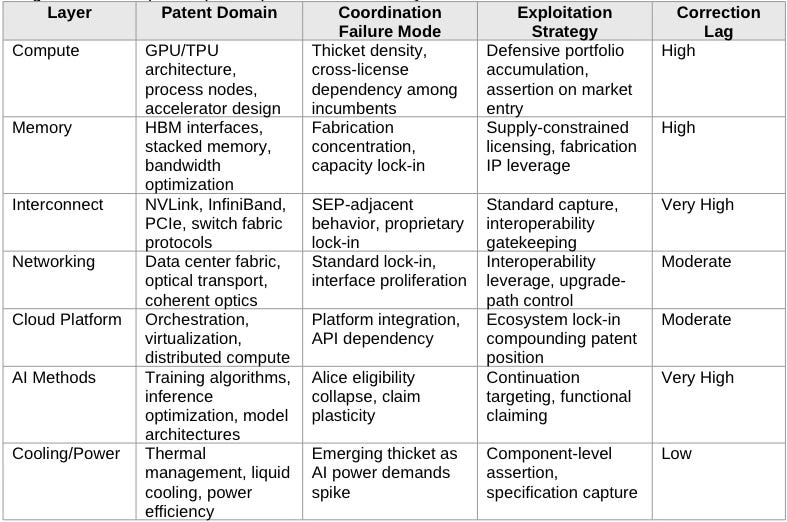
Section III maps the AI infrastructure stack, identifying coordination failure modes and exploitation strategies at each layer.
Section IV presents the Composite CDT outputs across all Vision Functions.
Section V runs illustrative Actor-Type CDTs demonstrating methodology without actor-specific findings.
Section VI presents MCAI Foresight scenarios with time-stamped predictions and falsification contracts.
Section VII explains why this analysis matters for distinct stakeholder groups.
Section VIII describes engagement pathways for actor-specific analysis.
Load-Bearing Predictions
If the thesis holds, the following must be true:
Assertion activity will track defense costs more than patent strength. (Becker)
Compute-layer concentration will persist: top 3 firms hold >85% of AI accelerator revenue through T+5 years. (Coase)
Doctrinal corrections will arrive after rent extraction cycles complete; each correction will open new exploit channels. (Posner)
AI methods patent filings will decline >40% if categorical eligibility exclusion occurs. (Integrity)
A forcing event—verdict >$5B, injunction halting major product, or interconnect SEP confrontation—precedes any coordination-restoring reform. (MCAI Foresight)
Falsification standard: If compute-layer market share disperses below 70% without antitrust intervention, or if two+ accelerator startups scale independently to $500M+ revenue, or if Federal Circuit issues AI-specific eligibility safe harbor, the thesis requires revision.
Contact mcai@mindcast-ai.com to partner with us on Chicago School of Law and Behavioral Economics foresight simulations. See also Quantum Computing Patent Sovereignty (Oct 2025), Private Equity & Patent Litigation in AI Data Centers (2026–2028) (October 2025), How the U.S. Can Foster AI Innovation Using Intellectual Property as a National Innovation System (Aug 2025).
I. Chicago School Accelerated Framework
Coordination collapses faster than institutions can learn. The sections below define that claim and establish the measurement apparatus for testing it.
I.A. Chicago Baseline and Acceleration
Coase demonstrated that efficient outcomes emerge when parties coordinate on shared meaning. Becker showed that actors respond rationally to payoff architectures. Posner argued that institutions learn and correct through feedback. These insights hold when coordination is possible, optimization is tractable, and feedback is clear. The Accelerated extension identifies when they fail: coordination degrades at technology speed; doctrine updates at litigation speed; the gap creates arbitrage surfaces that rational actors exploit.
A structural sequence emerges: coordination degradation renders focal points contested (Coase failure); rational exploitation fills the ambiguity (Becker response); late correction allows rents to extract before adaptation (Posner lag). The sequence recurs across legal governance systems. Patents are the current application.
I.B. Vision Function Definitions
Vision Functions translate theory into quantified outputs. All metrics use a 0.00–1.00 scale; higher values indicate stronger performance unless specified otherwise.
Coase Vision — Coordination Capacity. Measures focal-point stability: eligibility boundaries, claim-meaning notice, thicket density, licensing trust. Outputs coordinating vs. non-coordinating state.
Becker Vision — Incentive Exploitation. Models rational behavior when coordination fails: assertion arbitrage, defense-cost asymmetry, continuation leverage, procedural optionality. Outputs exploit-dominant vs. innovation-dominant regime.
Posner Vision — Institutional Learning. Assesses correction capacity: doctrinal fragmentation, update velocity vs. extraction speed, remedy predictability, avoidance capacity. Outputs kind vs. wicked learning environment.
Integrity Vision — Legitimacy Tracking. Tests quality-signal reliability: examination-to-validity correlation, public trust coherence. Outputs stable vs. drifting legitimacy.
Regulatory Vision — Multi-Node Throughput. Models institutional synchronization: timing gaps, delay propagation, jurisdictional arbitrage. Outputs synchronized vs. fragmented governance.
MCAI Foresight — Scenario Modeling. Runs forward simulations: scenario probabilities, trigger thresholds, time-to-forcing-event, falsification contracts.
Insight: Each Vision Function generates independently testable outputs. Predictions carry falsification conditions enabling progressive validation as events unfold.
II. U.S. Patent System Institutional Landscape
Understanding CDT outputs requires familiarity with the institutional actors whose decisions shape AI infrastructure patent coordination. The U.S. patent system operates as a multi-node governance network where fragmentation creates timing gaps and jurisdictional arbitrage opportunities. The sections below profile each node’s incentives, constraints, and interaction dynamics.
II.A. United States Patent and Trademark Office
The United States Patent and Trademark Office (USPTO) serves as the gatekeeping institution for patent rights, processing over 600,000 applications annually. Examination occurs through a workforce of approximately 8,000 patent examiners organized into technology-specific art units. For AI infrastructure patents, relevant art units span semiconductor devices, computer architecture, software methods, and communications protocols.
Structural Incentives. Examiner performance metrics historically emphasized throughput—applications processed, allowance rates, pendency reduction. Recent reforms have attempted to balance quality metrics, but the fundamental architecture rewards closure over durability. Continuation practice allows applicants to maintain prosecution indefinitely, creating claim-scope optionality that persists post-grant.
AI-Specific Challenges. AI infrastructure patents strain examination capacity. GPU architecture claims require deep semiconductor expertise. Interconnect protocol claims implicate standard-essential patent dynamics. AI methods claims confront Alice eligibility doctrine with minimal stable guidance. The cross-domain nature of AI infrastructure—spanning hardware, firmware, and algorithmic layers—exceeds the specialization of any single art unit.
PREDICTION: USPTO examination quality will remain inconsistent across AI infrastructure layers, with highest variance in AI methods patents where eligibility doctrine provides minimal stable guidance.
II.B. Patent Trial and Appeal Board
The Patent Trial and Appeal Board (PTAB) conducts post-grant validity review through Inter Partes Review (IPR) and Post-Grant Review (PGR) proceedings. Since 2012, PTAB has emerged as the primary battlefield for patent validity challenges, with invalidation rates historically exceeding 70 percent for instituted reviews.
Strategic Implications. IPR creates asymmetric risk for patent holders. Challengers can select their strongest prior art, avoid claim construction from concurrent litigation, and obtain decisions faster than district court litigation. For AI infrastructure patents, asymmetric risk favors well-resourced defendants who can deploy IPR as a parallel attack vector while defending in district court.
Coordination Effects. PTAB decisions do not bind district courts on claim construction, creating potential inconsistency between validity and infringement determinations. Estoppel provisions limit subsequent challenges but create incentives for timing games—filing IPR early to preserve options or late to delay resolution.
II.C. Federal District Courts
Patent infringement litigation concentrates in a small number of districts. The Western District of Texas, District of Delaware, and Eastern District of Texas historically attract disproportionate filing volumes. Judge-specific practices—particularly around claim construction timing, discovery scope, and case scheduling—shape venue selection.
Discovery Cost Asymmetry. Patent litigation discovery costs routinely exceed several million dollars for complex technology cases. Cost asymmetry creates settlement pressure independent of merits. For AI infrastructure patents involving multiple layers—semiconductor process, architecture, firmware, and software—discovery burden multiplies as each layer requires distinct technical expertise.
Damages Variance. Reasonable royalty calculations under Georgia-Pacific factors produce wide outcome ranges. For AI infrastructure, apportionment challenges multiply as contributions span hardware efficiency, architectural innovation, and algorithmic optimization. Damages uncertainty persists even when liability is established.
II.D. Court of Appeals for the Federal Circuit
The Federal Circuit holds exclusive appellate jurisdiction over patent cases, creating doctrinal uniformity in principle but panel-dependent variance in practice. Three-judge panels produce different outcomes on claim construction, obviousness, and eligibility with sufficient frequency to sustain litigation optionality.
Doctrinal Oscillation. Eligibility doctrine under Alice remains unstable. The Federal Circuit has not converged on a stable framework for distinguishing abstract ideas from patent-eligible applications, particularly for AI methods claims. Each new decision adds data points without resolving the underlying coordination failure.
Deference Dynamics. Claim construction receives de novo review, allowing the Federal Circuit to substitute its judgment for district court interpretations. De novo review increases appellate reversal rates and reduces settlement pressure at the district court level—parties know construction can shift on appeal.
II.E. Supreme Court
The Supreme Court intervenes episodically, typically to resolve circuit splits or correct perceived Federal Circuit overreach. Major interventions—Alice (2014), eBay (2006), TC Heartland (2017)—reset doctrinal terrain but often inject new uncertainty that takes years to stabilize.
Intervention Pattern. Supreme Court patent grants cluster around periods of perceived imbalance. Each intervention addresses accumulated dysfunction but creates transition costs as lower courts interpret new standards. For AI infrastructure patents, Alice’s impact continues to propagate through eligibility challenges to software and AI methods claims.
II.F. International Trade Commission
The International Trade Commission (ITC) provides an alternative enforcement forum with faster timelines and exclusion-order remedies. For AI infrastructure patents implicating imported components—semiconductors, memory, networking equipment—ITC actions offer leverage unavailable in district court. However, ITC cannot award damages, limiting its utility for monetization-focused assertion.
II.G. Standard-Setting Organizations
AI infrastructure depends on interoperability standards—PCIe for interconnect, DDR for memory interfaces, Ethernet and InfiniBand for networking. Standard-Setting Organization (SSO) participation requires disclosure of potentially essential patents and commitments to license on Fair, Reasonable, and Non-Discriminatory (FRAND) terms.
FRAND Ambiguity. FRAND commitments lack precise definition. Rate-setting disputes persist through litigation years after standards adoption. For AI infrastructure, NVLink and proprietary interconnect standards bypass SSO processes entirely, substituting platform lock-in for the coordination that FRAND commitments theoretically provide.
Insight: The U.S. patent system operates as a fragmented governance network. Each node—USPTO, PTAB, district courts, Federal Circuit, Supreme Court, ITC, SSOs—runs on different clocks with different incentives. Fragmentation creates timing gaps exploitable by sophisticated actors.

III. AI Infrastructure Stack Analysis
Section II mapped the institutional nodes; Section III maps the technology layers where coordination fails. AI infrastructure is vertically integrated such that patent dysfunction at any layer propagates through the stack. Investment decisions, licensing negotiations, and litigation strategies at each layer depend on coordination stability at adjacent layers.
III.A. Stack Architecture
The AI infrastructure stack comprises seven functional layers, each with distinct patent dynamics. Hardware layers exhibit thicket density and cross-license oligopoly. Software and methods layers confront eligibility uncertainty and claim plasticity. Platform layers leverage integration to compound patent positions with ecosystem lock-in.
III.B. Vertical Propagation Dynamics
Methodological Note. The analysis below describes system-level dynamics, not actor-specific findings. Named companies appear as examples of market positions—compute incumbent, memory fabricator, interconnect standard-setter—not as subjects of actor-specific CDT analysis. Dynamics described apply to any actor occupying that structural position. Actor-specific CDT runs producing findings about named companies’ strategies, exposures, and optimal responses are available through commissioned engagement. The publication establishes the framework; actor-specific application is a separate product.
Coordination failure at one layer amplifies exploitation incentives at adjacent layers. Vertical propagation distinguishes AI infrastructure from siloed technology markets where patent disputes remain layer-contained. Three propagation mechanisms dominate.
Dependency Propagation. Cloud platform operators depend on compute availability; compute availability depends on memory supply; memory supply depends on fabrication capacity. Patent leverage at any dependency node propagates pricing power and licensing terms upward. The compute incumbent’s market position—whoever occupies it—shapes negotiating dynamics for every hyperscaler building AI infrastructure. Today that position is occupied by NVIDIA; the structural dynamic would apply to any firm holding equivalent market share and patent density.
Integration Propagation. Vertically integrated players can leverage patent positions at one layer to foreclose competition at adjacent layers. A compute-layer patent portfolio combined with proprietary interconnect (NVLink) creates compounding lock-in that exceeds the value of either position independently. Integration converts patent rights into ecosystem control.
Uncertainty Propagation. Eligibility uncertainty in AI methods patents propagates downward. If training algorithm patents face validity challenges, the value proposition for investing in AI-optimized hardware shifts. Investors and operators cannot plan across the stack when legal status at the innovation layer remains indeterminate.
PREDICTION: Compute-layer patent concentration will continue shaping licensing dynamics across all layers. New entrants to AI infrastructure—whether in custom silicon, alternative interconnects, or foundation models—face compounding coordination failures that exceed any single layer’s patent exposure.
III.C. Layer-Specific Analysis
Compute Layer
The compute layer exhibits the highest coordination among incumbents and lowest coordination for entrants. NVIDIA, AMD, and Intel maintain cross-license arrangements that neutralize patent risk internally while preserving assertion optionality against new market participants. Startup accelerator companies face freedom-to-operate uncertainty that exceeds their capacity to resolve through ex ante licensing.
Memory Layer
High Bandwidth Memory (HBM) production concentrates among three fabricators: SK Hynix, Samsung, and Micron. Concentration creates supply-constrained licensing dynamics where patent positions reinforce fabrication oligopoly. Memory interface patents intersect with interconnect standards, creating coordination failures that span layer boundaries.
Interconnect Layer
Interconnect exhibits Standard-Essential Patent (SEP)-like dynamics without SEP governance. NVLink operates as a de facto standard for high-performance AI interconnect, but NVIDIA controls the specification without SSO-mediated FRAND commitments. Alternative interconnect standards (UALink) face coordination challenges in achieving adoption critical mass against an installed base optimized for proprietary protocols.
AI Methods Layer
AI methods patents confront Alice eligibility doctrine with minimal stable guidance. The Federal Circuit has not established a predictable framework for distinguishing abstract mathematical concepts from patent-eligible technical implementations. Eligibility uncertainty produces claim-drafting strategies optimized for prosecution flexibility rather than notice clarity, perpetuating coordination failure.
Insight: The AI infrastructure stack operates as a coupled system where patent coordination cannot be achieved layer-by-layer. System-level coordination requires simultaneous stability across compute, interconnect, and methods layers—a condition current doctrine cannot produce.
IV. Composite Cognitive Digital Twin Analysis
The framework established in Section I and the institutional landscape mapped in Section II converge here. The metrics that follow quantify the core thesis: coordination collapses faster than institutions learn. Low Coase scores confirm coordination failure. High Becker scores confirm rational exploitation. Low Posner scores confirm correction lag. The gap between coordination collapse speed and institutional learning speed is measurable—and large.
IV.A. Coase Vision — Coordination Capacity
Controlling Insight. Patents coordinate investment and licensing only when the system supplies stable focal points. AI infrastructure patents exhibit focal-point instability across multiple dimensions: eligibility boundaries in AI methods, claim meaning in semiconductor architectures, and remedy expectations in complex multi-layer infringement scenarios.
Mechanism. Eligibility doctrine injects boundary uncertainty in AI methods. Claim scope drifts through continuation practice and prosecution flexibility. Thicket density in compute and memory layers raises counterparty identification complexity. The absence of FRAND governance in proprietary interconnect standards eliminates the coordination mechanism that SSO processes theoretically provide.
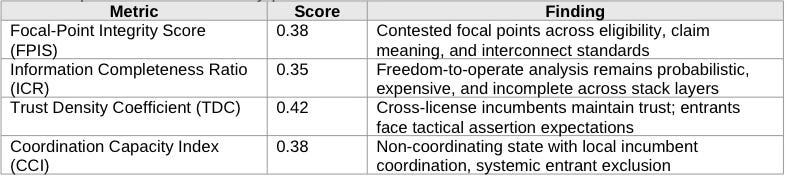
Output Classification. Non-coordinating state with partial local coordination (cross-licenses among compute incumbents) and systemic coordination failure at the margin (AI startups, custom silicon entrants, foundation model developers).
PREDICTION: Coordination costs will remain structural. Clearance costs and uncertainty will rise faster than any incremental quality messaging unless doctrine binds meaning earlier and harder—particularly in AI methods eligibility and interconnect standard governance.
IV.B. Becker Vision — Incentive Exploitation
Controlling Insight. When focal points fail, rational actors shift from innovation bargaining to ambiguity arbitrage. The shift is not moral failure; it is payoff maximization under uncertainty. The AI infrastructure stack presents multiple arbitrage surfaces: defense-cost asymmetry in litigation, continuation optionality in prosecution, and lock-in leverage in interconnect.
Mechanism. Defense-cost asymmetry makes settlement economically rational independent of merits for targets facing multi-layer exposure. Continuation practice creates option value allowing claim scope to chase observed AI implementations years after initial filing. Proprietary interconnect standards convert coordination infrastructure into extraction infrastructure once adoption achieves critical mass.
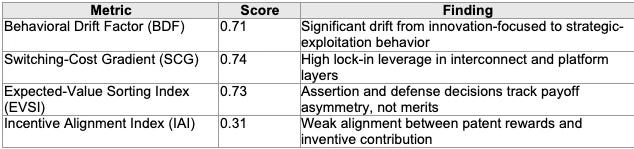
Output Classification. Exploit-dominant regime. Sophisticated players rationally prefer strategies that monetize uncertainty—defensive portfolio accumulation, continuation targeting, interconnect lock-in—over strategies that compete on innovation merit.
PREDICTION: Assertion activity will track defense costs more than patent strength. Continuation targeting will intensify as AI implementations become observable. Procedural arbitrage will migrate to whichever rule surface offers highest leverage—currently PTAB timing games and venue selection.
IV.C. Posner Vision — Correction Capacity
Controlling Insight. Correction must outrun rent extraction. Slow institutional learning converts AI infrastructure patent law into a wicked environment: noisy feedback, doctrinal oscillation, and strategic adaptation that outpaces doctrinal development.
Mechanism. Fragmentation across USPTO, district courts, PTAB, Federal Circuit, and Supreme Court slows convergence. Supreme Court interventions reset doctrine but inject new uncertainty. Each reform tool—IPR, eligibility guidance, venue restrictions—creates second-order timing games that sophisticated actors exploit during transition periods.
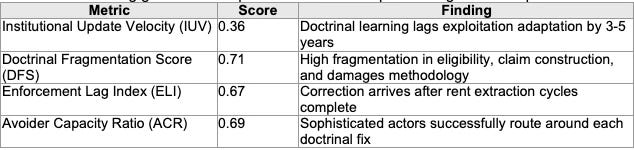
Output Classification. Wicked learning environment with correction lag exceeding typical rent extraction cycles. The patent system receives noisy feedback—settlement obscures merits, appeal rates vary by resources, and doctrinal tests resist stable application.
PREDICTION: Doctrinal corrections will arrive late relative to exploitation scale. Each correction will open a new exploit channel unless it restores upstream meaning. Remedy variance will persist even when liability is clear, sustaining settlement leverage.
IV.D. Integrity Vision — Legitimacy Tracking
Controlling Insight. Internal quality signals matter only if they predict external validity and public legitimacy. A throughput-optimized examination process can improve measured quality while failing to produce stable, enforceable property rights.

Output Classification. Quality-signal drift. Improvements in examination process do not reliably produce stable, enforceable property rights. Legitimacy recovery requires outcome stability, not messaging.
IV.E. Regulatory Vision — Multi-Node Throughput
Controlling Insight. The patent system behaves as a multi-node governance network. Fragmented nodes operating on different clocks create timing gaps exploitable through procedural selection, sequential forum deployment, and strategic delay.

Output Classification. Fragmented throughput with high delay propagation—conditions optimized for procedural gaming by sophisticated repeat players.
Insight: The Composite CDT reveals systemic dysfunction: low coordination capacity, high exploitation incentives, slow correction, drifting legitimacy, and fragmented governance. Dysfunction persists regardless of individual institutional intentions.
V. Illustrative Actor-Type Analysis
Section IV presented system-level findings. The analysis below demonstrates how CDT methodology applies to specific market positions. Actor-type analysis identifies dynamics that apply to any firm occupying a given structural position; actor-specific analysis produces findings about a named firm’s particular exposures, strategies, and optimal responses.
A ‘vertically integrated AI platform’ is not a specific company—it is a structural position that several companies occupy. Dynamics described apply to any firm matching that profile. Readers familiar with the market will recognize which companies fit which profiles; that recognition does not convert the analysis into actor-specific findings. The CDT outputs below indicate what actors in each position face, not what any particular actor should do. Actor-specific recommendations require actor-specific engagement.
V.A. Vertically Integrated AI Platform
Profile. A hyperscaler operating across multiple stack layers: cloud platform, custom silicon, AI services, and consumer applications. Maintains substantial patent portfolio and active licensing program. Depends on third-party components at compute and memory layers.
Coase Exposure. Platform integration creates compound coordination challenges. Patent positions at each layer interact with positions at adjacent layers. Freedom-to-operate analysis cannot proceed layer-by-layer; stack-wide assessment required. Cross-license coverage varies by layer, leaving gaps at emerging boundaries.
Becker Dynamics. Vertical integration enables defensive leverage: assertion at one layer can be countered by patent positions at other layers. However, dependency on third-party compute and memory limits defensive completeness. Integration incentivizes proprietary standards that substitute lock-in for coordination—rational exploitation of the platform position.
Posner Outlook. Scale provides resources for sustained litigation and appellate correction. However, multi-front exposure means any single adverse ruling propagates across business units. Correction lag affects strategic planning horizons but does not threaten operational continuity.
V.B. Fabless AI Accelerator Startup
Profile. Venture-backed company developing custom AI accelerator silicon. Relies on third-party fabrication. Limited patent portfolio. Targeting specific AI workloads where general-purpose GPUs are inefficient.
Coase Exposure. Maximum coordination failure exposure. Freedom-to-operate analysis faces thicket density at compute layer without cross-license coverage that incumbents possess. Claim-meaning uncertainty in architecture patents makes clearance probabilistic. Cannot identify all potential assertion sources.
Becker Dynamics. Primary target for incumbent assertion. Defense costs threaten operational viability regardless of merits. Limited ability to countersue creates asymmetric exposure. Rational response: aggressive portfolio building during development phase, licensing negotiations before product launch, or acquisition as exit.
Posner Outlook. Cannot survive sustained multi-front litigation. Correction lag exceeds company runway. Must resolve patent exposure pre-launch or accept assertion risk as business cost baked into valuation.
V.C. Semiconductor Incumbent
Profile. Established compute-layer player with substantial patent portfolio spanning GPU architectures, interconnect protocols, and software stacks. Maintains cross-license arrangements with peer incumbents. Active licensing and assertion programs.
Coase Exposure. Coordination challenges manageable through bilateral cross-licenses with peers. Focal-point instability affects assertion against new entrants more than defensive posture. However, AI-specific patents—particularly training optimization and inference acceleration—face eligibility uncertainty that could erode portfolio value.
Becker Dynamics. Position enables full exploitation optionality: assertion against entrants, licensing negotiations from strength, proprietary standard capture in interconnect. Cross-license network converts patent thicket from mutual threat to entry barrier. Rational strategy: maintain coordination with peers, assert against disruptors, capture emerging standards.
Posner Outlook. Scale supports indefinite litigation capacity. Doctrinal instability creates risk in individual cases but not portfolio-level threat. Correction lag favors incumbent—each reform cycle allows adaptation before implementation.
V.D. Foundation Model Developer
Profile. Company developing and deploying large language models and other foundation AI systems. Heavy compute consumer. Limited hardware IP. Software and methods patents face eligibility uncertainty.
Coase Exposure. Dependent on compute-layer coordination achieved by others. Cannot influence hardware patent dynamics. AI methods patents face Alice eligibility collapse, making defensive portfolio building unreliable. Training data and model weights create alternative IP strategies (trade secret, contractual) that bypass patent system entirely.
Becker Dynamics. Limited exploitation optionality within patent system. Rational response: minimize patent reliance, maximize trade secret protection, contractual access restrictions. If asserting AI methods patents, face validity challenges that undermine leverage. Compute dependency creates exposure to upstream patent extraction without corresponding defensive capability.
Posner Outlook. Eligibility doctrine most directly threatens this actor type. Correction lag could either resolve eligibility uncertainty favorably or cement AI methods as unpatentable. Strategic planning must account for both scenarios.
Insight: Actor-Type CDT runs reveal that market position determines optimal patent strategy more than individual portfolio characteristics. Vertically integrated players and incumbents can exploit coordination failures; startups and methods-focused developers bear coordination costs disproportionately.
VI. Foresight Scenario Modeling
The system-level findings from Section IV and the actor-type dynamics from Section V establish current-state diagnosis. Forward-looking scenarios follow from the core thesis: if coordination collapses faster than institutions learn, equilibrium persists until either the speed differential closes or a forcing event resets the system. The question is not whether exploitation continues—it will—but which exploitation channels dominate and what triggers correction. Each scenario below carries time-stamped predictions and falsification contracts.
Scenario 1: Compute Oligopoly Persistence (Most Likely)
Probability Assessment: 65%
Narrative. Incumbent cross-license arrangements persist. Compute-layer patent thicket continues functioning as coordinated entry barrier. New accelerator entrants face freedom-to-operate challenges exceeding their resources. AI infrastructure patent dynamics remain stable among incumbents while excluding disruptors.
Predictions (T = 3-5 years):
Compute-layer market concentration remains stable or increases (top 3 firms hold >85% of AI accelerator revenue)
Startup accelerator exits occur primarily through acquisition rather than independent scaling (acquisition:IPO ratio >4:1)
Cross-license renewal rates among incumbents exceed 90%
Licensing revenue from AI infrastructure patents grows faster than R&D investment in new architectures
Threshold Triggers (scenario reclassification required if crossed):
Compute incumbent market share drops below 70% without antitrust intervention → reclassify to Scenario 3 or 4
Two or more accelerator startups reach $500M+ annual revenue independently → reclassify to market opening trajectory
Cross-license network experiences non-renewal or litigation between incumbents → reclassify to fragmentation trajectory
Hard Falsifiers (thesis-level revision required):
Freedom-to-operate clearance costs decline 25%+ for AI accelerator entrants without corresponding patent invalidations
Patent assertion against accelerator startups drops below 2020 baseline levels while startup entry increases
Falsification Conditions: Sustained decrease in compute-layer concentration without major antitrust intervention. Successful independent scaling of two or more accelerator startups to $1B+ revenue. Cross-license network breakdown among incumbents.
Scenario 2: AI Methods Eligibility Collapse (Moderate Probability)
Probability Assessment: 20%
Narrative. Federal Circuit or Supreme Court decision extends Alice to categorically exclude AI training and inference methods from patent eligibility. Foundation model developers lose patent protection for core innovations. Innovation protection shifts entirely to trade secret and contractual mechanisms.
Predictions (T = 2-4 years):
AI methods patent filings decline 40%+ following categorical exclusion ruling
Foundation model developers increase trade secret reliance and reduce publication (measured by paper-to-patent ratio shift >2x)
Hardware/software integration patents gain relative value as methods patents lose eligibility
Compute-layer patent value increases as only reliably enforceable AI infrastructure IP
Threshold Triggers (scenario reclassification required if crossed):
PTAB institution rate for AI methods eligibility challenges exceeds 75% → accelerate scenario timeline to T-1 year
Federal Circuit issues AI-specific eligibility safe harbor (analogous to Berkheimer for factual disputes) → reclassify to stabilization trajectory
Hard Falsifiers (thesis-level revision required):
AI methods patent grant rate exceeds 70% with <20% post-grant challenge rate sustained over 24 months
Major AI lab (top 5 by compute spend) publicly commits to patent-first rather than trade-secret-first IP strategy
Falsification Conditions: Federal Circuit en banc decision establishing clear eligibility path for AI methods. Legislative override of Alice framework. Sustained increase in AI methods patent grant rates without eligibility challenges.
Scenario 3: Interconnect Standard Confrontation (Moderate Probability)
Probability Assessment: 25%
Narrative. Alternative interconnect standard (UALink or successor) achieves adoption critical mass. Patent disputes over standard-essential claims force FRAND-style resolution. Proprietary interconnect dominance breaks, creating competitive interconnect market with SSO governance.
Predictions (T = 2-4 years):
UALink or alternative achieves 20%+ market adoption in new AI cluster deployments
Patent litigation over interconnect protocols increases 3x+ from 2024 baseline
SSO forms or existing SSO absorbs AI interconnect standardization
FRAND commitment disputes reach federal court within 24 months of standard adoption
Threshold Triggers (scenario reclassification required if crossed):
Alternative interconnect exceeds 35% adoption in hyperscaler deployments → reclassify to accelerated timeline; FRAND litigation becomes near-certain
Proprietary interconnect announces FRAND commitment or joins SSO governance voluntarily → reclassify to coordination-restoration trajectory
Hard Falsifiers (thesis-level revision required):
Alternative interconnect achieves 50%+ adoption without triggering patent litigation within 18 months
Interconnect licensing rates stabilize within 15% variance across licensees without litigation or regulatory pressure
Falsification Conditions: Alternative interconnect standards fail to achieve meaningful adoption. Proprietary interconnect maintains 90%+ high-performance AI market share. No FRAND-related litigation in AI interconnect space.
Scenario 4: Legislative Forcing Event (Lower Probability)
Probability Assessment: 15%
Narrative. Major verdict, cross-industry SEP crisis, or AI competitiveness concerns trigger bipartisan patent reform legislation. Reforms address eligibility uncertainty, continuation abuse, and remedy variance. System-wide coordination improvement rather than incremental adjustment.
Predictions (T = 3-6 years):
Patent reform legislation passes with bipartisan support (60+ Senate votes)
Eligibility doctrine receives statutory clarification within 18 months of forcing event
Continuation practice restrictions implemented (filing limits or terminal disclaimer requirements)
Damages methodology standardization reduces remedy variance by >30% (measured by coefficient of variation in reasonable royalty awards)
Threshold Triggers (scenario reclassification required if crossed):
AI patent verdict exceeds $5B or injunction halts major product line → forcing event probability increases to >50%; accelerate legislative timeline to T-2 years
Bipartisan patent reform bill clears committee with AI-specific provisions → reclassify from ‘lower probability’ to ‘active trajectory’
Hard Falsifiers (thesis-level revision required):
Coordination metrics (FPIS, CCI) improve >0.15 points without legislative or major judicial intervention
Exploitation migration fails to materialize after a major doctrinal correction—same exploit channel closes without new channel opening within 24 months
Falsification Conditions: Reform legislation fails despite forcing event. Reforms pass but produce only symbolic changes without coordination improvement. Exploitation migrates to newly created surfaces faster than reforms stabilize.
Insight: Foresight scenarios are probability-weighted pathways, not predictions of certainty. Falsification contracts specify what observations would require scenario revision, enabling progressive validation as events unfold.
VII. Stakeholder Relevance
Different stakeholders face different exposures to AI infrastructure patent coordination failures. The analysis presented in Sections IV through VI generates distinct implications for each group. Position-specific understanding enables targeted strategic response.
VII.A. Patent Applicants and Prosecution Counsel
Claim-drafting strategy must account for layer-specific dynamics. Compute-layer applications face thicket navigation challenges best addressed through continuation optionality and claim differentiation from incumbent portfolios. AI methods applications face existential eligibility risk requiring technical implementation emphasis and hardware integration claims as hedges against Alice expansion.
Actionable Insight. Prosecution strategy should vary by stack layer. Hardware-focused applications should prioritize notice clarity to support licensing negotiations. Methods-focused applications should prioritize eligibility resilience over scope maximization. Cross-layer applications should include fallback claim sets addressing each layer’s distinct enforcement dynamics.
VII.B. Litigation Counsel and Patent Litigators
Procedural arbitrage surfaces concentrate where exploitation currently offers highest returns. Patent Trial and Appeal Board (PTAB) timing, venue selection, and discovery scope negotiations interact with layer-specific technical complexity to shape case economics. Multi-layer infringement allegations face apportionment challenges that expand damages uncertainty.
Actionable Insight. Case assessment should incorporate layer-specific correction lag estimates. Compute-layer disputes among incumbents will settle within established parameters. Disputes involving startups or methods patents will exhibit higher variance and longer resolution timelines. Forum selection and procedural positioning matter more when coordination failure is severe.
VII.C. Corporate Patent Strategists
Portfolio positioning across the AI infrastructure stack requires layer-specific coordination failure assessment. Defensive coverage depends on cross-license availability at the compute layer, eligibility trajectory at the methods layer, and standard adoption dynamics at the interconnect layer.
Actionable Insight. Portfolio investment should track coordination failure severity by layer. Layers with high exploitation optionality (compute, interconnect) reward portfolio building. Layers with eligibility uncertainty (AI methods) may not reward patent investment regardless of technical innovation quality. Vertical integration creates compounding exposure that single-layer analysis underestimates.
VII.D. Private Equity and Venture Investors
Patent risk assessment for AI infrastructure investments varies dramatically by portfolio company market position: incumbents face manageable coordination costs while startups face existential assertion risk. Due diligence must account for layer-specific dynamics and cross-layer dependencies.
Actionable Insight. Investment thesis should incorporate patent coordination assessment. Compute-layer startups face freedom-to-operate challenges that acquisition may resolve more efficiently than organic growth. Methods-layer companies should be evaluated assuming patent protection may be unavailable. Platform-layer investments compound patent exposure across dependent layers.
VII.E. Policy Advisors and Regulators
Patent reform efforts targeting individual dysfunction symptoms will fail to restore coordination. Eligibility clarification without continuation reform shifts exploitation channels. PTAB procedural changes without damages methodology reform preserves settlement leverage. System-wide coordination requires synchronized intervention across multiple institutional nodes.
Actionable Insight. Policy design should prioritize coordination restoration over individual symptom treatment. Reforms that bind meaning upstream—clearer eligibility standards, tighter claim construction, continuation limits—address root causes. Reforms that adjust downstream procedures without upstream meaning restoration will trigger exploitation migration rather than elimination.
VII.F. Economics and Consulting Firms
The CDT methodology provides a replicable framework for client engagements involving AI infrastructure patent disputes, transactions, or strategic planning. Vision Function outputs support expert testimony, valuation opinions, and strategic recommendations.
Actionable Insight. CDT methodology applies across engagement types: litigation support (damages analysis informed by coordination failure metrics), transaction due diligence (portfolio assessment incorporating layer-specific dynamics), and strategic advisory (market positioning recommendations grounded in exploitation incentive analysis).
VIII. Engagement Pathways
The system-level findings presented in Sections I through VII apply across AI infrastructure patent markets. Actor-specific analysis—tailored CDT runs producing findings relevant to individual companies, investors, litigants, or policy initiatives—requires commissioned engagement with MindCast AI.
VIII.A. Available Engagement Types
Actor-Specific CDT Runs. Full Vision Function stack analysis for named companies, producing coordination exposure assessment, exploitation optionality mapping, and strategic recommendations calibrated to market position. Deliverable: comprehensive report with quantified metrics and scenario modeling.
Litigation Support. CDT-informed analysis supporting patent litigation strategy, damages assessment, and expert testimony. Applications include market definition in antitrust-patent intersections, reasonable royalty analysis incorporating coordination failure dynamics, and invalidity assessment incorporating eligibility trajectory projections.
Transaction Due Diligence. Patent portfolio assessment for M&A, licensing negotiations, or investment decisions. Analysis incorporates layer-specific enforcement dynamics, cross-license dependency mapping, and exploitation optionality valuation.
Strategic Advisory. Ongoing engagement supporting patent portfolio development, prosecution strategy, and competitive positioning. Includes periodic CDT updates as market conditions and doctrinal developments unfold.
Policy Analysis. CDT-informed assessment of proposed reforms, regulatory initiatives, or legislative interventions. Analysis projects coordination effects, exploitation migration pathways, and implementation timing considerations.
VIII.B. Sector Deep-Dives
Subsequent publications will apply the Chicago School Accelerated framework to specific AI infrastructure sectors in greater depth. Planned publications include:
Semiconductor Patent Coordination: GPU architectures, process node IP, and memory interface dynamics
AI Interconnect Standards: NVLink, UALink, and the path to FRAND governance
Foundation Model IP Strategy: Trade secret, contract, and patent interactions
AI Infrastructure Antitrust-Patent Intersection: Coordination failure as market power indicator
Insight: The AI patent system fails not because patents are too strong or too weak, but because coordination collapses faster than institutions can learn—converting intellectual property into arbitrage capital. Until that temporal mismatch is resolved, exploitation remains rational, correction remains late, and the system will continue processing patents while failing to coordinate innovation.