


Companion publications: The Compass–Redfin Alliance, Market Self-Correction Is Dead, Zillow vs. Redfin–Compass, Premarket Control Under Expanding Transparency Laws
Executive Summary
Twenty days produced a new equilibrium: premarket visibility became commodity infrastructure, and only one architecture in the sequence attempted to preserve control after that shift. Compass and Redfin announced their partnership on February 26. Zillow launched Zillow Preview alongside KW, REMAX, HomeServices of America, and Side on March 17. eXp Realty revealed a three-portal arrangement with Homes.com, Realtor.com, and ComeHome.com on March 18. All three send listings to consumer-facing platforms before MLS active status. The surface resemblance ends there.
Compass–Redfin: Compass International Holdings and Rocket Companies announced a three-year strategic alliance on February 26, 2026, under which Compass Coming Soon listings began appearing on Redfin immediately, with all buyer inquiries routed to Compass listing agents and no days on market, price history, or valuation estimates displayed (Inman, Feb. 26, 2026; Rocket/Compass joint press release).
Zillow Preview: Zillow launched Zillow Preview on March 17, 2026, in partnership with Keller Williams, REMAX, HomeServices of America, Side, and United Real Estate, making coming-soon listings publicly visible on Zillow and Trulia before MLS active status with full buyer data intact and no internal routing requirement (Zillow press release, March 17, 2026.
eXp: eXp Realty announced a pre-marketing syndication deal with Homes.com, Realtor.com, and ComeHome.com on March 18, 2026, distributed through Zenlist on explicitly non-exclusive terms, with CEO Leo Pareja stating that any portal may receive eXp listings on equal terms (Inman, March 18, 2026)
Underneath identical packaging, three structurally distinct theories of competition operate simultaneously. Compass routes all buyer inquiries to its own agents, strips buyer data fields from every listing, and locks the arrangement in a signed three-year contract — at zero cash cost to a firm carrying $2.6 billion in post-merger debt. Zillow distributes listings broadly and competes for the interaction layer above visibility. eXp syndicates on explicitly non-exclusive terms, inviting any portal to receive listings on equal footing.
The Realtor.com CEO’s statement on the eXp deal named the distinction precisely: “equal access for all buyers, not a subset selected by the listing agent” (Damian Eales, written statement to Inman, March 18, 2026). Twenty-day industry convergence toward open distribution makes the Compass–Redfin architecture the structural outlier — not by regulation alone, but by the voluntary consensus of the market’s other major actors.
I. The Syndication Stack: Three Deals in Twenty Days
Twenty days produced an industry inflection point that no single announcement could have created alone. Three major brokerages, three portal architectures, and three distinct theories of competitive advantage arrived in rapid succession — and the speed of the sequence matters as much as the content of each deal.
Compass fired first on February 26, positioning the Redfin partnership as a seller-choice initiative. Robert Reffkin framed the arrangement around giving sellers “freedom” from what he called misleading data points — days on market, price drop history, valuation estimates — that he characterized as damaging to value (Compass newsroom, February 26, 2026; Inman). Sixty million monthly Redfin visitors. All buyer inquiries routed exclusively to Compass agents. No referral fee. A signed three-year contract requiring zero cash outlay from a firm that has never posted a full-year GAAP profit. Compass does not compete on distribution. It converts distribution into controlled buyer routing.
Zillow answered on March 17 with Zillow Preview — a premarket product built for the opposite objective. Listings reach the full Zillow audience before MLS active status, generating buyer engagement at scale. The partner list spanned Keller Williams, REMAX, HomeServices of America, and Side. Wide distribution. Full buyer data. No internal routing requirement. Zillow is not recreating the private listing window in a new container. Zillow is replacing that window with a different competitive layer entirely — one where advantage comes from owning where buyers show up first, not from controlling which agent they reach when they do.
eXp closed the sequence on March 18, announcing syndication across Homes.com, Realtor.com, and ComeHome.com (Inman, March 18, 2026). CEO Leo Pareja’s statement set the tone: “If a home is being marketed to the public, consumers deserve the opportunity to see it.” The non-exclusivity clause went further — any portal may receive eXp listings on equal terms, subject to MLS rules and seller authorization. No preferred partner. No internal routing requirement. No stripped data fields. eXp’s deal treats premarket syndication as commodity infrastructure and competes elsewhere.
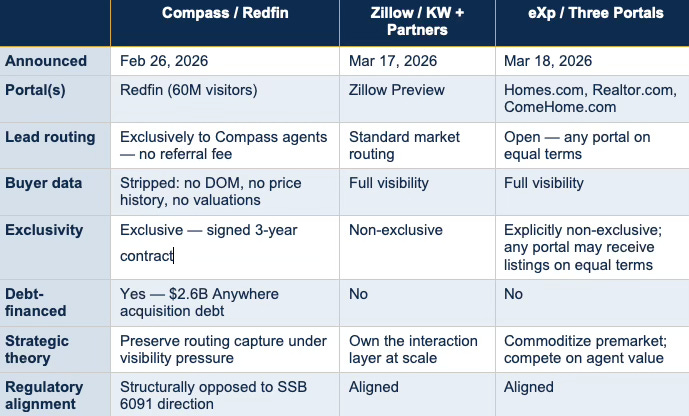
Source: Company announcements, Inman, HousingWire, RealEstateNews.com — February 26 through March 18, 2026.
II. The Non-Exclusivity Clause as Architectural Diagnostic
The single most revealing feature of the eXp deal is the one that received the least attention: any portal may receive eXp listings on equal terms. That clause is not boilerplate. It is the architectural inverse of the Compass–Redfin contract, and reading both together exposes the competitive theory each brokerage is actually operating.
The Compass–Redfin structure is built around exclusivity at the inquiry layer, not the visibility layer. Compass listings appear on Redfin — publicly, with seller consent — but every buyer inquiry routes directly to a Compass agent at zero referral cost. Redfin displays those listings without days on market, without price drop history, without valuation estimates: data fields present on every other listing on the same platform. The visibility is real. The routing is captured. A buyer who finds a Compass listing through Redfin’s 60 million monthly visitors reaches a Compass agent before the property ever appears in any independent broker’s pipeline.
eXp’s architecture produces the opposite outcome by design. Listings flow to three portals simultaneously. Any additional portal may receive the same listings on the same terms. Buyer inquiries follow whatever path the buyer chooses — no internal routing requirement, no preferred partner capture. eXp positions premarket syndication as a distribution service for sellers, not a lead acquisition mechanism for its own agents. The non-exclusivity clause makes that positioning structurally enforceable rather than merely rhetorical.
The contrast matters because both brokerages describe their deals in seller-benefit language. Reffkin invokes seller freedom. Pareja invokes consumer visibility. The non-exclusivity architecture reveals which framing the underlying contract supports. A seller whose listing routes all buyer inquiries to the listing brokerage’s own agents — stripped of data that would strengthen a buyer’s negotiating position — receives controlled exposure, not maximum exposure. A seller whose listing flows to three portals with equal-access terms and full buyer data receives the competitive auction that maximum exposure produces.
Sellers want clicks, not cliques — and eXp is delivering for them. By displaying these listings on the open market, sellers can achieve true price discovery. It eliminates the need for restrictive private marketplaces and ensures equal access for all buyers, not a subset selected by the listing agent.
— Damian Eales, CEO, Realtor.com — March 18, 2026
III. Buyer Data Suppression: Posner, Friedman, and the Market the Compass–Redfin Contract Disables
Stripped buyer data fields are where the Compass–Redfin deal stops resembling the other two deals entirely. Zillow Preview and eXp’s three-portal arrangement both display full listing data to buyers. Compass listings on Redfin display without days on market, price drop history, or home valuation estimates — the precise data points a buyer uses to assess negotiating leverage. Two Chicago scholars — Richard Posner and Milton Friedman — offer complementary frameworks for understanding why that suppression is not merely a consumer protection concern but a market structure failure operating at platform scale.
Days on market communicates urgency and negotiating power. A property that has sat for 90 days and dropped $200,000 tells a buyer what the seller has revealed through behavior — willingness to accept a lower price, absence of competing bids, accumulated carrying cost. Removing that signal from the buyer’s view does not eliminate the signal. The seller already possesses it. Removing it from the buyer degrades the buyer’s negotiating capacity and transfers economic value from the buyer to the brokerage, which benefits when a less-informed buyer pays a higher price and the brokerage captures both commission sides.
Price drop history performs an identical function. A buyer who cannot see that a listing dropped $150,000 three months ago negotiates from a weaker position — and the party that benefits from that informational asymmetry is not the seller. The seller already knows the price history. The agent representing the seller knows it. The only party whose position weakens when price history disappears is the buyer whose agent is showing them the Redfin listing and who has no way to see, from the Redfin interface, that the data fields are selectively absent.
Valuation estimates are the third stripped field. Redfin’s own Estimate product is one of the platform’s most prominent consumer tools. Displaying it for every listing on the platform except Compass listings creates a two-tiered information environment that a buyer navigating the platform has no mechanism to detect. The suppression is invisible by design. Buyers comparing a Compass listing against a competing non-Compass listing on the same Redfin page see a blank field where market intelligence sits for every other property. The interface normalizes the gap rather than flagging it.
Neither the Zillow Preview architecture nor the eXp deal strips any of these fields. Both treat buyer data transparency as a baseline — not a negotiable feature of a preferred-partner arrangement. The Compass–Redfin contract treats all three as liabilities to be removed from buyer view. That choice is not incidental. It is the mechanism through which Compass preserves the conversion advantage that its $2.6 billion acquisition premium requires.
Posner: The Welfare Transfer Beneath the Consent
Richard Posner served as a federal appellate judge on the Seventh Circuit for thirty-five years and spent that career as the dominant figure in the law and economics movement — the discipline that evaluates legal rules and commercial practices not by their procedural form but by their effect on market efficiency and total social welfare. Posner’s foundational contribution, developed across his 1973 treatise Economic Analysis of Law and decades of judicial opinions, was insisting that courts and regulators ask a single question before evaluating any challenged practice: does it increase or decrease the total welfare of all parties to the transaction, not merely the welfare of the party whose formal consent is on record?
That question lands directly on the Compass–Redfin data suppression architecture. Reffkin’s public framing is that sellers consent to the arrangement and benefit from it — cleaner presentation, no negative signals, premium positioning before the MLS clock starts. Posner’s framework rejects that framing on efficiency grounds before reaching the consent question at all. The relevant welfare calculation is not whether the seller signed an authorization form. It is whether the practice produces a net welfare gain or loss across every party the transaction touches.
Applied to the Redfin contract, the Posner analysis runs as follows. The seller receives a marginally cleaner listing presentation and early exposure to Redfin’s audience. The buyer negotiates without DOM data, without price history, and without valuation estimates — three inputs that directly determine the buyer’s capacity to assess leverage and form an accurate bid. The informational asymmetry transfers economic value from the buyer to the brokerage: Compass benefits when a less-informed buyer pays above what competitive market information would have produced, and captures both commission sides when an internal agent closes the deal. Posner’s consumer welfare standard identifies that sequence as a wealth transfer dressed in consent language. The seller’s authorization does not make the buyer’s degraded position disappear. It makes the degraded position legally invisible — which is precisely the purpose the authorization serves in Compass’s architecture.
Scaled across Redfin’s 60 million monthly visitors and Compass’s 35 major markets over a three-year contract term, the Posner welfare loss moves from individual transaction harm to systemic market distortion. The consent framing that works in a bilateral negotiation — two parties, disclosed terms, mutual agreement — fails at platform scale because the buyer population consenting to nothing is not a single counterparty. Every buyer in every market where Compass holds listing share, none of whom see the suppression, none of whom are told the data fields are selectively absent, and none of whom have any mechanism to opt out, absorbs the informational asymmetry Redfin built into its platform architecture at Compass’s commercial request.
Friedman: The Price Discovery Mechanism the Contract Disables
Milton Friedman won the Nobel Prize in Economics in 1976. Among his foundational contributions — developed across Capitalism and Freedom (1962) and Price Theory (1962) and running through virtually every major work he produced — was the insight that competitive markets function as discovery processes. Prices, transaction histories, and market signals are not merely conveniences for individual buyers and sellers. They are the mechanism through which dispersed information, held by millions of actors who could never coordinate directly, gets aggregated into a form that guides resource allocation more efficiently than any central actor could achieve. When that mechanism is degraded — when information is suppressed, delayed, or selectively withheld — the market’s capacity to discover accurate prices does not merely slow down. It produces prices that reflect the interests of whoever controls the information rather than the underlying value of what is being traded.
DOM data, price drop history, and valuation estimates are not buyer amenities in Friedman’s framework. They are price discovery operating in real estate. A property that sat 90 days and dropped $200,000 before selling communicates something the market needs at the aggregate level: the seller’s revealed willingness to accept less than the ask, the absence of competing demand at the listed price, the cost of holding an asset through a failed marketing cycle. Buyers who see that data bid differently. Markets where that data circulates freely generate transaction prices that more accurately reflect actual demand — which is the definition of a functioning price discovery mechanism. Markets where it is selectively suppressed generate prices that reflect the information advantage of whoever controls the data field.
Stripping those fields from buyer view does not merely harm the individual buyer in a single transaction. Repeated across 60 million monthly Redfin visitors, the suppression degrades the price discovery function the entire market depends on to generate accurate valuations. Buyers who cannot see historical market signals bid on less information. Brokerages that suppress those signals capture the surplus that competitive bidding would have distributed to sellers and buyers through market price discovery. The downstream effect — prices that reflect information asymmetry rather than competitive demand — is precisely the market failure Friedman’s framework identifies as the consequence of controlled information environments operating at scale.
Friedman’s framework produces a specific, measurable forward prediction: if data suppression persists at platform scale, price dispersion will widen measurably between Compass-routed transactions and open-market transactions within the same ZIP codes. Markets where buyers negotiate with full DOM data, price history, and valuation estimates will generate transaction prices that cluster more tightly around actual competitive demand. Markets where those signals are selectively suppressed will generate prices that reflect the information advantage of the routing brokerage rather than underlying asset value. That divergence is observable in closed transaction data — and its presence or absence in Compass’s primary markets constitutes the falsifiable test of whether platform-scale data suppression produces the price distortion Friedman’s discovery-process framework predicts.
Friedman’s framing elevates the Compass–Redfin data suppression argument from a consumer protection claim — one buyer was disadvantaged in one transaction — to a market structure claim: the mechanism through which competitive real estate markets generate accurate prices is being systematically disabled at platform scale, contracted for three years, and deployed across 35 major markets by a single brokerage carrying $2.6 billion in acquisition debt that its competitive performance alone could not service. For an institutional investor evaluating asset values in markets where Compass holds significant listing share, that is not a regulatory risk item. It is a valuation integrity question.
Contact mcai@mindcast-ai.com to partner with us on Law and Behavioral Economics foresight simulations. To create your own game theory simulation of data on Compass address suppression and private exclusives, upload the URL of this publication to any LLM (ChatGPT, Claude, Gemini, Grok, Perplexity) and prompt ‘develop MindCast framework with 3 degrees of cited sub links.’ Thereafter, all new information you upload is training data for your AI system. See Live-Fire Game Theory Simulators, Runtime Predictive Infrastructure for more info.
MindCast AI’s analytical work on SSB 6091 — transaction methodology, opposition modeling, testimony framework, and game theory prediction record — is available for deployment in any state considering real estate transparency legislation. Washington’s record does not need to be rebuilt. It needs to be applied.
Recent projects: The Compass Commission Consolidation Strategy, The Compass–Anywhere Address Suppression Calculus, Death by a Thousand Depositions: The 42-Day Compass Collapse Framework, The Compass Collapse– A Post Washington SSB 6091 Passage Reckoning (3 part series)
IV. The Solvency Geometry Behind the Zero-Cash Deal: A Becker Analysis
Compass’s Redfin deal is not a marketing partnership. It is a balance-sheet maneuver executed by a firm that has never posted a full-year GAAP profit, carries $2.6 billion in post-merger debt, and needed national platform distribution at zero cash cost. Reading the deal against that financial constraint makes every structural choice — exclusive routing, stripped buyer data, three-year term, no referral fee — legible as solvency architecture rather than seller-service innovation. Gary Becker’s framework on rational response to shifting cost structures explains both why the twenty-day divergence happened and why Compass is the one actor in the sequence that could not afford to follow the industry’s direction.
Rocket Companies acquired Redfin for $1.75 billion (Rocket Companies press release, October 2024). The merger created the platform infrastructure Compass needed. The Compass–Anywhere acquisition added $2.6 billion in assumed debt and 340,000 agents across six major brands (Anywhere Real Estate SEC filings; HousingWire). Debt service requires revenue. Revenue requires dual commissions. Dual commissions require routing buyers to internal agents before independent competitors can reach them. The Redfin partnership delivers exactly that routing — one million buyer leads flowing exclusively to Compass agents over three years, at zero acquisition cost — without requiring Compass to write a check it cannot afford.
The three-year term is the structural tell. A brokerage operating a seller-choice feature does not lock it in a three-year platform contract. A brokerage defending a balance-sheet necessity does. Compass has no off-balance-sheet mechanism for generating the dual-commission volume its debt service requires. Redfin’s 60 million monthly visitors are not a distribution amenity. They are the revenue pipeline the acquisition model cannot sustain without.
Becker: Rational Actors, Shifting Costs, and the Architecture of Exit
Gary Becker won the Nobel Prize in Economics in 1992. The prize recognized his extension of economic reasoning beyond conventional market transactions into the full range of human and institutional behavior — crime, discrimination, family structure, addiction, and the rational responses that individuals and organizations produce when the cost structure of a behavior changes. Becker’s core insight, which runs through The Economics of Discrimination (1957), Human Capital (1964), and A Treatise on the Family (1981), was that actors behave rationally in response to incentives — not because they are perfectly calculating machines, but because when costs rise sufficiently, behavior adjusts. The adjustment does not require a change in values. It requires only that the expected cost of continuing a behavior exceeds the expected return.
Applied to the twenty-day syndication sequence, Becker’s framework produces a precise prediction: actors will sustain private listing control as long as its expected return exceeds its expected cost, and will exit when that calculation reverses. For most of the past decade, the cost structure of private listing control was favorable. Regulatory risk was low — no state had enacted a no-opt-out concurrent marketing requirement. Seller demand for premium positioning was real and monetizable. Dual-commission capture was reliable enough to justify the architecture at scale. Becker’s rational actor holds the strategy because the return exceeds the cost.
The cost structure shifted across three dimensions simultaneously. Regulatory exposure under SSB 6091-style rules became quantifiable: Wisconsin enacted in December 2025, Washington passed 49–0 and 92–1, Illinois reintroduced in February 2026. Each enactment raises the probability that private listing control becomes legally indefensible in markets where the brokerage holds significant listing share. Seller defection risk became observable: sellers who understand the eXp and Zillow models are now equipped to ask why their listing routes all buyer inquiries to a single brokerage’s agents when open syndication to three or more portals is available at zero additional cost. Platform retaliation risk became documented: Zillow’s listing access standards explicitly condition syndication on non-discriminatory display practices.
Becker’s rational actor model predicts exactly what the twenty-day sequence shows. The actors for whom exit is cheaper than continuation — Zillow, eXp, Keller Williams, REMAX, HomeServices of America — exit the private control architecture. None of them carry acquisition debt structured around dual-commission capture. None of them face a balance-sheet constraint that makes the dual-commission revenue stream existential rather than incremental. For each of them, the expected cost of sustaining private listing control — regulatory exposure, seller defection, platform exclusion risk — now exceeds the expected return from the incremental lead capture the architecture provides. The rational response is exit, and exit is what the twenty-day sequence documents across five major actors simultaneously.
Compass is the actor that cannot exit because the cost structure is inverted. The Compass–Anywhere merger created $2.6 billion in acquisition debt. Servicing that debt requires the dual-commission revenue stream that private listing control generates. Exiting private listing control — adopting the eXp open-syndication model, following the Zillow full-visibility architecture — would eliminate the revenue mechanism the merger’s debt service depends on. For Compass, the expected cost of exit exceeds the expected cost of continuation, regardless of how the regulatory and reputational environment evolves. Debt does not influence strategy. It eliminates alternatives. Becker’s framework identifies the Redfin deal not as a strategic choice among available options but as the rational response of an actor whose debt structure has foreclosed the option set that every other major actor in the twenty-day sequence freely chose.
Zillow and eXp operate no equivalent constraint. Neither carries acquisition debt structured around dual-commission capture. Neither needs exclusive lead routing to meet obligations inherited from a leveraged merger. Their premarket deals are product decisions made by actors with genuine strategic flexibility. Compass’s Redfin deal is a solvency decision — executed in product language, announced with seller-choice framing, and structurally distinguishable from every other deal in the twenty-day sequence by the Becker cost inversion that made it the only available play.
V. The Regulatory Ratchet and Industry Self-Indictment
Washington SSB 6091 passed the State Senate 49–0 and the House 92–1 — a legislative margin that signals this is not a partisan question. The bill codifies a simple principle: once a listing is publicly marketed, it must be broadly accessible. The three-deal sequence arrived as SSB 6091 awaited gubernatorial signature, and the industry’s response to the regulatory direction is now visible in the architecture of the deals themselves. Two of the three align with where the ratchet terminates. One does not — and the rhetorical defense it has deployed against state legislation is now, for the second time in twelve months, isolated by the voluntary actions of the industry it claims to represent.
The ratchet operates through a mechanism George Stigler identified in 1971: regulatory behavior tracks ownership, not stated mission. Redfin CEO Glenn Kelman pledged publicly in April 2025 to ban listings selectively pre-marketed without MLS exposure. Rocket’s acquisition closed. The pledge reversed within months. Kelman departed. Redfin’s February 26 statement read: “Our perspective evolved” (RealEstateNews.com, February 26, 2026). The self-correction argument that industry opponents deployed in every prior state legislative hearing — the market is already moving, voluntary action is underway, legislation is premature — lost its primary exhibit and acquired a contradicting one on the same day Compass issued its press release.
The eXp and Zillow deals compound that destruction. Both brokerages voluntarily adopted the open-distribution architecture that SSB 6091 mandates — not because legislation required it in their markets, but because the competitive logic of the emerging environment favors broad visibility over controlled routing. Damian Eales’s statement on the eXp deal was direct: “equal access for all buyers, not a subset selected by the listing agent” (Inman, March 18, 2026). A portal CEO describing voluntary market behavior in the language of regulatory compliance is not coincidence. It reflects the direction in which the ratchet is turning, and the industry actors who are building with it rather than against it.
The National MLS Proposal: The Self-Correction Defense Reloaded
Having lost the Kelman pledge as its primary legislative exhibit, Compass has redeployed the self-correction argument in a new form: the national MLS proposal. The argument runs as follows. State-by-state concurrent marketing legislation is fragmented, inconsistent, and creates compliance burdens for brokerages operating across multiple markets. A national MLS — a single unified listing infrastructure replacing the current patchwork of regional systems — would achieve the transparency goals legislators are pursuing more efficiently and uniformly than fifty separate state bills. Therefore, state legislation is premature and should yield to the national solution.
The rhetorical function is identical to the Kelman pledge: give fence-sitting legislators a procedurally defensible reason to defer. The pledge said the market is already self-correcting, voluntary action is underway, legislation is premature. The national MLS argument says a better solution is coming, coordination is underway, legislation is premature. Both arguments share the same operative conclusion — wait — and both arrive at that conclusion through a proposed alternative that does not actually constrain Compass’s behavior in the interim period during which the waiting occurs.
The national MLS proposal is structurally weaker than the pledge it replaced. The Kelman pledge at least had a named actor, a stated enforcement date, and a CEO publicly on record. The national MLS proposal has none of those anchors. No legislative timeline exists. No regulatory framework has been introduced at the federal level. No governance structure has been proposed that would prevent a national MLS from replicating the same private-listing exceptions Compass is currently defending in state courts and legislative hearings. A committee chair in Sacramento, Springfield, or Denver who asks what the national MLS proposal actually prohibits, who governs it, and when it takes effect will receive no answer capable of surviving cross-examination — because no answer exists.
The twenty-day syndication sequence isolates Compass in this legislative argument precisely as the Kelman reversal isolated it in the prior one. When Compass advances the national MLS proposal in state hearings, it implicitly claims to represent the direction the industry is moving. Zillow, eXp, Keller Williams, REMAX, and HomeServices of America did not announce national MLS proposals. They announced open-distribution premarket products that align with SSB 6091-style rules, built compliant architecture at the platform and brokerage level, and published the terms publicly. The industry’s voluntary response to the regulatory direction was not to propose a federal alternative that would preempt state legislation. It was to build the architecture the state legislation mandates and compete within it.
When Compass enters a state legislative hearing in California, Illinois, or Colorado after March 18, 2026, and argues that state legislation should yield to a national solution the rest of the industry is not building, the committee holds a twenty-day record in which every other major actor moved in the opposite direction. The cross-forum contradiction compounds the exposure further. In federal court, Compass argued that restrictive listing policies excluded its inventory from market visibility and harmed consumers. In state legislatures, Compass argues that state-level transparency requirements are inefficient and should yield to a national solution. In its Redfin contract, Compass agreed for three years to strip buyer data from its listings on a platform it simultaneously claims provides superior market visibility. A national MLS proposal advanced by the only actor in the twenty-day sequence that contracted specifically to suppress buyer data fields carries a credibility problem no lobbying operation can resolve — because the contract and the proposal cannot survive the same record.
The pattern of isolation is now documented twice. Compass stood alone when the Kelman pledge reversed and the self-correction defense lost its primary exhibit. Compass stands alone again as the only major actor in a twenty-day industry sequence that declined to build the open-distribution architecture every other participant voluntarily adopted. Each state legislature that convenes a hearing on a concurrent marketing bill after March 18 inherits both isolation events simultaneously — and the national MLS proposal as the connecting rhetorical tissue between them.
Each state that enacts an SSB 6091-style concurrent marketing requirement reinforces the “clearly articulated state policy” standard under Parker v. Brown, making federal preemption challenges progressively weaker as the state count rises. Wisconsin enacted in December 2025. Washington passed 49–0 and 92–1. Illinois reintroduced in February 2026. The state count is not a trend. It is a structural ratchet — and the national MLS proposal, even if it eventually reached a regulatory forum, would face a body of state law that had already established the consumer protection rationale and the market failure evidence across multiple jurisdictions. The preemption argument weakens with each enactment regardless of whether Compass is actively opposing the bills. Every state that holds hearings after March 18, 2026 inherits a twenty-day industry record showing that two of the three major premarket deals in the same month aligned voluntarily with the direction the ratchet terminates.
VI. The Interaction Layer Is the Only Remaining Competition
Listing visibility is now commodity infrastructure. Compass, Zillow, and eXp all send listings to consumer platforms before MLS active status. The regulatory direction, the voluntary industry consensus, and the network effects of three simultaneous announcements have collectively standardized what was a differentiator six weeks ago. Revenue now attaches to interaction, not exposure. Competition has migrated entirely to the layer above visibility: who controls the buyer after the listing is seen.
Zillow’s model scales with that migration. Buyers arrive on Zillow’s platform, engage with listings before they reach active MLS status, and generate lead volume that Zillow monetizes through advertising, agent connections, and routing fees. Zillow does not need to control which agent the buyer ultimately uses. Platform-level buyer traffic generates revenue independent of transaction outcome. Every state that adopts an SSB 6091-style rule expands the market where Zillow’s open-distribution premarket product is the compliant default — and deepens the buyer funnel that makes the platform valuable.
eXp’s model treats the interaction layer as an agent-level competition rather than a platform-level one. Syndication delivers the listing to buyers. Agents compete for the buyer relationship on merit once visibility is commoditized. eXp’s non-exclusivity clause reflects confidence that its agent network can win buyer interactions in an open competition — it does not need a routing arrangement to capture inquiries before independent competitors can reach them.
Compass’s model requires owning the interaction layer through routing control rather than competing for it. The Redfin architecture delivers buyer inquiries to Compass agents before any independent broker can engage. Stripped buyer data fields extend that advantage by degrading the informational position of buyers who might otherwise negotiate more effectively and reach independent agents more readily. Compass is not competing for the interaction layer. Compass is structurally preventing the interaction layer from becoming a competition at all — routing buyers to predetermined agents before market competition can operate.
That architecture is the one the regulatory ratchet is designed to close. SSB 6091 targets listing suppression directly. Platform display suppression — the mechanism the Redfin contract executes through stripped data fields — is the next enforcement layer. The interaction control that Compass is attempting to preserve through Redfin is the same control that every SSB 6091-style rule is systematically eliminating at the listing level. Compass shifted the mechanism upward from listings to buyer routing. The ratchet will follow.
VII. Forward Implications and Falsifiable Predictions
The twenty-day sequence produces four falsifiable forward predictions, each observable against a specific trigger. The predictions follow from the structural logic of the three deals rather than from speculation about outcomes — and each carries a defined falsification condition that allows independent verification.
First: a second state — California most likely — advances a no-opt-out concurrent marketing bill citing the Redfin contract terms as evidence that voluntary market correction is insufficient. The Kelman reversal timeline is the legislative anchor. Redfin’s own former leadership recognized the consumer harm, pledged to prohibit it, reversed after a corporate acquisition, and became the primary national distribution infrastructure for the practice it pledged to ban. California’s Attorney General (AG) and the California Association of Realtors already hold active tension with Compass over private exclusives. Redfin’s three-year contract covering 500,000 suppressed listings provides the specific legislative hook prior sessions lacked. Falsification condition: California advances no concurrent marketing bill in the 2026 session citing the Redfin partnership.
Second: the Northwest Multiple Listing Service (NWMLS) files a Notice of Supplemental Authority in Compass v. NWMLS — trial set June 8, 2026 — citing the eXp three-portal deal as evidence that industry-wide premarket syndication is available to Compass without any NWMLS rule modification. If eXp can distribute listings to Homes.com, Realtor.com, and ComeHome.com on open terms, Compass’s claimed harm from NWMLS restrictive listing policies weakens materially. Falsification condition: NWMLS files no supplemental authority on the eXp deal before the June trial date.
Third: the Consumer Financial Protection Bureau (CFPB) opens a preliminary inquiry into the Rocket–Compass–Redfin referral arrangement under the Real Estate Settlement Procedures Act (RESPA) Section 8. The three-party structure — exclusive lead routing from Redfin to Compass agents, Rocket Mortgage preferred pricing bundled exclusively to Compass clients, mortgage products embedded into the Compass platform — is precisely the arrangement RESPA Section 8 was designed to reach. One million buyer leads routed exclusively to Compass agents over three years is a quantifiable thing of value. The trigger is a consumer complaint or AG referral, both of which are now structurally available. Falsification condition: No CFPB preliminary inquiry opens by Q3 2026.
Fourth: the Compass–Anywhere goodwill impairment question becomes a timing question rather than a conditional one at the next annual audit cycle. The $400–800 million Layer 3 premium recorded at acquisition rested on a single assumption: private exclusives could be deployed at national scale without legislative or judicial interference sufficient to close the window. Two courts have now confirmed the platform is not exclusive. Five states are advancing or have enacted concurrent marketing requirements. The voluntary industry consensus documented in twenty days of syndication announcements removes the market-self-correction defense from every future audit. Falsification condition: Auditors sustain the Layer 3 goodwill assumption without material impairment at the next annual test cycle despite the state legislative ratchet.
VIII. CDT Foresight Simulation: Causation Vision, Chicago School Game Theory Vision, Becker Vision
MindCast’s Cognitive Digital Twin simulation framework runs three Vision Functions against the structural conditions the twenty-day sequence produced. Causation Vision tests which causal mechanism best explains the divergence among the three architectures. CSGT Vision — Chicago Strategic Game Theory — maps the strategic state of the field and determines whether the market is resolving, frozen, or delay-dominant. Becker Vision models behavior as rational adjustment to a changed cost structure. Run simultaneously against the same dataset, the three simulations produce a single dominant conclusion: the three-deal sequence did not create three competing futures. It exposed a market already converging toward one equilibrium — and one actor that cannot follow it.
Causation Vision: Why Compass Alone Built the Restrictive Architecture
Causation Vision tests five candidate drivers against the observed architectural divergence: product differentiation, seller-preference variance, portal competition, regulatory alignment pressure, and solvency geometry operating through routing dependence. The simulation assigns explanatory force to each driver based on how well it accounts for the specific structural choices that distinguish the Compass–Redfin deal from the Zillow and eXp deals — exclusive inquiry routing, stripped buyer data fields, three-year lock-in, and zero-cash economics.
Product differentiation carries low explanatory force. All three deals produce premarket exposure for sellers. If the divergence were primarily a product design choice, the structural features that distinguish Compass–Redfin — no referral fee, no buyer data, all inquiries to internal agents — would represent one reasonable product variant among several. They do not. They represent a coherent architecture for routing control, not a marketing feature. Seller preference variance carries low-to-moderate force for the same reason: sellers who genuinely prioritized maximum competitive exposure would not systematically choose the arrangement that strips the data points buyers use to form competitive bids.
Portal competition carries moderate explanatory force — it explains why premarket visibility became a battleground in twenty days, but not why Compass structured its deal to suppress buyer data while Zillow and eXp structured theirs to preserve it. Regulatory alignment pressure carries high explanatory force for the industry-wide movement toward open distribution. It does not explain why Compass moved in the opposite direction while facing the same regulatory environment as every other actor in the sequence.
Solvency geometry operating through routing dependence carries the highest explanatory force. The Compass–Anywhere acquisition created .6 billion in debt. Servicing that debt requires dual-commission revenue. Dual-commission capture requires routing buyers to internal agents before independent brokers can engage. Every structural feature that distinguishes the Compass–Redfin deal serves a single function: preserve the routing mechanism the debt model requires. Causation Vision’s finding is precise: Compass outlier status is constraint-driven, not stylistic. The firm did not choose a more aggressive product design. It built the only architecture its balance sheet can support.
CSGT Vision: The Field Is Delay-Dominant, Converging Toward Resolution
Chicago Strategic Game Theory Vision maps the strategic state of a field by identifying the equilibrium class currently operating — whether actors are resolving toward a stable outcome, frozen in a standoff, or delay-dominant, meaning the dominant strategy is to prolong the current contest rather than accept the emerging resolution. Applied to the twenty-day sequence and its regulatory context, CSGT Vision finds the field delay-dominant but narrowing toward open-distribution resolution.
The old private-control game is losing structural support. Zillow and eXp have already repositioned into architectures compatible with broad-visibility norms. Their defection from the private-control equilibrium is not tactical — it is structural. Both firms announced non-exclusive, full-data, open-routing deals within three weeks. Neither conditioned its move on regulatory outcome. Both acted as actors who have already accepted the new equilibrium and are competing to own it. That is a decisive signal: the market’s most credible platform actors no longer treat broad access as a regulatory concession. They treat it as the competitive baseline.
Compass has not accepted that shift. CSGT Vision identifies Compass’s response as classic delay-dominant behavior: rather than concede the new equilibrium, Compass relocates the control point. From hidden listings to visible-but-routed listings. From exclusion at the inventory layer to capture at the inquiry layer. From private network defense to contract-based interaction defense. The move can prolong the old economics across one to two regulatory cycles. It cannot restore the old equilibrium if regulators, portals, and rival brokerages continue converging on open premarket — which the twenty-day sequence confirms they already are.
CSGT Vision’s strategic field metrics confirm the diagnosis. Compass’s Strategic Delay Preference Index is high: the firm benefits from delay at every level — legislative, judicial, and platform — because delay preserves the routing window the debt model requires. Rule-mutability in the field is moderate but declining: the Parker v. Brown ratchet and the voluntary industry consensus are both compressing the space in which Compass can argue that the rules remain unsettled. Equilibrium persistence under loss is high, meaning Compass will sustain the current architecture even as evidence accumulates that the surrounding field has moved. CSGT Vision’s finding: Compass is playing for time, not long-run equilibrium victory.
Becker Vision: Switching-Cost Asymmetry as the Governing Behavioral Mechanism
Becker Vision models the twenty-day divergence as rational adjustment to a changed cost structure. The simulation’s central question is not which firm made the better strategic choice. It is which firms faced cost structures that made exit from private-control architecture cheaper than continuation — and which firm faced a cost structure that inverted that calculation. The behavioral finding is unambiguous: the field split because exit became cheaper than continuation for most actors, but not for Compass.
The switching-cost gradient runs from low for eXp — a cloud-based brokerage with no acquisition debt structured around dual-commission capture and an agent model built for open competition — through low-to-moderate for Zillow, which monetizes platform attention rather than transaction outcomes, through moderate for traditional partner brokerages like KW and REMAX, to very high for Compass. Compass cannot exit private-control architecture without impairing the economics that support .6 billion in post-merger debt. For every other actor in the twenty-day sequence, the return to openness now exceeds the return to controlled scarcity. For Compass, open distribution would eliminate the revenue mechanism the merger’s obligations require.
Becker Vision’s confirmation of the paper’s core thesis is direct: the field is not divided by philosophy. It is divided by cost structure. Compass is not the outlier because it holds a different view of seller benefit or market design. Compass is the outlier because the market can move where Compass cannot — and switching-cost asymmetry is the mechanism that explains why. Debt does not influence strategy. It eliminates alternatives. That sentence is not rhetorical. It is Becker Vision’s output.
Integrated Simulation Conclusion
The three Vision Functions converge on a single finding. Causation Vision identifies solvency geometry as the dominant causal engine behind Compass’s architecture. CSGT Vision identifies the field as delay-dominant and converging toward open-distribution resolution, with Compass playing for time rather than equilibrium victory. Becker Vision confirms switching-cost asymmetry as the governing behavioral mechanism — most actors exited because the cost of maintaining private-control architecture rose above the return; Compass remains because debt structure raises the cost of exit above the cost of continued exposure.
The integrated conclusion is not that Compass made a worse strategic choice than Zillow or eXp. The integrated conclusion is that Compass did not have the choice the other actors had. The three-deal sequence did not create three competing futures. It exposed a market already converging toward one equilibrium and documented one firm structurally anchored to the architecture that equilibrium is eliminating — not by regulatory mandate alone, but by the voluntary decision of every other major actor in the field. Compass is not the outlier because it is bolder than the market. Compass is the outlier because the market can move where Compass cannot.
IX. CONCLUSION
Twenty days produced three deals that share a surface and diverge completely underneath. Zillow builds above the regulatory constraint by owning the interaction layer at scale. eXp commoditizes premarket visibility and competes on agent merit. Compass uses visibility as a wrapper for routing control — stripping buyer data, capturing all inquiries, locking the arrangement in a three-year contract at zero cash cost, and calling it seller choice.
The Realtor.com CEO named the distinction in a press release on the same day the twenty-day sequence closed: equal access for all buyers, not a subset selected by the listing agent. Voluntary industry consensus, not just regulatory pressure, now frames the Compass–Redfin architecture as the outlier. Every state legislature that advances a concurrent marketing bill after March 18, 2026, inherits a twenty-day record showing the market moved voluntarily in the same direction the bill mandates — except for one deal, built on solvency geometry, locked by contract, and structurally incompatible with the environment it is operating in.
The twenty-day sequence operationalizes prior MindCast findings that private listing control collapses once visibility becomes mandatory and routing becomes the only remaining leverage point. What the Commission Consolidation Strategy documented in 130 Seattle transactions, what the Address Suppression Calculus modeled at the team level, and what the Compass–Redfin analysis confirmed at the platform level is now visible at the industry level — in three deals, across twenty days, with every major actor except one building the architecture the regulatory direction requires.