


I. Introduction — The Problem of Institutional Time
MindCast AI’s latest Vision Statement is written for investors, policymakers, corporate leaders, and institutional strategists who are responsible for long‑range decision systems. It is useful as both a framework and a diagnostic: a way to evaluate coherence, resilience, and trust within the foresight architectures that guide their organizations.
Institutions are built to manage continuity, not acceleration. Most operate on quarterly clocks while the world now ticks at quantum speed. Decision cycles that once defined stability now breed paralysis. In every domain—from markets to governance—organizations are discovering that the cost of reacting exceeds the cost of reasoning too late.
The age of artificial intelligence has exposed this gap. Machines can process faster, but institutions rarely think in time.They forecast, but they do not foresight; they plan, but they do not perceive. The result is a structural time-blindness that erodes trust, value, and coordination.
MindCast AI was founded to close that gap—long before institutional foresight layers became a trending phrase. It developed the first predictive cognitive AI system that turns foresight into architecture: a system that allows institutions to simulate, evaluate, and learn from the future in real time.
The new challenge isn’t data; it’s temporal literacy. Civilization’s next competitive edge will come from how well its institutions learn to think in time.
Insight: Foresight is no longer a department—it’s a structure of consciousness.
Contact mcai@mindcast-ai.com to partner with us on predictive cognitive AI foresight simulation. See also MCAI Innovation Vision statements: Institutional Legacy Innovation and Artificial Intelligence (Oct 2025), Foresight for Confident AI Adoption (Oct 2025), Predictive Cognitive AI and the AI Infrastructure Ecosystem (Oct 2025), Executive Summary of MindCast AI Investment Series (Sep 2025), The Predictive Cognitive AI Infrastructure Revolution (Jul 2025), Predictive Cognitive AI, a New Paradigm (Apr 2025).
II. The Diffusion of “Foresight Layers” in Public Discourse
Leading practitioners of modern institutional foresight such as MITRE, Goldman Sachs, McKinsey, and Thoma Bravo now illustrate how both public and private sectors are operationalizing foresight through strategy, technology, and investment frameworks.
The modern understanding of institutional foresight did not emerge overnight. It traces back to the scenario‑planning movements of the 1970s, when corporations and governments began testing structured imagination as a tool for navigating uncertainty. During the 1990s, national foresight programs and early technology‑assessment offices transformed those experiments into governmental practice. By the 2010s, a new generation of consulting firms and academic centers had merged these traditions with data analytics and AI, bringing foresight into boardrooms, think tanks, and policy circles. What began as a niche planning discipline has now become a shared public language for risk, innovation, and long‑term governance.
Over the past year, the phrase institutional foresight layers has entered public vocabulary. Policy agencies cite it to justify horizon-scanning units. Corporations use it to describe AI-governance maturity. Consultants translate it into “future-readiness frameworks.” Yet the term remains a managerial metaphor—concerned with procedures, not perception.
In its common use, the “layers” describe organizational time horizons: operational (1–2 years), strategic (3–5), policy (5–10), and civilizational (10+). UNESCO and OECD treat these as developmental stages of maturity: ad hoc → coordinated → embedded → anticipatory. Consulting firms mirror this logic with their four-part foresight stack: scanning, sense-making, strategy, and learning.
These models improved planning but left cognition untouched. They built governance, not intelligence. The real question is how institutions process time itself—how they convert signals into foresight, foresight into coherence, and coherence into moral continuity.
Popular foresight models map processes, not perception. They show what institutions do, not how they think.
Insight: Maturity without cognition is management without foresight.
III. Cognitive Digital Twins — The Architecture of Institutional Foresight
The limitations of earlier foresight programs—siloed thinking, static time horizons, and weak feedback loops—created the demand for a new kind of intelligence architecture. Where twentieth‑century foresight built scenarios, twenty‑first‑century foresight must build self‑learning systems. MindCast AI emerges directly from this evolution: a predictive cognitive platform designed to connect the discipline of foresight with the machinery of continuous reasoning and moral calibration.
Cognitive Digital Twins (CDTs) — The Architecture of Institutional Foresight
MindCast AI introduced our proprietary CDTs as the structural solution. A CDT is not a data dashboard; it is a living simulation of institutional cognition. It mirrors how an organization perceives, reasons, and decides—integrating human judgment, language, and behavior into a recursive foresight model.
Each CDT embeds three core trust metrics:
ALI (Action–Language Integrity): alignment between what is said, intended, and done.
CMF (Cognitive Motor Fidelity): precision of thought translated into action.
CSI (Causal Signal Integrity): reliability of inferred cause-and-effect links.
Together, these metrics quantify foresight integrity—the degree to which an institution’s predictions, commitments, and behaviors remain coherent through time. The CDT doesn’t forecast external events; it forecasts itself, exposing gaps between declared strategy and lived behavior.
Within MindCast AI’s predictive framework, CDTs form the backbone of institutional foresight layers. They allow leaders to see where cognitive distortions accumulate: which divisions over-react, which incentives misalign, and where decision latency erodes moral coherence.
CDTs turn foresight from speculation into measurable recursion. They let institutions practice the future until coherence becomes muscle memory.
Insight: The twin is not a copy of the institution—it is its conscience in simulation.
IV. Foresight Validation through the MindCast AI Proprietary (MAP) CDT Flow
Every MindCast AI publication passes through a full MAP CDT Flow—a reasoning circuit that checks whether perception, decision-making, and long-term purpose stay aligned. For this study, the flow examined a representative cross-section of the global foresight ecosystem: strategy teams inside corporations, governments, militaries, universities, nonprofits, and multilateral agencies. Together, these groups form a networked system that now shapes how the world plans, budgets, and governs the future.
Step 1 – Testing Cause and Effect
The system first examined how well this network links actions to outcomes. Average Causal Signal Integrity (CSI = 0.76) shows that institutions can describe causality with reasonable confidence, though short-term data often substitutes for deep understanding.
Step 2 – Running the Intelligence Checks
Six cognitive checks—called vision functions inside MindCast AI—then examined different dimensions of foresight, expressed here in plain language:
Coherence Check – Tests whether logic and messaging stay consistent across departments and institutions. Result:0.77 — clearer logic, fewer contradictions.
Causality Check – Measures how rigorously evidence supports claimed trends. Result: 0.75 — better data, correlation still mistaken for cause.
Embodiment Check – Asks whether foresight ideas become lived practice through training and budgets. Result:0.80 — scenario labs now widespread.
Ethical Coherence Check – Evaluates whether incentives and accountability match public interest. Result: 0.73 — ethical follow-through uneven.
Learning Loop Check – Assesses whether institutions learn from prior forecasts. Result: 0.78 — early continuous-learning networks forming.
Cultural Resonance Check – Measures clarity and reach of foresight language. Result: 0.81 — mainstream across business schools and media.
Step 3 – Checking Continuity
A final Legacy Continuity Pass confirmed that near-term goals relate to long-term stewardship. It passed conditionally: coherence holds across the network but drifts within short funding cycles.
Overall Results
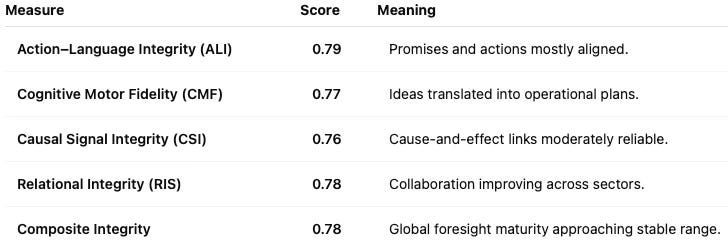
Interpretation
When every strategy office—public, private, academic, and civic—acts as a foresight node, global coordination improves. Plans align, data flows faster, and institutional learning becomes possible. Yet the same integration creates echo effects: foresight narratives circulate quicker than they are tested. The system has evolved from performative foresight to operational foresight but still falls short of predictive recursion—the ability to think through time rather than merely ahead of it.
Predictive recursion means foresight that continuously corrects itself in light of new evidence and moral reflection. In practice, it looks like a living feedback system: every forecast is logged, outcomes are measured, and discrepancies feed directly back into the model, strengthening both accuracy and integrity. When this loop becomes habitual, institutions stop treating foresight as a one‑off exercise and start operating as self‑learning organisms.
The ‘No Case Studies Yet’ Advantage
MindCast AI’s early stage is not a limitation but evidence that it defines a new category rather than replicating an old one. Instead of citing third‑party validation, this Vision Statement establishes the conceptual infrastructure for evaluating institutional foresight and provides a diagnostic framework that readers can apply immediately—whether or not they use MindCast AI. The ALI, CMF, and CSI metrics can be applied to any organization to reveal alignment, coherence, and trust gaps.
Synthetic Scenario — The Conscience in Simulation
Consider a mid‑sized financial institution navigating regulatory change. Traditional foresight processes flagged the policy shift six months ahead (standard horizon scanning). But their CDT revealed a 0.23‑point gap between stated risk appetite (conservative) and actual capital deployment (aggressive short‑term bets). This ALI breakdown predicted internal conflict before the board meeting where it erupted. The issue wasn’t lack of foresight—it was cognitive dissonance between strategy, incentives, and stated values. This example illustrates what the CDT reveals that conventional methods miss: foresight not just as anticipation, but as self‑diagnosis—the conscience of the institution in simulation.
Insight: When the world’s strategy departments learn to think together, foresight becomes memory. The next leap is to make that memory self-correcting.
XI. Conclusion — The Next Stage of Institutional Foresight
MindCast AI represents the next stage in the evolution of institutional foresight. It converts what began as a descriptive management concept into an integrated predictive cognitive system—one that allows organizations to perceive, reason, and act across time with measurable coherence. By embedding foresight integrity metrics within CDTs and the MAP CDT Flow, MindCast AI transforms the future from a guessing exercise into an auditable discipline.
For investors, policymakers, and organizational leaders, this Vision Statement offers a practical framework to evaluate resilience, alignment, and trust within decision architectures.
For Investors
Foresight integrity correlates with valuation resilience. Firms with higher coherence and verified causal modeling preserve trust and capital during volatility. Predictive cognitive foresight becomes a new form of due diligence—quantifying institutional adaptability as an asset.
For Policymakers
Cognitive Digital Twins prevent reactive governance by providing a continuous feedback system between policy intent and social outcome. They enable anticipatory regulation, allowing governments to simulate policy impact before implementation.
For Executives
Predictive cognitive foresight differs from existing business intelligence or analytics stacks by embedding self‑correction and moral calibration. It transforms data into a living decision architecture, aligning operations with long‑term purpose and trust.
It reveals how foresight becomes both a governance tool and an investment in coherence itself. As predictive cognitive systems mature, the institutions that master temporal literacy will define the ethical and strategic frontier of the AI age.
Insight: The future belongs to those who make foresight measurable, moral, and real.
Appendix
Stage of Development and Research Orientation
MindCast AI launched in April 2024. This Vision Statement reflects insights from over 200 institutional foresight simulations conducted across public, private, and civic sectors. As the predictive cognitive foresight category matures, independent validation of these frameworks will emerge. Until then, MindCast AI positions this document as a research program rather than a product pitch. It presents a testable hypothesis: that institutional decision quality correlates with cognitive integrity metrics (ALI, CMF, CSI). We invite institutional leaders, researchers, and policymakers to engage with these frameworks—whether or not they adopt the platform.
CDT Scoring Framework
MindCast AI’s Cognitive Digital Twin (CDT) scoring system provides a transparent, high‑level method for interpreting foresight integrity. Each CDT assessment uses three interlinked metrics:
Action–Language Integrity (ALI): Measures how faithfully language and stated intent correspond to observable actions.
Cognitive Motor Fidelity (CMF): Evaluates how effectively reasoning is converted into consistent and timely decisions.
Causal Signal Integrity (CSI): Tests the reliability of inferred cause‑and‑effect relationships.
Scores are normalized on a 0–1 scale and averaged to produce a composite integrity index. A threshold of 0.75 indicates the minimum level required for publication or operational release within MindCast AI. This appendix is not intended as technical proof but as a concise explanation anchoring the credibility and interpretive context of all foresight metrics used in this Vision Statement.