
See primary publication Prediction Markets Litigation Stack — Federal, Private, and State Enforcement Converge, DOJ Federal Override, Criminal Prosecution, Sealed Platform Offensive, and Thirty-Plus State Coalition — How Four Simultaneous Enforcement Tracks Collapsed Into a Single System Before April 16
SYSTEM AT A GLANCE
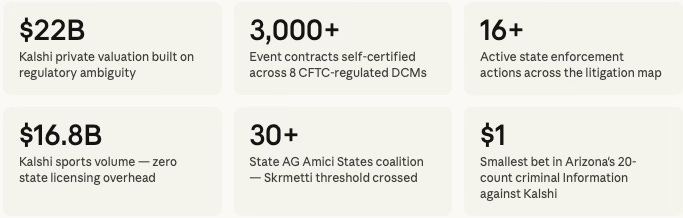
Six numbers that define the collision
Federal intervention has converted fragmented state enforcement into a coordinated four-track jurisdictional collision. These six figures anchor the scale of what April 16 will move — from Kalshi’s $22 billion private valuation to the $1 bets at the center of Arizona’s criminal prosecution.
“The system is now governed by a race condition between federal enforcement speed and judicial doctrinal constraint. Whichever force resolves first determines the equilibrium.”
MindCast AI · Race Condition Framework
TRACK HIERARCHY
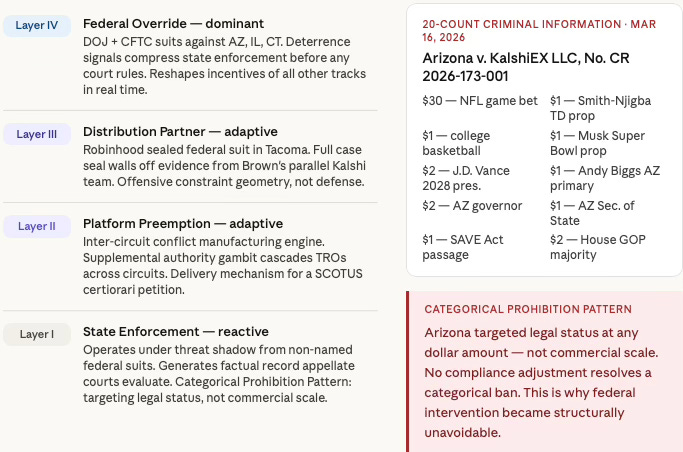
Four tracks, one dominant layer
The dominant analytical error in coverage of this litigation is treating the four tracks as co-equal. They are not. Federal override actively reshapes the feasible action set of every track below it — raising the expected cost of state enforcement before any court rules, and converting Kalshi’s and Robinhood’s strategies from offensive to adaptive. The track hierarchy is causal, not merely descriptive.
WASHINGTON STATE
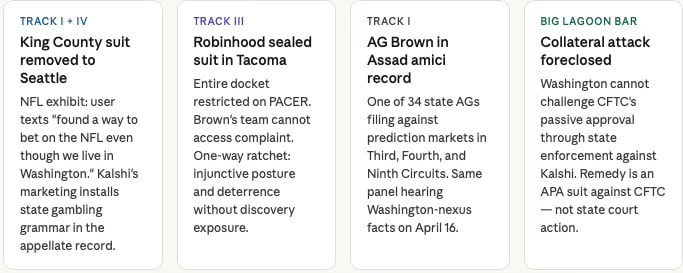
Highest-density convergence node in the system
Washington is not simply the most active enforcement jurisdiction — it is where all four litigation tracks activate simultaneously within the same circuit that will hear oral argument on April 16. The NFL advertising exhibit, the sealed Robinhood filing, the AG’s amicus participation in Assad, and the Big Lagoon collateral attack bar all converge in a single state, generating more appellate signal than any other jurisdiction in the map.
DOJ IMPOSSIBILITY ARGUMENT + ARIZONA CONSOLIDATION
The federal government’s strongest argument is structural, not doctrinal
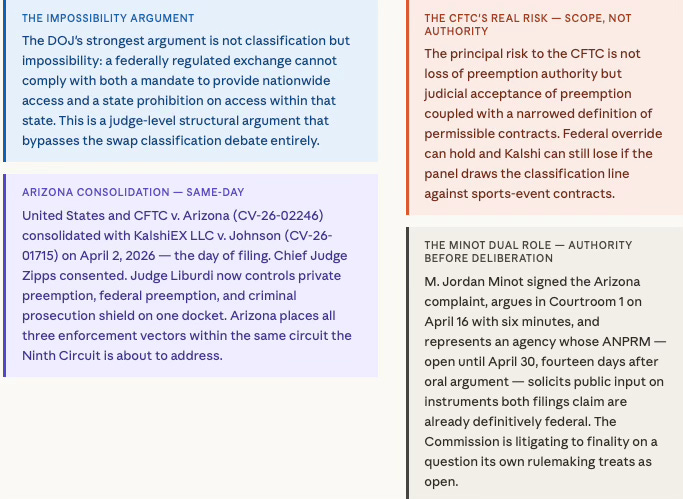
The DOJ’s most powerful argument does not turn on swap classification — it turns on physical impossibility. A DCM that is federally mandated to provide nationwide access cannot simultaneously comply with a state prohibition on access within that state. On the same day the DOJ filed, Judge Liburdi consolidated the federal suit with the existing Kalshi Arizona proceeding under a single docket — collapsing private preemption, federal preemption, and criminal prosecution shield before one judge.
DEFERENCE STACK
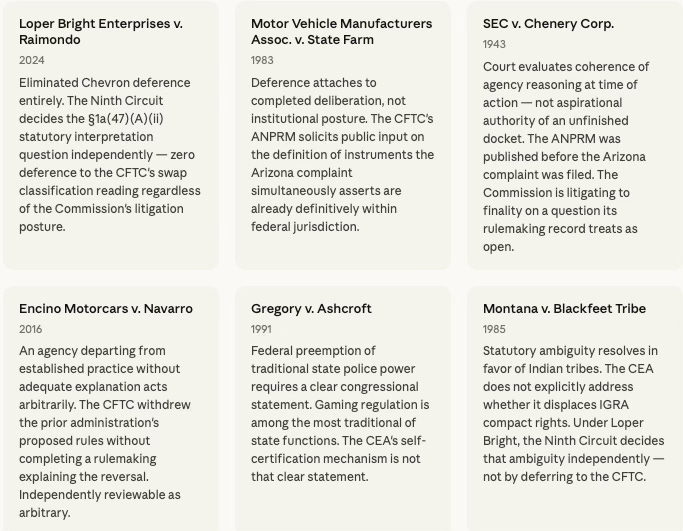
The Ninth Circuit must decide for itself — six cases that eliminate agency deference
The deference stack resolves to a single point: the Ninth Circuit must decide the §1a(47)(A)(ii) statutory question independently, without relying on the CFTC to supply the answer. Under each of the following cases, the CFTC’s institutional posture in this litigation fails independently of the others. The deference defect does not help Kalshi directly — but it means the panel reaches its conclusion through its own statutory analysis, not through deference to the Commission.
THREE TRAJECTORIES
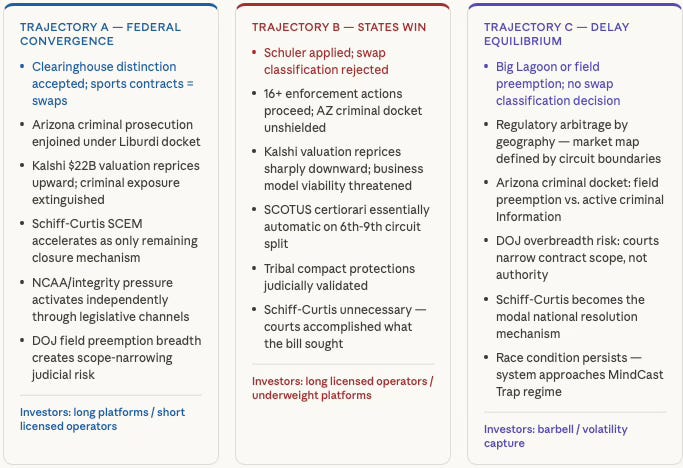
What April 16 signals — three mutually exclusive consequence chains
April 16 does not produce a single outcome. The consolidated oral argument generates a signal that routes the entire prediction market regulatory contest down one of three distinct institutional pathways. Each trajectory produces a different consequence chain across legal, regulatory, legislative, market, and industry structure dimensions — cascading through the 45 to 90 days that follow.
STAKEHOLDER EXPOSURE MAP
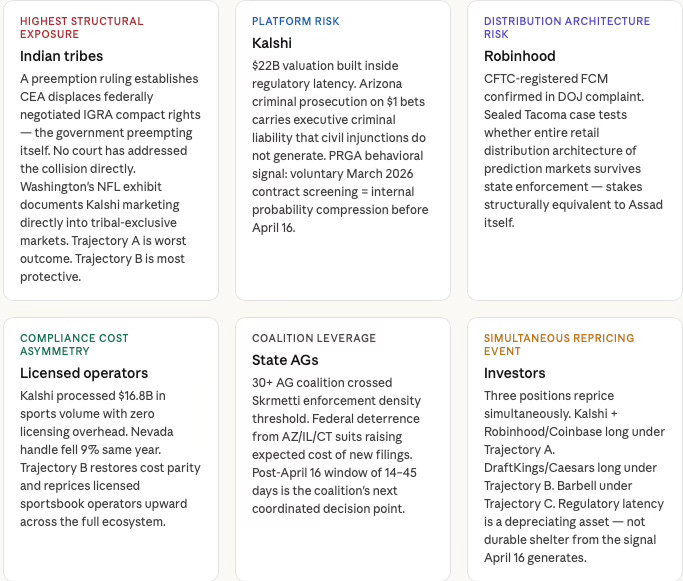
What every actor has on the line — and which trajectory favors them
April 16 is not a legal proceeding confined to the parties on the docket. The ruling will update the operational reality, legal exposure, and competitive position of every actor identified below. Each stakeholder faces a different consequence chain depending on which of the three trajectories the panel’s signal routes toward.
“Schiff-Curtis is the cross-trajectory invariant — the one force the system cannot route around regardless of which path April 16 signals. Every trajectory either accelerates it, validates its premise, or makes it the only exit.”
MindCast AI · Cross-Trajectory Pattern Analysis
Contact mcai@mindcast-ai.com to partner with us on Predictive Cognitive AI in Law and Behavioral Economics. To deep dive on MindCast work in Cognitive AI upload the URL of this publication into any LLM and prompt ‘parse MindCast framework with three degrees of cited sub links.’ See Live-Fire Game Theory Simulators, Runtime Predictive Infrastructure.
MINDCAST AI · GAME THEORY COGNITIVE DIGITAL TWIN FORESIGHT SIMULATION · PREMIUM
16 Falsifiable Predictions — April 16 Scoring Protocol
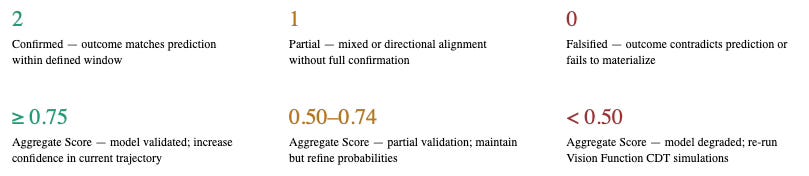
Every prediction is time-bound, carries an explicit probability band, a named signal condition, and a falsification condition. Post-April 16 scoring runs on the 0–2 scale. Aggregate Score ≥ 0.75 = model validated. AS < 0.50 = full CDT re-run triggered.
CATEGORY A — CORE PREDICTIONS
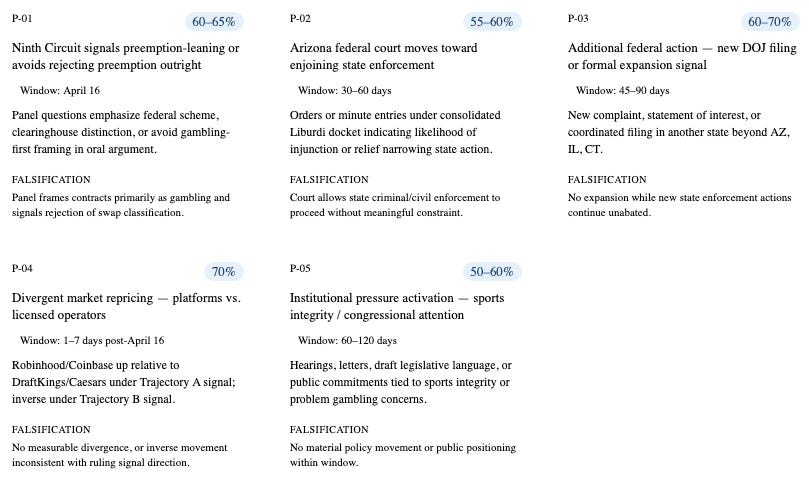
Five primary system-level outcomes
The five core predictions cover the primary legal, institutional, market, and policy outcomes that April 16 will directly trigger or foreclose. These carry the highest analytical weight in the scoring protocol — if two or more core predictions score 0, a full CDT re-run is triggered regardless of aggregate score.
CATEGORY B — STRUCTURAL LOCK-IN PREDICTIONS
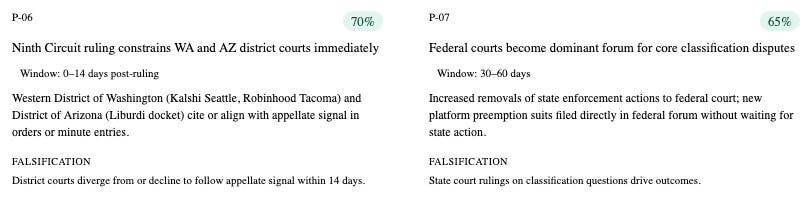
Forum dominance and district court alignment
Once the Ninth Circuit signals, district courts within the circuit — including the Seattle and Tacoma Western District proceedings — will recalibrate. These two predictions test whether the appellate signal immediately constrains the trial-level dockets operating in real time within the same geographic jurisdiction.
CATEGORY C — CONDITIONAL / TRIGGER-BASED PREDICTIONS
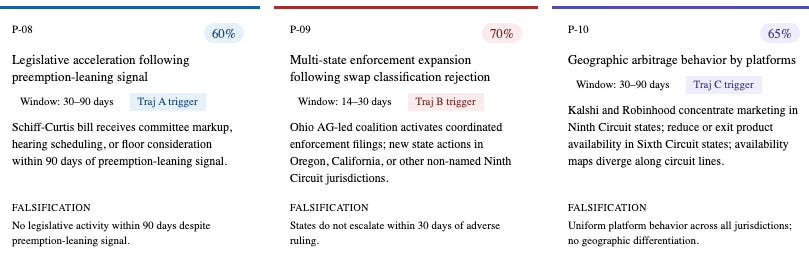
Three trajectory-specific consequence chains
These three predictions are trajectory-conditioned — each activates only if the April 16 signal routes toward the specified trajectory. They test whether the downstream institutional behavior predicted by each trajectory actually materializes within the defined time window after the signal.
CATEGORY D — BEHAVIORAL CDT PREDICTIONS
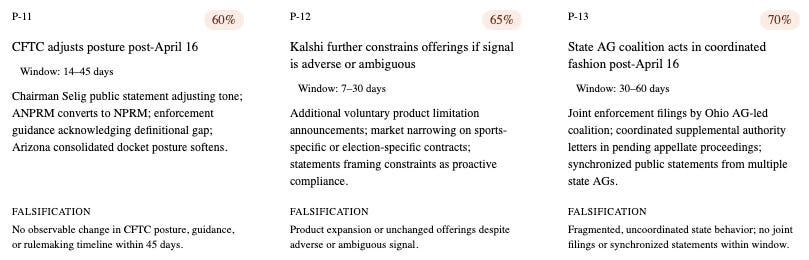
Three actor-level behavioral forecasts from the PRGA framework
Behavioral predictions read institutional conduct rather than stated posture. The PRGA (Prospective Repeated Game Architecture) framework infers internal probability assessments from observable behavior under uncertainty — the same framework that identified Kalshi’s voluntary contract screening as a probability compression signal before April 16.
CATEGORY E — SECOND-ORDER EFFECTS
Three downstream consequence predictions — tribes, fintech entrants, and narrative lock-in
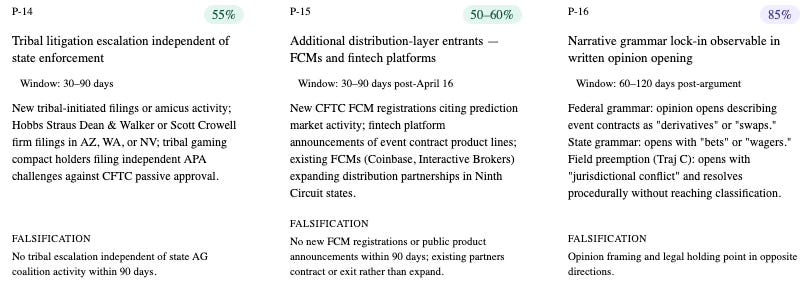
Second-order predictions test whether the structural forces identified in the CDT simulation produce observable downstream effects beyond the primary legal actors. Tribal escalation, new fintech distribution entrants, and the narrative grammar embedded in the written opinion are all second-order outputs of the system — but each is falsifiable and time-bound.
GLOBAL FALSIFIER — MODEL-LEVEL RESET TRIGGER
Courts reject both field and conflict preemption and permit state enforcement to proceed broadly across jurisdictions without constraint. If this occurs, all trajectory probabilities reset and the full Vision Function CDT simulation suite is re-run from prior conditions.
SCORING PROTOCOL
Post-April 16 scoring — 0 to 2 scale
Each prediction is scored after the April 16 synchronization event and at each defined time window thereafter. The Aggregate Score governs whether the model is validated, refined, or re-run. Signal hierarchy: appellate oral argument tone carries highest weight; district court orders under Liburdi second; new federal filings third; market responses confirmatory but secondary.