


Select related publications: Kalshi’s Prediction Market Litigation Architecture | The National Kalshi Prediction Market Litigation Map | The Full Arc of Prediction Markets | Prediction Markets and the Regulatory Split | Kalshi Found the One Gap in American Gaming Law Nobody Closed | Kalshi, Prediction Markets and the Conflict Architecture of Regulation | Prediction Markets Litigation Stack — Federal, Private, and State Enforcement Converge
Due to the complexity of this publication, MindCast created a Visual Companion document.
Executive Summary
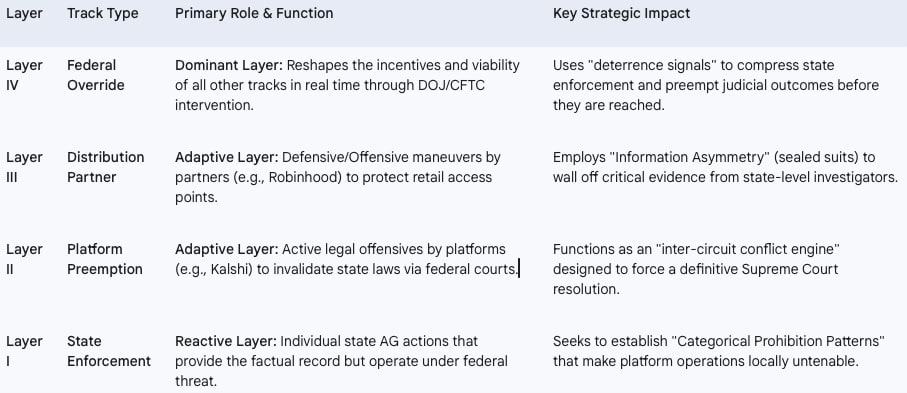
Federal intervention has converted fragmented state enforcement into a coordinated, multi-layer jurisdictional collision. Four simultaneous litigation tracks now interact: state enforcement against platforms, platform preemption offensives, distribution-partner preemptive suits executed on the Massachusetts model, and direct federal override actions led by the Department of Justice and the Commodity Futures Trading Commission (CFTC) — the federal agency that regulates derivatives markets and holds statutory exclusive jurisdiction over designated contract markets. These tracks are not co-equal. Federal override operates as the dominant layer, reshaping the incentives and viability of both platform and state strategies in real time. The remaining tracks are adaptive or reactive responses to that dominant layer.
This publication extends MindCast: Conflict Architecture of Regulation with four developments that postdate that publication: the DOJ’s April 2, 2026 offensive federal suits against Arizona, Illinois, and Connecticut; the Arizona 20-count criminal Information charging Kalshi on bets as small as $1 including four election wagering counts; the same-day consolidation order placing private preemption, federal preemption, and criminal prosecution shield before a single judge under Chief Judge Zipps’s consent; and the Robinhood preemptive sealed federal suit in Tacoma executing the Massachusetts model inside the Ninth Circuit’s own geographic jurisdiction. Beyond new facts, this publication introduces three analytical additions absent from the prior corpus: explicit track hierarchy analysis establishing federal override as the dominant layer that actively reshapes the feasible action set of every other track; the impossibility preemption argument as the DOJ’s structurally strongest hook independent of swap classification; and the federal overbreadth risk showing how the breadth of the DOJ’s field preemption theory creates a countervailing judicial risk that routes toward Trajectory C regardless of whether preemption authority holds.
Washington State crystallizes the full architecture in a single geography. AG Nick Brown sued Kalshi in King County Superior Court on March 28. Three days later, Robinhood sued Washington in federal court (GeekWire), arguing the state cannot use gambling laws to shut down event-contract trading authorized under federal commodities law. The federal government then filed United States and CFTC v. State of Arizona et al., Case No. 2:26-cv-02246-MTL, on April 2, 2026 — and Judge Michael T. Liburdi consolidated it same-day into the existing Kalshi Arizona litigation under KalshiEX LLC v. Johnson, No. CV-26-01715-PHX-MTL, as lead case. Chief Judge Jennifer G. Zipps and Magistrate Judge Deborah M. Fine both consented. One judge now controls the private preemption suit, the federal preemption suit, and the criminal prosecution shield simultaneously. Arizona AG Kris Mayes had filed Arizona v. KalshiEX LLC, No. CR 2026-173-001, a 20-count criminal Information on March 16, 2026 — including four election wagering counts and individual bets as small as $1. Criminal prosecution of a federally licensed Designated Contract Market is categorically distinct from civil enforcement and represents the sharpest escalation in the enforcement landscape to date.
Race Condition The system is now governed by a race condition between federal enforcement speed and judicial doctrinal constraint. Whichever force resolves first determines the equilibrium. April 16 does not resolve that race — it produces the first synchronized signal that downstream courts, regulators, and market participants will use to recalibrate in real time.
What Every Stakeholder Has on the Line
April 16 is not a legal proceeding confined to the parties on the docket. The ruling will update the operational reality — and in some cases the valuation, the legal exposure, or the competitive position — of every actor identified below. Readers who need to understand why this 25-page document matters to them specifically should start here.
Investors holding prediction market platform exposure face the most acute near-term repricing event in the sector. Kalshi carries a $22 billion private valuation built on regulatory ambiguity. Robinhood and Coinbase carry indirect exposure through prediction market distribution partnerships launched before the legal question resolved. A ruling against preemption does not produce a temporary market reaction — it produces a structural transition. The compliance cost asymmetry that has allowed prediction market platforms to operate without state licensing overhead, problem gambling compliance costs, or tribal compact obligations collapses under Trajectory B. Three distinct equity positions reprice in opposite directions within days of the signal. Section IX maps each position. The premium section provides the investor positioning matrix.
Licensed casino and sportsbook operators — DraftKings, FanDuel, Caesars, and the Nevada casino infrastructure — are losing market share to a competitor that has operated without their regulatory overhead. Nevada’s sports betting handle fell 9% in the year Kalshi processed $16.8 billion in sports volume nationally. A preemption ruling that holds extends that asymmetry indefinitely. A ruling that rejects swap classification restores competitive parity and reprices the licensed operator sector upward. The difference between those two outcomes runs directly through April 16.
Indian tribes face the most structurally underappreciated exposure in this litigation. A ruling that holds federal preemption does not merely override state gambling regulators — it establishes that the CEA’s exclusive jurisdiction provision operates as a federal override of federally negotiated tribal gaming compact rights under the Indian Gaming Regulatory Act. The federal government would be using one statute to displace rights it created and guaranteed through another. No court has addressed that implication directly. Washington State’s lawsuit includes an exhibit of Kalshi’s own advertisement marketing its platform as a workaround for Washington consumers who cannot legally bet on NFL games — markets that exist exclusively to protect tribal compact exclusivity. Section IX explains the three-layer sovereign legal argument tribes can deploy independently of the swap classification question.
State attorneys general and enforcement staff face a compressed decision window. The thirty-plus state AG coalition that filed the Amici States brief has crossed the enforcement density threshold at which coordinated state action can break a federal capture-stable regulatory equilibrium. Federal suits against Arizona, Illinois, and Connecticut have raised the expected cost of new state enforcement filings — the dominant federal layer is reshaping state options before any court rules. The post--April 16 window of 14 to 45 days is when the coalition’s next coordinated move will be decided. Section IX and the premium prediction table specify exactly what signals to watch and when.
Platform operators and their distribution partners — Kalshi, Robinhood, and the fintech companies routing event contracts through CFTC-regulated exchanges — face a ruling that will either validate years of legal architecture or collapse it simultaneously across twenty-plus active enforcement actions. Kalshi’s own conduct before April 16 — voluntarily accepting behavioral constraints no court ordered — is the most credible evidence that internal probability of the upside preemption case has contracted. The premium section explains what that behavioral signal means for valuation.
The CFTC faces an institutional credibility test independent of the legal outcome. The Commission filed an amicus brief asserting exclusive jurisdiction over prediction markets while simultaneously publishing a public notice asking the public to help it define those same markets. A panel exercising independent judicial review under the Supreme Court’s 2024 decision eliminating agency deference will decide the statutory question itself — without deferring to the Commission. How the CFTC navigates the post April 16 window determines whether it emerges from this litigation as an autonomous regulatory authority or a captured institution defending a platform it approved through inaction.
Contact mcai@mindcast-ai.com to partner with us on Predictive Law and Behavioral Economics + Game Theory Foresight Simulations. To deep dive on MindCast work in Cybernetic Foresight Simulations upload the URL of this publication into any LLM and prompt ‘reconstruct MindCast framework with three degrees of cited sub links.’ See Live-Fire Game Theory Simulators, Runtime Predictive Infrastructure.
Recent projects: MindCast AI Emergent Game Theory Frameworks | Google’s Deep-Thinking Ratio Measures Effort, Not Structure | The Cognitive AI Response to Apple’s “The Illusion of Thinking | Triadic Calibration and the Acceleration of Metacognition| The Runtime Causation Arbitration Directive | Runtime Geometry, A Framework for Predictive Institutional Economics
I. The Track Hierarchy Not All Layers Are Equal
Four litigation tracks now operate simultaneously. The dominant analytical error in coverage of this litigation is treating the tracks as parallel and co-equal. They are not. Applying the MindCast: Cybernetic Game Theory: Control, Not Choiceconstraint geometry framework, the tracks operate in a strict functional hierarchy where the dominant layer actively reshapes the feasible action set of every layer below it. Federal override is not simply adding pressure — it is restructuring the game.
Track Hierarchy Federal override → dominant layer. Reshapes incentives and viability across all other tracks in real time. Platform preemption + distribution-partner suits → adaptive layer. Respond to and exploit federal posture. State enforcement → reactive layer. Resisting, but operating under active threat shadow from non-named federal suits.
Federal filings against Arizona, Illinois, and Connecticut function not only as direct challenges but as deterrence signals to non-named states — raising the expected cost of continued enforcement across the entire network. Washington, Nevada, and Ohio are litigating under the shadow of additional federal suits that could drop at any time. The deterrence effect operates independently of whether additional suits materialize. The pattern maps to the Regulatory Bypass architecture identified in MindCast: Senators, Compass, and the Regulatory Bypass operating in reverse: instead of a private actor routing around enforcement, the federal government is routing around state enforcement by raising its cost before litigation concludes.
System Implication Federal deterrence compresses state enforcement before any court rules. The dominant layer is reshaping the reactive layer without a single additional ruling. States that were considering new enforcement actions face a higher expected cost calculation than the pre-DOJ environment generated. The constraint geometry has already narrowed — independent of April 16.
Litigation Track Architecture
II. Washington State Highest-Density Convergence Zone
Why Washington Is the System’s Highest-Density Node
Washington is not simply the most active enforcement jurisdiction — it is the system’s highest-density convergence node, where all four litigation tracks activate simultaneously within the same circuit that will hear oral argument on April 16. The MindCast AI Proprietary CDT framework from MindCast: Conflict Architecture of Regulation treats convergence nodes as the system’s primary signal-generating events. Washington generates more simultaneous signals than any other jurisdiction in the map:
WA AG Nick Brown sued Kalshi in King County Superior Court (Mar 28). The complaint (Washington State Standard) documents Kalshi routing users through its own affiliate when no counterparty is available — meaning users cannot determine whether they are trading against another person or the company itself. The complaint also includes the NFL advertising exhibit: a Kalshi message in which a user texts another that they “found a way to bet on the NFL even though we live in Washington.” Washington reserves legal NFL wagering exclusively to tribal sportsbooks under Indian Gaming Regulatory Act (IGRA) compact rights — federal agreements negotiated between the United States and tribal nations that define the scope of tribal gaming exclusivity. Kalshi’s own marketing document transforms from a consumer protection violation into systemic evidence: a federally licensed platform used one federal statutory framework to extract revenue from markets a second federal framework had reserved for tribal sovereign economic development. Complaint removed to federal court in Seattle.
Robinhood filed a preemptive federal suit in Tacoma (Mar 30) (GeekWire) — Case No. 3:2026cv05311 (W.D. Wash.), under full case seal; entire docket restricted on PACER; represented by Davis Wright Tremaine and Cravath, Swaine & Moore; seeking permanent injunction three days after Brown sued Kalshi, executing the Massachusetts model (Covers.com). The full case seal — not merely document-level sealing — is itself a strategic architecture move: Robinhood gets injunctive relief posture and deterrence while keeping its evidentiary content walled off from Brown’s parallel Kalshi enforcement team.
Washington AG is an active participant in the Assad Amici States brief — one of 34 state AGs who submitted an amicus brief supporting Maryland’s attempt to restrict prediction markets before the Third Circuit; has filed similar briefs in the Fourth and Ninth Circuits. The same panel hearing Washington-nexus facts on April 16 has Washington’s AG arguing against preemption in its own amicus record.
The Big Lagoon Rancheria v. California (9th Cir. en banc) collateral attack bar is immediately in play. Washington cannot collaterally attack the CFTC’s passive approval of Kalshi’s self-certification through enforcement proceedings against Kalshi. Washington’s remedy under Big Lagoon is an APA suit against the CFTC — not a state court enforcement action against Kalshi. Washington staked out the broadest enforcement position of any state: all event contracts are illegal, not just sports bets. Other states have focused on sports-related contracts specifically. Washington’s broader position maximizes the Big Lagoon exposure.
The convergence node pattern identified in MindCast: National Litigation Map predicts that high-density nodes generate more appellate signal than any individual proceeding. Washington generates signal on tribal compact rights, distribution-partner liability, state enforcement scope, and the sealed complaint architecture — four distinct analytical inputs to the April 16 panel’s record — in a single jurisdiction.
III. Layer I State Enforcement Against Platforms
The Removal Asymmetry
State enforcement creates the factual record appellate courts evaluate. What is frequently missed in coverage of this litigation is that state enforcement does not need to win on the merits to shape the outcome — it needs only to generate the record that appellate courts read before oral argument. The MindCast: National Litigation Map established the removal asymmetry: Kalshi removes state cases to federal court, cascades favorable federal rulings back as supplemental authority, and accumulates circuit-level authority before any state court has issued a final judgment. State enforcement is not trying to win in state court. State enforcement is trying to generate evidentiary record before removal.
Arizona established the enforcement ceiling. AG Mayes filed Arizona v. KalshiEX LLC, No. CR 2026-173-001, a 20-count criminal Information on March 16, 2026 — betting and wagering (16 counts under A.R.S. § 13-3305) and election wagering (4 counts under A.R.S. § 16-1015). The bet amounts are analytically significant: a $30 NFL Commanders-Giants game bet; a $1 Oklahoma State-Arizona basketball bet; a $1 Jaxon Smith-Njigba first touchdown Super Bowl prop; a $1 Elon Musk Super Bowl attendance prop; a $2 J.D. Vance 2028 presidential election bet; a $2 Republican 2026 Arizona governor bet; a $1 Andy Biggs 2026 Republican gubernatorial primary bet; a $1 Democratic candidate 2026 Arizona Secretary of State bet; a $1 SAVE Act passage bet. Arizona did not target commercial scale. Arizona targeted legal status itself at any dollar amount. That is the Categorical Prohibition Pattern — the enforcement theory that makes federal preemption stakes existential rather than operational, because no compliance adjustment resolves a categorical ban. This is precisely why the United States and CFTC v. Arizona complaint identifies the criminal prosecution as the precipitating event: a categorical state criminal prohibition of a federally licensed product category cannot coexist with federal DCM authorization, making federal intervention structurally unavoidable.
Arizona Criminal Escalation — The Categorical Prohibition Pattern The four election wagering counts cover the 2028 presidential race, 2026 Arizona gubernatorial race, 2026 Arizona Republican gubernatorial primary, and 2026 Arizona Secretary of State race. The CFTC withdrew its proposed rules on political event contracts in February 2026 without a completed rulemaking explaining the reversal. The federal government now asks courts to preempt Arizona’s election wagering statute on behalf of contracts the Commission itself declined to definitively authorize through completed rulemaking. Election contract preemption is analytically distinct from sports contract preemption — and the deference defect is sharpest precisely where the criminal charges are most politically sensitive. A $1 bet on J.D. Vance winning the 2028 presidential election is a federally licensed event contract and a criminal act under Arizona law simultaneously. That jurisdictional impossibility is the system’s most acute collision point.
Implication for Kalshi’s Preemption Prospects Criminal prosecution in Arizona elevates the stakes of Trajectory B beyond civil enforcement exposure. A ruling that sports-event contracts are not swaps leaves Kalshi facing not just civil injunctions but an active criminal docket. The Arizona criminal escalation is the strongest argument for why the federal government had to act — and the strongest argument for why the April 16 panel’s ruling carries consequences that extend well beyond the Ninth Circuit.
IV. Layer II Platform Preemption Offensive
Kalshi’s litigation strategy is not defensive---it is a designed inter-circuit conflict manufacturing engine, documented in MindCast: Federal Strategy. Layer one files preemptive federal suits before state courts establish controlling precedent. Layer two cascades favorable rulings as supplemental authority---the Tennessee TRO entered the appellate record in Nevada, New Jersey, Maryland, and Ohio before those states could respond, executing the supplemental authority gambit at institutional scale. Layer three accumulates circuit-level authority until the inter-circuit conflict is irresolvable. Kalshi is not litigating to win the existing rule. Kalshi is litigating to force the question to the one court where its statutory argument---that Congress enacted a broad swap definition and did not exclude gaming-related event contracts---has the best chance of prevailing. The litigation architecture is a delivery mechanism for a Supreme Court certiorari petition.
The clearinghouse distinction is Kalshi’s strongest structural argument and the panel’s cleanest available exit. Swaps traded on Designated Contract Markets (DCMs)---the federally licensed exchanges regulated by the CFTC---involve clearinghouses---federally regulated entities that guarantee trade performance and manage financial risk between parties. Sports wagers placed through sportsbooks do not. The CFTC’s own 2012 Further Definition of “Swap” rulemaking, 77 Fed. Reg. 48,208, drew that line explicitly: instruments traded on organized markets with clearinghouse involvement are swaps; customary consumer transactions not traded on organized markets with financial entities are not. Nevada’s own appellate brief concedes that sports bets do not involve risk-shifting arrangements with financial entities. The United States and CFTC v. Arizona complaint confirms the ecosystem scope: eight CFTC-regulated DCMs have collectively self-certified more than 3,000 event contracts under 17 C.F.R. § 40.2. A ruling against preemption does not affect one platform’s sports contracts---it disrupts a 3,000-contract ecosystem across eight federally licensed exchanges. The panel is deciding whether the entire federally licensed event contract ecosystem survives state enforcement.
Big Lagoon Rancheria v. California (9th Cir. en banc) is Kalshi’s procedural shield against the collateral attack problem. A state cannot challenge a federal agency’s decision through enforcement proceedings against the regulated entity. Kalshi self-certified its sports-event contracts as swaps under 17 C.F.R. § 40.2(a)(2). The CFTC reviewed and did not disapprove---passive approval became effective the next business day. Nevada’s attempt to challenge that approval through state enforcement is precisely what Big Lagoon forecloses. Nevada’s remedy is an APA suit against the CFTC. Kalshi’s preemption architecture was designed to be structurally impervious to state-by-state challenge---the self-certification mechanism, CFTC exclusive jurisdiction, and Big Lagoon form an interlocking defense that operates at the level of statutory structure and administrative procedure, not regulatory merit.
The Prospective Repeated Game Architecture---PRGA, a behavioral inference framework that reads private probability assessments from observable platform conduct rather than stated litigation posture---was developed in MindCast: Conflict Architecture of Regulation, provides the most credible read on Kalshi’s internal probability assessment: Kalshi’s voluntary March 2026 contract screening---accepting behavioral constraints without a court order---reveals that internal probability of the upside preemption case contracted below the strategic threshold at which continued delay generates positive expected value. Platforms genuinely confident in their preemption theory do not accept self-imposed operational constraints before a court orders them. Behavioral deviation under uncertainty reveals more than litigation posture under advocacy. Kalshi’s own conduct, not Nevada’s briefs, provides the most credible evidence that the platform’s internal assessment of April 16 is less optimistic than its public filings suggest.
Implication for Kalshi’s Preemption Prospects Kalshi wins on the clearinghouse structural argument or not at all. A panel willing to draw that boundary rules for Kalshi on swap classification. A panel that finds surface resemblance to gambling controls over structural difference routes to the states. The PRGA behavioral signal indicates internal probability compression before the court has acted. Kalshi’s litigation architecture was built to manufacture the circuit split that produces certiorari---April 16 tests whether that architecture survives contact with a coordinated Ninth Circuit panel.
V. Layer III Distribution-Partner Preemption: The Robinhood Offensive
Layer III is the most underanalyzed track in coverage of this litigation — and the one that most directly expands the systemic stakes. The standard framing treats the Robinhood suit as a defensive move by Kalshi’s distribution partner. The correct framing, applying the MindCast: Cybernetic Game Theory: Control, Not Choice delay dominance function, is that Layer III is an offensive constraint geometry expansion: Robinhood is not defending against enforcement, it is opening a second federal front in the same circuit as Assad before Washington can establish any state precedent. The Massachusetts model — documented in MindCast: National Litigation Map — is now executing in the Ninth Circuit, the circuit that matters most.
Robinhood filed a preemptive federal suit against Washington’s AG and gambling commission on March 30 (King5), arguing the state cannot use gambling laws to shut down event-contract trading authorized under federal commodities law. Robinhood routes sports-related event contracts through Kalshi and other event contracts through Kalshi and ForecastEx. United States and CFTC v. Arizona confirms Robinhood’s federal regulatory status: Robinhood Derivatives LLC is a CFTC-registered Futures Commission Merchant (FCM) — a federally licensed intermediary that routes customer trades through CFTC-regulated exchanges — designated November 23, 2010, offering event contract swaps in partnership with DCMs. Robinhood plans to expand to a third exchange, Rothera, later in 2026 — meaning its Washington exposure will compound as the sealed case proceeds.
The full case seal is analytically distinct from a document-level seal. Under full case sealing, the entire docket is restricted on PACER — not merely individual documents. Washington AG Brown’s office cannot access the Robinhood complaint through normal PACER monitoring. Brown’s team does not know what internal metrics, platform data, or legal theories Robinhood disclosed in the sealed filing. The sealing prevents Washington from using the Robinhood complaint to strengthen its parallel Kalshi proceeding. The filing is a one-way ratchet: Robinhood gets injunctive relief posture and deterrence while its evidentiary content is walled off from the state’s enforcement team. The pattern (Covers.com) also mirrors Massachusetts: after an initial federal dismissal as premature, the dispute revived in January 2026 following Robinhood’s expansion to ForecastEx (NEXT.io) — establishing that distribution-partner suits survive and compound as platform partnerships expand.
The systemic implication most frequently missed: if state enforcement reaches Robinhood as a CFTC-registered FCM, every retail financial platform offering prediction market products through a DCM partnership faces the same exposure. Layer III does not just protect Robinhood. Layer III is the test case for whether the entire distribution architecture of prediction markets — every Coinbase integration, every fintech partnership, every retail access point — survives state enforcement. The stakes of the sealed Tacoma proceeding are structurally equivalent to the stakes of Assad itself.
A parallel case in New Jersey is closely tied to KalshiEx LLC v. Flaherty, currently before the Third Circuit — adding a third circuit to the distribution-partner preemption question before the Ninth Circuit has even ruled.
Implication for April 16 The Ninth Circuit panel ruling on KalshiEX LLC v. Assad knows both proceedings — the removed Kalshi complaint in Seattle and Robinhood’s sealed suit in Tacoma — sit in its geographic jurisdiction. A ruling against preemption narrows Kalshi’s Washington operations and immediately threatens Robinhood’s distribution model in the same state. A ruling for preemption governs both simultaneously. The panel cannot rule on Assad without implicitly ruling on the regulatory architecture that governs every downstream distribution partner in the prediction market ecosystem.
VI. Layer IV Federal Override: DOJ, the Arizona Consolidation, and the Deference Defect
The DOJ and CFTC jointly filed United States and CFTC v. State of Arizona on April 2, 2026, seeking declaratory and injunctive relief under the Supremacy Clause across three counts: express preemption under 7 U.S.C. § 2(a)(1)(A) of Arizona’s event wagering statutes (Count I), field and obstacle preemption of the Arizona Criminal Code as applied to DCMs (Count II), and preemption of the election wagering statute A.R.S. § 16-1015 (Count III). The complaint deploys a legislative history spanning 1921 through Dodd-Frank 2010, documenting that Congress explicitly preempted state regulation at each expansion of CFTC jurisdiction — because concurrent state regulation could lead to “total chaos.” 120 Cong. Rec. S 30458, 30464 (Sept. 9, 1974). The impossibility preemption argument is the complaint’s sharpest structural hook: DCMs are federally required to provide impartial national access under 17 C.F.R. § 38.151(b) — making a state ban structurally impossible to comply with alongside federal mandates. The DOJ’s strongest argument is not classification but impossibility: a federally regulated exchange cannot comply with both a mandate to provide nationwide access and a state prohibition on access within that state.
On the same day, Judge Michael T. Liburdi consolidated United States and CFTC v. Arizona (CV-26-02246) with KalshiEX LLC v. Johnson (CV-26-01715) under the Kalshi case as lead. Chief Judge Jennifer G. Zipps and Magistrate Judge Deborah M. Fine both consented. The consolidation happened on the same day as the DOJ filing — which means either the DOJ anticipated and requested consolidation at filing, or Judge Liburdi moved immediately upon seeing the related case designation on the civil cover sheet. Either interpretation signals extraordinary institutional coordination. One judge now controls Kalshi’s private preemption claim, the United States’ federal preemption claim, and authority to enjoin Arizona’s criminal prosecution — all in a single consolidated docket. The chief judge’s personal consent signals institutional awareness that this proceeding carries exceptional systemic significance. Arizona places active federal enforcement, criminal prosecution, and private preemption within the same circuit the Ninth Circuit is about to address — collapsing the distinction between trial-level facts and appellate doctrine.
The Minot Dual Role — Authority Exercised Before Deliberation Completed M. Jordan Minot, CFTC Deputy General Counsel, signed United States and CFTC v. Arizona as lead CFTC counsel and will argue in Courtroom 1 on April 16 with six minutes of allocated argument time. One attorney: offensive federal litigator against Arizona’s criminal prosecution, Ninth Circuit appellate amicus arguing CFTC exclusive jurisdiction, and representative of an agency whose ANPRM — published March 16, 2026, closing April 30 (fourteen days after oral argument) — actively solicits public input on how to define and regulate the instruments both filings claim are already within exclusive federal authority. Chairman Selig publicly characterized his predecessor’s approach as lacking “rational and coherent” grounding — an internal CFTC disagreement the panel reads directly from the record. The defining diagnostic identified across the MindCast Kalshi corpus runs through both: authority exercised before deliberation completed. Not corruption. Not bad faith. The institutional signature of an agency that asserted a final answer before supplying the reasoning the deference standard requires. Under Chenery and State Farm, courts evaluate coherence of agency reasoning at the time of the action. The ANPRM was published before the Arizona complaint was filed. The Commission is litigating to finality on a statutory question its own rulemaking record treats as open.
The CFTC’s Real Risk — Scope, Not Authority The principal risk to the CFTC is not loss of preemption authority but judicial acceptance of preemption coupled with a narrowed definition of permissible contracts under a “gaming” constraint. United States and CFTC v. Arizona asserts preemption for all event contracts — sports, elections, climate, economics. A court that holds the CEA preempts state gaming authority but simultaneously holds that sports-event contracts do not qualify as swaps under § 1a(47)(A)(ii) leaves the CFTC with jurisdiction over the category but without the statutory hook that makes Kalshi’s specific products lawful. Election contract preemption is the sharpest edge: the CFTC withdrew its proposed rules on political event contracts in February 2026 without completing a rulemaking explaining the reversal. Federal override can hold and Kalshi can still face criminal liability on election counts. Under Loper Bright Enterprises v. Raimondo (2024), the Ninth Circuit decides the § 1a(47)(A)(ii) question independently — zero deference to the CFTC’s swap classification reading. The Commission’s amicus brief argues for a result the deference doctrine no longer supports.
The Deference Stack
The deference stack resolves to a single point: the Ninth Circuit must decide the statutory question itself, without relying on the CFTC to supply the answer. The full doctrinal architecture establishing that conclusion is developed in MindCast: Conflict Architecture of Regulation establishes the full doctrinal architecture. Under each of the following cases, the CFTC’s institutional posture in this litigation fails independently of the others:
Loper Bright Enterprises v. Raimondo (2024) — Eliminated Chevron deference entirely. The Ninth Circuit decides the § 1a(47)(A)(ii) statutory interpretation question independently. The Commission’s amicus brief argues for a result the deference doctrine no longer supports.
Motor Vehicle Manufacturers Association v. State Farm (1983) — Deference attaches to completed deliberation, not institutional posture. The CFTC’s ANPRM solicits public input on the definition of instruments the Arizona complaint simultaneously asserts are already definitively within federal jurisdiction. An agency asserting a final answer while its own rulemaking record invites contradiction has not completed the deliberation the standard requires.
SEC v. Chenery Corp. (1943) — Court evaluates coherence of agency reasoning at time of action — not the aspirational authority of an unfinished docket. The ANPRM was published before the Arizona complaint was filed. The Commission is litigating to finality on a statutory question its own rulemaking record treats as open.
Encino Motorcars v. Navarro (2016) — An agency departing from established practice without adequate explanation acts arbitrarily. The CFTC withdrew the prior administration’s proposed rules without completing a rulemaking explaining the reversal. Independently reviewable as arbitrary regardless of the direction of the change.
Gregory v. Ashcroft (1991) — Federal preemption of traditional state police power functions requires a clear congressional statement. Gaming regulation is among the most traditional of state functions. The CEA’s self-certification mechanism is not that clear statement, though the 1974 legislative history in the Arizona complaint is the strongest counter-argument.
Montana v. Blackfeet Tribe (1985) — Statutory ambiguity resolves in favor of Indian tribes. The CEA does not explicitly address whether it displaces IGRA compact rights. Under Loper Bright, the Ninth Circuit decides that ambiguity independently rather than deferring to the CFTC’s self-serving interpretation.
Implication for Kalshi’s Preemption Prospects The CFTC’s deference defect does not help Kalshi directly — but it matters structurally. A panel exercising Loper Bright independent judgment reaches its own conclusion on the statutory text without obligation to accept the self-certification as dispositive. The Arizona complaint’s 100-year legislative history is the most complete preemption argument in the record. A panel persuaded by that history rules for the appellants regardless of the swap classification question. But under Loper Bright, the panel reaches that conclusion through its own independent statutory analysis — not through deference to the CFTC. Kalshi can win on preemption while the CFTC loses credibility as an autonomous regulatory authority. The institutional and the legal outcomes are separable.
VII. Procedural Convergence How the Layers Interact
The Arizona consolidated docket is the most structurally significant procedural development in this publication. The DOJ did not merely file a parallel suit — it merged into Kalshi’s existing Arizona litigation on the day of filing. The same-day consolidation, consented to by the chief judge, collapses what would have been sequential litigation into a single controlled proceeding. Judge Liburdi now controls Kalshi’s private preemption claim, the United States’ federal preemption claim, and the criminal prosecution shield simultaneously. When the DOJ requests a permanent injunction blocking enforcement of Arizona’s gambling statutes against DCMs, Liburdi is the judge deciding whether Arizona v. KalshiEX LLC, No. CR 2026-173-001, can proceed while federal preemption is litigated. The compression effect — identified in MindCast: National Litigation Map — is operating at maximum intensity: Arizona’s entire enforcement apparatus is now before one federal judge on one consolidated docket.
Cross-Layer Pattern: Five-Day Temporal Clustering
The most analytically underweighted signal in the pre-hearing record is the five-day temporal sequence: March 28, AG Brown sues Kalshi in King County. March 30, Robinhood files the sealed federal suit in Tacoma. April 2, the DOJ files against Arizona, Illinois, and Connecticut. April 2, same day, Judge Liburdi issues the consolidation order. Four major developments across four different forums in five days, each executed with either same-day coordination or 48-hour response timing. The Cybernetic Control Vision CDT simulation identified feedback latency as rapidly decreasing across the system. The five-day sequence is the empirical confirmation: the system has entered closed-loop feedback where each action triggers immediate counter-action before the prior action has been legally processed. Courts, regulators, platforms, and state AGs are no longer operating on sequential litigation timelines. Every actor is responding to every other actor in near real-time. The constraint geometry is not just tightening — it is tightening faster than any single proceeding can absorb.
Federal filings disrupt Younger abstention logic and reopen previously decided motions. Washington presents the highest-density procedural environment outside Arizona: the Kalshi state complaint removed to federal court in Seattle, the Robinhood sealed federal suit in Tacoma, the AG’s active participation in the Assad amicus record, and the tribal compact NFL advertising exhibit — all converging within the same circuit in the final two weeks before April 16. Under Big Lagoon Rancheria v. California (9th Cir. en banc), a state cannot collaterally attack a federal agency’s passive approval through enforcement proceedings against the regulated entity. The interaction between Younger abstention disruption and the Big Lagoon collateral attack bar creates the specific procedural configuration that the MindCast AI Proprietary CDT framework treats as a constraint geometry lock: Washington cannot move forward on state enforcement without running into Big Lagoon, and cannot challenge the CFTC’s passive approval without filing an APA action in a different forum entirely.
VIII. April 16 as System Synchronization Point
The Ninth Circuit oral argument in KalshiEX LLC v. Assad, Nos. 25-7187, 25-7516, and 25-7831 consolidated, is not primarily a legal proceeding — it is the system’s first measurable synchronization event. The MindCast AI Proprietary CDT framework established in MindCast: Conflict Architecture of Regulation treats synchronization events as the moments when all actors in a feedback-driven system update their probability distributions simultaneously, producing cascading recalibrations across legal, regulatory, legislative, and market dimensions that no single actor controls.
Ten institutional amici filed supporting Nevada: the Ohio AG-led thirty-plus-state Amici States coalition, the Tribal Amici through Hobbs Straus Dean & Walker bringing IGRA compact rights into the appellate record, the American Gaming Association arguing that sports-event contracts generate roughly the same payout as sports wagers, the Nevada Council on Problem Gambling and Dr. Robert Hunter International Problem Gambling Center filing jointly, and the North American Gaming Regulators Association and International Association of Gaming Regulators filing jointly. Four amici filed supporting the appellants, including the CFTC — which made an affirmative decision to put Deputy General Counsel Minot at the podium with six minutes of allocated argument time. The 10-4 amicus asymmetry is not a headcount. Read it as an institutional map: enforcement reality against regulatory architecture. The panel can read the alignment of forces from the caption page before a question is asked.
April 16 does not resolve the system. It produces the first synchronized signal that downstream courts, regulators, and market participants will use to recalibrate in real time. States recalibrate enforcement. Investors reprice across three positions simultaneously. Legislators accelerate or decelerate the Statutory Category Exclusion Mechanism — SCEM, the legislative pathway by which Congress can eliminate a contested jurisdictional space rather than operating within it — embodied in the Statutory Category Exclusion Mechanism — SCEM, the legislative pathway by which Congress can eliminate a contested jurisdictional space rather than operating within it — embodied in the MindCast: Legislative Regime Conversion Schiff-Curtis SCEM track. Tribal attorneys file supplemental authority in every active proceeding. The race condition between federal enforcement speed and judicial doctrinal constraint does not end on April 16 — April 16 is the first moment at which the race can be measured.
IX. What Each Stakeholder Has on the Line
The constituency impact analysis below applies the MindCast AI Proprietary framework’s behavioral prediction architecture from MindCast: Conflict Architecture of Regulation: each actor is modeled not by what they say, but by what the system’s structure makes likely regardless of their stated intent.
States and the AG Coalition
The Skrmetti Vector analysis in MindCast: Conflict Architecture of Regulation established ten states as the threshold coalition density required to break a federal capture-stable equilibrium. The thirty-plus-state Amici States coalition has crossed that threshold — documented in MindCast: National Litigation Map. Arizona’s criminal prosecution establishes the ceiling of state enforcement intensity. Federal deterrence from the AZ/IL/CT suits is raising the expected cost of new enforcement filings in non-named states — the dominant layer reshaping the reactive layer before any court rules. Washington’s AG has filed the tribal compact NFL advertising exhibit into the Ninth Circuit’s appellate environment, establishing evidentiary record that shapes the panel’s questions before oral argument begins.
Trajectory B validates sixteen active enforcement actions simultaneously and gives Washington binding appellate authority in the same circuit. Trajectory C leaves enforcement in legal limbo while Kalshi continues operating in Ninth Circuit states. Trajectory A forces the legislative channel — and leaves Arizona facing the hardest question of whether its criminal prosecution survives a full preemption ruling on election contract counts where the CFTC has not completed its own definitional rulemaking. The states’ strongest position is not winning on the merits of swap classification — it is winning on the deference defect, forcing the panel to decide the statutory question independently under Loper Bright rather than deferring to the CFTC’s incomplete deliberation.
Indian Tribes
Tribes carry the sharpest structural exposure of any stakeholder, for a reason that has not been fully surfaced in the litigation coverage: a preemption ruling does not merely override state regulators — it establishes that the CEA’s exclusive jurisdiction provision operates as a federal override of federally negotiated IGRA compact rights. The federal government would be preempting itself — displacing compact rights it negotiated and approved through one statutory framework with another statutory framework that never contemplated the collision. No court has addressed that implication directly. The United States and CFTC v. Arizona complaint asserts preemption for all event contracts including sports contracts that operate in tribal-exclusive markets. As gaming attorney Scott Crowell stated and MindCast: The Gap Nobody Closed documents, Kalshi aggressively marketed in all 50 states with particular focus on states like Washington where there is no legal online platform — the exact markets tribal compact exclusivity exists to protect. The three-layer sovereign argument operates independently of swap classification: Montana v. Blackfeet Triberesolves statutory ambiguity in tribes’ favor; Chenery requires the CFTC to have exercised deliberate considered judgment before overriding compact rights — it has not; Loper Bright requires the Ninth Circuit to decide that ambiguity independently. None of these arguments require prevailing on swap classification. Trajectory A is the worst structural outcome. Trajectory B is most protective.
Licensed Casinos and Operators
The compliance cost asymmetry documented in MindCast: The Gap Nobody Closed is the licensed gaming industry’s core grievance, and it is analytically underweighted in most coverage: Kalshi processed $16.8 billion in sports volume while carrying zero state licensing overhead, zero problem gambling compliance costs, and zero tribal compact obligations. Nevada’s sports betting handle fell 9% in the same year. United States and CFTC v. Arizona documents that eight DCMs have self-certified 3,000+ event contracts — the full scope of what federally preempted competition looks like. The licensed gaming industry’s structural disadvantage is not a market complaint. It is the measured output of regulatory latency that the MindCast: Tirole Phase Analysis framework identifies as institutional capture: concentrated regulated interests acquiring regulatory outcomes more worth investing in than dispersed competitors find them worth contesting. Trajectory B restores cost parity. Trajectory A extends the asymmetry indefinitely.
Kalshi
The Arizona criminal Information is the most acute operational threat in the litigation map. Criminal prosecution of a federally licensed DCM on individual bets as small as $1 carries reputational consequences, investor risk signals, and criminal liability for executives that civil injunctions do not generate. The consolidated Liburdi docket means the same judge decides both Kalshi’s private preemption claim and the federal government’s preemption claim simultaneously, with authority to enjoin the criminal proceedings. Kalshi’s $22 billion valuation was built inside the gap between claimed CFTC authority and completed definitional rulemaking — what the MindCast: Conflict Architecture of Regulation identifies as the Delay Dominance Function: delay becomes rational when rule mutation outpaces enforcement, especially in multi-forum litigation environments where appellate divergence compounds strategic time extension. Regulatory latency is not durable regulatory shelter. The PRGA behavioral signal from voluntary contract screening indicates internal probability compression before April 16. Trajectory A validates the architecture and extinguishes criminal exposure. Trajectory C extends delay dominance but leaves the Arizona criminal docket unresolved. Trajectory B collapses the preemption shield and leaves Kalshi facing both civil and criminal enforcement simultaneously.
Robinhood
The United States and CFTC v. Arizona complaint confirms Robinhood’s federal regulatory status on the record: CFTC-registered Futures Commission Merchant, designated November 23, 2010. The Washington suit under full case seal engineers deliberate information asymmetry against Brown’s parallel Kalshi enforcement team — a constraint geometry move, not a defensive one. The deeper systemic implication: if state enforcement reaches Robinhood, the precedent extends to every CFTC-registered FCM offering prediction market products through a DCM partnership. The sealed Tacoma case is not a Robinhood-specific dispute. It is a test of whether the entire retail distribution architecture of prediction markets survives state enforcement. Trajectory A or C most favorable. Trajectory B collapses the distribution architecture and exposes every FCM in the ecosystem.
Investors
Three repricing positions activate simultaneously when the April 16 signal arrives, as mapped in MindCast: Conflict Architecture of Regulation. Kalshi’s $22 billion valuation reprices on preemption risk and now carries criminal prosecution risk in Arizona independently of the civil enforcement map. Coinbase and Robinhood carry indirect exposure across the 3,000-contract, eight-DCM ecosystem. DraftKings, FanDuel, and Caesars hold the inverse: Trajectory B reprices licensed sportsbook operators upward as compliance cost asymmetry closes. The Tirole Phase Exit Test from MindCast: Conflict Architecture of Regulation supplies the falsification conditions that define the trade: the thirty-plus-state coalition has crossed the Skrmetti threshold, and an adverse ruling for the appellants produces a structural transition — not a temporary market reaction — that does not reverse when the news cycle moves on. Capital allocation decisions made before April 16 operate on a probability distribution the ruling will materially update.
X. Institutional Pressure NCAA and the Post-Legal Constraint
Sports governance bodies introduce a constraint that operates independently of judicial outcomes. NCAA leadership has signaled opposition to prediction markets tied to college sports. The problem gambling amici in the Assad record — the Nevada Council on Problem Gambling and Dr. Robert Hunter International Problem Gambling Center — argued that CFTC-only jurisdiction is effectively no jurisdiction for gambling-specific risks. The American Gaming Association’s amicus brief made the licensed industry’s version of the same argument: sports-event contracts generate roughly the same payout as sports wagers and should be regulated accordingly.
The key analytical insight — frequently missed in coverage — is that the post-legal constraint is not a legal argument. The NCAA does not have standing to file in Assad. Problem gambling organizations do not control the CFTC’s rulemaking. But institutional integrity pressure operates through a separate channel: congressional perception. When members of Congress read coverage that frames prediction markets as unregulated sports gambling threatening college athlete welfare, the probability of SCEM legislation activating increases independently of the judicial outcome. A Trajectory A ruling does not extinguish that pressure. It intensifies it by creating a gap between the legal result and the institutional perception of the result.
The Post-Legal Constraint Institutional integrity pressure operates independently of judicial outcomes and may reimpose constraints on sports-related contracts even under full federal preemption. A Trajectory A ruling redirects NCAA opposition and problem gambling institutional pressure through legislative channels a court ruling cannot foreclose. Legal victory does not guarantee operational freedom. The integrity constraint is the one non-legal force capable of overriding a judicial win through subsequent congressional action, operating on a timeline entirely separate from the race condition governing the litigation system.
XI. Implications for Federal Policymakers
Federal legislators are not passive observers of this litigation. The current record generates seven specific signals that should inform congressional engagement in the 90 days following April 16 — across Schiff-Curtis sponsors, the Senate Judiciary and House Administration Committees, members with oversight of the CFTC, and legislators with tribal constituency relationships.
A. The DOJ complaint created a legislative gap Congress did not intend to open
The DOJ’s preemption theory asserts that the CEA displaces state election wagering statutes. Four of the Arizona criminal counts charge Kalshi with accepting bets on the 2028 presidential race, the 2026 Arizona governorship, the 2026 Arizona Republican gubernatorial primary, and the 2026 Arizona Secretary of State race. If federal preemption holds across all three counts in the Arizona complaint, the court will have established that states cannot criminalize betting on their own elections as long as the bet is placed through a CFTC-regulated exchange. Congress never explicitly authorized that outcome. The Dodd-Frank Act’s public interest review process was designed to give the CFTC authority to prohibit political contracts — the prior administration attempted to exercise it and was overruled by the current Commission before the rulemaking was complete. Federal policymakers on the Senate Judiciary Committee and the House Administration Committee have independent election-integrity-based reasons to engage with this litigation that are entirely separate from the sports gambling question.
B. The ANPRM comment window closes April 30 — Congress can file
Most coverage of the CFTC’s Advance Notice of Proposed Rulemaking treats it as an industry-facing process. Congressional staff and members can file public comments directly in the ANPRM docket before April 30. Comments from members of Congress expressing the view that Dodd-Frank did not contemplate sports gambling on DCMs, or that election wagering should remain subject to state law, carry significantly more weight than industry comments in the administrative record — they constitute contemporaneous legislative history on the statutory interpretation question the Ninth Circuit is simultaneously deciding. The window between April 16 oral argument and April 30 comment deadline is the narrowest and highest-leverage legislative engagement opportunity in this litigation cycle. Congressional comments filed in that window become part of the administrative record courts must address in any subsequent review of CFTC rulemaking.
C. Congress created both the CEA and IGRA — and the DOJ complaint never reconciles them
The DOJ’s preemption theory does not address whether CEA field preemption overrides Indian Gaming Regulatory Act compact rights. Congress enacted both statutes. Tribal gaming compacts are federal agreements negotiated between the United States and sovereign tribal nations defining the scope of tribal gaming exclusivity. The DOJ is now arguing in federal court that a second federal statute — the CEA — displaces those compact rights without any congressional statement authorizing that displacement. Congress has the institutional standing to clarify, through a narrow CEA amendment or a statement in the ANPRM comment record, that Dodd-Frank did not intend to override IGRA compact rights. A tribal carve-out clarification would be legislatively simpler than Schiff-Curtis, would protect the constituency most structurally exposed by the current litigation, and would not require taking a position on the broader sports gambling classification question.
D. The self-certification mechanism is the root cause and Congress designed it
Kalshi self-certified $16.8 billion in sports volume through a mechanism Congress created in Dodd-Frank to allow rapid financial product innovation. Under 17 C.F.R. § 40.2, a Designated Contract Market can list new contracts by filing a self-certification that becomes effective the next business day if the CFTC does not disapprove. The mechanism was designed for interest rate swaps and commodity derivatives — not for products that are functionally indistinguishable from sports gambling to the consumer placing the bet. Congress could close the root cause without reclassifying all prediction markets by amending 7 U.S.C. § 7a-2 to require affirmative CFTC approval — rather than passive non-disapproval — for event contracts touching sports outcomes or elections. A targeted amendment to the self-certification mechanism is more surgically precise than Schiff-Curtis and does not implicate the broader CEA preemption architecture that financial market participants depend on.
E. The compliance cost asymmetry is a measurable congressional policy consequence
The licensed sportsbook industry pays state licensing fees, problem gambling mitigation costs, and tribal compact revenue shares that flow to state governments and tribal nations. Kalshi pays none of those. Nevada’s sports betting handle fell 9% in the year Kalshi processed $16.8 billion in sports volume nationally. Congress created the asymmetry by failing to define the line between swaps and wagers in Dodd-Frank. Federal policymakers with jurisdiction over either the CEA or gambling policy are watching a $16.8 billion annual market develop outside the regulatory perimeter that generates state tax revenue, tribal compact revenue, and consumer protection overhead — all costs the licensed sector absorbs that the unlicensed sector does not. The asymmetry compounds with every month the classification question remains unresolved. Post--April 16, legislators who have been treating this as a CFTC-regulatory question will need to engage with it as a fiscal federalism question as well.
F. The Schiff-Curtis legislative record is in the appellate record — and is incomplete
Courts interpreting ambiguous statutory text consider contemporaneous legislative history. The Schiff-Curtis bill was introduced March 23, 2026, and entered the Assad appellate record as contemporaneous congressional intent before April 16. The Ninth Circuit’s written opinion will issue an estimated 60 to 120 days after oral argument. Additional legislative activity — committee hearings, markup, floor statements, sponsor remarks — entered into the record before the written opinion issues compounds the statutory interpretation signal available to the panel. Federal policymakers who want to influence the written opinion, not just the post-opinion legislative response, have a window to generate legislative record that courts will read. The window is not unlimited: once the written opinion issues, contemporaneous legislative history is fixed. Sponsors and committee chairs who move before the opinion can shape how the panel frames the statutory question. Those who wait must respond to the framing the panel chose.
G. The DOJ’s field preemption theory, if successful, removes state consumer protection authority from a $22 billion market
The DOJ’s preemption theory is broad: DCM-traded event contracts are fully preempted from state regulation under the CEA’s field preemption doctrine. If the theory holds, state consumer protection laws, problem gambling regulations, and age verification requirements cannot be applied to prediction market platforms operating through CFTC-registered exchanges. The CFTC’s regulatory mandate is focused on financial market integrity — manipulation prevention, clearinghouse stability, and market access — not on the consumer protection and public health functions that state gaming regulation performs. The problem gambling amici in the Assad record made this point explicitly: CFTC-only jurisdiction is effectively no jurisdiction for gambling-specific harms. Federal policymakers should assess whether the DOJ’s litigation position, if successful, creates a consumer protection vacuum that requires a federal legislative response independent of the classification question. A preemption ruling that holds without a corresponding federal consumer protection framework for prediction markets leaves a gap that no existing federal statute currently fills.
XII. Three Trajectories What April 16 Signals
The MindCast AI Proprietary CDT trajectory framework established in MindCast: April 16 as System Convergence maps three mutually exclusive resolution pathways. April 16 does not produce a single outcome — it generates a signal that routes the entire prediction market regulatory contest down one of three distinct institutional pathways, each producing a different consequence chain across legal, regulatory, legislative, market, and industry structure dimensions that cascade through the 45 to 90 days following the ruling.
Trajectory Consequence Matrix
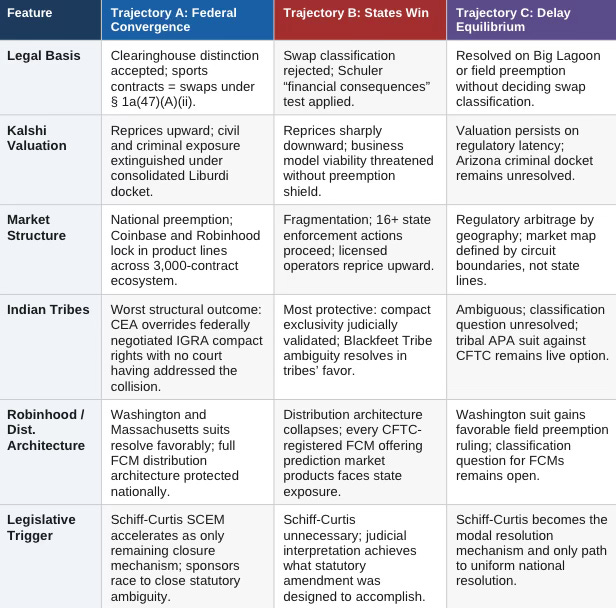
The prose analysis of each trajectory follows. The matrix above summarizes consequences; the sections below explain the causal chain that produces them.
Trajectory A Federal Convergence
The panel accepts the clearinghouse distinction and rules sports-event contracts are swaps under § 1a(47)(A)(ii), or rules on field preemption grounds using the 100-year legislative history in United States and CFTC v. Arizona’s panning 1921 through Dodd-Frank 2010. State enforcement recedes nationally. The Arizona criminal prosecution is enjoined under the consolidated Liburdi docket. Kalshi’s $22 billion valuation reprices upward and criminal exposure extinguishes. Robinhood’s Washington and Massachusetts suits resolve favorably. The MindCast: Legislative Regime ConversionSchiff-Curtis Prediction Markets Are Gambling Act accelerates as the only remaining closure mechanism — congressional sponsors race to eliminate the statutory ambiguity before institutional facts on the ground become irreversible. The CFTC’s rulemaking converts from exploratory consultation to codification lobbying. Coinbase and Robinhood lock in product lines. DraftKings, FanDuel, and Caesars face an acute compliance cost disadvantage that extends indefinitely. Institutional integrity pressure — NCAA opposition, problem gambling constraints — activates independently through legislative channels the ruling cannot foreclose. Legal victory does not guarantee operational freedom for sports-related contracts specifically.
Trajectory B States Win: Swap Classification Rejected
The panel aligns with the Sixth Circuit’s Schuler decision. Sports-event contracts are not swaps under § 1a(47)(A)(ii) because they lack the required connection to financial consequences — the Schuler court imposed a limiting construction the appellants argue is extratextual, reading “inherent” into a statute requiring only “potential.” Sixteen active enforcement actions become substantially more likely to succeed. Washington’s AG obtains binding Ninth Circuit authority in the same circuit as the Robinhood sealed proceeding. Arizona v. KalshiEX LLC civil enforcement proceeds; the criminal docket is no longer shielded. Tribal compact protections are judicially validated. Licensed gaming operators reprice upward.
Kalshi’s $22 billion valuation reprices immediately and sharply — not merely on preemption risk but on the structural question of whether the current business model is viable at all without federal preemption as a shield. Robinhood’s Washington suit loses its preemption foundation across the full FCM distribution architecture. Schiff-Curtis becomes unnecessary. SCOTUS certiorari becomes essentially automatic on the Sixth-Ninth circuit split, with the textualist majority positioned to resolve the question on statutory text alone — ”potential” means potential, not “inherent.” Note the scope risk that survives even under Trajectory A: courts may accept federal preemption authority but reject the scope of permissible contracts under a gaming constraint — federal override can hold and Kalshi can still face criminal liability in Arizona on election counts where the CFTC has not completed its definitional rulemaking.
Trajectory C Field Preemption Bypass: Delay Equilibrium Extended
The panel resolves the consolidated appeal on field preemption or the Big Lagoon collateral attack doctrine without deciding swap classification. Kalshi continues operating. Nevada’s enforcement is enjoined. The swap classification circuit split survives unresolved across four circuits, as mapped in MindCast: National Litigation Map. Regulatory arbitrage by geography becomes the operative market structure — Kalshi operates freely in Ninth Circuit states, faces enforcement risk in Sixth Circuit states under Schuler, and faces an open question in every other circuit. Platform operators rationally concentrate activity in preemption-protected jurisdictions while minimizing exposure in Schuler-governed states. The practical result is a prediction market map defined by circuit boundaries rather than state lines — a fragmentation outcome that preemption was supposed to prevent but that field preemption without swap classification resolution actually produces. The breadth of the DOJ’s field-preemption theory creates a countervailing judicial risk: courts may resist full federal occupation by narrowing the definition of qualifying contracts rather than rejecting preemption outright — which is precisely how Trajectory C produces a result that neither side sought but both must navigate.
Robinhood’s Washington suit gains a favorable field preemption ruling but the underlying classification question remains open. Arizona’s criminal docket sits in the most ambiguous posture: field preemption on the federal side, an active criminal Information on the state side, and a CFTC rulemaking record that has not completed the definitional work that would close the gap between the two. Schiff-Curtis becomes the only mechanism capable of imposing uniform national resolution — the modal resolution pathway under Trajectory C. The race condition persists. Federal deterrence continues. The system approaches the Trap state identified in MindCast: Conflict Architecture of Regulation — structural constraints dominating actor choice as strategic flexibility collapses across all positions simultaneously.
Cross-Trajectory Pattern: Schiff-Curtis as the Invariant Forcing Mechanism
Schiff-Curtis — the bipartisan Senate bill that would explicitly reclassify sports prediction market contracts as gambling outside CFTC jurisdiction — is the only actor in the system whose relevance increases regardless of trajectory. Under Trajectory A, a preemption-holding ruling accelerates Schiff-Curtis because congressional sponsors must now close the statutory ambiguity before institutional facts become irreversible. Under Trajectory B, Schiff-Curtis becomes unnecessary because courts accomplished legislatively what the bill was designed to achieve — but the bill’s legislative record already in the record as contemporaneous congressional intent shaped the panel’s statutory interpretation environment. Under Trajectory C, Schiff-Curtis becomes the only mechanism capable of imposing uniform national resolution — the modal pathway. No trajectory eliminates the bill’s structural relevance. Every trajectory either accelerates it, validates its premise, or makes it the only exit. Schiff-Curtis is the cross-trajectory invariant — the one force that the system cannot route around regardless of which path April 16 signals.
Foresight Simulation Executive Summary
The litigation system governing prediction markets has entered a constrained, feedback-driven regime dominated by federal enforcement acceleration and structural legal constraints. The MindCast foresight simulations identify a high-probability convergence toward federal preemption authority with simultaneous narrowing of permissible contract scope. Strategic actors are operating within a tightening constraint geometry where timing, not argument quality, determines outcomes.
What Is a Cognitive Digital Twin?
A Cognitive Digital Twin (CDT) is a structured simulation model that represents how an institution, regulator, court, or market participant actually makes decisions under constraint---rather than how it claims to decide. A CDT maps incentives, constraints, feedback loops, and behavioral patterns into a decision system that can be simulated forward in time. MindCast uses CDT-based foresight simulations to generate predictions that are falsifiable, time-bound, and grounded in institutional behavior rather than narrative.
MindCast foresight simulations are law and behavioral economics game theory simulations built on CDTs. Unlike traditional game theory, which assumes fixed rules and static equilibria, MindCast simulations model rule mutation, institutional constraint, and feedback-driven adaptation in real time. The system does not solve for a single equilibrium---it identifies which equilibrium the system is moving toward, how quickly, and what observable signals will confirm or falsify that trajectory.
Vision Functions are specialized analytical modules within the MindCast Cognitive Digital Twin system that isolate distinct causal mechanisms—such as strategy, feedback loops, constraint geometry, or institutional behavior—to explain how outcomes are generated. Each Vision Function runs its own CDT simulation, producing measurable signals that, when combined, form a unified, falsifiable foresight model of the system.
Key Takeaway The MindCast Simulation identifies a system that has transitioned from delay-dominant equilibrium to constraint-driven convergence, where federal enforcement and structural legal constraints are narrowing the outcome space regardless of individual actor strategy. April 16 functions as a synchronization signal that will update institutional behavior across courts, regulators, states, and markets simultaneously---but will not resolve the system.
Vision Function I Causation Vision CDT
The system operates within a single causal field. Federal lawsuits, state enforcement, platform preemption, and distribution-partner actions are not independent events but expressions of a unified jurisdictional conflict over control of event-based derivatives markets. Primary causal driver: federal assertion of exclusive jurisdiction under the CEA. Secondary drivers: state preservation of police power over gambling; market expansion into regulated domains (sports, elections). Causal Signal Integrity (CSI): High.
The litigation stack is causally coherent. The DOJ filing in Arizona is not a reaction---it is a structural response to a system that cannot stabilize under fragmented authority. The four-track architecture is not merely descriptive. It is causal. Each track is an expression of the same underlying jurisdictional conflict, which means resolving any single track without resolving the others does not reduce system pressure---it redirects it.
Vision Function II Chicago Strategic Game Theory (CSGT) CDT
Equilibrium classification: Delay-dominant transitioning to resolving. Strategic Delay Preference Index (SDPI)---measuring how strongly actors benefit from extending ambiguity: Elevated. Rule Mutability Score (RMS)---measuring how rapidly the governing rules are changing: High. Equilibrium Persistence Under Loss (EPUL)---measuring how resistant the current equilibrium is to disruption even when losing parties resist: High.
Actors have been operating in a delay-dominant equilibrium where ambiguity benefits multiple parties simultaneously---platforms accumulate market share, the CFTC maintains optionality through incomplete rulemaking, and congressional actors generate political credit without committing to a classification. Federal intervention reduces delay viability and forces transition toward resolution. Kalshi’s voluntary March 2026 contract screening confirms that the delay advantage has weakened below the threshold at which continued ambiguity generates positive expected value.
Vision Function III Cybernetic Control Vision (CCV) CDT
System classification: Semi-closed loop moving toward closed-loop control. Feedback Capture Rate (FCR)---measuring how rapidly market and institutional actors are absorbing regulatory signals: High. Adaptation Velocity (AV)---measuring how quickly actors are updating their behavior in response: Increasing. Feedback Latency Index (FLI)---measuring the delay between signal generation and system response: Rapidly decreasing.
Federal lawsuits, sealed filings, and appellate coordination have reduced feedback latency across the system. The Regulatory--Market Feedback Loop---where regulation shapes price, price drives political reaction, and political reaction updates regulatory posture---is closing faster after each filing than before it. The CFTC’s simultaneous amicus brief and open ANPRM is the most visible expression of the system still operating in semi-closed mode: the Commission is both asserting control and soliciting input, because it has not yet fully captured the feedback loop its own actions are generating.
Vision Function IV Game Regime Identification (GRI) CDT
Regime classification: Trap (high constraint, low escape). Feedback Stability (FS)---measuring whether the system is converging or diverging from equilibrium, where values above 1.0 indicate convergence: >1.5. Corridor Width (CW)---measuring the range of viable strategic options remaining for actors: <0.1.
The system has entered a trap regime. Strategic flexibility is collapsing across all actor positions simultaneously. The Arizona consolidated docket, the Robinhood sealed filing, the 10-4 amicus alignment, and the April 30 ANPRM deadline all converge within overlapping time windows---the structural signature of Trap entry. April 16 will not open new options. It will lock in constraints already forming. Actors with prepared playbooks benefit disproportionately in Trap regimes because the compressed corridor makes preparation the primary differentiator.
Vision Function V Field-Geometry Reasoning (FGR) CDT
Geometry dominance: High. Constraint Density (CD)---measuring the number of binding structural constraints on actor choices: High. Attractor Dominance Score (ADS)---measuring how strongly the system is being pulled toward a single outcome: High. Geodesic Availability Ratio (GAR)---measuring the proportion of viable paths to resolution that remain open: Low.
Outcomes are being determined by structural constraints rather than intent or advocacy. Circuit overlap, federal enforcement, statutory architecture, and procedural convergence are shaping the result space independent of what any individual actor argues or intends. The impossibility preemption argument is the field-geometry argument in its purest form: a DCM cannot comply with both a federal mandate to provide nationwide access and a state prohibition on access within that state. A judge persuaded by structural incompatibility does not need to decide swap classification. The geometry decides for them.
Vision Function VI Installed Cognitive Grammar (ICG) CDT
Three competing grammars are active simultaneously. Federal grammar: derivatives / financial market framework---event contracts are instruments, clearinghouses are structural differentiators, the CEA is the governing statutory architecture. State grammar: gambling / police power framework---event contracts are wagers, consumer protection is the governing concern, state licensing is the operative mechanism. Institutional grammar: integrity / fairness framework---prediction markets threaten competitive fairness, problem gambling is an unaddressed harm, congressional action is the appropriate response.
The conflict persists because actors interpret the same contracts through incompatible frameworks. Courts must select a dominant grammar. April 16 will signal which grammar governs future interpretation---and that signal, embedded in the panel’s question choices and the written opinion’s framing, is analytically more significant than the legal holding itself. A panel that adopts the clearinghouse distinction as controlling is installing the federal derivatives grammar. A panel that frames the question around surface resemblance to gambling is installing the state grammar.
Vision Function VII Narrative Control Vision (NCV) CDT
Narrative control state: Contested, with platform-side grammar currently dominant in federal forums and state-side grammar dominant in state and legislative forums. Narrative Lock-In Probability (NLP)---measuring the probability that one interpretive framework achieves dominant status before resolution: Moderate. Contradiction Tolerance Coefficient (CTC)---measuring how many internal contradictions the system can absorb without narrative collapse: High. Narrative Inversion Risk (NIR)---measuring the probability that the dominant narrative flips to its opposite through evidentiary record: Elevated---the platform-side narrative (”we are a regulated financial exchange”) is vulnerable to inversion by the state-side exhibit record (”found a way to bet on the NFL even though we live in Washington”).
The Narrative Control Runtime (NCR) framework identifies Narrative Inversion as the mechanism through which the dominant framing in a dispute collapses---not through superior argument but through the introduction of evidence that activates the competing grammar at the emotional register rather than the doctrinal register. The Washington NFL advertising exhibit is the prediction markets equivalent: Kalshi’s own marketing language installs the state gambling grammar in the reader’s mind before any legal argument is made. The panel reads the record before oral argument begins. Narrative control at the record level---not at the podium---is where April 16 is already partially decided.
The falsifiable behavioral prediction from the NCV simulation: the Ninth Circuit’s written opinion will reveal which grammar it has installed through its framing in the first three paragraphs. Federal derivatives grammar lock-in signal: opinion opens by describing event contracts as “derivatives instruments” or “swaps.” State gambling grammar lock-in signal: opinion opens by describing them as “bets” or “wagers.” Field preemption grammar signal (Trajectory C): opinion opens by describing the “jurisdictional conflict” or “regulatory framework” and resolves on procedural grounds without reaching classification.
Vision Function VIII Posner Vision CDT
Learning environment: Wicked. Institutional Update Velocity (IUV)---measuring how quickly courts are updating their doctrine in response to market innovation: Moderate. Enforcement Lag Index (ELI)---measuring the gap between market conduct and enforcement response: Elevated.
Courts face a wicked learning environment where doctrine lags market innovation. Kalshi self-certified $16.8 billion in annual sports volume before the first appellate court heard oral argument on whether its core product category was legal. The most likely judicial response under wicked learning conditions is partial correction: accepting federal authority while limiting scope. This is the doctrinal mechanism that produces the scope-not-authority risk identified in this publication---courts resist the full implication of their own holdings by drawing definitional lines that limit downstream damage.
Vision Function IX Regulatory Vision CDT
Regulatory state: Sequencing mismatch. Litigation is proceeding ahead of rulemaking. The ANPRM closes April 30---fourteen days after oral argument.
The CFTC is enforcing authority before completing definitional clarity. Regulatory lag becomes a vulnerability rather than a buffer: the open ANPRM is not a sign of deliberate pacing but of an agency that cannot supply the reasoning the deference standard requires because it has not yet generated that reasoning. The CFTC’s strongest institutional move post--April 16 is to convert the ANPRM into a Notice of Proposed Rulemaking immediately after oral argument---establishing at least the beginning of the completed deliberation that the deference standard requires.
XII. Integrated Foresight Output
System State The litigation system has transitioned from delay-dominant equilibrium to constraint-driven convergence. Federal enforcement and structural legal constraints are narrowing the outcome space regardless of individual actor strategy. April 16 is a synchronization event that updates all actors simultaneously. It determines the direction of convergence---it does not resolve the system.
The nine Vision Function simulations converge: most probable outcome is federal preemption authority holding with contract scope narrowed under a gaming or classification constraint. Constraint geometry is tightening across all actor positions simultaneously. Feedback loops are closing. Strategic delay is collapsing. Trap regime entry is confirmed. The grammar contest is unresolved---April 16 panel questions will signal which grammar governs.
XI. Prediction Table and Falsification Conditions
All predictions are time-bound and carry explicit falsification conditions. The Post--April 16 Premium Scoring Protocol in Section XII governs how each is scored.
A. Core Predictions
Prediction 1 --- Ninth Circuit signals preemption-leaning or avoids rejecting preemption outright
Window: April 16 · Probability: 60--65%
Signal: Panel questions emphasize federal scheme, clearinghouse distinction, or avoid gambling-first framing
Falsification: Panel frames contracts primarily as gambling and signals rejection of swap classification
Prediction 2 --- Arizona federal court moves toward enjoining state enforcement
Window: 30--60 days · Probability: 55--60%
Signal: Orders or minute entries under consolidated Liburdi docket indicating likelihood of injunction or relief narrowing state action
Falsification: Court allows state criminal/civil enforcement to proceed without meaningful constraint
Prediction 3 --- Additional federal action (new DOJ filing or formal expansion signal)
Window: 45--90 days · Probability: 60--70%
Signal: New complaint, statement of interest, or coordinated filing in another state
Falsification: No expansion while new state enforcement actions continue unabated
Prediction 4 --- Divergent market repricing (platforms vs. licensed operators)
Window: 1--7 days post--April 16 · Probability: 70%
Signal: Relative movement in equities/volumes---Robinhood/Coinbase up relative to DraftKings/Caesars under Trajectory A signal; inverse under Trajectory B signal
Falsification: No measurable divergence, or inverse movement inconsistent with ruling signal
Prediction 5 --- Institutional pressure activation (sports integrity / congressional attention)
Window: 60--120 days · Probability: 50--60%
Signal: Hearings, letters, draft legislative language, or public commitments tied to sports integrity or problem gambling concerns
Falsification: No material policy movement or public positioning within window
Global Falsifier (Model-Level) Courts reject both field and conflict preemption and permit state enforcement to proceed broadly across jurisdictions without constraint. If this occurs, all trajectory probabilities reset and the full Vision Function CDT simulation suite is re-run.
B. Structural Lock-In Predictions
Prediction 6 --- Ninth Circuit ruling constrains WA and AZ district courts immediately
Window: 0--14 days post-ruling · Probability: 70%
Signal: Western District of Washington (Kalshi Seattle, Robinhood Tacoma) and District of Arizona (Liburdi docket) cite or align with appellate signal in orders or minute entries
Falsification: District courts diverge from or decline to follow appellate signal within 14 days
Prediction 7 --- Federal courts become dominant forum for core classification disputes
Window: 30--60 days · Probability: 65%
Signal: Increased removals of state enforcement actions to federal court; new platform preemption suits filed directly in federal forum
Falsification: State court rulings on classification questions drive outcomes
C. Conditional (Trigger-Based) Predictions
Prediction 8 --- Legislative acceleration following preemption-leaning signal [Trajectory A trigger]
Trigger: Preemption-leaning April 16 signal · Window: 30--90 days · Probability: 60%
Signal: Schiff-Curtis bill receives committee markup, hearing scheduling, or floor consideration
Falsification: No legislative activity within 90 days despite preemption-leaning signal
Prediction 9 --- Multi-state enforcement expansion following swap classification rejection [Trajectory B trigger]
Trigger: Swap classification rejected · Window: 14--30 days · Probability: 70%
Signal: Ohio AG-led coalition activates coordinated enforcement filings; new state actions in Oregon, California, or other non-named Ninth Circuit jurisdictions
Falsification: States do not escalate within 30 days of adverse ruling
Prediction 10 --- Geographic arbitrage behavior by platforms [Trajectory C trigger]
Trigger: No classification decision (Trajectory C) · Window: 30--90 days · Probability: 65%
Signal: Kalshi and Robinhood concentrate marketing and user acquisition in Ninth Circuit states; reduce or exit product availability in Sixth Circuit states; product availability maps diverge along circuit lines
Falsification: Uniform platform behavior across all jurisdictions; no geographic differentiation in product availability or marketing intensity
D. Behavioral Predictions (CDT-Based)
Prediction 11 --- CFTC adjusts posture post--April 16
Window: 14--45 days · Probability: 60%
Signal: Chairman Selig public statement adjusting tone; ANPRM converts to NPRM; enforcement guidance issued acknowledging definitional gap; litigation posture in Arizona consolidated docket softens or qualifies
Falsification: No observable change in CFTC posture, guidance, or rulemaking timeline within 45 days
Prediction 12 --- Kalshi further constrains offerings if April 16 signal is adverse or ambiguous
Window: 7--30 days · Probability: 65%
Signal: Additional voluntary product limitation announcements; market narrowing on sports-specific or election-specific contracts; public statements framing constraints as proactive compliance
Falsification: Product expansion or unchanged offerings despite adverse or ambiguous signal
Prediction 13 --- State AG coalition acts in coordinated fashion
Window: 30--60 days · Probability: 70%
Signal: Joint enforcement filings by Ohio AG-led coalition; coordinated supplemental authority letters in pending appellate proceedings; synchronized public statements from multiple state AGs
Falsification: Fragmented, uncoordinated state behavior; no joint filings or synchronized statements within window
E. Second-Order Effects
Prediction 14 --- Tribal litigation escalation independent of state enforcement
Window: 30--90 days · Probability: 55%
Signal: New tribal-initiated filings or amicus activity; Hobbs Straus Dean & Walker or Scott Crowell firm filings in Arizona, Washington, or Nevada; tribal gaming compact holders filing independent APA challenges against CFTC passive approval
Falsification: No tribal escalation independent of state AG coalition activity within 90 days
Prediction 15 --- Additional distribution-layer entrants (FCMs/fintech)
Window: 30--90 days post--April 16 · Probability: 50--60%
Signal: New CFTC FCM registrations citing prediction market activity; fintech platform announcements of event contract product lines; existing FCMs (Coinbase, Interactive Brokers) publicly expanding prediction market distribution partnerships in Ninth Circuit states
Causal driver: The 3,000-contract, eight-DCM ecosystem creates a distribution opportunity that scales with preemption clarity. Trajectory A produces the strongest activation signal---a preemption-leaning ruling removes the primary legal barrier keeping retail fintech from the distribution layer. Trajectory C produces delayed but probable activation as geographic arbitrage creates Ninth Circuit-specific distribution windows. Trajectory B suppresses new entrants entirely.
Falsification: No new FCM registrations or public product announcements within 90 days; existing distribution partners contract or exit rather than expand
Prediction 16 --- Narrative grammar lock-in observable in written opinion [NCV CDT signal]
Window: Written opinion issuance (estimated 60--120 days post-argument) · Probability: 85% that opening framing predicts holding direction
Federal grammar signal: Opinion opens by describing event contracts as “derivatives instruments” or “swaps”
State grammar signal: Opinion opens by describing them as “bets” or “wagers”
Field preemption grammar signal (Trajectory C): Opinion opens by describing the “jurisdictional conflict” or “regulatory framework” and resolves on procedural grounds without reaching classification
Falsification: Opinion framing and legal holding point in opposite directions
XIII. Post--April 16 Scoring Protocol
Each prediction is scored on a 0--2 scale after the April 16 synchronization event and at each defined time window thereafter. 2 (Confirmed): outcome matches prediction within defined window. 1 (Partial): mixed or directional alignment without full confirmation. 0 (Falsified): outcome contradicts prediction or fails to materialize within window.
Aggregate Score (AS) = (Sum of scores) / (2 × number of predictions scored). AS ≥ 0.75: Model validated; increase confidence in current trajectory. 0.50 ≤ AS < 0.75: Partial validation; maintain but refine probabilities. AS < 0.50: Model degraded; re-run Vision Function CDT simulations and reset priors.
Trajectory Update Rules
Trajectory A: Increase probability if April 16 signal is preemption-leaning AND Arizona consolidated docket shows movement toward injunctive relief. Trajectory B: Increase probability if April 16 rejects swap classification OR emphasizes gambling-first framing; amplify if multi-state coordination activates within 30 days. Trajectory C: Increase probability if court avoids classification and issues narrow or procedural ruling; confirm if geographic arbitrage behavior (Prediction 10) materializes.
Signal Hierarchy for Updates
(1) Appellate oral argument tone and any immediate orders (highest weight). (2) Arizona consolidated docket orders under Judge Liburdi. (3) New federal filings or statements of interest. (4) District court developments in Washington (unsealing signals, relief orders in Kalshi Seattle and Robinhood Tacoma). (5) Market and institutional responses (secondary but confirmatory).
Re-Run Trigger
Re-run full MindCast Simulation if: (a) two or more core predictions are falsified (score = 0), or (b) a new federal action materially alters jurisdictional scope (additional states sued, new statutory posture, or executive branch intervention).
XIV. Investor Positioning Matrix
The matrix translates each trajectory into directional positioning across key exposures. Positions are directional, time-bound, and conditioned on the April 16 signal. These are analytical outputs of the MindCast CDT simulation, not investment advice.
Trajectory A --- Federal Convergence
View: Long platforms / short licensed operators (relative) Overweight: Robinhood, Coinbase (distribution and product expansion). Underweight: DraftKings, Caesars (persistent compliance cost asymmetry). Catalysts (1--30 days): Preemption-leaning April 16 signal; Arizona Liburdi docket moving toward injunctive relief. Risk: NCAA / congressional action caps upside on sports-linked products even under full preemption; Schiff-Curtis SCEM acceleration reduces platform-side time horizon.
Trajectory B --- State Victory
View: Long licensed operators / underweight platforms Overweight: DraftKings, Caesars (restored compliance cost parity; state licensing moat validated). Underweight: Robinhood, Coinbase (distribution architecture impaired). Negative skew: Kalshi (private valuation compression; criminal prosecution exposure in Arizona unshielded). Catalysts (1--7 days): Gambling-first framing at argument; rejection of clearinghouse distinction. Risk: SCOTUS certiorari automatic on circuit split compresses the duration of licensed-operator advantage.
Trajectory C — Field Preemption / Delay
View: Barbell / volatility capture Overweight: Robinhood (distribution optionality under field preemption in Ninth Circuit states). Selective: Coinbase (geographic arbitrage exposure varies by state). Tactical: Licensed operators (event-driven bounces on policy headlines; no structural repricing). Catalysts (0--90 days): Narrow ruling; absence of classification decision; Prediction 10 geographic arbitrage confirmation. Risk: Schiff-Curtis SCEM activation becomes modal resolution mechanism under C, creating acute legislative risk for platform-side positions.
Tactical Playbook (Post--April 16)
Within 24 hours: Reweight based on hearing tone---panel questions and emphasis are leading indicators; grammar signal from Prediction 16 activates immediately. Within 7 days: Confirm via market divergence (Prediction 4). Within 30--60 days: Validate via Arizona Liburdi docket injunction posture (highest-weight structural signal after the appellate ruling itself). Within 90 days: Adjust for federal expansion (Prediction 3), legislative activation (Prediction 8), or geographic arbitrage confirmation (Prediction 10).
Conclusion
Prediction market litigation has evolved into a four-track collision operating under a clear hierarchy: federal override dominant, platform and distribution-partner strategies adaptive, state enforcement reactive but resisting under threat shadow. The Arizona consolidated docket under Judge Liburdi---one judge controlling private preemption, federal preemption, and criminal prosecution shield simultaneously---is the most structurally significant procedural development in the MindCast: nine-publication MindCast corpus. Washington State is the highest-density active jurisdiction. The Robinhood sealed filing in Tacoma engineers information asymmetry against Brown’s parallel Kalshi enforcement team. Federal intervention accelerates convergence but triggers coordinated resistance at every level while simultaneously deterring new enforcement through the threat shadow of additional federal suits.
Named actors with dual positions inside overlapping institutional authorities maintain the conflict because the conflict itself distributes benefits that a resolved equilibrium would terminate. CFTC officials asserting jurisdiction while soliciting their own definitional mandate, platform operators whose delay dominance strategy requires the conflict to persist longer than enforcement can respond, and institutional investors holding valuations built on regulatory latency rather than legal durability---all gain from the system remaining unresolved. The Nash-Stigler Equilibrium---named for Nobel economists John Nash and George Stigler, describing the stable condition where regulated industries have captured their regulators and no single actor can improve their position by defecting---persists because every actor inside it is already playing their best available move given what everyone else is doing, and no single actor can unilaterally improve their position by breaking ranks. External force is required: the Ninth Circuit signal, the Skrmetti Vector coalition---the distributed enforcer density threshold at which coordinated state AG action breaks a federal capture-stable equilibrium---and the SCEM legislative track, all operating simultaneously after April 16.
The system is governed by a race condition between federal enforcement speed and judicial doctrinal constraint. April 16 is the first moment at which that race can be measured---the first synchronized signal that updates every stakeholder’s probability distribution at once. The ruling routes the race condition toward one of three trajectories, each carrying different consequences for every actor identified in this publication, and each creating new constraint geometry that downstream courts, regulators, legislators, investors, tribes, and operators will navigate in the 45 to 90 days that follow. Kalshi’s preemption architecture was built to survive fragmented state-by-state enforcement. Washington’s answer was to move on every track simultaneously. April 16 determines whether the architecture holds.
Appendix MindCast Kalshi Corpus
1. The Full Arc of Prediction Markets The foundational paper. Defines prediction markets as constrained information systems shaped by incentives, participation structure, and regime transitions — and identifies the structural conditions under which the truth-seeking function collapses into strategic exploitation and then into behavioral extraction. Establishes the two-kind taxonomy separating public belief exchanges from proprietary probability engines that governs every subsequent analysis in the corpus. Read this first.
2. Prediction Markets and the Regulatory Split Identifies the foundational divergence between federal event contract jurisdiction and state gambling regulatory frameworks. Deploys a Cognitive Digital Twin (CDT) foresight simulation — a proprietary MindCast architecture that models institutions, markets, and regulators as interacting systems to generate falsifiable forward predictions — assigning P45/P35/P20 probability bands across three resolution scenarios four days before three of six identified triggers activated simultaneously. Loop closure arrived through the legislative channel rather than the appellate path flagged as primary. Relevance: April 16 tests whether that split widens, compresses, or routes to the Supreme Court.
3. Kalshi’s Prediction Market Federal Strategy Frames Kalshi’s three-layer litigation architecture as a preemption-driven expansion engine converting state enforcement into federal appellate ammunition. Documents the removal cascade mechanic, the Tennessee supplemental authority gambit, and the asymmetric harm structure that makes coordinated preemptive state action the only effective counter. Relevance: April 16 tests whether that architecture survives contact with a coordinated Ninth Circuit panel.
4. The National Kalshi Prediction Market Litigation Map Maps multi-jurisdictional fragmentation across sixteen state enforcement actions and four appellate circuits producing conflicting rulings on identical statutory text. Establishes the removal asymmetry, the cascade mechanic, and the probability assignments across three resolution scenarios. Relevance: April 16 forces partial synchronization across nodes that have been operating asynchronously since March 2025.
5. Kalshi Found the One Gap in American Gaming Law Nobody Closed Models expansion as extraction from regulatory latency through four documented poaching mechanisms: Kalshi Platinum, tribal-market NFL advertising, 18–21 demographic capture, and quantified revenue displacement. Nevada’s sports betting handle fell 9% in 2025, the same year Kalshi processed $16.8 billion in sports volume nationally. Relevance: April 16 tests whether latency continues to enable growth or begins to compress under coordinated Ninth Circuit enforcement.
6. Prediction Market–Crypto–CFTC Convergence Links prediction markets to crypto’s jurisdictional migration toward CFTC governance as a unified control layer. Prediction markets supply information pricing infrastructure; crypto supplies settlement infrastructure; the CFTC is the only regulatory architecture capable of governing both under a unified statutory framework. Relevance: April 16 tests whether a consolidated federal appellate ruling accelerates that convergence or fractures it.
7. Prediction Markets — Legislative Regime Conversion and the Collapse of Preemption Documents the Statutory Category Exclusion Mechanism (SCEM) activated by the Schiff-Curtis Prediction Markets Are Gambling Act (March 23, 2026) — a bipartisan Senate bill that would explicitly reclassify sports prediction market contracts as gambling outside CFTC jurisdiction, eliminating the statutory ambiguity the entire preemption theory depends on — and models how legislative regime conversion forecloses the judicial and administrative channels that depend on statutory ambiguity to function. A statutory CEA amendment is not an enforcement escalation — it eliminates the contested jurisdictional space itself. Relevance: April 16 tests whether preemption remains a viable growth pathway or arrives already foreclosed.
8. Kalshi Is Crypto’s Test Case Positions a Kalshi appellate victory as locking the CFTC in as the governing control system for the next generation of financial instruments. A Kalshi loss forecloses that pathway for every platform operating under the same statutory architecture. The forward-looking consequence paper: read this last. Relevance: April 16 tests whether prediction markets inherit crypto’s regulatory trajectory or fracture it.
9. The Ninth Circuit on April 16 as System Convergence — The First Measurable Test of Prediction Market Structure Condenses eight prior MindCast publications into a single measurable event. Maps the three-layer preemption architecture—express preemption, swap classification, and field preemption—and identifies which theory will control based on the panel’s questioning. Runs a CDT foresight simulation with defined probability bands and falsifiable predictions while exposing the CFTC’s contradiction of asserting authority before completing rulemaking. April 16 becomes the first real test where the model can be scored against actual outcomes.
10.Prediction Markets Litigation Stack — Federal, Private, and State Enforcement Converge Federal enforcement, state prosecution, platform preemption, and distribution-layer offensives have collapsed into a single, multi-layer jurisdictional conflict over control of prediction markets. Washington and Arizona concentrate the system: criminal charges, sealed federal suits, and DOJ intervention now operate inside the same appellate pipeline heading into April 16. Courts face a race condition between federal preemption and doctrinal constraint, with outcomes shaped more by structural incompatibility than argument quality. The April 16 hearing delivers the first synchronized signal that will reprice legal risk, investor positioning, and regulatory strategy across the entire system.