
Companion economics works: Chicago School Accelerated: The Integrated Modernized Framework of Chicago Law and Behavioral Economics (2025) | The Dual Nash-Stigler Equilibrium Architecture (2026) | Dynamic Predictive Game Theory Meets the Era of AI: Operationalizing Fudenberg’s Research Agenda with Cognitive Digital Twins (2026) | The Computational Era Operationalizes Cybernetics and Predictive Game Theory (2026) | Chicago’s Randal Picker Was Simulating Law and Economics Before AI (2026) | MindCast Foresight Prediction Simulations, Synthesizing Behavioral Economics + Game Theory (2026)
Classical music foundations: Mozart’s Mirror: How K. 491 Reflects Romantic Complexity and the Architecture of Intelligence (June 2025) | The Mozart Effect 2.0: Cognitive Elegance as a Depth Assessment Paradigm (April 2025)
I. Executive Summary
Mozart Makes Structural Change Tangible
Mozart’s Piano Concerto No. 24 in C minor (K. 491) separates playing a game from changing it. The finale carries one theme through eight variations, and the theme persists while texture, intensity and dramatic weight change. In game-theory terms, the theme is the game’s structure and each variation is a new strategy played inside it.
Core insight. A game mutation occurs when strategic interaction changes the game itself, not just the strategies played inside it. Actors usually vary strategies inside a stable game. Mutation changes the rules, players, information or payoffs. The old game then stops governing what happens next.
Mozart challenges the concerto’s conventions when the piano enters the first movement with material that does not simply repeat the orchestra’s opening theme. Listeners meet a different development from the one familiar concerto practice leads them to expect. In game-theory terms, the entry illustrates what happens when a shared convention stops coordinating expectations.
The orchestra adds clarinets alongside oboes and widens the work’s range of musical relationships. The concerto ends in C minor rather than with the major-key resolution listeners anticipate, so a listener who predicted from convention would have forecast the wrong ending. Economic competition presents a comparable forecasting problem: familiar participants can remain in place while new rules, incentives and institutional relationships transform their strategic environment.
Thesis. Strategic games contain identifiable incentives, institutional constraints and behavioral patterns that reveal the pressure for structural change. Mozart Predictive Dynamic Economics forecasts when that pressure will transform the governing game, which actors will shape the transition and how the replacement will emerge. The Mozart Effect 2.0: Cognitive Elegance as a Depth Assessment Paradigm (2025) treats Mozart’s compositions as models of structured thought. Mozart Effect 2.0 supports the premise that an actor’s departures from convention follow from its installed architecture, meaning the established goals and decision rules it brings to every contest.
Three mechanisms. Institutional clock speed lets the timing of institutional interventions shape which replacement games become feasible, and Kalshi shows it most clearly. Endogenous adaptation lets accumulated strategic responses change the structure before any rule does, as Compass’s opponents learned to answer its playbook. Constraint migration moves the decisive bottleneck, as AI data centers moved from power to permission. U.S.–China AI competition and AI governance carry the three mechanisms beyond their clearest cases.
What distinguishes the MindCast approach. MindCast AI applies Predictive Behavioral Economics + Dynamic Game Theory through MindCast AI Proprietary Cognitive Digital Twin Foresight Simulations (MP CDT FS). Behavioral Economics supplies the decision rules. Game Theory supplies the payoff structure. Predictive simulations emerge from the combination.
Behavioral economics captures how actors anchor on convention, overweight salient events and keep playing an old game after it has changed. Game theory adds equilibrium selection by identifying who gains from changing the structure, who can trigger the change and what the replacement game rewards. Mozart’s audience anchored on a major-key ending, and market actors anchor on yesterday’s rules in the same way.
Classical game theory solves a fixed game, and Drew Fudenberg’s “Predictive Game Theory” (2011) asks how real people play inside one. MindCast forecasts which game will exist next and which actors stay coherent when it arrives. Cognitive Digital Twins (CDTs) model each actor’s installed architecture from its public conduct, and the simulations run those actors against one another through rule changes.
The gap the series fills. Six MindCast economic frameworks each explain part of how strategic contests behave. Together they model how contests adapt, stabilize and replace their games. The series builds on them to forecast the change of the game itself.
Chicago School Accelerated: The Integrated Modernized Framework of Chicago Law and Behavioral Economics(2025) explains why rules move toward whoever values them most. Game mutation theory adds the point at which that movement replaces the game.
The Dual Nash-Stigler Equilibrium Architecture (2026) defines when a game comes to rest on stable strategies and sufficient information. Mutation Equilibrium carries the question to when games stop changing.
Dynamic Predictive Game Theory Meets the Era of AI: Operationalizing Fudenberg’s Research Agenda with Cognitive Digital Twins (2026) defines Adaptive Coherence Equilibrium (ACE) and poses the moving-game question. Five live controversies supply the test.
The Computational Era Operationalizes Cybernetics and Predictive Game Theory (2026) identifies when feedback breaks a model’s predictions. Game mutation theory identifies the game that takes over once they break.
Chicago’s Randal Picker Was Simulating Law and Economics Before AI (2026) shows how populations migrate between equilibria inside one game. Game mutation theory addresses how populations reorganize after the game itself is replaced.
MindCast Foresight Prediction Simulations, Synthesizing Behavioral Economics + Game Theory (2026) makes the transition between states the object of forecasting. Game mutation theory applies that object to transitions between games.
Mozart Vision. MindCast introduces Mozart Predictive Dynamic Behavioral Economics + Dynamic Game Theory Vision (Mozart Vision), a Vision Function built to forecast why, when and how strategic games mutate. Mozart Vision integrates the six frameworks around a distinct question: what changes the governing game itself? How Games Mutate asks why, Who Changes the Rules asks when and Predicting the Next Game asks how.
What the series does. Mozart Predictive Dynamic Economics follows five continuing controversies, each a live case of a game changing during play.
Two controversies turn on who writes the rules. Compass is running one playbook against multiple listing services (MLSs) nationwide. Kalshi, the CFTC and the Supreme Court are contesting who regulates prediction markets.
Three controversies turn on shifting constraints in AI. The United States and China are competing over AI capability through hardware, model access and harvested data. AI data center developers face a binding constraint that moved from power to permission to the holder of the veto. MindCast forecasts that contracts and insurance will make AI governance a condition of market access before the law does.
Why K. 491. The shortlist came from the concertos MindCast’s founder returns to most: No. 4 in G major (K. 41); No. 9 in E-flat major (K. 271); No. 17 in G major (K. 453); No. 20 in D minor (K. 466); No. 23 in A major (K. 488). No. 20 in D minor ran closest, because it shares K. 491’s minor-key tension and opens the piano part with new material. K. 466 turns to D major in its final bars and grants the resolution listeners expect. K. 491 keeps all three departures the series needs: a finale built as theme and variations, an orchestra with both oboes and clarinets, and an ending that stays in C minor.
How the shortlist maps to the five controversies. Each column tests one musical feature tied to a controversy’s mechanism. Green means the concerto has the feature in full, yellow means a partial or contained version and red means the feature is absent or reversed. The cadenza is the solo passage near the end of a movement, which a composer can write out or leave to the performer.
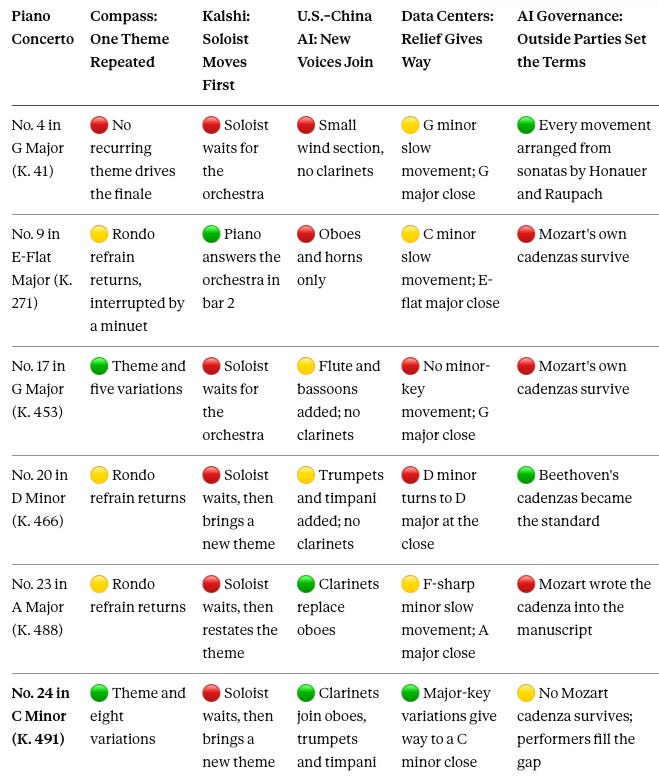
K. 491 earns three greens, the most of any concerto, and those three features anchor the installments. No concerto is green in every column. No. 9 (K. 271) shows the out-of-turn entry that mirrors the CFTC, and No. 20 (K. 466) shows where governance is heading, with one outside party’s version becoming the standard.
MindCast’s Mozart’s Mirror: How K. 491 Reflects Romantic Complexity and the Architecture of Intelligence (2025) reads the concerto as three self-contained movements joined by one argument. Each installment of Mozart Predictive Dynamic Economics follows the same design, asks one question of all five controversies and takes its lens from one of Mozart’s departures.
How Games Mutate takes the finale’s theme and variations. The installment separates variation inside a stable game from a change in the game itself, and legal change from economic change. Compass supplies the clearest demonstration of endogenous adaptation. The Compass playbook is the theme and each MLS contest a variation, while Washington’s statute changed the form.
Who Changes the Rules takes the soloist’s new material and the added clarinets. Kalshi supplies the clearest demonstration: the CFTC entered with a new rule while the Supreme Court was still deciding whether to hear the case. The U.S.–China AI competition shows new players joining the game as private enforcers and corpus brokers.
Predicting the Next Game takes the C minor ending. Convention misled Mozart’s listeners, and a model that freezes the current game forecasts the wrong constraint in the same way. AI data centers supply the clearest demonstration, because a forecast anchored on power would have missed the shift to permission. AI governance tests continuity through transformation by asking which firms stay recognizably themselves as governance becomes a condition of entry.
Stakeholder callouts.
🏛️ Policymakers: A statute or rule changes the game for every actor at once, and actors respond unevenly. Draft for the population response, not the average firm.
💼 Executives: A winning strategy teaches opponents how to answer it. Ask which earlier victory has become evidence for the next opponent.
⚖️ Counsel: Petitions, proposed rules and threatened suits change behavior before anything binds. Separate anticipated mutation from realized mutation in every risk assessment.
📊 Investors: Value moves to whoever controls scarce approvals and licenses. Track the binding constraint rather than the headline.
Takeaway. Mozart shows that a recognizable identity can persist while the relationships governing it change, and the series shows how to forecast when that happens in markets and law.
II. Mozart in Game Theory Terms
Theme and Variation as Strategic Adaptation
A game in the classical sense fixes the players, the available moves and the payoffs. John von Neumann and Oskar Morgenstern built that object in Theory of Games and Economic Behavior (1944). John Nash then defined equilibrium inside it.
Mozart’s theme in the K. 491 finale corresponds to a fixed game, and each variation corresponds to strategic adaptation. Each of the eight variations changes rhythm, range and ornament while the harmonic frame holds. Listeners recognize the theme every time because the structure persists.
Takeaway. Variation inside a stable form corresponds to strategic adaptation, the most common kind of change and the one classical game theory handles well.
Broken Conventions as Structural Change
Musical convention works as a focal point, the shared expectation Thomas Schelling showed players coordinate on when formal rules leave the outcome open. Classical concerto form supplied one such focal point: the soloist restates the orchestra’s opening theme.
K. 491 breaks the restatement convention when the soloist enters with new material. Everyone coordinating on the convention must update to a new sequence of moves.
The added clarinets and the minor-key ending change two more structural elements of the concerto. By analogy, the clarinets illustrate a wider set of relationships and the ending a resolution the form led listeners to expect and then withheld.
Takeaway. Structural change occurs when the coordinating expectations, the player set or the payoffs change, not merely when a strategy changes.
Identity Survives While Structure Changes
K. 491 stays recognizably Mozart’s through every departure because his installed grammar persists while the relationships it governs change. The Mozart Effect 2.0 treats that grammar as a model of structured thought, and the form’s constraints make each innovation legible.
ACE measures continuity through transformation in strategic actors. An actor at ACE changes strategy whenever the game changes and remains recognizably itself while doing so. Compass changes forum, speaker and argument while its objective stays fixed. The question for each actor is whether its architecture survives the replacement game.
Takeaway. Continuity through transformation is the property that lets an observer predict an actor’s next move after the rules change.
Architecture and Constraint Explain Mozart’s Departures
Mozart’s compositional architecture explains why his departures remain coherent within the concerto’s established form. The explanation runs through architecture and constraint, rather than by extrapolating from earlier passages.
Predictive Behavioral Economics + Dynamic Game Theory extends that structural inquiry to institutions, whose incentives, decision rules and constraints supply evidence about strategic change. Model each actor’s installed architecture and binding constraints, then identify who gains from changing the structure and who can trigger the change. Mozart Vision turns that method into a Vision Function, and evidence from five controversies carries the forecasts.
Takeaway. Forecasting mutation rests on an actor’s architecture and binding constraints, not on extrapolating its past moves.
III. Game Mutation Theory Separates New Games From New Tactics
Only One of Three Levels of Change Is Mutation
Change in a strategic contest happens at three levels, and only the third is mutation.
Strategic adaptation. Actors change choices inside a materially stable game.
Equilibrium migration. The dominant pattern across a population changes while the game stays intact. Randal Picker’s 1997 simulations of 10,201 agents showed how small seeds can flip a population from one equilibrium to another.
Game replacement. A structural element of the game changes materially and durably.
Takeaway. Most change sits at the first two levels, and calling it mutation produces bad forecasts.
A New Game Requires Structural Change and Durability
A development replaces the game only when it passes two stages: structural change and durability.
Stage A: structural change. The development materially changes feasible strategies, the player set or authority. A change in information architecture or payoff-generating technology also qualifies. Statutes, court rulings, new technologies and shifts in market structure can each pass Stage A.
Stage B: durability. The change persists long enough to shape later strategic choices, and actors cannot easily reverse it.
Anticipated mutations change behavior before anything binds. Petitions, proposed rules and threatened suits fall in this class. A realized mutation passes both stages.
Two dimensions. Mutation can occur along a legal-institutional dimension, an economic-strategic dimension or both. Legal-institutional mutation occurs when an authoritative decision changes governing rights or constraints. Economic-strategic mutation occurs when feasible strategies, payoffs, participants or market architecture change without any legal act. A statute can leave a market’s economics intact, and a new technology can transform a market no rule has touched.
Takeaway. The test separates a new tactic from a new game, and the two dimensions assess legal change and economic change separately.
Three Mechanisms Compete to Explain Each Mutation
Three explanations compete to account for game mutation, and each has one controversy that shows it most clearly.
Institutional clock speed. The relative timing of institutional interventions changes which replacement games become feasible and which actors can influence the transition. Kalshi is the principal case.
Endogenous adaptation. Accumulated responses alter the structure ahead of formal intervention. Compass is the principal case.
Constraint migration. Innovation and resource reallocation move the decisive economic bottleneck. AI data centers are the principal case.
A fourth explanation carries equal weight in every controversy: the existing game persists despite heavy strategic activity.
Kalshi shows institutional timing: the CFTC issued an interim final rule and a proposed rule while New Jersey’s petition was still pending. Compass shows endogenous adaptation: each MLS contest taught the next target how to answer the playbook. AI data centers show constraint migration: developers who secure power still need permission.
The remaining two cases carry the three explanations into new sectors. Capability acquisition can shift channels faster than any rule follows. Governance can become an entry condition through contracts before any law moves.
Initiators choose courts; other institutions change the rules. Compass litigated and Washington legislated. Kalshi litigated and the CFTC moved to write the rule. In data centers a state executive, not developers or courts, set the binding constraint.
The pattern points to a testable proposition: an actor can help create the conditions for a replacement game without controlling the game that emerges.
Takeaway. The governing mechanism differs across controversies, so each case needs its own causal account.
Mutations Are Designed, Emergent, Imposed or Failed
Designed. An actor invests in changing the rules because the replacement game pays more than the current one, net of the cost of change and the value of waiting.
Emergent. Interactions among actors produce a new structure that no one intended.
Imposed. An outside authority or shock changes the game.
Failed. Actors attempt structural change, and the existing game persists.
Designed mutation follows the logic of Ronald Coase and George Stigler: rules move toward whoever values the replacement most, and concentrated actors change rules at lower cost than diffuse ones. William Riker called winning by changing the structure of a contest heresthetics.
A failed mutation can still contribute to a later and different one. The sequence runs from attempted change to resistance, then to new information and coalitions, then to an intervention that produces a replacement the initiator never sought. The game an actor tries to install and the game that actually emerges are separate forecasts.
Takeaway. Forecasting mutation requires knowing which kind is in play, because each kind has different triggers.
Mutation Equilibrium Marks When a Game Stops Changing
Mutation stops when no actor or coalition with access to a rule-changing venue expects enough net gain to replace the game over the relevant horizon. Net gain accounts for coordination costs and uncertainty, along with reversibility and the value of waiting. MindCast calls the condition Mutation Equilibrium and sets it beside Nash equilibrium, Stigler’s search sufficiency, Picker’s population basins and ACE.
A game can also persist when actors expect gains from change but lack coordination, credible commitment or information. Mutation Equilibrium separates that practical inability from strategic stability.
Populations respond unevenly when a binding change replaces the game for everyone at once. A statute changes the formal rules for every firm, yet size and infrastructure shape each response, and so do risk tolerance and business model. Forecasting the population response is the hardest problem in the series and the one with the most practical value.
Takeaway. The open questions are when games stop changing and how whole populations reorganize when they do.
The Series Builds on Eight Decades of Game Theory
MindCast’s work extends a lineage that begins with von Neumann and Morgenstern’s definition of the game and Nash’s definition of equilibrium inside it.
Four later contributions supply the dynamic layer.
Lloyd Shapley’s “Stochastic Games” (1953) modeled play that moves between states.
Robert Lucas showed in 1976 that behavior depends on the regime.
Randal Picker simulated population transitions in 1997.
Drew Fudenberg’s “Predictive Game Theory” (2011) asked how real people actually play.
The MindCast extension changes three assumptions: the states are different games, rule-makers and players drive the transitions, and behaviorally modeled actors replace rational ones. MindCast’s Dynamic Predictive Game Theory poses the moving-game question, and the series applies it to five live controversies.
Takeaway. The series extends a research program that runs from von Neumann and Nash to Fudenberg.
IV. Five Live Controversies Test the Theory
Five live controversies show each mechanism at work. Each case links one feature of K. 491 to the strategic problem it illustrates, then names the game-theory and behavioral forces in play.
Compass Turns One Listing-Service Playbook Into a Nationwide Campaign
Compass’s nationwide MLS campaign repeats one four-step playbook: private demand, public deadline, threatened antitrust suit and negotiated rule change. Compass ran the playbook against the Northwest Multiple Listing Service (NWMLS) until Washington replaced private rules with public law through SSB 6091, which passed 49–0 and 92–1 and took effect as Chapter 57, Laws of 2026. CRMLS received the same demand and sued Compass first in New York on October 5, 2026. CRMLS attached Compass’s own 2024 letter as Exhibit D.
The Mozart link. In Mozart’s terms, Compass keeps varying one theme, and Washington’s statute changed the form. In game-theory terms, each MLS fight is a repeated game in which targets learn the playbook. In behavioral terms, each public fight hands the next target Compass’s earlier demands and pleadings, which changes how that target judges the risk of resisting.
Compass is the principal case of endogenous adaptation in its contests, because each target learned from the last. Washington’s enacted statute marks the point where the legal rules changed. Compass’s negotiated rule changes show private governance adjusting case by case without a statute.
Kalshi Faces an Agency Moving Faster Than the Supreme Court
Kalshi’s prediction market contest began moving from many forums toward one when New Jersey petitioned the Supreme Court on September 2, 2026. Kalshi offers sports event contracts under a claim of federal exclusivity that states, tribes and sportsbooks contest. Eleven amicus briefs followed the petition between September 22 and October 9. On October 9 the CFTC acted on two tracks: an interim final rule that takes effect when published and a proposed rule that needs a final rule before it binds.
The Kalshi case shows institutions running on different clocks, with the fastest moving to redefine the rule while the petition is pending.
The Mozart link. In Mozart’s terms, the CFTC behaves like the soloist in No. 9 (K. 271), who answers the orchestra in the second bar instead of waiting. K. 491’s soloist waits through the orchestral opening and then enters with new material, the substance of the CFTC’s move without its timing. In game-theory terms, the agency moved first and changed the payoffs the Court must weigh. In behavioral terms, market participants treat the agency’s rule as the salient signal before it binds.
Washington and Beijing Compete for Artificial Intelligence Across Hardware, Models and Data
U.S.–China AI competition runs through four interacting channels: hardware controls, model-access controls, runtime extraction and corpus acquisition. Runtime extraction copies a model’s capability by querying it at scale, and corpus acquisition buys the harvested outputs. The United States controls capability through hardware and model-access restrictions, and China operates its own import gate on Nvidia’s H200 chip.
On June 12 a Commerce export control directive suspended foreign nationals’ access to two Anthropic models, and Commerce lifted the controls on June 30. The reversal makes the restriction a failed imposed mutation. In September a joint U.S. advisory, as summarized by the Cloud Security Alliance, named six Chinese AI firms in allegations of distillation campaigns against U.S. frontier models.
MindCast’s runtime research traces capability acquisition toward layers no current instrument names, from extraction conduct to harvested corpora. Who Changes the Rules follows the pattern across sectors.
The Mozart link. In Mozart’s terms, new voices joined the orchestra as frontier labs began enforcing access rules and brokers began selling harvested data. In game-theory terms, each restriction shifts payoffs toward the next uncovered channel. In behavioral terms, regulators anchor on objects they already control while acquirers search the channels no rule names.
Artificial Intelligence Data Centers Now Turn on Who Grants Permission
AI data center development has moved its binding constraint from power toward permission and the veto holder. Solving one constraint can expose another without replacing the governing game. On August 3, 2026 Texas paused approvals for data centers in the Electric Reliability Council of Texas (ERCOT) interconnection process and state environmental permits in late September.
Permission now runs through five authorities: the utility, the state and the county, plus lenders and tenant contracts.
Data centers are the principal case of constraint migration, because relieving one constraint moved scarcity to the next input no market supplies.
The Mozart link. In Mozart’s terms, the concerto refuses the expected resolution, and solving power did not resolve the data center game. In game-theory terms, the binding constraint moved to whoever holds the veto over the next commitment. In behavioral terms, forecasts anchored on power missed the shift because the most salient constraint was the one already solved.
Artificial Intelligence Governance Moves Toward a Condition of Market Access
MindCast forecasts that AI governance will turn from a cost of doing business into a condition of market access through contracts and insurance terms before the law moves. Agentic AI moves the scarce input inside firms from capability to governance. MindCast’s The Duty to Foresee (2026) argues that pre-deployment simulation is moving from competitive edge toward standard of care. Commerce’s June 2026 restriction showed institutional trust governing access for 18 days.
The Mozart link. In Mozart’s terms, performers supply the K. 491 cadenza because no version by Mozart survives, and contracts and insurers supply the governance terms the law has not written. In No. 20 (K. 466), Beethoven’s cadenzas became the version most pianists play, which marks where governance is heading: one outside party’s terms becoming the standard. In game-theory terms, insurers and enterprise buyers decide which controls earn coverage and contracts. In behavioral terms, firms treat governance as a compliance cost until a counterparty makes it a condition of the deal.
What the controversies mean for each audience.
🏛️ Policymakers: Washington’s statute shows that one legislature can replace a private rule system that years of litigation left intact.
💼 Executives: Compass’s targets learned to file first, so a repeated playbook loses force with each use.
⚖️ Counsel: An interim final rule and a proposed rule carry different legal effect, and risk memos should treat them separately.
📊 Investors: Data center returns now depend on which authority approves the next commitment, not only on power supply.
Takeaway. Each controversy maps to a feature of K. 491, and all five continue past the date of publication.
V. Each Installment Asks One Mozart Vision Question
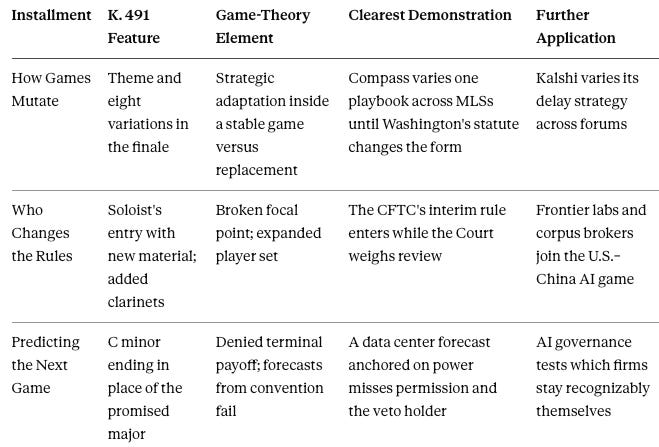
Each installment takes one feature of K. 491 as its lens and applies it to all five controversies. The table shows where the Mozart analogy does the most work.
How Games Mutate
How Games Mutate explains the forces that push contests to rewrite their rules, with Compass leading and Kalshi second. The installment applies the two-stage test and the four kinds of mutation to all five controversies and asks why actors persist with strategies built for an old game. The installment also separates legal-institutional from economic-strategic mutation and traces how Compass’s contested campaign preceded Washington’s statute, keeping sequence distinct from cause.
The installment carries Mozart Vision’s first question: why does a game become susceptible to change? Compass shows that pressure alone does not answer it, because repeated demands taught later targets to resist while a legislature changed the rule.
Who Changes the Rules
Who Changes the Rules identifies which institutions hold binding authority and how fast they move, with Kalshi leading and the U.S.–China AI competition second. The installment maps courts, agencies and legislatures across all five controversies, along with sovereigns and private enforcers. Kalshi carries the test of institutional clock speed, and the installment asks whether regulation migrates toward activity no instrument yet names.
The installment carries Mozart Vision’s second question: when does a prospective change become operative? The CFTC’s October 9 actions show why the line matters, because an interim final rule binds on publication while a proposed rule only signals direction.
Predicting the Next Game
Predicting the Next Game forecasts the replacement game in each controversy and who stays coherent, with AI data centers leading and AI governance second. The installment issues MindCast Foresight Simulation Predictions for all five controversies. The installment also examines how heterogeneous populations reorganize after replacement and which existing MindCast tools explain mutation, then returns to Mozart’s unresolved ending.
The installment carries Mozart Vision’s third question: how does the old game become the new one? Sportsbooks already running prediction-market products show why the answer matters, because one ruling could carry them into legal-betting states.
Takeaway. Each installment stands alone on one feature of K. 491 and one Mozart Vision question. The questions interact, so together the installments build one causal account from why to when to how.
VI. Dated Events Will Show Which Games Change First
The five controversies reach dated decision points over the next six months. Each event below shows whether a game is changing or holding.
November 9, 2026. Kalshi’s response to New Jersey’s petition is due in No. 26-299.
Late 2026. The CFTC’s interim final rule takes effect on Federal Register publication, and comments on both October 9 actions close 30 days after publication.
Late 2026. Compass has said it will file its own suit against CRMLS.
About December 10, 2026. ERCOT expects its initial data center audit filing, which bears on when Texas lifts or conditions its permit pause.
February 2027. California’s bill-introduction deadline shows whether the MLS dispute reaches the legislature.
2027 sessions. Oregon and other states take up data center cost allocation and moratorium proposals.
The dominant fork. The Supreme Court either takes up No. 26-299, asks the Solicitor General for the federal government’s views or denies review. Each path changes which institution governs prediction markets next.
Takeaway. The next six months supply the first observable tests of every mechanism the series examines.
Working With MindCast
MindCast AI applies the series’ method to a client’s own strategic contest. Each engagement answers the three questions the installments ask: why the client’s game could change, which institution can change it and when, and what the replacement game will reward.
An engagement delivers three outputs.
Actor and Constraint Map. The actors, institutions and binding constraints in the client’s contest, with each actor modeled as a Cognitive Digital Twin.
Simulation Predictions. MindCast Foresight Simulation Predictions for each plausible path, paired with the dated events that show which path is unfolding.
Strategy Test. The client’s options run against each replacement game before the client commits capital, filings or votes.
The five controversies show who engages and what they test.
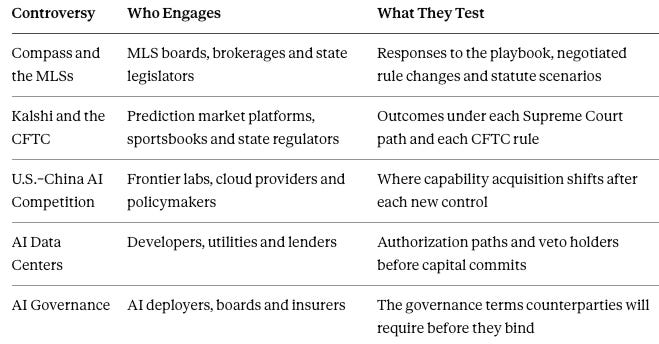
🏛️ Policymakers test how a statute or rule will move the whole population of affected firms before drafting closes.
💼 Executives test whether a winning playbook still works once opponents have learned it.
⚖️ Counsel test litigation and regulatory paths under each sequence of court and agency action.
📊 Investors identify which authority holds the binding constraint before capital commits.
Takeaway. MindCast tests a client’s strategy against the rules that may replace today’s, before those rules take effect. Engagements begin at mindcast-ai.com.
Appendix. Sources
MindCast Frameworks
Dynamic Predictive Game Theory Meets the Era of AI: Operationalizing Fudenberg’s Research Agenda with Cognitive Digital Twins (July 2026). Defines Adaptive Coherence Equilibrium and poses the moving-game question the series answers.
The Dual Nash-Stigler Equilibrium Architecture (January 2026). Supplies the closure conditions Mutation Equilibrium is tested against.
Chicago School Accelerated: The Integrated Modernized Framework of Chicago Law and Behavioral Economics(December 2025). Supplies the Coase and Becker logic for why rules move toward whoever values them most.
The Computational Era Operationalizes Cybernetics and Predictive Game Theory (May 2026). Supplies the Prediction Break Condition and the regime output classes.
Chicago’s Randal Picker Was Simulating Law and Economics Before AI (August 2026). Supplies equilibrium migration across populations.
MindCast Foresight Prediction Simulations, Synthesizing Behavioral Economics + Game Theory (August 2026). Makes the transition itself the forecast object.
Mozart’s Mirror: How K. 491 Reflects Romantic Complexity and the Architecture of Intelligence (June 2025). Reads K. 491 as three self-contained movements and supplies the design each installment follows.
The Mozart Effect 2.0: Cognitive Elegance as a Depth Assessment Paradigm (April 2025). Treats Mozart’s compositions as models of structured thought and grounds the series thesis.
The Duty to Foresee (June 2026). Supplies the AI governance argument that simulation is becoming a standard of care.
Primary Sources for Operative Facts
Supreme Court of the United States. Docket No. 26-299, Flaherty v. KalshiEX, LLC. Petition, extension and amicus record.
Commodity Futures Trading Commission. Release No. 9309-26 and Release No. 9310-26, October 9, 2026. Interim final rule and proposed rule.
Real Estate News. “CRMLS files suit against Compass over listing rules”, October 5, 2026.
Anthropic. “Statement on Fable and Mythos access”, June 12, 2026.
Greenberg Traurig. “AI company Anthropic suspends access to Claude Fable 5 and Claude Mythos 5 following US export control directive”, June 17, 2026.
Engadget. “US government allows Anthropic to redeploy its Mythos and Fable AI models”, June 30, 2026.
Cloud Security Alliance. “CISA Advisory: China’s Industrial-Scale AI Distillation Campaign”, September 18, 2026. Summary of joint advisory AA26-251A.
Foley & Lardner. “Governor Abbott pauses Texas data center interconnections and calls for verification and audit”, August 2026.
Troutman Pepper Locke. “Governor Abbott directs TCEQ to halt all data center permits pending ERCOT and TWDB audits”, September 22, 2026.
Washington State Legislature. SSB 6091 bill summary (2025–26). Senate vote 49–0 on February 10 and House vote 92–1 on March 3, 2026; Chapter 57, Laws of 2026.
External Sources
John von Neumann and Oskar Morgenstern. 1944. Theory of Games and Economic Behavior. Princeton University Press.
John Nash. 1950. “Equilibrium Points in N-Person Games.” Proceedings of the National Academy of Sciences 36 (1): 48–49.
John Nash. 1951. “Non-Cooperative Games.” Annals of Mathematics 54 (2): 286–295.
Thomas C. Schelling. 1960. The Strategy of Conflict. Harvard University Press.
Lloyd S. Shapley. 1953. “Stochastic Games.” Proceedings of the National Academy of Sciences 39 (10): 1095–1100.
Drew Fudenberg. 2011. “Predictive Game Theory.” SSRN Working Paper No. 1889146.
Drew Fudenberg and David K. Levine. 1998. The Theory of Learning in Games. MIT Press.
Robert E. Lucas Jr. 1976. “Econometric Policy Evaluation: A Critique.” Carnegie-Rochester Conference Series on Public Policy 1: 19–46.
William H. Riker. 1986. The Art of Political Manipulation. Yale University Press.
George Tsebelis. 2002. Veto Players: How Political Institutions Work. Princeton University Press.
Avner Greif and David D. Laitin. 2004. “A Theory of Endogenous Institutional Change.” American Political Science Review 98 (4): 633–652.
Avinash K. Dixit and Robert S. Pindyck. 1994. Investment Under Uncertainty. Princeton University Press.
Randal C. Picker. 1997. “Simple Games in a Complex World: A Generative Approach to the Adoption of Norms.” University of Chicago Law Review 64: 1225.