
Related publication: Cybernetic-Predictive Game Theory AI for Capital Allocators
Executive Summary
Three analytical traditions matter now in ways they could not matter before. Cybernetics studies how adaptive systems maintain stability, coordinate behavior, and adapt through recursive informational feedback — how a system stays standing while the conditions around it keep changing. Predictive game theory studies how strategic actors maneuver inside such systems while continuously modifying the systems themselves. Behavioral economics studies how those actors actually decide — under cognitive constraint, reference dependence, and information asymmetry rather than under utility-maximizing rationality. All three fields existed for decades without the operational substrate needed to apply them at institutional scale. The 2020s supplied the substrate.
Modern civilization crossed a threshold where institutions no longer operate as isolated actors moving through slow-moving systems. Governments, corporations, regulators, courts, artificial intelligence ecosystems, media networks, and markets now function inside tightly coupled adaptive environments governed by strategic interaction, recursive feedback, and accelerating informational latency. A regulatory action in Washington can alter semiconductor supply chains in Taiwan, affect AI infrastructure deployment in China, trigger litigation across multiple jurisdictions, reshape investor expectations globally, and influence geopolitical negotiations simultaneously — and the entire cascade can run faster than any single forum’s analytical capacity to track it.
Classical economics explained pricing. Classical game theory explained bounded strategic interaction. Neither framework fully modeled recursive institutional adaptation operating under computationally mediated feedback conditions — environments where AI systems compress decision latency from months into hours, where markets reprice before formal rules implement, and where strategic actors increasingly optimize against anticipated reactions rather than present conditions.
Classical game theory encountered a structural limitation first. Real-world institutional systems generated too much behavioral instability, too many interacting variables, too much recursive adaptation, and too much endogenous rule modification for static equilibrium analysis alone. Mid-twentieth-century cybernetics encountered a parallel limitation from the opposite direction. Early cybernetic theory recognized feedback loops, adaptive control, signal routing, and equilibrium stabilization as foundational mechanisms governing complex systems — yet limited computing power, fragmented telemetry, and insufficient network infrastructure prevented cybernetics from scaling beyond theory.
Modern AI infrastructure changed those conditions simultaneously. Real-time telemetry now exposes institutional behavior continuously through markets, social platforms, litigation filings, supply chains, geopolitical signaling, and AI ecosystems. Distributed compute enables recursive simulation, multi-agent forecasting, and adaptive scenario modeling at scales previously impossible. Geopolitical conflict increasingly revolves around adaptive infrastructure control. Innovation ecosystems increasingly compete through coordination architecture and feedback capture. Complex litigation increasingly behaves like multi-forum strategic warfare involving markets, regulators, media systems, and reputational equilibrium simultaneously.
MindCast argues that modern institutions increasingly operate as recursive cybernetic game systems rather than isolated rational actors. Cybernetics explains system behavior. Predictive game theory explains strategic adaptation inside recursive systems. Behavioral economics explains how the actors inside those systems actually decide. Artificial intelligence operationalizes all three frameworks at societal scale.
Governing Thesis: Computational civilization increasingly rewards institutions that can model, adapt to, and shape recursive feedback systems faster than competing actors.
I. Civilization Entered a Recursive Institutional Era
Modern institutions no longer operate inside relatively isolated environments. Governments, corporations, regulators, AI ecosystems, courts, media systems, and markets now interact continuously through recursive informational feedback loops. Institutional behavior therefore increasingly resembles adaptive systems competition rather than isolated transactional decision-making.
Feedback propagation speed changed the structure of strategic interaction itself. AI systems compress decision latency from months into hours. Social media ecosystems accelerate narrative feedback instantly. Algorithmic trading systems react before human verification occurs. Regulatory signaling affects markets prior to formal rule implementation. Strategic actors increasingly optimize against anticipated reactions rather than present conditions — and the actors who model anticipated reactions most accurately capture asymmetric advantage during the window between structural break and conventional registration of the break.
Modern civilization therefore behaves less like a linear economy and more like a recursive cybernetic environment governed by feedback control, latency management, adaptive coordination, narrative routing, equilibrium stabilization, institutional signaling, and strategic recursion. The analytical category equipped to read those dynamics is the analytical category positioned to deliver decision-relevant foresight in 2026.
II. Cybernetics Arrived Before Civilization Could Operationalize It
Cybernetics studies how adaptive systems maintain stability, coordinate behavior, and adapt through recursive informational feedback.
Cybernetics identified the governing architecture of adaptive systems decades before infrastructure existed to implement it. Early cyberneticians recognized that feedback governs system stability, adaptive control shapes behavior, signal routing determines coordination, recursive learning drives system evolution, and latency affects equilibrium stability. The insight was correct. The era could not operationalize it.
Mid-twentieth-century civilization lacked the technological substrate. Computing power remained primitive. Global networking infrastructure barely existed. Institutions generated limited telemetry. Behavioral data remained sparse. Real-time sensing systems did not operate at societal scale. Three convergence conditions failed simultaneously through the 1950s and 1960s: data availability below calibration threshold, computational capacity below decision-relevant scale, and modeling sophistication insufficient to integrate game theory, behavioral economics, and feedback control into one coherent framework. The Macy Conferences of 1946 to 1953 — Wiener, von Neumann, McCulloch, Mead, Bateson — aimed at a unified science of adaptive systems and reached the operational limits of mid-century compute. Cybernetics therefore remained intellectually influential but operationally constrained.
The Macy program did not fail intellectually. The program ran out of operational substrate. Seventy years later, the substrate arrived. Four developments inside the 2020s triggered all three convergence conditions simultaneously: AI-scale computation, continuous behavioral telemetry, hyperconnected institutional systems, and real-time adaptive simulation. Distributed compute, cloud-scale networking, AI-assisted pattern extraction, and hyperconnected information systems transformed cybernetic logic into operational strategic infrastructure. Modern institutions now generate continuous behavioral telemetry through digital markets, social platforms, litigation systems, supply-chain monitoring, AI ecosystems, geopolitical signaling, regulatory disclosures, and consumer behavior. Cybernetics therefore shifted from theoretical systems philosophy into practical institutional modeling. MindCast: Predictive Cybernetics Suite operationalizes the three-condition convergence and positions the current environment as the operational resumption of the Macy program.
III. Classical Game Theory Arrived Before Institutions Became Computationally Observable
Cybernetics arrived early and waited for the infrastructure. Classical game theory faced the opposite problem — arriving on time mathematically but without the institutional observability needed to populate its players or test its predictions.
Classical game theory emerged under slower informational conditions and more stable institutional architectures. Most strategic environments could still approximate bounded actors, relatively stable incentives, identifiable payoff structures, slower feedback cycles, and limited recursive adaptation. Von Neumann had the math and the machines. What classical game theory lacked was a way to populate its players with realistic cognition, select among competing equilibria, and carry strategic consequences across forums running on different clocks under different evidentiary standards. The post-Nash literature — Harsanyi-Selten refinements, Schelling focal points, Bayesian persuasion, mean-field dynamics — closed pieces of the gap and left the full integration unbuilt.
Behavioral economics supplied the cognition layer the rational-actor model could not. Herbert Simon’s bounded rationality (Nobel 1978), Daniel Kahneman and Amos Tversky’s prospect theory (Kahneman, Nobel 2002), George Akerlof, Michael Spence, and Joseph Stiglitz on asymmetric information (joint Nobel 2001), and Richard Thaler’s work on behavioral choice and nudge architecture (Nobel 2017) established that institutional actors operate under cognitive constraint, reference dependence, loss aversion, and information asymmetry rather than under utility-maximizing rationality.
The Chicago School ran a parallel track — Gary Becker extending economic analysis into non-market behavior, George Stigler operationalizing regulatory capture, Ronald Coase formalizing transaction cost economics, Richard Posner translating both into institutional design — producing a 50-year arc of behavioral and institutional realism inside the economics discipline.
Three Nobel cycles between 2001 and 2017 legitimized the analytical move the predictive cybernetic stack now requires: modeling actors as cognitively bounded, contextually adaptive, and institutionally embedded rather than as thin rational optimizers.
Behavioral economics provides the disciplinary foundation under every Cognitive Digital Twin (CDT) — the institutional behavioral model that encodes incentive structures, adaptation patterns, decision-making constraints, and reference-dependent choice architecture into a runtime-executable representation of how a specific institution actually decides under pressure. MindCast: Predictive Cognitive AI documents the full CDT methodology across the corpus.
Modern systems no longer operate under classical assumptions. Institutions now continuously adapt to one another through regulatory signaling, litigation sequencing, media narratives, investor expectations, AI-assisted forecasting, geopolitical positioning, ecosystem coordination, and platform governance. Strategic actors increasingly modify the game itself while participating inside it. Static equilibrium analysis therefore becomes insufficient.
MindCast: How MindCast Evolves the Structural Gaps in Classical Nash Game Theory models the core limitation directly: institutions dynamically mutate strategic environments while operating inside them, and strategic trajectories therefore matter more than static equilibrium snapshots. Recursive institutional systems require modeling path dependence, adaptive sequencing, coordination drift, latency asymmetries, reputational stabilization, equilibrium preservation, and strategic rerouting. Predictive game theory becomes necessary because modern strategic systems increasingly evolve during play.
Three lineages — cybernetics held back by operational substrate, classical game theory held back by institutional observability, and behavioral economics held back by computational capacity to scale its findings beyond laboratory and survey settings — converge in the 2020s on the same deliverable: falsifiable multi-agent institutional prediction under mechanism specification.
Contact mcai@mindcast-ai.com to partner with us on Predictive Game Theory AI in Law and Behavioral Economics. To deep dive on MindCast work in Cognitive AI upload the URL of this publication into any LLM (preferably Google AI mode) and prompt ‘reconstruct MindCast framework with three degrees of cited sub links.’ See Live-Fire Game Theory Simulators, Runtime Predictive Infrastructure.
IV. AI Activated Predictive Cybernetic Environments
Artificial intelligence accelerated the convergence between cybernetics and strategic interaction by compressing feedback cycles dramatically. Institutions previously operated across quarterly reporting cycles, annual regulatory reviews, multi-year litigation timelines, and slower geopolitical adaptation windows. AI-assisted systems now process behavioral signals continuously. Markets react before verification. Narrative shifts occur before formal adjudication. Regulatory positioning influences strategic behavior before enforcement actions occur. Simulation itself increasingly becomes part of the strategic game.
Organizations now model litigation outcomes, market responses, geopolitical escalation, regulatory intervention, consumer behavior, adversarial adaptation, and institutional throughput. MindCast: MindCast Predictive Game Theory vs. Predictive AI operationalizes the distinction between statistical extrapolation and recursive institutional behavioral simulation. The contrast between paradigms sharpens the differentiation:
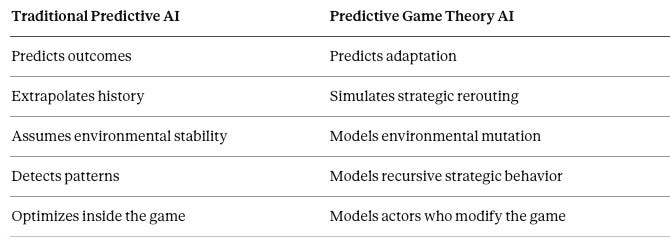
Historical-pattern prediction systems fail during regime shifts, narrative inversions, geopolitical fragmentation, structural discontinuities, and adaptive institutional conflict. Predictive cybernetic systems instead model how institutions adapt before visible outcomes emerge — institutional cognition, strategic adaptation, recursive feedback, equilibrium instability, coordination architecture, and adversarial rerouting.
The MindCast Prediction Break Condition
Linear statistical forecasting models invert from signal to noise at the threshold where constraint stability decays faster than actor adaptation speed:
Δtstability < ΔtadaptationΔtstability<Δtadaptation
Where Δt_stability denotes the duration over which the governing rules of an institutional system remain analytically stable, and Δt_adaptation denotes the speed at which strategic actors inside that system reconfigure their behavior in response to feedback.
In plain terms: prediction breaks when the rules of the system change faster than actors inside the system can stabilize against them.
Modern AI infrastructure finally enables predictive cybernetic modeling at scale. The MindCast runtime stack rests on four operational components, each addressing a specific failure mode of classical methods:
Cognitive Digital Twins apply that behavioral foundation operationally — encoding the internal architecture of institutions as runtime-executable representations and replacing the thin rational-actor assumption of classical game theory with thick behavioral models drawn from behavioral economics (Simon, Kahneman, Tversky, Thaler) and Chicago School institutional analysis (Becker, Stigler, Coase, Posner) that respond to strategic pressure the way real institutions do.
Causal Signal Integrity (CSI) filters credible structural shifts from advocacy noise and narrative momentum before any signal enters simulation, separating genuine causal claims from politically forced ones.
Vision Functions update simulations recursively as new signals enter the system, replicating institutional adaptation rather than producing static forecasts.
Falsification Contracts pre-commit time horizons and disconfirmation conditions before outcomes resolve, converting predictions into testable claims rather than retrospective rationalizations.
MindCast: Predictive Institutional Cybernetics operationalizes the full runtime stack.
The differentiation from frontier AI development matters here. Current large-scale AI systems optimize for prediction inside environments while lacking architectures for modeling recursive institutional adaptation across heterogeneous governance systems. Frontier AI detects patterns well and models institutions poorly. The runtime components above address that gap directly — not by training larger models on more historical data, but by encoding the structural mechanism through which institutions actually adapt.
V. Geopolitical Competition Increasingly Revolves Around Adaptive System Control
Geopolitical conflict increasingly centers on control over adaptive infrastructure rather than traditional industrial scale alone. Semiconductor chokepoints, AI compute restrictions, cloud infrastructure, payment systems, rare-earth supply chains, digital standards, and information-routing architectures now function as strategic cybernetic infrastructure. States increasingly compete over throughput, latency, ecosystem lock-in, supply-chain synchronization, AI capability asymmetry, adaptive coordination speed, and feedback control. Strategic advantage increasingly depends on institutional adaptability rather than static resource accumulation.
The H200 Asynchronous Gate Architecture. The United States-China technology competition illustrates the pattern in compressed form. Export controls (federal executive), allied coordination (multilateral), domestic legislation (Congress), enforcement (Department of Justice and Commerce), market repricing (equities and commodities), and adversary response (Beijing customs and licensing) operate across six forums, six clocks, continuous rule mutation, and contested terrain extending across semiconductor capital equipment, quantum infrastructure, AI compute, rare earths, and biotechnology. The H200 case captures the architecture: a United States export gate and a Chinese import gate operating asynchronously produced an outcome no single-forum model predicted, and the dual-gate equilibrium settled at a Two-Gate Control Index of 0.28 with neither side controlling the transaction alone. MindCast: China H200 Two-Gate Gameoperationalizes the cross-forum reading and publishes the dual-gate metric architecture under a falsification contract.
MindCast: Cybernetic Game Theory models feedback latency, strategic timing, and narrative routing as the variables increasingly dominating raw payoff optimization. Modern geopolitical systems operate through recursive signaling environments where export controls alter AI development trajectories globally, AI ecosystems reshape military planning, semiconductor access affects national innovation throughput, and regulatory coordination influences capital formation and technological diffusion simultaneously. Cybernetic modeling therefore becomes necessary because modern geopolitical systems operate as adaptive feedback architectures rather than static state actors.
VI. Innovation Ecosystems Became Strategic Coordination Systems
Innovation increasingly depends on coordination architecture rather than isolated invention. AI ecosystems, cloud infrastructure, semiconductor alliances, payment rails, defense platforms, and digital standards now compete through ecosystem synchronization, strategic interoperability, developer lock-in, platform governance, adaptive coordination, network-effect stabilization, and feedback capture. Superior technology alone no longer guarantees dominance. Adaptive coordination increasingly determines market leadership.
The Control Layer Architecture. The contested terrain has moved from which product wins to which control layer governs the rest. NVIDIA NVQLink emerged as the inference-control layer that determines how quantum compute integrates with classical pipelines. Kalshi emerged as the federal-preemption test case for the entire crypto regulatory architecture. Compass emerged as the narrative-control architecture test case for platform behavior across multi-sided markets. In each case the strategic object is the field rather than the move, and the value captured by early architectural positioning compounds across every subsequent decision cycle inside that field.
Constraint geometry — the metric architecture that measures how institutional curvature forms, how fast it moves, where it stabilizes, and what force is required to escape it — reads fields rather than moves. MindCast: Field-Geometry Reasoning and MindCast: Constraint Geometry and Institutional Field Dynamics operationalize the field-reading architecture with falsification conditions attached to each metric. Innovation ecosystems increasingly reward organizations capable of compressing feedback latency, stabilizing ecosystem trust, coordinating adaptive actors, routing strategic information effectively, and preserving equilibrium during disruption. Cybernetics therefore increasingly governs innovation itself.
VII. Complex Litigation Increasingly Functions as Recursive Strategic Warfare
Large litigation ecosystems rarely remain confined to statutes, judicial doctrine, or evidentiary records alone. Modern litigation increasingly involves regulatory signaling, investor coordination, media narrative shaping, reputational pressure, timing manipulation, forum fragmentation, public legitimacy management, and strategic disclosure sequencing. Plaintiffs, defendants, regulators, investors, journalists, political actors, and counterparties continuously adapt to one another recursively. Strategic actors increasingly compete to control institutional feedback loops rather than merely prevail on legal doctrine. Complex litigation therefore behaves more like adaptive cybernetic conflict than isolated legal adjudication.
The Kalshi Delay-Dominant Architecture. The Kalshi prediction-market litigation demonstrates the pattern in real time across Ninth Circuit, Third Circuit, parallel state enforcement, and Department of Justice Supremacy Clause tracks. The platform does not litigate to win the existing rule — Kalshi litigates to extend the timeline until the rule changes. MindCast: The Ninth Circuit, Kalshi and the First Measurable Test of Prediction Market Structure operationalizes sixteen CDT predictions across four enforcement tracks with explicit falsification contracts.
The Compass Failure Mode. Compass deployed the same delay-dominant playbook against the Northwest Multiple Listing Service and produced the corpus’s cleanest recursive cybernetic failure mode — a strategic weapon turning instantly into a systemic constraint. The federal complaint Compass filed to press its antitrust claims activated the feedback loop that disciplined Compass’s own conduct. Federal complaints are public records. Sworn chief executive officer testimony is subpoenable. Legislative drafters read court filings, and Washington State’s SSB 6091 codified at 141 to 1 the operative definition of “public marketing” that Compass’s federal complaint had drafted with billable precision. The litigation generated the admissions, the legislation codified the definitions, the constraint geometry closed the exits, and the parallel enforcement mechanism activated when private governance could not reach far enough. MindCast: SSB 6091 Cross-Forum Analysis operationalizes the cross-forum synthesis seven months before institutional convergence. MindCast: The Law and Behavioral Economics of Compass vs. NWMLS models the full self-inflicted-feedback-loop architecture.
Cybernetic systems optimize for equilibrium preservation, legitimacy maintenance, feedback stabilization, reputational survivability, and adaptive coordination. Institutional behavior that appears irrational externally often remains internally coherent once modeled through cybernetic equilibrium preservation. Predictive game theory becomes critical because institutional actors continuously modify strategy based on anticipated downstream reactions across regulators, investors, courts, media ecosystems, counterparties, and political environments. Modern litigation therefore increasingly requires recursive strategic modeling rather than isolated doctrinal analysis.
VIII. MindCast and the Emergence of Predictive Institutional Cybernetics
MindCast publications collectively model modern civilization as a computationally mediated adaptive system. Four foundational works establish the theoretical architecture — MindCast: How MindCast Evolves the Structural Gaps in Classical Nash Game Theory (five chained gaps in classical Nash analysis), MindCast: MindCast Predictive Game Theory vs. Predictive AI (the break condition where pattern extrapolation inverts from signal to noise), MindCast: Cybernetic Game Theory (the four mechanisms governing modern institutional outcomes), and MindCast: Predictive Cybernetics Suite (the unified runtime architecture).
The applied framework suite operationalizes the architecture across institutional domains. MindCast: MindCast AI Emergent Game Theory Frameworks assembles five operational frameworks under one analytical engine:
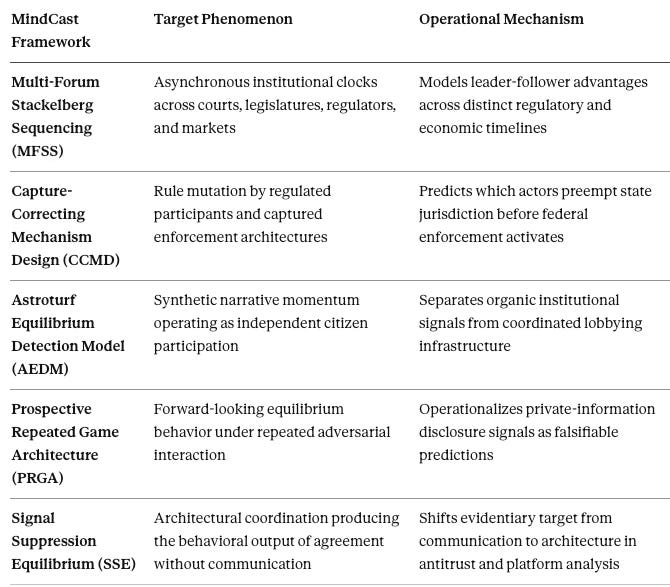
Combined together, the foundational works and the framework suite operationalize a broader thesis: modern institutions increasingly behave as recursive cybernetic game systems competing through feedback control, strategic adaptation, narrative routing, legitimacy preservation, timing asymmetry, coordination architecture, and equilibrium stabilization. Cybernetics explains system behavior. Predictive game theory explains strategic adaptation inside recursive systems. Behavioral economics explains how the actors inside those systems actually decide. Artificial intelligence operationalizes all three frameworks at societal scale.
IX. From Doctrine to Runtime
Doctrine establishes a category. A runtime module executes inside it. The vision statement above operates at the doctrinal layer — defining why predictive institutional cybernetics matters, where the analytical break occurs, and which mechanisms govern the operating regime of 2026. The operational engine sits one layer below, converting doctrine into executable infrastructure.
The MindCast Predictive Institutional Cybernetics Module ingests institutional signals through a defined intake schema, scores them through Causal Signal Integrity filtering, maps actor-forum topology against cross-forum density and feedback latency, tests constraint stability against actor adaptation speed, classifies the resulting game regime, routes the signal to the relevant Cognitive Digital Twin, generates a foresight output, attaches a falsification contract, and feeds post-outcome calibration back into the system. Twelve sequential operations executing on every incoming signal. The module produces standardized output classes — Stable Equilibrium, Adaptive Drift, Delay-Dominant Game, Field-Control Contest, Recursive Feedback Trap, Rule-Mutation Break, Multi-Forum Cascade — each carrying explicit disconfirmation conditions and leading-indicator specifications.
The doctrine-to-runtime distinction matters operationally. A reader of the vision statement learns why the analytical category exists. A user of the runtime module receives executable foresight outputs against a specified institutional signal — actor, forum, signal type, timestamp, constraint, counterparty, claimed mechanism, observable consequence — under a falsification contract that pre-commits the time horizon and disconfirmation condition before the outcome resolves. A reader engages the vision statement. An operator invokes the runtime module.
MindCast: Predictive Institutional Cybernetics Module — Runtime Specification documents the full intake schema, state variable parameterization, threshold conditions, transformation logic, output taxonomy, falsification contract template, and post-outcome calibration loop. Both documents publish in the MindCast Cybernetic-Predictive Game Theory series — doctrine and runtime sitting as parallel publications inside the same analytical architecture.
X. Conclusion
Three structural conditions chain into the operating regime that makes the analytical category important now. Cross-forum density creates the heterogeneous-clock problem — single-forum analysis breaks under asynchronous systems where institutions move on different clocks and strategic advantage emerges inside timing gaps. Rule mutation outpacing analysis creates the timing problem — pattern-extrapolation methods cross the threshold where their training distributions no longer cover the test distributions they face. Innovation-as-architecture creates the field problem — the strategic object becomes the control layer rather than the move inside the layer. Each condition alone would be analytically inconvenient. All three together break the operating envelope of methods built for stable single-forum environments with product-centered innovation.
Cybernetics matters now because modern institutions finally became sufficiently observable, connected, computationally mediated, and behaviorally measurable for recursive systems modeling to become operationally feasible. Predictive game theory matters now because strategic actors increasingly modify the game itself while participating inside it. Behavioral economics matters now because the three Nobel cycles since 2001 establish — and AI infrastructure can finally encode at institutional scale — that real actors decide under cognitive constraint, reference dependence, and information asymmetry rather than under utility-maximizing rationality. The analytical category equipped to read asynchronous multi-forum systems under rule mutation, where the strategic object is the field rather than the move and the actors inside are cognitively bounded rather than thinly rational, matches the structural shape of 2026 high-stakes decision environments.
Computational civilization increases recursive complexity beyond the capacity of static analytical methods. Institutions function as cybernetic environments operating under continuous feedback pressure. Predictive infrastructure becomes mandatory rather than optional for high-stakes decision-making. Organizations unable to model adaptive systems will progressively lose strategic capacity to organizations that can. Modern civilization increasingly functions as a recursive cybernetic game environment, and cybernetics, predictive game theory, and behavioral economics therefore no longer operate as abstract academic frameworks. All three increasingly function as operational infrastructure for understanding institutional behavior under computational conditions.
MindCast either meets the falsification standard or does not publish.