
Executive Summary
Core insight: A compliance control does the most for a US firm while the preventive window it answers is still open. Once an indictment names a channel partner or a filing quotes a compliance statement, that window closes. Later audits and corrections can still shape remedies and penalties, but they cannot change the earlier evidence.
Thesis: Super Micro’s preventive window on its two vendor clocks closed in March 2026 on an indictment and a securities complaint, not on any new rule. For every US firm not yet named, two exposures turn on dated forks: November 10 for ownership and January 3 for tenant rules. The financier exposure has no scheduled closing date at all.
What distinguishes MindCast: The war game holds the Snapshot’s Cognitive Digital Twins fixed and changes one US firm’s move at a time. The difference between the replay and the alternative is the finding. A legal memo says whether a firm is exposed, while a war game shows which move on which date would have kept the exposure from forming.
What the paper does: Sections I and II state the governing rule and date five exposures. Sections III and IV replay six turns and play five alternative moves against the same board. Section V isolates the trade still open, and Section VI carries the result to each US firm type. The paper closes with competing hypotheses, seven carried Simulation Predictions, a Risk Mitigation Layer and dated observables.
🏛️ Policymakers: Each new instrument lands on the nearest US firm, while most displaced demand moves to domestic Chinese chips. Reward verification adopted before a rule, because verification adopted after an indictment proves only that the firm could have acted.
💼 Executives: Verification bought before a closing date reduces exposure. Bought after it, the same program becomes a feasibility exhibit in someone else’s complaint.
⚖️ Counsel: Compliance statements reviewed against reseller audits decide whether a disclosure count exists at all. Ownership maps finished before November 10 decide whether a voluntary self-disclosure is a choice or a scramble.
📊 Investors: Read a US hardware or hosting firm’s exposure as five separate clocks. Two of them turn on forks inside the next ten weeks.
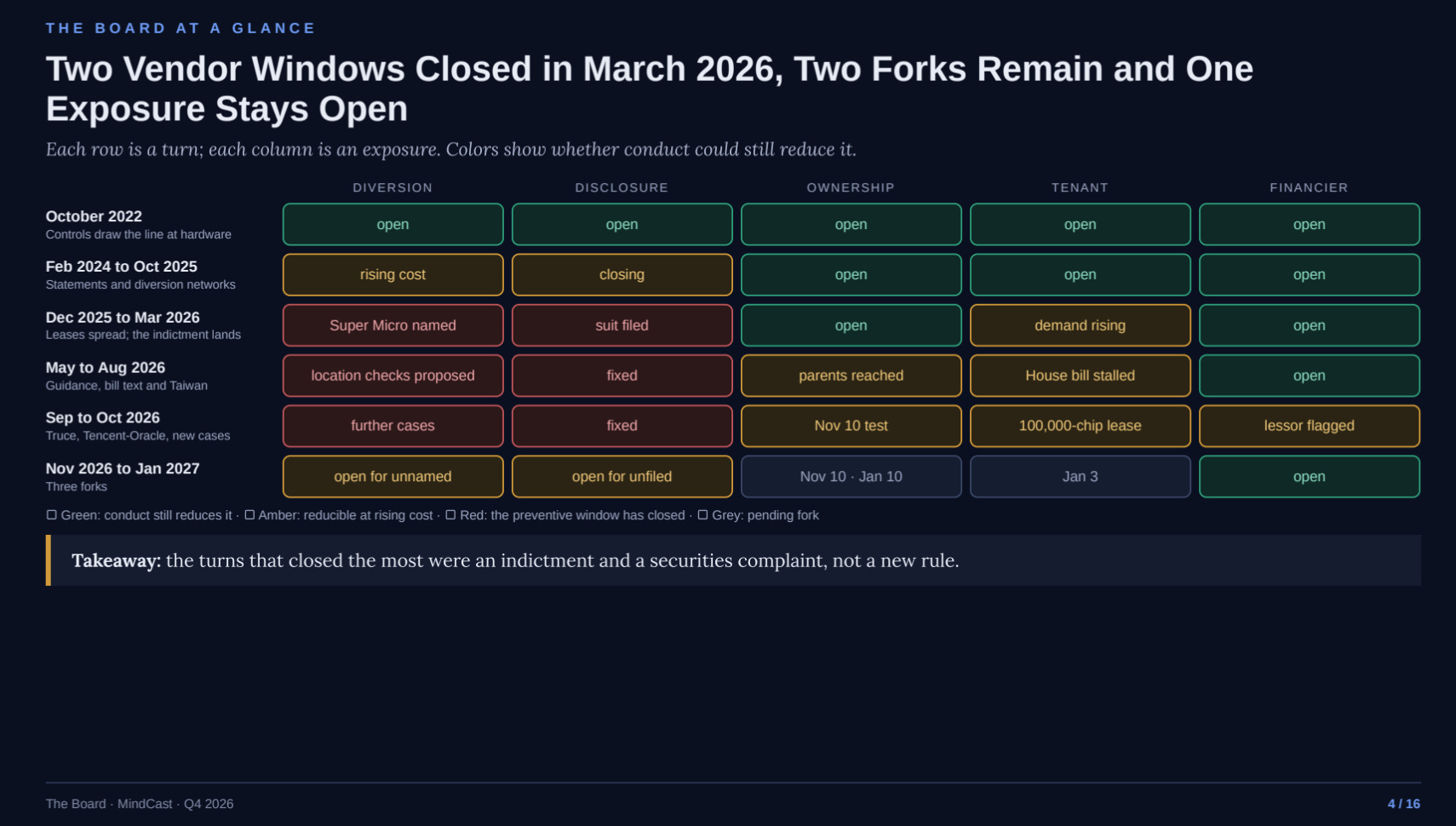
Takeaway: the war game finds two dated forks and one open-ended exposure, which makes timing the control US firms still hold.
How the War Game Works
MindCast AI applies Predictive Behavioral Economics + Dynamic Game Theory through MindCast AI Proprietary Cognitive Digital Twin Foresight Simulations (MP CDT FS). Behavioral Economics supplies the decision rules. Game Theory supplies the payoff structure. Predictive simulations emerge from the combination.
Cognitive Digital Twins: Each actor on the board is a Cognitive Digital Twin (CDT) built from its own filings and conduct. The enforcers are the Justice Department and the Bureau of Industry and Security (BIS). Congress, the White House trade team and Taiwan’s regulators move the rules. China-parented tenants and financiers choose the routes.
The US vendors, hosts and lenders whose seats the reader plays complete the set. The war game reuses the Snapshot’s Cognitive Digital Twins without changing their decision rules.
Predictive Behavioral Economics: Prosecutors anchor on a server crossing a border because invoices and customs papers prove the case. A named US company is the most salient defendant available. A fact finder reads a written compliance statement through hindsight, so the dated statement outweighs the later audit.
Dynamic Game Theory: A case against a US firm costs an enforcer little, while a case against an offshore tenant is unavailable. China-parented buyers choose the route with the lowest expected penalty. Cooperation credit goes to a firm that discloses its own violations before the government finds them, so delay forfeits the discount.
Takeaway: the reader changes one move, and the same enforcers, tenants and legislators respond under the same rules.
I. Verification Buys the Most Before the Closing Event
The rule follows from how export enforcement reads evidence. A control adopted before any indictment gives the firm evidence on the knowledge question. After a partner is charged, the same audit can still support remediation, but it can no longer change what the firm checked beforehand. Enforcement weighs the gap between what a firm could have known and what it checked.
Gary Becker’s Crime and Punishment: An Economic Approach (1968) sets the expected penalty as detection probability times sanction. Both terms are rising for US firms. Detection now reaches co-founders and channel staff, and the plaintiffs’ bar converts each indictment into a securities claim.
A reseller audit completed before the indictment cuts the violations the detection term can find and earns mitigation on the sanction. Completed after it, the audit bears mainly on the sanction.
Not every exposure turns on conduct alone. A disclosure count turns on what the company said, and an ownership exposure turns on whether BIS publishes a notice. No audit completed later undoes a statement already filed.
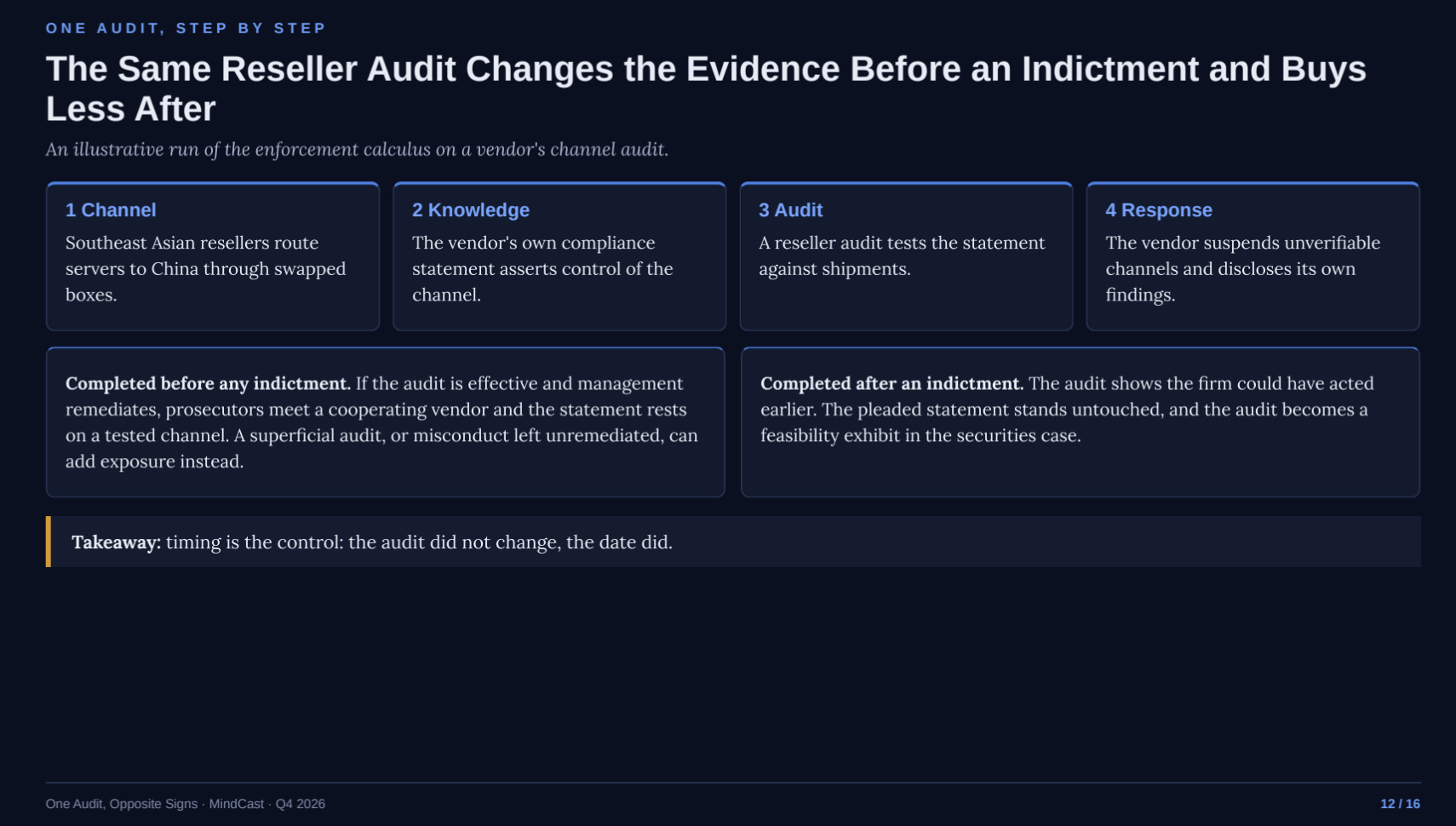
Takeaway: timing is the control, and the same program that builds evidence before a closing event buys less after it.
II. US Firms Carry Five Exposures, and Each Closes on Its Own Date
Each clock carries two dates: when the exposure originates and when a particular preventive move stops being available. Penalties, remedies and corporate liability stay contestable after the second date. Each of the five clocks below belongs to a different US firm type.
Diversion: The question is whether a vendor’s servers reached China through its own channel partners. The exposure originates when servers move through the channel. The preventive window for Super Micro closed on March 19, 2026, when prosecutors charged co-founder Wally Liaw over about $2.5 billion in servers (Robbins Geller). The indictment raised prosecution and disclosure risk without establishing corporate knowledge.
Disclosure: The question is whether a vendor’s public statements matched its controls. Super Micro investors plead the company’s statement that it followed all US export control requirements (Bernstein Litowitz).
The disclosure exposure originated when the statements were made. The statements cannot change, though later correction and remediation can still affect liability and remedies.
Ownership: The question is whether an exporter’s customers sit within 50% ownership of a listed party. The legal date is November 10, set by the 2025 suspension rule unless BIS posts a notice first, and BIS had posted none as of October 22 (Pillsbury). January 10 is the diplomatic deadline that can move the legal date. The preventive window runs until the rule applies.
Tenant: The question is whether a host’s offshore leases survive a rule on remote access by China-parented tenants. Tencent leases about 100,000 accelerators from Oracle in Southeast Asia (Network World). January 3 is the legislative deadline for the authority. Any host compliance duty would begin later, when a rule takes effect.
Financier: The question is whether a lender or exporter can trace who paid for restricted hardware. A state-controlled lessor financed restricted Blackwell servers and then redacted hardware details from its filings (TFTC). No current instrument names the financier alone, though sanctions, ownership rules and contract terms may already reach the relationship. The exposure has no scheduled closing date.
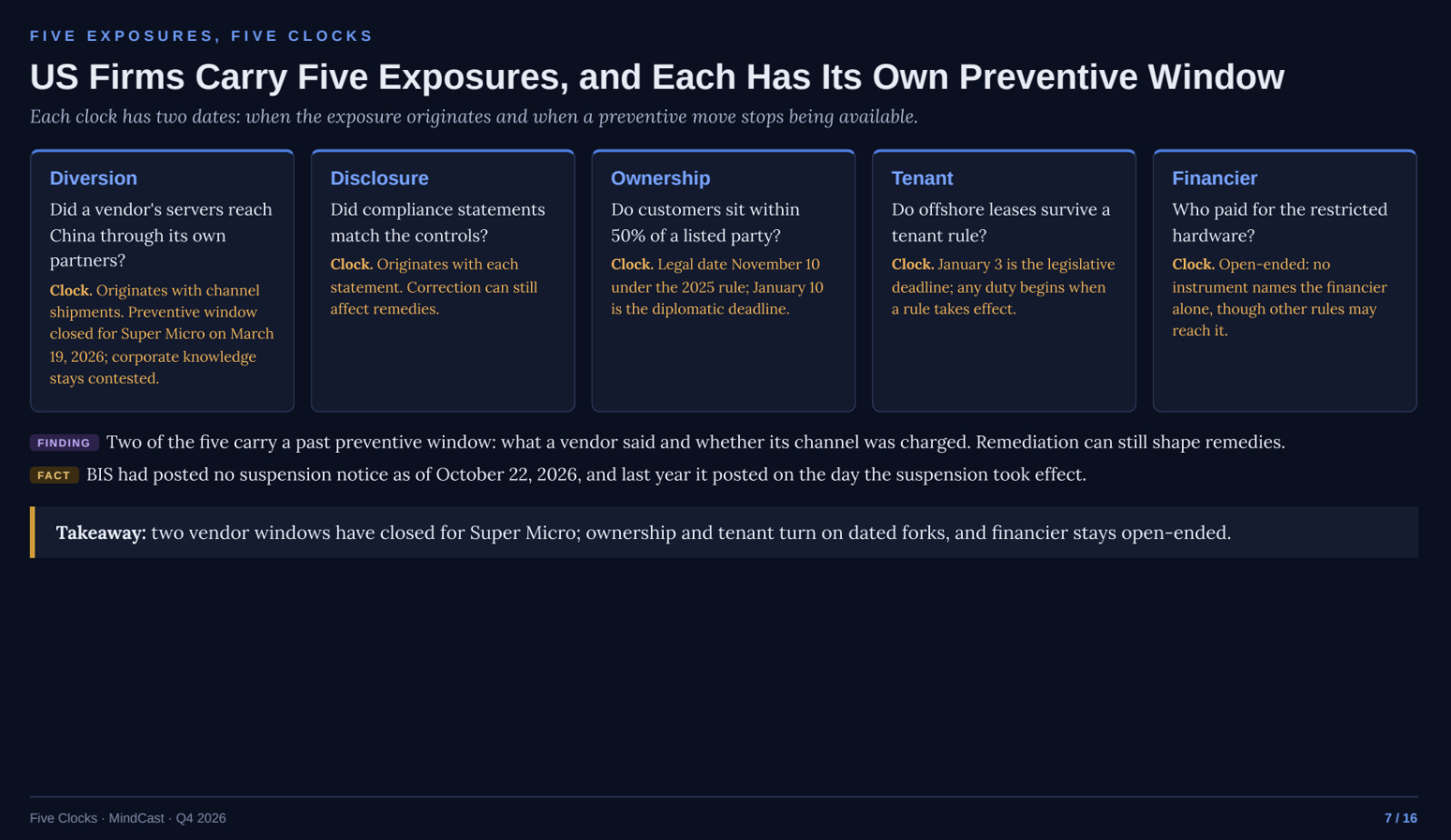
Takeaway: two vendor windows closed for Super Micro in March, two exposures turn on dated forks and the financier exposure stays open-ended.
III. Six Turns From the 2022 Controls to the January Forks
The replay steps through six dated turns. The clock states by turn come first, and each turn below then names what US firms did, the response of the opposing Cognitive Digital Twins and the state of the five clocks afterward.
October 2022: all five clocks open.
February 2024 to October 2025: diversion at rising cost and disclosure closing. Ownership, tenant and financier open.
December 2025 to March 2026: diversion and disclosure windows closed for Super Micro. Tenant demand rising. Ownership and financier open.
May to August 2026: location checks proposed on diversion, and disclosure closed. Ownership reaches parents, and the House tenant bill stalls in the Senate. Financier open.
September to October 2026: further diversion cases, and disclosure closed. Ownership faces the November 10 test, and a 100,000-chip lease lands on the tenant clock. The financier clock flags a lessor.
November 2026 to January 2027: diversion open for unnamed vendors and disclosure open for unfiled vendors. Ownership turns on the November 10 legal date and tenant on the January 3 deadline. Financier open-ended.
Turn 1 · October 2022 · The controls draw the line at hardware: The advanced computing controls made a shipped server the object of enforcement. Hardware became reachable while access, finance and model outputs stayed out of reach. All five clocks opened at low cost, because no channel partner had yet been charged.
Turn 2 · February 2024 to October 2025 · Statements and diversion networks: Super Micro told investors it followed all US export control requirements, starting the period its investors now plead. Hao Global and its owner exported or attempted to export at least $160 million in Nvidia processors before pleading guilty in October 2025 (Justice Department). The disclosure clock began closing with each statement, and the diversion clock moved to rising cost.
Turn 3 · December 2025 to March 2026 · Leases spread and the indictment lands: Tencent took most of Datasection’s 15,000 Blackwell accelerators in Japan, as the Financial Times reported in December 2025 (3DNews, citing the Financial Times). Beijing blocked H200 imports in January, and ByteDance arranged about 36,000 B200 chips in Malaysia (The Decoder). The Liaw indictment on March 19 closed the preventive window on both vendor clocks for Super Micro, and shares fell 33% the next day.
Turn 4 · May to August 2026 · Guidance, bill text and Taiwan: BIS guidance of May 31 reached entities owned by an ultimate parent headquartered in China (Greenberg Traurig). The Senate’s defense-bill text added the AI OVERWATCH Act and the Chip Security Act (Senator Banks). Taiwan indicted nine people over 74 B300 servers in August, including Nvidia and Super Micro staff (Al Jazeera). Super Micro’s own investigation found no evidence that current senior management knew of the scheme (Super Micro).
Turn 5 · September to October 2026 · Truce, a 100,000-chip lease and new cases: Treasury Secretary Scott Bessent announced on September 23 that the trade truce runs to January 10 (Pillsbury). The Tencent-Oracle lease surfaced on September 30, and prosecutors arrested Greg Lui of Earthmade Computer on October 1 over about $300 million in servers (Bloomberg Law). Taiwan announced a criminal control-list route on October 16. The tenant and financier clocks rose without any court acting.
Turn 6 · November 2026 to January 2027 · Three forks: BIS either posts the suspension notice by November 10 or the Affiliates Rule returns by default. Congress either enacts remote-access authority by January 3 or lets it lapse, and the truce deadline falls on January 10. In the Snapshot simulation, the suspension holding with no statute is the largest single state at about 40% of outcomes.
Takeaway: each turn moved at least one clock, and the turns that closed the most were an indictment and a securities complaint, not a new rule.
IV. Five Alternative Moves and How the Board Responds
Play mode changes one US firm move and runs the same enforcers, legislators and tenants against it. Each alternative below states the move, the turn, what it changes and its cost tier. The alternatives are exploratory moves played against the Snapshot’s Cognitive Digital Twins; only the Simulation Predictions in Section VIII carry odds.
Each alternative changes the evidence and the mitigation available, not the outcome of any proceeding. An audit helps only if it is effective and management remediates what it finds. A superficial audit, or one that uncovers misconduct left unremediated, can add exposure instead.
Alternative 1 · A vendor audits its Southeast Asian resellers and suspends unverifiable channels (Turn 2): If the audit is effective and the vendor remediates, prosecutors meet a cooperating vendor instead of a silent one. The compliance statement would rest on a tested channel, which weakens the pleaded misstatement without guaranteeing dismissal. Cost tier: high, from audit labor and suspended-channel revenue.
Alternative 2 · A vendor reconciles its compliance statements to its reseller audit before the annual report (Turn 2): The statement would match what the firm knew, which narrows the pleaded misstatement; a court still decides whether any count survives. The diversion clock still runs on the channel’s conduct. Cost tier: low to medium, from legal review.
Alternative 3 · A host writes transition, suspension and workload-visibility clauses into China-parented leases (Turn 5): The host gains visibility and suspension rights, so it can sort eligible from ineligible workloads under any rule. Whether a tenancy survives still depends on the rule and the tenant’s eligibility: service continues, continues under a license or modified terms, or ends. Cost tier: medium, from renegotiation and tenants who refuse or relocate.
Alternative 4 · An exporter maps customer ownership to 50% and prepares a voluntary self-disclosure decision (Turn 6): The ownership clock would convert from a surprise into a scheduled decision. If BIS misses its notice, the exporter licenses or exits affiliate sales on November 10 instead of discovering them later. Cost tier: medium, from diligence labor on paths where the suspension holds.
Alternative 5 · A lender traces four roles per China-linked counterparty and keys covenants to tenant eligibility (Turn 5): The four roles are the financier, the legal owner, the operator and the user. The lender gains credit and ownership visibility, and refinancing can rest on cash flows that survive a rule change. Cost tier: low to medium, from data access and credit review.
Two actual moves deepened exposure. Super Micro’s compliance statements gave plaintiffs a dated quotation to plead against the indictment. Oracle’s acceptance of a reported upfront payment of about 30% ties host revenue to a tenant a rule could convert (TechRepublic).
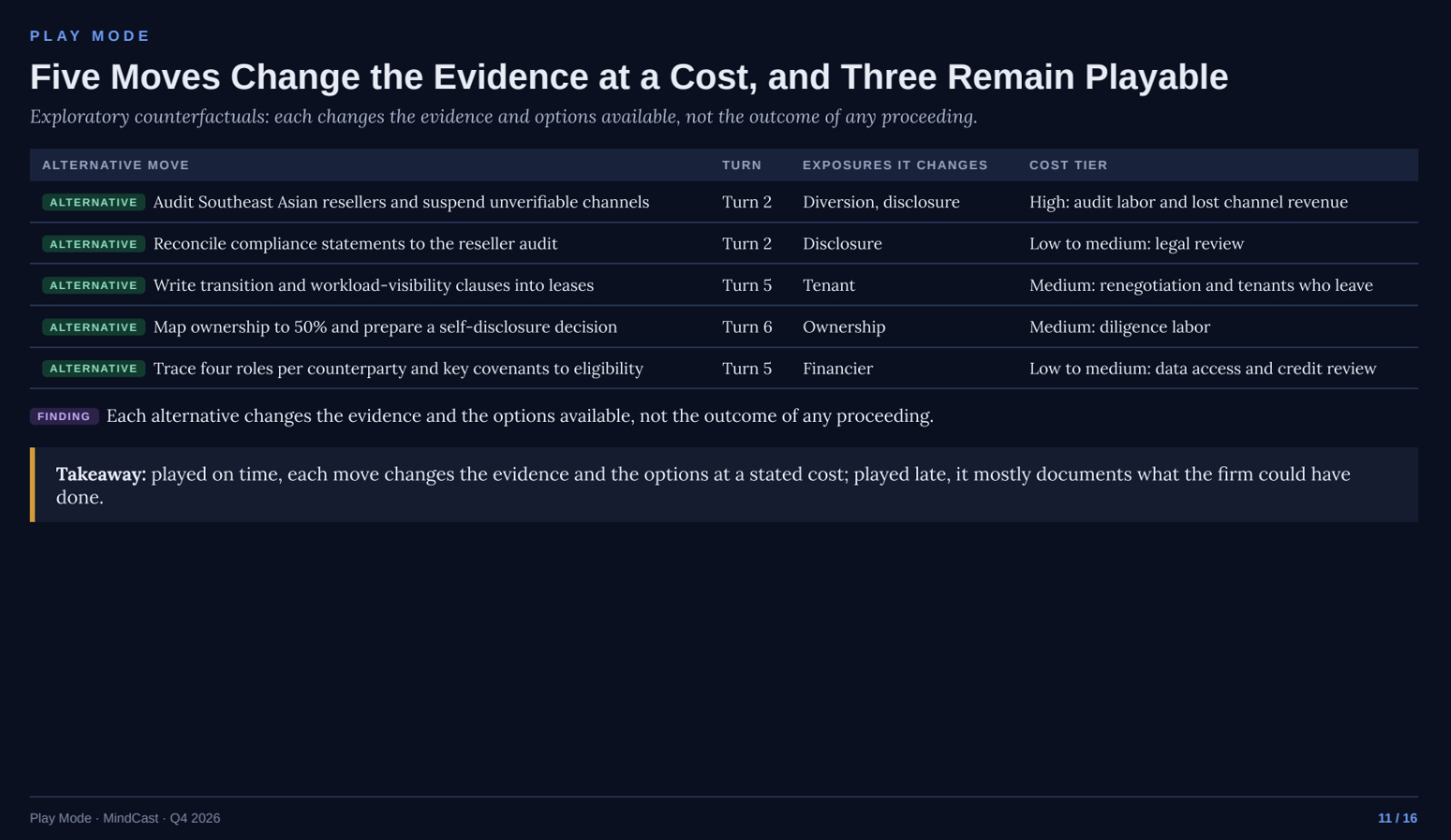
Takeaway: played on time, each alternative changes the evidence and the options at a stated cost; played after the closing event, the same move mostly documents what the firm could have done.
V. Tenant Verification Before January 3 Is the Exposure Most Open to Conduct
The tenant clock measures whether a host’s offshore leases survive a rule on remote access. A host’s chip supply already turns on its tenants through license conditions and Entity List designations. The host controls one input to that clock: whether it verifies tenants before a rule requires it.
Tenant verification adopted before January 3 trades compliance work now for the ability to sort tenants when a rule arrives.
The Snapshot published the result by path. If the suspension continues and remote-access authority lapses, verified firms gain little immediate edge but carry no conversion cost. If the Affiliates Rule returns or Congress enacts the authority, verified firms can continue, license or end each tenancy in order. Unverified competitors face the same choices without the information.
The trade is real on both sides. Verification turns away some ineligible customers now, and the Snapshot puts enactment by January 3 at 20% against 80% for lapse. The net sign turns on how long a host expects to hold China-parented tenants, which makes lease terms the timing variable.
Tencent, Oracle, and the Remote-Access Gap in US AI Chip Export Controls mapped the authorities over rented compute. The paper matters here because it shows which tool reaches the host first.
⚖️ Counsel: The verification trade belongs in the lease amendment decision, alongside its effect on renewal terms.
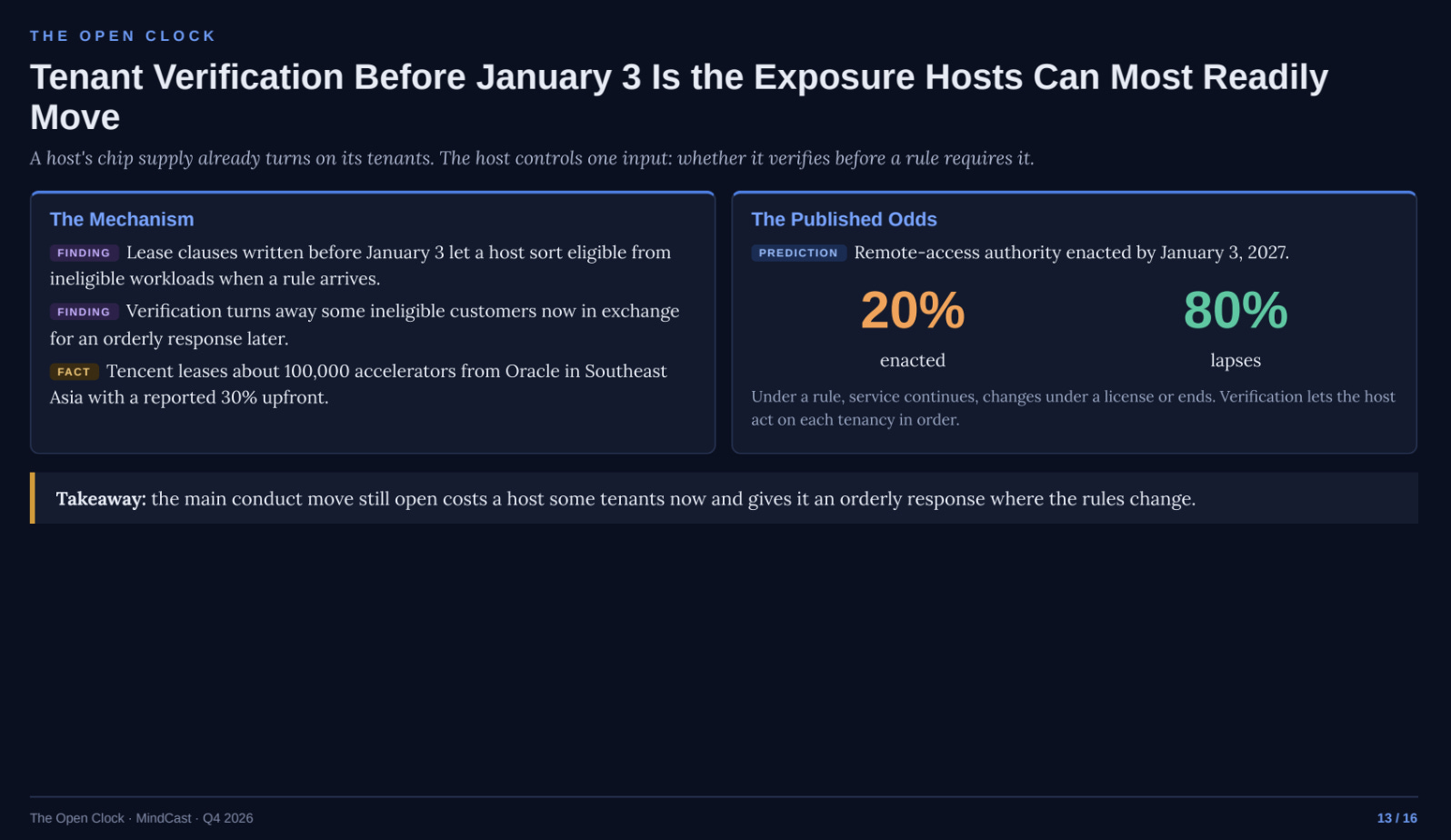
Takeaway: the main conduct move still open costs a host some tenants now and gives it an orderly response on the two paths where the game evolves.
VI. What the War Game Means for Vendors, Hosts, Exporters and Lenders
The board generalizes to any US firm in the export chain. Each firm type carries its own clock, and each clock closes on a public event that can be dated in advance. A control bought after the closing event buys a narrower remedy and a better file, not protection from the exposure.
💼 Chip vendors and server makers: The preventive window on diversion and disclosure closes on someone else’s indictment. Super Micro’s investigation found no management knowledge, yet the company still carries a June grand jury subpoena and a March 2027 trial date in its partner’s case (Fortune via edgeX). Location-verification text in the defense bill would add a duty that lands on the vendor.
💼 Cloud hosts and data center operators: The tenant clock is the only one still open at low cost for most hosts. Lease clauses written before January 3 decide whether a host can respond to a tenant rule in order. The rule and the tenant’s eligibility decide whether service continues.
⚖️ Exporters and their counsel: The legal date is November 10 under the 2025 rule, and January 10 is the diplomatic deadline that can move it. Last year BIS posted the suspension for public inspection on the day it took effect (BIS notice), so diligence that waits for the notice waits until the last day.
📊 Lenders and lessors: The financier exposure stays open-ended because no instrument names the financier alone, though sanctions and ownership rules may already reach the relationship. Rental hosts buy their own hardware, so state lessors finance shipped hardware far more than rented capacity. A lender that maps four roles per counterparty measures a risk that a designation would otherwise reveal.
Takeaway: controls sold without a date sell documentation, while controls keyed to a dated clock sell a lower exposure the firm can verify.
VII. Competing Hypotheses
Three explanations compete for how US firm controls affect export enforcement exposure. Each carries its own falsifier and each is stated before the forecast set.
Hypothesis A · Controls reduce exposure at any date. Audits and verification lower exposure whenever adopted. Falsifier: a corporate-level resolution in which a vendor’s post-indictment audit earns no credit.
Hypothesis B · Controls reduce exposure only while the preventive window is open. The war game’s thesis. Falsifier: a Justice Department or BIS resolution grants a post-indictment audit the same credit as a pre-indictment one.
Hypothesis C · Rules decide everything, and firm conduct is irrelevant. Falsifier: after the January forks, verified hosts and unverified hosts lose China-parented tenants at different rates.
Takeaway: Hypothesis B predicts a split result, with no relief on closed clocks and real protection on open ones; A and C each predict a uniform result.
VIII. MindCast Simulation Predictions
The forecast set carries seven MindCast Foresight Simulation Predictions selected from the Snapshot’s 21, which remain the full reference set. The war game adds no new odds; its findings carry falsifiers instead.
BIS posts a notice for public inspection extending or modifying the Affiliates Rule suspension by November 10, 2026 (80%). Falsifier: no notice posted by November 10. The ownership clock’s first test resolves here.
Washington extends the Affiliates Rule suspension past the truce or narrows the rule by January 10, 2027 (80%), against full return (20%). Falsifier: full reinstatement with no new notice. A missed November notice carries about a third of the full-return odds.
Congress enacts remote-access authority over tenants or hosts by January 3, 2027 (20%), against lapse (80%). Falsifier: the 119th Congress adjourns without it. The tenant clock resolves here.
BIS adds a non-Chinese offshore data center operator to the Entity List for serving China-parented tenants by December 31, 2027 (20%). Falsifier: no such listing. Hosts carry this clock even without a statute.
The Justice Department or BIS announces a corporate-level resolution with a major chip vendor or server maker by October 31, 2027 (30%). Falsifier: no major-vendor resolution. The diversion clock for vendors still unnamed resolves here.
A securities class action citing export-control compliance is filed against a listed AI hardware company other than Super Micro by December 31, 2027 (50%). Falsifier: no such filing. The disclosure clock for other vendors resolves here.
BIS or Treasury designates a PRC financial lessor or state-capital vehicle for financing controlled AI hardware by December 31, 2027 (20%). Falsifier: no such designation. The financier clock resolves here.
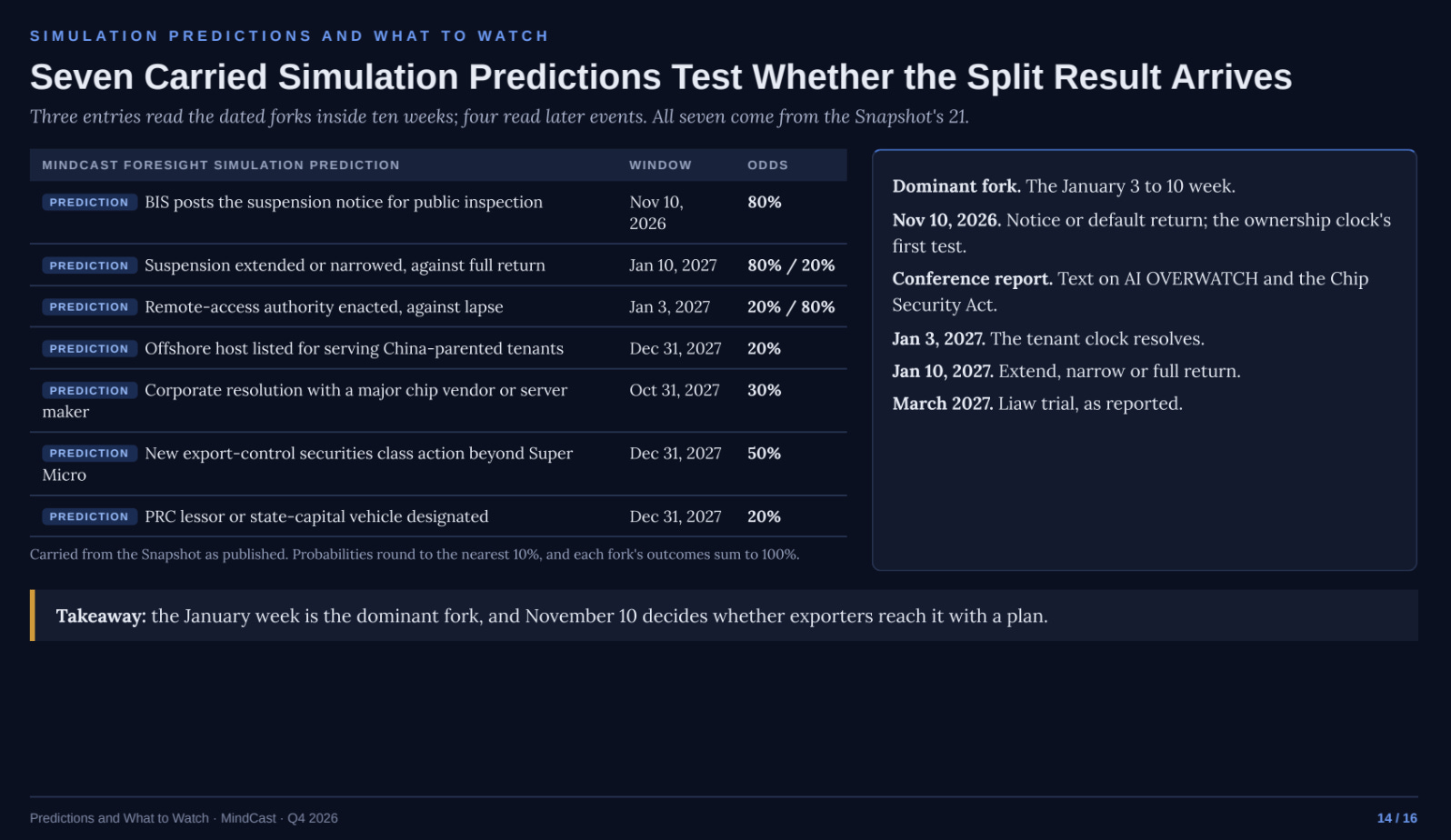
Takeaway: three entries test the dated forks inside the next ten weeks, and four test later events.
IX. Risk Mitigation Layer
Each entry states the Simulation Prediction with its odds and the exposure in units the stakeholder controls. Actions carry an owner and a deadline, and the residual follows.
Hosts · remote-access enactment (20%)
Severity: high on enactment. Exposure: offshore leases to China-parented tenants, counted in contracted accelerator capacity.
Action 1: add transition, suspension and workload-visibility clauses (host legal, by January 3).
Action 2: build tenant verification (product and compliance, by the first quarter of 2027).
Residual: tenants who refuse amendment.
Exporters · suspension notice (80%) and full return (20%)
Severity: medium to high on full return. Exposure: affiliates of listed parties in the customer base, counted in open orders.
Action 1: map ownership to 50% (trade compliance, by November 10).
Action 2: prepare a voluntary self-disclosure decision under 15 C.F.R. § 764.5 (general counsel, by November 10).
Residual: undisclosed beneficial owners.
Chip vendors and server makers · major-vendor resolution (30%) and new class action (50%)
Severity: high. Exposure: revenue through Southeast Asian and Taiwanese resellers.
Action 1: audit top resellers (general counsel, by year-end).
Action 2: test compliance statements against the audit (disclosure committee, before the next annual report).
Residual: prior-period statements already filed.
Lenders and lessors · financier designation (20%)
Severity: medium. Exposure: campus cash flows dependent on China-parented tenants.
Action 1: map the four roles per counterparty (credit, at the next amendment).
Action 2: stress-test tenant loss (risk, by January 3).
Residual: concentration in one tenant.
Takeaway: unnamed vendors can still act on two clocks, hosts and exporters each face one dated fork, and lenders hold an open-ended exposure they can measure now.
X. What to Watch
November 10, 2026 · Notice or default return: The ownership clock’s first test. A posted notice moves the decision to January 10.
Defense-bill conference, date not set: Text on the AI OVERWATCH Act and the Chip Security Act decides whether a location-verification duty lands on vendors.
January 3, 2027 · End of the 119th Congress: The tenant clock resolves on enactment or lapse.
January 10, 2027 · Truce deadline · Dominant fork: Washington extends, narrows or lets the Affiliates Rule return. The White House can trade this decision against the January 3 outcome.
March 2027 · Liaw trial, as reported: Evidence at trial tests the major-vendor resolution forecast.
Takeaway: the January 3 to 10 week is the dominant fork, and November 10 decides whether exporters reach it with a plan.
XI. Conclusion
The statement Super Micro investors plead is the statement the company published to show it was careful. The war game’s principal counterfactual for vendors is the window between those statements and the March 2026 indictment, when an effective reseller audit could have changed the evidence on both vendor clocks.
The transferable result is a dating discipline. Every US firm in the export chain carries the same five clocks, and two of them now turn on scheduled forks. A control bought before the date changes the evidence and the options; the same control bought after it mostly documents what the firm could have done.
Working With MindCast
MindCast AI applies Predictive Behavioral Economics + Dynamic Game Theory through MindCast AI Proprietary Cognitive Digital Twin Foresight Simulations (MP CDT FS). Behavioral Economics supplies the decision rules. Game Theory supplies the payoff structure. Predictive simulations emerge from the combination.
A commissioned war game builds Cognitive Digital Twins of the client’s own enforcers, tenants, carriers and counterparties. The engagement then plays the client’s own seat through both forks within five to seven business days.
For a vendor it dates the diversion and disclosure clocks across the reseller channel. For a host it tests lease terms against the January 3 fork. For an exporter it maps the customer base against the November 10 and January 10 dates.
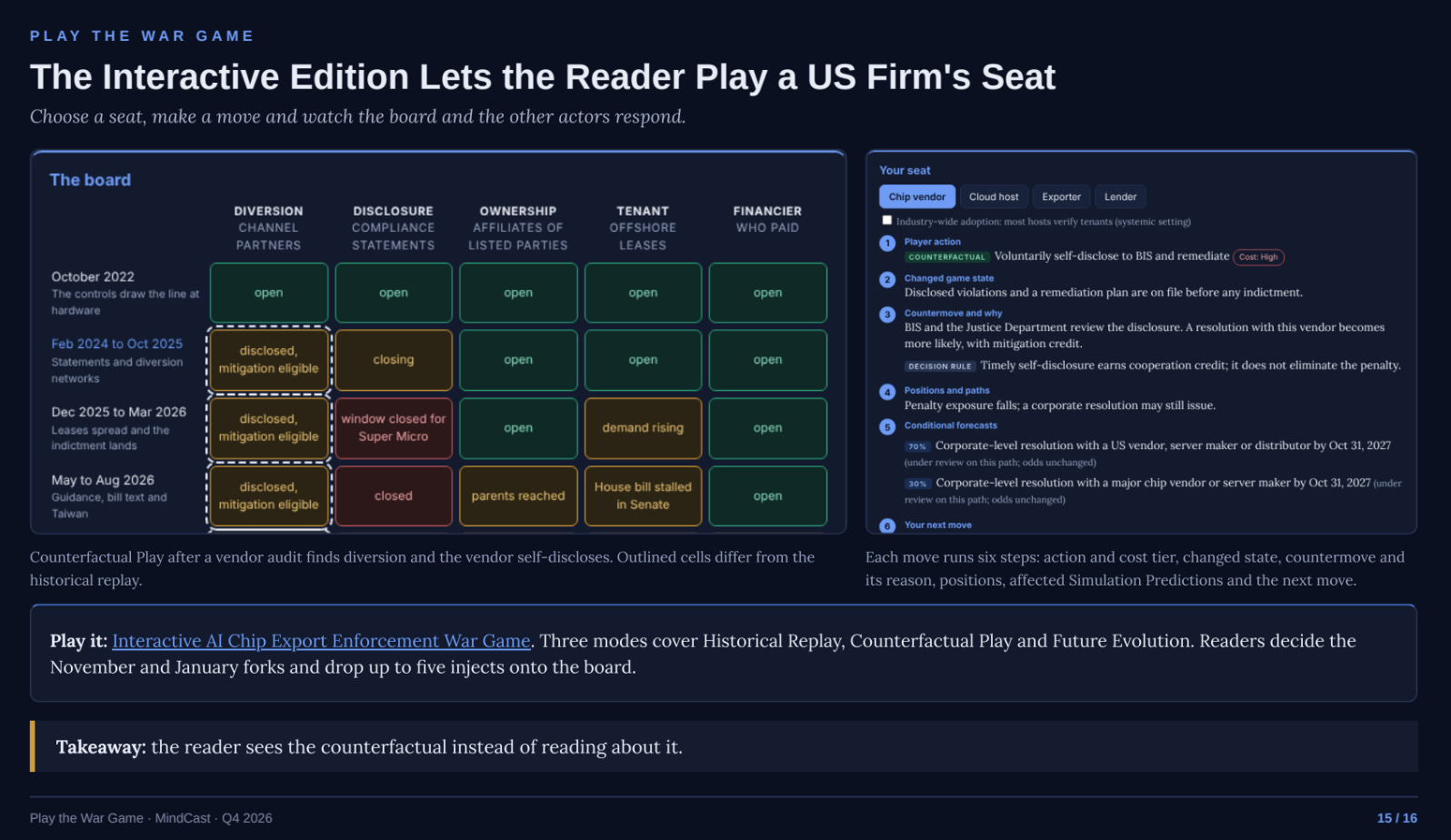
Readers can replay the six turns and play the five alternatives in the Interactive AI Chip Export Enforcement War Game. The AI Chip Export Enforcement War Game Executive Presentationcarries the full board for briefings.
MindCast offers a complimentary pilot built from public filings before any retainer. Contact noel@mindcast-ai.com.
Selected MindCast Works
AI Chip Export Enforcement Shifts Risk Onto US Firms as China Demand Moves to Domestic Chips, Rented Compute and State Financing. Supplies the board, the Cognitive Digital Twins and every carried Simulation Prediction.
AI Chip Export Enforcement War Game Executive Presentation. Condenses the six turns, five alternatives and three forks into a briefing for executives and counsel.
Interactive AI Chip Export Enforcement War Game. Lets a reader replay the turns and play a US firm’s seat without changing any Snapshot odds.
Tencent, Oracle, and the Remote-Access Gap in US AI Chip Export Controls. Maps the authorities that reach a host through its tenants.
OpenAI Liability War Game — When AI Safety Controls Reduce Exposure and When They Become Evidence. Supplies the war game format and the clock method this paper applies to export enforcement.
The Beijing Summit Validation — Geopolitical Ripples for the AI Industry Across the Three-Layer Equilibrium. Validated the two-gate model behind the hardware turn.
Sources
Gary S. Becker, Crime and Punishment: An Economic Approach, Journal of Political Economy 76, no. 2 (1968). Supplies the expected-penalty calculus behind the vendor clocks.
Robbins Geller, Super Micro Computer, Inc. Class Action Lawsuit, 2026. Supplies the Liaw indictment and the share decline.
Bernstein Litowitz Berger & Grossmann, City of Hialeah Employees’ Retirement System v. Super Micro Computer, Inc., April 8, 2026. Quotes the pleaded compliance statement.
Justice Department, U.S. Authorities Shut Down Major China-Linked AI Tech Smuggling Network, December 8, 2025. Reports the Hao Global plea.
3DNews, report on Tencent’s use of Datasection’s Blackwell capacity, citing the Financial Times, December 22, 2025. Reports the first large offshore lease.
The Decoder, Bytedance secures access to Nvidia Blackwell cluster in Malaysia, circumventing US export ban on China, March 2026. Reports the ByteDance-Aolani lease.
Greenberg Traurig, Enforcement Pause Has Limits: BIS Clarifies Ongoing License Requirement for Advanced Computing Items to China-Linked Entities, June 2026. Explains the May 31 guidance.
Senator Jim Banks, Banks Secures AI OVERWATCH Act in Senate NDAA, July 14, 2026. Places the chip provisions in the Senate text.
Al Jazeera, Nvidia, Supermicro employees charged over export of AI servers to China, August 25, 2026. Reports Taiwan’s August indictments.
Super Micro, Supermicro Announces Completion of Independent Investigation and Continued Enhancement of Export Compliance Program, August 20, 2026. Primary release of the investigation findings.
Fortune via edgeX, Supermicro says board probe found no evidence senior management knew of alleged $2.5 billion Nvidia chip smuggling scheme, August 20, 2026. Reports the subpoena and the trial date.
Pillsbury, BIS Affiliates Rule, updated October 22, 2026. Ties the suspension to the truce extension and dates the missing notice.
Federal Register, One-Year Suspension of Expansion of End-User Controls for Affiliates of Certain Listed Entities, 90 FR 50857, public inspection November 10, 2025. Dates last year’s notice.
Network World, Oracle reportedly lands $7B GPU deal for Tencent, October 9, 2026, following the Financial Times report. Reports the Tencent-Oracle lease.
TechRepublic, Tencent Reportedly Turns to Southeast Asia for $7B Oracle AI Chip Deal, October 2, 2026. Supplies the upfront payment term.
TFTC, Chinese State Financing Linked to Nvidia Blackwell Chips in Restricted Data Centers, October 2026. Documents Semi-Tech Leasing’s financing.
Bloomberg Law, Man Charged With Illegally Shipping Nvidia Chips to China, October 2, 2026. Reports the Earthmade arrest.