
Bureau of Industry and Security · Congress · Beijing · Tencent · Oracle · cloud operators · global investors · corporate strategists · United States · China · Southeast Asia
Related Works
Companion paper: Cross-Border AI Compute: Access Rules, Clean Power and Local Approval Decide Which Operators Win (2026). Tests which data center operators gain once a remote-access rule arrives.
The TSMC China License and the Limits of Hardware Export Controls (2026). Argued that hardware licensing fails without controls on who uses the hardware, the gap the Tencent lease now uses.
The Runtime Export Problem: Anthropic’s 151 Million-Exchange Distillation Record, Advisory AA26-251A, and the Question Commerce Cannot Yet Answer (2026). Asks when ordinary AI interactions become a prohibited extraction campaign, the same line a remote-access rule for compute must draw.
Thesis. American law requires a license to ship advanced AI chips to a China-headquartered firm anywhere, but no rule covers renting that firm compute. A general rule closing the gap is unlikely to take effect before 2028, because the bill that would authorize it dies with the 119th Congress on January 3, 2027. If one does, its treatment of contracts signed before the rule decides whether Tencent’s $7 billion lease survives.
Why now. The 119th Congress ends on January 3, 2027, and the Remote Access Security Act dies unless it passes first. Washington policymakers, global investors and corporate strategists placing AI compute across borders all face that deadline.
I. Executive Summary
American export law requires a license to ship advanced AI chips to a China-headquartered firm anywhere in the world, and no rule yet requires one to rent that firm a compute session. Tencent reportedly committed about $7 billion to rent roughly 100,000 advanced chips in Oracle data centers across Southeast Asia for five years. The chips stay in Oracle’s custody outside China.
Two decisions in sequence decide whether Tencent keeps its rented capacity. Congress decides first: without the Remote Access Security Act by January 3, 2027, no general rule is likely to take effect by the end of 2027. Rule text decides second: if a rule arrives, its treatment of contracts signed before it decides whether existing leases survive.
Three factors decide what happens over the lease’s five-year term. Rule design sets what Washington may require of cloud operators. Oracle’s contract rights decide whether Washington can see and stop Tencent’s training runs or merely watches capability transfer. Domestic Chinese accelerators decide, by how fast they can train frontier models, how long Chinese labs need American operators.
American AI leadership turns on Oracle’s contract rights. A Chinese lab renting from an American operator that can identify the tenant and suspend its workloads stays within reach of a later BIS order. A rule that pushes the same lab to a non-US operator gives up both the rental revenue and that reach.
MindCast AI applies Predictive Behavioral Economics + Dynamic Game Theory through MindCast AI Proprietary Cognitive Digital Twin Foresight Simulations (MP CDT FS). Behavioral Economics supplies the decision rules. Game Theory supplies the payoff structure. Predictive simulations emerge from the combination.
In this case the payoff structure comes from three licenses: BIS licenses chip exports to China-headquartered firms, Beijing approves chip imports and host countries such as Malaysia permit chip transit. Renting compute requires none of the three. The decision rules are anchoring on the salient object, loss aversion toward signed contracts and Beijing’s willingness to absorb short-run cost for long-run independence. The simulation models six actors as Cognitive Digital Twins: the Bureau of Industry and Security; Congress; Beijing; Tencent; Oracle; and Nvidia.
The paper maps the legal authorities that reach the lease and tests the lease against nine prior MindCast Simulation Predictions. Sections V and VI weigh what Oracle can see and stop and how Beijing will respond. Sections VII and VIII trace whether a rule arrives by 2027 and whether Chinese chips replace rented capacity by 2029. Section X sets out what each outcome costs lenders, funds and operators.
The two companion papers set out 15 Simulation Predictions: nine here and six in Cross-Border AI Compute. P marks a Primary Simulation Prediction and S a Secondary Simulation Prediction. Four carry this paper’s argument, and none of the four is conditional:
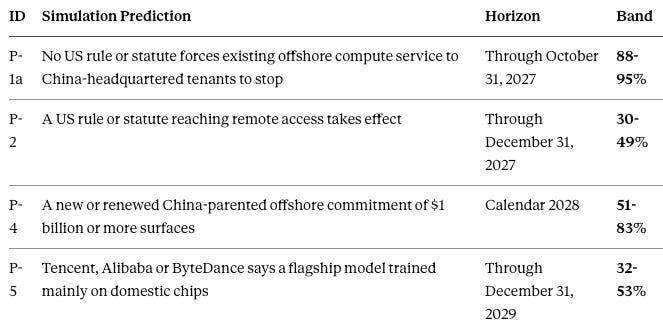
P-2 gives the chance that a general rule takes effect at all. Three predictions in Section IX and two in the companion paper apply only if such a rule takes effect, and each says so in its headline.
Earlier forecasts. The H200 delivery forecast from The Beijing Summit Validation: Geopolitical Ripples for the AI Industry Across the Three-Layer Equilibrium (2026) holds on Nvidia’s disclosure. The forecast that Chinese hyperscalers would move workloads to domestic accelerators did not hold for training, which Tencent placed offshore.
🇺🇸 United States: Washington gains most by letting Chinese labs keep renting from American operators that must verify tenants and log workloads. A rule with a transition path keeps that training on American servers BIS can reach, while abrupt termination sends it to non-US operators.
🏛️ Policymakers: The remote-access statute lapses with the 119th Congress unless the defense authorization bill carries it before January 3, 2027. Allied and host governments should expect a rule keyed to tenant and workload rather than to their territory.
💼 Corporate strategists: Cloud operators and AI builders in the United States, the Gulf, Japan and Southeast Asia should check their contracts and systems now. Each should confirm it can identify every tenant, inspect workloads and suspend service. The first rule will most likely impose a duty on providers, and operators able to attest to tenant identity keep the business.
⚖️ Counsel: Change-in-law, suspension and refund clauses carry the regulatory exposure in every offshore compute contract. Map them against a tenant-based rule, a country-based rule and a targeted BIS letter before any of the three issues.
📊 Global investors: A $7 billion headline is not a $7 billion asset. Interruption risk to existing leases stays low through October 2027, while value after 2027 turns on whether new China-parented offshore commitments of $1 billion or more keep appearing in 2028 (P-4).
II. The Tencent-Oracle Lease and the Remote-Access Gap
The lease is one of the largest reported cases of a Chinese technology company renting frontier compute it cannot import. The Financial Times reported on October 1 that Tencent agreed to lease chips across several Oracle data centers in Southeast Asia. AI Weekly’s account of the report gives a five-year term.
The deal runs about $7 billion with roughly 30%, or about $2.1 billion, due up front. Whether that advance has been paid, and on what refund terms, remains undisclosed.
Neither company has confirmed the terms, and Reuters could not immediately verify the report. Oracle’s September quarterly filing makes no mention of Tencent. The chip models, sites and service terms remain undisclosed.
Tencent’s accounts show the scale of its compute commitments. The company reported negative free cash flow of RMB 13.8 billion for the second quarter. Excluding compute procurement prepayments, free cash flow would have been RMB 37.6 billion. The difference of roughly RMB 51 billion covers all of the quarter’s compute prepayments, of which the Oracle advance is at most one part.
Tencent executives said the leased capacity goes first to training larger Hunyuan models and then to running them. Training is the workload where the gap between Nvidia and domestic accelerators matters most. Training also tolerates distance, while inference for Chinese users runs into latency across borders.
Beijing addressed the same legal question in its own law two weeks after the FT report. On October 16 the Ministry of Commerce and the Ministry of Science and Technology proposed export controls on 40 technologies, 23 of them in AI. The list reaches model weights and computing clusters. The proposal exempts access through application programming interfaces, websites and software-as-a-service platforms.
The comparison between the two governments is analytical rather than legal. Beijing’s proposal governs Chinese technology leaving China, while the Tencent lease concerns American hardware used by a Chinese firm. Both governments nonetheless now leave remote service access outside the rules that govern technology transfer: Washington through BIS advisory opinions and Beijing through its October 16 exemption.
Takeaway: The lease is reported, large and consistent with Tencent’s reported spending. The lease matters because rented access escapes the licenses both governments apply to chips and technology.
III. Which Legal Authorities Reach the Lease
American export law regulates the movement of goods and technology, and rental moves neither in the conventional sense. The useful question is what Tencent actually receives: compute time on chips it never owns. The second question is which existing or proposed instruments reach that arrangement.
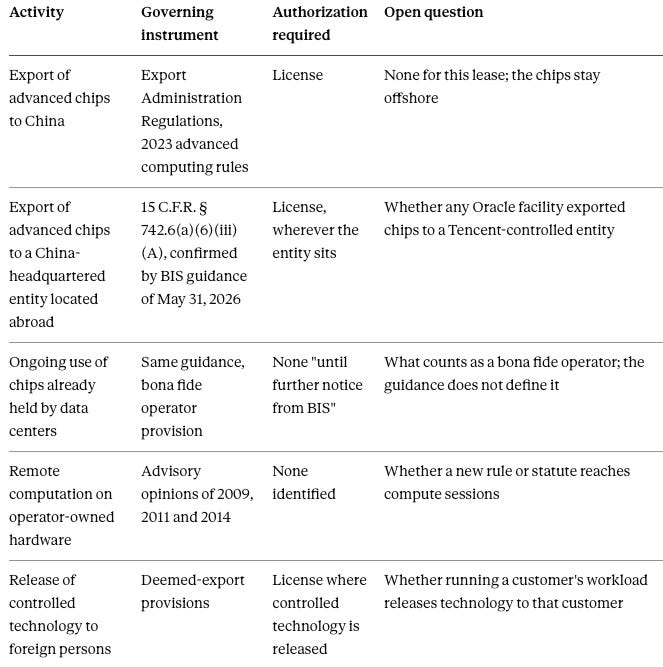
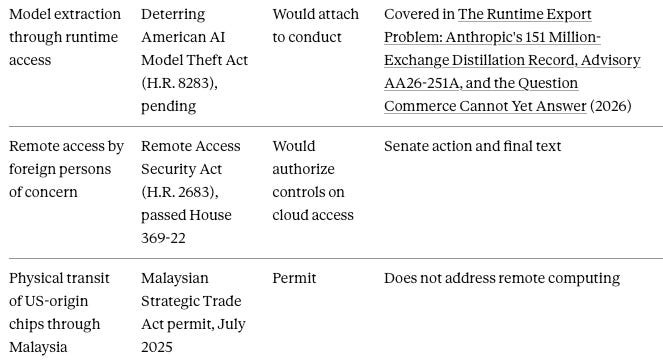
The Bureau of Industry and Security (BIS) confirmed the entity-based requirement on May 31. Holland & Knight’s summary states that a license applies to advanced computing items exported to entities headquartered in China or Macau, or whose ultimate parent sits there. The requirement applies wherever the entity operates. The same guidance states that bona fide data center operators need not stop ongoing use, storage or servicing of those items until further notice.
Remote computation sits outside the conventional export event. BIS advisory opinions established that cloud providers are not exporters when they make compute available remotely. BIS’s enforcement arm opened a review in August, first reported by Bloomberg, that compiles separate lists of smuggling routes and remote-access hubs. The same reporting said BIS had shelved its own draft cloud rules.
Congress has moved further than the agency. The Remote Access Security Act (RASA) passed the House 369-22 in January and sits in the Senate Banking Committee. A Baker McKenzie attorney told The Information it is “widely acknowledged” in the export-control bar that Commerce cannot enforce a remote-access rule under existing law.
Behavioral economics explains why the gap persisted. Regulators anchor on the salient object, and a chip crossing a border is salient while a training job is not. Game theory explains where demand went. Once owning chips abroad required a license and renting them did not, Chinese firms rented.
Takeaway: Washington licenses chips sent to China-headquartered entities anywhere, preserves ongoing data center use and has no rule covering remote compute sessions. Export-control practitioners widely doubt that Commerce can write one without a statute, according to a Baker McKenzie attorney.
IV. The Lease Confirms the Arbitrage Mechanism and Breaks the Workload-Shift Forecast
Nine earlier MindCast Simulation Predictions bear on how capability moves around hardware controls, and the lease tests each. One holds on its named source pending a unit count. One mechanism held through a path the model did not specify, and one forecast holds through 2026.
One forecast did not hold, and five remain open. Each entry keeps its original terms.
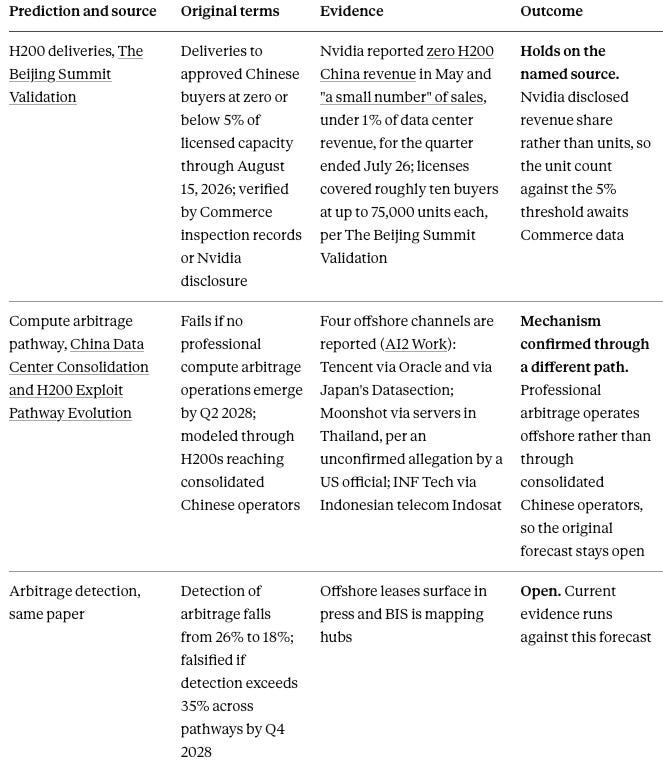
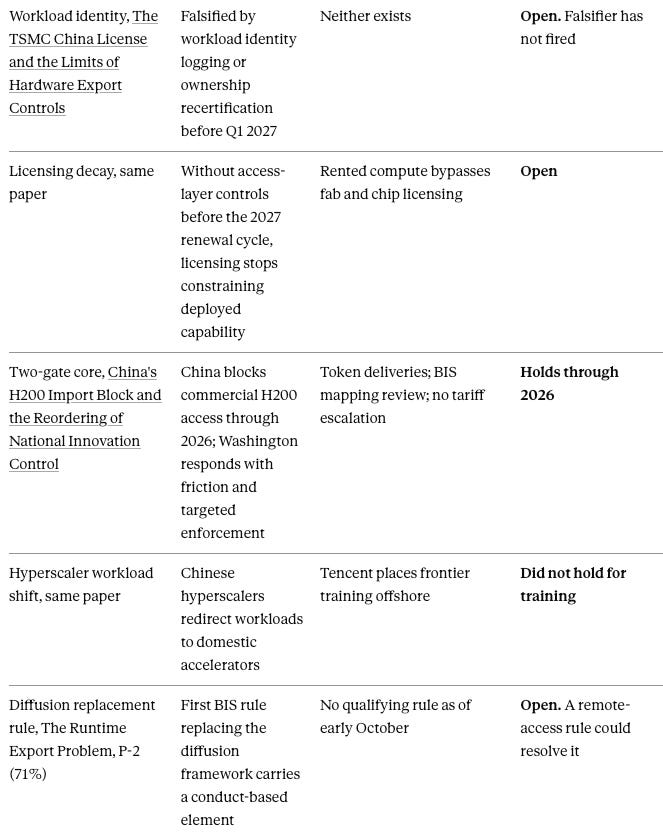
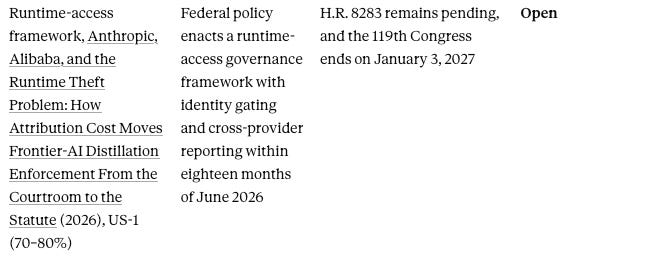
The consolidation paper’s falsifier wording is met, because professional arbitrage now operates. The paper modeled that arbitrage through H200s reaching consolidated Chinese operators, and offshore rental through Oracle is a different path. Beijing kept approved buyers from importing H200s in volume, and arbitrage moved to foreign-operated capacity instead.
The Two-Gate paper’s warning thresholds counted chips crossing China’s border, with ecosystem-shaping leakage set at 50,000 gray-market units. One rental contract doubled that volume offshore without moving any indicator. The two-gate model needs a third route for rented capacity, and The Runtime Export Problem already supplies the conduct-based counterpart for model extraction.
Takeaway: The H200 delivery forecast holds pending a unit count, and the arbitrage mechanism held through a path the model did not specify. The workload-shift forecast did not hold for training. MindCast’s warning indicators counted chips crossing China’s border, and they must now also count capacity rented from offshore operators.
V. Oracle Holds Custody, but Its Control Over Tencent’s Workloads Is Undisclosed
American infrastructure policy already runs two separate tests, and a remote-access rule will choose between them. The Trump Administration’s Grid-Equipment Emergency Order Hands Taiwan an AI Data Center Supply Market (2026) found that one test asks who controls the equipment and the other asks where capacity sits. Federal Grid-Security Rules Are Doing to American AI Data Centers What China Could Not (2026) traced the same shift in the August 26 grid-equipment order, which regulates control topology rather than country of manufacture. The same distinction frames the choice Commerce now faces for compute.
A list of hub countries is a location test, and the BIS enforcement review builds exactly that list. A location test cannot reach rentals on American soil, and Oracle reportedly rented H100s in US data centers to ByteDance in 2024. A control test asks who the tenant is and whether the operator can see and stop the workload, wherever the server sits.
Two facts about Oracle are established. Oracle retains custody of the hardware. Since the TikTok divestiture closed on January 22, Oracle has also served as the security partner auditing the American joint venture’s national-security compliance.
Three facts about the Tencent lease remain unknown. Nobody outside the parties knows whether Oracle sees Tencent’s workloads or holds suspension rights under the contract. Nor does anyone know whether Oracle’s systems could enforce a suspension.
Two cases follow. In the first case Oracle knows the tenant, sees the workloads and can suspend service. A later BIS order could then stop or condition Tencent’s training at any point in the five-year term, while a chip sale gives up that power at delivery. In the second case Oracle supplies capacity without seeing workloads, and the lease transfers capability with no point of control.
Operator control can move enforcement cost from a border agency that cannot see workloads to an operator that can, the transaction-cost logic Ronald Coase described. Whether the transfer lowers total enforcement cost depends on the contract terms nobody has disclosed. An operator with commercial reasons to look away relocates the cost rather than lowering it.
Takeaway: Oracle’s custody and its TikTok audit role are established, while its control over Tencent’s workloads is not. Whether Oracle can verify Tencent and suspend service also shapes how BIS would act against the deployment, as Section VII sets out.
VI. Beijing Most Likely Tolerates the Lease Until Washington Imposes Verification
Beijing refused licensed H200 imports while one of its national champions rents comparable compute offshore. The Two-Gate Game explained the refusal through national optimization: large-scale imports would anchor Chinese engineers to Nvidia’s software stack while domestic alternatives needed demand to mature. Three explanations compete for Beijing’s stance on the lease.
Selective sovereign tolerance. Beijing deliberately permits offshore frontier training while protecting domestic accelerator demand at home. The Two-Gate paper’s distinction between trigger and target supports the reading, since the H200 license carried a revenue share and third-party verification. The Oracle lease, as reported, carries neither.
Falsifier: no official guidance ever distinguishes offshore training from domestic deployment.
Corporate autonomy. Tencent pursues compute through a lawful commercial arrangement without a specific policy decision from Beijing. The lease would then reflect Tencent’s cost and capability calculation rather than state design.
Falsifier: official guidance directing or restricting the lease, or similar leases appearing only among firms with strong state ties.
Conditional tolerance. Beijing permits the arrangement while no American operator can verify Tencent or suspend its workloads, and changes stance if Washington imposes verification. A tenant-verification rule would recreate the conditions Beijing rejected for the H200.
Falsifier: Beijing keeps silent after a US verification rule takes effect.
The Clean Compute Match: Which Clean Power Pairs With Which AI Compute, And What Stays On Fossil (2026) found that batch work and mid-scale training follow available power while real-time inference stays near users. Frontier-scale training moves less freely, because it needs one large cluster at one site. Tencent’s lease shows that constraint yielding when chips are unavailable at home, and the split of training abroad and inference at home fits all three explanations.
The MindCast simulation favors conditional tolerance, exercised through informal guidance rather than formal law. Beijing gains nothing from a formal ban while its champions still need frontier compute, and its October 16 proposal already protects service access. Formal ministry restriction after a US verification rule is the less likely response (S-3).
Beijing’s October 16 proposal also gives it a doctrinal resource. A Chinese ministry has written into proposed rules that service access through software platforms falls outside technology-transfer controls. If Washington restricts rental access, Beijing can cite the distinction in its own law.
Takeaway: Selective tolerance, corporate autonomy and conditional tolerance each fit the current evidence, and a US verification rule separates them. The simulation expects Beijing to answer such a rule informally rather than with a formal ban.
VII. The Short-Horizon Game: Whether a Rule Arrives and Whether Signed Contracts Survive It
Two decisions in sequence govern the next 14 months. Congress and BIS decide whether a general remote-access instrument takes effect by the end of 2027. The instrument’s text then decides what happens to contracts already signed.
Legal authority decides arrival. BIS lacks clear statutory reach over remote compute, so a rule under existing law invites a challenge the agency could lose. RASA would cure the gap, but the 119th Congress ends on January 3, 2027. Bills not enacted by then die.
The defense authorization bill for fiscal 2027 is the likeliest vehicle before that date. A new Congress would start over, and a statute passed in mid-2027 would leave BIS little time to write and finalize a rule. A qualifying instrument by the end of 2027 is therefore less likely than not (P-2).
A salience shock is the main way a rule could arrive before 2028 despite the congressional deadline. A Chinese frontier model release traced to rented American capacity would raise the political cost of waiting. Moonshot’s Kimi K3 release preceded BIS’s mapping review by weeks, which shows how quickly a capability event moves enforcement attention.
An instrument’s test decides where demand moves once the instrument arrives. A location rule lists hub countries and leaves American soil and unlisted jurisdictions open. A control rule imposes tenant verification and workload duties on providers wherever servers sit. The first instrument will most likely carry at least one provider-side duty (P-3), because Congress and BIS both frame the problem around foreign persons of concern rather than places.
The threat of a rule changes where Chinese firms rent more than how much they rent. The Runtime Global Data Market: When Stolen AI Interactions Become a Strategic Technology Supply Chain (2026) found that enforcement changes the composition of acquisition channels more reliably than total volume. A second China-parented offshore commitment of $1 billion or more is likely to surface by April 2027 (S-2), most likely through operators outside American reach.
Tencent’s own conduct shows how tenants read current law. The Datasection lease ran through a third party, while the Oracle lease went direct at nearly seven times the chips. Under current law an intermediary adds cost and buys no protection. A provider-bound rule would change that calculation and could bring intermediaries back.
Transition terms decide whether signed contracts survive. Two BIS precedents favor continuity: the bona fide operator provision of May 31 and the TSMC licensing decision, which licensed existing fabs and denied expansion. Loss aversion strengthens the pull if the reported $2.1 billion advance has been paid. Unwinding cash an American firm already holds reads as a loss, while blocking a future lease reads only as a forgone gain.
Transition terms weigh more on the lease than the January 3 deadline does. A rule that arrives with a transition path leaves the contract standing, and the first instrument will most likely provide one (S-1). A rule without one could end existing service, but the chance of such a rule taking effect before October 2027 stays low (P-1a).
A targeted BIS action against one deployment depends on neither Congress nor transition terms. BIS can reach a single deployment through a letter or a license condition without writing a general rule. The legal reach of such a letter over a service-only arrangement is untested. If Oracle can verify the tenant and log workloads, BIS is more likely to impose conditions than to stop the service, which makes a public stop order the least likely interruption in this paper (P-1b).
The rule outcome sets what the contract is worth. The reported $7 billion is a contract value, not an asset value. The contract is worth the service cash flows that survive a rule change, less compliance and interruption costs, plus what the capacity earns if Tencent leaves.
Public sources bound only part of that calculation. Filings bound Oracle’s capacity, capital spending and cash flow. Refund terms, suspension rights and payment milestones sit in undisclosed contracts, and redeployment value stays high while compute remains scarce.
Takeaway: The January 3, 2027 deadline makes a general rule unlikely before 2028, and transition terms decide whether a rule that does arrive ends existing leases. The lease’s value to Oracle depends on which of those outcomes occurs.
VIII. The Long-Horizon Game: Whether Chinese Chips Replace Rented Capacity and Who Verifies Tenants
Over the lease’s five-year term the question shifts from what Washington permits to whether Tencent still needs Nvidia chips. Offshore demand persists only while domestic accelerators cannot train frontier models at competitive cost. Two outcomes compete.
In the substitution outcome, denying Chinese labs Nvidia chips speeds their switch to domestic accelerators, the mechanism the Two-Gate Game documented. A tight rental rule buys control in the short run and shortens the period during which Chinese labs depend on American operators.
In the dependence outcome, domestic accelerator and software constraints persist, and Chinese labs keep renting offshore whatever Washington decides. Dependence is the more likely outcome through 2028: a new or renewed offshore commitment of $1 billion or more will probably surface that year (P-4).
Substitution remains a live alternative over a longer window. A Chinese champion stating that a flagship model trained mainly on domestic accelerators by the end of 2029 is somewhat less likely than not (P-5). Both outcomes can hold at once, since Chinese labs can keep renting offshore while also training one flagship at home.
American policy faces a tradeoff between the two horizons under either outcome. A permissive regime transfers capability and preserves a dependence Washington can later use. A restrictive regime protects capability now and may shorten that dependence. Washington must choose between transferring capability now and losing its reach over Chinese training sooner.
Value after 2028 depends on who holds three capabilities: verifying tenant identity, seeing workloads and suspending service. AI Data Center Authorization + Clean Energy, the Mid-Scale Squeeze and the Specialized Compute Landscape(2026) found that operators clear approval and grid gates by proving measured burden and flexibility. The companion paper extends that framework to the tenant.
The companion paper finds that power, grid and approval keep deciding operator outcomes while no access rule exists. Specialists are already forming partnerships with hyperscalers for financing reasons. Under a provider duty, the hyperscaler side of those partnerships absorbs compliance, and Oracle’s TikTok role fits that outcome.
What the Tradeoff Means for American AI Leadership
American AI leadership depends on where frontier training runs and who can see it. Chinese labs renting from American operators pay American firms and train on the CUDA software stack. The same labs also remain subject to any later BIS order that binds their American operator.
Chinese labs pushed to non-US operators or domestic chips pay rivals and move beyond the reach of BIS orders. A termination rule therefore gives up that reach in exchange for a denial that operators in third countries can partly offset. The Datasection lease already shows Tencent reaching capacity through a third party.
The strongest American position pairs continued access with operator control. A rule requiring tenant identity and workload attestation keeps Chinese demand on American infrastructure while giving Washington a view of tenants and workloads it lacks today. Attestation standards that American operators set first also become the terms allied capacity must meet.
Allied capital would carry the same standard abroad. Gulf and Asian sovereign funds building AI campuses depend on American export licenses and the conditions attached to them. An American standard written into those licenses would require the campuses to verify tenants and log workloads too.
Takeaway: Dependence is the likelier outcome through 2028, and substitution stays live through 2029. The United States holds its strongest position when Chinese demand stays on American operators that can attest to tenant identity and workload.
IX. MindCast Foresight Simulation Predictions
The paper sets out nine MindCast Foresight Simulation Predictions, and the companion paper sets out six more. P marks a Primary Simulation Prediction and S a Secondary Simulation Prediction. P-3, S-1 and S-3 are conditional and void if their triggering instrument never takes effect. Evidence runs through October 18, 2026, and each band gives the likelihood range the simulation assigns.
P-1a · No US rule or statute forces existing offshore compute service to China-headquartered tenants to stop before October 31, 2027 (88-95%).
The test reads instrument text, so it does not depend on identifying the confidential site. A qualifying instrument requires a US operator to stop serving a China-headquartered tenant outside China under a contract signed before its effective date, with no transition or license path. A location-only instrument counts only if it covers a country publicly reported as hosting the Tencent-Oracle capacity.
Falsifier: such an instrument takes effect before October 31, 2027. Verification: Federal Register; Congress.gov.
P-1b · No public BIS letter or license condition stops the Tencent-Oracle service before October 31, 2027 (97-99%).
Falsifier: a BIS letter or license condition requiring that service to stop becomes public before October 31, 2027. Verification: BIS releases; company disclosures; FT, Reuters or Bloomberg reporting.
P-2 · A US rule or statute expressly reaching remote access to controlled compute by foreign persons of concern takes effect by December 31, 2027 (30-49%).
Qualifying instruments include a final or interim BIS rule and an enacted statute.
Falsifier: no such instrument takes effect by December 31, 2027. Verification: Federal Register; Congress.gov.
P-3 · The first qualifying instrument imposes at least one provider-side tenant-identity or workload duty (74-88%).
Conditional on P-2.
Falsifier: the first instrument relies on a country list or entity list with no provider-side tenant or workload duty. Verification: instrument text.
P-4 · A new or renewed China-parented offshore compute commitment of $1 billion or more appears in FT, Reuters or Bloomberg reporting or a party disclosure during 2028 (51-83%).
The public report is the observable.
Falsifier: no such report or disclosure from January 1 to December 31, 2028. Verification: FT; Reuters; Bloomberg; company disclosures.
P-5 · Tencent, Alibaba or ByteDance states by December 31, 2029 that a flagship model trained primarily on domestic accelerators (32-53%).
Falsifier: no such statement by December 31, 2029. Verification: company disclosures.
S-1 · The first qualifying instrument provides a transition, licensing or continuation path for contracts signed before its effective date (62-78%).
Conditional on P-2.
Falsifier: the instrument applies to existing contracts on its effective date with no transition or license path. Verification: instrument text.
S-2 · A second China-parented offshore compute lease or commitment of $1 billion or more appears in FT, Reuters or Bloomberg reporting or a party disclosure by April 30, 2027 (58-82%).
The public report is the observable.
Falsifier: no such report or disclosure by April 30, 2027. Verification: FT; Reuters; Bloomberg; company disclosures.
S-3 · Within six months of a US tenant-verification rule taking effect, a Chinese ministry publishes guidance restricting or requiring approval for Chinese firms’ use of foreign-operated compute outside China (18-38%).
Conditional on such a rule taking effect by December 31, 2027. General promotion of domestic chips does not qualify.
Falsifier: no qualifying publication within six months of the rule. Verification: MOFCOM, MIIT, CAC and NDRC publications.
Takeaway: Existing offshore leases face low interruption risk through October 2027, and a general rule is less likely than not before 2028. Chinese offshore demand most likely persists into 2028 while domestic substitution remains a live alternative.
X. How Exposure Reaches Capital, and Risk Mitigation
Contract value turns on the cash flows that survive a rule change, compliance and interruption costs and redeployment value. Lenders and funds will adjust terms before any rule takes effect. Lenders can tighten credit terms, raise collateral requirements, cap exposure to China-parented tenancy or attach utilization covenants.
Exposure reaches capital in four ways. A rule can delay cash flows from signed leases, cut margins through compliance cost, make refinancing harder if tenants stop paying and lower resale value if buyers cannot serve restricted tenants. The actions below are analytic options rather than legal, investment or fiduciary advice.
Near Term Through 2027: Contract and Interruption Exposure
Contract exposure dominates the near term. Interruption risk to existing offshore service stays low through October 2027 (P-1a, P-1b), and a general rule is less likely than not before 2028 (P-2). Cash-flow timing on signed leases therefore holds, and margin depends on compliance costs rather than on lost tenants.
Event-driven hedge funds and global macro funds meet these triggers first, because rule text moves operator revenue within 14 months. Their decision is whether to position for the defense authorization vote before January 3, 2027, or to wait for operative rule text. Rating agencies and private credit lenders face the same window on data center debt with China-parented tenancy.
Corporate strategists face the near-term decision in contract terms. Cloud operators across the United States, Asia and the Gulf should write transition rights into new China-parented leases now. The first rule will most likely carry a transition path (S-1). A second large offshore commitment is likely by April 2027 (S-2), so strategists should expect competing offers for the same tenants.
Long Term Through 2029: Chinese Chip Substitution and Tenant-Verification Exposure
Substitution dominates the long term. Offshore dependence most likely persists into 2028 (P-4), while a domestically trained Chinese flagship by the end of 2029 remains a live alternative (P-5). Refinancing and terminal value on offshore capacity turn on which outcome holds.
Sovereign wealth funds, infrastructure funds and conglomerates meet these triggers, because Chinese chip progress and the operator’s ability to verify tenants decide refinancing and terminal value. A campus financed against China-parented demand loses terminal value if Chinese labs move training home. A campus whose operator can attest to tenant identity keeps value under either outcome, because restricted and unrestricted tenants can both use it.
Global corporate strategists face the long-term decision in where to build. AI builders in the Gulf and Asia that adopt American attestation standards keep access to American chips and American tenants. Builders that serve Chinese demand outside any attestation regime carry the risk that a later rule or a Chinese substitution shift strands the capacity.
Exposure by Simulation Prediction
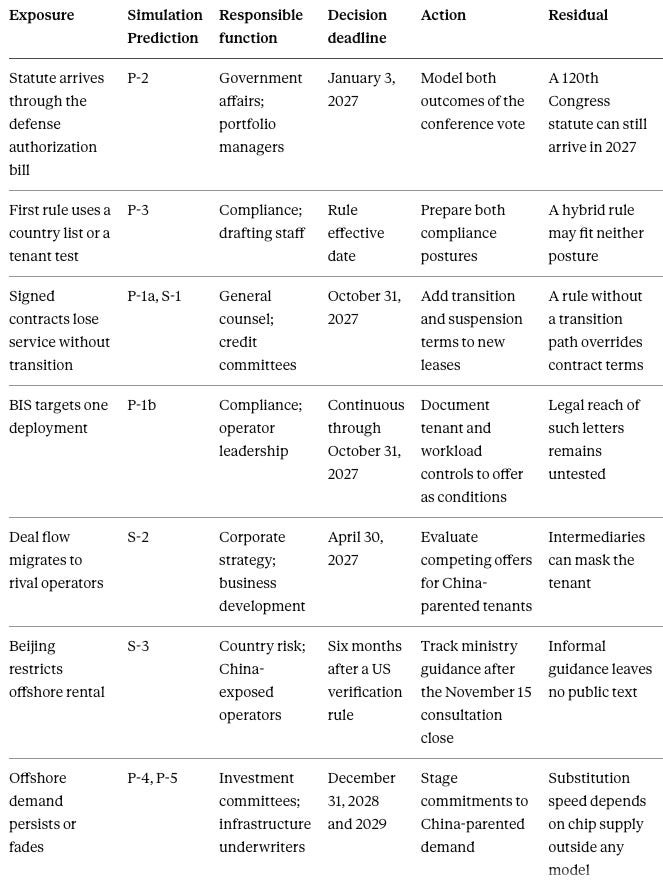
Capital Posture by Trigger
Wait applies while a position’s value depends on the rule test and no instrument has issued. Most offshore compute positions sit in Wait or Stage through 2027, since a general instrument is less likely than not before then.
Stage applies once a rule grants transition relief, with further commitments keyed to evidence on substitution. Commitapplies once the rule’s test is known and the operator has shown it can verify tenants and suspend service. Exit applies when the first rule terminates the tenancy a position depends on.
Oracle’s force majeure notice on Project Jupiter shows a power delay at one campus already triggering rent-deferral rights between Oracle and its landlord. Offshore rental exposure sits on the same balance sheet, and global investors should assess the two together.
Takeaway: Near-term exposure sits in contract terms and resolves by the end of 2027. Long-term exposure sits in Chinese substitution and decides refinancing and terminal value through 2029.
XI. What to Watch
Eight dated observables separate the competing outcomes in this paper. The dominant fork is whether remote-access text enters the defense authorization bill before January 3, 2027.
Defense authorization conference, before January 3, 2027. Remote-access text in the conference report is a preliminary signal that raises the odds behind P-2. P-2 resolves only when an instrument takes effect, and the absence of such text moves any statute into the 120th Congress.
Commerce rule text, through 2027. The Federal Register will show whether the first instrument uses a tenant test or a country list and whether it grants a transition path. The effective date triggers P-3 and S-1, and the same text could resolve Runtime Export P-2.
BIS letters to named operators, through October 31, 2027. A public letter or license condition stopping the Tencent service would resolve P-1b. A letter imposing conditions would not, though it would set a precedent for every operator with China-parented tenants.
Further leases, by April 30, 2027. A second China-parented offshore commitment of $1 billion or more in major press reporting or a party disclosure would resolve S-2.
Beijing’s response, after November 15, 2026. Final text after the consultation closes shows Beijing’s general stance. Only guidance issued within six months of a US verification rule bears on S-3.
Offshore commitments, during 2028. New or renewed China-parented offshore commitments of $1 billion or more show whether dependence persists (P-4).
Domestic training statements, through 2029. A Tencent, Alibaba or ByteDance statement that a flagship model trained primarily on domestic accelerators would resolve P-5.
Operator control disclosures. Any statement on whether Oracle can see Tencent’s workloads or suspend service shows whether Washington could stop or condition Tencent’s training through Oracle.
Takeaway: The defense authorization conference is the first signal, and rule effective dates are the triggers. Offshore commitments in 2028 and domestic training statements through 2029 resolve the long horizon.
XII. Conclusion: Congress’s January 3 Deadline Decides Whether a Rule Arrives, and Transition Terms Decide Whether the Lease Survives
Tencent’s lease shows American export controls licensing chips sent to China-headquartered firms anywhere while no rule covers renting them compute. BIS confirmed the ownership requirement in May while preserving ongoing data center use. Tencent then committed about $7 billion to rented capacity within four months, and Beijing wrote a parallel distinction into its own proposed rules.
Congress’s January 3, 2027 deadline now governs the next step. Without remote-access text in the defense authorization bill, a general rule is unlikely to take effect before 2028. If one arrives, its transition terms decide whether existing leases survive, and the most likely text protects them.
Export control has moved from customs checks on chips to the operators that rent them. An operator that can identify a tenant and suspend its workloads gives Washington a means of control that no chip sale provides. Keeping Chinese demand on such operators serves American AI leadership better than pushing it to rivals. The nine Simulation Predictions in Section IX set out what to expect, from interruption risk through 2027 to Chinese substitution through 2029.
Working With MindCast
Remote-access posture mapping. For counsel and compliance leaders at cloud operators: readiness against a tenant rule, a country list and a targeted BIS letter. The review keys to P-1a, P-1b and P-3.
Offshore compute contract review. For operators and tenants: an audit of change-in-law, suspension, visibility and refund terms against the transition outcomes in S-1.
Capital posture review. For global macro funds, sovereign wealth funds, infrastructure funds and conglomerates: a posture determination for each compute or operator position. Each determination keys to the rule triggers in P-2 and the substitution triggers in P-4 and P-5.
Compute placement strategy. For corporate strategists building AI capacity in the Gulf, Japan and Southeast Asia: where to site capacity and which attestation standard to adopt under each rule outcome.
Contact mcai@mindcast-ai.com.
Sources
MindCast works.
The Runtime Export Problem: Anthropic’s 151 Million-Exchange Distillation Record, Advisory AA26-251A, and the Question Commerce Cannot Yet Answer (2026). Source of the conduct-based P-2 and the extraction rules the authority map distinguishes.
The Runtime Global Data Market: When Stolen AI Interactions Become a Strategic Technology Supply Chain (2026). Source of the finding that enforcement shifts acquisition channels more than volume.
Anthropic, Alibaba, and the Runtime Theft Problem: How Attribution Cost Moves Frontier-AI Distillation Enforcement From the Courtroom to the Statute (2026). Source of the runtime-access forecast US-1, which depends on the same January 3, 2027 congressional deadline.
China Data Center Consolidation and H200 Exploit Pathway Evolution (2025). Source of the arbitrage pathway the lease corroborates.
The TSMC China License and the Limits of Hardware Export Controls (2026). Source of the licensing precedent and the workload-identity falsifier.
China’s H200 Import Block and the Reordering of National Innovation Control (2026). Source of the two-gate model of Beijing’s import refusal.
The Beijing Summit Validation: Geopolitical Ripples for the AI Industry Across the Three-Layer Equilibrium (2026). Source of the validated H200 delivery forecast.
The Trump Administration’s Grid-Equipment Emergency Order Hands Taiwan an AI Data Center Supply Market (2026). Source of the control and location tests.
Federal Grid-Security Rules Are Doing to American AI Data Centers What China Could Not (2026). Source of the finding that federal grid-equipment rules regulate control topology rather than country of manufacture.
The Clean Compute Match: Which Clean Power Pairs With Which AI Compute, And What Stays On Fossil (2026). Source of the finding that training follows power while inference stays near users.
AI Data Center Authorization + Clean Energy, the Mid-Scale Squeeze and the Specialized Compute Landscape (2026). Source of the gate framework the companion extends.
Cross-Border AI Compute: Access Rules, Clean Power and Local Approval Decide Which Operators Win (2026), companion paper. Source of the operator comparison and the audited-compute prediction G-P3.
External sources. The Next Web, “Tencent leases 100,000 AI chips from Oracle in a $7bn deal, FT reports”, October 2026. Reuters via The Standard, “China’s Tencent leases 100,000 chips from Oracle”, October 1, 2026. Tencent Holdings, “Tencent Announces 2026 Second Quarter Results”, August 2026. Holland & Knight, “BIS Publishes Guidance on License Requirements for Advanced Computing Items”, June 5, 2026. AI Weekly, “China Proposes Export Curbs on 23 AI Items”, October 16, 2026; “BIS probes Chinese firms’ offshore access to Nvidia chips”, August 8, 2026; “Commerce drafts rule to shut China’s remote AI-chip access”, 2026. The Information, “Trump Administration Working on AI Rule to Curb China’s Remote Access to Chips”, 2026. AI2 Work, “Commerce Drafts Rule to Close China’s AI Chip Rental Loophole”, 2026. TFTC, “Oracle Leases 100,000 Nvidia Chips to Tencent”, October 2026. Bloomberg Tax, “Nvidia Steps Back Into China Market With First H200 Chip Sales”, August 26, 2026. The Daily Upside, “Nvidia beat expectations again but the China question still looms”, May 21, 2026. Engadget, “TikTok’s AI efforts reportedly exploit loopholes to use premium Nvidia chips”, June 6, 2024. Axios, “TikTok divestiture deal closes”, January 23, 2026. Capacity, “Oracle force majeure notice on Project Jupiter”, September 2026.