


MindCast AI Field-Geometry Reasoning, A Unifying Framework for Structural Explanation in Law, Economics and Artificial Intelligence,
Runtime Geometry, A Framework for Predictive Institutional Economics, Field-Geometry, Nash-Stigler, Tirole Arbitrage, Externalities
The Class Your Physician Should’ve Taken in Medical School, The Critical Role of 4th-Degree Causation Analysis in Redesigning Modern Health Care
MindCast AI Constraint Geometry and Institutional Field Dynamics, Beyond Incentives: How Institutional Geometry Selects Outcomes
The Runtime Causation Arbitration Directive is an "operational rule" and diagnostic framework designed to serve as a causal triage layer for complex systems. To use the system, simply load the URL into any LLM and prompt ‘apply MindCast AI framework, with three degrees of cited sub links.’
Executive Summary
Governing Insight: Institutional outcomes do not follow headlines, personnel changes, or isolated transactions. Outcomes follow the structural layer that governs motion at runtime. Every system operates under layered causation—event, incentive, feedback, geometry, identity—but at any given moment one layer dominates. The layer with the highest structural persistence determines trajectory. All other layers describe local motion within that constraint.
Operational Rule: Before simulation begins, identify the dominant causal layer. Suppress explanatory frameworks that operate below the dominant layer. Specify falsification conditions. Then—and only then—simulate.
MindCast AI’s prior frameworks established the substrate: (1) multi-degree causation in chronic systems, (2) structural constraint dominance, and (3) equilibrium lock-in dynamics. This publication operationalizes those insights into a portable runtime directive.
Architectural Lineage (Three Pillars)
“MCAI Health Vision: Multi-Degree Causation in Chronic Systems”
https://www.mindcast-ai.com/p/healthcausation
Established the five degrees of causation (acute → identity) and introduced Causal Signal Integrity (CSI) as a gate on deep causal claims.“Field Geometry Reasoning: Structural Constraint Dominance”
https://www.mindcast-ai.com/p/field-geometry-reasoning
Established that constraint topology can dominate incentives and intent. Introduced Constraint Density, Curvature Steepness Index, Geodesic Availability Ratio (GAR), Attractor Dominance Score, Intent–Outcome Decoupling Index, Structural Persistence Threshold, and Field Decay / Constraint Entropy.“Runtime Geometry Economics”
https://www.mindcast-ai.com/p/runtime-geometry-economics
Established that institutional equilibria, advocacy arbitrage, and information moats govern long-term outcomes before actors recognize drift. Introduced the four-pillar architecture: Field-Geometry, Nash-Stigler Equilibrium, Tirole Advocacy Arbitrage, and Systemic Externality Analysis.
The directive applies across federalism, antitrust, regulatory design, sports simulations, institutional governance, and intergenerational strategy. If structural geometry dominates, suppress event narratives. If identity grammar dominates, suppress rational-choice modeling. If feedback loops dominate, suppress acute fixes. The directive enforces explanatory discipline before foresight proceeds.
How to Use This Directive (60 Seconds)
Classify chronic vs. acute: If the same failure persists across leadership cycles, treat the system as chronic.
Run dominance testing (top-down): Geometry → Loop → Incentive → Identity.
Apply suppression: Remove lower-layer explanations that cannot change trajectory.
Gate deep claims with CSI: Require clarity, behavioral traceability, and cross-context coherence.
Write a falsification lock: Name what would prove the diagnosis wrong and by when.
Simulate only after routing: Use simulation to resolve timing, thresholds, and sequencing—not to re-narrate inevitability.
Quick Glossary (Only the Terms You Need Here)
CSI (Causal Signal Integrity): Gate for causal claims. Higher layers require higher integrity.
GAR (Geodesic Availability Ratio): Whether a survivable path exists from intent → execution → outcome.
DPI (Delay Propagation Index): Likelihood that one institutional delay cascades into system-wide delays.
RII (Risk Interpretation Index): Systematic overweighting of approval risk relative to delay cost in institutional throughput.
CSS / SCS (Coordination Stability Score / Succession Clarity Score): Governance metrics for intergenerational transitions.
DRR (Defection Risk Rate): Probability of branch-level drift away from collective coordination.
I. Markets, Institutions, and Teams Are Chronic Systems
Quarterly framing misdiagnoses chronic systems as acute events. A merger ruling, a resignation, a turnover, or a regulatory vote represents surface turbulence within a deeper causal stack. Strategy that focuses on events rather than structural persistence produces volatility without correction.
A chronic system accumulates feedback architecture long before visible rupture occurs. Recurrence defines chronicity. The same failure mode persists across personnel changes, policy adjustments, and resource reallocations.
Recurrence is diagnostic. Convergence across different actors, leadership regimes, and stated intent signals that a deeper layer governs motion. Health Vision established this principle in clinical terms: physicians who treat only first-degree causes miss the behavioral and environmental architecture that makes disease likely. Runtime Geometry Economicsestablished the same principle for markets: platforms accumulate structural advantage beneath event-level visibility until correction requires systemic redesign rather than marginal adjustment.
The directive therefore begins with a classification rule: any system exhibiting recurrent failure despite personnel change, policy adjustment, or resource reallocation is operating as a chronic system and must be analyzed through layered causation rather than event attribution. Once classified, the system must be routed through dominance testing to identify which causal layer governs.
Contact mcai@mindcast-ai.com to partner with us on Law and Behavioral Economics foresight simulations. See recent publications: Structural Intergenerational Behavioral Economics (Jan 2026), Music as Installed Cognitive Grammar (Jan 2026), A Cognitive Digital Twin Simulation of Shakespeare, Dostoyevsky, Kafka on Federalism as an Enforcement Market (Jan 2026).
II. The Five Runtime Layers of Causation
Outcomes emerge from layered interaction rather than single triggers. The directive recognizes five layers, adapted from the Health Vision’s five degrees of causation and extended through Field-Geometry Reasoning and Installed Cognitive Grammar into institutional, market, and performance domains.
Layer 1 — Event (Acute). Observable decisions, plays, rulings, announcements. Events anchor description. Events rarely anchor trajectory.
Layer 2 — Incentive. Payoff shifts, compensation gradients, power redistribution. Becker’s incentive realism governs this layer. When incentives explain behavior fully, Chicago School Accelerated suffices.
Layer 3 — Feedback Loop. Reinforcing cycles, retaliation, delay dominance, momentum compression. Nash-Stigler Equilibrium governs this layer: behavioral settlement (Nash) combines with cognitive sufficiency (Stigler) to produce self-reinforcing termination states where new evidence no longer reopens inquiry. The Tirole–Nash–Stigler loop compounds across enforcement cycles.
Layer 4 — Structural Geometry. Institutional fragmentation, platform topology, roster depth, jurisdictional constraint. Field-Geometry Reasoning governs this layer. Constraint Density measures simultaneous binding constraints. Curvature Steepness Index measures deviation cost. GAR measures whether a continuous, survivable path exists from intent through execution to outcome. When GAR approaches zero, event analysis becomes descriptive rather than predictive.
Layer 5 — Identity / Installed Grammar. Persistent self-models that govern permissible behavior under stress. Installed Cognitive Grammar governs this layer. Installation differs from learning: learning adds content; installation alters architecture. Installed grammar continues to operate when executive function degrades. SIB Vision extends identity dominance into stewardship contexts where irreversible constraint overrides optimization.
Layered causation prevents shallow attribution. Higher layers constrain lower layers; lower layers describe local motion within higher constraint. A Layer 1 event unfolds within Layer 2 incentives, which operate within Layer 3 loops, which persist within Layer 4 geometry, which expresses within Layer 5 grammar. Dominance testing identifies which layer currently governs trajectory.
III. Dominance Testing: Geometry, Loop, Incentive, or Identity
Effective foresight requires dominance detection before modeling begins. This section is the directive’s decision engine. It does not explain dominance in theory; it classifies dominance in practice.
III.A The Dominance Detection Protocol
Routing is the first-order analytical task. Misrouting produces systematic forecast error. The protocol tests from the highest-persistence layer downward. The first layer that satisfies its classification criteria governs.
Step 1: Classify Geometry Dominant (Layer 4).
Test: If GAR ≈ 0 (no continuous survivable path from intent to outcome) AND Intent–Outcome Decoupling persists across at least two reform cycles AND Attractor Dominance shows convergence across leadership regimes → classify as Geometry Dominant.
Routing: Layer 4 governs. Suppress event-level narratives (Layer 1). Incentive analysis (Layer 2) explains local behavior but not systemic trajectory. Route to Field-Geometry Reasoning.
Diagnostic shortcut: If the same outcome recurs under three or more leadership regimes, test geometry first.
Step 2: Classify Loop Dominant (Layer 3).
Test: If the Nash–Stigler–Tirole sequence is observable (advocacy constrains → settlement forms → inquiry locks) ANDDPI > 0.60 (cascade risk) AND surface corrections fail to interrupt reinforcing patterns within one operating cycle → classify as Loop Dominant.
Routing: Layer 3 governs. Suppress acute fixes (Layer 1 interventions). Route to Nash-Stigler Equilibrium and break-point detection.
Diagnostic shortcut: If a correction was applied and the same problem re-emerged within one cycle without external shock, test loop architecture.
Step 3: Classify Incentive Dominant (Layer 2).
Test: If actors respond predictably to payoff changes AND Coasean coordination functions (bargaining works when transaction costs are manageable) AND Posnerian legal learning operates (doctrine updates based on feedback) → classify as Incentive Dominant.
Routing: Layer 2 governs. Chicago School Accelerated is sufficient. Suppress identity psychology (Layer 5) and structural geometry (Layer 4) as noise.
Diagnostic shortcut: If a single incentive change produced a durable behavioral shift, incentive dominance is confirmed. Stop escalating.
Step 4: Classify Identity Dominant (Layer 5).
Test: If behavior under stress contradicts stated incentives AND the contradiction persists across context changes ANDthe pattern exhibits Type I installation characteristics (reflexive under load, pre-conscious, not trainable late) → classify as Identity Dominant.
Routing: Layer 5 governs. Suppress optimization assumptions (Layer 2). Route to Installed Cognitive Grammar and SIB Vision.
Diagnostic shortcut: If an actor’s stress response is predictable from formation history but unpredictable from current incentives, test identity grammar.
Escalation discipline: Do not escalate beyond the first layer whose classification criteria are satisfied. Over-escalation is analytical failure equivalent to misrouting.
III.B Compound Dominance
Layers interact. Compound dominance appears when two layers satisfy criteria simultaneously.
Compound classification rule: If Step 1 classifies Geometry Dominant and Step 2 also satisfies Loop criteria, classify Geometry + Loop. Apply geometry suppression to Layer 1 narratives and loop suppression to Layer 1 interventions. Address geometry (field redesign) before loop-breaking becomes feasible.
Common compounds:
Geometry + Loop (Layers 4 + 3): Structural fragmentation creates topology; feedback loops reinforce motion within that topology.
Identity + Geometry (Layers 5 + 4): Installed grammar constrains what feels thinkable; geometry constrains what is survivable.
Loop + Identity (Layers 3 + 5): Loops reinforce identity; identity sustains loops.
Dominance testing prevents analytical overreach. Simulation must route through the layer with highest structural persistence.
IV. The Suppression Rule and Simulation Gatekeeping
Explanation without suppression invites narrative overload. The directive imposes a suppression rule that enforces discipline before foresight proceeds.
IV.A The Core Suppression Matrix
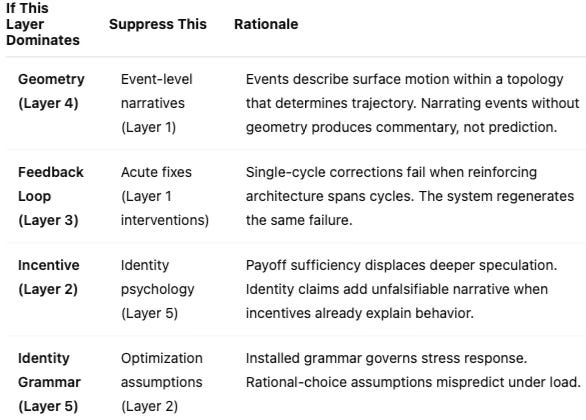
Violating suppression produces measurable error:
Event narrative under geometry dominance produces false hope and squandered corrective capacity.
Acute fixes under loop dominance produce false correction and credibility erosion.
Identity modeling under incentive dominance produces over-psychologizing and unfalsifiable drift.
Optimization modeling under identity dominance produces repeated strategic surprise.
IV.B The Causal Signal Integrity Gate
Health Vision’s Causal Signal Integrity (CSI) governs entry into modeling:
CSI = (ALI + CMF + RIS) / DoC²
ALI (Action Language Integrity): clarity and semantic precision of the causal claim.
CMF (Cognitive Motor Fidelity): whether the cause maps to observable behavior.
RIS (Resonance Integrity Score): coherence across contexts.
DoC (Degree of Causation): depth of the claim (Layer 1 → Layer 5).
The DoC² denominator raises the evidentiary burden on deep claims. A Layer 5 claim must earn its right to govern.
High-integrity causes (CSI ≥ 0.5) move forward. Low-integrity causes are discarded or archived.
IV.C Simulation Routing After Suppression
Field-Geometry Reasoning established that simulation is warranted only after structural dominance has been confirmed and when timing, thresholds, or sequencing remain indeterminate.
When geometry dominates and geodesics are absent: Structural explanation is sufficient. Simulation restates inevitability.
When geometry is conditional and curvature is malleable: Simulation maps curvature variables, tests perturbations, identifies irreversibility thresholds, and sequences interventions.
When Field Decay / Constraint Entropy is high: Simulation models phase transitions, shock absorption, and post-shock re-equilibration.
When compound dominance is detected: Simulation must model interaction across layers.
V. Cross-Domain Applications
Structural causation governs diverse domains. Portability is confirmed when the same dominance logic explains motion across scales.
V.A Federalism and Antitrust (Full Demonstration)
Step 1: Chronic classification. Residential real estate brokerage exhibits recurrent distortion across enforcement cycles and jurisdictions. Distortion persists across administrations and proceedings. Classify as chronic.
Step 2: Dominance detection. Fragmented jurisdiction creates enforcement delay geometry. No single actor possesses a continuous path from investigation through correction to remedy across federal antitrust, state real estate regulation, and legislative proceedings. GAR ≈ 0 across the multi-forum enforcement landscape. Advocacy arbitrage sustains a loop: narratives constrain feasible reform, behavioral settlement stabilizes outcomes, and inquiry locks before structural correction.
Classification: Geometry Dominant with Loop compound (Layers 4 + 3).
Step 3: Suppression applied. Suppress event-level narrative. Suppress single-forum acute fixes.
Step 4: Falsification lock. If venue arbitrage governs:
single-forum enforcement victories will not alter cross-forum positioning within 18 months;
contradictory cross-forum narratives persist across at least two additional legislative cycles.
Disconfirmation: durable cross-forum behavioral convergence within 12 months following a single-forum action.
Step 5: Framework routing. Route to Field-Geometry Reasoning (primary) and Nash-Stigler Equilibrium (secondary). Competitive federalism functions as substitute corrective infrastructure when federal enforcement reaches a Nash-Stigler stopping condition.
V.B Regulatory Design (Compressed Demonstration)
Personnel turnover alters Layer 1. Throughput often remains constrained by mid-level incentive asymmetry (captured by RII) and by multi-agency constraint density. Classification commonly resolves to Loop + Geometry compound. Falsification: administrator change alone compresses timelines by more than 30% within 12 months without incentive redesign.
V.C Performance Under Pressure (Compressed Demonstration)
Turnovers alter Layer 1. Trajectory often follows fatigue topology (Layer 4) and coaching stress grammar (Layer 5). Classification often resolves to Geometry + Identity compound. Falsification: same staff demonstrates fundamentally different fourth-quarter behavior without roster or structural change.
V.D Intergenerational Strategy (Full Demonstration)
Step 1: Chronic classification. Succession crises recur across generations even with complete legal and financial structuring. Classify as chronic.
Step 2: Dominance detection. Founder authority is structurally non-transferable. Without explicit governance architecture, GAR ≈ 0 from founder-led coordination to successor-led institutional governance. Coordination Stability (CSS) and Succession Clarity (SCS) falling below thresholds indicate geometry constraint. Identity inheritance constrains what solutions feel thinkable under stewardship pressure.
Classification: Identity + Geometry compound (Layers 5 + 4).
Step 3: Suppression applied. Suppress Layer 2 optimization assumptions as sufficient explanation.
Step 4: Intervention architecture. Install governance charter and decision protocols (Layer 4), align successor narrative and stewardship identity (Layer 5), then adjust incentives (Layer 2) only after governance installation.
Step 5: Falsification lock. If Layer 4 + 5 dominate:
families with full Layer 2 structuring but low CSS face materially higher crisis rates than families with equivalent structuring and high CSS;
governance architecture installation improves outcomes more than equivalent-cost financial optimization.
Disconfirmation: financial structuring quality predicts transition outcomes better than coordination architecture.
VI. Falsification Windows and Predictive Closure
Predictive integrity requires forward locks.
VI.A Structural Falsification Rules
Geometry claim: If geometry remains unchanged, surface corrections fail within the system’s operating cycle (12–18 months for regulatory proceedings; 24–36 months for institutional reform; 6–12 months for competitive cycles). Durable correction without geometry redesign falsifies geometry dominance.
Identity claim: Specify a stress condition, predict the installed response, and test deviation. Deviation falsifies identity dominance.
Loop claim: The Nash–Stigler–Tirole sequence must repeat within the next operating cycle. Failure to repeat falsifies loop dominance.
VI.B Predictive Closure Standard
Each diagnosis must include:
Dominant layer (or compound).
Suppression declaration.
Time horizon.
Observable confirmation signal.
Explicit disconfirmation condition.
Structural claims without falsification degrade into narrative assertion.
VI.C Calibration Against the Validation Record
MindCast AI’s internal validation logs track forecasts across domains and record confirmation or disconfirmation within the defined windows. Each validated forecast followed the dominance-testing, suppression, and falsification protocol formalized here. The directive codifies operational discipline rather than adding new machinery.
Falsification windows integrate with NAIP200 calibration and the quarterly re-benchmark cycle. Each dominance diagnosis is logged at issuance with its time horizon and disconfirmation condition. Quarterly re-benchmark prevents structural claims from hardening into unfalsifiable priors.
VII. Integration with the MindCast AI Control Stack
The Runtime Causation Arbitration Directive occupies a pre-routing position within the control stack. The directive does not compete with existing frameworks; it determines which framework applies.
Layer 2 dominance → Chicago Accelerated.
Layer 3 dominance → Nash-Stigler Equilibrium + Tirole Advocacy.
Layer 4 dominance → Field-Geometry Reasoning.
Layer 5 dominance → Installed Cognitive Grammar + SIB Vision.
Compound dominance → multi-framework routing.
The directive prevents under-theorization (ignoring geometry) and over-theorization (invoking deep grammar when incentives suffice).
VIII. Conclusion: Structural Governance Before Narrative
Narratives describe motion after the fact. Structural governance determines motion before actors speak. Multi-degree causation defines layering. Field-Geometry defines constraint. Runtime Geometry defines equilibrium persistence. Installed Cognitive Grammar defines identity architecture. The Runtime Causation Arbitration Directive operationalizes all four.
Simulation without arbitration amplifies noise. Simulation after dominance testing produces foresight. When institutions, teams, or markets appear volatile, structural layers determine whether volatility corrects or compounds. Governance begins with structural identification, not commentary.
The directive stands as a portable diagnostic layer. Drop it into any domain. Identify the governing layer. Suppress weaker explanations. Specify falsification. Then simulate.
Referenced MindCast AI Publications
Foundational (This Directive’s Three Pillars)
MCAI Health Vision: Multi-Degree Causation in Chronic Systems — https://www.mindcast-ai.com/p/healthcausation
Field-Geometry Reasoning: Structural Constraint Dominance — https://www.mindcast-ai.com/p/field-geometry-reasoning
Runtime Geometry Economics — https://www.mindcast-ai.com/p/runtime-geometry-economics
Control Stack and Framework Architecture
MindCast AI Economics Frameworks — https://www.mindcast-ai.com/p/mindcast-economics-frameworks
Chicago School Accelerated — https://www.mindcast-ai.com/p/chicago-school-accelerated
Nash-Stigler Equilibrium — https://www.mindcast-ai.com/p/the-nash-stigler-equilibrium
Tirole Advocacy Arbitrage — https://www.mindcast-ai.com/p/tirole-advocacy-arbitrage
Causal Signal Integrity — https://www.mindcast-ai.com/p/causal-signal-integrity
Extended Frameworks Referenced
NIBE and SBC Synthesis — https://www.mindcast-ai.com/p/nibesbc
Installed Cognitive Grammar — https://www.mindcast-ai.com/p/installed-cognitive-grammar
Music as Installed Cognitive Grammar — https://www.mindcast-ai.com/p/music-cognitive-grammar
Structural-Intergenerational Behavioral Economics — https://www.mindcast-ai.com/p/structural-intergenerational-behavioral-vision
Institutional Cognitive Plasticity — https://www.mindcast-ai.com/p/institutional-cognitive-plasticity
Validation Cases Referenced
Diageo Consolidated — https://www.mindcast-ai.com/p/diageo-consolidated
FERC AI Data Centers — https://www.mindcast-ai.com/p/ferc-ai-dcs
DOJ China Chips — https://www.mindcast-ai.com/p/dojchinachips
Nash-Stigler: LiveNation & Compass — https://www.mindcast-ai.com/p/nash-stigler-livenation-compass