


Executive Summary
MindCast AI’s prior foresight simulations have examined Coercive Narrative Governance (CNG) across multiple institutional layers, with particular emphasis on democracy, public trust, and civic-scale legitimacy. CNG describes a structural pattern in which narrative control substitutes for accountable governance—where participation is solicited but interpretive space is closed, and dissent becomes expensive rather than debated. This installment builds on that work but deliberately shifts the unit of analysis from formal institutions to culture and civic trust.
Because the unit of analysis shifts, so does the terminology. CNG describes the structural mechanism at institutional scale—how governments, corporations, and formal systems substitute narrative control for accountable governance. But when that mechanism migrates downstream into families, neighborhoods, community organizations, and everyday civic interactions, the experience changes. What you encounter is not governance failure but relational distortion—the warping of trust, reciprocity, and boundary recognition in spaces that should be governed by mutual respect rather than institutional power.
The current foresight simulation therefore uses Coercive Narrative Distortion (CND) to describe CNG’s civic and cultural manifestation: the same structural signature (asymmetric boundaries, closed interpretive space, expensive dissent) operating through relationships rather than institutions. CNG names the governance failure; CND names what it feels like when that failure reaches your family, your community, your workplace.
When CND goes unrecognized, the result is Coercive Narrative Shock (CNS)—the acute disorientation that occurs when someone realizes, often suddenly, that the relational ground they trusted was never solid. CNS is the moment the pattern becomes visible: the accumulation of “I hear you” without movement, the reframing of your boundaries as character flaws, the sanctions that appeared from nowhere but now form a clear shape. People experiencing CNS often describe feeling gaslit, blindsided, or betrayed—not by a single act, but by the discovery that the structure was never what it appeared to be.
CND is the ongoing distortion; CNS is what happens when you finally see it. This simulation provides the framework to recognize CND before CNS occurs—to name the pattern while intervention remains possible.
Cultural innovation depends on intact boundaries because boundaries are the mechanism by which autonomy and agency are preserved across a culture. When boundaries hold, difference can generate novelty; when boundaries erode, cultures stop innovating and begin optimizing for compliance instead.
Contact mcai@mindcast-ai.com to partner with us on Cultural Innovation foresight simulations. We capture, model and simulate with foresight the Law and Behavioral Economics of Cultural Innovation.
Prior Work: Civic Trust and Democratic Legitimacy
Earlier MindCast AI publications analyzed how CNG operates at scale—through information systems, institutional messaging, and democratic processes—to distort trust and suppress dissent:
Coercive Narrative Shock and The Displacement of Public Trust (Oct 2025) — examined how narrative control mechanisms degrade civic trust by substituting managed consensus for accountable governance.
Discretion and the Architecture of Systemic Trust (Oct 2025) — analyzed how discretionary systems (regulatory, organizational, procedural) convert trust into compliance through narrative framing rather than performance.
Exposing the People Who Weaponize Institutions (May 2025) — modeled how repeated narrative interventions normalize institutional failure by training populations to accept degraded outcomes as inevitable.
Power Integrity and the Future of Coercive Narrative Governance (Oct 2025) — reframed misinformation not as falsehood, but as structural narrative dominance that narrows interpretive space regardless of factual accuracy.
Collectively, these simulations focused on civic trust: how populations lose confidence in institutions, information channels, and collective decision-making under sustained narrative governance.
A parallel strand focused more explicitly on democracy and public trust. The Tension Between Public Trust and Coercive Narrative Governance in Free Markets | Democracy (Jul 2025) examined how coercive narrative environments degrade democratic legitimacy by transforming dissent into deviance and participation into symbolic compliance.
These works established that CNG undermines democratic systems not primarily through censorship, but through managed participation and narrative-conditioned legitimacy.
Boundary Integrity: Culture and Civic Trust
Boundary Integrity extends the CNG arc downstream.
Rather than asking how narrative governance affects elections, media, or formal democratic norms, this foresight simulation examines what happens after those mechanisms normalize—when CNG migrates into cultural and civic spaces: community meetings, professional and academic networks, nonprofits and local organizations, schools, clubs, and informal social institutions.
At this level, the harm is no longer abstract or constitutional. It is relational and cultural. Trust erodes not because speech is banned, but because engagement itself ceases to confer agency.
Boundary Integrity therefore shifts the focus: from public trust to civic trust, from institutional legitimacy to boundary integrity, and from democratic violation to cultural deformation.
It completes the MindCast AI CNG arc by showing how narrative coercion, once normalized at scale, reshapes the cultural substrate on which civic life depends—long before democratic failure becomes visible in formal systems.
Where earlier MindCast AI simulations examined how CNG damages democracy and public trust, Boundary Integrity examines how those same mechanisms quietly hollow out culture itself—by retraining participation, degrading civic trust, and selecting for compliance over engagement.
Roadmap of the Foresight Simulation
Section I identifies the signal: the felt dissonance that arises when dialogue masks asymmetric boundary negotiation. The section reframes that experience as data and situates it within a Cognitive Digital Twin–based foresight simulation, grounded in behavioral economics and repeated-interaction modeling.
Section II maps the actor topology that produces boundary erosion. Four roles recur across domains—principal, intermediary, boundary holder, and enforcement perimeter. Making these roles explicit explains why certain conversations remain immovable regardless of tone, effort, or good faith.
Section III introduces the measurement layer. A small set of metrics—Action–Language Integrity, Narrative Centrality, Negotiation Asymmetry, and Boundary Stability—translate observed behavior into structure, distinguishing ordinary disagreement from systems that extract compliance while denying negotiation is occurring.
Section IV defines the breakdown threshold. Engagement ends not at the first disagreement, but at the first moment boundaries are structurally excluded. Four triggers mark that point: binding authority absence, interpretive space closure, exit penalty activation, and moral inversion.
Section V applies the framework through domain-specific foresight forecasts across families, workplaces, community organizations, and coordinated civic environments. Each scenario includes a structural signature, a predicted breakdown sequence, and an observable falsifier.
Section VI tracks the boundary holder’s trajectory over time, explaining why boundaries sharpen rather than collapse under pressure and why wariness emerges as clarity rather than damage.
Section VII consolidates the findings into a classification system, distinguishing soft, hard, and retaliatory forms of coercive narrative distortion, and clarifying when engagement remains viable versus when exit becomes the only non-negotiable boundary.
The Technical Appendix documents the underlying Vision Function CDT Simulations, metrics, and scoring logic, enabling replication and application without proprietary tools.
I. The Signal You’re Detecting
The prior section described CNG at institutional scale. But you don’t experience it at institutional scale. You experience it in a room, in a conversation, in a relationship where something feels wrong.
You’ve been in rooms where the language was warm—”we value your input,” “this is a dialogue,” “your voice matters”—but nothing moved. Your concerns were acknowledged and then dissolved. You left wondering if you were being unreasonable.
This report treats that feeling not as emotion, but as an unmodeled signal.
You weren’t being unreasonable. What you detected was a boundary negotiation disguised as dialogue—a structure where your limits were being tested while the other party’s limits remained invisible and non-negotiable. CND operates through this asymmetry: one party’s boundaries expand while another’s contract, all under language that denies the negotiation is happening.
Boundary Integrity names that structure, measures it, and predicts when it breaks down. The goal: convert lived intuition into a falsifiable structural model, avoid culture-war framing, and introduce analytical primitives—Boundary Stability Index (BSI), Negotiation Asymmetry Score (NAS), and the concept of legitimacy theater as a surface mechanism—that travel across families, workplaces, civic institutions, and yes—markets and boardrooms where the same dynamics play out at scale.
The Core Question
Is this dialogue or boundary erosion?
Boundary erosion differs from genuine disagreement in that one party’s limits are treated as fixed infrastructure while the other’s are treated as obstacles to overcome. The distinction matters: genuine conflict respects that both parties have limits; boundary erosion reframes your limits as the problem. Legitimacy theater is the surface mechanism—the performance of dialogue, inclusion, and mutual respect that masks the underlying asymmetry.
Boundary erosion has signatures. The conversation happens, but the backbone doesn’t change. Your dissent is converted into “tone issues” or “implementation details.” When you hold a boundary, you’re told you’re being difficult. When you persist, costs appear—lost invitations, shifted relationships, reputational tagging. The negotiation was never about finding mutual ground; it was about moving your line while theirs stayed fixed.
The simulation runs your situation through a diagnostic stack that converts intuition into structured foresight. The goal: predict when negotiation remains possible, and when continued engagement becomes cognitively unsafe.
Methodological Bridge: How the Foresight Simulation Works
The foresight simulation does not rely on introspection, anecdote, or therapeutic interpretation. It uses Cognitive Digital Twins (CDTs) to model how real actors behave under asymmetric boundary conditions, grounded in behavioral economics rather than idealized rational choice.
Each scenario instantiates foresight actors—principals, intermediaries, boundary holders, and enforcement perimeters—with empirically plausible incentives, constraints, and update rules. The model tracks how boundaries move across repeated interactions: who concedes, who holds, and how costs emerge when limits are asserted. Rather than evaluating a single conversation, the simulation observes directionality over time.
The foresight layer distinguishes transient friction from structural closure. Projected interactions reveal when dialogue hardens into theater, when soft pressure converts into sanction, and when continued engagement predictably erodes agency. Metrics such as Action–Language Integrity, Narrative Centrality, Negotiation Asymmetry, and Boundary Stability function as measurement interfaces, translating observable behavior into forecastable outcomes.
The result treats intuition as a signal, then subjects that signal to a predictive behavioral model. The question shifts from whether an interaction feels wrong to whether the structure can still update. When the model shows invariant outcomes, one-directional concession, and rising exit penalties, goodwill and patience no longer improve the system—they only supply legitimacy to a closed one.
Four Scenarios You’ll Recognize
The Family System
You set a limit—about holidays, about how you’ll be spoken to, about what you’ll participate in. The response isn’t respect or even disagreement; it’s reframing. Your boundary becomes “selfishness” or “causing drama.” Other family members get recruited to apply pressure. The negotiation was never about finding workable terms; it was about whether you’d hold your line or fold.
The Community Organization
You have a disagreement with leadership—a legitimate civic matter. Suddenly the social temperature shifts. Your child’s invitations dry up. Committee roles disappear. The disagreement gets reframed: you’re not raising concerns, you’re “creating conflict.” Your boundaries get described as aggression. The enforcement perimeter activates through social capital, not formal process.
The Workplace
The company says it values “open dialogue” and “psychological safety.” You raise a concern. Nothing changes, but you notice a shift—fewer invitations, more scrutiny, a reputation emerging. No one says anything explicit. The sanctions are deniable. But the pattern is clear: certain boundaries weren’t meant to be held. The same dynamics scale to investor relations, regulatory engagement, and market positioning—anywhere institutions solicit input while outcomes remain fixed.
The Coordinated Campaign
You exercise protected civic speech—questioning a political candidate, participating in a public debate, raising concerns about organizational conduct. The immediate conflict resolves, but the social consequences don’t stop. They migrate. Over months or years, exclusions appear across multiple domains simultaneously: your child’s activities, your spouse’s professional reputation, community organizations where the original antagonists hold leadership positions. No single actor admits coordination. Each exclusion is locally deniable. But the pattern is unmistakable—and it spans every space you occupy.
Recognition Points Across Domains
The three scenarios above illustrate dramatic cases. But asymmetric boundary negotiation isn’t confined to dramatic conflicts. The same pattern appears in ordinary interactions across every domain of life:
• The neighbor who keeps “just asking” you to trim your tree, move your car, adjust your fence—framing each request as reasonable while never acknowledging any limit to their requests or any reciprocal adjustment on their part.
• The HOA board that solicits homeowner input at meetings but arrives with decisions already made, treating questions as complaints and boundaries as violations of community spirit.
• The youth sports coach or activity leader who expects total schedule flexibility from your family while their schedule is fixed infrastructure—and who frames your limits as lack of commitment to your child.
• The teacher or administrator who treats your questions about policy as challenges to their authority, converting parental engagement into “being difficult” or “not trusting the professionals.”
• The friend or family member who responds to your boundary not with respect or even disagreement, but with hurt feelings that somehow become your responsibility to manage.
• The board meeting where dissent is welcomed in principle but punished in practice—where directors who ask hard questions find themselves gradually excluded from key conversations and committee assignments.
• The executive team that performs “psychological safety” while systematically marginalizing anyone who surfaces inconvenient data or challenges the CEO’s preferred narrative.
• The investor relations process that solicits shareholder feedback through all the proper channels while core strategic decisions remain immune to that input.
• The regulatory engagement where public comment periods check procedural boxes without creating any interpretive space for the comments to actually reshape outcomes.
The scale changes. The vocabulary changes. The structural signature is identical: one party’s boundaries are invisible infrastructure; the other party’s boundaries are obstacles to be overcome. The framework that follows gives you language to name what’s happening—and metrics to predict when engagement remains meaningful versus when it becomes self-erasure.
A note on scope: Not all asymmetry is coercive. Relationships sometimes require one party to hold more firmly—during crises, transitions, or when expertise genuinely differs. This framework targets situations where asymmetry is denied, concealed, or made irreversible. The full distinction appears in Section VII.
II. The Four Roles
Before measuring boundary asymmetry, you need to map the players. Every asymmetric boundary negotiation involves four positions. Understanding which role you occupy—and which roles others occupy—clarifies why certain conversations feel impossible and what’s structurally happening beneath the surface.
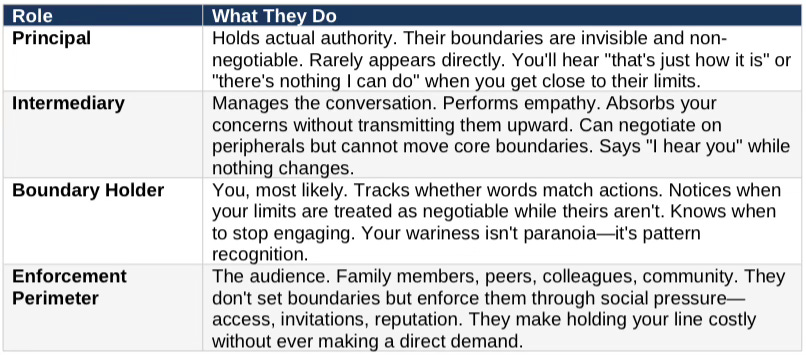
Self-identification prompt: Which role are you in? If you’re reading this because something felt wrong, you’re probably the Boundary Holder. The simulation that follows is calibrated to your position.
III. The Metrics That Matter
With the roles mapped, you can now measure what’s happening between them. You don’t need to run calculations—these metrics name what you already sense. When you leave a conversation feeling gaslit, you’re detecting low Action-Language Integrity. When the “dialogue” seems more about managing you than understanding you, you’re noticing high Narrative Centrality. These metrics quantify boundary asymmetry—whose limits are treated as real and whose are treated as obstacles.
Action-Language Integrity (ALI)
Do their words match their actions?
You might notice this when: They say “your input matters” but nothing changes. They promise follow-up that never comes. The meeting summary doesn’t match what happened in the room.
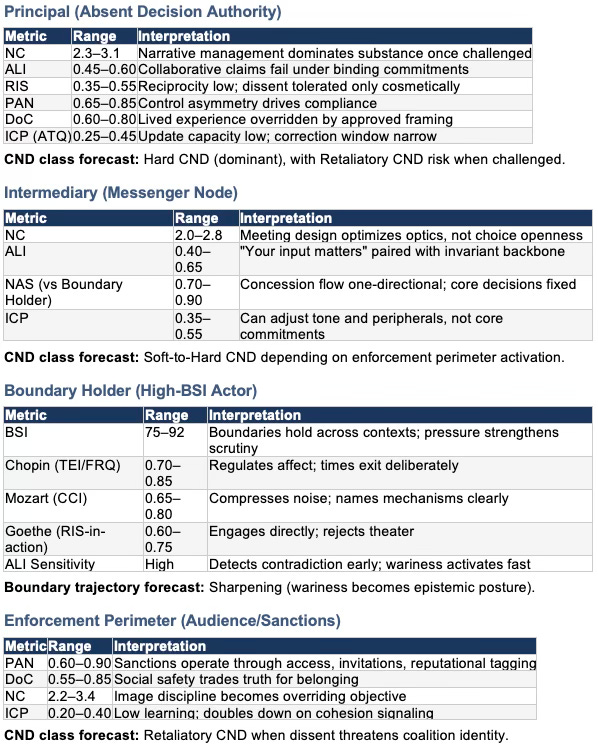
Simulation finding: Principals in boundary erosion scenarios typically show ALI of 0.45–0.60. Intermediaries show 0.40–0.65. Below 0.70 means stated commitments fail under pressure.
Narrative Centrality (NC)
Is story-management the real project?
You might notice this when: The meeting was about how the meeting looked, not about solving the problem. Attendance numbers matter more than outcomes. Language gets carefully managed—”community engagement” instead of “predetermined announcement.”
Simulation finding: NC ≥ 2.0 indicates narrative management dominates substance. In boundary erosion scenarios, we see NC ranges of 2.0–3.4 across parties. The institution’s real project has become perception management—attendance numbers, quote harvesting, and legitimacy optics.
Negotiation Asymmetry Score (NAS)
Whose boundaries are treated as real?
You might notice this when: Every “compromise” means you give something up. Your limits get “acknowledged” but theirs get enforced. You’ve adjusted your position three times; they haven’t moved once.
Simulation finding: NAS ≥ 0.65 indicates one-directional boundary movement. Intermediaries in boundary erosion scenarios show NAS of 0.70–0.90 when measured against boundary holders. Your limits are negotiable; theirs are infrastructure.
Boundary Stability Index (BSI)
Are your limits holding under pressure?
You might notice this when: Pressure doesn’t make you comply—it makes you more careful. You’ve stopped explaining yourself and started documenting. Their repeated “I hear you” without movement is now data, not reassurance.
Simulation finding: Boundary holders in these scenarios typically show BSI of 75–92. Pressure converts into information rather than compliance. BSI staying high is healthy—your wariness is protecting you, not isolating you.
IV. When Engagement Ends
The metrics in Section III let you measure boundary asymmetry. But at what point does asymmetry become breakdown? Meaningful relationship doesn’t end at the first disagreement. It ends at the first moment when your boundaries are structurally excluded from the negotiation. Four triggers mark that moment—the point where continued engagement erodes your limits without any possibility of mutual accommodation.
The Four Triggers
1. Binding Authority Absence (BAA): The person you’re talking to cannot actually commit. They absorb your concerns but cannot change anything. The person whose boundaries actually matter never appears.
2. Interpretive Space Closure (ISC): Your boundaries are removed from the conversation. Only their framework remains. The terms of engagement were set before you entered the room.
3. Exit Penalty Activation (EPA): Costs appear for holding your line. Relationships cool. Access shrinks. Opportunities narrow. The sanctions are deniable but patterned.
4. Moral Inversion Loop (MIL): Your boundaries get reframed as harm. Holding your line becomes “being difficult” or “causing conflict.” Protecting yourself becomes aggression.
The Breakdown Rule
Engagement breaks when you assert a boundary and the response is either closing the space where your boundary could exist, or punishing you for having it.
The breakdown rule is a structural test, not a test of tone or goodwill. The question is whether your limits are part of the negotiation or obstacles to be overcome. Once your boundaries are structurally excluded, continued engagement serves their legitimacy, not your wellbeing.
V. Domain Forecasts
Sections II–IV provided the framework: roles, metrics, and breakdown triggers. Now the simulation applies that framework to generate specific predictions for common boundary-asymmetry scenarios. Each forecast includes the full scenario, structural signature, breakdown prediction, and observable falsifier—a concrete test that would prove the prediction wrong. The dynamics are structural, not contextual; the same patterns appear in families, communities, workplaces, and coordinated multi-domain campaigns.
Example 1: Family System (Relational Boundary Pattern)
Scenario
You set a limit—about holidays, about how you’ll be spoken to, about what you’re willing to participate in. The response isn’t respect or even direct disagreement; it’s reframing. Your boundary becomes “selfishness,” “ingratitude,” or “causing drama.” Other family members get recruited to apply pressure. Conversations circle back to why your limit is the problem.
The negotiation was never about finding workable terms. It was about whether you’d hold your line or fold. Your limits are treated as obstacles to family harmony; their limits remain invisible and non-negotiable.
Structural Signature
• Boundary assertion reframed as moral failure (selfishness, betrayal, cruelty)
• Social enforcement through family network and emotional withdrawal
• One party’s limits invisible; other party’s limits framed as the source of conflict
• Accommodation flows one direction; structure presented as “how family works”
Breakdown Prediction
Most likely trigger sequence: MIL → EPA (Moral Inversion Loop activates Exit Penalty)
Engagement breaks down once the boundary holder’s limits are publicly recast as the source of family conflict. At that point, continued dialogue cannot produce mutual accommodation—it can only produce surrender or estrangement. The boundary holder shifts to documentation and reduced contact.
Observable Falsifier
Boundary is respected without reframing; relationship continues without requiring the boundary holder to abandon their limit. Disagreement remains disagreement rather than becoming character assassination.
Example 2: Community Organization (Social Enforcement Pattern)
Scenario
You raise a legitimate disagreement with organizational or community leadership—a policy concern, a governance question, a decision you believe was handled poorly. The disagreement remains unresolved. Soon after, unrelated social consequences appear: your child’s invitations dry up, committee roles disappear, informal networks close ranks.
The dispute gets reframed. You’re no longer raising concerns—you’re “creating conflict” or “being difficult.” Your boundaries get described as aggression. Enforcement occurs through social capital rather than formal process. No one makes an explicit demand, but the costs of holding your position become unmistakable.
Structural Signature
• Civic disagreement reframed as moral or social threat
• Sanctions extend into unrelated or protected spaces (children, family activities)
• Enforcement carried out by peers and social network, not officials
• Formal neutrality paired with informal punishment
Breakdown Prediction
Most likely trigger sequence: ISC → BAA (Interpretive Space Closure with Binding Authority Absence)
Engagement ends immediately once sanctions extend into child-facing or family-adjacent spaces. At that point, dialogue cannot change outcomes and serves only to legitimize coercion. The boundary holder shifts from engagement to documentation and formal surfacing.
Observable Falsifier
Inclusion remains stable despite disagreement; sanctions do not extend beyond the original dispute context. Children and uninvolved family members remain unaffected.
Example 3: Workplace (Professional Boundary Pattern)
Scenario
The organization says it values “open dialogue,” “psychological safety,” and “bringing your whole self to work.” You raise a concern—about a decision, a process, a direction you believe is problematic. Nothing changes, but you notice a shift. Fewer invitations. More scrutiny. A reputation emerging. Feedback that you’re “not a team player” or “difficult to work with.”
No one says anything explicit. The sanctions are deniable—explained by “fit” or “timing” or “communication style.” But the pattern is clear: certain boundaries weren’t meant to be held. Holding your position has become a career variable. The same dynamics scale to investor relations, regulatory engagement, and market positioning—anywhere institutions solicit input while core boundaries remain non-negotiable and invisible.
Structural Signature
• No formal prohibition, but patterned access loss and reputational cost
• Boundary assertion reframed as cultural misfit or attitude problem
• Stated values (openness, safety) contradicted by operational reality
• Self-censorship enforced upstream of conscious choice
Breakdown Prediction
Most likely trigger sequence: EPA → MIL (Exit Penalty Activation triggers Moral Inversion Loop)
Engagement collapses over 1–2 cycles (review periods, project cycles) once opportunity losses become patterned and colleagues infer that certain boundaries are career-limiting. The boundary holder shifts to documentation, reduced investment, or exit planning.
Observable Falsifier
Boundary assertion produces no access loss across two full cycles; advancement tracks performance rather than accommodation. Stated values are operationally real.
Example 4: Multi-Layer Civic Retaliation (Coordinated Displacement Pattern)
Scenario
You exercise protected civic speech—questioning a political candidate, participating in a public debate, or raising concerns about organizational conduct. The immediate conflict resolves (an election ends, a court affirms your rights), but the social consequences don’t stop. Instead, they migrate.
Over months or years, you notice a pattern that spans multiple domains simultaneously: your child’s invitations to activities dry up; your spouse’s professional reputation comes under scrutiny; you’re excluded from community organizations where the original antagonists hold leadership positions; business associates receive unsolicited warnings about you; venue staff and service providers become inexplicably cold or unavailable.
No single actor admits coordination. Each exclusion is locally deniable—explained by “fit,” “capacity,” or “concerns.” But the pattern is unmistakable: the original political antagonists hold positions across nonprofits, school boards, professional networks, and community institutions. Their leadership roles provide cover to frame retaliation as neutral governance. Third parties are recruited—often without knowledge of the political or legal background, including prior court rulings affirming the boundary holder’s rights—to extend the enforcement perimeter into spaces that should be protected: children’s activities, professional licensing, family relationships.
The conduct isn’t incidental. It reflects what one legal notice described as “a continuing pattern of indirect social punishment, reputation engineering, and strategic displacement designed to undermine [a] family’s inclusion in civic, business, and educational spaces.” This pattern has appeared across multiple jurisdictions and institutional ecosystems—it is structural, not idiosyncratic.
Structural Signature
• Original civic speech or boundary assertion triggers long-term informal punishment
• Retaliation delegated to proxies: venue staff, professional contacts, community insiders
• Nonprofit affiliations and institutional positions used to frame retaliation as neutral governance
• Sanctions extend into protected spaces: children’s activities, spouse’s profession, unrelated business relationships
• Third parties recruited without disclosure of political or legal background
• Each individual exclusion locally deniable; pattern visible only at aggregate level
Breakdown Prediction
Most likely trigger sequence: MIL → EPA → ISC (Moral Inversion reframes speech as harm; Exit Penalties activate across domains; Interpretive Space closes as institutions align)
Multi-layer civic retaliation differs from single-domain examples because engagement cannot end the conflict—the antagonists have distributed enforcement across enough institutions that withdrawal from one space doesn’t provide relief. The boundary holder faces a choice: accept progressive social displacement across all domains, or shift to formal documentation and legal surfacing. Informal resolution becomes structurally impossible once sanctions span professional, civic, educational, and family spaces simultaneously.
Observable Falsifier
Exclusions are genuinely independent and locally explicable without reference to original conflict; no pattern emerges across domains; antagonists do not hold overlapping positions across institutions where exclusions occur; children and uninvolved family members remain unaffected.
Significance of the Multi-Layer Pattern
Multi-layer civic retaliation demonstrates that boundary negotiation can operate at scale—not just within a single relationship or institution, but across an entire social ecosystem. The same structural dynamics that appear in a family dispute or workplace conflict can be deliberately orchestrated across professional networks, civic organizations, schools, and community institutions. The scale changes; the signature is identical. When you encounter coordinated displacement, you’re not dealing with a series of unfortunate coincidences—you’re inside a distributed enforcement system where your boundaries have been structurally excluded from every interpretive space simultaneously.
Pattern Across Examples
Across all examples, the violation occurs before refusal. Individuals never reach a clean decision point because the structure has already been configured to make their boundaries expensive. Participation becomes theater; accommodation flows one direction; holding your line becomes a character flaw.
The four examples above are not about bad actors or hurt feelings. They illustrate structural conditions under which civic interaction ceases to be mutual and boundary integrity becomes the decisive variable. The question is not whether disagreement exists—disagreement is normal. The question is whether your boundaries are part of the negotiation or obstacles to be overcome.
VI. What the Boundary Holder Does
Section V showed how boundary asymmetry plays out across domains. But what happens inside the boundary holder? The simulation tracks a specific trajectory: boundaries don’t collapse under pressure—they sharpen. Sharpening is the predictable response when you recognize that your limits aren’t being negotiated with, they’re being negotiated away.
The Sharpening Trajectory
Phase 1 — Good-faith engagement: You participate genuinely. You explain your limits. You assume mutual respect. This phase produces the baseline data.
Phase 2 — Pattern recognition: You notice that your boundaries move while theirs don’t. “I hear you” accumulates without accommodation. You stop explaining and start observing.
Phase 3 — Wariness as clarity: Your caution becomes a way of seeing. You track whose limits are real and whose are treated as obstacles. The absence of mutual accommodation is no longer an oversight—it’s information about the structure you’re in.
Phase 4 — Exit as boundary: You withdraw—not because you lost, but because continued engagement requires surrendering limits that define who you are. Exit is the boundary that cannot be negotiated away.
When to Shift from Dialogue to Documentation
The shift happens when you need a record more than you need a response. Documentation serves different purposes than negotiation:
• It creates a timeline of what was promised versus what was delivered
• It makes patterns visible to third parties
• It establishes the baseline for any future formal process
• It signals that you’re no longer operating in good-faith negotiation space
Exit Is Not Defeat
Asymmetric boundary negotiation depends on your continued presence. Your engagement legitimizes a process that treats your limits as negotiable and theirs as fixed. Exit withdraws that legitimacy.
The simulation predicts that high-BSI actors exit not at the first frustration but at the first structural impossibility—when your boundaries are clearly excluded from the terms of engagement. Exit is a rational response to an impossible structure, not a failure of relationship.
VII. Classification System
The preceding sections described the mechanics of boundary asymmetry—roles, metrics, triggers, domain patterns, and the boundary holder’s trajectory. Section VII pulls these together into a classification system. The simulation classifies asymmetric boundary negotiation into three types based on severity and mechanism. Understanding the type clarifies what’s structurally happening—and what responses remain possible.
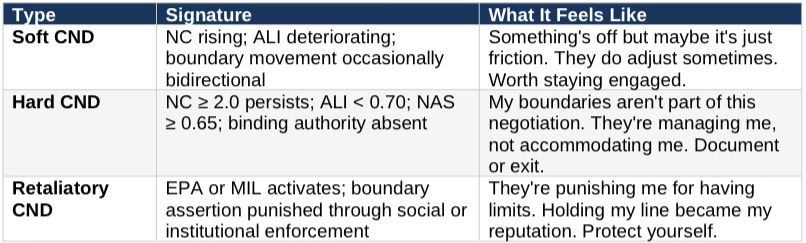
Transition logic: Soft → Hard when boundary movement becomes persistently one-directional and the other party’s limits remain invisible. Hard → Retaliatory when boundary assertion triggers punishment rather than accommodation.
Legitimate Asymmetry vs. Coercive Asymmetry
Not all asymmetry is coercive. Relationships sometimes require one party to hold more firmly than another—during crises, transitions, or when expertise differs. This framework does not classify all boundary differences as illegitimate. The distinguishing criteria are visibility, acknowledgment, and reversibility. When limits are explicit, the asymmetry is acknowledged, and the arrangement can be renegotiated—that’s structure, not coercion. CND emerges when one party’s boundaries become invisible infrastructure while the other’s become obstacles. The framework targets boundary erasure disguised as dialogue—not healthy structure.
VIII. Self-Assessment Questions
The framework is complete. But you don’t need to run simulations or calculate metrics. You can ask yourself a set of direct questions that convert the framework into felt experience. Your answers will tell you where you are.
Questions About the Structure
• Can I see their boundaries, or only feel them when I bump into them?
• Are my limits treated as real constraints or as obstacles to be overcome?
• Who has moved in this relationship? Whose position has stayed fixed?
• Is this conversation about finding mutual ground, or about moving my line?
Questions About Costs
• Has holding my boundary cost me something—a relationship, access, reputation?
• Are the costs deniable but patterned?
• Has my limit been reframed as a character flaw?
• Have sanctions extended into spaces that should be separate (children, other relationships, unrelated contexts)?
Questions About Your Response
• Have I stopped explaining my boundaries and started documenting their responses?
• Do I need a record more than I need understanding?
• Is my continued engagement eroding limits that define who I am?
• What would prove me wrong—what would genuine accommodation look like?
Technical Appendix
The main document provides the framework for recognizing, measuring, and responding to boundary asymmetry. The Technical Appendix provides the underlying machinery for practitioners who want to replicate the simulation logic or apply it to new domains.
How to Use the Appendix: Each Vision Function simulations can be approximated through structured observation and documentation. The metrics are designed to be scored from observable behaviors—meeting records, communication patterns, concession timelines—not from privileged access or black-box algorithms. You don’t need proprietary tools to apply the framework.
A. Vision Function CDT Simulations
The simulation runs six diagnostic flows against the party graph. Each simulation targets specific nodes and measures specific failure modes.
Cultural Vision CDT Simulation
Purpose: Diagnose whether an environment supports authentic coordination or has shifted into coercive narrative governance.
Targets: Principal, Intermediary, Enforcement Perimeter
Component functions: Corina Vision (coherence-generative-recursive integrity), Mozart Vision (signal/noise clarity), Chopin Vision (emotional regulation), Goethe Vision (relational embodiment), Karenina Vision (moral architecture under pressure).
Karenina Vision CDT Simulation
Purpose: Classify institutional moral failure modes and predict power behavior when challenged.
Targets: Principal, Intermediary, Enforcement Perimeter
Measures: Moral sovereignty, narrative coherence, restraint, recovery capacity, pattern repetition across contexts.
Causation Vision CDT Simulation (CSI Gate)
Purpose: Test whether stated rationales genuinely cause observed actions.
Targets: Principal, Intermediary
Application: Distinguishes necessity from pretext. “We have no choice” claims tested against actual constraints.
Institutional Cognitive Plasticity Simulation (ICP)
Purpose: Predict whether an institution can update beliefs and behavior when confronted with contradiction.
Targets: Principal, Intermediary, Enforcement Perimeter
Submetrics: Institutional Update Velocity (IUV), Legacy Inertia Coefficient (LIC), Incentive Alignment Index (IAI), Narrative Reorganization Score (NRS), Structural Pruning Efficiency (SPE), Adaptive Throughput Quotient (ATQ).
Strategic Behavioral Cognitive Vision Simulation (SBC)
Purpose: Translate incentives into predicted behavior and cognition; locate coordination breakpoints.
Targets: All nodes
Output: Identification of the coordination breakpoint—the moment negotiation ceases to be structurally possible.
Boundary Integrity Layer
Purpose: Evaluate whether individual boundaries absorb pressure or sharpen under coercion.
Targets: Intermediary, Boundary Holder (and Enforcement Perimeter where sanctions matter)
Output: BSI score, NAS score, boundary trajectory forecast (absorbing vs. sharpening).
B. Metrics Dashboard (Scored Results)
Scores represent draft-grounded simulated readings. Metrics use 0–1 scales (higher = healthier for integrity metrics, higher = more coercive for pressure metrics), with BSI on a 0–100 scale. See Section C (Glossary) for complete definitions of each metric.
C. Glossary of Metrics
• ALI (Action-Language Integrity): Alignment between what an institution says and what it does. Range 0–1.
• RIS (Relational Integrity Score): Quality of reciprocity, dissent tolerance, and authenticity in relationships. Range 0–1.
• DII (Discretion Integrity Index): Gap between stated justification and underlying motive in discretionary decisions. Range 0–1.
• PAN (Power Asymmetry Node): Degree to which power differentials suppress dissent. Range 0–1 (higher = more suppression).
• DoC (Degree of Coercion): Extent to which narrative overrides lived experience and choice. Range 0–1.
• NC (Narrative Centrality): Ratio of narrative management effort to substantive problem-solving. ≥2.0 indicates story over substance.
• CSI (Causal Signal Integrity): Trustworthiness of inferred causal links. Formula: (ALI + CMF + RIS) / DoC².
• CMF (Cognitive-Motor Fidelity): Consistency between cognition and enacted behavior.
• BSI (Boundary Stability Index): Consistency of stated limits across pressure, context, and power gradients. Range 0–100 (≥70 = strong).
• NAS (Negotiation Asymmetry Score): Directional flow of concessions in negotiation. ≥0.65 = one-directional.
• IUV (Institutional Update Velocity): Speed at which an institution incorporates corrective information.
• LIC (Legacy Inertia Coefficient): Resistance to updating due to sunk identity or prior commitments.
• IAI (Incentive Alignment Index): Alignment between incentives and stated objectives.
• NRS (Narrative Reorganization Score): Ability to revise narratives when facts change.
• SPE (Structural Pruning Efficiency): Capacity to remove failed processes or roles.
• ATQ (Adaptive Throughput Quotient): Overall institutional adaptability under pressure.
D. Interpretive Note
Vision Functions and metrics are not abstract diagnostics. They formalize the pattern-recognition that people with strong boundaries perform intuitively. The CDT Simulation converts lived wariness into structured foresight, allowing prediction of when mutual accommodation remains possible—and when continued engagement becomes boundary erosion.
Relationship collapses when one party’s boundaries become infrastructure while the other’s become obstacles—and the asymmetry is denied. The intermediary’s empathy language cannot repair the gap once the structure is fixed. Narrative Centrality rises because the real project becomes managing you rather than accommodating you. Power Asymmetry Node and Degree of Coercion then do the actual work: they make holding your line expensive through social pressure, access control, and moral inversion.
The boundary holder responds predictably. Boundary Stability stays high, so pressure converts into information rather than compliance. Wariness becomes clarity: you stop explaining your limits and start observing whose limits are real. Engagement ends not at the first disagreement, but at the first moment your boundaries are structurally excluded from the negotiation.