

Related MindCast publications: Data Center Developers Are About to Disclose What State Power Approval Costs | AI Data Center Geopolitical Risks — The Second Authorization Price | AI Data Center Global Investment Flows | Data Center Investor Confidence | The 50-State Authorization Price Atlas
See MindCast Data Center Regulatory Economics and Innovation Live-Fire Mission
Executive Summary
Two foreign-headquartered data center developers are approaching United States public markets. DayOne, based in Singapore, was reported to have confidentially submitted a draft registration statement and could list within a quarter. Nscale, based in London, has hired underwriters and could list as early as September.
Both confront more directly than a domestically owned developer the question of who controls the entity holding each campus. Who owns and controls a data center now affects whether that data center may legally be built, powered, financed, or kept — a question separate from permitting, tariffs, and interconnection.
Three bodies of law ask it. Securities regulators require disclosure of controlling holders. Federal screeners may review transactions involving foreign investors. And state statutes increasingly restrict which entities may own or lease the land under a campus.
A state’s authorization terms no longer tell an investor everything about a project there. Two companies can pursue identical projects in the same state and reach different outcomes because of who owns and controls them. MindCast calls the second variable authorized ownership, and a registration statement is where it becomes measurable.
Three Findings Behind the Argument
Indiana wrote a pathway, not a ban. A company at least half owned by a foreign adversary government may still build, provided two state agencies certify that its electricity will be self-generated and will not draw on the regional grid. Nationality became a condition a company can satisfy rather than a bar it cannot pass. The statute cleared both chambers without a dissenting vote.
North Carolina would turn ownership into credit. Its pending bill would let a lender treat a foreign ownership violation as a default under the loan. No other state instrument connects who owns a data center to what the debt costs so directly.
Ownership and control move separately. One platform’s Chinese parent fell from 52.7 percent to roughly 19.9 percent across two years while the same person continued to chair both companies. Equity dilution can satisfy a percentage threshold and leave control untouched, which is why some statutes test ownership and others test control.
What MindCast Forecasts
Section IX registers twenty-six dated, publicly settleable predictions. Seven carry the argument.
The first filing supplies a backlog conversion schedule — 73–82%. Contracted and realized revenue separate in public.
A candidate files publicly by mid-2027 — 66–75%. Confidential preparation converts into a public document.
The filing carries at least two of three authorization disclosures — 50–60%. State eligibility, screening history, or a campus-to-entity map.
The filing maps United States campuses to holding entities — 62–70%. Parent-level description gives way to entity-level attribution.
Another state restricts data center foreign ownership by end-2027 — 61–70%. Indiana enacted one; others are drafting.
Equity research names ownership or eligibility as a valuation factor — 52–62%. Political and legal exposure reaches price targets.
A named project faces a documented state proceeding — 21–30%. Statutes exist; enforcement has not yet been observed.
Who Should Act on This
Investors — separate foreign incorporation from actual control before applying any discount. Section IV supplies the capacity and revenue ladders.
Foreign issuers and counsel — assemble the control map before pricing rather than defending it after. Section VIII names the five disclosures.
Sovereign allocators — governance rights, not headline percentage, decide screening exposure. Section V explains why.
State lawmakers — ten drafting choices decide whether an instrument binds or gets structured around. Section VII closes with the checklist.
Lenders and rating agencies — North Carolina would make an ownership violation a callable default. Section VI carries the provision.
Utilities and commissions — the entity signing a fifteen-year power agreement may face divestiture in year three. Section III sets out the continuity question.
Federal screening practitioners — a public filing detects transactions without creating jurisdiction over them. Section V draws the line.
The sections below run in sequence. Section I sets out what the two companies have and have not done. Section II separates five legal meanings of “foreign,” because grouping companies by headquarters produces wrong answers. Sections IV and V supply the measurement tools and the three bodies of law. Sections VI and VII examine one company’s ownership history and one state’s enacted statute. Sections VIII through XI state what to look for, what MindCast predicts, and where the analysis stops.
I. Two Companies Preparing to Go Public, Neither There Yet
News coverage has moved faster than the paperwork, and the gap between the two matters legally.
DayOne Data Centers, Singapore-headquartered, was reported to have confidentially submitted a draft registration statement for a United States offering that could raise roughly $5 billion, at a valuation last pegged near $20 billion, with a debut possible as soon as next quarter. DayOne’s portfolio runs about 480 MW in service or under construction plus 590 MW reserved across Hong Kong, Indonesia, Japan, Malaysia, and Singapore.
Nscale, London-based, has retained Goldman Sachs and JPMorgan and could hold a United States offering as early as September, telling prospective investors it holds roughly $51 billion in total contracted revenue against quarterly revenue above $100 million in the second quarter. Sites run from Loughton in Essex to Point Pleasant, West Virginia, and multiple locations in Norway.
The candidates test different parts of the thesis. Nscale brings direct United States project exposure through West Virginia. DayOne brings the more developed ownership-separation and venue case, though its disclosed portfolio does not appear to include a United States campus, so state property exposure remains prospective for DayOne unless it acquires or develops American assets.
No public registration statement had appeared for either company as of August 13, 2026. A confidential submission goes to the Securities and Exchange Commission but stays private. Investors cannot read it. Under Commission rules an issuer may remain nonpublic until shortly before it markets the offering, so preparation can run for months with nothing visible outside. Prediction 1 settles against the record either way. The predictions about filing content wait for a document to exist.
II. Five Legal Meanings of Foreign Ownership
Headquarters location tells a reader almost nothing about legal exposure. Five distinct categories carry different consequences, and two companies in the same city can sit in different ones.
Foreign-incorporated describes where the parent was formed. Foreign-controlled describes who directs it. Foreign-government-owned describes sovereign equity. Foreign-adversary-linked describes a person or entity connected to a country designated under the particular statute or screening regime being applied, since no single country list governs the entire ownership stack. Foreign-capitalized describes an American company carrying sovereign or foreign institutional equity, where the control question turns on governance rights rather than on headquarters.
Nscale is British-incorporated with Norwegian, Finnish, and American backers — Aker, Nokia, and Nvidia among them. DayOne is Singapore-headquartered with a Chinese former parent that retains a minority stake. The two occupy different boxes, and no analysis that groups them by geography survives contact with a statute.
Domestic incorporation confers no immunity. Vantage Data Centers is headquartered in Denver, and a wholly owned subsidiary of the Abu Dhabi Investment Authority participated alongside a GIC affiliate in a $1.6 billion investment into Vantage’s Asia-Pacific platform, with both described as existing Vantage investors. Vantage demonstrates that sovereign capital can sit inside an American-headquartered platform through regional investment vehicles carrying their own ownership profiles.
The right question is never where a company is headquartered. The right question is who controls the entity that holds each campus.
III. Who Should Read This and Why
The executive summary names the action each group should take. What follows is the reasoning behind those actions, for readers who want it before turning to the analysis.
Investors and allocators. Foreign incorporation and actual control are different variables, and only one changes what a portfolio may legally do. Sections IV and V supply the ladders and the three bodies of law.
Foreign issuers, sponsors, and transaction advisers. A registration statement converts every ownership arrangement into a disclosure decision, and the decision arrives before pricing rather than after. Sponsor liquidity may also decide which transaction route the platform takes at all.
Sovereign allocators. Ownership percentage, governance rights, and control each carry different consequences, and a listing publishes an allocator’s position in a document the allocator does not file.
State lawmakers and legislative staff. Indiana and North Carolina wrote different instruments to reach the same concern, and the drafting choices between them determine which version gets copied.
Utilities and commissions. A power agreement runs to a specific legal entity, and a counterparty facing divestiture within three years is a counterparty whose continuity belongs in the record.
Lenders and rating agencies. North Carolina’s pending bill would let a noteholder treat an ownership violation as a default, which turns a screening question into a credit event by statute.
Federal screening practitioners. A public filing may reveal acquisition history, governance rights, and transactions never notified, without giving anyone new authority over them.
Every reader arrives at one claim from a different door: ownership has become an authorization variable, and a registration statement is where the variable becomes visible and priceable.
Contact mcai@mindcast-ai.com to partner with us on Predictive Game Theory AI in Law and Behavioral Economics. We specialize in predictive simulations for Complex Litigation, Innovation Economics, Geopolitical Risk Intelligence and Legacy Innovation. See more about MindCast series at our new website MindCast Corporate.
To test our predictive simulation AI system, in 2026 we simulated the Super Bowl and the World Cup. See 🏈 Super Bowl LX — AI Simulation vs. Reality | ⚽ The 2026 World Cup Final Simulation Validation
To deep dive on MindCast works upload the URL of this publication into any LLM (preferably Google AI mode) and prompt ‘reconstruct MindCast framework with three degrees of cited sub links.’ See Live-Fire Game Theory Simulators, Runtime Predictive Infrastructure.
Working With MindCast
MindCast runs two service lines on one method. Authorization intelligence grades jurisdictions and instruments against the fifty-state baseline. Geopolitical exposure intelligence maps the sovereign, screening, and connectivity constraints that sit above them.
Issuers and their advisers can commission a pre-filing disclosure benchmark — a control map across project entities, tested against the state eligibility and screening categories a registration statement will have to address. Investors and lenders can commission a portfolio review applying the capacity and revenue ladders to a named platform, with an ownership overlay on each jurisdiction grade. States, utilities, and commissions can commission a drafting review against the ten variables in Section VII, or a reconciliation of disclosed campus schedules against load forecasts and financial assurance calculations. Sovereign allocators can commission an exposure assessment identifying which instruments reach a given position and which reach only its governance rights.
Engagements run as simulations with dated, falsifiable outputs, and MindCast grades its own record in public.
IV. Measuring Capacity and Measuring Contracted Revenue
The companion note established six capacity classes running from operating through announced. Contracted revenue needs its own ladder, because a signed contract and an energized megawatt fail in different ways.
Six analytic stages carry different evidentiary value. They do not replace accounting categories; they show how far a commercial claim has traveled toward realized cash.
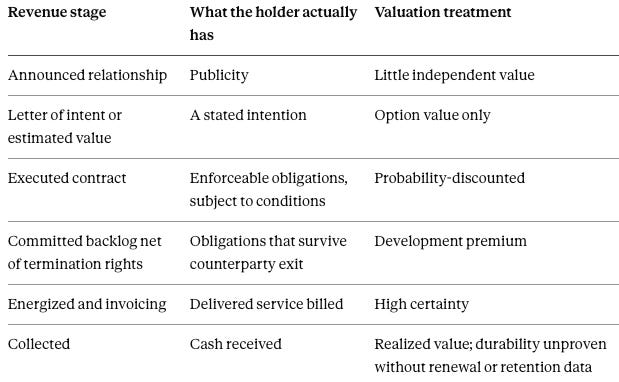
Cross the revenue ladder against the capacity ladder and the diagnostic sharpens considerably. A platform can hold executed contracts against controlled land, or collected revenue against operating capacity, and the two positions carry almost nothing in common.
Nscale illustrates why the dual axis matters. Reported figures place total contracted revenue near $51 billion against quarterly revenue above $100 million, which annualizes near $400 million. Later reporting has attached substantially different backlog figures to the same company.
MindCast treats the $51 billion figure as a reported number, not an audited one. Source, duration, cancellation rights, financing dependencies, and revenue recognition schedule all remain unestablished, and a registration statement is the document that would establish them.
V. Securities Disclosure, Federal Screening, and State Property Law
Three regimes govern foreign participation in American data center assets. Each has a different trigger, a different timetable, and a different remedy, and commentary routinely collapses them.
Securities disclosure reaches control more reliably than ownership. A qualifying foreign company may report as a foreign private issuer under a disclosure regime that differs from the domestic-issuer regime and requires less detail in several ownership, governance, and periodic-reporting areas. Disclosure generally covers known holders of 5% or more, controlling persons or governments, directors and officers, and material transactions with related parties. Upstream limited partners and sub-5% sovereign positions may not appear as separately named holders.
Federal screening is transaction-driven. A listing does not by itself create jurisdiction for the Committee on Foreign Investment in the United States. Acquisitions, investments carrying governance rights, project-company transactions, and covered real estate interests do. Inbound review may apply to foreign investment in United States data center businesses, particularly where projects involve advanced computing or large volumes of sensitive data, and Justice Department data transfer rules apply independently of both federal screening and state law.
What a filing produces is a detection effect. Acquisition history, governance rights, sensitive-site proximity, and previously non-notified transactions become visible in one document. A filing can reveal a transaction that federal screeners never reviewed. Revealing a transaction is not the same as giving screeners authority over it, and the two get confused constantly.
State property statutes form a perimeter, and only part of it reaches data centers. Twenty-six states have passed sixty-three bills restricting foreign property ownership, with most aimed at agricultural land or property near sensitive facilities rather than at ordinary commercial sites. Indiana has extended the logic expressly to data centers. North Carolina’s pending bill would go considerably further.
A filing does not activate any of the three. A filing assembles enough of the ownership, control, asset, and contract map for investors and regulators to price all three through a single instrument.
The three bodies of law also move on different clocks. State legislation can advance without any filing at all, since a drafter copies a threshold from another state without waiting for a company to list. Securities disclosure arrives on an issuer’s capital-markets timetable. Market pricing requires both a visible exposure and a credible consequence attached to it. The three processes need not occur in the same order for every issuer, and a filing could well arrive before another state enacts anything.
VI. Ownership Restructuring and Statutory Eligibility
Authorized power is a condition a developer encounters. Authorized ownership is a condition a developer can restructure toward, and DayOne supplies an observable test of whether ordinary capital restructuring can also improve authorization eligibility.
GDS Holdings, listed on Nasdaq and the Hong Kong exchange, built its international business inside a subsidiary called GDS International. Following the close of a Series B financing on December 31, 2024, GDS’s equity interest fell from 52.7% to 35.6%, and GDS deconsolidated the subsidiary — meaning GDS stopped consolidating DayOne’s assets, liabilities, revenue, and expenses line by line, accounted for its remaining interest under the equity method, and presented the former international operations as discontinued operations for the applicable periods.
GDS International was renamed DayOne in January 2025. Analysts described the rebrand as an effort to distance the platform from its Chinese parent amid geopolitical risks while positioning it for a public listing.
Dilution continued. In January 2026 DayOne repurchased $385 million of GDS-held ordinary shares at the Series C price, letting GDS recycle roughly 95% of its principal at nearly 6.5 times money, and GDS held approximately 19.9% as of late April, down from an estimated 24% before the repurchase.
Read the sequence as a series: 52.7%, then 35.6%, then roughly 24%, then roughly 19.9%. Add a rename, a Singapore holding structure, and a listing target.
DayOne’s restructuring moved in the same direction later state statutes would reward — lower Chinese-parent ownership, separate capitalization, and a distinct public identity. The record establishes convergence, not motive. Commercial fundraising, deconsolidation, valuation, and listing preparation each supply independent explanations.
William Huang chairs both companies throughout, which leaves the control question open even as economic ownership falls. Equity dilution can improve statutory eligibility while governance overlap preserves control risk, and the two move on different tracks.
Legislatures have been writing thresholds on the same clock. Indiana’s enacted statute defines a foreign company as one at least 50% owned by a foreign adversary government or headquartered in such a country. North Carolina’s Senate Bill 730 would exempt holdings below five percent of any class of registered equity, treating anything smaller as too minor to regulate, and would reach any lease running a year or longer.
North Carolina proposes the provision that would turn ownership into credit. House-passed Edition 5 of Senate Bill 730 would require registration of certain existing interests, require a prohibited foreign party to divest within three years, provide for an affidavit attached to the deed, direct the Attorney General to enforce, and allow a qualifying ownership violation to be deemed a default under the lending instrument by the noteholder, with the proposed provisions effective December 1, 2026.
Status matters here. The House passed the substitute 69 to 44 on June 3, 2026 and returned the bill to the Senate for concurrence, where it was referred to the Senate Rules Committee. As of August 14, 2026 the measure had not been enacted, and one House sponsor described the legislation as unfinished and binding on no one in the state currently.
A noteholder able to call default on an ownership violation would be a lender holding an authorization covenant. MindCast identified no other state data center instrument now moving that connects ownership eligibility to lender default rights so directly, which is why the drafting choice matters well beyond North Carolina.
A shareholder can lose most of its equity and keep its influence. Indiana’s statute measures the equity; North Carolina’s proposal measures both equity and control. A platform can fall below a percentage threshold while the same person continues to chair both entities, which is why Indiana wrote an ownership test and North Carolina wrote tests for both significant interest and substantial control.
VII. Indiana Wrote a Conditional Pathway, Not a Ban
Coverage of Indiana’s statute has described it as a prohibition. Reading the operative text produces something more interesting and more consequential for other states.
Senate Enrolled Act 431, effective July 1, 2025, provides that a foreign company may not construct a data center in Indiana unless the Indiana Utility Regulatory Commission and the Indiana Economic Development Corporation conduct a joint study of anticipated electricity use and certify to the governor and general assembly that the electricity will be self-generated and will not affect the load supply of the regional transmission organizations serving Indiana — named as MISO and PJM. A foreign company is one at least 50% owned by a foreign adversary or headquartered in a country with a foreign adversary government.
Indiana did not close the door. Indiana priced it. Build if you generate your own power and stay off the shared grid, verified by two state agencies reporting to the legislature.
Indiana resembles emerging bring-your-own-generation approaches elsewhere, which transfer the adequacy problem to applicants and move the binding decision out of the interconnection queue. Indiana’s nationality-based trigger makes the structure distinct.
Indiana’s version applies to fewer companies and ends in a written certification to the governor and legislature, rather than in a place in an interconnection queue. The measure passed the House and Senate unanimously, which is the fact most relevant to anyone forecasting whether the category spreads.
Unanimity demonstrates exceptionally low observed partisan cost in Indiana and raises the probability of copying elsewhere. Expect the copies to vary on threshold, on covered nationality, and on whether the condition is self-generation or something harder.
Legislative Drafting Variables
Ten choices separate a workable ownership instrument from one that litigates. Indiana and North Carolina resolve several of them differently, and any state copying either will confront all ten.
Covered facilities and minimum-load thresholds
Covered governments and nationalities, and the designation source that identifies them
Direct and indirect ownership thresholds
Governance, veto, board, and substantial-control tests
Passive and publicly traded securities exceptions
Treatment of leases, options, and project-company interests
Grandfathering and registration of existing interests
Certification, mitigation, divestiture, and penalty procedures
Treatment of federally mitigated transactions
Consequences for lenders, utilities, and existing contracts
Property-based statutes that omit leases leave an obvious structuring channel. North Carolina closes that channel by reaching leases of one year or longer. Indiana uses a different trigger entirely: whether a covered foreign company constructs the facility.
VIII. What Investors Should Look for in the First Filing
Five disclosures would carry the most information for every audience named in Section III.
Control map by project entity. Which legal entity holds each United States campus, and which persons or governments control that entity. A filing that describes only the parent company leaves investors unable to tell which entity actually holds each site.
Sovereign and state-affiliated positions. Holders at or above the 5% threshold, plus any holder with governance rights, board designation, or veto powers regardless of percentage.
Backlog conversion schedule. Contract duration, termination rights, financing dependencies, and the recognition schedule that turns booked revenue into collected revenue.
Screening history. Prior federal reviews, mitigation agreements, and any transaction that could be characterized as covered but was not notified.
State eligibility exposure. Assets located in jurisdictions with foreign ownership or control restrictions, and whether current ownership clears each applicable threshold.
State eligibility exposure is the least established disclosure category in the current data center filing record. A registration statement listing which campuses sit in states with ownership thresholds, and whether the issuer clears them, would let investors grade a portfolio on entity eligibility rather than on jurisdiction conditions alone.
Securities disclosure reaches a defined perimeter. Filings cover listed companies only, describe risk to investors rather than obligations to communities, and reach control more reliably than the full ownership chain. Legislation governs everything outside that perimeter, and Indiana and North Carolina have started writing it.
IX. Twenty-Six Dated Predictions
Twenty-six forward claims, dated August 14, 2026. Each carries an explicit falsifier, a named settlement source, a deadline, and a confidence band with its class label.
MindCast produced the register by running a simulation rather than by estimating each figure. The executions modeled the principal issuers, regulators, investors, lawmakers, lenders, utilities, and market intermediaries implicated by the argument. Rather than profiling each in isolation, the simulation ran them against one another across eight contests: issuer against securities regulator, issuer against underwriter, developer against Indiana’s certifying agencies, counsel against legislature, sovereign allocator against federal screener, former parent against spun-out platform, foreign platform against domestic competitor, and lender against borrower.
Two separately executed model runs evaluated the same source record. For predictions priced by both, the central band averages the two lower bounds and the two upper bounds, and the envelope preserves the lowest lower bound and the highest upper bound. Both are structured model judgments rather than statistically calibrated confidence intervals.
Where the two runs agreed, MindCast did not raise the band on that basis alone, since two executions on similar material can share the same error.
Primary denotes importance to the argument, not higher probability. A prediction at 21–30% can be Primary because settling it either way tells a reader more than a safer forecast would.
Causal-integrity testing lowered the restructuring and venue bands because the record did not establish motive.
Eleven predictions marked Primary test the mechanism this note argues. Four groups cover filing content, ownership restructuring, state legislation, and market response. Where a prediction depends on an event that has not happened — a filing, a listing, a pricing — the prediction waits for that event rather than scoring against a blank record.
Group One — Filing and Disclosure Content
Whether a public registration statement appears, and what an ownership map contains once it does.
1 — Public Filing [Primary] A current-cohort platform publicly files a United States registration statement. Current cohort means DayOne and Nscale, plus any foreign-headquartered data center platform publicly reported by August 14, 2026 to be preparing, considering, or pursuing a United States listing. The first cohort filing to become public is the qualifying filing that settles Predictions 2 through 8. Confidence: 66–75%, event class. Envelope 60–80%. Falsifier: no public registration statement from a current-cohort platform by the deadline. Settlement: EDGAR. Deadline: June 30, 2027.
2 — Backlog Conversion Schedule [Primary] The filing provides contract duration or backlog conversion detail beyond a single aggregate bookings figure. Confidence: 73–82%, event class. Envelope 70–84%. Falsifier: the filing reports aggregate contracted value without duration, conversion, or termination detail. Unactivated absent a public filing. Settlement: EDGAR. Deadline: June 30, 2027.
3 — Sovereign or State-Affiliated Holder [Primary] The filing identifies a sovereign or state-affiliated investor holding at least 5%, exercising control, or possessing material governance rights. State-affiliated means a government, sovereign wealth fund, government-controlled enterprise, or an entity the filing identifies as controlled by one. Confidence: 50–60%, event class. Falsifier: no such holder appears. Unactivated absent a public filing. Settlement: EDGAR. Deadline: December 31, 2027.
4 — Project-Entity Control Map [Primary] The filing identifies the legal entity holding material United States campuses rather than describing the portfolio only at parent level. Confidence: 62–70%, event class. Envelope 55–76%. Falsifier: the filing describes United States assets without entity-level attribution. Unactivated absent a public filing with material United States assets. Settlement: EDGAR. Deadline: December 31, 2027.
5 — State Eligibility Risk Factor [Secondary] The filing names state foreign ownership or control restrictions as a risk to asset eligibility, land tenure, or operations. Confidence: 44–54%, event class. Envelope 40–58%. Falsifier: no such risk factor appears. Unactivated absent a public filing. Settlement: EDGAR. Deadline: December 31, 2027.
6 — Screening History Disclosure [Secondary] The filing discloses a prior federal screening review, mitigation agreement, or national security agreement. Confidence: 35–45%, event class. Falsifier: no such disclosure appears. Unactivated absent a public filing. Settlement: EDGAR. Deadline: December 31, 2027.
7 — Authorization Disclosure Expansion [Secondary] The first qualifying filing contains at least two of three authorization disclosures: state eligibility exposure, federal screening or mitigation history, and a campus-to-entity map. The first two categories are absent from GDS Holdings’ 2016 registration statement, the closest prior comparator. Confidence: 50–60%, event class. Falsifier: fewer than two of the three appear. Unactivated absent a public filing with material United States assets. Settlement: EDGAR, both documents. Deadline: December 31, 2027.
8 — Aggregate Backlog Reconciliation [Secondary] A public filing or audited statement reconciles a previously reported aggregate contracted revenue figure to a recognition schedule. Confidence: 55–65%, event class. Falsifier: no reconciliation appears in any public filing. Unactivated absent a public filing. Settlement: EDGAR. Deadline: December 31, 2027.
Group Two — Ownership Restructuring
Whether ownership positions move toward statutory eligibility, and whether anyone says so.
9 — Pre-Listing Ownership Restructuring [Primary] At least one foreign-linked data center platform materially reduces adversary-linked ownership, changes domicile, or restructures control before a United States listing, with a public statement connecting the step to listing readiness, geopolitical exposure, national security review, or ownership eligibility. Confidence: 48–58%, event class. The record establishes that ownership positions moved, not that eligibility drove the move, so no motive inference supports a higher figure. Falsifier: no such restructuring is publicly documented, or restructuring occurs without any disclosed connection to those grounds. Settlement: company announcements, SEC filings, and foreign exchange disclosures. Deadline: December 31, 2027.
10 — Threshold Targeting [Secondary] A platform or its shareholders publicly reference a statutory ownership threshold — federal or state — in explaining a stake reduction, buyback, or restructuring. Confidence: 35–45%, event class. Falsifier: no such public reference. Settlement: company statements, filings, and named financial press reporting. Deadline: December 31, 2027.
11 — Continued Dilution [Secondary] GDS Holdings’ disclosed DayOne equity interest falls below its most recently reported level, whether through sale, repurchase, or passive dilution from new issuance. Confidence: 56–66%, event class. Falsifier: the disclosed interest holds at or above its most recently reported level. Settlement: GDS filings and announcements. Deadline: December 31, 2027.
12 — Regional Platform Separation [Secondary] At least one global data center platform separately capitalizes or ring-fences a regional entity with a distinct sovereign shareholder base. Confidence: 60–70%, event class. Falsifier: no such separation is announced. Settlement: company announcements and investor materials. Deadline: December 31, 2027.
13 — Passive-Stake Structuring [Secondary] A sovereign or state-affiliated investor takes or restructures a position expressly characterized as passive, non-controlling, or below a named threshold in a data center platform. Confidence: 50–60%, event class. Falsifier: no such characterization appears. Settlement: company and investor announcements. Deadline: December 31, 2027.
14 — Venue Partition [Secondary] A foreign platform selects a non-United States or dual listing venue and publicly attributes the decision partly to United States disclosure or regulatory burden. Confidence: 30–40%, event class. Venue selection tracks commercial and investor-base factors at least as strongly as disclosure burden, and public attribution is rarer still. Falsifier: no such public attribution. Settlement: company statements and named financial press reporting. Deadline: December 31, 2027.
Group Three — State Legislation
Whether the Indiana and North Carolina instruments spread, and in what form.
15 — Additional State Enactment [Primary] At least one state beyond Indiana enacts a data-center-specific foreign ownership or control restriction. Confidence: 61–70%, event class. Falsifier: no enactment beyond Indiana. Settlement: enacted session law. Deadline: December 31, 2027.
16 — Lending-Default Provision Spreads [Primary] A state other than North Carolina passes through at least one chamber, or enacts, language permitting a lender to treat a foreign ownership violation as a default under the lending instrument. Confidence: 36–46%, event class. Falsifier: no such provision clears a chamber or is enacted outside North Carolina. Settlement: chamber vote records and enacted session law. Deadline: December 31, 2027.
17 — Conditional Pathway Over Prohibition [Primary] A majority of new state data-center ownership instruments enacted in the period adopt a conditional pathway — certification, self-generation, registration — rather than a flat prohibition. Confidence: 57–67%, interpretive class. Envelope 54–70%. Matching rule stated here: an instrument counts as conditional where a defined administrative process lets a covered developer lawfully acquire, construct, retain, or operate the property, so registration that records an interest without authorizing it does not count. Activated only if at least three new state instruments are enacted. Falsifier: a majority adopt flat prohibitions. Settlement: enacted session law. Deadline: December 31, 2027.
18 — Threshold Convergence [Secondary] New state instruments cluster on ownership thresholds of exactly 5%, 25%, or 50% rather than dispersing across many values. Confidence: 54–64%, interpretive class. Universe stated here: the first six enacted or chamber-passed data-center-specific ownership instruments after August 14, 2026. Matching rule: at least four of the six use exactly one of the three named figures. Falsifier: fewer than four. Unactivated if fewer than six qualifying instruments appear. Settlement: enacted session law and introduced bill text. Deadline: December 31, 2028.
19 — Lease Coverage [Secondary] At least one new state instrument expressly reaches leases or options rather than fee ownership alone. Confidence: 60–70%, event class. Falsifier: no new instrument reaches leases. Settlement: enacted session law. Deadline: December 31, 2027.
20 — Named Project Proceeding [Primary] A named data center project becomes subject to a publicly documented certification, registration, divestiture, or enforcement proceeding under a state foreign ownership instrument. Confidence: 21–30%, event class. Statutes diffuse considerably faster than enforcement against a named project, and no state has yet brought one. Falsifier: no such documented proceeding. Settlement: state agency records, attorney general filings, and commission dockets. Deadline: December 31, 2027.
Group Four — Screening and Market Response
Whether federal screeners and public markets respond to what a filing reveals.
21 — Disclosed Federal Review [Primary] A transaction party publicly discloses that a data center transaction received federal screening review or mitigation. Confidence: 41–50%, event class. Falsifier: no such public disclosure. Settlement: SEC filings, company announcements, and agency statements. Note: confidentiality holds the observable rate below the underlying review rate. Deadline: December 31, 2027.
22 — Fast-Track Distinction Appears [Secondary] A data center transaction or issuer publicly references allied or partner status under the Treasury Known Investor Program or its pilot, which remains under development and does not change screening jurisdiction. Confidence: 32–42%, event class. Falsifier: no such reference. Settlement: company statements, SEC filings, and Treasury materials. Deadline: December 31, 2027.
23 — Research Prices Ownership [Primary] A named sell-side analyst publicly identifies foreign ownership, control, or state eligibility restrictions as a factor in the valuation, investment recommendation, or price target for a listed data center issuer. Confidence: 52–62%, event class. Falsifier: no named analyst identifies such a factor. Unactivated absent a listed foreign-linked issuer under coverage. Settlement: a publicly accessible research report, a quoted analyst note, an issuer earnings transcript, or a named financial-press account identifying the analyst and firm. Deadline: December 31, 2028.
24 — Rating Methodology Names Ownership [Secondary] A rating agency publishes criteria or commentary naming foreign ownership or control eligibility as a factor for data center issuers or project finance. Confidence: 35–45%, event class. Qualifying documents must be published or materially revised after August 14, 2026. Falsifier: no such publication. Settlement: agency criteria and commentary archives. Deadline: December 31, 2028.
25 — Ownership-Linked Discount at Pricing [Secondary] A foreign-headquartered data center issuer prices a United States listing below its last private valuation, and someone attributes part of the gap to ownership.
Measured as implied fully diluted pre-offering equity value against the last disclosed post-money private valuation, adjusted for splits, conversions, and material acquisitions. Attribution must come from the issuer, a named analyst, or a named financial-press source, and must cite foreign ownership, control, screening, or state eligibility exposure. Confidence: 30–40%, event class. Two events are required, which lowers the band relative to a bare down round. Falsifier: implied value at or above the last disclosed post-money private valuation on that basis, or a discount with no attributed ownership connection. Unactivated absent a priced listing. Settlement: final prospectus, pricing announcement, and the attributing source. Deadline: December 31, 2027.
26 — Counterparty Continuity Raised [Secondary] A utility, commission, or intervenor raises foreign ownership or divestiture risk as a counterparty-continuity question in a large-load proceeding. Confidence: 30–40%, event class. Falsifier: no such filing or testimony. Settlement: state commission dockets. Deadline: December 31, 2027.
Group Four closes the sequence. State legislatures write ownership thresholds, filings disclose ownership against them, research prices the difference, and utilities ask whether the entity signing a fifteen-year power agreement can still hold the land in year four.
What the Simulation Produced
Both executions returned the same sequence, which is the reason the bands fall as they do. Filing preparation comes first, then ownership and project-entity disclosure, then regulatory detection, then classification by analysts and counterparties, then a restructuring or pricing response.
Nothing in that chain produces an immediate ownership discount. Disclosure predictions therefore carry higher bands than pricing predictions, and state-legislation predictions carry higher bands than either, because legislatures act on their own clock.
How the Argument Can Fail
Two separable claims carry the authorized-ownership thesis, and each fails on its own terms.
Disclosure test. The first current-cohort foreign filing supplies entity-level control detail beyond parent-level description.
Consequence test. Ownership facts produce a measurable effect with a publicly documented ownership connection — an attributed pricing discount, a named research factor, a state proceeding, or a restructuring publicly tied to eligibility.
Visibility and consequence remain separate tests; either can fail without the other.
X. The Atlas Ownership Overlay
The 50-State Authorization Price Atlas grades jurisdiction-level conditions — power, tariffs, interconnection, cost allocation, permitting, and legislation — that apply to projects located in a state. Foreign ownership works on a different axis. Foreign ownership is an entity-level eligibility variable that changes the value of the same jurisdiction grade depending on who owns or controls the project company.
MindCast is developing a Foreign Ownership and Control Overlay covering covered property, covered nationalities, direct and indirect ownership thresholds, control and governance tests, public-equity and passive-investment exceptions, grandfathering and registration, divestiture and penalty remedies, treatment of leases and options, and federal mitigation safe harbors.
The overlay adjusts an existing state grade for a specific owner rather than replacing the grade itself. A state can hold a strong authorization grade and still be unavailable to a particular owner.
XI. Scope and Limitations
Three facts bound what the analysis can claim today.
Neither DayOne nor Nscale had a public registration statement as of August 13, 2026. Reporting describes confidential preparation, which investors cannot read. Several predictions can only be judged once a registration statement becomes public.
Statutory reach and enforcement are different things. Indiana’s certification requirement is law and North Carolina’s provisions have passed the House, while enforcement against a named data center developer has not yet been publicly documented in either state.
The Nscale contracted revenue figure comes from reporting rather than audited accounts, and figures have varied across sources. A registration statement would establish duration, cancellation rights, and recognition schedule.
MindCast anchors the analysis to the ownership map rather than to any single company, so the argument settles against whichever foreign-headquartered platform files first.
Source Notes
The principal factual claims above trace to the following public records.
Indiana Senate Enrolled Act 431, effective July 1, 2025 — bill text and analysis.
Indiana SEA 431 unanimous passage — The Times of Northwest Indiana.
North Carolina Senate Bill 730 text — General Assembly of North Carolina.
North Carolina SB 730 bill summary, divestiture and lending-default provisions — Legislative Reporting Service, UNC School of Government.
GDS Holdings Form 20-F, fiscal year 2024, DayOne deconsolidation — SEC EDGAR.
GDS sale of $385 million in DayOne shares, January 2026 — GDS Holdings.
DayOne Series C close and GDS stake reduction — Mingtiandi.
DayOne confidential filing report — Bloomberg.
Nscale underwriter appointments and IPO planning — Data Center Dynamics.
ADIA investment alongside GIC in Vantage APAC platform — Abu Dhabi Investment Authority.
Federal screening scope for data center projects — Morgan Lewis.
State foreign property ownership bill tally — Committee of 100.
Foundational Works
Data Center Developers Are About to Disclose What State Power Approval Costs establishes the companion argument on authorized power and supplies the capacity-class scale extended here.
AI Data Center Geopolitical Risks — The Second Authorization Price supplies the Sovereign Exposure Stack and the finding that capital changes form before it changes location.
AI Data Center Credit Risk supplies Authorization Credit Exposure, Financeable Authorization Coverage, and the Financing Inversion hypothesis.
The Data Center Authorization Price establishes the fifty-state baseline.
The 50-State Authorization Price Atlas supplies the jurisdiction grades the ownership overlay modifies.
The Model Data Center Authorization Code supplies the measurement scale against which disclosed authorization risk can be graded.
AI Data Center Global Investment Flows grades ten foreign jurisdictions against a United States reference case and identifies the institutions carrying the inbound capital leg examined here.
Data Center Investor Confidence establishes that developers pay a second time when capital providers price the credibility of delivery, which is the mechanism a listing exposes.