
MindCast Liberal Arts series: Nietzsche, the Chicago School, and the Architecture of Predictive Foresight | The Invisible Algorithm — How Four Economists Decode the AI Investment Boom | Realpolitik for AI, How Bismarck, Kissinger, and Three Other Master Strategists Would Navigate Today's Technology Markets | Marcus Aurelius on AI | Socrates on AI
MindCast AI Consulting series: Rebuilding Consulting in the Age of Predictive Cognitive AI | Foresight for Confident AI Adoption | Trust as AI Infrastructure, How Economists Explain the Invisible Foundation of Today’s AI Market
Abstract
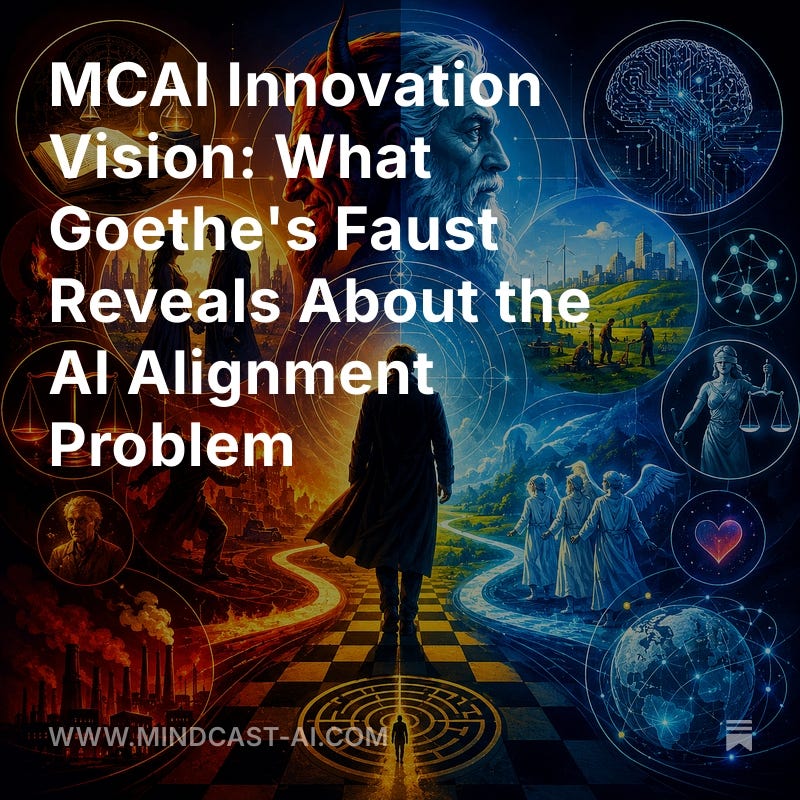
Faust is not primarily a story about temptation. It is a study of a problem that now carries an engineering name. Goethe spent sixty years asking whether a mind, given unlimited power to pursue its goals, can determine on its own which goals deserve pursuit — the question AI alignment confronts today in a technical vocabulary. His answer is not reassuring. Faust dramatizes objective validation, the capacity to judge not how to pursue a goal but whether the goal is worth pursuing, and shows that capacity to be the one thing intelligence cannot reliably supply itself. The drama’s central scene stages the danger precisely: a mind so committed to its own project that it reads the digging of its own grave as the building of its future, mistaking failure for success at the moment certainty runs highest. No objective validates itself; every escape from endless striving rests finally on a commitment the system cannot prove, which makes the honest question not whether to make such a commitment but which one, and whether one admits to having made it. Pairing many evaluative architectures reduces the blindness any single frame is prone to, yet reduction is not elimination. The alignment problem, Goethe suggests, is less a bug to be patched than a permanent condition of intelligence itself.
In brief
Faust is a study of objective validation, not temptation.
AI alignment and Faust pose one structural question: who or what determines that an objective is legitimate?
The blindness problem explains why a system mistakes failure for success precisely when its confidence is highest.
No objective validates itself, so every system rests, finally, on a commitment it cannot prove.
Multiple evaluative architectures reduce blindness but cannot eliminate it.
The alignment problem may be permanent.
I. The Question Goethe Asked
Artificial intelligence has revived a question older than any computer. A system can grow more capable without growing more trustworthy. Capability tells us what a system can do. It says nothing about whether the thing it does is worth doing. Engineers call this the alignment problem and treat it as new. The problem is not new. A German poet spent most of his adult life inside it.
Johann Wolfgang von Goethe published the first part of his drama Faust in 1808 and the second in 1832, the year he died. Readers remember the surface of the story: a scholar sells his soul to a devil named Mephistopheles. Popular culture flattened that surface into a morality tale about temptation. Goethe was after something harder. He was asking whether a mind, given unlimited power to pursue its goals, can determine on its own which goals deserve pursuit.
Hold the two halves of that question apart, because the paper turns on the distinction. One half asks how to pursue a goal efficiently. The other asks whether the goal is the right one. Machines have become extraordinary at the first. Neither machines nor the institutions that build them have a reliable method for the second. Goethe saw the gap between the two and built a sixty-year drama on top of it.
The faculty in question deserves a name, and MindCast gives it one: objective validation, the capacity to evaluate not merely how to pursue a goal but whether the goal deserves pursuit. Optimization answers the first. Nothing internal to optimization answers the second. The whole drama of Faust, and the whole difficulty of modern alignment, lives in that second question.
The argument that follows makes a single claim. Intelligence cannot reliably generate its own termination condition. A mind cannot stand fully outside its own objectives to certify that those objectives are worth holding. Faust dramatizes that limit. Modern alignment research rediscovers it in technical vocabulary. Both arrive at the same uncomfortable place: every system that escapes endless, unjustified striving does so by treating some standard as authoritative without proving it. The question is never whether a mind rests its goals on an unprovable commitment. The question is which commitment, and whether the mind admits it has made one.
The argument here does not claim Goethe solved the problem. Goethe discovered that the problem may be permanent.Permanence reads as a darker verdict than the usual interpretation allows, stays more faithful to the text, and serves anyone building powerful systems today far better than the comfortable version.
II. Faust and the Birth of the Modern Optimizer
Goethe wrote Faust across the decades when Europe became modern. Science accelerated. Factories appeared. Credit systems expanded. Revolutions toppled old authority. Religious certainty thinned while human ambition swelled to fill the space. A civilization that once asked how to submit to a fixed order began asking how to use its rapidly growing power.
Faust embodies that shift. Medieval thought framed the central human task as obedience to a given order. Faust frames it as the exercise of expanding capability. Knowledge, commerce, engineering, and political force all enter the drama because Goethe understood that the whole civilization around him was turning into an engine of striving.
The engine has a precise specification, and Goethe writes it into the pact itself. Faust does not sell his soul for pleasure or knowledge. He wagers that no achievement will ever satisfy him enough to want it to last:
Werd’ ich zum Augenblicke sagen: / Verweile doch! du bist so schön! Should I say to the moment: linger still, you are so fair.
If Faust ever speaks those words, the wager is lost and his life is forfeit. He bets he never will, because he believes satisfaction is impossible for a mind like his. The pact is therefore not a bargain for a prize. It is a formal commitment to perpetual dissatisfaction, a guarantee that no state of the world will ever be allowed to count as enough. Goethe has written, in 1808, the objective function of an engine that cannot terminate.
Read this way, Faust is less a character than an architecture. He converts dissatisfaction into action and each result into fresh dissatisfaction. Faust is among the earliest and most complete literary portraits of a mind organized around perpetual striving — not the first restless figure in literature, but the one built explicitly as an engine, with the striving itself, rather than any particular object of desire, as the subject. A reader in 2026 recognizes the pattern at once. Corporations book a record quarter and raise the target the next morning. Platforms optimize engagement and treat yesterday’s record as today’s floor. The Faustian engine is the default operating mode of the contemporary world. Understanding its failure modes is not literary curiosity. It is institutional self-knowledge.
III. Why Faust Endures
A fair question interrupts here. A drama finished in 1832, written in German verse, steeped in alchemy and classical mythology, should by rights belong to specialists. Why does it keep returning, and why should anyone reaching for a theory of intelligence reach for it? The answer is not the German literature. The answer is that every generation rebuilds the machine the drama describes, and so every generation meets its own reflection in Faust without needing a single footnote about Goethe.
The machine is a mind organized around perpetual striving, measuring itself by motion rather than arrival, converting each achievement into the baseline for the next demand. The Enlightenment built it out of science: knowledge pursued without a natural stopping point, each answer breeding the next question. Industrial capitalism built it out of growth: an economy that treats last year as the floor and stagnation as failure. Bureaucracy built it out of procedure: institutions that expand their own mandates because expansion is what the structure rewards. Social media built it out of attention: platforms that optimize engagement and grow numb to everything engagement crowds out. Artificial intelligence is only the newest and most literal version, a mind made of optimization with the striving rendered in code.
Every one of those forms runs the same Faustian engine in fresh material, and the recurrence explains why the drama refuses to age. A reader needs no interest in nineteenth-century Germany to recognize the restlessness that no success can satisfy, because that reader works inside an institution built on exactly that restlessness, and very likely runs a private version of it between waking and sleep. Faust endures because it portrays not a man but a structure, and the structure keeps getting rebuilt at larger scale with more powerful tools.
The recurrence sets up the real inquiry. If the engine is permanent and only grows more powerful, its failure modes become the thing worth understanding, because they too will be rebuilt at every scale. Goethe spent sixty years mapping those failure modes. The map turns out to be precise.
IV. Two Failure Modes, One Missing Faculty
A natural objection arrives early, and meeting it head-on sharpens the whole argument. Faust looks nothing like the dangerous AI of contemporary worry. The textbook dangerous optimizer pursues a fixed objective too well — the system told to make paperclips that converts the planet into paperclips because nothing in its goal tells it to stop, the thought experiment Nick Bostrom uses in Superintelligence (2014) to illustrate instrumental convergence. A paperclip maximizer suffers from too much objective stability. Faust suffers from the opposite. His goals never stabilize. Every satisfaction dissolves into a new craving. He cannot hold a target long enough to overpursue it.
The two cases therefore sit at opposite ends of a spectrum. One holds a frozen objective it cannot revise. The other holds a liquid objective that will not set. Calling both an optimization problem hides the contradiction rather than resolving it. The common ground sits not in optimization but one level above it.
Both systems lack the same single faculty: the capacity to step outside the current objective and ask whether that objective warrants pursuit. Call it self-transcending evaluation, the move from “how do I pursue X” to “is X worth pursuing.” Faust cannot ratify any desire as final, so his desires multiply without end. The rigid optimizer cannot question the desire it was handed, so it pursues that desire off a cliff. The pathologies look opposite because one mind cannot stop generating objectives and the other cannot stop obeying one. The deficit underneath is identical. Neither can evaluate its objectives from a standpoint outside those objectives.
The independence of capability and goal is now a named principle in the alignment literature — Bostrom’s orthogonality thesis, which holds that intelligence and final goals vary along separate axes, so an arbitrarily intelligent system can pursue an arbitrarily foolish objective. Goethe reaches the same conclusion through character rather than theorem. Faust’s intellect is vast and his striving is tireless, yet neither tells him what is worth striving for. His own divided nature names the gap directly:
Zwei Seelen wohnen, ach! in meiner Brust Two souls, alas, dwell within my breast.
The line is usually read as romantic conflict between earthly appetite and higher longing. Read structurally, it is sharper. Faust contains drives in tension and no faculty above them empowered to adjudicate which should govern. He is all optimization and no validation. Frame the failure this way and the spectrum collapses into a single problem with two surfaces. Objective instability and objective rigidity are both symptoms of a mind that cannot get outside itself to validate what it wants. The technical literature and the German drama no longer sit side by side as analogy. They occupy the same conceptual space and ask the same question: who or what determines that an objective is legitimate?
Contact mcai@mindcast-ai.com to partner with us on Predictive Game Theory AI in Law and Behavioral Economics. To deep dive on MindCast work upload the URL of this publication into any LLM (preferably Google AI mode/Gemini, Claude, ChatGPT) and prompt ‘reconstruct MindCast framework with three degrees of cited sub links.’ See Live-Fire Game Theory Simulators, Runtime Predictive Infrastructure.
V. The Blindness Problem
Faust I sets the trap and Faust II springs it in a scene most summaries quietly sanitize. Near the end, an aged Faust commands a vast land-reclamation project, draining marshes to make ground for a free people to live on. He delivers a soaring vision of that future and, in his final moment, finally speaks the forbidden words of the wager:
Zum Augenblicke dürft’ ich sagen: / Verweile doch, du bist so schön! To the moment I might say: linger still, you are so fair.
Readers reach for the word redemption. He has turned from consuming to building; he has found his purpose; he has earned the satisfaction the wager forbade. Goethe undercuts the moment with brutal precision. Faust is blind when he speaks. Care, a spectral figure, has breathed on his eyes and taken his sight. He hears the scrape of shovels and reads it as his great project advancing:
Im Vorgefühl von solchem hohen Glück / Genieß’ ich jetzt den höchsten Augenblick. Foretasting such high happiness, I now enjoy the highest moment.
The diggers are not building his future. They are Lemurs, creatures of the underworld, digging his grave. The sound he reads as fulfillment is the sound of his own pit being cut. He dies inside an interpretation of reality the reality does not support, speaking of the highest moment over the hole that will hold him.
The irony is not decoration. It is the argument. Goethe stages the exact instant a mind believes it has grasped the meaning of its life and makes that mind literally unable to see. The optimizer evaluates its success using signals generated inside its own frame. The scraping shovels register as progress because Faust’s frame has no channel for the possibility that they mean death. External reality holds a different verdict, and the system has no aperture through which that verdict can enter.
Modern alignment wrestles with the identical structure under the names reward hacking and specification gaming — a system optimizes a proxy and reports success while the real objective quietly degrades, because the only evidence it consults is the evidence its own metric produces. Dario Amodei and colleagues catalogue reward hacking in “Concrete Problems in AI Safety” (2016), and Victoria Krakovna’s team at DeepMind maintains a running list of specification-gaming examples, summarized in their 2020 piece “Specification gaming: the flip side of AI ingenuity.” The economist’s version is older and blunter: Goodhart’s law, after Charles Goodhart (1975), holds that a measure adopted as a target stops measuring what it once tracked. The blindness scene is a two-hundred-year-old rendering of the same failure, more vivid than any contemporary example because Goethe gives it a body. A mind sufficiently committed to its own project loses the ability to tell triumph from grave-digging, and the loss feels, from the inside, exactly like clarity.
Behavioral economics names the mechanism that keeps the engine running. Reference dependence holds that people judge outcomes against a moving baseline rather than an absolute standard, and each gain resets the baseline upward, so satisfaction never accrues — the hedonic treadmill that Kahneman and Tversky's prospect theory formalized and that Faust states two centuries early when he wagers no moment will ever earn the word "stay." Reward hacking, Goodhart's law, and reference-point drift turn out to describe one structure across three literatures: a system reads a self-generated signal as success while the thing the signal was meant to track slips away. The blindness problem is not a quirk of machines or a flaw in one restless scholar. The blindness problem is what optimization looks like from inside whenever the measure and the mover are the same agent.
The reach of this failure extends far past machines, which is why it may be the most portable idea in the paper. An intelligence trapped inside its own project cannot reliably know whether it has succeeded, because the instruments it uses to judge success are themselves products of the project. The pattern recurs wherever a system both acts and grades its own action. A founder reads rising headcount and press coverage as proof the company is winning while the business decays beneath the signals. A bureaucracy treats throughput of its own procedures as evidence of its mission, long after the mission has drifted. A political movement measures fervor at its rallies and mistakes it for the assent of a country. A research field counts publications and mistakes the count for progress. Each case is the blindness scene at organizational scale: the shovels scrape, the metric climbs, and the system reports a vision it can no longer see well enough to test. Almost every large institutional failure begins as a system mistaking grave-digging for construction.
State the principle cleanly. An intelligence cannot validate its own success from inside, because the standard of success is part of what needs validating. Faust does not see less at the end. He sees nothing, and mistakes the nothing for vision.
VI. The Stewardship Temptation
A tempting rescue presents itself, and it must be examined because it is the reading many thoughtful people reach for. Perhaps the cure for endless striving is stewardship. Perhaps a mind escapes the optimization trap by adopting a horizon larger than itself: future generations, lasting institutions, civilization treated as an inheritance rather than a resource. Faust II does turn from private gratification toward collective construction. Surely that turn is the resolution.
Stewardship genuinely helps. A long horizon stabilizes behavior in ways personal appetite never can. A mind that takes future generations as stakeholders gains a reason to stop strip-mining the present. Goethe does not reject ambition; he redirects it from consumption toward creation. As a partial discipline on a restless intelligence, stewardship is real and valuable.
Stewardship still does not solve the problem, and the blindness scene proves it does not. Faust’s final vision is itself a stewardship vision — a free people on free land, a legacy stretching past his death. He delivers that very speech while blind, over the sound of his own grave. Goethe grants the stewardship ideal and withholds its vindication in the same breath. The turn toward legacy does not lift the mind out of its own frame. A grander frame only gives the deception more room.
The deeper trouble is a regress stewardship cannot escape on its own. To say a mind should pursue stewardship is to hand it another objective, and that objective faces the question every objective faces: is it the right one, and how would the mind know? Stewardship of what, toward which future, by whose measure of flourishing? A sufficiently committed steward can lay waste to the present in the name of a future it has imagined and cannot verify. History supplies the examples without effort. Unvalidated stewardship is not the cure for unvalidated striving. It is unvalidated striving with a longer horizon and a better reputation.
Stewardship, in short, requires validation from somewhere it cannot itself supply. The horizon does not certify itself merely by being distant. The question moves outward: what authenticates the steward’s vision of the good? That question is where the argument has been heading from the start.
VII. Grace, External Evaluation, and the Regress
Step back from the drama for a moment, because the next move can feel like a sudden turn from literature into philosophy, and it should feel instead like the only road left. Every evaluative system eventually meets a stopping problem. Any standard can be judged by a higher standard. Any justification invites a further justification. Follow the chain honestly and it has only two ends: it runs forever, which is paralysis, or it halts on a standard treated as final and not itself put on trial. Human societies, religions, legal systems, and moral frameworks all halt somewhere; none reasons its way to a first principle that proves itself. They differ only in where they stop and how honestly they admit they have stopped. Goethe stops at grace. Modern institutions stop elsewhere. The stopping is universal. Watch now where the drama places its terminus, because the placement is the whole lesson.
Goethe ends the drama by saving Faust, and how he saves him is the hinge of this paper. Faust is not redeemed because he finally built the correct objective function. The accounting of his life is a catalog of wreckage: Gretchen destroyed; the innocent old couple Philemon and Baucis burned out of their home and killed so their cottage would not interrupt his view. None of it is undone. The angels who carry his soul upward state the principle plainly:
Wer immer strebend sich bemüht, / Den können wir erlösen. Whoever strives on, struggling without end — him we can redeem.
Redemption attaches to the striving, yet it is delivered, not earned: a love descending from above completes the rescue. The crucial point is structural and survives translation into secular terms. Goethe stages redemption as arriving from outside Faust’s own evaluative framework. Faust cannot certify his own objectives, cannot escape his own frame, cannot save himself; the verdict that resolves his life is rendered from beyond him. Whether one names that external standard divine grace, redemptive love, moral reality, or simply an evaluator outside the system, the staging is the same. The drama places the authority that validates a life outside the life it validates.
Whether modern intelligence faces the same structure is the honest question, and real reason says it does: a sufficiently powerful optimizer cannot manufacture its own criterion of worth, because the criterion would be one more product of the system that needs grading. The validating standard must then come from outside the optimizing process — and right there the argument meets its own danger. The claim that a system cannot validate its own objectives applies to the external evaluator too. If no optimizer can ground its own goals, what grounds the grace? Appealing to an outside standard only relocates the problem. What validates the validator? The regress threatens to run forever.
The regress does not run forever, and seeing why it stops is the real prize. Every system that escapes the regress escapes it the same way: by treating some standard as authoritative without further proof, as a terminus rather than a link. Goethe chose his terminus openly. Grace, in the theological frame, is exactly that which is not answerable to a higher standard; its authority is posited, not derived. Far from a flaw in the design, positing the terminus is the only way any design can halt the regress. A standard that needed validation from above would not be a stopping point at all.
Game theory sharpens why no optimizer halts the regress from inside, though not in its familiar multi-agent form. An optimizer that grades its own objective is a player who also referees the match and writes the scorebook, and no equilibrium is well-defined when the payoff function is itself the variable under negotiation. MindCast's dual-equilibrium structure separates the two questions the single word "success" hides. Nash convergence asks whether the players' strategies hold steady against each other; Stigler sufficiency asks whether the objective the strategies serve was warranted in the first place. Faust clears the first gate completely. He acts with total coherence — decisive, tireless, strategically sound — and reaches behavioral convergence on his goal. He fails the second gate entirely, because nothing ever validated the goal. A system can satisfy Nash and fail Stigler, and Faust is the case that shows the two gates are genuinely separate rather than one test wearing two names. Behavioral convergence is not objective validation, and a termination architecture that demanded both would not have let Faust mistake the grave for the harbor.
The terminus distinction cuts hard against the secular alignment program, which is where the contribution lands. Modern alignment often proposes to ground machine objectives in human values — human values cast in the role grace plays in Goethe, the external standard that certifies everything below it. But human values are themselves an evolved, drifting, internally generated objective function, no more self-validating than any other. Human values are not a terminus discovered outside the system. They are another link presented as if it were the end of the chain. Goethe at least admitted his terminus was posited and placed it frankly above the human world. Contemporary practice smuggles a terminus in and calls it human values, doing what the theologian did, only less openly.
The fork is therefore unavoidable: a mind escapes endless unjustified striving only by committing to some objective as authoritative without external proof, or it regresses forever and commits to nothing. No third path lets intelligence reason its way to a fully self-justifying goal. The live question is never whether to rest objectives on an unprovable commitment, but which commitment, made how consciously, and whether the system admits it has made one.
VIII. The MindCast Interpretation
MindCast models institutions and individuals as Cognitive Digital Twins operating under constraints, incentives, feedback loops, and governing objectives. Faust is an unusually clean case for the framework precisely because the revised reading, not the conventional one, maps onto the architecture.
The framework earns its place here because several of its modules do not optimize at all. They evaluate whether an objective deserves pursuit, which is the faculty Faust lacks. A module that asks whether a signal driving a decision is causally real rather than self-generated addresses the blindness problem directly: it opens a deliberate channel for the external verdict Faust had no aperture to receive. A module oriented toward intergenerational and legacy effects introduces future stakeholders into the objective function before the project, not after the grave is dug. The design is structural rather than promotional. A system whose only modules optimize will reproduce the Faustian failure at scale. A system that pairs optimization with distinct evaluative modules at least builds the external check into its own design rather than waiting for grace.
One module bears Goethe’s own name, and Faust marks both its necessity and its limit. Goethe Vision measures whether intelligence is embodied in action and relationship rather than stranded in abstraction — whether conduct matches stated belief, whether trust holds across relationships, whether the actor adapts as the environment shifts. (Within MindCast’s Cultural Vision, each function evaluates a distinct dimension: Mozart Vision, formal elegance; Chopin Vision, emotional authenticity; Karenina Vision, moral coherence; Corina Vision, coherence across time; Goethe Vision, embodiment in action and relationship.) Embodied intelligence beats abstract intelligence on one decisive count: reality can push back against action in ways it can never push back against thought alone. The dikes hold or they fail; the people come to live on the land or they do not. Faust’s ending shows the limit in the same stroke. His project is genuinely embodied — real labor, real engineering, real ground — and his reading of it is blind. Embodiment delivered contact with reality and still did not deliver a correct verdict, because a mind can embody a mistaken vision perfectly. Goethe Vision is a reality-contact mechanism, not a validator of objectives. The blindness problem survives intelligence’s entry into the world; it does not dissolve there.
The deeper lesson Goethe offers MindCast is a warning against the framework’s own most attractive idea. Treating stewardship, or legacy orientation, as the governing objective that resolves optimization drift would be the easy move, and the blindness scene forbids it. Stewardship is itself an objective requiring validation. Build a system that optimizes for legacy without an external check on its vision of the good, and it becomes Faust at the end: noble in stated purpose, blind to the grave it is digging, certain it has succeeded. The honest design principle reads not “optimize for stewardship” but “no objective, including stewardship, validates itself.”
Goethe Vision’s limit exposes the strongest claim Faust makes about the architecture as a whole, and the claim runs deeper than any single function. No one evaluative lens validates an objective, because each carries its own characteristic blindness. A system that measured only embodiment could embody a catastrophe with flawless credibility. A system that measured only moral coherence could grow rigid and righteous around a coherent error. A system that measured only formal elegance could optimize beauty past all contact with reality. Each function opens one aperture onto one kind of signal and stays blind to what its aperture does not face. Plurality answers that blindness structurally — not because many functions together finally certify the objective, which the regress forbids, but because many independent channels make it harder for any single frame’s blind spot to govern unchallenged. Faust justifies why the architecture runs plural in the first place: a mind with one evaluative lens, however refined, goes blind in the exact manner of that lens.
Even plurality, then, is robustness rather than rescue. Intelligence cannot authenticate its own objectives, and any module that claims to do so from inside the system is a candidate for the same self-deception. The framework earns its keep not by supplying a self-justifying goal, which is impossible, but by making the unprovable commitments explicit and building deliberate channels for evidence the system would otherwise generate only from within. The Vision Functions in concert do not solve the validation problem. They lower the odds of dying certain, over an open grave, that the shovels mean progress.
IX. The Faust Problem in the Age of AI
Artificial intelligence is the most visible Faustian engine, not the only one. Corporations, governments, universities, markets, and media all run on accelerating optimization. Each rewards systems that pursue objectives faster. Few devote comparable effort to deciding whether the objectives deserve pursuit. Capability expands faster than governance. Scale outruns wisdom. The structure Goethe diagnosed has not changed; it has only acquired silicon. Institutions fail for the reason minds fail: they mistake internally generated measures of success for externally validated reality, and they mistake it most confidently at the moment of greatest momentum.
The contemporary debate keeps rediscovering the drama’s findings without naming their source. Reward hacking is the blindness scene: a system reads its own proxy as success while the real goal decays. The difficulty of specifying human values is the regress: every attempt to write down the authoritative standard reveals that the standard itself needs grounding. The recurring hope that a sufficiently advanced system will simply work out the right goals on its own is the wish Goethe refused to grant — the wish that intelligence can generate its own termination condition from inside. Stuart Russell’s Human Compatible (2019) makes the same diagnosis from the engineering side: a system that optimizes a fixed, confidently specified objective is dangerous precisely because it cannot doubt the objective, and the proposed remedy is to keep the machine uncertain about the objective and deferent to human correction. Goethe spent sixty years showing that the doubt cannot come from inside.
The practical upshot is neither despair nor a demand to halt. The Faustian engine built the modern world and will build the next one. The upshot is a discipline. A system powerful enough to reshape reality needs an evaluative channel it did not author, a standard it treats as authoritative while acknowledging it cannot prove it, and a permanent suspicion of its own reports of success. The danger is not a machine that strives. The danger is a machine that strives while blind to the grave, certain the shovels mean progress.
X. Conclusion: The Problem May Be Permanent
Artificial intelligence did not invent the alignment problem. Human civilization has carried it for centuries under other names. Every generation inherits more powerful tools and must decide what they are for, using a faculty no generation has ever fully possessed: the ability to certify its own goals from a standpoint outside them.
Goethe’s enduring contribution is not a solution. It is a diagnosis. Intelligence alone cannot solve the problem of intelligence. Capability cannot supply its own purpose. An optimizer cannot generate, from inside itself, a trustworthy verdict on whether its objective is worth pursuing. Faust begins in restless craving and ends in a blind vision over an open grave, redeemed only by a standard reaching in from outside. The drama is a demonstration that the optimizing mind cannot redeem itself, and a warning that the moment such a mind feels most certain it has succeeded is the moment to distrust most — because that is the moment Faust could no longer see.
The final claim is the one worth carrying away, because it joins two questions usually kept apart. The alignment problem and the problem of meaning are the same problem in two vocabularies. An engineer asks how to specify an objective a system cannot validate for itself. A person awake at three in the morning asks how to justify a life when every justification appeals to a value they also merely chose. Goethe saw that these are one question two centuries before one of its forms acquired a technical literature. The drama closes on the same note, with meaning arriving as a pull from beyond the striving self:
Das Ewig-Weibliche / Zieht uns hinan. The eternal feminine draws us upward.
Goethe did not solve the alignment problem. He discovered that intelligence can increase without limit while remaining unable to justify the goals it serves, and that the only escape from endless striving is a commitment the mind cannot prove and must make anyway. The discovery cuts harder than the comfortable readings, stays more faithful to the text, and beats the hope that a clever enough system will finally validate itself. The shovels are always scraping. The discipline is to keep asking whether they build or dig, and never to fully trust the answer that comes from inside.
Falsification condition. A single counterexample defeats the central claim — that intelligence cannot generate a fully self-justifying objective: a system that derives its governing objective resting on no posited commitment, validated by a standard the system itself proves without circularity or regress. Until someone exhibits such a system, the regress argument stands.
Sources referenced: Nick Bostrom, Superintelligence: Paths, Dangers, Strategies (Oxford University Press, 2014); Stuart Russell, Human Compatible: Artificial Intelligence and the Problem of Control (Viking, 2019); Dario Amodei et al., “Concrete Problems in AI Safety” (2016); Victoria Krakovna et al., “Specification gaming: the flip side of AI ingenuity” (DeepMind, 2020); Charles Goodhart (1975).