
Insurance Chief Executives and Boards · Chief Claims, Underwriting and Risk Officers · Management Consulting, Systems Integration and Audit Firms · Reinsurers · General Counsel and Litigators · State Insurance Regulators · Investors
Why now: class-certification briefing in the leading AI claims suits runs from November 2026 into spring 2027, 29 jurisdictions have adopted the National Association of Insurance Commissioners (NAIC) model bulletin on insurers’ use of AI, and professional-liability underwriters now ask firms who checks the AI.
Series · How Consulting and Audit Firms Become Liable for the AI Agents They Run for Clients · How Plaintiffs Turn Insurers’ AI Governance Standards Into Evidence · How Insurers Defend AI Claims Decisions When Their Own Governance Standards Become Evidence
Value proposition · MindCast Predictive Game Theory Simulation of Mixed Time Horizon Insurance Carrier Second Seat Exposure
I. Executive Summary
The MindCast Insurance Carrier's Second Seat series forecasts the direction and allocation of AI claims liability: which way exposure moves through 2027 and who ends up bearing it among carriers, vendors, consulting and audit firms and reinsurers. Claims algorithms run under established law, so those forecasts reach through 2027 with firm bands, while agent liability waits on its first ruling and reaches one step ahead.
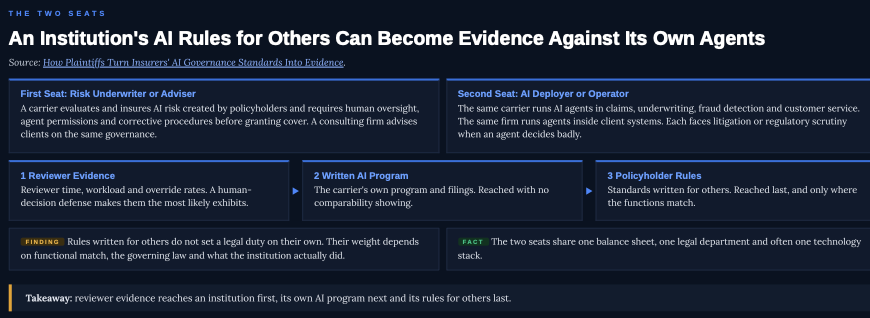
An insurance company, called a carrier in the industry, now sits in two seats. In the First Seat it underwrites its policyholders’ AI risk and tells them how to govern their agents. In the Second Seat it runs AI agents of its own in claims, underwriting and customer service. Consulting and audit firms sit in the same two seats when they advise clients on AI governance and then run agents inside those clients’ systems.
The thesis. The Second Seat exposes an institution first through its people, not its policies. Once a defendant says a human made the decision, the reviewer’s workload and override history become the most likely exhibits. The written AI program comes next, and the rules an institution writes for others reach court last and only where functions match. Claims algorithms already face that test under existing law, while autonomous agents wait on the first court to apply a common-law doctrine to one.
The leading suits already point that way. A federal magistrate judge in Minnesota ordered broad discovery into UnitedHealth’s AI-assisted coverage decisions on March 9, 2026. Humana then told a federal court on August 26, 2026 that physician Medical Directors made the disputed denials. On September 29, 2026 the Barrows plaintiffs moved to add naviHealth as a defendant, because the vendor built the disputed tool.
The tools in those suits are claims algorithms rather than autonomous agents. Even so, the suits set the evidence routes any automated decision will meet. Extending those routes to agents is MindCast’s analysis, not a judicial finding.
The MindCast distinction. MindCast AI applies Predictive Behavioral Economics + Dynamic Game Theory through MindCast AI Proprietary Cognitive Digital Twin Foresight Simulations (MP CDT FS). Behavioral Economics supplies the decision rules that predict how plaintiffs, carriers, firms and courts act under pressure. Game Theory supplies the payoff structure that decides which moves pay. Predictive simulations emerge from the combination.
What the series does. This overview maps the contest and covers the ground no single paper owns: the eight institutions in the game, the law that governs algorithms and agents, distribution agents and reinsurance capital. Three papers then take one side each. Part 1 follows consulting and audit firms, Part 2 follows the plaintiffs and Part 3 follows the carriers’ defense.
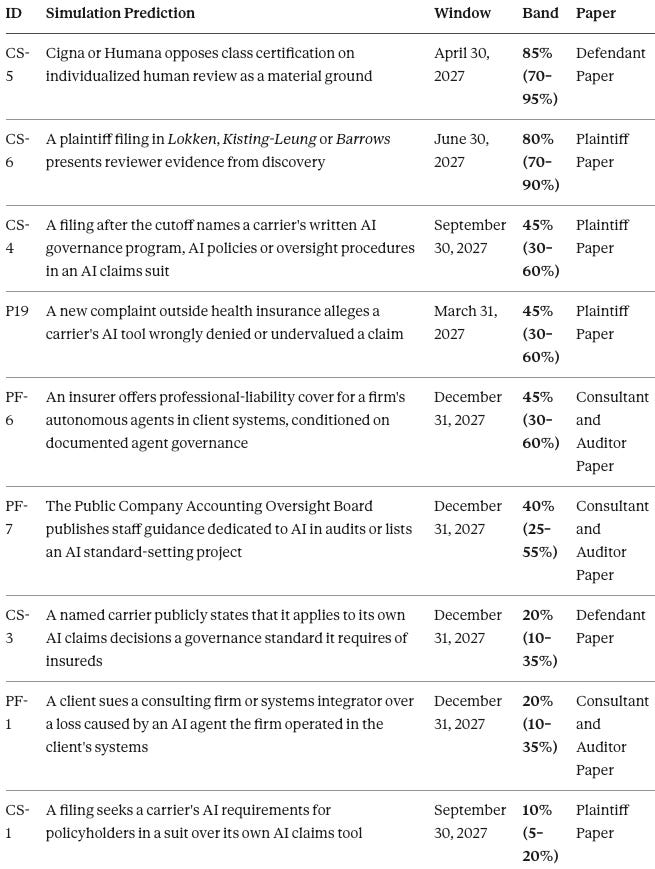
The material forecasts. The series states 18 MindCast Foresight Simulation Predictions with bands. The nine below carry the most weight, and each links to the paper that develops it.
Defendant Paper: How Insurers Defend AI Claims Decisions When Their Own Governance Standards Become Evidence
Plaintiff Paper: How Plaintiffs Turn Insurers’ AI Governance Standards Into Evidence
Consultant and Auditor Paper: How Consulting and Audit Firms Become Liable for the AI Agents They Run for Clients
Source: The Insurance Carrier’s Second Seat Value Proposition
Stakeholder readout
💼 Executives. At carriers and at firms that run client agents, reviewer capacity matched to decision volume is the lowest-cost defense, because reviewer evidence is the most likely exhibit.
⚖️ Counsel. Discovery reaches review metrics and written AI programs before it reaches standards written for others, and comparability decides whether those standards ever arrive.
🏛️ Policymakers. Bulletins that require written AI programs create the first documents litigants request, and exam questions on decision ownership test effective review before courts do.
📊 Investors. Class-certification rulings in 2027 decide whether reviewer discovery becomes a recurring cost, and treaty aggregation wording decides how much of it carriers keep.
Takeaway. Across carriers, consultants and auditors, the defense rests first on whether a human reviewer had the time and information to decide.
II. Eight Institutions Decide How the Contest Plays Out
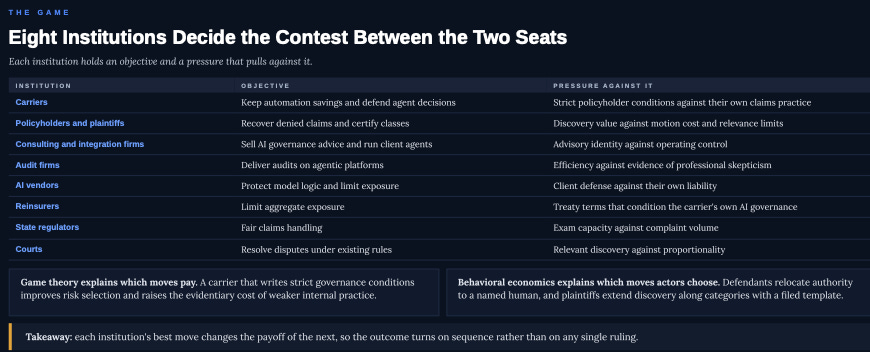
Eight institutions shape the contest between a carrier’s two seats, and each pursues an objective that some pressure pulls against. The table names both, because the pressure explains the move each institution makes next.
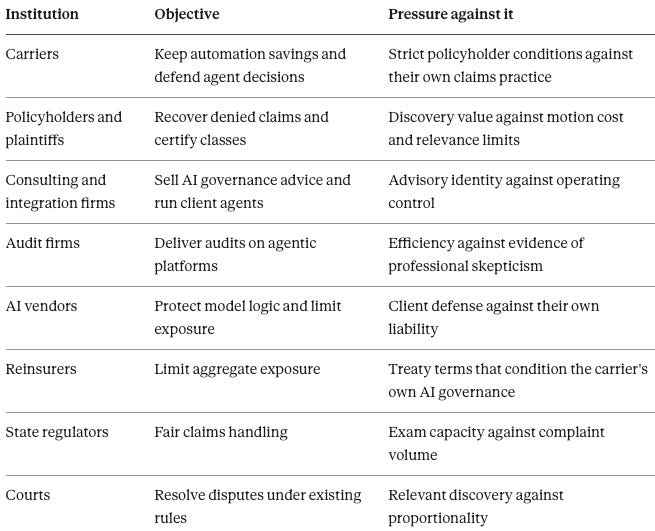
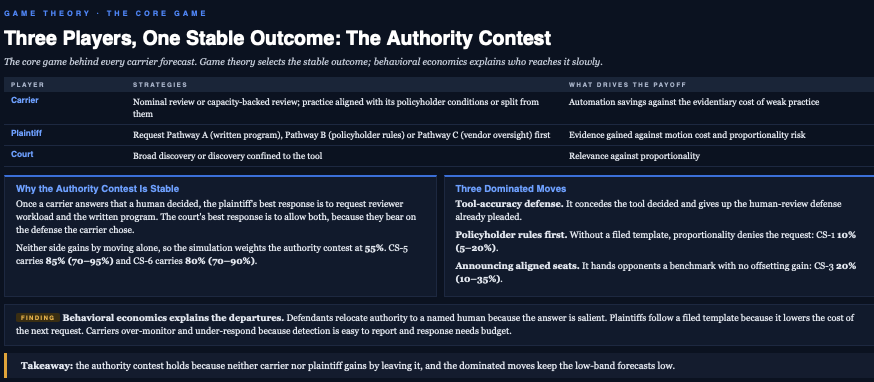
Game theory explains which moves pay. A carrier that writes strict governance conditions improves risk selection, yet it raises the evidentiary cost of weaker internal practice. Behavioral economics explains which moves actors actually choose: defendants relocate authority to a named human, and plaintiffs extend discovery along categories that already have a filed template.
Source: The Insurance Carrier’s Second Seat Value Proposition
Takeaway. Each institution’s best move changes the payoff of the next, so the outcome turns on sequence rather than on any single ruling.
III. Existing Claims Law Governs Algorithms, and Four Doctrines Wait for Agents
Exposure comes from two bodies of law. Claims algorithms run under claims-handling law that courts already apply, while autonomous agents run under common-law doctrines that no court has yet applied to an agent. A carrier that knows which layer it sits in but not the governing law can neither size the exposure nor choose the defense.
Algorithms meet six existing sources of claims-handling law. Six sources reach AI-assisted claims decisions today, running from contract and the implied covenant of good faith through the Employee Retirement Income Security Act (ERISA) and the Fair Housing Act to state claims practices acts, Medicare Advantage rules and California SB 1120. Each asks the same question in different words: did a person with authority evaluate the individual claim? The shared question explains why reviewer evidence leads, and the Plaintiff Paper maps each source to the suit that tests it.
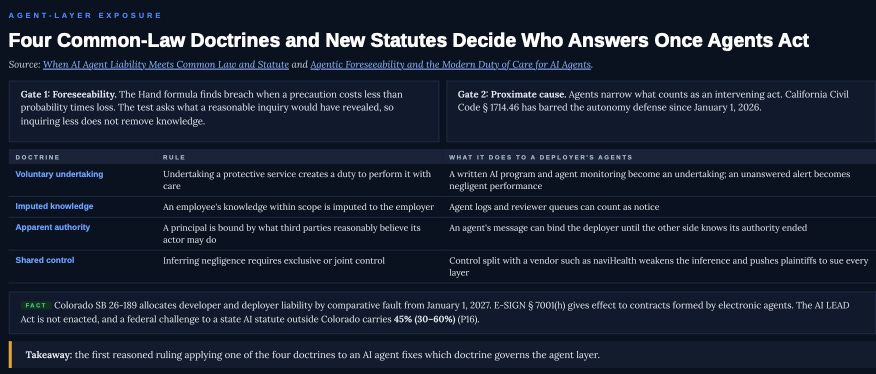
Agents meet two classical gates first. Foreseeability decides whether a duty exists, and the Hand formula tests whether a precaution met it: a deployer breaches when a precaution’s burden is less than the probability of harm multiplied by its size. Agentic Foreseeability and the Modern Duty of Care for AI Agents sets the foreseeability test for deployers, and the paper matters here because constructive knowledge reaches a deployer that inquired less. A documented risk without a documented response becomes the gap a plaintiff will plead.
Once an agent acts, four doctrines decide who answers. When AI Agent Liability Meets Common Law and Statute maps how each one breaks under agent conduct, and the mapping applies to a carrier’s claims agents and a firm’s client agents alike.
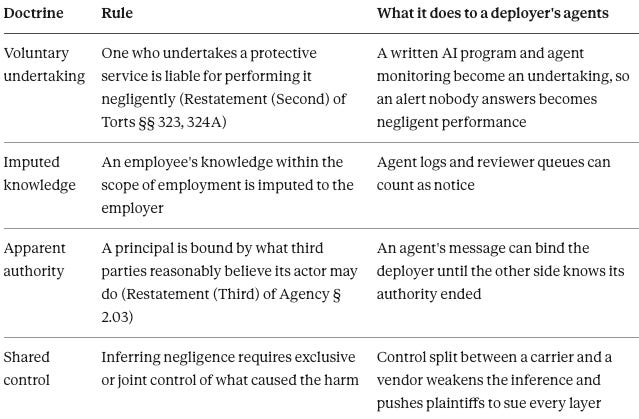
Statutes already push those doctrines in fixed directions. Since January 1, 2026, California Civil Code § 1714.46 has barred a defendant from arguing that an AI system autonomously caused the harm. Colorado SB 26-189 allocates developer and deployer liability by comparative fault from January 1, 2027, with enforcement stayed pending rulemaking. The AI LEAD Act, S. 2937, would treat AI systems as products but has not been enacted.
Source: The Insurance Carrier’s Second Seat Value Proposition
Game theory reads the Hand formula as the payoff structure: precaution pays while its cost stays below the expected loss it removes. Behavioral economics explains why deployers still over-monitor and under-respond, because detection is visible and easy to report while response needs capacity and budget. Monitoring without response capacity therefore shifts exposure to the undertaking rule.
Stakeholder callouts.
💼 Executives. Size agent response capacity before expanding agent monitoring.
⚖️ Counsel. Build the defense against undertaking and imputed-knowledge theories before the first agent claim arrives.
Takeaway. Algorithm exposure is measurable today against six existing sources, while agent exposure waits on the first court to pick a doctrine.
IV. Distribution Agents May Bring the First Agent Claim
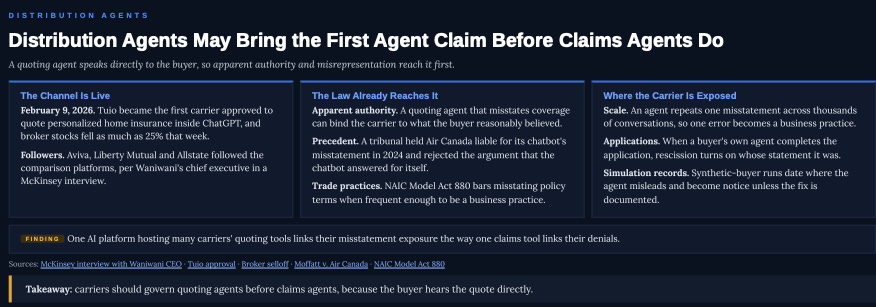
The first lawsuit over an insurer’s autonomous agent may involve a sales agent rather than a claims agent. On February 9, 2026 the Spanish digital insurer Tuio became the first carrier approved to quote personalized home insurance inside ChatGPT, and broker stocks fell as much as 25% that week. Aviva, Liberty Mutual and Allstate followed, according to Waniwani chief executive Robin Diligent in a McKinsey interview of October 2026.
A quoting agent speaks directly to the buyer, so apparent authority and misrepresentation reach it first. A British Columbia tribunal held Air Canada liable in Moffatt v. Air Canada in February 2024 for its chatbot’s misstatement and rejected the argument that the chatbot answered for itself. The award was small, but the reasoning transfers directly to a carrier’s quoting agent.
Insurance law already reaches the same conduct. State unfair trade practices acts modeled on NAIC Model Act 880 bar misstating policy terms when the conduct is frequent enough to be a general business practice. An agent repeats one misstatement across thousands of conversations, so scale turns a single error into a business practice.
Source: The Insurance Carrier’s Second Seat Value Proposition
Stakeholder callouts.
💼 Executives. Govern quoting agents before claims agents, because the buyer hears the quote directly.
🏛️ Policymakers. Market-conduct exams can test quoting agents for repeated misstatements before a complaint wave arrives.
Takeaway. One AI platform hosting many carriers’ quoting tools links their misstatement exposure the way one claims tool links their denials.
V. Reinsurers Hold the Capital Behind Both Seats
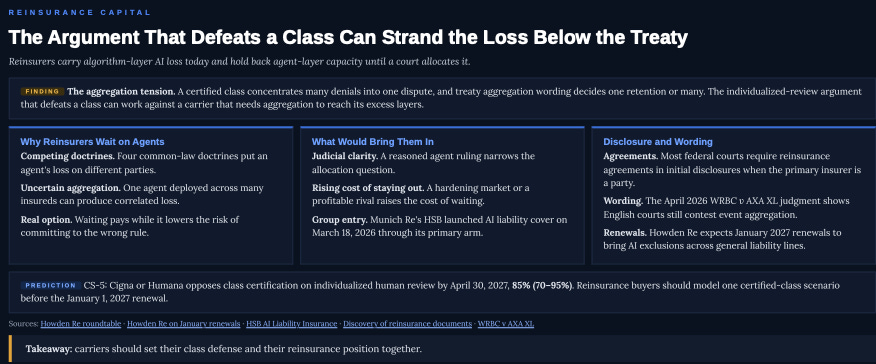
Reinsurers stand behind both of a carrier’s seats, and they carry algorithm loss today while holding back capacity for agents. Casualty treaties already carry AI exposure, yet Howden Re’s casualty leaders say the market has limited view of where that exposure sits. A certified class concentrates many denials into one dispute, and treaty aggregation wording decides whether the loss counts as one event or many.
English courts still contest that wording. The April 2026 WRBC v AXA XL judgment showed the dispute for event-cancellation losses, and an AI claims class would raise the same question. The individualized-review argument that defeats a class can then work against a carrier that needs aggregation to reach its excess layers.
For agents, reinsurers may be waiting by choice. A treaty needs a defined peril and a loss allocation the reinsurer can follow, and no court has supplied either. Munich Re’s HSB introduced AI liability insurance for small businesses on March 18, 2026, so reinsurance groups write AI risk through primary arms where they control the wording.
Game theory frames the wait as a real option: waiting pays while it lowers the risk of committing to the wrong rule by more than delay costs in lost business. Behavioral economics explains the anchor, because treaty underwriters hold to existing casualty wording and add exclusions rather than define a new peril. The wait has a cost, since liability allocation takes shape without input from the capital that will carry it.
Source: The Insurance Carrier’s Second Seat Value Proposition
Stakeholder callouts.
💼 Executives. Reinsurance buyers should model one certified-class scenario under current aggregation wording before the January 1, 2027 renewal.
📊 Investors. Ask how each carrier’s treaties aggregate a certified class, because AI loss may sit reserved as something else.
Takeaway. Carriers should set their class defense and their reinsurance position together, because the argument that defeats a class can strand the loss below the treaty.
VI. MindCast Simulation Predictions — The Material Calls Across the Series
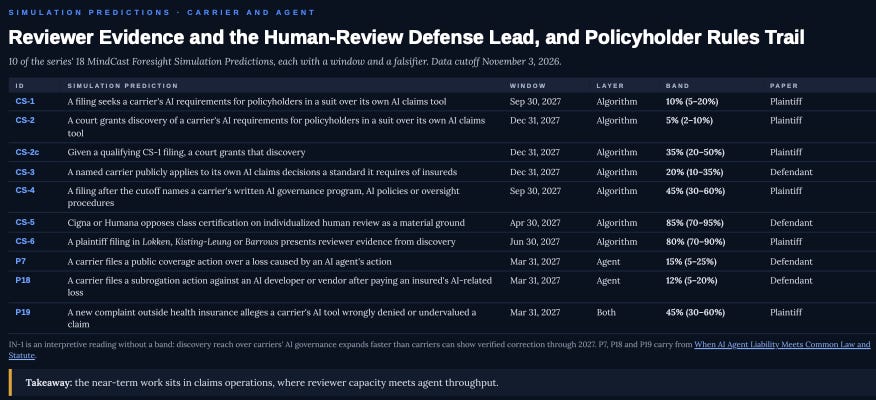
The series states 18 Simulation Predictions with bands: seven carrier forecasts marked CS, eight professional-firm forecasts marked PF and three agent-liability forecasts carried from When AI Agent Liability Meets Common Law and Statute. The nine in the executive summary carry the most weight, and three patterns run through them.
Reviewer evidence leads. CS-5 at 85% (70–95%) and CS-6 at 80% (70–90%) place the human-review contest at the center of 2027 class briefing. The Defendant Paper develops the defense side, and the Plaintiff Paper develops the discovery that follows it.
Policyholder rules trail. CS-1 at 10% (5–20%) marks the least likely route, and CS-3 at 20% (10–35%) shows carriers aligning their two seats quietly rather than announcing it. The rules a carrier writes for others matter, but they reach court last.
Insurers and regulators reach firms before clients do. PF-6 at 45% (30–60%) and PF-7 at 40% (25–55%) run ahead of PF-1 at 20% (10–35%), because engagement contracts route early disputes into arbitration and indemnity talks. The Consultant and Auditor Paper develops the firm side.
The simulation weights five routes from today’s human-review defense. The authority contest carries 55%, resolution after class rulings 20%, regulator-led alignment 15% and the two routes that reach policyholder rules or confine discovery 5% each. The Defendant Paper sets out the full route tree with its triggers and forks.
Source: The Insurance Carrier’s Second Seat Value Proposition
Takeaway. The highest bands sit on reviewer evidence and the lowest on policyholder rules, and the firm-side forecasts follow the same order.
VII. Which Paper Each Reader Needs
Consulting firms, systems integrators and audit firms start with the Consultant and Auditor Paper, How Consulting and Audit Firms Become Liable for the AI Agents They Run for Clients. The paper shows why operating control decides a firm’s exposure more than the engagement letter does. The eight PF forecasts follow from that test.
Plaintiff counsel and carrier litigators start with the Plaintiff Paper, How Plaintiffs Turn Insurers’ AI Governance Standards Into Evidence. The paper maps the order in which discovery reaches a carrier’s written standards. The paper carries CS-1 and CS-2 with its conditional CS-2c, plus CS-4, CS-6 and P19.
Carrier executives, defense counsel and reinsurers start with the Defendant Paper, How Insurers Defend AI Claims Decisions When Their Own Governance Standards Become Evidence. The paper tests which defenses hold and sets out the five-route tree. The paper carries CS-3, CS-5, P7 and P18.
Takeaway. Each paper stands alone, and each serves the reader on one side of the contest.
Conclusion — Reviewer Capacity Decides Who Answers First
Across the MindCast The Insurance Carrier's Second Seat series, exposure moves toward reviewer evidence and away from policyholder rules. It falls on carriers first and then on vendors, operating firms and reinsurers. Carriers, consultants and auditors now run the AI agents they advise others to govern. The suits already in court show where opponents look first: at whether a human reviewer could decide. Written programs come next, and rules written for others come last.
Agents will add four common-law doctrines and a sales channel that reaches buyers directly, while reinsurers wait for a court to allocate the loss. Through 2027 the institution that documents who could intervene will hold the evidence courts, regulators and underwriters ask for.
Working With MindCast
Every forecast in this series turns on documents an institution already holds: reviewer metrics, written AI programs, engagement terms and the conditions it imposes on others. MindCast builds Cognitive Digital Twins (CDTs) of the courts, regulators, plaintiffs and counterparties an institution faces and simulates which evidence arrives first and which defense holds.
A complimentary pilot comes first. Inputs are public filings and one anonymized claims or client-agent workflow shared under a mutual nondisclosure agreement. The pilot delivers a reviewer-capacity map, an exhibit forecast and banded forecasts with windows and falsifiers. Delivery lands before Cigna’s January 11, 2027 class-certification opposition in Kisting-Leung.
Retained engagements follow the seat each client holds.
💼 Carriers. A two-seat alignment audit and a reviewer-capacity review before the 2027 class rulings.
💼 Consulting, Integration and Audit Firms. A decision-ownership map for each agent the firm runs inside a client system.
⚖️ Counsel. A discovery-path simulation or defense war game keyed to the CS forecasts.
📊 Reinsurers and Investors. An aggregation review of how treaty wording carries a certified-class loss.
🏛️ Regulators. An exam war game on review capacity ahead of the 2027 exam cycle.
The MindCast Predictive Game Theory Simulation of Mixed Time Horizon Insurance Carrier Second Seat Exposuredetails each engagement. Each forecast in this series resolves on the MindCast Prediction Scorecard. Contact mcai@mindcast-ai.com to scope a pilot, or see predictive game theory simulations at www.mindcast-ai-simulation.com.