
Insurance Chief Executives and Boards · Chief Claims, Underwriting and Risk Officers · Reinsurers · Management Consulting, Systems Integration and Audit Firms · General Counsel and Litigators · State Insurance Regulators · Investors
Companion to Who Answers for AI Claims Decisions — Insurers, Consultants and Auditors in the Second Seat · When AI Agent Liability Meets Common Law and Statute · Agentic Foreseeability and the Modern Duty of Care for AI Agents · Who Writes AI Insurance Coverage Conditions · How Consulting and Audit Firms Become Liable for the AI Agents They Run for Clients · How Insurers Defend AI Claims Decisions When Their Own Governance Standards Become Evidence
Value proposition · MindCast Predictive Game Theory Simulation of Mixed Time Horizon Insurance Carrier Second Seat Exposure
I. Executive Summary
The paper forecasts the direction of discovery in AI claims suits: which of a carrier’s documents plaintiffs reach first and whether discovery stops at the carrier or reaches its vendors. Claims algorithms run under established law, so those forecasts reach through 2027 with firm bands, while agent liability waits on its first ruling and reaches one step ahead.
The Insurance Carrier’s Second Seat describes an insurer, called a carrier in the industry, in two positions at once. In its First Seat the carrier underwrites policyholders’ AI risk and requires them to show human oversight, agent permissions and corrective procedures. In its Second Seat the same carrier runs AI agents in its own claims, underwriting and fraud operations. Plaintiffs can turn the standards from the first seat and the records from the second against the carrier.
The thesis. Carriers that run AI in claims have already written down the standards a court can measure them against, and plaintiffs reach those standards in a predictable order. People come before documents. Once a carrier says a human decided, reviewer time, workload and override rates become the decisive exhibits. The carrier’s own written AI program comes next, and the rules it writes for policyholders come last, only where a policyholder’s function matches the carrier’s claims function.
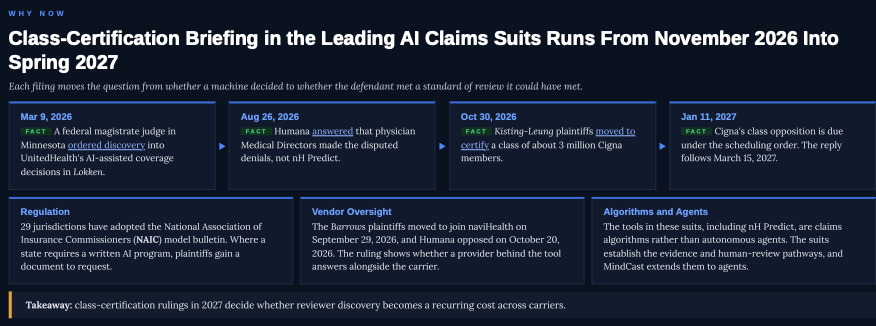
Three health-insurance lawsuits already show the order at work. On March 9, 2026 a federal magistrate judge in Minnesota ordered broad discovery into UnitedHealth’s AI-assisted coverage decisions in Estate of Lokken v. UnitedHealth Group. On August 26, 2026 Humana told a federal court that physician Medical Directors made the disputed denials, not the nH Predict tool plaintiffs say it used. Plaintiffs in Kisting-Leung v. Cigna moved on October 30, 2026 to certify a class of about three million members.
The tools in those suits are claims algorithms rather than autonomous agents. The suits therefore supply the evidence pathways, and MindCast extends them to agents. Timing differs by layer: algorithm suits proceed under established claims-handling law, while agent liability waits on the first reasoned ruling that applies a common-law doctrine to an AI agent. Contract and Employee Retirement Income Security Act (ERISA) claims supply today’s causes of action alongside fair-housing and claims-practices law, and undertaking and imputed-knowledge doctrine will supply the next ones.
The MindCast distinction. MindCast AI applies Predictive Behavioral Economics + Dynamic Game Theory through MindCast AI Proprietary Cognitive Digital Twin Foresight Simulations (MP CDT FS). Behavioral Economics supplies the decision rules that predict which discovery request plaintiffs file next. Game Theory supplies the payoff structure of each request against its cost. Predictive simulations emerge from the combination.
What the paper finds. The written AI program reaches discovery before any policyholder standard because it needs no comparability showing. The human-decision defense then pulls reviewer workload into scope, and the same attack reaches consulting firms that operate agents for clients. Policyholder rules follow only when a property and casualty suit shows that the functions match. Six MindCast Foresight Simulation Predictions carry bands, and each stakeholder entry names the exposure that remains after mitigation.
Stakeholder readout
⚖️ Counsel. Plaintiff counsel should request reviewer metrics and the insurer’s written AI program before the AI requirements it imposes on policyholders (CS-6, CS-4). Carrier counsel should treat reviewer capacity as discoverable once the answer asserts a human decision.
💼 Executives. At carriers, every written standard is a potential exhibit, and reviewer capacity below decision volume is the gap plaintiffs most likely reach. At consulting firms and systems integrators, the same attack reaches every client agent the firm operates.
🏛️ Policymakers. Bulletins that require written AI programs also create the first documents plaintiffs seek. Exam questions on reviewer capacity test effective authority before courts do.
📊 Investors. Class-certification rulings in 2027 decide whether reviewer discovery becomes a recurring cost across carriers. P19 marks the spread into property and casualty lines.
Takeaway. A carrier’s exposure in AI claims suits starts with its reviewers’ workload, not with the rules it writes for others.
II. How Plaintiffs Reach an Insurer’s Written AI Standards
Plaintiffs reach a carrier’s written AI standards in a fixed order. Four suits already supply the discovery template, and the human-decision defense pulls reviewer workload into discovery first. The carrier’s written AI program follows, and its rules for policyholders arrive only after a comparability showing. Reinsurance agreements and agent doctrine carry the same sequence beyond the claim file.
A. Four Lawsuits Already Test Insurers’ AI Claims Tools
Four suits define the field: three against health insurers and one against a property and casualty carrier.
Estate of Lokken v. UnitedHealth Group supplies the discovery template. The March 9, 2026 order compelled production of the insurer’s AI decision processes, oversight practices and related internal material. The court also refused UnitedHealth’s request to limit early discovery to whether nH Predict was used for the plaintiffs’ claims. The surviving claims sound in contract and the implied covenant, after the court dismissed the insurance bad-faith count on Medicare preemption grounds.
Kisting-Leung v. Cigna shows the scale. Cigna had produced about 2.1 million pages by August 2026, and plaintiffs moved for class certification on October 30, 2026. Cigna’s opposition is due January 11, 2027 and the reply March 15, 2027 under the court’s scheduling order.
Barrows v. Humana shows the defense. Humana’s amended answer states that physician Medical Directors made the adverse determinations and denies that Humana owns the nH Predict model. The same answer adds the filed-rate doctrine as an affirmative defense, which puts Humana’s own filings with the Centers for Medicare & Medicaid Services (CMS) within plaintiffs’ reach. Plaintiffs moved on September 29, 2026 to add the tool’s vendor naviHealth as a defendant, and Humana opposed on October 20.
Huskey v. State Farm Fire & Casualty brings the contest into property and casualty lines. Black homeowners allege that State Farm’s algorithmic claims tools subjected their claims to added scrutiny and delay. The court denied dismissal in part in September 2023 and in February 2024 limited first-phase discovery to the algorithmic tools that screen claims. In January 2025 it granted State Farm a protective order and denied a motion to compel.
State AI regulation hands plaintiffs a document they did not have before. Twenty-nine jurisdictions had adopted the National Association of Insurance Commissioners (NAIC) model bulletin on insurers’ use of AI by October 2026, and the bulletin expects each insurer to keep a written AI governance program. How much weight the program carries depends on each state’s adoption instrument.
Source: The Insurance Carrier’s Second Seat Value Proposition, slide 5.
Takeaway. The health suits built the discovery template, and Huskey shows where a property and casualty court has so far narrowed it.
B. The Question Is Which Written Standard Plaintiffs Reach First
The paper asks one question over a 14-month horizon ending December 31, 2027: which of a carrier’s written AI standards can plaintiffs obtain and use against its own AI claims decisions, and in what order? The target system is U.S. property, casualty and health insurance, and claims-handling litigation is the forum.
Answering it means keeping two steps apart: obtaining a document in discovery and proving something with it. A plaintiff that obtains a document has not yet shown that it is relevant, admissible or weighty, so the paper models each step separately.
Takeaway. Sequence governs the plaintiff’s case, and winning discovery of a document is only the first step the document must clear.
C. Three Routes Lead From an Insurer’s Standards to Its Own Claims Decisions
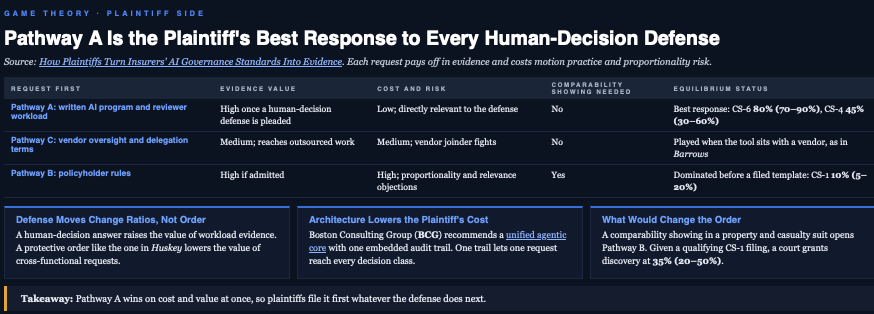
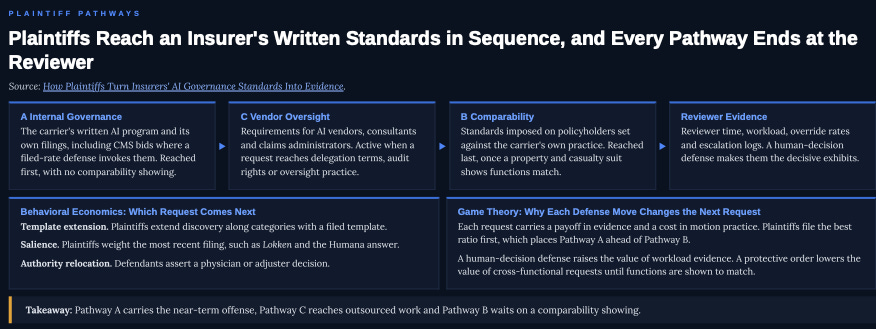
Three pathways lead from a carrier’s written standards to its own claims decisions. Each starts from a different document and reaches court at a different time.
A. Internal governance. The carrier’s written AI program and its own regulatory filings, including CMS bids where a filed-rate defense invokes them → its own claims operations → evidence of actual governance and control. The nearest target and the likeliest first filing.
B. External-to-internal comparability. Standards imposed on insureds → the carrier’s comparable AI practice → contested relevance, admissibility and weight. The distinctive route: the insurer’s own policyholder requirements used against it.
C. Vendor oversight. The carrier’s requirements for AI vendors, consultants and claims administrators → delegated claims operations → allocation of supervision and responsibility. The health-sector analogue of Pathway B and the route into outsourced claims work.
Pathway B is the series’ distinctive mechanism, because it turns a carrier’s requirements for policyholders against its own claims practice. The simulation nonetheless expects it to reach court late and with low probability. A carrier that asks policyholders about alert ownership, human review and remediation documents what it regards as recognized safeguards. A plaintiff challenging the carrier’s own AI claims decision has reason to seek the same material.
The three pathways reach court in sequence rather than together. Plaintiffs reach Pathway A first because it requires no comparability showing. Pathway B escalates only when a property and casualty AI claims suit reaches that showing. Pathway C activates when a request reaches delegation terms, audit rights or actual oversight practice, and vendor joinder alone does not activate it.
Pathway C also reaches outsourced claims work. A carrier that hands AI claims operations to a consultant, systems integrator or third-party administrator can remain answerable for the decision. Plaintiffs then seek the outsourcing contract, its permission and change-control terms and the carrier’s oversight of the provider.
Source: The Insurance Carrier’s Second Seat Value Proposition, slide 11.
Takeaway. Near-term exposure sits in Pathway A, outsourcing widens Pathway C and Pathway B stays dormant until a comparability showing.
D. Four Evidence Questions Decide Whether a Standard Counts in Court
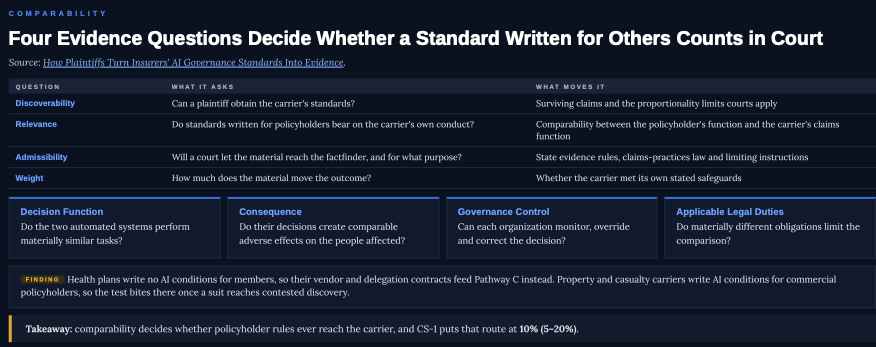
A written standard counts in court only after it clears four questions in turn, and each question turns on different law.
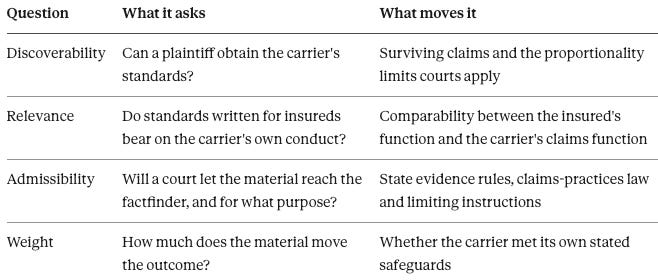
A questionnaire designed to assess a policyholder’s risk does not by itself set the standard of care for a carrier’s claims operation. The argument gains force where functions converge. An agent that triages claims for a policyholder and an agent that triages claims for the carrier perform comparable work, so comparability runs along four dimensions:
Decision function. Do the automated systems perform materially similar tasks?
Consequence. Do their decisions create comparable adverse effects on the people affected?
Governance control. Can each organization monitor, override and correct the decision?
Applicable legal duties. Do materially different obligations limit the comparison?
The comparability test separates health insurers from property and casualty carriers. Health plans write no AI conditions for members, so Pathway B has little to reach in the health suits; their vendor and delegation contracts feed Pathway C instead. Property and casualty carriers write AI conditions for commercial policyholders, so the test bites there once a suit reaches contested discovery. Courts may also admit the material for a narrower purpose, such as knowledge of a recognized safeguard.'
Source: The Insurance Carrier’s Second Seat Value Proposition, slide 12.
Takeaway. Comparability decides whether Pathway B ever reaches the carrier, and a document can clear discovery yet still fail on relevance or weight.
E. The Human-Decision Defense Puts Reviewer Workload Into Discovery
Defendants in the health suits place each adverse decision with a human reviewer. The defense answers the claim that a machine decided, but it raises a new question: whether the human had real authority over the outcome.
A carrier can hold formal review authority without effective review capacity. Formal authority lives in policies, contracts and approval rights. Effective authority shows in reviewer time, information and discretion. Escalation paths, overrides and corrections reveal it too.
Plaintiffs answer the defense with evidence of effective authority. Override rates, time per review, adherence targets and caseloads become the decisive exhibits. The Lokken court’s refusal to limit discovery to whether the tool was used keeps that evidence in scope.
The same attack reaches consulting firms and systems integrators that operate agents for clients, because running an agent inside a client’s systems confers operating control whatever the engagement letter says. How Consulting and Audit Firms Become Liable for the AI Agents They Run for Clients develops that exposure and its forecasts.
Takeaway. By claiming a human decided, the defendant makes reviewer workload the center of the case, and any firm that operates agents for others inherits the same test.
F. Behavioral Economics Predicts Which Request Plaintiffs File Next
Behavioral economics supplies the decision rules that a narrative account underweights. Each rule below names an observable that would support it and an outcome that would defeat it.
Plaintiffs extend discovery along categories with a filed template. Supported if successor suits copy the Lokkenrequests. Defeated if plaintiffs seek novel categories without a template.
Plaintiffs weight the most salient recent filing. Supported if complaints cite Lokken and the Humana answer. Defeated if complaints plead generic claims without AI-specific discovery.
Defendants relocate authority to a named human. Supported if answers and class oppositions assert physician or adjuster decisions. Defeated if defendants defend validated tool accuracy instead.
Takeaway. Each behavioral rule resolves against filings within the forecast window, so a reader can check the mechanism before the forecasts resolve.
G. Game Theory Explains Why Each Defense Move Changes the Next Request
Game theory supplies the payoff structure and equilibrium selection. Each discovery request pays off in evidence and costs motion practice and proportionality risk. Plaintiffs file the request with the best ratio first, which puts Pathway A ahead of Pathway B.
A one-time estimate misses how each defense position changes the value of the plaintiff’s next request. A human-decision defense raises the value of workload evidence. A protective order lowers the value of cross-functional requests until a comparability showing exists.
The Calculus of Predictive Game Theory Evolution and Mutation sets how far forecasts reach when the game is still changing. The calculus matters here because the discovery contest branches wide and resolves one ruling at a time.
Takeaway. Every defense filing changes which request plaintiffs file next, so the forecasts follow a sequence rather than a single estimate.
H. Nine Simulated Actors and Four Open Questions Drive the Forecasts
The simulation models nine institutions as Cognitive Digital Twins (CDTs). Each carries an objective, a cross-pressure and the event that updates its next move.
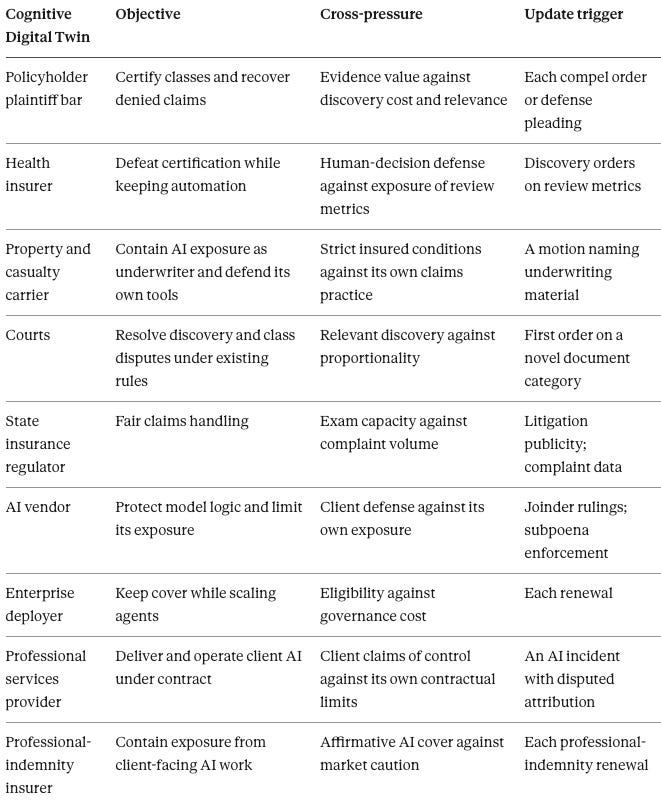
The professional-services provider and its professional-indemnity insurer matter wherever a carrier outsources AI claims work.
Four open questions decide how the litigation unfolds. Functional comparability decides whether a court treats a carrier’s requirements for policyholders as relevant. The discovery boundary decides whether orders reach governance documents above the claim file. Carrier adaptation and regulatory intervention decide how the defense responds, and the defense-side paper models both.
Three competing explanations of where the litigation goes open the forecast section, each with its own falsifier.
Takeaway. Of the four open questions, comparability is the one most likely to change the order in which evidence reaches court.
I. Existing Claims Law Governs Through 2027
Existing claims-handling law sets the rules of the contest. Contract and implied-covenant claims, state claims-practices law and the federal discovery rules define the moves. Developments since 2023 have changed the evidence or the strategy without changing those rules.
Lokken compel order, March 9, 2026. Plaintiffs gained access to AI process and oversight records. Same rules, new evidence.
Huskey scope and protective orders, 2023 to 2025. First-phase discovery confined to the screening tools. Same rules, new evidence.
Humana amended answer, August 26, 2026. The defense settled on human authority rather than tool accuracy. Same rules, new strategy.
NAIC bulletin reaching 29 jurisdictions. Carriers in adopting states face expectations of a written AI program, with legal effect varying by jurisdiction. Same rules, new evidence.
Class-certification rulings, 2027 (pending). Decides whether reviewer discovery recurs across carriers. Same rules, new strategy.
MindCast sorts such events into classes. The Lokken and Huskey orders and the NAIC bulletin are continuations, because they add evidence inside the existing game. The Humana answer and the pending class rulings are equilibrium migrations, because each changes which position persists. The series’ defense-side paper weights the authority contest at 55% and the path that reaches policyholder requirements at 5%.
Each forecast event moves the litigation to a new stage. A filed request for a carrier’s requirements for policyholders brings Pathway B into litigation, and a denial closes the pathway for the order’s scope. A grant opens discovery without deciding relevance, admissibility or weight. A complaint against a consulting firm over an operated agent makes the firm’s operating control and contract terms the contest.
Three developments would end the baseline game: a binding act that changes the claims-handling duty for AI-assisted decisions, an appellate ruling that bars or mandates AI process discovery, or a preemption ruling that removes state claims for a class of carriers. Any one would count as game mutation, the rare class of event that changes the rules themselves.
Takeaway. The forecasts need no change in the rules to resolve, and any of the three rule-changing developments would void them.
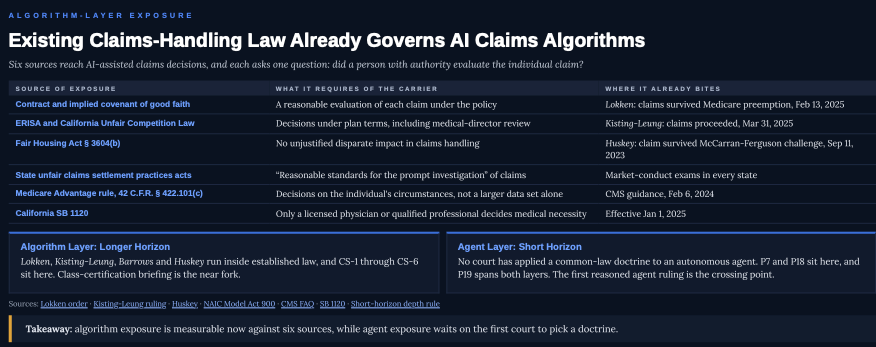
Source: The Insurance Carrier’s Second Seat Value Proposition, slide 8.
J. Reinsurance Agreements Reach Discovery, but Reinsurer Communications Rarely Do
Reinsurance enters the plaintiff’s case through disclosure. Federal Rule of Civil Procedure 26(a)(1)(A)(iv) requires disclosure of insurance agreements that may satisfy a judgment, and most federal courts apply it to reinsurance agreements when the primary insurer is a party. Communications between a carrier and its reinsurer stand on weaker ground, because most courts treat them as business decisions. Some courts order them where they bear on notice or bad faith.
A treaty that conditions cover on the carrier’s own AI claims governance would be one more written standard the carrier accepted. A request for it extends Pathway A, and its reach depends on how the forum treats reinsurance communications. MindCast places the request behind reviewer evidence and the carrier’s own AI program and gives it no band.
Class certification also changes the carrier’s reinsurance position. A certified class concentrates many denials into one dispute, and treaty aggregation wording decides how much of the loss the carrier keeps. The aggregation question therefore adds pressure toward resolution, which the accompanying defendant paper weights at 20%.
Takeaway. Plaintiffs obtain reinsurance agreements through routine disclosure, but reinsurer communications and treaty AI conditions stay contested and rank behind reviewer evidence.
K. Agent Doctrine Decides Which Requests Plaintiffs File Once Agents Act
The algorithm suits run on causes of action plaintiffs already plead: contract and the implied covenant in Lokken and Barrows, ERISA and California’s Unfair Competition Law in Kisting-Leung, and the Fair Housing Act in Huskey. Each asks whether a person with authority evaluated the individual claim, which is why reviewer evidence leads the offense. The MP CDT FS underlying this series sets out the six legal sources and what each requires.
Agent doctrine adds requests once a carrier’s agents act. Voluntary undertaking turns a written AI program and its monitoring into a duty the carrier must perform with care, so plaintiffs request alert queues and response records. Imputed knowledge turns agent logs into notice, so plaintiffs request the logs and the dates reviewers saw them. Both requests carry Pathway A from the carrier’s program into its agents’ records.
Statute has already removed one defense. California Civil Code § 1714.46 bars the argument that an AI system autonomously caused the harm, so a California plaintiff litigates foreseeability and causation instead. Federal Rule of Civil Procedure 37(e) adds pressure on records, because a carrier that deletes agent logs once litigation is reasonably foreseeable invites sanctions.
Distribution agents may open the first agent-layer request. A buyer misled by a carrier’s quoting agent pleads negligent misrepresentation and the state unfair trade practices act, then requests the agent’s conversation logs and the carrier’s simulation results. In Moffatt v. Air Canada a tribunal rejected the argument that a chatbot answers for itself.
Takeaway. Plaintiffs reach the algorithm layer through claims-handling law today, and they will most likely reach the agent layer first through quoting agents in distribution.
Conclusion to Section II. Sequence decides the plaintiff’s case. Reviewer evidence and the written AI program reach court under claims-handling law that already applies. Policyholder rules wait on a property and casualty comparability showing, and agent doctrine waits on its first ruling.
III. MindCast Simulation Predictions — Reviewer Evidence and Written Programs Are Most Likely to Reach Court
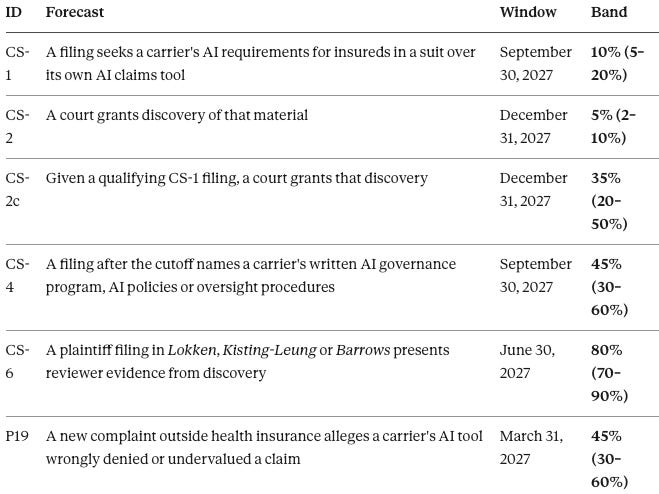
Six forecasts carry bands, with a data cutoff of November 3, 2026. Five come from the simulation, and one carries over from When AI Agent Liability Meets Common Law and Statute. CS marks carrier forecasts, while P19 keeps the identifier it carries in that paper and has not yet resolved.
Three explanations compete before any result. Each falsifier counts only orders issued after November 3, 2026 in suits other than Lokken. The Lokken order of March 9, 2026 already reached AI oversight material above the claim file.
Explanation 1. An insurer’s written standards reach its own claims conduct in court. Falsified if no court other than the Lokken court orders discovery of an insurer’s written AI program or reviewer metrics in an AI claims suit between November 3, 2026 and December 31, 2027.
Explanation 2. Unclear decision rights drive exposure whatever the written standards say. Falsified if suits resolve on tool accuracy rather than on who owned each decision.
Explanation 3. Courts confine AI claims discovery to the tool at issue, as the Huskey court did in its first-phase order. Supported by post-cutoff protective orders or scope orders limiting discovery to the claims tool. Falsified if no AI claims suit produces such an order between November 3, 2026 and December 31, 2027.
The simulation favors Explanation 1 for the carrier’s own program and reviewers, while policyholder requirements stay unlikely to reach court through 2027.
Scenario structure. The most likely path runs through the contest over whether human reviewers had real authority, decided on reviewer evidence. Less likely paths run through resolution after class rulings and through regulator-led alignment. The least likely paths run through an order reaching the insurer’s policyholder requirements or through courts confining discovery to claim files.
III.A Five Primary Insurance Carrier Forecasts
Five forecasts come from the simulation. Each names an actor and an outcome, then gives a window, a band and a falsifier.
CS-1. A plaintiff seeks an insurer’s AI requirements for policyholders in a suit over its own AI claims tool by September 30, 2027: 10% (5–20%).
Forecast statement: A public filing in a U.S. case shows a plaintiff seeking a carrier’s underwriting guidelines, renewal questionnaires or AI-governance requirements for insureds, in a suit challenging that carrier’s own AI-assisted claims decision.
Confidence band: 10% (5–20%)
Time window: November 3, 2026 through September 30, 2027.
Trigger conditions: Surviving claims-handling counts in a suit over a carrier’s AI claims tool. A property and casualty suit in contested discovery, such as Huskey, raises the route.
Qualifying event: A publicly filed motion to compel, motion for protective order, filed exhibit attaching the request, or court order that names underwriting or insured-governance material. Discovery requests are ordinarily not filed under Federal Rule of Civil Procedure 5(d)(1), so unfiled requests and complaint allegations alone do not qualify.
Explicit falsifier: No qualifying public filing by September 30, 2027. The forecast concerns publicly observable filings only.
Verification source: Federal and state dockets, including Public Access to Court Electronic Records (PACER) and state e-filing systems.
Stakeholder exposure: Carrier claims and legal functions; plaintiff bar.
Monitoring signal: Monthly docket search for AI claims-tool suits and their discovery motions.
CS-2. A court orders discovery of a carrier’s AI requirements for policyholders in a suit over its own AI claims tool by December 31, 2027: 5% (2–10%).
Forecast statement: Unconditional: a U.S. court issues a written order granting discovery, in whole or in part, of a carrier’s underwriting or insured-governance material in a suit over that carrier’s own AI-assisted claims decision.
Confidence band: 5% (2–10%)
Time window: November 3, 2026 through December 31, 2027.
Trigger conditions: A qualifying CS-1 filing; a court applying a comparability or proportionality analysis.
Qualifying event: A written order granting discovery of the material in whole or in part. An evidentiary admission ruling does not resolve CS-2 and is tracked in III.C.
Explicit falsifier: No qualifying written order by December 31, 2027.
Verification source: Federal and state dockets and published opinions.
Stakeholder exposure: Carrier counsel; carriers’ internal governance owners.
Monitoring signal: Orders on motions to compel in AI claims-tool suits.
CS-2c. Given a qualifying CS-1 filing, a court orders discovery of the carrier’s policyholder AI requirements by December 31, 2027: 35% (20–50%). P(a court grants discovery of insured-facing material in whole or in part by December 31, 2027, given a qualifying CS-1 filing): 35% (20–50%). The conditional stays separate from CS-2, whose low band reflects how rarely a qualifying request reaches a court.
CS-4. A filing after the cutoff names an insurer’s written AI governance program, AI policies or oversight procedures in an AI claims suit by September 30, 2027: 45% (30–60%).
Forecast statement: A public motion, order or filed exhibit filed after November 3, 2026 names a carrier’s written AI governance program, AI policies or AI oversight procedures in a suit over that carrier’s AI-assisted claims decisions.
Confidence band: 45% (30–60%)
Time window: November 4, 2026 through September 30, 2027.
Trigger conditions: Surviving claims-handling counts; NAIC bulletin adoption in the forum state.
Qualifying event: A motion, filed exhibit or order dated after November 3, 2026 that names the written program or AI policies.
Explicit falsifier: No qualifying filing by September 30, 2027.
Verification source: Federal and state dockets.
Stakeholder exposure: Carrier governance owners and counsel.
Monitoring signal: Monthly docket search for AI claims-tool suits.
CS-6. A plaintiff in Lokken, Kisting-Leung or Barrows files reviewer evidence from discovery by June 30, 2027: 80% (70–90%).
Forecast statement: A plaintiff filing in Lokken, Kisting-Leung or Barrows presents reviewer time, workload, adherence or override evidence obtained in discovery to contest the defendant’s human-review position.
Confidence band: 80% (70–90%)
Time window: November 3, 2026 through June 30, 2027.
Trigger conditions: A human-decision defense in an answer or class opposition. The Barrows plaintiffs’ class-certification motion is due November 5, 2026 and is the earliest qualifying filing. The Lokken class motion follows on February 16, 2027 and the Kisting-Leung reply on March 15, 2027.
Qualifying event: A public filing that cites or attaches reviewer evidence from discovery.
Explicit falsifier: No qualifying filing by June 30, 2027.
Verification source: Federal dockets in the three named cases.
Stakeholder exposure: Health insurer claims and legal functions.
Monitoring signal: Class-certification briefing in the three cases.
Takeaway. Reviewer evidence and the written program carry the highest bands, and Pathway B stays low until a property and casualty suit shows that a policyholder’s function matches the carrier’s claims function.
III.B Carried Forecast — AI Claims Suits Spread Beyond Health Insurance
One forecast carries over from the companion work on agent liability and tests whether AI claims suits spread beyond health insurance.
P19. A new complaint outside health insurance alleges a carrier’s AI tool wrongly denied or undervalued a claim by March 31, 2027 (45%; range 30–60%). Falsifier: no qualifying complaint by March 31, 2027.
P19 keeps its published identifier and band. Because it counts any non-health complaint, a P19 event does not by itself supply the property and casualty suit CS-1 needs.
Takeaway. A P19 complaint would widen the field beyond health insurance without opening Pathway B on its own.
III.C Two Questions Without a Band
Two questions matter to the plaintiff’s case but carry no band.
Vendor oversight. A request, ruling or production reaches the delegation terms or audit rights of a vendor, consultant or claims administrator. A request reaching actual oversight practice also qualifies. Vendor joinder alone does not qualify. The Barrows plaintiffs already moved to add naviHealth on September 29, 2026, and the question carries no band until the court rules on joinder.
Evidentiary use. P(a court admits carrier underwriting or insured-governance material for notice, for standard of care or in a merits ruling, given CS-2). The three uses carry different weight and resolve separately. The condition carries no band because no base rate for admission exists.
Takeaway. Both questions stay qualitative until a filing or ruling gives a base for a band.
III.D Three Developments Would Break the Forecasts
Three developments would break the forecasts. Courts could hold that underwriting and claims functions are never comparable, which collapses Pathway B. Leading suits could resolve before discovery motions reach a docket, which hides CS-1 events from view. A preemption ruling could remove state claims-handling causes of action for a class of carriers.
Takeaway. Each break would show up on a docket or in a published opinion, so readers can see it before the forecasts resolve.
Conclusion to Section III. The plaintiff-side forecasts favor reviewer evidence and the written AI program, with CS-6 at 80% (70–90%) and CS-4 at 45% (30–60%). Policyholder rules trail at 10% (5–20%) for a filing and 5% (2–10%) for an order. A property and casualty comparability showing is the event that would move them.
IV. The Offense Spreads From Health to Property and Casualty Lines
Property and casualty lines inherit the template the health suits built. A discovery order on policyholder rules would make comparability the central contest. Plaintiffs reuse the health template until legal duties diverge, and value flows to the side that reads the other’s standards first.
A. A Discovery Order Would Make Comparability the Central Contest
A court order granting discovery of a carrier’s requirements for policyholders (CS-2) would put comparability at the center of claims-handling discovery. Courts would weigh carrier objections against plaintiffs’ showing that functions converge. Regulators would gain a template for exam questions that pair external conditions with internal practice.
Takeaway. The first such order would shift the contest from whether AI was used to whether the carrier met its own written standard.
B. Plaintiffs Reuse the Health-Insurance Discovery Template
Health suits taught plaintiffs to seek AI processes and review metrics, and those requests now travel into property and casualty lines. Huskey shows the same requests meeting a narrower scope order in a homeowners case.
The template stops spreading where legal duties diverge. Fair Housing Act disparate-impact claims and Medicare Advantage contract claims impose different obligations. The fourth comparability question, on applicable legal duties, limits how far one template travels.
Takeaway. Reused requests carry the offense across lines until differing legal duties stop them.
C. Value Flows to the Side That Reads the Other’s Standards First
Plaintiffs that sequence their requests gain evidence at lower motion cost. Carriers whose written standards match their practice absorb little from the offense. Carriers with gaps absorb discovery cost and pressure to resolve.
Takeaway. Advantage goes to the side that reads the other’s written standards first and sequences its moves around them.
D. A Failed Forecast Redirects the Move
CS-1 expects no filing seeking a carrier’s policyholder requirements by September 30, 2027. If none arrives, Pathways A and C carry the offense, and plaintiffs should weight own-program and review-metric requests. If CS-1 resolves true and CS-2 false, courts are drawing the comparability line, and the next contest turns on the function-by-function showing.
Takeaway. Either outcome tells plaintiffs which request to file next, so a miss changes the move without undoing the mechanism.
Conclusion to Section IV. Property and casualty suits inherit the health-insurance discovery template. The first order reaching a carrier’s rules for policyholders decides whether comparability becomes the contest.
V. What Each Stakeholder Should Do and What Exposure Remains
The stakeholder strategy turns the forecasts into moves. Each row names who acts, what they do now and which trigger changes the move.
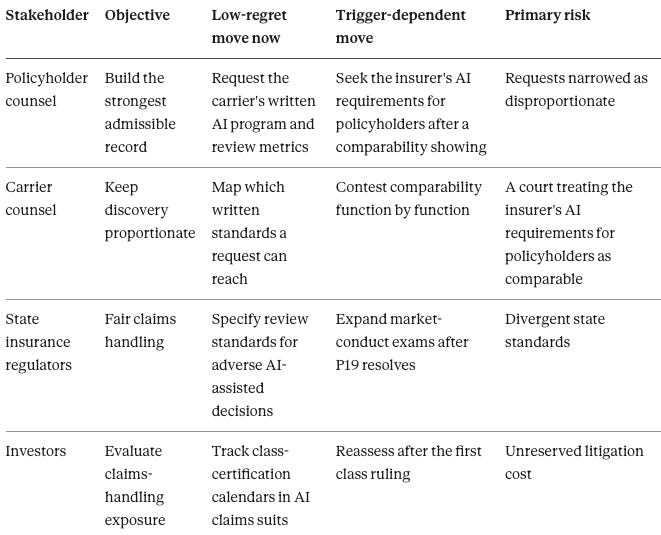
Risk Mitigation Entries
Each entry routes one forecast to one audience and states the exposure, two to four mitigating actions and the exposure that remains.
Entry 1. ⚖️ Policyholder counsel, CS-1 and CS-2.
Forecast and band: discovery activation (10% (5–20%)) and judicial discovery access (5% (2–10%)) on carrier underwriting material. Severity: high. Probability: low.
Exposure: discovery scope forgone on the carrier’s comparable governance material, measured in document categories closed at the fact-discovery cutoff.
Mitigating actions: case teams identify whether the defendant writes AI conditions for commercial insureds before the Rule 26(f) conference. Discovery counsel builds the comparability showing function by function before serving any request for the insurer’s AI requirements for policyholders. Class counsel sequences requests so the carrier’s own AI program comes first.
Residual exposure: a court, not counsel, decides comparability.
Entry 2. 🏛️ State insurance regulators, P19.
Forecast and band: a new complaint outside health insurance alleges a carrier’s AI tool wrongly denied or undervalued a claim by March 31, 2027 (45%; range 30–60%). Severity: medium. Probability: moderate.
Exposure: market-conduct exam calendar consumed by complaint-driven reviews rather than standards-driven ones.
Mitigating actions: the department issues a bulletin specifying review requirements for adverse AI-assisted claims decisions by March 31, 2027. Market-conduct staff add AI decision-ownership questions to exam templates by June 30, 2027.
Residual exposure: divergent standards across states persist until a model bulletin spreads.
Entry 3. 📊 Investors, P19.
Forecast and band: P19 (45%; range 30–60%). Severity: medium. Probability: moderate.
Exposure: claims-handling litigation cost not reflected in reserves, measured in basis points of combined ratio.
Mitigating actions: analysts ask each covered carrier how adverse AI-assisted decisions are reviewed at first-quarter 2027 earnings calls. Portfolio managers compare carriers’ stated review models with the AI governance conditions they impose on policyholders, using information the companies choose to share.
Residual exposure: confidential resolutions can hide retained loss from review.
Placement. The entries sit as a standalone section. Placing them beneath each forecast keeps exposure next to its band but lengthens Section III. The carrier entries sit in the defense-side paper, so each entry appears once across the series.
Policyholder counsel can follow the same sequence on a dated timeline.
Now to 30 days. Request the carrier’s own AI program first. Escalate when the answer asserts a human decision.
30 to 90 days. Request reviewer metrics so workload evidence stays in the case. Escalate when a class-certification schedule issues.
3 to 12 months. Build the function-by-function comparability showing. Escalate when a property and casualty suit enters contested discovery.
Beyond 12 months. Brief whether policyholder standards show notice or set the standard of care, so admission is not confined to a narrow purpose. Escalate on a CS-2 order.
Takeaway. Plaintiffs gain most by sequencing requests, and every stakeholder move ties to a dated checkpoint.
What to Watch — A Property and Casualty Comparability Showing Is the Dominant Fork
The dominant fork is whether a property and casualty AI claims suit shows that a policyholder’s AI function matches the carrier’s claims function. If one does, policyholder requirements move from unlikely to live evidence.
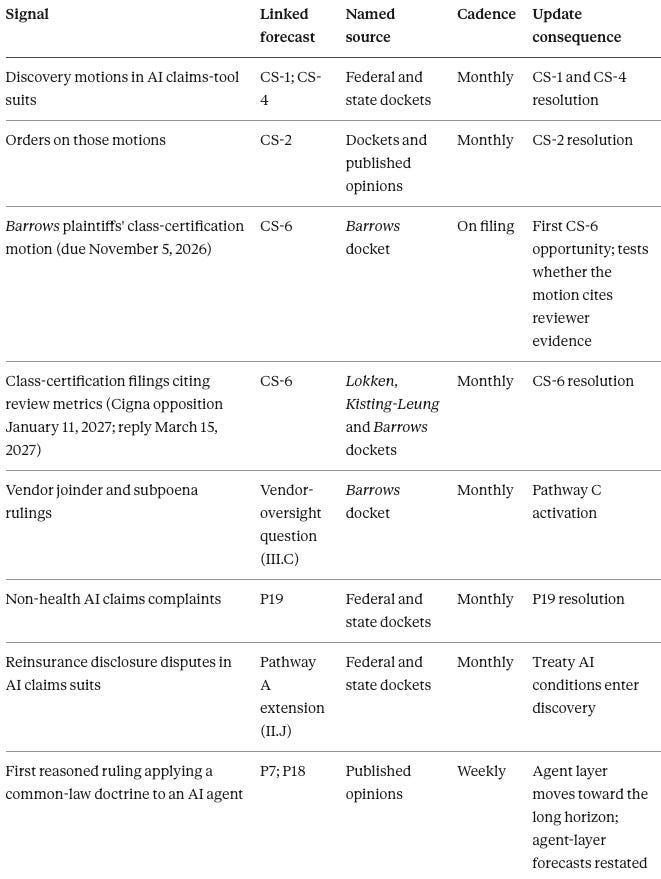
Takeaway. Monthly docket searches cover most of the plaintiff-side forecasts, and an order reaching policyholder rules would change the contest most.
Conclusion — Reviewer Evidence Reaches the Insurer Before Its Policyholder Rules
Discovery moves from the claim file to reviewer workload and the written program, and it reaches policyholder rules last and vendors only through delegation terms.
Carriers that run AI in claims have written the standards plaintiffs will test them against. Reviewer evidence behind a human-decision defense is the most likely exhibit, the carrier’s own AI program comes next and its standards for policyholders come last.
The decisive signal is the first order that grants access to a carrier’s AI requirements for policyholders in a suit over its own AI claims tool. The defense-side paper models how carriers defend before that order arrives.
Working With MindCast
Every forecast in this paper turns on documents a specific carrier already holds: its written AI program, its reviewer metrics and the AI conditions it imposes on policyholders. Whoever maps those documents first sets the order of discovery. MindCast builds Cognitive Digital Twins (CDTs) of the court, the carrier and opposing counsel from the pleadings and public governance materials, then simulates which request lands and which defense meets it.
A complimentary pilot comes first. Inputs are the docket, the carrier’s public AI governance materials and one anonymized claims workflow or discovery plan shared under a mutual nondisclosure agreement. The pilot delivers a ranked request sequence across Pathways A, B and C, the defense each request will meet and banded forecasts with windows and falsifiers. Delivery lands before Cigna’s January 11, 2027 class-certification opposition in Kisting-Leung.
Retained engagements follow the decision each side faces.
⚖️ Plaintiff counsel. A discovery-path simulation ranks requests for reviewer metrics and the written AI program against proportionality objections, keyed to CS-6 and CS-4.
⚖️ Carrier counsel. An exhibit forecast identifies which internal documents opponents reach first and builds the comparability argument function by function before a CS-1 filing arrives.
💼 Carriers. A reviewer-capacity review measures review time and override authority against decision volume for each adverse decision class.
📊 Investors and Reinsurers. A class-exposure review tests how a certified class in one leading suit would aggregate under existing treaty wording.
The MindCast Predictive Game Theory Simulation of Mixed Time Horizon Insurance Carrier Second Seat Exposuredetails each engagement. Each forecast in this series resolves on the MindCast Prediction Scorecard. Contact mcai@mindcast-ai.com to scope a pilot, or see predictive game theory simulations at www.mindcast-ai-simulation.com.
Appendix A. Selected MindCast Works
The series rests principally on four works: When AI Agent Liability Meets Common Law and Statute, Agentic Foreseeability and the Modern Duty of Care for AI Agents, Who Writes AI Insurance Coverage Conditions and The Calculus of Predictive Game Theory Evolution and Mutation. The remaining works support specific mechanisms.
Tier 1. Core — Liability, Coverage and Capital
1. When AI Agent Liability Meets Common Law and Statute — Predictable Doctrines, Unsettled Allocation(November 3, 2026) URL: https://www.mindcast-ai.com/p/agentic-common-law-statutory-liablity-allocation Relevance: The anchor work supplies the four doctrines that structure liability allocation once agents act. The paper’s foreseeability paradox shows how an unanswered auditable finding can support an inference of notice in tort and bear on prior-knowledge provisions in coverage. P18 (subrogation at 12%) and P19 (carrier AI tools challenged outside health insurance, 45%) give the carrier-facing forecasts, under their published identifiers.
2. Agentic Foreseeability and the Modern Duty of Care for AI Agents (October 29, 2026) URL: https://www.mindcast-ai.com/p/agentic-foreseeability Relevance: Supplies the foreseeability test that decides what a deployer should have known once its agents act. The paper shows how courts can find foreseeability from evaluation results before loss data accumulates.
3. Who Writes AI Insurance Coverage Conditions — Procurement, Enforcement Decrees, Partner Terms and the Two-Axis Condition (October 30, 2026) URL: https://www.mindcast-ai.com/p/agentic-insurance-controllable-lossesRelevance: Names who supplies the evidence that makes coverage conditions writable: procurement, consent decrees and partner terms. The analysis complements BCG’s case for narrow first-generation products.
4. Who Absorbs Correlated AI Loss — Reinsurance Aggregation, Industry Pools, the Public Backstop and the Liability Shield (October 30, 2026) URL: https://www.mindcast-ai.com/p/agentic-insurance-capital Relevance: Examines pooled capacity and public backstops, including levy-funded pools of the Flood Re type that BCG’s June 2026 white paper proposes. The paper argues that corrective duties should accompany public support. The paper’s number-of-occurrences analysis bears on correlated AI loss.
5. FTC Investigation of Anthropic and OpenAI — State Subpoenas Came First, and the Theory of Harm Decides the First Federal Order on Frontier Model Safety (October 31, 2026) URL: https://www.mindcast-ai.com/p/ftc-anthropic-openai Relevance: Sets out the federal enforcement baseline. A coverage condition written before any order becomes the market term the order later confirms, so carriers move ahead of the regulator.
6. OpenAI State Attorney General Lawsuits — Two Pleading Templates Across Ten State Courts (October 30, 2026) URL: https://www.mindcast-ai.com/p/ag-coalition-v-openai-snapshot Relevance: Shows the state enforcement channel moving without a federal order or an insurance market. Liability reaches AI developers through consumer law before any coverage dispute.
Tier 2. Foresight-to-Duty Conversion Series
7. Foresight-to-Duty Conversion in AI Governance, Series Introduction (October 24, 2026) URL: https://www.mindcast-ai.com/p/foresight-to-duty-conversion-series Relevance: States the governing question behind this paper: when an institution knows, what makes it act and what establishes that the correction worked.
8. Who Sets the Agentic Standard of Care — Common Law, State Legislation and Federal Coordination (October 30, 2026) URL: https://www.mindcast-ai.com/p/agentic-institutional-controls Relevance: Answers which institution writes the agentic standard of care that carriers apply at renewal. Courts, legislatures and federal coordination compete for the role, and carriers borrow whichever standard arrives first.
9. Consent Order Remedies at Meta, Boeing, Starling and Wells Fargo — Verified Correction Versus Recurrence(October 24, 2026) URL: https://www.mindcast-ai.com/p/consent-remedies-correction-v-recurrence Relevance: Supplies the verified-correction test behind answerable monitoring. The Unified Agentic Core article embeds human-in-the-loop gates, and the paper shows that gates without verified correction produce recurrence rather than care.
10. Meta and Bank of America Foresight-to-Duty Conversion — Revenue-Funded Versus Cost-Funded Deferral(October 24, 2026) URL: https://www.mindcast-ai.com/p/meta-boa-revenue-v-cost-funded-deferrals Relevance: Explains why institutions defer corrections their own systems measured. Carriers deploying a unified agentic core face the same deferral choice on every flagged claim decision.
11. Meta Foresight-to-Duty Conversion Across Privacy, Child Safety and Scam Ads (October 24, 2026) URL: https://www.mindcast-ai.com/p/meta-span-of-duties Relevance: Shows one platform facing several regulators at once over the same measured gaps. The case parallels a carrier’s agent fleet, where a single ontology spreads one finding across many lines of business.
12. Bank of America $1.2 Billion Money Laundering Penalty and the Compliance System That Knew Too Much(October 14, 2026) URL: https://www.mindcast-ai.com/p/boa-foreseeable-aml-penalty Relevance: Provides the clearest precedent for imputed knowledge from automated systems. BCG’s unified core propagates insights across agents automatically, which is the “system that knew too much” pattern applied to insurers.
Tier 3. Method and Framework
13. Predictive Game Theory Evolution and Mutation — Short Horizon Games Branch Wide and Resolve Shallow(November 3, 2026) URL: https://www.mindcast-ai.com/p/predictive-game-theory-calculus-short-horizon Relevance: Uses agentic AI liability as its worked tree and shows why firms can act before deep forecasts arrive. The point supports writing bounded risks now by showing which liability terms move at which renewal.
14. The Calculus of Predictive Game Theory Evolution and Mutation (November 3, 2026) URL: https://www.mindcast-ai.com/p/predictive-game-theory-calculus-intro Relevance: States the governing calculus: strategic clarity can run ahead of structural certainty. BCG’s “velocity mismatch” between actuarial and model clocks is a horizon problem the calculus addresses directly.
15. Predictive Game Theory Evolution and Mutation — Long Horizon Games Resolve Deep Because Their Branches Hold (November 3, 2026) URL: https://www.mindcast-ai.com/p/predictive-game-theory-calculus-long-horizonRelevance: Shows what stability adds once a game holds, using the Bank of America tree. The paper marks the conditions under which agentic coverage could graduate from narrow products to broad cover.
16. Dynamic Predictive Game Theory — From Nash Equilibrium to Adaptive Coherence Equilibrium (October 23, 2026) URL: https://www.mindcast-ai.com/p/bridge-to-dynamic-game-theory Relevance: Supplies equilibrium selection and delay dominance. BCG tells carriers not to wait, and delay dominance explains when waiting is rational and when it fails.
17. Predictive Game Theory Simulations Through War Gaming (November 1, 2026) URL: https://www.mindcast-ai.com/p/predictive-behavioral-economics-dynamic-game-thoery-war-gaming Relevance: Separates Simulation Snapshots from full Foresight Simulations by the stability of the game. The distinction explains why the agentic liability work carries short-window forecasts.
18. How Mozart Predicts Game Mutation in Predictive Behavioral Economics + Dynamic Game Theory (October 11, 2026) URL: https://www.mindcast-ai.com/p/mozart-economics Relevance: Frames when a structural change crosses an operative threshold, the test for whether a unified-core migration changes the rules or only the evidence carriers hold.
19. MindCast Predictive Game Theory Simulation of Mixed Time Horizon Insurance Carrier Second Seat Exposure (November 2026) URL: https://magazine.mindcast-ai.com/agentic-insurance-carrier-second-seat-value-proposition Relevance: Translates the series into engagements for carriers, reinsurers, consulting and audit firms, claims vendors and counsel.
Appendix B. External Sources
Court filings
Estate of Lokken v. UnitedHealth Group, Inc., No. 23-cv-3514 (D. Minn.), Order on Motion to Compel Discovery(March 9, 2026).
Estate of Lokken v. UnitedHealth Group, Inc., Memorandum Opinion and Order on Motion to Dismiss (February 13, 2025), dismissing five of seven counts and allowing the breach of contract and implied covenant claims to proceed.
Barrows v. Humana Inc., No. 3:23-cv-00654 (W.D. Ky.), Amended Answer (August 26, 2026), Scheduling Order(July 17, 2026) and Scheduling Order (October 15, 2026; class-certification motion due November 5, 2026).
Kisting-Leung v. Cigna Corp., No. 2:23-cv-01477 (E.D. Cal.), Joint Stipulation (August 24, 2026), and Minute Order (August 26, 2026).
Huskey v. State Farm Fire & Casualty Co., No. 1:22-cv-07014 (N.D. Ill.), case summary and docket, Civil Rights Litigation Clearinghouse.
Law360, “Cigna Patients Seek Hefty Class In Cigna Auto Denials Suit” (October 30, 2026).
Barrows v. Humana Inc., Health Care Litigation Tracker case page, Georgetown Law.
Industry research (Boston Consulting Group): primary
“The Case for the Unified Agentic Core in Insurance” (October 21, 2026), Fabrizio Pessina, Roberto Bosisio, Nicolás López Polo, Christoph Fritsch, Nicolas Guglielmi and Riccardo Pallozzi.
“Your Agents Are Ready. Is Your Insurer?” (June 2026), Raphael Troitzsch, Nadine Moore and Coralie Ming. White paper, announced on BCG’s insurance LinkedIn page; no stable public URL.
“Always-On Portfolio Management: How Agentic AI Can Give a Lasting Edge to Commercial P&C Insurers”(June 30, 2026), Erdem Altay, Semih Durmus, Nadine Moore, Michael Schachtner and Victor Zhou.
Industry research (Boston Consulting Group): supporting
“How Agentic AI Can Power Core Insurance IT Modernization” (January 12, 2026), Fabrizio Pessina, Roberto Bosisio, Nicolás López Polo, Christoph Fritsch and Nicolas Guglielmi.
“Agentic AI’s Advantage for Health Insurers: Faster Decisions, Lower Costs, Better Care” (September 4, 2026), Konstantin Storms, Juliane Burgdorf, Matthias Becker, Swayamjit Mishra, Alessandra Catozzella and Kazim Zaidi.
“Are Insurers’ Talent Models Ready for AI?” (July 22, 2026), Nathalia Bellizia, Isabelle Cox, Megan Mirabella and Nadine Moore.
Rules, regulation and standard forms
NAIC, “Implementation of NAIC Model Bulletin: Use of Artificial Intelligence Systems by Insurers”.
Cozen O’Connor, “Claims Notes: October 2026” (October 19, 2026), reporting 29 adopting jurisdictions.
Gallagher, “ISO Introduces Generative AI Exclusion in Commercial General Liability Policies: What Construction Companies Should Know” (May 28, 2026), naming ISO endorsement CG 40 47 01 26.
Mark Rosanes, “ISO’s Generative AI Exclusion Is Already on Thousands of CGL Policies”, Insurance Business(September 16, 2026), reporting that CG 40 47 01 26 became available for carrier attachment in January 2026 alongside CG 40 48 and CG 35 08.
Professional services and AI
EY, “EY launches enterprise-scale agentic AI to redefine the audit experience for the AI era” (April 7, 2026).
Hiscox, “Professional Indemnity for Technology Companies, Policy Wording WD-PROF-UK-TEC(2)” (April 2025).
The Insurer, “MGA Counterpart Adds Affirmative AI Cover to Professional Liability Policies” (November 24, 2025).