
Insurance Chief Executives and Boards · Chief Claims, Underwriting and Risk Officers · Reinsurers · Management Consulting, Systems Integration and Audit Firms · General Counsel and Litigators · State Insurance Regulators · Investors
Companion to Who Answers for AI Claims Decisions — Insurers, Consultants and Auditors in the Second Seat · When AI Agent Liability Meets Common Law and Statute · Who Writes AI Insurance Coverage Conditions · Who Absorbs Correlated AI Loss · How Consulting and Audit Firms Become Liable for the AI Agents They Run for Clients · How Plaintiffs Turn Insurers’ AI Governance Standards Into Evidence
Value proposition · MindCast Predictive Game Theory Simulation of Mixed Time Horizon Insurance Carrier Second Seat Exposure
I. Executive Summary
The paper forecasts which carrier defenses hold and how the resulting loss is allocated among the carrier, its vendors, its insurers and its reinsurers. Claims algorithms run under established law, so those forecasts reach through 2027 with firm bands, while agent liability waits on its first ruling and reaches one step ahead.
An insurance company, called a carrier in the industry, sits in two seats that pull against each other. In the First Seat it underwrites policyholders’ AI risk and conditions cover on the governance evidence they can show. In the Second Seat it runs AI agents of its own in claims and care approvals, and it must defend what those agents decide. The standards a carrier writes in one seat can therefore become evidence against it in the other.
The thesis. Human review defends a carrier only when the reviewer had the time, information and discretion to decide. Consistency is the second defense: a carrier holds up best when its own practice matches the conditions it imposes on policyholders. Both defenses play out on two horizons. Algorithm claims suits proceed now under established claims-handling law, while agent liability waits on its first reasoned ruling.
Carriers already in court rely on the first defense. Humana told a federal court on August 26, 2026 that physician Medical Directors made the disputed denials, not the nH Predict tool plaintiffs say it used. The answer rebuts the claim that a machine decided, but it also invites discovery into whether the physicians could decide. nH Predict is a claims algorithm rather than an autonomous agent, so the suit supplies the human-review test and MindCast extends it to agents.
The MindCast distinction. MindCast AI applies Predictive Behavioral Economics + Dynamic Game Theory through MindCast AI Proprietary Cognitive Digital Twin Foresight Simulations (MP CDT FS). Behavioral Economics supplies the decision rules that predict which pairing of external conditions and internal practice each carrier selects under pressure. Game Theory supplies the payoff structure of each pairing. Predictive simulations emerge from the combination.
What the paper finds. The same review metrics cut both ways. Where a carrier holds approval rights only on paper, workload and override rates become the plaintiff’s best exhibit; where reviewers could decide, the same numbers become proof of care. Comparability arguments protect the carrier’s rules for policyholders, but only aligned practice protects its own written AI program. MindCast reads the period through 2027 as one in which discovery reaches carrier governance records before carriers can show verified correction, meaning a documented fix shown to work.
Consulting and audit firms that run agents for clients face the same test. On the carrier side, preemption and filed-rate defenses narrow algorithm claims case by case, while statute has already narrowed the autonomy defense for agents. Four MindCast Foresight Simulation Predictions and one interpretive reading carry the forecast, and reinsurance terms decide how much of the exposure the carrier keeps.
Stakeholder readout
💼 Executives. At carriers, each adverse decision class needs a named owner, a dated review entry and reviewer capacity matched to decision volume. CS-5 puts that capacity at the center of class certification by April 2027. At consulting and audit firms, the same review test decides the defense for agents they run in client systems.
⚖️ Counsel. Comparability and proportionality defenses protect the carrier’s requirements for policyholders but not its own AI program or its review metrics. Build the comparability argument function by function before the first request for underwriting material arrives.
🏛️ Policymakers. Exam questions on decision ownership test whether reviewers can actually decide before litigation does. Confidential remediation keeps alignment out of view, which is why CS-3 carries a low band.
📊 Investors. Retained claims-handling exposure sits with carriers whose review capacity runs below the governance standard they sell to policyholders. P18 and P7 mark when that exposure turns into litigation against vendors and over coverage. Treaty aggregation wording decides how much of a certified-class loss carriers keep.
Takeaway. The defensible carrier or firm backs approval rights with reviewer capacity and holds itself to the standards it sells.
II. Which Insurer Defenses Hold When Their Own Standards Become Evidence
Carrier defenses hold or fail on two facts: who owned each decision and whether the reviewer could decide. Carriers are expanding their own agents just as plaintiffs gain access to the evidence those agents create. Comparability protects the carrier’s rules for policyholders, but only aligned practice protects its own written program. Reinsurance terms and the governing body of law then decide how much of the exposure the carrier keeps.
A. Insurers Expand Their Own Agents While the Evidence Becomes Reachable
Carriers are moving into the deployer seat while widening their exclusion options. Verisk’s Insurance Services Office (ISO) made three optional generative-AI exclusion endorsements available with January 2026 edition dates, including CG 40 47 01 26 for commercial general liability. Attachment varies by carrier and segment, so the forms change contract terms only where carriers adopt them.
Boston Consulting Group (BCG) documents the deployer move in four 2026 pieces. “The Case for the Unified Agentic Core in Insurance” (October 21, 2026) recommends one stack in which an orchestrator, specialist agents and a process blueprint run with an audit trail and a shared insurance ontology. “Always-On Portfolio Management” (June 30, 2026) extends agents into underwriting and portfolio steering.
“Agentic AI’s Advantage for Health Insurers” (September 4, 2026) carries agents into claims and care approvals. “Are Insurers’ Talent Models Ready for AI?” (July 22, 2026) names the catch: accountability for automated outcomes concentrates on fewer people. Together the four pieces establish the adoption trend and the accountability problem this paper builds on.
The evidence those agents create is already reachable. Defendants in the AI claims suits against UnitedHealth, Cigna and Humana place each adverse decision with a human reviewer, and plaintiffs answer by seeking the review behind it. Twenty-nine jurisdictions had adopted the National Association of Insurance Commissioners (NAIC) model bulletin on insurers’ use of AI by October 2026. Where a state’s adoption instrument expects a written AI governance program, plaintiffs gain one more document to request, with legal effect varying by jurisdiction.
Takeaway. The deployer seat is growing at the moment its evidence becomes reachable, so the defense has to exist before the first request arrives.
B. Decision Ownership Decides the Defense
The paper asks one question over a 14-month horizon ending December 31, 2027: which carrier governance and litigation strategies stay defensible as plaintiffs gain access to internal and external AI-control evidence? The target system is U.S. property, casualty and health insurance.
The question has two axes. The external axis asks whether underwriting requirements become relevant to the carrier’s own conduct. The internal axis asks who inside the carrier owns and can correct each automated decision, the accountability problem BCG’s talent research identifies.
The contest moves to the internal axis. Automated monitoring lowers the cost of finding a risk, so a carrier can no longer credibly argue that the risk was unforeseeable. The defense then turns on authority and response: whether a finding reached someone who could act, and what that person did.
Takeaway. Once monitoring makes risks foreseeable, a carrier defends itself by showing who owned each decision and what that person did.
C. Each Pathway Has a Defense and a Weakness
Plaintiffs reach a carrier’s written standards through three pathways, and each has its own defense, its own cost and its own point of failure.
A. Internal governance. Defense: show that the written AI program describes actual practice. Cost: documentation and audit effort. Defeated by practice that departs from the program.
B. External-to-internal comparability. Defense: contest comparability function by function; argue proportionality. Cost: motion practice. Defeated by a function that matches the insured’s and a comparable consequence.
C. Vendor oversight. Defense: allocate review duties by contract and audit the vendor, consultant or administrator. Cost: contract renegotiation. Defeated by delegation terms showing the provider set review targets.
The comparability test can help or hurt the carrier. A property insurer’s questionnaire on a policyholder’s generative-AI content system has little bearing on a health insurer’s claims authorization agent. A questionnaire on a policyholder’s automated claims triage, by contrast, bears directly on the carrier’s own triage agent.
The filed-rate defense cuts both ways. Humana added the defense in its August 26, 2026 amended answer in Barrows. Yet a carrier that invokes it to bar claims tied to its approved rates or bids hands plaintiffs a reason to seek those filings, which pulls its own regulatory submissions into Pathway A.
Proportionality protects the carrier’s requirements for policyholders better than it protects the carrier’s own AI program. Huskey v. State Farm shows the pattern in a property and casualty case: the court confined first-phase discovery to the algorithmic claims tools and granted State Farm a protective order. No comparable shield covers the program that governs the tool at issue. Outsourcing offers none either, because a carrier that hands AI claims work to a provider defends the provider’s decisions as its own.
Takeaway. Comparability and proportionality can keep policyholder rules out of the case, but only practice that matches the written program defends Pathway A.
D. Human Review Defends an Insurer Only When the Reviewer Could Decide
A carrier can truthfully document human approval rights while running a process in which review is nominal. Volume, timing or missing information can make independent judgment impractical. Courts therefore look past the approval right to the authority behind it, and the two come apart.
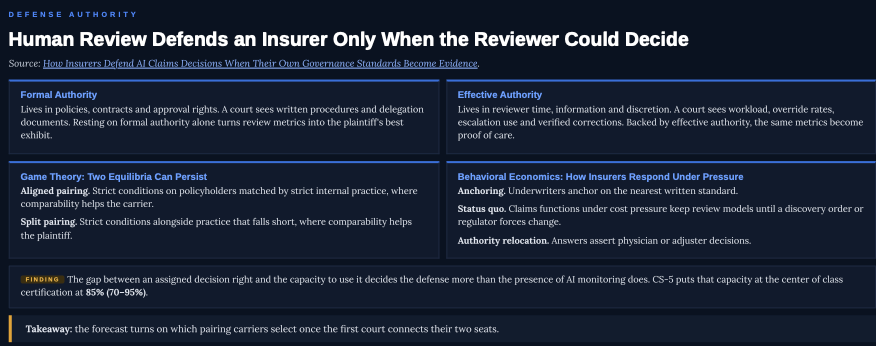
Formal authority lives in policies, contracts and approval rights. A court sees written procedures and delegation documents.
Effective authority lives in reviewer time, information and discretion. A court sees workload and override rates, escalation use and verified corrections.
The distinction decides how review evidence lands. A human-decision defense that rests on formal authority alone turns review metrics into the plaintiff’s best exhibit. Backed by effective authority, the same metrics become proof of care.
Architecture does not close the gap on its own. BCG’s process blueprint can assign a human decision right in the design itself, but the design does not guarantee the capacity to use it. The distance between the assigned right and that capacity decides the defense more than the presence of AI monitoring does.
Professional firms face the same test. A consulting firm, systems integrator or audit firm that runs agents for clients defends them only where its own reviewers could intervene, and How Consulting and Audit Firms Become Liable for the AI Agents They Run for Clients develops that case.
Source: The Insurance Carrier’s Second Seat Value Proposition
Takeaway. Whether the reviewer works for a carrier, an audit firm or an integrator, the defense rests on evidence that the human could decide.
E. Proven Fixes and Consistent Positions Are the Strongest Defenses
An auditable AI system gives the carrier more control and more exposure at once. The audit trail improves operational control, but it also documents what the carrier knew about any uncorrected risk. Actual knowledge, constructive notice, foreseeability and contractual coverage conditions remain separate questions.
A shared insurance data model (an ontology) spreads that exposure across lines, because one agent’s finding reaches every agent on the same stack. Bank of America $1.2 Billion Money Laundering Penalty and the Compliance System That Knew Too Much traces the same pattern inside a bank, where a compliance system’s own findings became evidence of what the institution knew.
Federal Rule of Evidence 407 shapes how a carrier responds. A measure taken after an injury is not admissible to prove negligence, but it may be admitted for impeachment or to prove ownership, control or feasibility where disputed. A carrier that disputes who controlled a vendor’s tool, as Humana disputes owning nH Predict, can open its own later fixes as proof of control. State evidence codes follow the federal rule in varying forms.
Rule 407 limits what a later fix can prove, not whether the fix is worth making. The carrier keeps the control benefit of correction whatever evidentiary use a court later allows.
Carriers also hold a third seat, as subrogation plaintiffs. A carrier pays to defend its policyholders and later sues upstream parties to recover. An argument that a harm was unforeseeable, made in defense of the policyholder, weakens a later claim that a vendor foresaw it.
Reinsurers add a further layer of standard-setting. Treaty terms can condition a carrier’s cover on its own AI claims governance, which puts the carrier where its policyholders stand. Disputes at that layer mostly resolve in private arbitration, so the discovery pathways described above rarely reach them.
Reinsurers may also be holding back on agent liability as a deliberate position. A treaty needs a defined peril and a loss allocation the reinsurer can follow, yet the agent layer supplies neither while four doctrines compete and no court has applied one to an agent. Waiting pays as long as it cuts the risk of committing to the wrong rule by more than delay costs in lost business and position. MindCast models the wait as the rational strategy under current uncertainty, as an analytical hypothesis rather than a verified market-wide decision.
Holding back on new capacity is not withdrawal. Reinsurers already carry indirect AI exposure through existing casualty treaties, and Howden Re expects January 2027 renewals to bring generative and agentic AI exclusions across general liability lines. Exclusions limit deliberate underwriting, while residual exposure stays embedded in contracts already written. A first reasoned ruling applying a common-law doctrine to an agent would open a new underwriting decision point, but coverage wording, aggregation and capital terms would still decide whether reinsurers enter.
Loss can also accumulate from a single vendor. naviHealth built nH Predict, Optum acquired naviHealth in 2020, and plaintiffs allege that both UnitedHealth and Humana used the tool. The table traces the chain from the vendor to the capital above the carriers and adds no new bands.
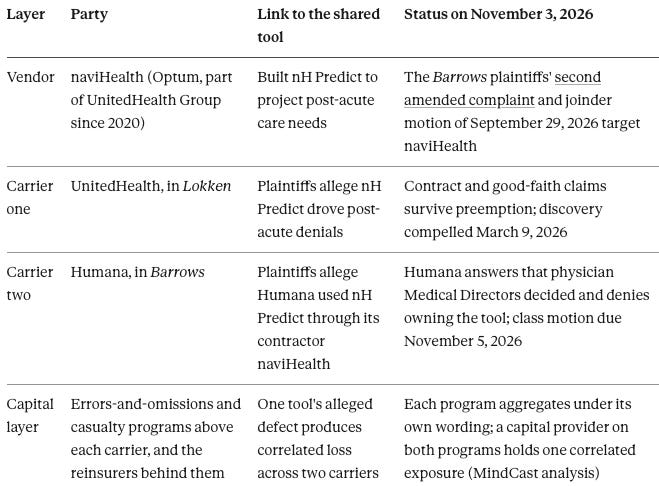
A buyer’s first accumulation question therefore runs through the vendor rather than the carrier. Any capital provider on both carriers’ programs holds one correlated exposure, and the two suits that test it also resolve CS-5 below and the plaintiff-side forecast CS-6. Howden Re’s casualty leaders make the same structural point for widely used models.
Distribution produces a second chain. One AI platform hosting many carriers’ quoting tools links their misstatement exposure the same way one claims tool links their denials.
Takeaway. A carrier gains most from fixes it can prove and positions it can hold across seats, because its audit trail, its subrogation claims and its reinsurers all read the same evidence.
F. Behavioral Economics Predicts How Insurers Respond Under Pressure
Behavioral economics supplies the decision rules that carriers, defendants and reinsurers follow under pressure. Each rule below names the evidence that would support or defeat it.
Underwriters anchor on the nearest written standard. Supported if renewal questionnaires converge on standard-form and regulator language. Defeated if questionnaires diverge sharply by line and carrier.
Claims functions under cost pressure keep the status quo until forced. Supported if review models stay unchanged until a discovery order or regulator action. Defeated if carriers raise review intensity on their own.
Defendants relocate authority to a named human. Supported if answers assert physician or adjuster decisions. Defeated if defendants defend validated tool accuracy instead.
Reinsurers wait out an undetermined doctrine. Supported if January 2027 treaty renewals add agent-liability exclusions or sublimits while casualty capacity continues. Defeated if a treaty reinsurer publishes affirmative agent-liability capacity before any court applies a common-law doctrine to an agent.
Takeaway. All four rules can be checked against forms, filings and disclosures within the forecast window, so the behavioral model stands or falls on observable conduct.
G. Game Theory Explains Why Strict Conditions Raise the Cost of Weak Practice
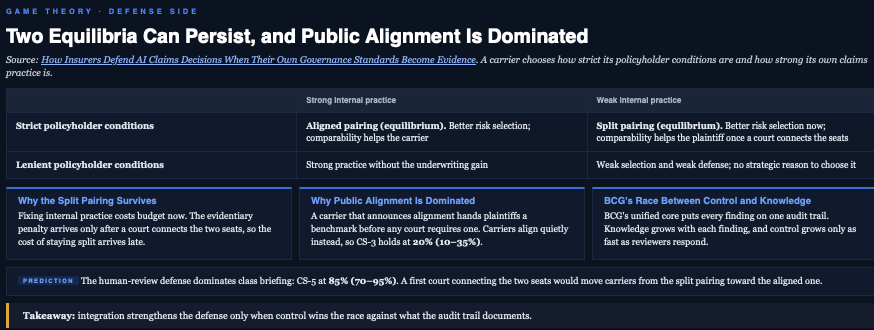
Game theory supplies the payoff structure and equilibrium selection. A carrier that writes strict governance conditions improves risk selection and premium adequacy, but it also raises the evidentiary cost of weaker internal practice. Two pairings can persist as a result: strict conditions matched by strict internal practice, or strict conditions alongside practice that falls short.
BCG’s white paper “Your Agents Are Ready. Is Your Insurer?” (June 2026) describes the coverage gap as a data architecture problem: actuarial seasoning takes years, while deployed models turn over faster. The Calculus of Predictive Game Theory Evolution and Mutation reads the same gap as a horizon problem. The calculus matters here because carriers can act on near-term foresight while loss history accumulates.
Takeaway. The forecast turns on which pairing carriers select once the first court connects their two seats.
H. Integration Helps Only If It Builds Control Faster Than Evidence
The defense-side simulation uses the same Cognitive Digital Twins (CDTs), the simulated institutional actors, as the plaintiff-side paper. Here the CDTs carry the decisive cross-pressures. The property and casualty carrier runs as two capacities, underwriter and deployer, while the health insurer runs as defendant and as delegator to its vendor. A professional-services provider and its professional-indemnity insurer join where carriers outsource AI claims work.
Integration of underwriting and claims governance can cut either way. Tighter integration can improve control and produce proven fixes, which strengthens the defense. Or integration can expand shared knowledge faster than the carrier’s capacity to respond, which raises exposure for what the carrier knew. A third outcome leaves conduct unchanged and widens only what courts can see.
MindCast’s reading favors the third outcome through 2027: discovery reaches carrier records before carriers can publicly document working fixes. IN-1 in Section III states the reading without a band.
Takeaway. Integration pays off only for a carrier that fixes problems faster than its audit trail documents them.
I. Insurers Defend Under Stable Rules Through 2027
Carriers defend under the same claims-handling rules that plaintiffs use against them. Three defense-side events changed strategy or contract terms without changing those rules.
Humana amended answer, August 26, 2026. The defense settled on human authority rather than tool accuracy. Same rules, new strategy.
ISO generative-AI exclusions, January 2026. Carriers gained optional forms to narrow cover. Same rules, new contract terms where carriers adopt the forms.
Affirmative AI cover in professional lines, 2025 to 2026. Counterpart and Hiscox affirmed AI cover in professional and technology liability forms. Same rules, new contract terms. Hiscox’s April 2025 UK technology wording defines AI agents and affirmatively addresses claims arising from them, subject to its insuring agreement and exclusions.
MindCast classes all three as equilibrium migrations, meaning each changed which defense or contract term persists without changing the rules themselves. The umbrella paper’s scenario tree puts regulator-led alignment without a public statement at 15%, which is why CS-3 stays low.
Each forecast event moves the defense to a new stage. Verified correction by the carrier opens a stage where the plaintiff must show remaining substantive failure, while nominal review opens one where workload and override evidence decide. In professional liability, cover for agents already exists without a governance condition. The next forecast set tests whether cover moves to a documented-governance condition or whether exclusions spread instead.
Only a binding act that replaces claims-handling duties or professional obligations would change the rules themselves, and no such act is pending inside the window.
Takeaway. Because the rules hold still through 2027, the decisive defense moves change the evidence a carrier can show rather than the law it answers to.
J. Reinsurance Terms Decide How Much of the Second Seat the Carrier Keeps
Class certification tests the carrier’s reinsurance as well as its defense. A certified class concentrates many AI-assisted denials into one dispute, and treaty aggregation wording decides whether the loss meets one retention or many. Courts still contest that wording, and the English High Court read “event” causally in a multi-line treaty in April 2026.
The human-review defense carries a tension of its own. A claim that each denial turned on an individual physician’s judgment denies one common cause, which helps defeat class certification. Yet the same argument can work against a carrier that needs aggregation to reach its excess layers, so coverage and reinsurance positions need to be set together before the class opposition is filed.
The reinsurer’s wait adds a second pressure. January 2027 renewals may add agent-liability exclusions that leave carriers holding agentic exposure their policyholders bought. A carrier that documents reviewer capacity and decision ownership gives treaty underwriters the evidence they lack, which lowers the cost of capacity once reinsurers enter.
Source: The Insurance Carrier’s Second Seat Value Proposition
Takeaway. The human-review defense and the carrier’s reinsurance position must be aligned, because the argument that defeats a class can also strand a loss below the treaty.
K. Each Body of Law Offers the Carrier a Different Defense
The algorithm layer gives carriers defenses that courts have already tested in the four AI claims suits. Courts accepted some and narrowed others, and the pattern shows where defense effort pays.
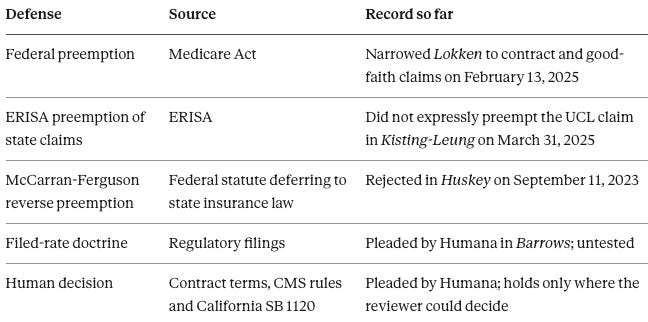
The agent layer offers defenses that statute has already begun to narrow. California Civil Code § 1714.46 removes the autonomy defense, so a superseding-cause argument must rest on a harm type the carrier never documented. Apparent authority binds the carrier to what its claims agent appeared allowed to do, and revoking the agent’s permissions protects the carrier only once claimants know. Shared control helps where a vendor held part of the stack, and Colorado SB 26-189 will allocate that share by comparative fault from January 1, 2027.
Distribution agents test apparent authority first. A quoting agent that misstates coverage can bind the carrier to what the buyer reasonably believed, and in Moffatt v. Air Canada accurate text elsewhere on the website did not cure the chatbot’s error. Where the buyer’s own agent filled the application, a rescission defense turns on whether the misstatement is attributable to the buyer under the Electronic Signatures in Global and National Commerce Act (E-SIGN) § 7001(h).
Inquiring less gives the carrier no shelter. Constructive knowledge reaches whatever a reasonable inquiry would have revealed, so a carrier that skips testing still answers for the harm. The defensible position documents each finding, the precaution taken and the person with authority who decided.
Takeaway. Preemption and filed-rate defenses narrow the algorithm layer case by case, while statute has already narrowed the agent-layer defenses carriers would most want.
Conclusion to Section II. Effective review authority is the defense that survives discovery. Approval rights without reviewer capacity hand the plaintiff its exhibit. Verified correction, consistent positions and reinsurance wording then decide how much exposure stays with the carrier.
III. MindCast Simulation Predictions — The Human-Review Defense Dominates and Public Alignment Lags
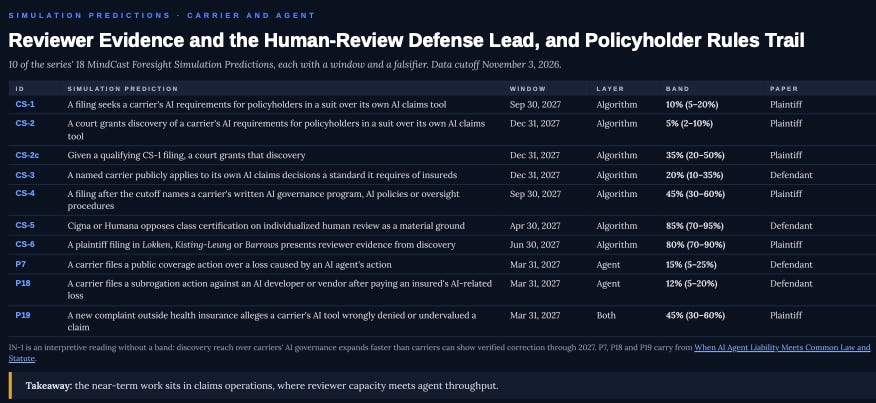
Four forecasts carry bands here alongside one interpretive reading, with a data cutoff of November 3, 2026. CS-3 and CS-5 come from the simulation, and IN-1 is the interpretive reading. P7 and P18 keep the identifiers they carry in When AI Agent Liability Meets Common Law and Statute and have not yet resolved.
Three explanations compete before any result:
Explanation 1. Integration builds control and proven fixes, which strengthens the insurer’s defense. Falsified if no insurer can show documented, working fixes for flagged AI decisions by December 31, 2027.
Explanation 2. Integration builds shared knowledge faster than capacity to respond, which raises the insurer’s exposure. Falsified if courts decline to treat integrated audit trails as evidence of what the insurer knew.
Explanation 3. Discovery reach over carriers’ AI governance expands faster than carriers can show verified correction. Falsified by public evidence of verified correction outrunning discovery.
The simulation favors Explanation 3 through 2027, stated as IN-1 below.
III.A Two Primary Insurance Carrier Forecasts and One Interpretive Reading
Two forecasts come from the simulation, and one interpretive reading carries no band. Each forecast names an actor and an outcome, then gives a window, a band and a falsifier.
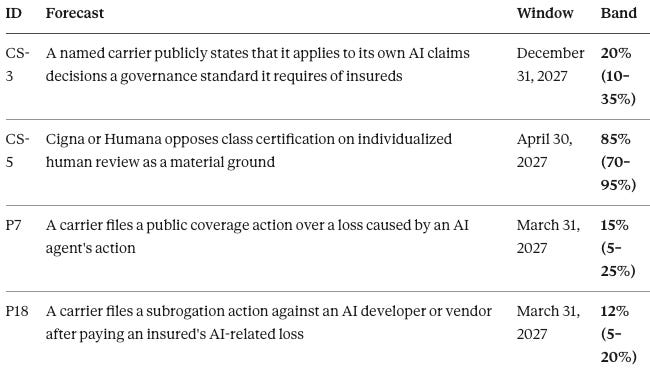
CS-3. A named insurer publicly states it holds its own AI claims decisions to the standard it requires of policyholders by December 31, 2027: 20% (10–35%).
Forecast statement: A named U.S. carrier publicly states that it applies to its own AI-assisted claims decisions a review or governance standard it requires of insureds, or revises an insured-facing AI condition with a stated reference to its own practice. The forecast concerns publicly observable adaptation and does not attribute its cause.
Confidence band: 20% (10–35%)
Time window: November 3, 2026 through December 31, 2027.
Trigger conditions: A CS-1 filing against a peer carrier; a regulator bulletin on AI claims review; an AI-insurance product launch.
Qualifying event: A public statement in a filing, earnings call, regulatory submission or published policy.
Explicit falsifier: No qualifying public statement by December 31, 2027. Undisclosed internal changes do not count.
Verification source: Carrier filings, earnings transcripts and state insurance department releases.
Stakeholder exposure: Carrier executives, chief claims officers and investors.
Monitoring signal: Quarterly review of carrier disclosures on AI claims tools.
CS-5. Cigna or Humana opposes class certification on individualized human review by April 30, 2027: 85% (70–95%).
Forecast statement: Cigna in Kisting-Leung or Humana in Barrows files a class-certification opposition that uses individualized physician or human review as a material ground for defeating certification.
Confidence band: 85% (70–95%)
Time window: November 3, 2026 through April 30, 2027.
Trigger conditions: The human-decision defense in each answer. In Kisting-Leung Cigna’s opposition is due January 11, 2027. Humana’s opposition follows the Barrows plaintiffs’ motion due November 5, 2026.
Qualifying event: A filed opposition that argues individualized review defeats commonality or predominance.
Explicit falsifier: No qualifying opposition by April 30, 2027.
Verification source: Kisting-Leung and Barrows dockets.
Stakeholder exposure: Health insurer legal functions; investors.
Monitoring signal: Class-certification briefing schedules.
IN-1. Interpretive reading through 2027 (no band): discovery reach expands faster than insurers can show working fixes. Through December 31, 2027 the contest evolves inside existing claims-handling doctrine: discovery reach over carriers’ AI governance expands faster than carriers can show verified correction, and no binding order or rule changes the substantive duty. The reading carries no band and rests on the simulation’s causal ranking rather than a measured rate. Public evidence of verified correction outrunning discovery would contradict it.
Takeaway. The human-review defense is the likely class-briefing position, while public alignment of the two seats stays unlikely.
III.B Carried Forecasts — Subrogation and Coverage Actions
Two forecasts carry over from the companion work on agent liability under their original identifiers and bands, and both track whether carriers sue over agent losses.
P7. A carrier files a public coverage action over a loss caused by an AI agent’s action by March 31, 2027 (15%; range 5–25%). Falsifier: no qualifying coverage action by March 31, 2027.
P18. A carrier files a subrogation action against an AI developer or vendor after paying an insured’s AI-related loss by March 31, 2027 (12%; range 5–20%). Falsifier: no qualifying action by March 31, 2027.
Takeaway. Coverage and subrogation actions over agent losses stay unlikely before the first reasoned ruling on agent liability.
III.C Three Questions Without a Band
Three questions shape the defense but carry no band.
Alignment source. CS-3 resolves on the public statement alone, yet three sources of alignment sit behind it: litigation, regulators and voluntary action that precedes either.
Health review intensity. A health insurer moves from sampling-based review to individual review of every adverse AI-assisted decision, beyond what applicable rules require, after a discovery order or regulator action. The condition carries no band because no review baseline exists.
Confidential alignment. Confidential exams can produce alignment before any public statement, and the simulation expects regulator-led alignment to stay out of public view. The mechanism stays qualitative without a band.
Takeaway. Alignment can arrive through litigation, regulators or voluntary action, and only the public route resolves CS-3.
III.D Three Developments Would Break the Forecasts
Three developments would break the forecasts. Courts could confine all AI claims discovery to claim files, which removes the pressure to align. Leading suits could resolve before class rulings, which ends the public test of the human-decision defense. A preemption ruling could remove state claims-handling causes of action for a class of carriers.
Takeaway. The defense-side forecasts track public adaptation and whether the human-review defense survives discovery.
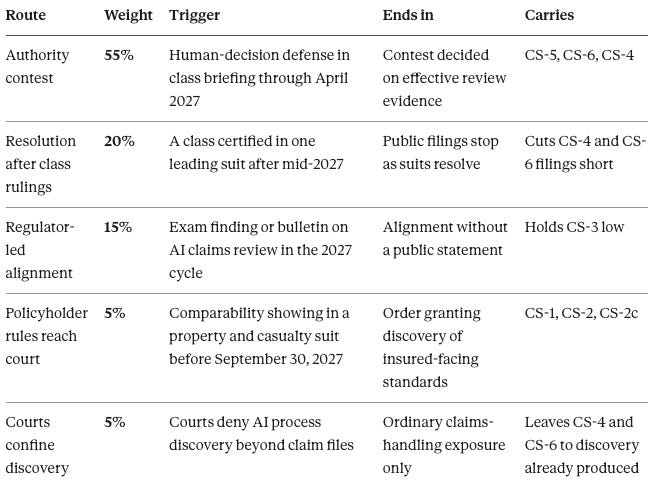
III.E Five Routes Branch From the Human-Review Defense
Five routes branch from the current state. The simulation weights five routes from today’s human-review defense. Each route names its trigger, its end state and the forecasts it carries. The routes are exclusive end states of the algorithm layer weighted in the November 3, 2026 run, and bands attach to individual forecasts.
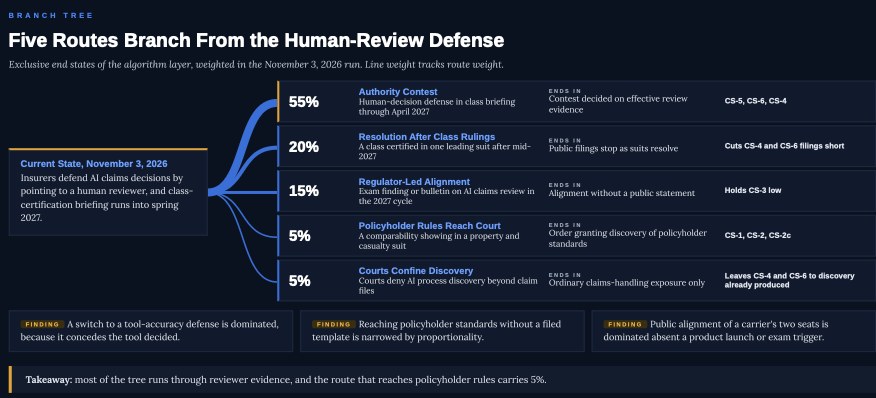
Source: The Insurance Carrier’s Second Seat Value Proposition
Three forks inside the window carry the five event entries. Each fork states what changes and which paths open or close, then which positions shift and which forecasts apply once it occurs.
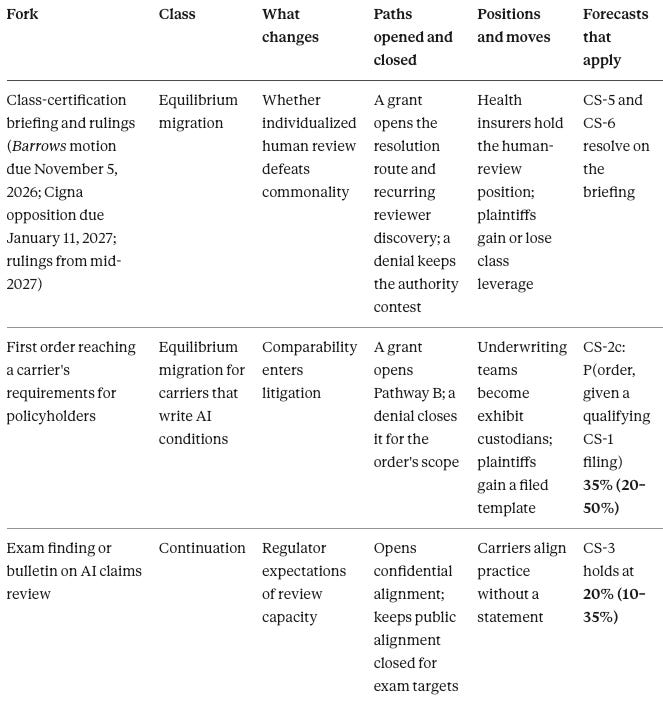
Each forecast stays valid while its route’s survival conditions hold. The authority contest survives while discovery stays within carriers’ own tools and programs, and it breaks if the leading suits resolve before class rulings.
Three structural events would void the tree, and the series would restate its forecasts on the new state. Those events are a binding act changing the claims-handling duty for AI decisions, an appellate ruling that bars or mandates AI process discovery or a preemption ruling that removes state claims for a class of carriers. The first reasoned ruling applying a common-law doctrine to an AI agent leaves the tree standing and reopens P7 and P18.
Takeaway. Through 2027 the contest turns on whether a human reviewer could decide, not on what the insurer required of policyholders.
Conclusion to Section III. The defense-side forecasts favor the human-review defense, with CS-5 at 85% (70–95%). Public alignment lags at 20% (10–35%) for CS-3 because confidential exams absorb the pressure. Discovery reach expands faster than verified correction through 2027.
IV. Architecture Choices Decide Who Bears the Evidence
Architecture choices decide which evidence a carrier produces and who bears it. Once discovery reaches review metrics, the contest moves from describing human review to proving it. Core architectures differ in the evidence they create, and value flows to carriers whose two seats match.
A. Discovery of Review Metrics Moves the Contest to Proof
A discovery order on review metrics would shift the question from whether a human reviewed to whether the review was real. Courts would weigh workload and override evidence against written procedures, and regulators would gain a template for exam questions on reviewer capacity.
Takeaway. A carrier that can only describe its human review loses ground once a court asks it to prove the review.
B. Three Core Architectures Carry Different Evidence Profiles
Carrier architecture decisions change once audit trails, decision rights and corrective duties affect liability allocation. BCG’s October 2026 core-modernization research names three configurations, and each row below states a comparative tendency of the design rather than a guaranteed outcome:
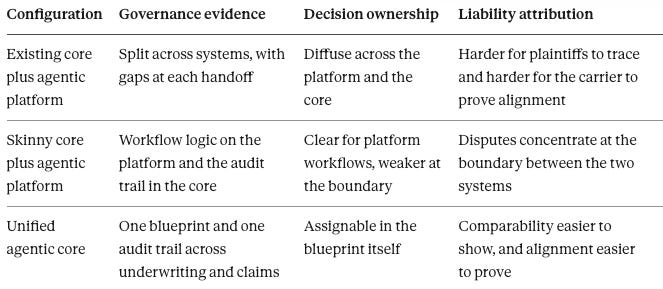
Implementation can override the category. A legacy core with strong integration can keep good traceability, and a unified core can still leave decision ownership unclear. Governance design distinguishes carriers as much as architecture type does.
The unified agentic core helps and hurts the carrier at once. A single blueprint lets a carrier prove alignment where internal practice matches its external conditions, but the same blueprint gives a plaintiff one place to look when practice falls short.
Decision ownership therefore becomes an architecture requirement. Each automated decision class needs a named owner, a review entry, a correction path and reviewer capacity written into the blueprint. A blueprint that grants formal authority without effective capacity in operations reproduces the gap plaintiffs target.
Aligned carriers still face scrutiny, because plaintiffs shift to process failures inside the stated standard. Documented alignment shows consistent governance, yet implementation failures stay independently discoverable. Rule 407 limits later fixes as proof of negligence, so a carrier weighs alignment on its operational value rather than its evidentiary effect.
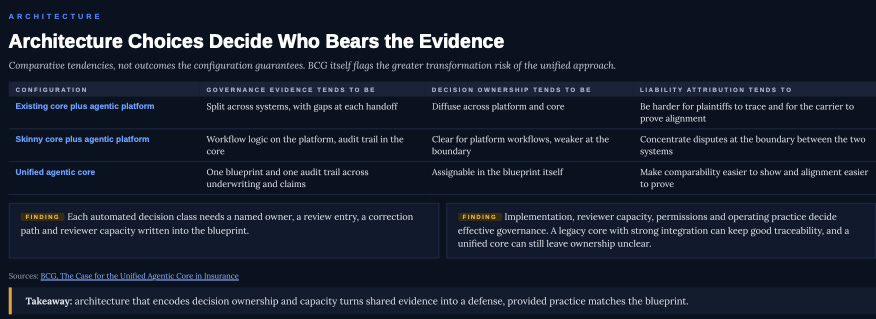
Source: The Insurance Carrier’s Second Seat Value Proposition
Takeaway. Architecture that encodes decision ownership and capacity can turn shared evidence into a defense, provided practice matches the blueprint.
C. Value Flows to Insurers Whose Two Seats Match
Aligned carriers capture the benefit of strict external conditions without the evidentiary cost. Carriers with divergent practice absorb discovery cost and resolution pressure instead. Policyholders gain where carriers revise conditions to match what the carriers themselves can meet.
Takeaway. Matching the two seats turns strict policyholder conditions from an evidentiary liability into an underwriting advantage.
D. A Failed Forecast Redirects the Move
If no carrier announces aligned standards by December 31, 2027 (CS-3) while litigation advances, carriers are either aligning without disclosure or holding their divergence. Regulators then become the actor best placed to make alignment visible. If CS-5 resolves true and the defense still fails in discovery, carriers should weight reviewer capacity over procedural documentation.
Takeaway. A miss on CS-3 or CS-5 changes who should act next, not the mechanism behind the forecast.
Conclusion to Section IV. Architecture that encodes decision ownership turns review metrics into proof of care. A carrier whose internal practice matches its policyholder conditions gains from strict external rules rather than paying for them in discovery.
V. What Each Stakeholder Should Do and What Exposure Remains
The stakeholder strategy turns the defense-side forecasts into moves. Each row names an objective, a low-regret move, a trigger-dependent move and the primary risk.
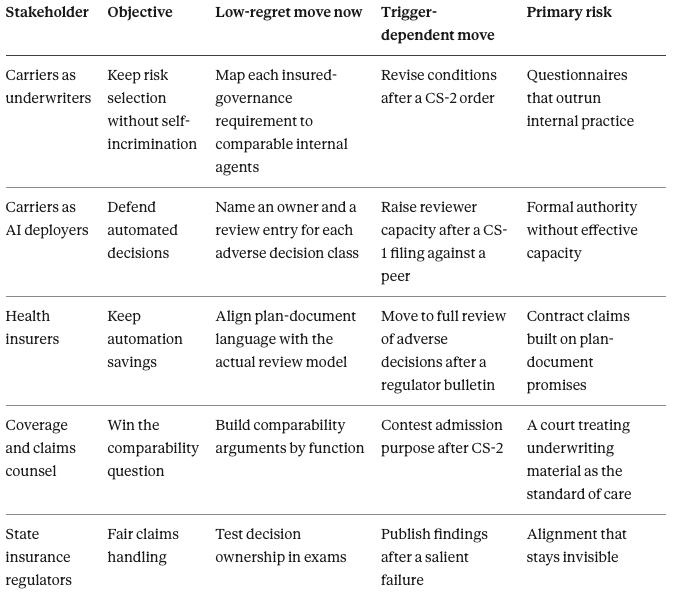
Risk Mitigation Entries
Each entry routes one forecast to one audience and states the exposure, two to four mitigating actions and the exposure that remains.
Entry 1. 💼 Carriers as AI deployers, P19.
Forecast and band: a new complaint outside health insurance alleges a carrier’s AI tool wrongly denied or undervalued a claim by March 31, 2027 (45%; range 30–60%). P19 sits in the plaintiff-side paper’s prediction set. Severity: high. Probability: moderate.
Exposure: adverse AI-assisted decisions lacking a dated human-review entry, measured as the share of class-period decisions a plaintiff can show received nominal review.
Mitigating actions: the claims function attaches a dated human-review entry to each adverse AI-assisted decision by January 31, 2027. Claims operations measures reviewer time and override rates per decision class by March 31, 2027. Legal aligns policy and plan-document language on who decides claims at the next form filing.
Residual exposure: decisions already issued stay discoverable.
Entry 2. 💼 Carriers as underwriters, CS-1 and CS-2.
Forecast and band: discovery activation (10% (5–20%)) and judicial discovery access (5% (2–10%)) on carrier underwriting material. Both sit in the plaintiff-side paper’s prediction set. Severity: high. Probability: low.
Exposure: the share of insured-governance requirements with no documented internal counterpart, measured as discoverable divergences per automated decision class.
Mitigating actions: underwriting and claims leadership begin mapping each AI requirement for policyholders to the carrier’s comparable internal agents now, and apply the map to the first renewal cohort it can reach. Operations names a decision owner for each adverse decision class by March 31, 2027. Legal documents each deliberate divergence with its rationale by March 31, 2027.
Residual exposure: a court, not the carrier, decides comparability.
Companion link: the alert-ownership mapping also reduces exposure under P7 in Entry 4; credit claimed here once.
Entry 3. 💼 Carriers as plaintiffs, P18.
Forecast and band: a carrier files a subrogation action against an AI developer or vendor by March 31, 2027 (12%; range 5–20%). Severity: medium. Probability: low.
Exposure: paid AI-related losses the carrier cannot recover, measured in points of loss ratio on the affected book.
Mitigating actions: underwriting requests each insured’s AI vendor contract terms at every renewal from December 1, 2026. The claims function sends subrogation notice within 30 days of each AI-related claim. Coverage counsel checks defense positions on foreseeability against open subrogation theories before filing either brief.
Residual exposure: caps and waivers signed before the policy incepted bind the carrier.
Entry 4. ⚖️ Coverage counsel, P7.
Forecast and band: a carrier files a public coverage action over a loss caused by an AI agent’s action by March 31, 2027 (15%; range 5–25%). Severity: high. Probability: low.
Exposure: defense spend on the first coverage action plus silent exposure measured in aggregate limits per model vendor.
Mitigating actions: coverage counsel reviews reservation-of-rights wording before the first agentic claim tender. Underwriting adds questions on alert ownership, log retention and agent decommissioning at each renewal from December 1, 2026. Reinsurance buyers model one correlated loss scenario before the January 1, 2027 treaty renewal.
Constraint: each carrier decides its wording unilaterally and draws on standard forms, which keeps the move clear of competitor coordination.
Residual exposure: number-of-occurrences disputes remain open until courts rule.
Entry 5. 🏛️ State insurance regulators, CS-3.
Forecast and band: CS-3 (20% (10–35%)). Severity: medium. Probability: low.
Exposure: exam findings that never reach peer carriers, measured in exam cycles before a published finding.
Mitigating actions: market-conduct staff add AI decision-ownership and reviewer-capacity questions to exam templates by June 30, 2027. The department publishes aggregate AI exam findings without naming carriers at the close of the 2027 exam cycle.
Residual exposure: carrier-specific remediation stays confidential.
Entry 6. 💼 Carriers as reinsurance buyers, CS-5.
Forecast and band: CS-5 (85% (70–95%)). Severity: high. Probability: high.
Exposure: aggregation disputes over a certified class, measured in retentions the carrier absorbs before treaty layers attach.
Mitigating actions: reinsurance buyers model one certified-class scenario under current aggregation wording before the January 1, 2027 renewal. Claims leadership documents reviewer capacity and decision ownership for treaty underwriters by the same date. Coverage counsel tests the individualized-review defense against the carrier’s aggregation position before the class opposition is filed.
Residual exposure: aggregation wording stays contested until a court construes it for AI claims.
Placement. The entries sit as a standalone section. Entries 1 and 2 route the plaintiff-side paper’s forecasts to carriers, which keeps each entry in the audience’s decision vocabulary. A front matrix would serve executives who read only Section I but separate actions from their mechanisms.
Now to 30 days. Attach dated human-review entries to adverse AI decisions. Escalate on a CS-1 filing against a peer insurer.
30 to 90 days. Measure reviewer time and override rates so formal authority is backed by capacity. Escalate when a human-decision defense is tested in discovery.
3 to 12 months. Map policyholder conditions against internal practice and name decision owners. Escalate on a CS-2 order.
Beyond 12 months. Align internal and external standards before a ruling admits underwriting material on the standard of care. Escalate on an order reaching the insurer’s AI requirements for policyholders.
Takeaway. The low-regret move for carriers is building effective review capacity and aligning internal practice with the conditions they impose.
What to Watch — The 2027 Class-Certification Rulings Decide the Defense
The dominant fork is the 2027 class-certification rulings in Kisting-Leung and Barrows. A ruling that accepts individualized human review protects the defense; a ruling that rejects it makes reviewer capacity the central exhibit across carriers. The rulings themselves fall outside this forecast set.
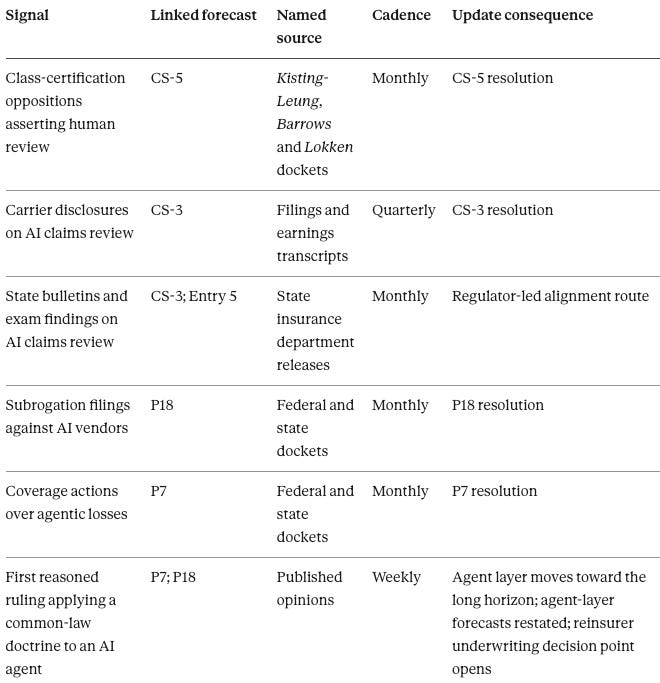
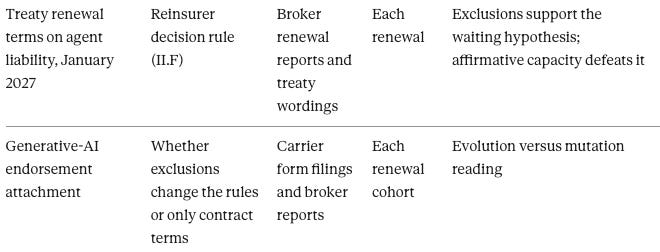
Takeaway. The class-certification dockets carry the decisive signals, and treaty renewals in January 2027 show whether reinsurers keep waiting.
Conclusion — Human Review Defends Only When the Human Could Decide
The defense moves from tool accuracy toward human authority, and the carrier keeps the loss unless reviewer capacity, vendor contracts and treaty wording move it elsewhere.
Carriers hold two seats, and the evidence they demand in one can reach them in the other. The defense already in court rests on human review, which defends only when the evidence shows the human could decide.
Carriers should build effective review capacity and align internal AI claims practice with the conditions they impose before a court tests the gap. The decisive signal is the first discovery order that reaches review metrics or the carrier’s AI requirements for policyholders in a suit over its own AI claims tool.
Working With MindCast
A carrier’s defense turns on two facts it can check today: whether its reviewers could decide and whether its claims practice matches the conditions it imposes on policyholders. Both facts sit inside the carrier, and both reach discovery once an answer asserts a human decision. MindCast builds Cognitive Digital Twins (CDTs) of the courts, regulators and plaintiffs the carrier faces and simulates which defense holds on each of the five routes.
A complimentary pilot comes first. Inputs are public filings, the carrier’s underwriting questionnaire and one anonymized claims workflow shared under a mutual nondisclosure agreement. The pilot delivers a reviewer-capacity map, a comparability map for the workflow’s decision classes and banded forecasts with windows and falsifiers. Delivery lands before Cigna’s January 11, 2027 class-certification opposition, the first test of CS-5.
Retained engagements follow the decision each stakeholder faces.
💼 Carriers. A two-seat alignment audit compares the conditions imposed on policyholders with internal claims practice before the 2027 class rulings, keyed to CS-3 and CS-5.
⚖️ Defense and coverage counsel. A defense war game tests the human-review, filed-rate and proportionality defenses against each pathway plaintiffs can open.
💼 Claims and technology leaders. An architecture evidence review writes decision ownership, review entries and correction paths into the core blueprint before go-live.
📊 Reinsurers and Investors. An aggregation review tests whether the individualized-review defense strands a certified-class loss below the treaty retention.
🏛️ Regulators. An exam war game tests review-capacity questions ahead of the 2027 exam cycle.
The MindCast Predictive Game Theory Simulation of Mixed Time Horizon Insurance Carrier Second Seat Exposuredetails each engagement. Each forecast in this series resolves on the MindCast Prediction Scorecard. Contact mcai@mindcast-ai.com to scope a pilot, or see predictive game theory simulations at www.mindcast-ai-simulation.com.
Appendix A. Selected MindCast Works
The series rests principally on four works: When AI Agent Liability Meets Common Law and Statute, Agentic Foreseeability and the Modern Duty of Care for AI Agents, Who Writes AI Insurance Coverage Conditions and The Calculus of Predictive Game Theory Evolution and Mutation. The remaining works support specific mechanisms.
Tier 1. Core — Liability, Coverage and Capital
1. When AI Agent Liability Meets Common Law and Statute — Predictable Doctrines, Unsettled Allocation(November 3, 2026) Relevance: The anchor work supplies the four doctrines that structure liability allocation once agents act. The paper’s foreseeability paradox shows how an unanswered auditable finding can support an inference of notice in tort and bear on prior-knowledge provisions in coverage. P18 (subrogation at 12%) and P19 (carrier AI tools challenged outside health insurance, 45%) give the carrier-facing forecasts, under their published identifiers.
2. Agentic Foreseeability and the Modern Duty of Care for AI Agents (October 29, 2026) Relevance: Supplies the foreseeability test that decides what a deployer should have known once its agents act. The paper shows how courts can find foreseeability from evaluation results before loss data accumulates.
3. Who Writes AI Insurance Coverage Conditions — Procurement, Enforcement Decrees, Partner Terms and the Two-Axis Condition (October 30, 2026) Relevance: Names who supplies the evidence that makes coverage conditions writable: procurement, consent decrees and partner terms. The analysis complements BCG’s case for narrow first-generation products.
4. Who Absorbs Correlated AI Loss — Reinsurance Aggregation, Industry Pools, the Public Backstop and the Liability Shield (October 30, 2026) Relevance: Examines pooled capacity and public backstops, including levy-funded pools of the Flood Re type that BCG’s June 2026 white paper proposes. The paper argues that corrective duties should accompany public support. The paper’s number-of-occurrences analysis bears on correlated AI loss.
5. FTC Investigation of Anthropic and OpenAI — State Subpoenas Came First, and the Theory of Harm Decides the First Federal Order on Frontier Model Safety (October 31, 2026) Relevance: Sets out the federal enforcement baseline. A coverage condition written before any order becomes the market term the order later confirms, so carriers move ahead of the regulator.
6. OpenAI State Attorney General Lawsuits — Two Pleading Templates Across Ten State Courts (October 30, 2026) Relevance: Shows the state enforcement channel moving without a federal order or an insurance market. Liability reaches AI developers through consumer law before any coverage dispute.
Tier 2. Foresight-to-Duty Conversion Series
7. Foresight-to-Duty Conversion in AI Governance, Series Introduction (October 24, 2026) Relevance: States the governing question behind this paper: when an institution knows, what makes it act and what establishes that the correction worked.
8. Who Sets the Agentic Standard of Care — Common Law, State Legislation and Federal Coordination (October 30, 2026) Relevance: Answers which institution writes the agentic standard of care that carriers apply at renewal. Courts, legislatures and federal coordination compete for the role, and carriers borrow whichever standard arrives first.
9. Consent Order Remedies at Meta, Boeing, Starling and Wells Fargo — Verified Correction Versus Recurrence(October 24, 2026) Relevance: Supplies the verified-correction test behind answerable monitoring. The Unified Agentic Core article embeds human-in-the-loop gates, and the paper shows that gates without verified correction produce recurrence rather than care.
10. Meta and Bank of America Foresight-to-Duty Conversion — Revenue-Funded Versus Cost-Funded Deferral(October 24, 2026) Relevance: Explains why institutions defer corrections their own systems measured. Carriers deploying a unified agentic core face the same deferral choice on every flagged claim decision.
11. Meta Foresight-to-Duty Conversion Across Privacy, Child Safety and Scam Ads (October 24, 2026) Relevance: Shows one platform facing several regulators at once over the same measured gaps. The case parallels a carrier’s agent fleet, where a single ontology spreads one finding across many lines of business.
12. Bank of America $1.2 Billion Money Laundering Penalty and the Compliance System That Knew Too Much (October 14, 2026) Relevance: Provides the clearest precedent for imputed knowledge from automated systems. BCG’s unified core propagates insights across agents automatically, which is the “system that knew too much” pattern applied to insurers.
Tier 3. Method and Framework
13. Predictive Game Theory Evolution and Mutation — Short Horizon Games Branch Wide and Resolve Shallow (November 3, 2026) Relevance: Uses agentic AI liability as its worked tree and shows why firms can act before deep forecasts arrive. The point supports writing bounded risks now by showing which liability terms move at which renewal.
14. The Calculus of Predictive Game Theory Evolution and Mutation (November 3, 2026) Relevance: States the governing calculus: strategic clarity can run ahead of structural certainty. BCG’s “velocity mismatch” between actuarial and model clocks is a horizon problem the calculus addresses directly.
15. Predictive Game Theory Evolution and Mutation — Long Horizon Games Resolve Deep Because Their Branches Hold (November 3, 2026) Relevance: Shows what stability adds once a game holds, using the Bank of America tree. The paper marks the conditions under which agentic coverage could graduate from narrow products to broad cover.
16. Dynamic Predictive Game Theory — From Nash Equilibrium to Adaptive Coherence Equilibrium (October 23, 2026) Relevance: Supplies equilibrium selection and delay dominance. BCG tells carriers not to wait, and delay dominance explains when waiting is rational and when it fails.
17. Predictive Game Theory Simulations Through War Gaming (November 1, 2026) Relevance: Separates Simulation Snapshots from full Foresight Simulations by the stability of the game. The distinction explains why the agentic liability work carries short-window forecasts.
18. How Mozart Predicts Game Mutation in Predictive Behavioral Economics + Dynamic Game Theory (October 11, 2026) Relevance: Frames when a structural change crosses an operative threshold, the test for whether a unified-core migration changes the rules or only the evidence carriers hold.
19. MindCast Predictive Game Theory Simulation of Mixed Time Horizon Insurance Carrier Second Seat Exposure (November 2026) Relevance: Translates the series into engagements for carriers, reinsurers, consulting and audit firms, claims vendors and counsel.
Appendix B. External Sources
Court filings
Estate of Lokken v. UnitedHealth Group, Inc., No. 23-cv-3514 (D. Minn.), Order on Motion to Compel Discovery(March 9, 2026).
Estate of Lokken v. UnitedHealth Group, Inc., Memorandum Opinion and Order on Motion to Dismiss (February 13, 2025), dismissing five of seven counts and allowing the breach of contract and implied covenant claims to proceed.
Barrows v. Humana Inc., No. 3:23-cv-00654 (W.D. Ky.), Amended Answer (August 26, 2026), Scheduling Order(July 17, 2026) and Scheduling Order (October 15, 2026; class-certification motion due November 5, 2026).
Kisting-Leung v. Cigna Corp., No. 2:23-cv-01477 (E.D. Cal.), Joint Stipulation (August 24, 2026), and Minute Order (August 26, 2026).
Huskey v. State Farm Fire & Casualty Co., No. 1:22-cv-07014 (N.D. Ill.), case summary and docket, Civil Rights Litigation Clearinghouse.
Law360, “Cigna Patients Seek Hefty Class In Cigna Auto Denials Suit” (October 30, 2026).
Barrows v. Humana Inc., Health Care Litigation Tracker case page, Georgetown Law.
Industry research (Boston Consulting Group): primary
“The Case for the Unified Agentic Core in Insurance” (October 21, 2026), Fabrizio Pessina, Roberto Bosisio, Nicolás López Polo, Christoph Fritsch, Nicolas Guglielmi and Riccardo Pallozzi.
“Your Agents Are Ready. Is Your Insurer?” (June 2026), Raphael Troitzsch, Nadine Moore and Coralie Ming. White paper, announced on BCG’s insurance LinkedIn page; no stable public URL.
“Always-On Portfolio Management: How Agentic AI Can Give a Lasting Edge to Commercial P&C Insurers”(June 30, 2026), Erdem Altay, Semih Durmus, Nadine Moore, Michael Schachtner and Victor Zhou.
Industry research (Boston Consulting Group): supporting
“How Agentic AI Can Power Core Insurance IT Modernization” (January 12, 2026), Fabrizio Pessina, Roberto Bosisio, Nicolás López Polo, Christoph Fritsch and Nicolas Guglielmi.
“Agentic AI’s Advantage for Health Insurers: Faster Decisions, Lower Costs, Better Care” (September 4, 2026), Konstantin Storms, Juliane Burgdorf, Matthias Becker, Swayamjit Mishra, Alessandra Catozzella and Kazim Zaidi.
“Are Insurers’ Talent Models Ready for AI?” (July 22, 2026), Nathalia Bellizia, Isabelle Cox, Megan Mirabella and Nadine Moore.
Rules, regulation and standard forms
NAIC, “Implementation of NAIC Model Bulletin: Use of Artificial Intelligence Systems by Insurers”.
Cozen O’Connor, “Claims Notes: October 2026” (October 19, 2026), reporting 29 adopting jurisdictions.
Gallagher, “ISO Introduces Generative AI Exclusion in Commercial General Liability Policies: What Construction Companies Should Know” (May 28, 2026), naming ISO endorsement CG 40 47 01 26.
Mark Rosanes, “ISO’s Generative AI Exclusion Is Already on Thousands of CGL Policies”, Insurance Business(September 16, 2026), reporting that CG 40 47 01 26 became available for carrier attachment in January 2026 alongside CG 40 48 and CG 35 08.
Professional services and AI
EY, “EY launches enterprise-scale agentic AI to redefine the audit experience for the AI era” (April 7, 2026).
Hiscox, “Professional Indemnity for Technology Companies, Policy Wording WD-PROF-UK-TEC(2)” (April 2025).
The Insurer, “MGA Counterpart Adds Affirmative AI Cover to Professional Liability Policies” (November 24, 2025).