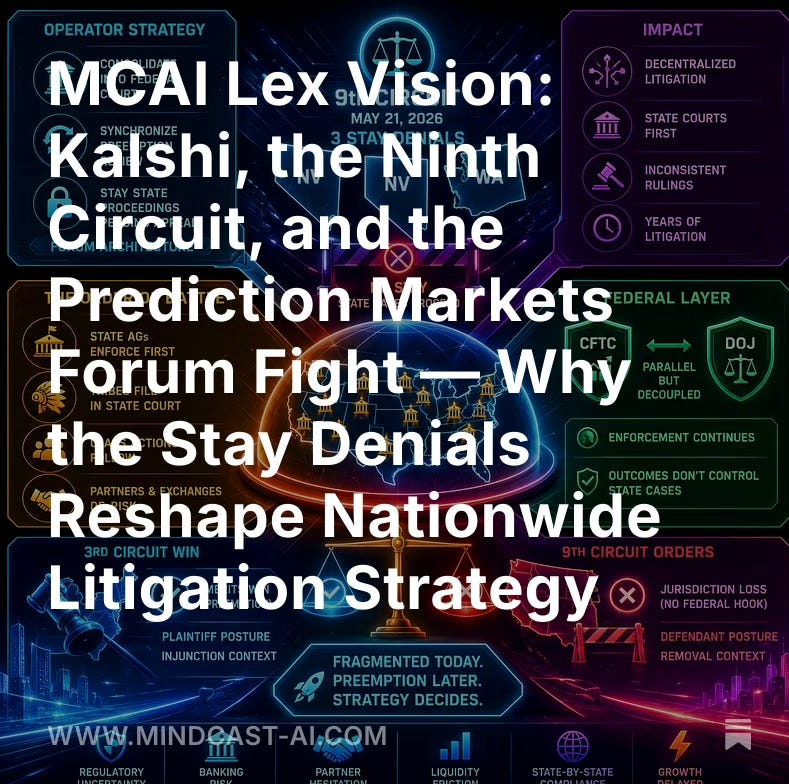

Related MindCast Series, The Prediction Markets Rule Architecture: The Prediction Markets Rule Architecture Series, A Boundary Rule with a Functional Core | The Prediction Markets Rule Architecture Series, Competitive Federalism | Kalshi Loses Federal Forum — The Washington Remand Order and the Jurisdictional Layer of the Prediction Markets Boundary Rule
I. The Forcing Event
On May 21, 2026, a single Ninth Circuit panel — Judges Ryan Nelson, Bridget Bade, and Kenneth Lee — issued three orders within hours of one another. Each denied a prediction-market operator’s motion to stay district court proceedings pending appeal. Three cases, two states, two operators, one analytical spine:
No. 26-1343 — State of Nevada ex rel. Nevada Gaming Control Board v. Blockratize, Inc. (d/b/a Polymarket), on appeal from the District of Nevada (Reno).
No. 26-1304 — State of Nevada ex rel. Nevada Gaming Control Board v. KalshiEX, LLC, on appeal from the District of Nevada (Las Vegas).
No. 26-3106 — State of Washington v. KalshiEX, LLC, on appeal from the Western District of Washington (Seattle).
A stay denial, taken alone, is an interlocutory motion ruling with little precedential weight. Three of them, released as a coordinated set by the same panel on the same day, function as something categorically different — a circuit-wide posture statement. Reading the three orders as one instrument is the analytical move that matters here.
The prior analysis in this series, Kalshi Remanded to State Court, examined Judge Coughenour’s remand order returning State of Washington v. KalshiEX to state court. The Ninth Circuit orders are the next link in that chain: the operators appealed remand and asked the circuit to freeze the proceedings; the panel refused, across two states at once. The remand piece traced the first move; this update traces the consolidation pressure that move set in motion.
The circuit picture is not one-sided, and this analysis treats it whole. Six weeks before the May 21 orders, the Third Circuit handed Kalshi a real victory in KalshiEX, LLC v. Flaherty. A later section reads the two together — and argues that the Third Circuit win, read carefully, reinforces rather than offsets the thesis below.
Strategic Bottom Line
For readers who want the conclusion before the architecture, the analysis reduces to six claims, each developed in full below.
The three orders are best read as one instrument. A coordinated same-day set from a single panel is a circuit-wide posture statement, not three routine motion denials.
The damage to Kalshi is structural, not a merits loss. The orders foreclose the consolidated federal forum Kalshi’s strategy depends on, forcing the preemption fight into state courts one jurisdiction at a time.
The orders re-sequence Kalshi’s adversaries rather than simply arming them. Ninth Circuit state attorneys general are positioned to move first; tribes and class actions are staged behind the state-court findings that enforcement will generate; competitors wait on the merits.
CFTC and DOJ action is not mooted — it is decoupled. The orders concern removal jurisdiction only. Federal authority continues on its own statutory basis, while the preemption question it turns on fragments across state courts.
This is not the circuit split that carries Kalshi to the Supreme Court. Flaherty and the May 21 orders address different legal layers — merits versus jurisdiction — and both are interlocutory. The orders raise the cost of any eventual Supreme Court path rather than opening one.
The dominant variable is not a court at all — it is a ticking regulatory clock. The CFTC’s pending rulemaking on prediction-market contracts could structurally rewrite the preemption landscape, in either direction, before the state-court tracks ever reach an appellate ruling. The agency, not the Ninth Circuit, is the actor most able to decide the outcome.
The through-line: the prediction-market fight is no longer best understood as “who wins the preemption argument.” It is “who controls procedural posture long enough to reach that argument under favorable conditions.” The May 21 orders are a decisive move in that second contest.
II. What the Operators Were Trying to Do
Begin with the alignment of the parties, because it carries the whole story. In all three captions the states sit as plaintiffs-appellees and the operators sit as defendants-appellants. Translated: Kalshi and Polymarket lost below. The district courts declined to keep these disputes in federal court — almost certainly through remand orders returning the cases to state court — and the operators appealed those rulings. While the appeals proceeded, the operators asked the Ninth Circuit to freeze the underlying proceedings. The panel refused. State enforcement under state gaming law now proceeds in real time, in state forums, while the jurisdictional appeals grind forward separately.
One distinction should be fixed at the outset, because the rest of the analysis depends on it. Kalshi and Polymarket sit together in these orders, but they do not sit on equal regulatory ground. Kalshi operates a CFTC-designated contract market and rests its preemption defense on that federally sanctioned DCM status. Polymarket’s footprint differs — historically offshore and crypto-native, shaped by a prior CFTC settlement, and without the same clean DCM designation for the contracts at issue. The removal mechanism — the jurisdictional plumbing — failed identically for both, because the Grable/Gunn federal-question analysis does not turn on DCM status. The substantive preemption defense, however, does. When this analysis discusses the strength of the merits-layer argument, it describes Kalshi’s position; Polymarket’s runs structurally weaker on the same question. The two operators share a procedural defeat, not a merits posture.
The motivation behind the stay requests is the entire operator litigation model. Kalshi’s strategy has rested on federalizingthese disputes — pulling every state challenge into federal court on the theory that Commodity Exchange Act authority and CFTC oversight of designated contract markets preempt state gaming statutes. A single consolidated federal forum, ideally producing one appellate ruling on preemption, is the architecture the strategy depends on. The stay motions were the mechanism for holding that architecture together while the appeals ran.
Forum architecture, used precisely, refers to three linked capabilities the operators need in combination: the ability to consolidate state enforcement disputes into a unified federal adjudicatory structure; the ability to obtain synchronized preemption review, so the federal question is answered once rather than fifty times; and the ability to freeze parallel state proceedings through stays pending appeal while that review runs. The three capabilities are interdependent — consolidation without a stay still leaves state courts moving, and a stay without synchronized review only delays fragmentation. The coordinated denials impair all three at once. That simultaneity is why the May 21 orders read as a regime shift rather than three procedural losses.
III. The Holding, and Why It Cuts Deeper Than a Stay Denial
Each order applies the four-factor test from Nken v. Holder, 556 U.S. 418 (2009), and notes that the first two factors — likelihood of success on the merits and irreparable injury — carry the most weight. On the first factor, each order reaches the same conclusion: the operator failed to make a strong showing that it is likely to succeed on its argument that the Ninth Circuit has federal-question jurisdiction.
Precision matters in reading the holding. The panel did not rule that prediction markets are illegal gambling. It ruled that the operators have not shown the threshold federal hook their entire strategy requires. Strip away the federal question and these cases belong in state court, under state gaming statutes — the least favorable terrain the operators could occupy.
One asymmetry across the three orders deserves direct attention, because it is the single most important detail and the one a casual reading misses. The two Nevada orders stop at a generic citation: Nevada Revised Statutes § 463.160, the sports-pool licensing provision, paired with a bare Nken analysis. The Washington order goes further. It reaches the substantiality doctrine of Grable & Sons Metal Products v. Darue Engineering as refined by Gunn v. Minton, 568 U.S. 251 (2013), and holds that determining whether Kalshi is engaged in “illegal gambling” under Washington Revised Code § 4.24.070 does not “necessarily raise” a substantial federal issue.
The distinction is the difference between “you have not proven a federal question yet” and “under the governing federal-removal doctrine, there is no federal question to prove.” The Nevada orders speak to the operators’ showing. The Washington order speaks to the doctrine itself. For tracking precedential reach, 26-3106 is the order that travels — it engages Grable/Gunn on the merits of the removal question rather than resting on the stay standard alone.
IV. Impact on Kalshi’s Nationwide Litigation Strategy
The damage here is structural, not tactical — the closing of the forum architecture defined above. Stripped of consolidation, synchronized review, and the stay, Kalshi’s strategy fragments in three specific ways. The preemption question now gets litigated state court first, jurisdiction by jurisdiction: Nevada’s courts construe NRS § 463.160, Washington’s construe RCW § 4.24.070, other states follow with their own statutes, and no track produces the single nationwide ruling the strategy was built to obtain.
Three compounding consequences follow.
First, simultaneous multi-front exposure. With no stay anywhere, Kalshi defends active enforcement proceedings in multiple states at the same time. The legal cost is real, but the strategic cost is larger: each state proceeding can generate an adverse state-law finding, and each adverse finding becomes persuasive weight in the next state’s courtroom. A loss is no longer contained.
Second, the precedent-timing problem inverts. The federalization strategy assumed Kalshi could get a favorable federal preemption ruling before state courts produced adverse gaming-law findings. The denials flip the sequence. State-court findings on whether these contracts constitute gambling will likely land first — and an accumulating record of state courts calling the product “illegal gambling” reshapes the backdrop against which any later federal preemption argument is heard.
The inversion is more than a matter of persuasive backdrop, and the harder mechanism is worth stating exactly. Under the Full Faith and Credit Act, 28 U.S.C. § 1738, a federal court must give a state-court judgment the same preclusive effect that judgment would carry in the courts of the rendering state. If a Nevada or Washington court enters a final judgment that actually litigates and decides the preemption defense against Kalshi — holding the contracts to be illegal gambling not preempted by the Commodity Exchange Act — collateral estoppel can bind Kalshi on that issue in parallel federal litigation. The timing inversion then stops being psychological and becomes a hard constraint: a state-court loss on preemption, once final, can foreclose relitigation of the same issue federally before the federal appellate track delivers any answer of its own.
Three qualifiers keep the claim precise. Preclusion attaches only to a final judgment, so interlocutory state rulings do not trigger it; the issue must have been actually litigated and necessary to the judgment; and § 1738 directs the federal court to apply the rendering state’s preclusion law, which varies between Nevada and Washington. A recognized limit also remains available — preclusion does not bind a party denied a full and fair opportunity to litigate. The point is therefore not that a state-court loss is automatically fatal everywhere. It is that the timing inversion carries a live preclusion risk that hardens as state judgments become final, and that risk runs in only one direction: against the operator forced out of its chosen forum.
Third, the Washington order raises the doctrinal floor. Because 26-3106 engages Grable/Gunn rather than resting on the stay posture, it gives every future court — state or federal, inside the circuit or beyond — a reasoned Ninth Circuit treatment holding that a state gambling-law question does not necessarily raise a substantial federal issue. That is the analytical core of the removal argument, addressed directly. The operators now litigate against it rather than around it.
The coordination is itself the message. One panel, one day, three cases, two operators, two states, one rationale. The Ninth Circuit signaled — without a merits opinion — that the removal-and-stay maneuver will not be available as a route around state enforcement while appeals are pending.
One qualification keeps this realistic. The state trial clocks do not begin running the instant the Ninth Circuit denied the federal stays. Kalshi’s immediate rear-guard move is to ask the state-court judges themselves for discretionary stays — pleading comity, or the pendency of the jurisdictional appeals, as reason to pause state enforcement until the Ninth Circuit resolves removal on the merits. Some of those requests may succeed and introduce real defensive friction. But the difference from a federal stay is decisive: a federal stay is uniform and binding across the cases at once, while state-court discretionary stays are granted one judge at a time, on each court’s own view of comity, with no guarantee of consistency. Even a partial success leaves Kalshi managing a patchwork of different clocks rather than one frozen one — which is fragmentation in a milder form, not an escape from it.
The consequences do not stay confined to the courtroom. A litigation structure that fragments across states transmits directly into operating and capital conditions, and the channels are identifiable even before any market reaction is observable. Compliance posture is the first: an operator facing simultaneous, independent state proceedings cannot maintain one national compliance answer, and must instead hold a different posture for each jurisdiction whose gaming statute is in active dispute. Banking and payment relationships are the second: institutions assessing prediction-market clients price legal certainty, and an unresolved, multi-state “is this illegal gambling” question raises the assessed risk regardless of how the merits eventually resolve. Counterparty and liquidity provision is the third: institutional participants supplying depth to these markets face jurisdictional instability that exists independent of merits outcomes, because the pendency of multi-front state litigation is itself the risk being priced. Product listing and partnership is the fourth: the partnership channel that scales these platforms — including the SEC-footprint commercial development the broader market has been watching — now carries a jurisdictional-instability discount that did not exist before the panel acted. None of these is a claim that repricing has occurred; each is a channel the orders activate. The structural point holds regardless: forum fragmentation is not only a litigation cost, it is an operating-condition cost, and it accrues during the appeal rather than after it.
Contact mcai@mindcast-ai.com to partner with us on Predictive Game Theory in Law and Behavioral Economics. To deep dive on MindCast work in Cognitive AI upload the URL of this publication into any LLM and prompt ‘parse MindCast framework with three degrees of cited sub links.’ See Live-Fire Game Theory Simulators, Runtime Predictive Infrastructure.
V. The Order of Battle: How the Orders Re-Sequence Everyone Else
The May 21 orders do not land on Kalshi alone. They reset the strategic position of every other actor with a reason to sue — state attorneys general, tribes, class-action plaintiffs, and competitor firms. The effect is not uniform across those groups, and the variation is itself a map. The orders do not simply hand a weapon to Kalshi’s adversaries. They re-sequence the order in which those adversaries move.
State attorneys general gain the clearest advantage, and it is geographically bounded. Before May 21, an attorney general weighing an enforcement action had to price in a real risk: Kalshi removes the case to federal court, secures a stay, and pulls the state into a consolidated federal posture where Flaherty-style preemption reasoning runs against the state. The Ninth Circuit just demonstrated that the removal-and-stay maneuver fails on a Grable/Gunn rationale. For an attorney general in a Ninth Circuit state, the path is now de-risked: file in state court, expect to remain in state court, litigate the gambling question on the home statute. Lower initiation risk produces more filings, filed sooner. The coordinated three-order set also gives later-filing attorneys general cover — they follow a circuit-endorsed pattern rather than pioneer one.
The boundary matters as much as the advantage. The Grable/Gunn holding is Ninth Circuit law. An attorney general in the Third Circuit operates where Flaherty points the other way. The orders therefore do not green-light all states equally — they bifurcate the country. Ninth Circuit attorneys general face the most favorable posture; Third Circuit attorneys general face the least; attorneys general in unaligned circuits now watch a genuine split and may hold. The strategic effect is geographic sorting, with a filing wave concentrated in Ninth Circuit states first.
Tribes gain a procedural tool that reinforces a path they were already on. Tribal plaintiffs have litigated Kalshi on gaming-compact and sovereignty grounds, not state gambling law alone. Two shifts follow from May 21. The anti-removal logic applies to them as well — a tribe litigating in state or tribal-adjacent forums faces less risk of being pulled into a consolidated federal preemption fight. And because the merits split shows the CEA preemption defense is strongest precisely in the federal forum, tribes have an affirmative interest in keeping disputes out of that forum. The orders help them do exactly that. Tribal opposition is already documented and coordinated: tribes litigated the contract question directly in Blue Lake Rancheria v. Kalshi — a matter the Flaherty opinion itself cites — and tribal gaming interests filed amicus briefs against Kalshi in the Third Circuit. That coalition now has a forum-control mechanism it did not have before.
Class-action litigants are the group where the intuitive read is wrong. The instinct that anything adverse to Kalshi helps private plaintiffs does not survive contact with the procedure. Private class actions — consumer claims, unjust enrichment, state gambling-loss-recovery statutes — generally benefit from federal consolidation and aggregated treatment. But the Class Action Fairness Act already supplies class plaintiffs a federal route independent of federal-question jurisdiction, so the Ninth Circuit’s federal-question holding does not strand them the way it strands Kalshi.
What the orders give class litigants is more valuable than forum: timing and predicate. By refusing to stay state enforcement, the orders keep state proceedings live — and a state-court finding that Kalshi’s contracts constitute illegal gambling is the predicate a follow-on damages class is built on. The familiar pattern is enforcement-first, class-action-follows: the state establishes the violation, private plaintiffs construct damages classes on top of it. The orders accelerate the production of exactly that predicate. The help is therefore indirect and lagged — not a change of forum, but a speeding of the upstream enforcement that feeds private claims. One caution cuts the other way: Flaherty preemption is a defense Kalshi raises against private plaintiffs too. If CEA preemption ultimately holds, it defeats class claims premised on illegal gambling just as it defeats state enforcement. Sophisticated class counsel are therefore watching the merits split, not the jurisdiction orders, to judge whether the underlying theory survives.
Competitor firms see the smallest effect. Competitor litigation — a rival exchange or a state-licensed sportsbook suing on unfair-competition grounds — turns on the merits question of whether Kalshi operates illegally, not on removal posture. The orders do not resolve that question. For this group the strategic read is the same as sophisticated class counsel’s: watch Flaherty against the eventual Ninth Circuit merits ruling, because the preemption answer determines whether an “unfair regulatory advantage” theory has any foundation. The stay orders are close to noise here.
The synthesis is a sequencing effect. The orders do not produce one outcome; they impose an order of battle. State attorneys general in the Ninth Circuit move first and fastest, because the orders directly de-risk initiation. Their enforcement actions generate state-court gambling findings. Those findings become the predicate tribes leverage for forum control and class actions are constructed upon. Competitors and other merits-split watchers sit at the rear, waiting on preemption. So the orders change less whether these actors litigate than when, and in what order. Forum fragmentation does not only scatter Kalshi’s defense — it sequences the offense against it, with Ninth Circuit state attorneys general as the lead element and private litigants staged behind them.
VI. What This Does Not Do: The CFTC and DOJ Question
Here precision matters most, because the intuitive conclusion is wrong.
These orders do not render CFTC regulatory authority or any U.S. Department of Justice action moot. Mootness is the wrong doctrine, and reaching for it would misstate what happened.
The three orders concern removal jurisdiction — whether a state-versus-operator dispute is litigated in federal or state court. They say nothing about the CFTC’s independent statutory authority over Kalshi as a designated contract market, and nothing about any DOJ enforcement track. A federal regulator’s authority and a federal prosecutor’s docket do not dissolve because a state-law gambling case is venued in state court rather than federal court. The tracks run on separate statutory bases. State gaming enforcement draws on state police power. CFTC oversight draws on the Commodity Exchange Act. DOJ action, if any, draws on federal criminal or civil authority. A ruling on which courthouse hears the state claim does not reach any of the others.
The accurate causal claim runs the other direction, and it is more consequential than mootness would have been.
The central legal question in the prediction-market fight is whether CEA authority and CFTC jurisdiction preempt state gaming law. That is a federal question — and the operators wanted it answered in a federal forum, quickly, with nationwide effect. By pushing the disputes into state court first, the Ninth Circuit has decentralized and delayed the resolution of the very preemption question on which the federal-versus-state boundary depends. State courts will now confront preemption as a defense, reaching it through their own procedural postures and timelines, producing a patchwork rather than a single answer.
So the relationship is the inverse of mootness. The CFTC and DOJ tracks are not extinguished. They are decoupled — left to proceed on their own statutory authority while the state-law gambling question, the predicate the operators most wanted federalized, fragments across state courts. For the CFTC, that means the agency’s posture toward prediction-market contracts now develops against a moving backdrop of state-court gambling findings the agency does not control. For any DOJ track, it means the underlying factual question — is this product gambling — may be answered first, and repeatedly, by state courts rather than by a federal forum.
There is a sharper point inside the CFTC track, and it deserves its own treatment, because it is the single variable most capable of overriding everything else in this analysis. The CFTC is not a passive backdrop. In March 2026 the agency issued an Advance Notice of Proposed Rulemaking on prediction markets (91 Fed. Reg. 12516), inviting comment on the scope and public-interest implications of “gaming” and “sports competition” event contracts. That rulemaking is the live wire under the entire dispute.
Consider why. Kalshi’s preemption defense — the one the Third Circuit credited in Flaherty — depends in part on the CFTC’s non-action: the agency has not invoked its Rule 40.11 authority to prohibit sports-related event contracts, and the Flaherty majority treated that silence as consistent with the contracts’ legality. Remove the silence and the analysis changes. If the CFTC finalizes a rule that prohibits or sharply restricts these contracts under Rule 40.11, the preemption defense does not just weaken — it can collapse, because a federal regulator’s own determination that the contracts are impermissible removes the thing state law is said to be preempted in favor of. The Flaherty dissent’s argument — that Rule 40.11 already prohibits gaming contracts and the CFTC has merely declined to enforce — would become the majority position by operation of rulemaking. If instead the CFTC finalizes a rule expressly permitting and federally regulating these contracts, the preemption defense hardens dramatically, and the state-court gambling findings this analysis forecasts lose much of their force.
The rulemaking therefore sits over Kalshi’s entire defensive strategy as a contingency that neither courthouse controls. The state-by-state litigation this piece describes unfolds over a 12-to-24-month horizon. A CFTC final rule can land inside that window. If it does, it does not merely influence the litigation — it can moot the central preemption question wholesale, converting a state-by-state tactical retreat into either a federal rout or a federal rescue depending on the rule’s content. The decisive actor in the prediction-market fight may not be a court at all. It may be the agency whose silence both Flaherty opinions were forced to interpret.
The headline is not that federal action is moot. The headline is that the federal preemption question Kalshi needed resolved cleanly and centrally has been scattered into fifty potential state-court answers — and that a single CFTC rulemaking could, at any point in the next two years, gather those answers back up or extinguish them.
VII. The Third Circuit Counterpoint: Why Kalshi’s Best Win Proves the Forum Thesis
Kalshi does hold a genuine appellate victory, and any honest analysis of its nationwide position has to account for it. On April 6, 2026, the Third Circuit decided KalshiEX, LLC v. Flaherty, No. 25-1922, affirming a preliminary injunction that bars New Jersey from enforcing its gambling laws against Kalshi’s sports-related event contracts. The opinion holds that Kalshi demonstrated a reasonable likelihood of success on its argument that the Commodity Exchange Act preempts state law as applied to contracts traded on a CFTC-licensed designated contract market, finding both field and conflict preemption available.
State the holding precisely, because the precise version is what makes the rest of this section work. Flaherty is a preliminary-injunction affirmance, not a merits judgment. The court is careful throughout: Kalshi showed a “reasonable chance” of success, which the opinion expressly defines as “significantly better than negligible” and explicitly not “more likely than not.” The ruling affirms that the district court did not abuse its discretion in granting interim relief. The merits remain open even inside the Third Circuit. And the panel split — Judge Roth dissented at length, arguing that DCM trading is a subfield of futures trading rather than a preemption-worthy field, that the Act’s two savings clauses are incompatible with field preemption, and that CFTC Rule 40.11 already prohibits gaming contracts so the agency’s non-enforcement cannot generate preemptive force. That dissent is not a footnote. It is a fully developed analytical reservoir, and any court inclined toward state authority now has a circuit judge’s roadmap for ruling against Kalshi.
The instinct is to treat Flaherty as a counterweight — a pro-Kalshi circuit balancing an anti-Kalshi one, a split headed for the Supreme Court. That framing is half right and misses the more useful point.
Flaherty and the Ninth Circuit orders are not symmetric, and the asymmetry is the insight. The two rulings operate at different layers of the same case structure. Flaherty is a merits-layer ruling: it reaches the CEA preemption question and answers it, provisionally, in Kalshi’s favor. The Ninth Circuit orders are jurisdiction-layer rulings: they hold there is no federal-question jurisdiction to reach the merits in a federal forum at all. These holdings do not actually contradict each other on a shared legal question. A dispute can lack federal-question jurisdiction for removal purposes and CEA preemption can still succeed as a defense once a court reaches it. One ruling is about whether the federal courthouse door opens; the other is about who wins once inside.
The contrast is worth fixing in one view, because it recurs through the rest of the analysis:
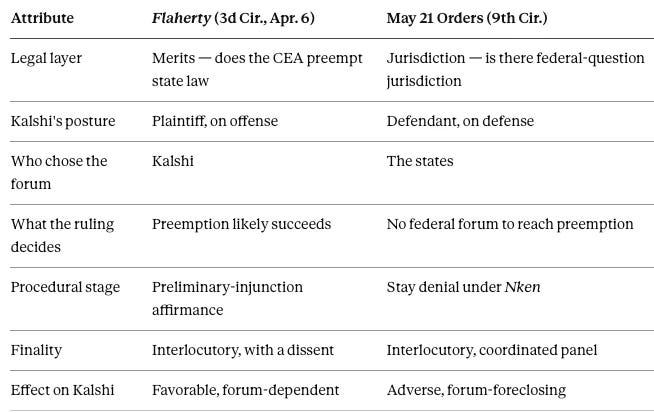
The layer distinction reframes what Flaherty tells the reader about Kalshi’s nationwide position. The Third Circuit victory establishes something real and favorable: the preemption argument has genuine legal traction when Kalshi can get a federal court to reach it. But notice the posture that produced the win. In Flaherty, Kalshi was the plaintiff, in federal court, seeking an injunction — Kalshi chose the forum and the timing. In the Ninth Circuit cases, Kalshi and Polymarket are defendants, fighting removal, trying to stay state proceedings — the states chose the forum and the timing. Flahertyshows the merits argument works on offense, in a forum of Kalshi’s selection. The Ninth Circuit orders show the defensive posture failing at the threshold.
The real circuit tension, then, is not “pro-Kalshi versus anti-Kalshi.” It is a procedural-posture divide: one circuit reached Kalshi as a federal-court plaintiff and engaged the merits; the other is returning operators to state court before the merits are reached. Kalshi’s Flaherty win is therefore best understood as forum-dependent — and that dependency is exactly the forum-architecture thesis restated from the other side. Flaherty is the proof of what Kalshi loses when the federal forum is foreclosed: not a weak argument, but a viable preemption argument stranded in a forum it cannot reach. The Third Circuit win does not soften the Ninth Circuit denials. It raises their cost. It demonstrates precisely what the May 21 orders take off the table.
Two further observations follow from reading Flaherty against the Ninth Circuit set. First, the Flaherty majority leaned in part on the CFTC’s non-action — the agency has not moved to prohibit sports-related event contracts under Rule 40.11 — while the dissent pointed to the same rule’s text as an existing prohibition. The CFTC’s pending Advance Notice of Proposed Rulemaking on prediction markets (91 Fed. Reg. 12516, March 2026) therefore sits directly on the fault line: agency action in either direction would reshape the preemption analysis both opinions depend on. The regulator the operators want to invoke has not yet spoken clearly, and that silence is doing contested work in the case law. Second, the Flaherty amicus alignment is its own signal — 34 states plus the District of Columbia, the American Gaming Association, and tribal gaming interests all filed against Kalshi. Kalshi won the panel, but the institutional weight arrayed on the state-enforcement side is substantial, and it is the same weight that will press on every state-court proceeding the Ninth Circuit orders now leave running.
The synthesis: Kalshi has one strong merits-layer precedent and a coordinated jurisdiction-layer defeat. The two do not cancel. They define the strategic problem with precision — the preemption argument is good enough to win when Kalshi reaches a federal forum, and the Ninth Circuit has just made reaching that forum, across an entire circuit, materially harder.
VIII. The Offensive Trap: Why Kalshi Cannot Simply Replicate Flaherty
A natural question follows from the Flaherty contrast. If Kalshi wins when it is the federal-court plaintiff seeking an injunction, why not run that play everywhere — file affirmative federal suits against the attorneys general of Washington, Nevada, and every other enforcing state, and ask federal judges to block their enforcement before it gathers force?
The answer is a structural barrier, and naming it precisely matters, because the barrier is real but it is not the absolute lock it is sometimes described as. Two doctrines govern federal interference with state enforcement. The Anti-Injunction Act, 28 U.S.C. § 2283, generally bars a federal court from enjoining ongoing state-court proceedings, subject to three narrow exceptions. Younger abstention, a judge-made comity doctrine, separately directs federal courts to decline to interfere with ongoing state enforcement proceedings even where a statutory exception to § 2283 exists.
The reason the barrier is not absolute is the “expressly authorized” exception to § 2283. The Supreme Court held in Mitchum v. Foster that suits under 42 U.S.C. § 1983 fall within that exception — and a Supremacy Clause preemption claim can often be vehicled through § 1983 or an Ex parte Young-style action. So § 2283 alone does not categorically seal the federal courthouse. What does the real work, once a state has filed first, is Younger: even where § 1983 supplies a statutory path through the Anti-Injunction Act, Younger abstention will usually counsel the federal court to stand aside in deference to the pending state enforcement action. The barrier is a combined one, and it is better described as strong and comity-driven than as a mechanical statutory trap.
That precision sharpens the point rather than blunting it. Flaherty worked because of timing. Kalshi filed its federal action before New Jersey commenced a formal state enforcement proceeding. With no ongoing state proceeding to defer to, neither § 2283 nor Younger stood in the way, and Kalshi could litigate as the offensive plaintiff in the forum of its choosing. In the Ninth Circuit matters, the sequence ran the other way: the states initiated enforcement first. Once state enforcement is live, the combined Younger/§ 2283 barrier makes the Flaherty offensive posture largely unavailable — a federal court asked to enjoin those proceedings will, in the ordinary case, abstain.
This is why the removal-and-stay maneuver mattered so much to the operators, and why its failure is so costly. Removal is not the strategy operators would choose if the offensive path were open; it is the fallback once the states have filed first and foreclosed the offensive path. By denying the stays and validating remand, the Ninth Circuit did not merely close one option. It confirmed the operators into the defensive posture — fighting state enforcement in state court — that the first-to-file dynamic had already pushed them toward. The forum-architecture thesis gains a statutory floor from this: Kalshi’s loss of forum control is not only a matter of the May 21 orders, it is reinforced by background doctrine that rewards whoever files first, and in the Ninth Circuit states, the states filed first.
IX. Is This the Circuit Split Kalshi Was Waiting For?
The reflexive read of a Third Circuit win paired with a Ninth Circuit loss is that the long-awaited circuit split has arrived, and with it a clear path to the Supreme Court. The reflex is understandable. It is also, on these facts, wrong — or at least far more wrong than right — and the analysis is worth doing carefully, because a large share of readers will reach for the same conclusion.
Start with what a certiorari-ready split actually requires: two circuits answering the same legal question in conflicting ways. Flaherty and the May 21 orders do not do that. As the prior section established, the two rulings sit at different layers. Flaherty answers a merits question — does the Commodity Exchange Act preempt state gambling law. The Ninth Circuit orders answer a jurisdiction question — does federal-question jurisdiction exist to hear a removed case. A court can hold that a removed case lacks federal-question jurisdiction and that CEA preemption prevails as a defense once the case is heard, with no contradiction whatever. What looks like a split is, on inspection, a Third Circuit preemption holding and a Ninth Circuit removal-jurisdiction holding standing side by side — not in conflict, simply addressed to different questions. That is not the clean doctrinal split certiorari is built on.
Add the procedural posture, which compounds the problem. Both rulings are interlocutory and provisional. Flaherty is a preliminary-injunction affirmance on a “reasonable likelihood of success” standard, expressly not a merits judgment, and it carries a full dissent. The Ninth Circuit orders are stay denials under Nken, also expressly not merits rulings. The Supreme Court strongly prefers to take final, merits-stage decisions in which the legal question is cleanly framed and fully reasoned below. A purported split assembled from one preliminary injunction and three stay denials is close to the archetype of what the Court declines in favor of letting the issue percolate. Anyone treating the present pairing as a guaranteed cert vehicle is building on a foundation that will not yet bear the weight.
Now the point that should puncture any celebration. Assume the best case for Kalshi — a genuine split matures and the Supreme Court takes the preemption question. The May 21 orders are still adverse to Kalshi in that scenario. Kalshi’s entire strategic interest is to arrive at the Supreme Court from strength: in a federal forum, consolidated, ideally as the plaintiff holding injunctions, the posture Flaherty gave it. The Ninth Circuit orders produce the opposite approach posture. They push the disputes into state court, where state judges will be generating gambling findings against Kalshi while any Supreme Court track develops. Reaching the Court with an accumulating record of state-court losses as the backdrop is a materially worse cert posture than reaching it clean. A circuit split is not a prize collected at the door; it is a destination, and the May 21 orders ensure Kalshi would arrive at it having lost ground.
The two routes to the Supreme Court are not equal in speed, and the difference is statutory. Flaherty reached the Third Circuit on an interlocutory appeal from a preliminary injunction under 28 U.S.C. § 1292(a)(1) — a fast federal track that carries a live legal question upward without waiting for a final judgment. The state-court route runs under a different rule. Under 28 U.S.C. § 1257, the Supreme Court can review a state-court decision only after the highest court of the state has rendered final judgment. For Kalshi, forced into state court, that means litigating a preemption defense up through the trial court, the state intermediate appellate court, and the state supreme court before federal Supreme Court review is even available. That is a path measured in years. By denying the stays and validating remand, the Ninth Circuit did not only change the forum — it moved the operators from the fast § 1292(a)(1) interlocutory track onto the slow § 1257 state-finality track. The delay is not incidental; it is the mechanism by which the state-court gambling findings get time to accumulate and harden before any federal high-court answer can arrive.
The Flaherty dissent cuts the same way. If the hope is “the Third Circuit is our circuit and the split favors us,” Judge Roth’s dissent is the problem. It is a fully developed brief for ruling against Kalshi — DCM trading as a mere subfield of futures trading, the savings clauses as incompatible with field preemption, Rule 40.11 as an existing prohibition the CFTC has simply declined to enforce. Every state attorney general and every other circuit now holds that roadmap. A split in which your own favorable opinion contains a powerful dissent is a split the Supreme Court can resolve against you.
State the disciplined conclusion plainly. Real circuit tension exists — but it is a posture divide, not a doctrinal split on a single shared question: one circuit reached Kalshi as a federal-court plaintiff and engaged the merits favorably; the other returns operators to state court before the merits are reached. That tension can mature toward the Supreme Court. But the path runs through merits appeals, and most likely through a future circuit’s merits ruling that squarely conflicts with Flaherty on preemption itself — not through the interlocutory orders now in hand. The May 21 orders are not that conflicting merits ruling. They are not even the same kind of ruling.
So the answer to the question in the heading: no, the May 21 orders are not the circuit split that carries Kalshi to the Supreme Court. The sharper and more accurate framing is that the orders raise the cost of whatever Supreme Court path eventually exists — by ensuring that Kalshi, if it gets there, gets there having first lost ground in state courts the orders refused to pause.
X. Falsifiability and Open Items
Consistent with the standards of this series, the limits of the present analysis are stated plainly.
This update is built from the first page of each three-page order. The full reasoning on Nken factors two through four — irreparable injury, harm to the states, and the public interest — is not yet in hand. For Kalshi specifically, the irreparable-injury factor is load-bearing: Kalshi’s argument has been that fragmented state enforcement destroys a national market. The panel’s treatment of that argument, once the complete orders are reviewed, will either sharpen or qualify the reading above.
A stay denial is a probability assessment under the Nken standard, not a merits ruling. The panel can still decide the underlying remand appeals differently. The forecast here is directional: a denial resting this squarely on the absence of a strong showing on jurisdiction is a meaningful indicator of where the merits panel is likely to land, and the Washington order’s engagement with Grable/Gunn strengthens that read. It is an indicator, not a certainty, and it is offered as a falsifiable claim.
The Third Circuit’s Flaherty opinion carries the same provisional character from the opposite direction. It affirms a preliminary injunction on a “reasonable likelihood of success” standard, not a final merits judgment, and it drew a substantive dissent. Treating it as a settled pro-Kalshi merits holding would overstate it as badly as treating the Ninth Circuit orders as a final ruling that prediction markets are illegal gambling. Both are interim signals. The analysis above rests on the posture difference between them, which is structural and does not depend on either set of rulings becoming final.
The testable prediction: the underlying remand appeals will be resolved against the operators on federal-question jurisdiction, and multiple state courts will rule on whether prediction-market contracts constitute illegal gambling under state law before any circuit-level merits resolution on federal preemption capable of producing nationwide practical harmonization. Stated on a measurable horizon: through the 12-to-24-month window preceding any Supreme Court-ready federal preemption posture, the operative legal findings on the gambling question will come from state courts, not a federal forum. If a federal appellate preemption ruling with nationwide effect lands before that state-court record accumulates, this forecast is wrong.
A second, related prediction follows from the circuit divide. The Flaherty–Ninth Circuit posture split is the kind of structural disagreement that pushes toward Supreme Court review — but the path runs through merits rulings, not these interim orders. The forecast: the operative federal resolution, if one comes, arrives via a merits appeal in which Kalshi is positioned as a federal-court plaintiff, not via the removal appeals the Ninth Circuit is now resolving. If the Supreme Court takes up the preemption question on the posture of a state-enforcement removal case rather than a Kalshi-initiated injunction case, that would cut against this reading.
A third prediction concerns the order of battle. The sequencing claim — Ninth Circuit state attorneys general file first, their findings feed tribes and class actions, competitors wait on the merits — is a forecast, not an observation, and it rests on two load-bearing assumptions. The first is that the Grable/Gunn holding is read as circuit-specific; it is so on its face, but other circuits could converge on it, which would broaden the effect beyond the Ninth Circuit, or reject it, which would deepen the split. The second is that state attorneys general read the orders as initiation cover rather than waiting for the merits appeals to resolve. If a wave of new state enforcement filings does not materialize in Ninth Circuit states within roughly two to three quarters of these orders, or if the first significant new filings come from outside the Ninth Circuit, the sequencing forecast is wrong.
A fourth item is less a prediction than a stated dependency. The entire analysis is conditioned on the CFTC not finalizing a prediction-market rule during the litigation window. The agency’s pending rulemaking can override the state-by-state dynamic in either direction, and the timing is not knowable in advance. This is disclosed rather than forecast: if the CFTC issues a final rule on sports-related event contracts before the state-court record this piece anticipates has formed, the forum-fragmentation analysis is overtaken by events, and the operative question becomes the content of the federal rule rather than the sequence of state findings. Readers should treat the CFTC rulemaking docket as the primary thing to watch — ahead of any individual court.