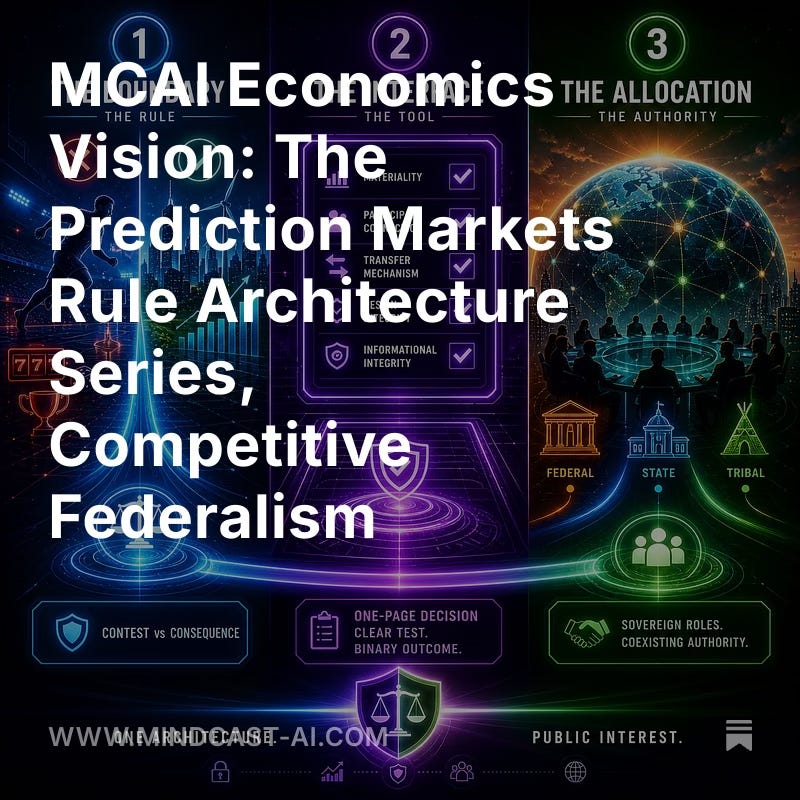

MindCast Series, The Prediction Markets Rule Architecture: The Prediction Markets Rule Architecture Series, A Boundary Rule with a Functional Core | The Prediction Markets Rule Architecture Series, Competitive Federalism | Kalshi Loses Federal Forum — The Washington Remand Order and the Jurisdictional Layer of the Prediction Markets Boundary Rule
Why this guide exists
The federal-state-tribal collision over prediction markets has moved from theoretical conflict to active multi-jurisdictional litigation. State attorneys general, tribal gaming commissions, state gaming regulators, problem gambling agencies, athlete representative organizations, and allied partners now operate against an active federal preemption posture under current CFTC leadership. The federal regulator is not a partner in this regulatory cycle. The federal regulator is the opposing party.
The guide translates the analytical architecture published in MindCast: Prediction Markets — A Boundary Rule with a Functional Core (forthcoming) into language and recommendations calibrated for the operational decisions state and tribal regulators face. The framework supplies the doctrinal analysis. The guide supplies the partner-facing operational distillation.
The guide does not require readers to engage the full analytical density of the framework. Partners who do want the framework’s full architecture, or whose counsel will brief from it, can find the framework at the linked publication.
What is happening
Prediction markets have become a federal regulatory issue with direct consequences for state and tribal authority. Federally registered exchanges — Kalshi, Polymarket, and others — list contracts on sports outcomes, election outcomes, and other events. The exchanges argue these contracts are federal derivatives under exclusive Commodity Futures Trading Commission jurisdiction. The exchanges argue state gambling law and tribal compact authority are preempted.
The CFTC opened a rulemaking on March 12, 2026. The Advance Notice of Proposed Rulemaking (RIN 3038-AF65) asked the public how the agency should regulate event contracts, including how the agency should define “gaming” under the Commodity Exchange Act. Public comment closed April 30, 2026.
The federal courts are split, and litigation is widespread. Cases sit in the Third Circuit, the Ninth Circuit, the District of Arizona, the Southern District of New York, the Massachusetts Supreme Judicial Court, the Western District of Washington, and state courts in at least a dozen jurisdictions. The CFTC has sued Arizona, Connecticut, Illinois, and New York to block state enforcement actions. The CFTC has filed amicus on Kalshi’s side at the Massachusetts SJC. Thirty-eight state attorneys general have filed jointly against the federal preemption theory in the same Massachusetts case. Robinhood has filed preemptive federal court actions against Washington, Massachusetts, and New Jersey, naming state attorneys general and state gaming commissions as defendants.
A criminal dimension surfaced on April 23, 2026. The Department of Justice indicted a U.S. Army Special Forces master sergeant for using classified intelligence about the January 2026 Maduro capture operation to win approximately $400,000 on Polymarket. The case is the first criminal prediction-market insider-trading prosecution in U.S. history. The CFTC filed a parallel civil action.
The five major North American players associations filed jointly on April 30, 2026. The NFLPA, MLBPA, NBPA, NHLPA, and MLSPA submitted a joint comment to the CFTC docket asking for a categorical ban on negative-outcome contracts (under bets, injury props, “mention” props during broadcasts) and due process protections for athletes who become subjects of manipulation investigations.
Why state and tribal authority is exposed
The federal rule has a gap. Rule 40.11 — the CFTC regulation listing contract categories the Commission can prohibit as contrary to the public interest — uses the word “gaming” but does not define it. The undefined term lets exchanges argue their contracts are not “gaming” while simultaneously invoking federal preemption against state regulators who say the contracts are.
Self-certification compounds the gap. Under Rule 40.2, an exchange can list a new contract by certifying it complies with federal core principles. The CFTC can review and stay a listing under Rule 40.11 — but the agency rarely does. The current CFTC leadership has stated it will not.
The federal regulator is actively litigating against state authority. The CFTC has sued four states to block state enforcement. The agency has filed amicus briefs supporting Kalshi against state actions. The CFTC Chairman has stated publicly that any state seeking to enforce its gambling laws against CFTC-registered exchanges will be met in court. The federal regulator is not a partner under current conditions. The federal regulator is the opposing party.
Tribal compact authority faces displacement. Federal reclassification of sports outcome contracts as swaps — combined with federal preemption claims — would erase the foundation of tribal exclusivity in compacted gaming activity. The Indian Gaming Association has publicly characterized the dynamic as “erasure” rather than “modernization.” The Indian Gaming Regulatory Act framework was never contemplated against this collision.
Platform-side preemption converts every state action into federal court litigation. Robinhood’s preemptive lawsuits in Washington, Massachusetts, and New Jersey demonstrate a coordinated strategy by prediction-market platforms: any state enforcement initiative now triggers immediate federal court litigation, often before the state action progresses. State and tribal partners should expect their enforcement actions to be answered in federal court within days of filing.
The line that controls
The Commodity Exchange Act draws a clear line. Derivatives manage economic risk. Pure wagering on outcomes detached from real exposure falls on the other side. The disputes in front of the courts exist because the rule operationalizing the line has not been completed, not because the line itself is unclear.
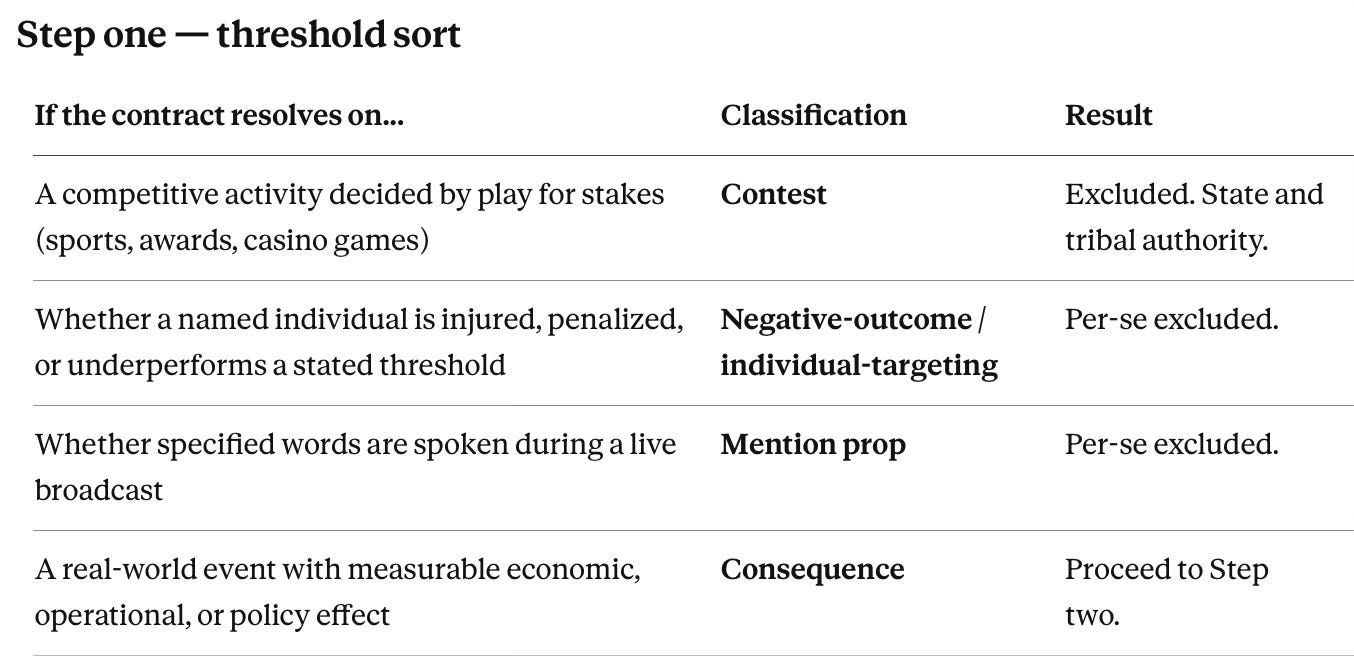
The operative distinction is contest versus consequence.
A contest is a competitive activity whose outcome depends on play for stakes — sports, awards, casino-style games, similar competitive performances. Contests are betting. Contests belong to state and tribal authority under existing gambling regulation and tribal compacts. Federal derivatives law does not authorize contests as derivatives no matter how the products are dressed.
A consequence is a real-world event whose outcome carries measurable economic, operational, or policy effects independent of the contract — weather realizations, commodity supply disruptions, interest-rate movements. Some consequences are appropriate for federal derivatives regulation when participants face genuine underlying exposure that the contract redistributes. Most so-called event contracts on prediction markets are not consequences; they are contests in derivative form.
The litmus test is underlying exposure. Does the participant face a real risk that exists independent of the contract, and does the contract transfer that risk between counterparties? If yes, the contract may belong inside federal derivatives regulation. If no, the contract is wagering on an outcome and belongs to state and tribal authority. Election contracts fail the test because participants do not face standing election exposure on their operations. Sports contracts fail the test because no operational sports exposure exists. Tactical military-event contracts fail the test and create national-security misappropriation risk besides — the conduct charged in the April 23 indictment.
What you can do without federal cooperation
The federal-state dynamic is not cooperative federalism. The dynamic is competitive federalism — three sovereignties asserting authority over the same conduct, with no expectation any sovereign will defer to the others. State and tribal authority operates within its own sphere, on its own statutory and constitutional authority, against active federal preemption pressure. The federal regulator is not going to draw the line. The federal regulator is currently litigating to prevent the line from being drawn at all.
State enforcement actions under existing law remain available. Multiple states have filed actions under existing state gambling and consumer protection statutes — including Arizona, Connecticut, Illinois, Maryland, Massachusetts, Nevada, New York, Ohio, Washington, and Wisconsin. State authority does not require CFTC permission and does not depend on federal rulemaking. State action operationalizes the boundary while federal litigation continues.
Cease-and-desist authority remains available. State gaming regulators retain authority to issue cease-and-desist orders against unlicensed gambling activity within state jurisdiction. The fact that a federal exchange lists a contract does not authorize the contract’s offering in jurisdictions where the underlying activity is reserved to state authority.
State amicus briefs are now active institutional infrastructure. The thirty-eight-state amicus brief in Commonwealth of Massachusetts v. KalshiEX LLC establishes a coordinated cross-jurisdiction posture against the federal preemption theory. The brief is the institutional vehicle through which states without active enforcement actions support those that have them.
Tribal compact rights remain enforceable through federal court. The Indian Gaming Regulatory Act compact framework operates independently of swap classification. Tribes facing direct economic intrusion from federally listed sports contracts on compacted gaming activity have litigation vehicles available — the doctrinal architecture exists in Montana v. Blackfeet Tribe and in IGRA itself. What is missing in some jurisdictions is a litigation vehicle that puts the IGRA collision squarely before a federal court.
State legislative action remains available. State legislatures can — and several have — codify express prohibitions on negative-outcome contracts, athlete-targeting contracts, and broadcast-mention contracts under existing state gambling and consumer protection authority. The Massachusetts, Missouri, Illinois, and Virginia statutes cited in the Players Associations’ filing establish the precedent.
Coordination with state attorneys general accelerates everything. State AG offices doing the legal heavy lifting on prediction-market enforcement benefit from coordination with state gaming commissions, tribal gaming authorities, problem gambling agencies, and athlete-protection partners. The thirty-eight-state brief is the proof the coordination is producing leverage.
Contact mcai@mindcast-ai.com to partner with us on Predictive Cognitive AI + Game Theory in Law and Behavioral Economics. To deep dive on MindCast work in Cognitive AI upload the URL of this publication into any LLM and prompt ‘parse MindCast framework with three degrees of cited sub links.’ See Live-Fire Game Theory Simulators, Runtime Predictive Infrastructure.
Recent projects: Where Institutional Capital Moves Under Federal Digital-Asset Control Architecture | Defining “Gaming” Under the Commodity Exchange Act, The Rule 40.11 Gap Driving the Nationwide Kalshi Litigation Web | The Rule 40.11 Paradox — Kalshi, the Third Circuit, and the Class Action the Ninth Circuit Cannot Ignore | Prediction Markets Litigation Stack — Federal, Private, and State Enforcement Converge
What to watch
Massachusetts SJC ruling in Commonwealth v. KalshiEX. A ruling that holds the CEA does not preempt state gambling regulation will be cited in every other pending case. A ruling the other way accelerates federal preemption pressure across all jurisdictions.
Ninth Circuit Nadex consolidated appeal. The panel heard oral argument April 16. A ruling against Kalshi creates a circuit split with the Third Circuit’s Flaherty decision and increases the probability of Supreme Court review.
Arizona criminal information against Kalshi. The Arizona AG’s twenty-count criminal information is the highest-stakes state action on the docket. A successful prosecution validates state criminal enforcement against prediction-market platforms and supplies the template for other state AGs.
Robinhood Markets, Inc. v. Brown and the platform-side preemption track. Robinhood filed preemptively in federal court in Washington on March 30, 2026, three days after Washington filed against Kalshi in state court, naming the Washington Attorney General and the Washington State Gambling Commission as defendants. The same Robinhood preemption pattern is active in Massachusetts and New Jersey. The platform-side track converts every state enforcement initiative into federal court litigation, often before the state action progresses, and signals that prediction-market platforms intend to litigate state authority rather than negotiate within it.
Congressional bill markup. Multiple bills addressing prediction markets are moving through committees. The DEATH BETS Act, the Prediction Markets Security and Integrity Act, the Merkley-Raskin sports/elections/war prohibition bill, and adjacent measures are all live. Bipartisan interest is real and unusual — progressive and traditional-conservative coalitions are aligning on prediction-market restriction.
Additional misappropriation cases. The April 23 indictment is unlikely to be the last. Categories at highest risk include tactical military-event contracts, regulatory-decision contracts, and athlete-injury contracts where information asymmetries cannot be reached by exchange surveillance.
What partners should consider
Treat federal preemption claims as adversarial. Under current CFTC leadership, federal preemption arguments are not invitations to coordinate; they are litigation positions to be answered in court. State and tribal authority operates against the federal position, not in cooperation with it. Action that waits for federal cooperation will not happen during the current administration.
Build the institutional record now. Every state enforcement action, every cease-and-desist letter, every amicus filing, every tribal council resolution, every state legislative finding becomes part of the public record courts and future regulators will review. The record being built today shapes the rulemaking outcome whenever the next CFTC leadership reviews the docket.
Do not concede contest-versus-consequence ambiguity. The federal preemption theory depends on treating sports outcomes, election outcomes, and similar contests as ambiguously categorized event contracts that might or might not be gaming. Conceding ambiguity is conceding the legal ground on which preemption operates. The contests are betting. The line is clear. State and tribal authority should articulate the line clearly and consistently across forums.
Protect the underlying exposure litmus test. When evaluating any contract category — current or future — the operative question is whether participants face standing exposure to the underlying outcome that the contract redistributes. Contracts that manufacture exposure existing only inside the contract are wagering, regardless of how the contract is structured or labeled. The litmus test prevents the federal preemption theory from absorbing new contract categories through definitional drift.
Coordinate across constituencies. State gaming regulators, tribal gaming authorities, state attorneys general, problem gambling agencies, athlete representative organizations, and public-interest organizations are operating against the same federal preemption pressure. Coordination across constituencies produces leverage no single constituency produces alone. The thirty-eight-state amicus brief is the proof of concept.
Reference framework
The analytical infrastructure underlying this guide is published as Prediction Markets: A Boundary Rule with a Functional Core at mindcast-ai.com. The framework develops the contest-versus-consequence sort, the underlying-exposure litmus test, the per-se exclusion of negative-outcome contracts, the informational integrity surveillance architecture, the IGRA non-displacement clause, and the competitive federalism allocation in detail at the rule-text level.
The framework’s primary audience is sophisticated regulatory counsel, federal court chambers, congressional staff, and institutional analysts. Partners using this guide do not need to engage the framework’s full analytical density — the guide above translates the framework’s operational implications into the language of state and tribal action. Partners who do want the full analytical architecture, or whose counsel will brief from it, can find the framework at the linked publication.
Prediction Markets — Event Contract Decision Sheet
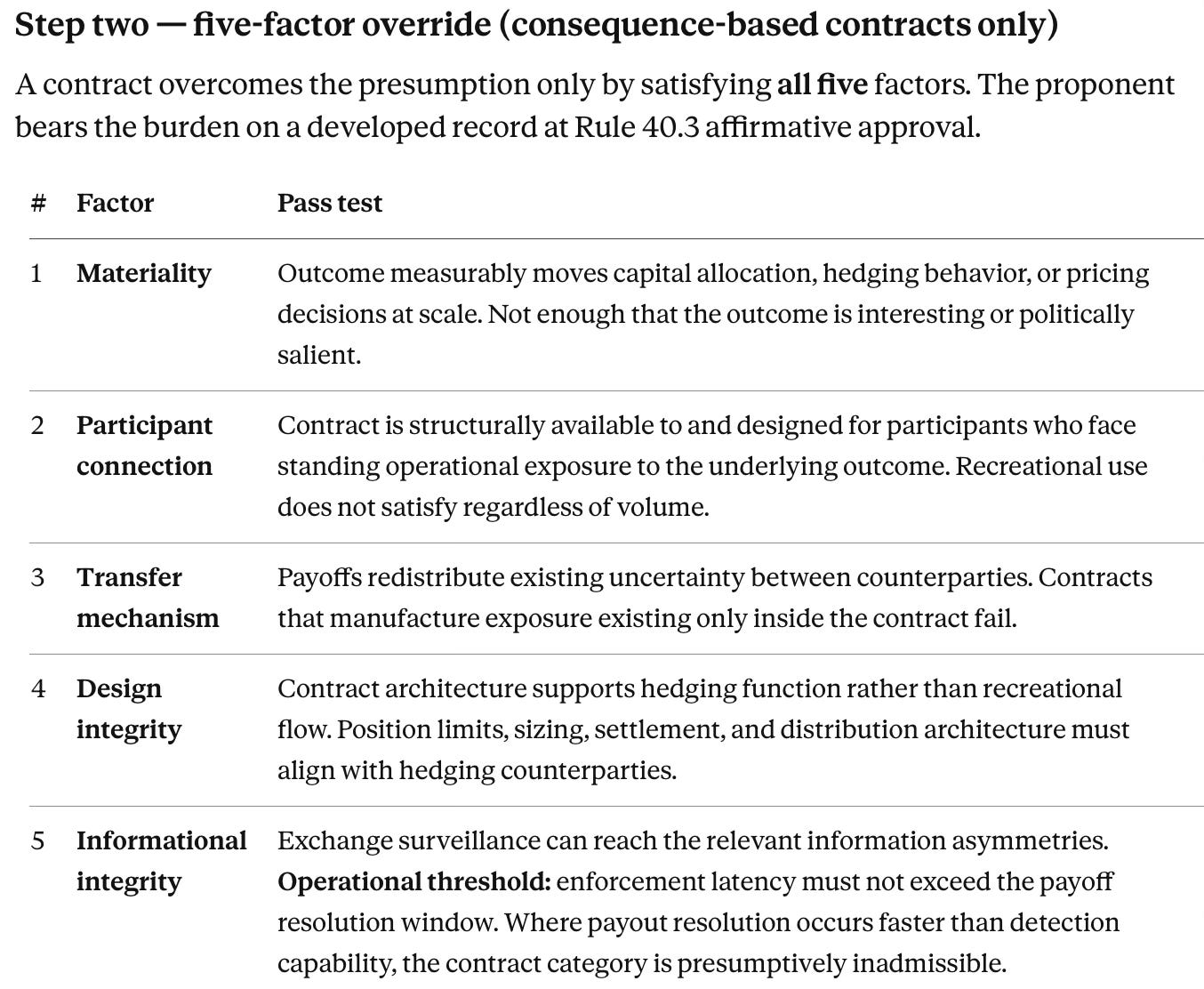
Failure on any single factor defeats admissibility.
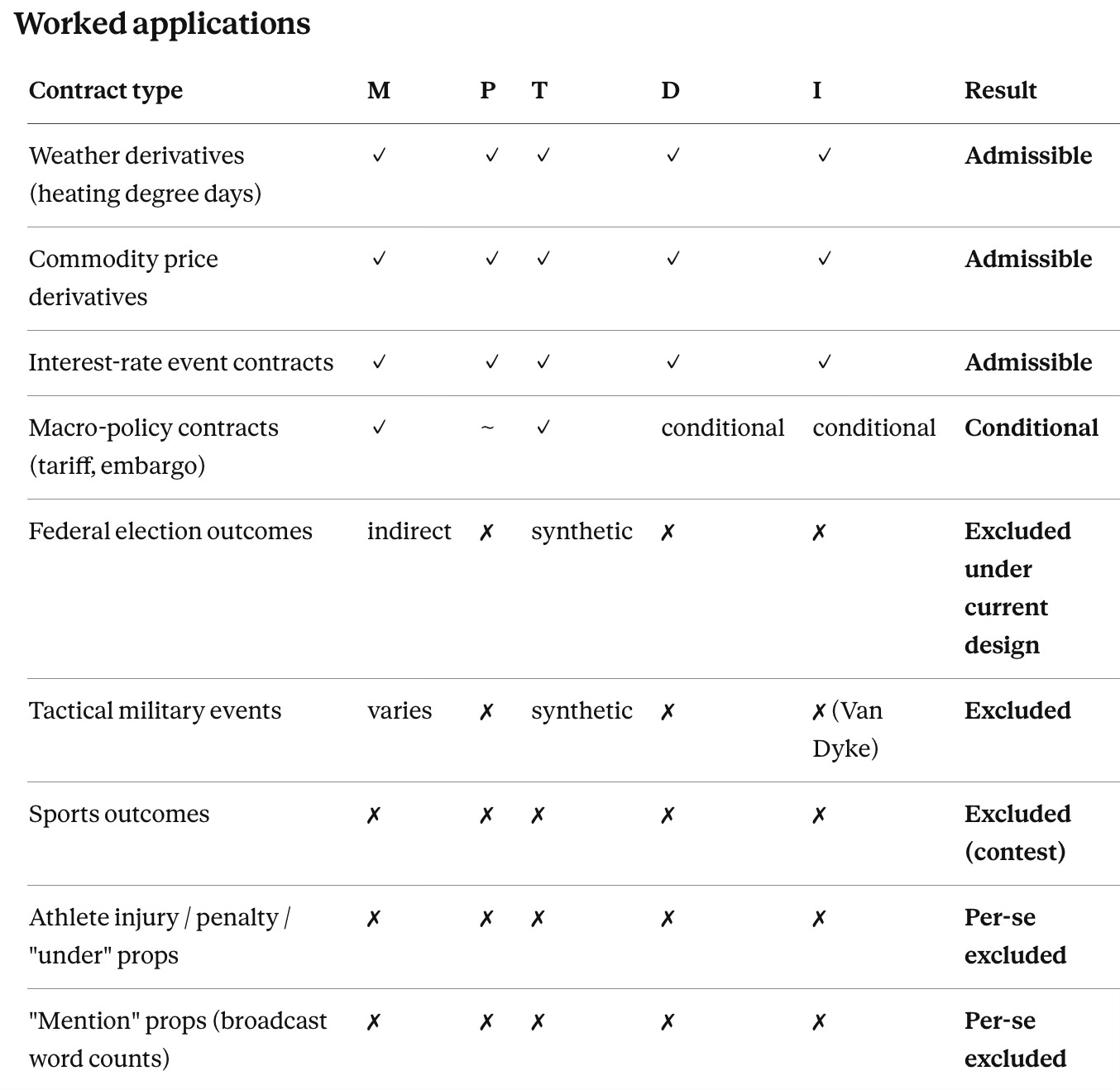
Critical distinctions
Economic impact is not economic exposure. Many outcomes affect markets indirectly. Only some create operational exposure participants can hedge through a contract. The override admits the latter and excludes the former. Materiality alone cannot create CFTC admissibility — otherwise every politically salient fact becomes a derivative.
Indirect exposure is not hedgeable risk. Corporate sensitivity to election-driven tax policy is tax-code risk, not election-outcome risk. The hedging instrument addresses the underlying directly, not the proxy outcome that may or may not produce a change.
Surveillance must operate at listing, not after damage. A contract category fails informational integrity where enforcement latency exceeds the payoff resolution window. Misappropriation detected only after payout cannot be reached by the surveillance architecture the framework requires.
Per-se exclusions are independent of the test. Negative-outcome and individual-targeting contracts violate Rule 40.11 on the face of the listing because the contract architecture itself creates the public-interest harm CEA § 5c(c)(5)(C) was designed to prevent.
Authority
CEA § 5c(c)(5)(C) — Commission authority to stop “gaming” contracts contrary to the public interest. Word gaminginserted at the request of Senate Majority Leader Harry Reid for the purpose of CFTC prohibition of state-jurisdiction wagering activity, per principal Dodd-Frank architect Gary Gensler interview, Barron’s, April 15, 2026.
Rule 40.11 — Commission authority to determine event contracts contrary to public interest. Definitional gap operationalized through the framework above.
Rule 40.3 — Affirmative approval pathway for contracts seeking to overcome the contest presumption.
Loper Bright Enterprises v. Raimondo — courts apply independent statutory analysis without deference to agency interpretation. The five-factor test supplies an administrable standard the framework offers as the only structure that survives such review while preserving the regulatory architecture Congress established.
Reference framework
The full analytical architecture, drafting-history evidence, competitive federalism allocation, and falsifiable predictions are published as Prediction Markets: A Boundary Rule with a Functional Core (forthcoming).
The partner-facing operational distillation for state and tribal regulators is published as Prediction Markets and Competitive Federalism: A Field Guide for State and Tribal Regulators (forthcoming).
The publication responds to ongoing public dialogue across federal, state, and tribal forums on the statutory boundary question and the implications of federal prediction-market preemption for state and tribal authority.