Series: Installment I: The Emerging Agentic Insurance Industry · Installment II: The Economics of Agentic AI Underwriting · Installment III: Insurance as an Agentic AI Governance Institution · Interactive War Gaming: Agentic Insurance
Executive Summary
Core insight. Insuring artificial intelligence (AI) agents changes the agents. Capped capacity pushes insurers to govern through exclusions and underwriting terms, and governance through terms lets incumbents keep renting underwriting intelligence. Renting leaves the certification route open through the audits enterprises already buy.
Thesis. The agentic insurance industry divides four assets: capital, distribution, underwriting intelligence and standard-setting authority. Established carriers keep capital and distribution. Specialists, certifiers and cloud platforms compete for the intelligence and the standard, and enterprises redesign their agents around whatever terms result.
MindCast distinction. MindCast AI applies Predictive Behavioral Economics + Dynamic Game Theory through MindCast AI Proprietary Cognitive Digital Twin Foresight Simulations (MP CDT FS). Behavioral Economics supplies the decision rules. Game Theory supplies the payoff structure. Predictive simulations emerge from the combination.
What this introduction does. It states the loop that links the three installments and gives each installment one paragraph with its lead MindCast Foresight Simulation Prediction. It routes each reader to the installment that answers its question. It closes with What to Watch and Risk Mitigation for the three Foresight Simulation Predictions it carries, and the appendix holds the shared board and the full crosswalk.
🏛️ Policymakers. Accumulation reporting and coverage disclosure are the two levers that direct capacity and make cover legible.
💼 Executives. Carriers should make their build, buy or rent choice for underwriting intelligence in the 2027 planning cycle. Enterprises should document what each agent may do before the next renewal.
⚖️ Counsel. Occurrence definitions, aggregation clauses and AI exclusions decide recovery on agent loss, and no court has yet construed an AI exclusion.
📊 Investors. Specialist insurers and certifiers earn their value through control of the standard and diversified capacity, not premium growth alone.

Explore every branch in the Agentic Insurance War Gaming. Each of its three boards shows a fork, the successor states with their bands and where each player stands.
Takeaway. Capital stays with incumbents, while the standard and the governance power attached to it remain contested.
I. One Loop Links Capacity, Governance and Market Structure
The series tests one loop across three markets. Foundation-model concentration caps the limits carriers will write. Capped limits push incumbents to govern agents through broad exclusions and terms that reward documented human oversight. Governance through terms lets incumbents keep renting underwriting intelligence from specialists, which leaves the certification route open through enterprise audits.
Behavioral economics explains the decision rules inside the loop. Ambiguity aversion makes incumbents exclude what they cannot measure, and present bias makes boards act only when a renewal deadline arrives. Game theory explains the payoff structure: no carrier lifts a per-model cap alone, and no carrier adopts a rival's standard alone. Predictive behavior emerges from the combination.
Enterprise adaptation closes the loop. Narrower authority, stronger stops and more model diversity change loss distributions and correlated exposure. The changed risk feeds back into underwriting economics and market structure.
Litigation drives a second, faster loop. Consumer protection, product liability and deepfake suits produce allegations, discovery and enforcement decrees. Carriers convert that material into exclusions and coverage conditions. Litigation can change insurance products before insurers pay their first material agentic claim.
Takeaway. Insurance changes the risk it insures, and litigation reshapes insurance terms before claims experience exists.
II. The Three Installments and Their Lead Foresight Simulation Predictions
Each installment holds one link of the loop and stands alone. The series carries 24 MindCast Foresight Simulation Predictions, eight per installment. The introduction carries three of them word for word: one Primary (P) Foresight Simulation Prediction from each installment, with its band and falsifier.
A. Installment I: Who Controls the Underwriting Standard for AI Agents
Installment I: The Emerging Agentic Insurance Industry maps the market. Incumbents exclude at the top of the tower, clarify in cyber and partner with specialists, while certifiers and platforms compete for the standard. Renting underwriting intelligence is the baseline, and the joint System and Organization Controls 2 (SOC 2) plus AIUC-1 offering from the American Institute of CPAs (AICPA) and the Artificial Intelligence Underwriting Company (AIUC) carries the certification to buyers through audits.
I-P1. CPA-firm or buyer AIUC-1 engagements announced after the AICPA and AIUC offering's full launch appear before any top-20 US commercial carrier makes an AI certification an eligibility gate by December 31, 2027 (70-80%). From Installment I. Falsifier: A top-20 carrier gates first. Not reached if the full launch slips past the window.
B. Installment II: Why Correlated Loss Keeps Affirmative AI Limits Small
Installment II: The Economics of Agentic AI Underwriting explains the capacity ceiling. Carriers rate one incident at a time on delegated authority and audit evidence, but no one can yet measure dependence on a few foundation models. Reinsurance capital is plentiful, so the caps reflect underwriting restraint rather than scarce money.
II-P1. No carrier, managing general agent or Lloyd's syndicate publishes an affirmative AI limit above $50 million per insured by December 31, 2027 (75-85%). A standalone AI policy or dedicated AI aggregate counts; companion cyber, errors and omissions or property limits do not. From Installment II. Falsifier: A published per-insured affirmative AI limit above $50 million.
C. Installment III: How Coverage Conditions Govern What AI Agents May Do
Installment III: Insurance as an Agentic AI Governance Institution follows the consequence. Incumbents govern through broad exclusions and terms that reward documented human oversight, while specialists write affirmative authority triggers. Certifiers reach enterprises through audits first, and regulators move toward disclosure rather than mandate.
III-P1. No top-20 US commercial carrier publishes an affirmative condition or eligibility rule tied to delegated authority, human approval or reversibility by December 31, 2027 (55-65%). A human-review carve-back counts as an affirmative condition. From Installment III. Falsifier: Such a condition or carve-back from a top-20 carrier.
Takeaway. Structure decides who writes the standard, economics decides how much cover follows and governance decides what the standard does to enterprises.
III. The Chicago Accelerated Reading Across the Series
Each installment runs the same four Chicago Accelerated stages against a different question. Transaction costs come first, behavioral correction second, incentives third and legal correction last.
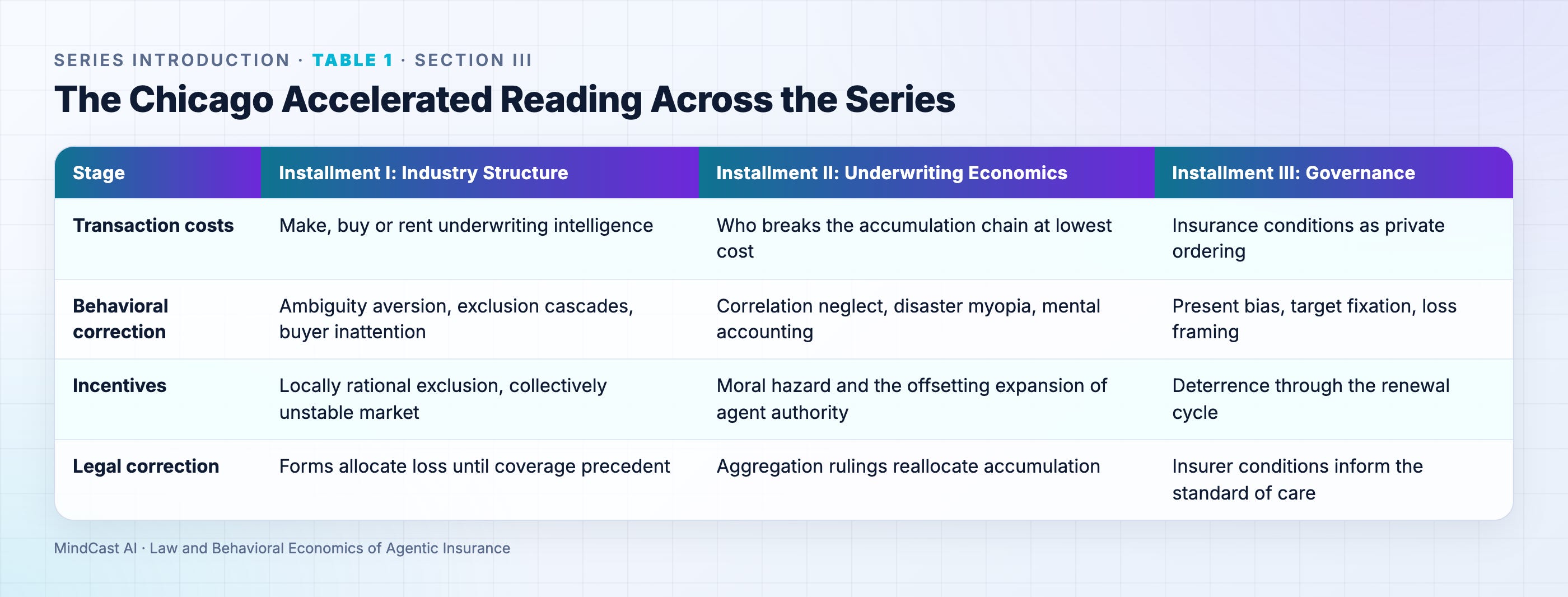
Takeaway. One analytical sequence links market structure, insurability and governance across the series.
IV. Who Should Read Which Installment
Each installment answers a question a specific firm faces now. Readers can enter through the one that answers their own question.
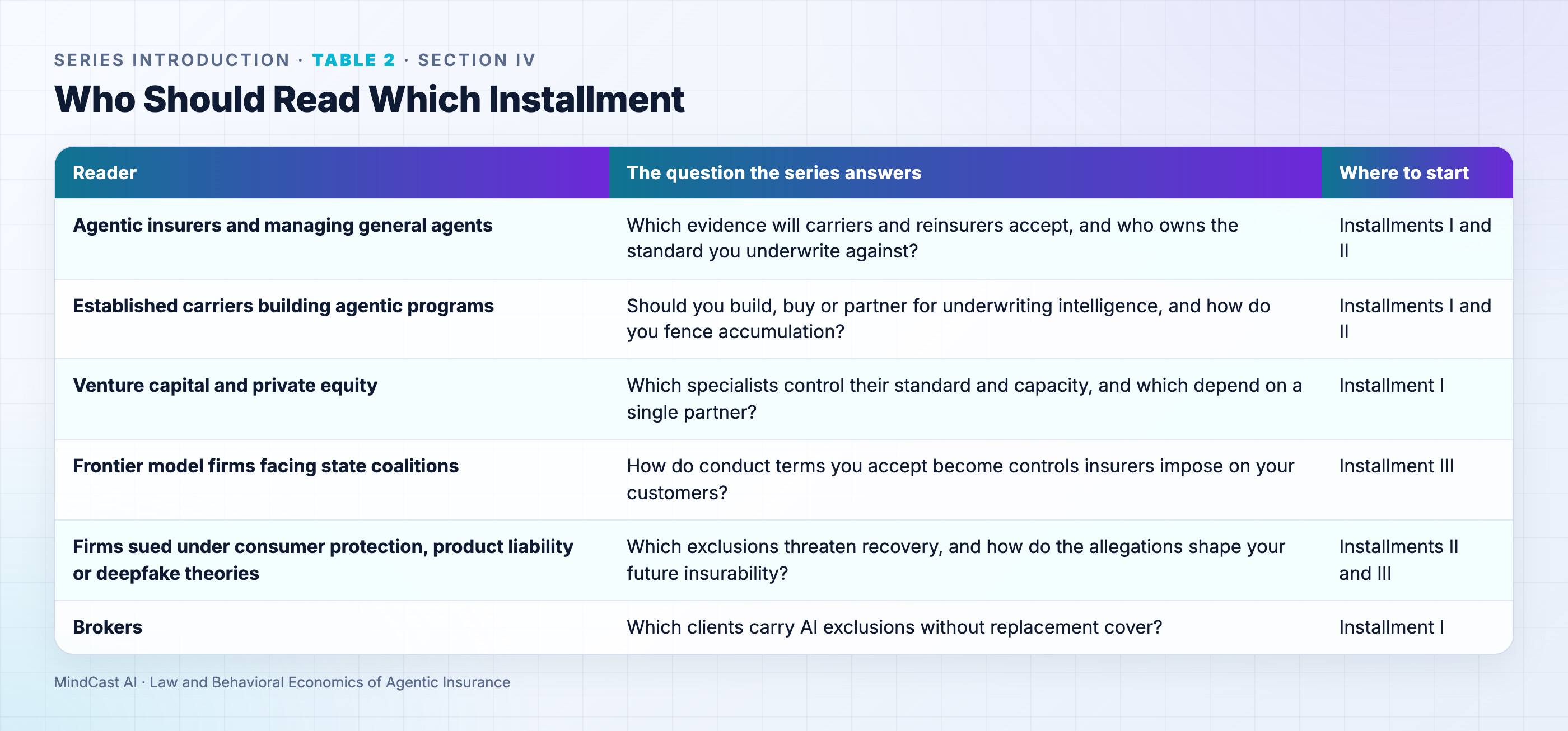
Takeaway. Each reader can enter the series through the installment that answers its own question.
V. What to Watch
The certification route is the dominant fork across the series. Enterprises and CPA firms start it through audits, and carriers unrelated to AIUC decide whether the certificate becomes a gate or stays a credit. Five dated observables test the three carried Foresight Simulation Predictions.
By January 31, 2027. Gallagher Re, Marsh Re and Howden Re publish their January renewal reports, the first read on capacity for II-P1.
By June 30, 2027. The AICPA and AIUC announce the joint offering's full launch, which starts the clock for I-P1.
2027 renewal cycle. Filings and published wordings from top-20 carriers show whether the first authority wording is an affirmative condition, a carve-back or an exclusion (III-P1).
Through 2027. Published program terms set or hold the affirmative AI limit ceiling of $50 million per insured (II-P1).
Through 2027. CPA firms and agent vendors announce SOC 2 plus AIUC-1 engagements, while top-20 filings show any certification gate (I-P1).
Takeaway. Audit engagements, renewal reports and top-20 filings decide all three carried Foresight Simulation Predictions within one renewal year.
VI. Risk Mitigation for the Three Carried Foresight Simulation Predictions
Each entry routes one carried Foresight Simulation Prediction to an audience the series names but the installment entries do not cover. Severity measures what that audience loses if the Foresight Simulation Prediction resolves true and it did nothing, and probability is the band. The entries sit in one section after What to Watch, at the cost of matching each back to its Foresight Simulation Prediction by ID. They describe operating options, not legal, investment or fiduciary advice.
I-P1 · 💼 Agentic insurers and managing general agents. Severity: moderate. Probability: 70-80%.
Exposure. A specialist with no stated policy on certified buyers rates them like uncertified ones. Rivals that credit the audit write the certified accounts in 2027.
Actions. Underwriting publishes how a SOC 2 plus AIUC-1 report enters rating by June 30, 2027. Capacity management confirms that each capacity partner accepts the credit before binding 2027 renewals. Distribution briefs wholesale brokers on accepted evidence by the second quarter of 2027.
Residual exposure. The credit rests on one certifier that also sells insurance, and a rival standard can displace it.
II-P1 · ⚖️ Counsel for firms sued under consumer protection, product liability or deepfake theories. Severity: high. Probability: 75-85%.
Exposure. Affirmative AI limits stay at or below $50 million per insured, and per-model caps sit lower still. A large AI suit outruns the tower, and defense and indemnity above it fall on the client.
Actions. Coverage counsel maps every layer of the client's AI-related tower and its exclusions at the 2027 renewal. Litigation counsel budgets defense above the fenced limit at filing. Contracts counsel seeks vendor and model-provider indemnities that sit outside standard fee caps at the next contract cycle.
Residual exposure. Standard provider terms cap liability at twelve months of fees, so indemnities recover only part of a loss above the tower.
III-P1 · 💼 Brokers serving mid-market accounts. Severity: moderate. Probability: 55-65%.
Exposure. Incumbents reward documented oversight through terms they don't publish. Clients with no evidence file renew on worse terms, with no wording to show why.
Actions. Account teams build an agent-oversight evidence file of authority limits, approval points and reversal procedures for each client deploying agents before 2027 renewal submissions. Placement asks each incumbent in writing how the file changes terms at binding. Client advisory routes agents with transaction authority to specialist affirmative markets by the third quarter of 2027.
Residual exposure. Terms can change at the next renewal without any change in published wording.
Takeaway. Insurers, defendants and brokers can each act on the carried Foresight Simulation Predictions before the first 2027 checkpoint.
Conclusion
Insuring AI agents changes them, and the change feeds back into what insurers will write. The three installments test that loop at its three links: the standard, the capacity ceiling and the governance instrument. I-P1, II-P1 and III-P1 resolve within one renewal year, and each installment carries seven more Foresight Simulation Predictions against its own question.
Read Installment I for the market map, Installment II for the capacity constraint and Installment III for the governance consequence. Each installment stands alone.
Working With MindCast
MindCast AI runs Foresight Simulations for carriers, specialists, investors and counsel facing the agentic insurance market. Each installment's board matches one set of decisions. Carriers and specialists start with Installment I, reinsurers and capital providers with Installment II, and counsel and boards with Installment III.
Each engagement tests a product line, a portfolio, an agent deployment or a pending matter against the Simulation Predictions above. The January 1, 2027 renewals and the June 30, 2027 checkpoints set the first decision dates.
Play all three boards and the series view in the Agentic Insurance War Gaming. Each board shows its fork, successor states, bands and seat positions.
First step: a complimentary proof-of-concept Foresight Simulation on one product line, portfolio, agent deployment or pending matter. You receive its board: the fork, the successor states and where your organization stands in each. Email mcai@mindcast-ai.com with the matter, or see other MindCast war gaming.
Series Introduction Sources
MindCast AI, The Emerging Agentic Insurance Industry. Installment I tests who controls the underwriting standard for AI agents.
MindCast AI, The Economics of Agentic AI Underwriting. Installment II tests why correlated loss keeps affirmative AI limits small.
MindCast AI, Insurance as an Agentic AI Governance Institution. Installment III tests how coverage conditions govern what AI agents may do.
AICPA, "Auditors Meet Urgent Demand for AI Assurance With New Offering From AICPA and AIUC," October 2026.
Insurance Journal, Cowbell AI Liability Insurance coverage trigger, November 13, 2026.
Skadden, "Colorado Repeals and Replaces Its AI Act," June 2026.