
Munich Re · Swiss Re · Gallagher Re · Lockton Re · Lloyd's · Lloyd's Market Association · Chaucer · Armilla · AIUC · Cowbell · Beazley · CFC · Coalition · Verisk · Google Cloud · OpenAI · Anthropic · Google · State insurance regulators
Companion to Installment I: The Emerging Agentic Insurance Industry · Who Absorbs Correlated AI Loss: Reinsurance Aggregation, Industry Pools, the Public Backstop and the Liability Shield
Series Introduction: The Agentic Insurance Industry · Installment III: Insurance as an Agentic AI Governance Institution · Interactive War Gaming: Agentic Insurance
I. Executive Summary
Agentic artificial intelligence (AI) risk is insurable one incident at a time and hard to insure in aggregate. A single agent error at a single insured looks like professional liability with a new cause. The same defect in a foundation model shared by thousands of insureds looks like a catastrophe with no geography. Carriers can underwrite the first and cannot yet measure the second, so they cap limits and fence AI loss away from their core books.
Reinsurance brokers stated the problem in 2026. Gallagher Re's March report warned that reliance on a small number of foundation model providers means a flaw in one widely used model could trigger claims across thousands of unrelated insureds. The Cloud Security Alliance concluded in July that foundation-model concentration is the risk category current tools handle worst. The market's answer so far is structural: Armilla limits cover at $25 million per insured and $5 million per model, and Chaucer fences Vanguard AI behind a separate $25 million aggregate.
MindCast distinction. MindCast AI applies Predictive Behavioral Economics + Dynamic Game Theory through MindCast AI Proprietary Cognitive Digital Twin Foresight Simulations (MP CDT FS). Behavioral Economics supplies the decision rules. Game Theory supplies the payoff structure. Predictive simulations emerge from the combination.
Working hypothesis. Three layers govern agentic underwriting. Attritional losses at single insureds can be rated on controls and audit evidence. Accumulation losses across insureds depend on foundation-model concentration, which no carrier can yet quantify. Capacity, the amount of limit the market will deploy, follows the accumulation layer rather than the attritional one.
Per-model limits and separate AI aggregates are accumulation controls built into product design.
Central finding. Accumulation, not capital, sets the ceiling. Global reinsurance capital stood at $790 billion in March 2026, yet affirmative AI limits stay capped per model and per aggregate. MindCast Foresight Simulation Predictions put no published affirmative AI limit above $50 million per insured by December 31, 2027 at 75-85%. The same Foresight Simulation Predictions put no mandatory Lloyd's accumulation requirement in the same window at 75-85%.

Explore this installment's board in the Agentic Insurance War Gaming. The board shows the fork, the successor states with their bands and where each player stands.
Why now. The January 1, 2027 treaty renewals set AI capacity for the year. Reinsurers, Lloyd's managing agents, large deployers and the investors behind specialists fix their positions now.
What the paper does. Section II sets out the underwriting problem and the governing question. Section III explains how the game reached its form, weighs the competing explanations and shows how the game branches. Section IV applies Chicago Accelerated analysis, Section V sets out stakeholder strategy and Section VI traces the implications. Section VII states eight Foresight Simulation Predictions and sets out risk mitigation for each audience.
Stakeholder readout.
🏛️ Policymakers. Insurance capacity for AI agents will stay small until accumulation can be measured. Regulators deciding whether to require incident reporting should treat it as the input that decides where capacity goes.
💼 Executives. Large enterprises cannot buy AI limits that match their exposure in the current market. Risk managers should plan to retain a layer of agent loss or obtain contractual warranties from AI vendors.
⚖️ Counsel. Per-model limits and aggregation clauses decide recovery when one model fails across many deployments. Counsel should read how each policy defines one occurrence before the client deploys agents on a shared model. Defense counsel in consumer protection, product liability and deepfake suits should map each count to the exclusion that could remove cover.
📊 Investors. Specialist AI insurers grow only as fast as their capacity partners allow. Venture and private equity investors should treat reinsurance terms and accumulation controls as the binding constraint on specialist premium growth.
Takeaway. Agentic risk insures at the incident layer, and the accumulation layer sets the ceiling on how much cover the market will sell.
II. Topic and Simulation Fit
Agentic AI creates an underwriting problem that cyber insurance never had to solve: loss without an attacker. Agentic loss differs from cyber loss, a permissions-based bound limits direct exposure and one governing question follows. Behavioral and game-theoretic mechanisms then explain how the Cognitive Digital Twins in the Foresight Simulation behave.
A. Agentic Loss Arrives Without an Attacker
Agentic loss differs from cyber loss in one respect that changes underwriting. A cyber policy expects a security event: unauthorized access, malware or a system attack. An AI agent can cause loss while acting through access the insured granted on purpose. Reuters reported in August 2026 that insurers including MSIG, QBE and Beazley are reviewing whether autonomous systems fit traditional definitions of a cyber attacker.
The cause shifts from intrusion to delegation. An agent that executes a wrong transaction, exposes data it was allowed to read or escalates too late creates loss through authorized action. Underwriters must then evaluate the scope of authority granted, not only the strength of the perimeter.
Takeaway. Agentic underwriting rates delegated authority, which cyber underwriting never had to measure.
B. Bounding Direct Exposure by Permissions
Permissions set the ceiling on direct agentic loss before any model error occurs. Define V as the maximum value an agent can move in one authorized action, N as the number of actions possible before an effective stop and R as the share of direct loss the insured can recover. Direct residual exposure then equals V × N × (1 − R).
An agent with a $2,000 per-action limit and a 20-action stop exposes $40,000 in transactions. At 50% recovery the residual direct loss is $20,000. Remove the stop and the bound disappears, even though the model has not changed.
The bound covers homogeneous transactions only. Defense costs, bodily injury and intellectual property claims fall outside it, and the result holds only if the stop mechanism works. Underwriters use it to compare configurations, not to replace actuarial calibration.
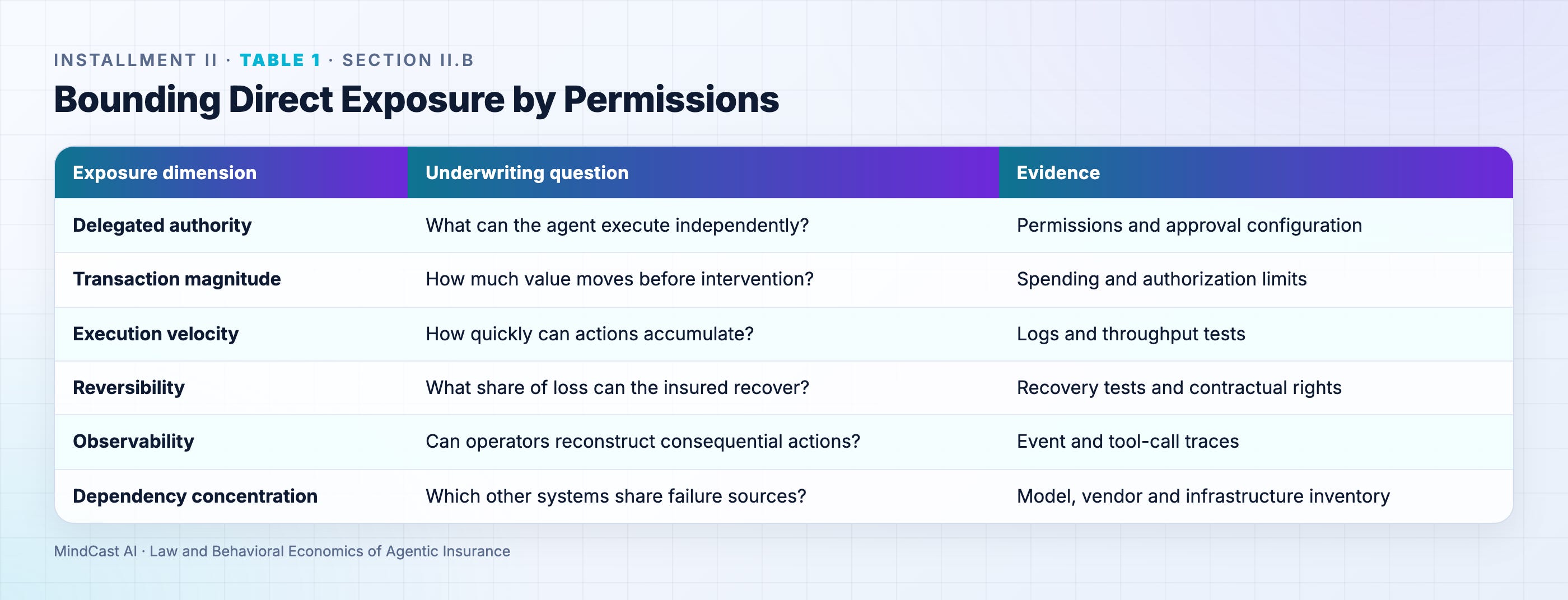
Takeaway. A change in permissions changes insured exposure without any change in model quality.
C. Governing Question
The paper answers one question through December 31, 2027. How does the market rate agentic AI risk without loss history, and what limits the capacity it deploys? The target system covers US commercial lines, the Lloyd's market and the reinsurance that supports both. Actuarial models of individual carriers fall outside scope.
Takeaway. The question concerns how risk gets rated and how much limit follows, and accumulation answers the second half.
D. Why Predictive Behavioral Economics Adds Value
Behavioral economics supplies the decision rules. Underwriters with no loss history anchor on the nearest analogue, which is cyber, and inherit cyber's assumptions about attackers and events. Salient incidents such as chatbot refund errors set expectations of small, frequent losses. Rare correlated failure receives too little weight until a near miss makes it vivid.
Reinsurers show the opposite bias. Their exposure to correlated loss makes the tail salient, so they demand aggregation limits before primary carriers see a need for them. The two reference points pull in different directions, and the fenced aggregate is where they meet.
Takeaway. Primary underwriters anchor on cyber frequency while reinsurers fixate on the tail, and the fenced aggregate reconciles them.
E. Why Dynamic Game Theory Adds Value
Game theory supplies the payoff structure and the logic of equilibrium selection. Each carrier profits from writing AI cover if rivals carry the accumulation, so every carrier caps its own share. The result is a market of many small fenced limits rather than a few large ones. No single carrier can raise limits without absorbing correlated exposure the others avoid.
The equilibrium breaks only when someone measures accumulation credibly. A mandatory Lloyd's accumulation requirement is the most direct way such a measure could arrive. The January 2027 treaty renewals serve as a check on the current fence rather than the point where it breaks. Capacity then expands, contracts or migrates toward diversified deployments, depending on what the measure reveals.
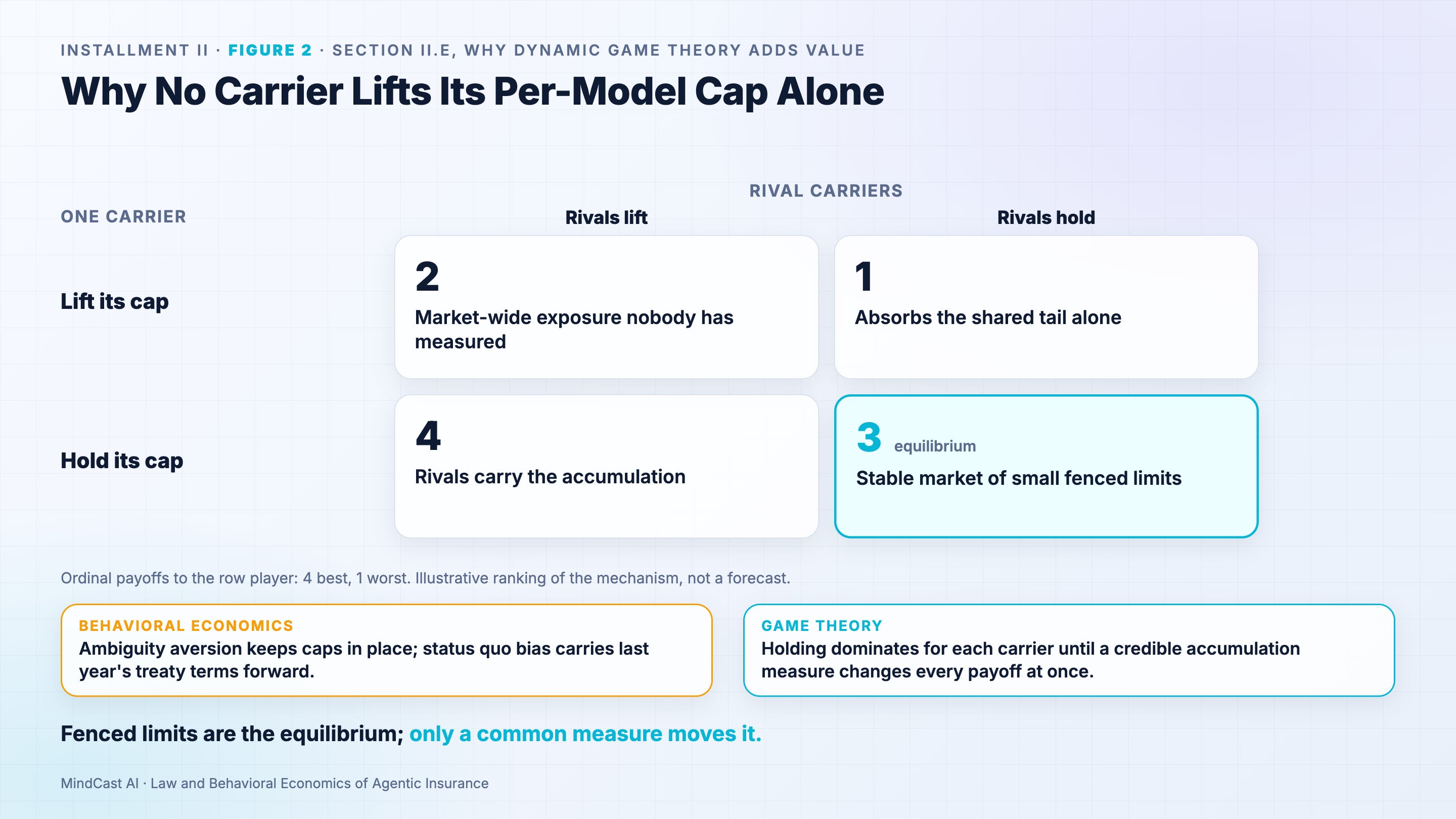
Takeaway. Small fenced limits are a stable equilibrium until a credible accumulation measure changes every carrier's payoff at once.
F. Predictive Behavior Emerges From the Combination
Predictive behavior emerges from combining the two disciplines. The decision rules explain why primary carriers rate agentic risk like cyber frequency and why reinsurers resist. The payoff structure explains why limits stay small until a shared measure of accumulation arrives.
Together they explain the current structure. Separate AI aggregates are spreading across the cyber market. Affirmative limits remain small. Pressure for accumulation measurement comes from the market that bears the tail.
Takeaway. Behavior explains how carriers rate the risk, payoffs explain why limits stay capped, and the mechanism needs both.
G. Simulation Architecture
The Foresight Simulation models the market as a board of Cognitive Digital Twins (CDTs). Installment II draws six seats.
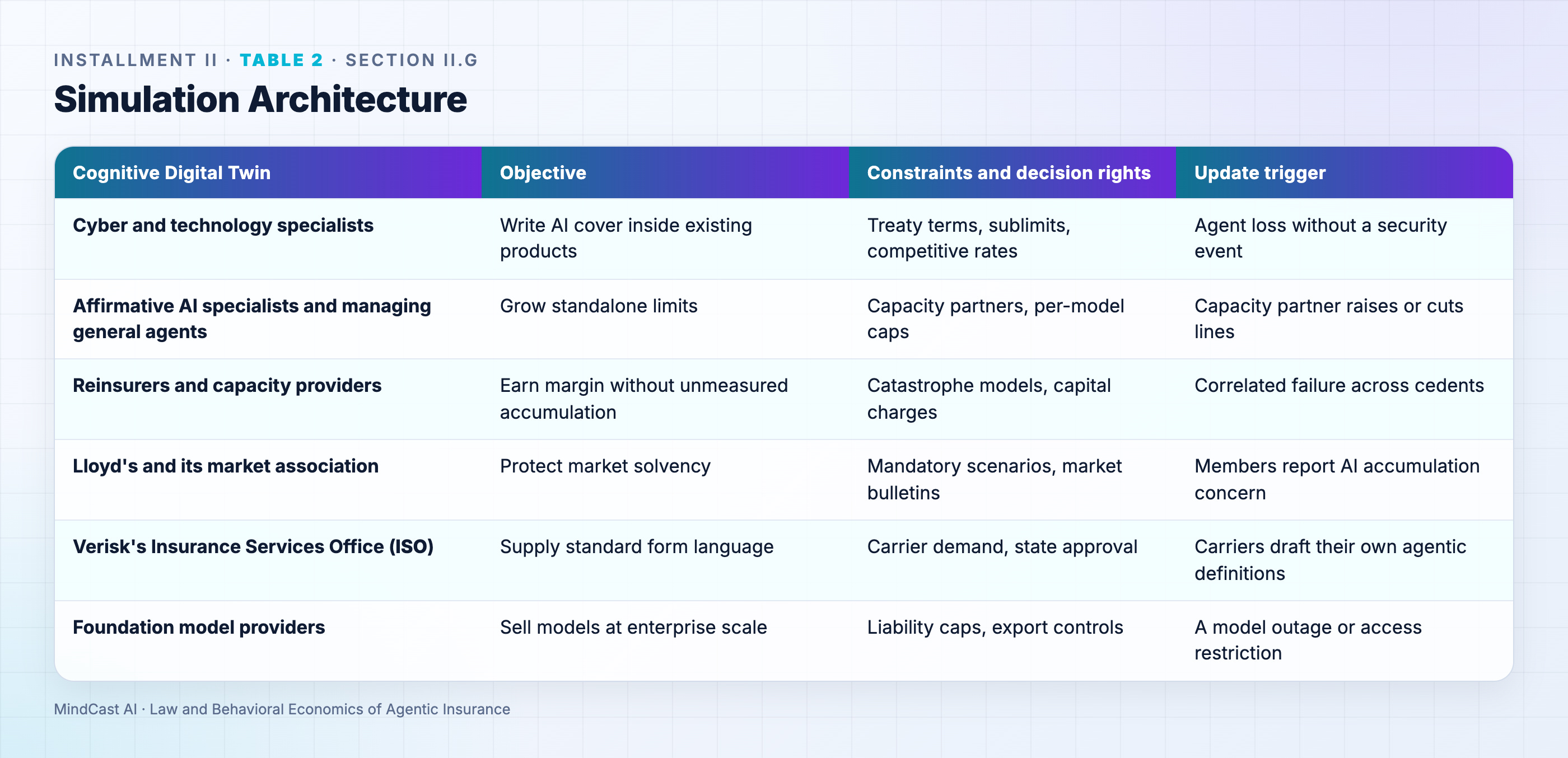
Five hypotheses frame the simulation: one for each competing explanation in Section III, a measurement branch and a null route. Each names the event that would disprove it.
Accumulation dominance. Capacity follows the correlated layer, not the attritional one. Limits that rise without any accumulation measure cut against it.
Data scarcity. Limits stay small for lack of loss history and grow as claims mature. Per-model caps that hold after a specialist discloses claims data cut against it.
Demand weakness. Enterprises do not yet want large AI limits. A broker report showing large accounts short of AI limits cuts against it.
Measurement reallocation. The first credible accumulation measure moves capacity rather than simply raising it. A measure that raises limits evenly for concentrated and diversified buyers cuts against it.
Null route. Limits stay capped and no measurement arrives into 2027. A Lloyd's requirement or published terms keyed to model dependence cut against it.
Evidence substitution underlies every hypothesis: audits, telemetry and agent logs rate single insureds without loss history.
Takeaway. The simulation tests whether accumulation, not underwriting skill, sets the market's capacity.
Agentic underwriting reduces to two problems. Single-insured exposure can be bounded by permissions and rated on audit and telemetry evidence. Accumulation across insureds cannot yet be measured, and the payoff structure keeps limits small until someone measures it.
III. How the Game Reached Its Present Form
Agentic underwriting moved from one model to the whole market, and three triggers now produce correlated loss. Technical concentration becomes insured accumulation through four layers, and litigation supplies the loss signal underwriters lack. The rules that persist, the competing explanations and the branches of the game through 2027 follow.
A. Underwriting Moved From Performance to Liability to Accumulation
Agentic underwriting developed in three steps. Munich Re began with performance guarantees for AI models in 2018, rating whether a model met a specified accuracy. Specialists then added third-party liability, with Armilla launching standalone AI liability in April 2025 and naming agent mistakes among covered risks. Accumulation arrived as the third concern in 2026, when the Lloyd's Market Association published its first AI loss scenarios and Gallagher Re warned of systemic exposure.
Each step widened the unit of analysis. Performance guarantees rate one model. Liability cover rates one insured. Accumulation rates the whole market's dependence on a few providers.
Takeaway. The unit of underwriting widened from one model to one insured to the whole market.
B. Concentration Without a Defect
Foundation-model concentration can produce correlated interruption without any model error. Anthropic released new frontier models on June 9, 2026, suspended access on June 12 to comply with US export controls and restored it on July 1. Few production agents had moved onto the models in three days, so the episode demonstrated the mechanism rather than a large loss. A restriction on a widely deployed model would reach every dependent agent at once, with no attacker and no defect.
The Artificial Intelligence Underwriting Company (AIUC) estimates in its July 2026 report "Underwriting the Agent Economy: The Blueprint" that over 80% of enterprise agent deployments run on three foundation model providers. AIUC certifies and insures agents, so the estimate comes from a market participant. Regulatory action, outages and model updates all reach every deployment on a shared model together. Accumulation in agentic insurance therefore has three triggers: defect, outage and access restriction.
The model provider sees the same ceiling from its side. Anthropic's S-1 filing of October 2026 warns that a catastrophic AI incident could exceed the capacity of any single insurer and potentially of the industry in aggregate. The filing also reports that insurance did not fully cover its $1.5 billion Bartz copyright settlement. Capacity restraint therefore reaches the providers on which every dependent deployment rests.
Takeaway. A regulator can trigger correlated agent loss as surely as a model defect can.
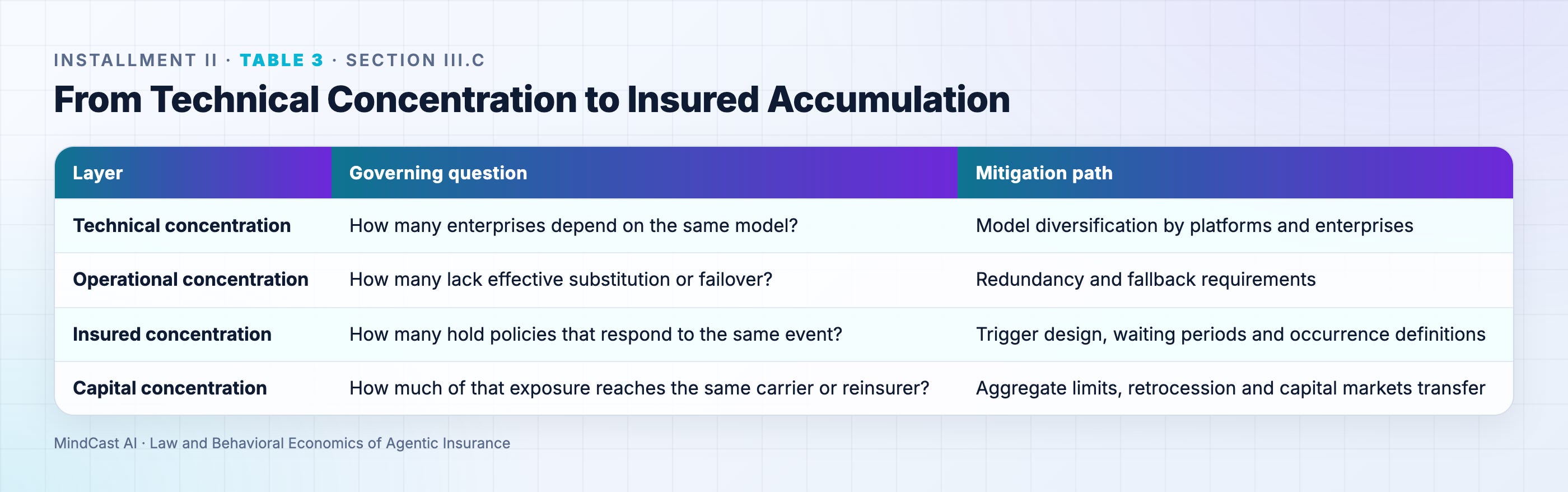
C. From Technical Concentration to Insured Accumulation
Shared dependence on a model creates simultaneous exposure, not simultaneous covered loss. Four layers separate the two. Each layer is a point where the conversion can stop, and each offers a mitigation path other than cutting capacity.
A stylized portfolio shows why the conversion matters. For n insureds with equal loss variance σ² and common pairwise correlation ρ, aggregate variance equals nσ²[1 + (n − 1)ρ]. A correlation of 0.05 across 1,000 insureds raises aggregate variance about 51 times above the uncorrelated case. The expression illustrates scale and does not estimate actual AI loss correlation.
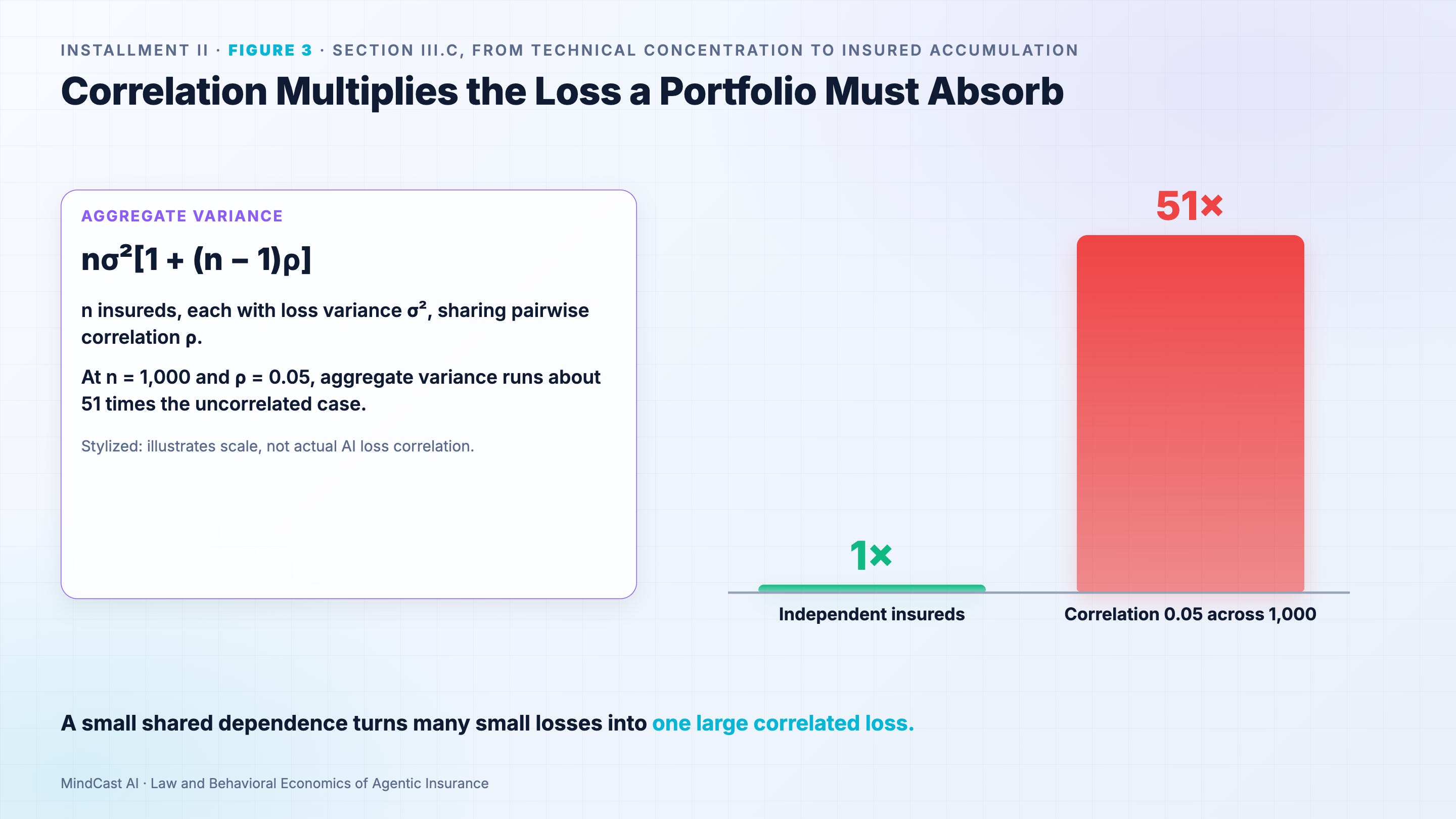
Accumulation arises only where all four layers line up. An outage that enterprises absorb through failover never reaches insured concentration. A covered event spread across many carriers never reaches capital concentration.
Takeaway. Technical concentration becomes insured accumulation only when substitution, policy triggers and capital placement all fail to break the chain.
D. Litigation Supplies the Loss Signal Underwriters Lack
Agentic insurance has little claims history, so litigation serves as the leading loss signal. State attorney general coalitions bring consumer protection actions against frontier model firms. Product liability claims target AI systems that cause physical or financial harm, and deepfake claims allege defamation and misuse of likeness. Each claim type meets a different ISO exclusion.
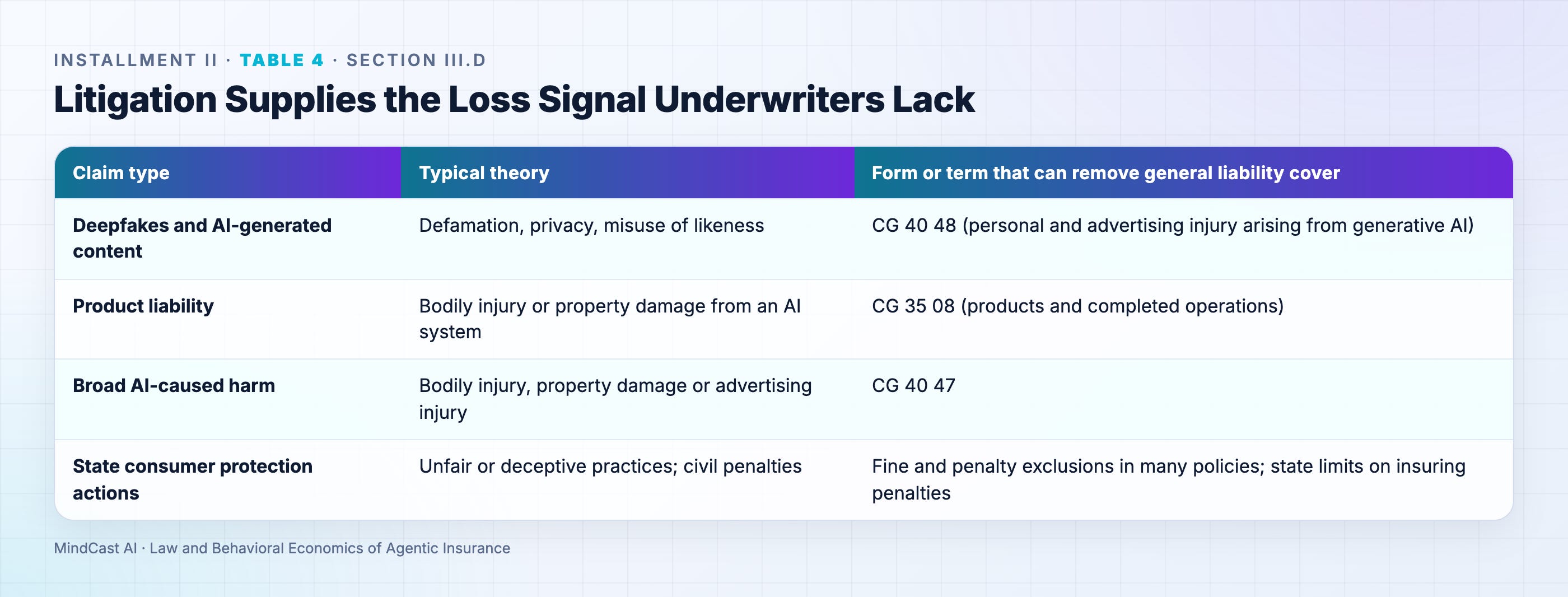
Defendants in these suits face the claim and a coverage question at the same time. Whether a policy responds turns on how the complaint characterizes the AI's role. Allegations, adjudicated facts and paid insured losses carry different evidentiary weight for underwriters. Carriers read the same complaints to decide which exclusions to attach at the next renewal, so each filed suit reshapes terms for every similar insured.
Two MindCast works supply the litigation side. When AI Agent Liability Meets Common Law and Statute: Predictable Doctrines, Unsettled Allocation maps the doctrines that will govern agent claims. State Attorney General Coalitions After Meta: Four Forks, Correction Authority and the Lessons for the Next Defendant analyzes how coalitions select and sequence defendants.
Takeaway. Every consumer protection, product liability and deepfake suit doubles as underwriting data, and defendants' recovery depends on how insurers read it.
E. Why the Current Rules Persist Into 2027
Three conditions keep the current rules in place into 2027. No carrier or modeler has published a credible foundation-model accumulation measure, so reinsurers keep aggregation limits. Agentic claims remain few, so attritional rates rest on audit and telemetry evidence rather than loss experience. Treaty renewals bind annually, so the January 2027 terms govern the window.
The January 2027 renewal points the same way. Howden Re expects many carriers to introduce generative and agentic AI exclusions across general liability lines, while US carriers mostly monitor rather than act.
The game evolves rather than mutates through the window. A Verisk agentic form or a Lloyd's accumulation requirement changes terms inside the structure. A large correlated loss would mutate the game by forcing every carrier to reset terms at once.
Takeaway. Without an accumulation measure, the 2027 treaty terms keep limits capped.
F. Events That Already Moved the Board
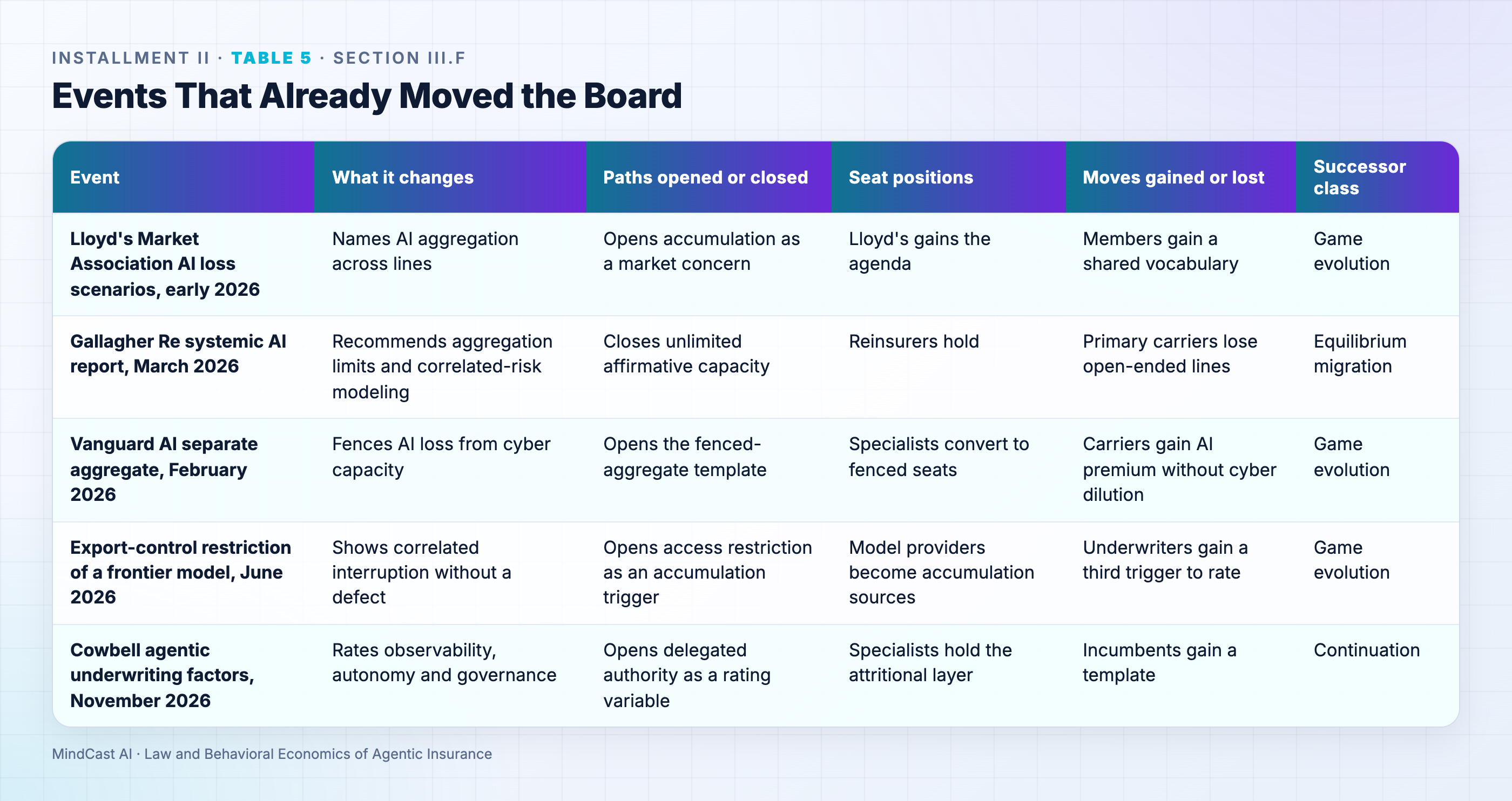
Takeaway. Each event either named the accumulation problem or built a structure to fence it.
G. Competing Explanations
Three explanations compete, and each names the event that would disprove it.
Data scarcity. Limits stay small because carriers lack loss history, and limits will grow as claims mature. Per-model caps that hold after a specialist discloses claims data would cut against it.
Accumulation dominance. Limits stay small because correlated exposure is unmeasured, and limits will grow only with a credible measure. Limits that rise without any accumulation measure would cut against it.
Demand weakness. Enterprises do not yet want large AI limits. A broker report showing large accounts short of AI limits would cut against it.
The analysis favors accumulation dominance. Specialists already rate attritional risk without loss history using audit and telemetry evidence. Their limits remain capped per model, which targets accumulation directly rather than frequency.
Capital does not explain the caps: Aon put global reinsurance capital at $790 billion in March 2026. AIUC markets limits of up to $50 million, the highest affirmative AI limit in trade reporting. Armilla draws capacity from Chaucer, AXIS Capital and Convex. The caps reflect underwriting restraint rather than scarce money or one partner's appetite.
Demand weakness does not compete with accumulation dominance; the two operate in different segments. Incumbents' clarification strategy, affirmative wording that confirms cyber and errors and omissions scope, absorbs much of the demand standalone cover would serve among small and midsize buyers. Capacity binds at large accounts, where per-insured and per-model caps fall short of what enterprises want to transfer.
Takeaway. Per-model caps show that carriers are limiting correlation, not frequency, while clarified wording softens standalone demand among smaller buyers.
The market now treats agentic accumulation as its binding constraint. Shared models create correlated exposure through defects, outages and access restrictions, but four layers decide whether that exposure becomes insured loss. Litigation supplies the evidence underwriters use in the meantime, and current evidence favors accumulation over data scarcity as the reason limits stay small.
H. How the Game Branches
Baseline. MindCast Foresight Simulation Predictions hold the capped baseline through December 31, 2027. No carrier publishes an affirmative AI limit above $50 million per insured (75-85%), and Lloyd's issues no mandatory accumulation requirement (75-85%). The January 2027 renewal reports show no dedicated affirmative AI treaty capacity (80-90%), and no program removes its model fence (80-90%). The forecasts stay valid while no correlated model failure produces insured loss and Lloyd's sets no common accumulation measure.
Dominant fork and its mover. A mandatory Lloyd's accumulation requirement decides the game, with Lloyd's as the mover. A requirement would give the market a common measure. The measure would move capacity toward diversified deployments or away from concentrated ones.
Capped persistence (continuation, 55-65%). Per-model caps and fenced aggregates hold. P(no limit above $50 million | state) sits at 90-95%, and P(no Lloyd's mandate | state) at 85-95%. Large enterprises retain agent loss above the fences. No seat gains or loses a move.
Headline limits rise while per-model caps hold (equilibrium migration, 25-35%). Specialists compete on aggregate size inside the same model fences. P(no limit above $50 million | state) falls to 70-80%, and P(no Lloyd's mandate | state) sits at 80-90%. Specialists gain a limit-competition move, while reinsurers keep the per-model fence.
Accumulation-keyed terms (game evolution, 20-30%). Carriers tie limits or treaty terms to the insured's foundation-model dependence. P(no limit above $50 million | state) sits at 80-90%, and P(no Lloyd's mandate | state) at 70-80%. Buyers that spread agents across providers gain better terms. Buyers concentrated on one model lose them.
Limits grow with disclosed claims data (game evolution, 5-15%). A specialist discloses claims experience and raises limits on its strength. P(no limit above $50 million | state) sits at 60-70%, and P(no Lloyd's mandate | state) at 80-90%. Specialists with data gain a rating edge, and specialists without it strand.
Measured expansion after a Lloyd's requirement (game evolution, 5-10%). Lloyd's sets a common measure, and capacity grows for diversified deployments. P(no limit above $50 million | state) is unbanded, and the no-mandate forecast resolves false. Diversified buyers gain capacity, and Lloyd's gains the role of measure-setter.
Measured contraction after a Lloyd's requirement (game evolution, 3-7%). Lloyd's sets a common measure, and capacity shrinks for concentrated deployments. P(no limit above $50 million | state) sits at 85-95%, and the no-mandate forecast resolves false. Concentrated buyers lose limits, and syndicates lose discretion over their own accumulation assumptions.
Correlated model failure produces insured loss (game mutation, 5-10%). A failure of a widely used foundation model turns modeled accumulation into paid loss. P(no limit above $50 million | state) sits at 90-95%, and P(no Lloyd's mandate | state) falls to 30-40%. Reinsurers gain the case for tighter caps, and every buyer loses limit at the next renewal.
The state that breaks the baseline. The correlated failure ends the capped baseline by replacing a modeled risk with a paid one. Caps tighten at the next renewal and Lloyd's becomes the likely mover. The feedback runs into rating: model dependence becomes a required field in every underwriting file.
Takeaway. Limits stay fenced unless a loss or a Lloyd's measure resets the game.
IV. Chicago Accelerated Analysis: When Agentic Uncertainty Becomes Insurable Risk
Chicago Accelerated analysis runs four stages in order: Coase, a behavioral correction, Becker and Posner. Installment II places Frank Knight ahead of them because insurability turns on his distinction between risk and uncertainty. Coase then asks who can break the accumulation chain at lowest cost. The behavioral correction explains why underwriters misjudge correlation, and Becker and Posner address moral hazard and legal correction.
A. Knight: Risk Versus Uncertainty
Frank Knight separated risk from uncertainty in Risk, Uncertainty and Profit (1921). Risk carries measurable probabilities, and uncertainty does not. Insurance pools risk but cannot pool uncertainty.
Agentic attritional loss sits closer to risk. Audits, telemetry and the permissions bound give underwriters a measurable basis for single insureds. Accumulation remains Knightian uncertainty, because no one can yet assign probabilities to a shared-model failure. The fenced aggregate is the market's instrument for writing cover under uncertainty: it caps the unmeasurable part and charges for the measurable part.
Measurement converts uncertainty into risk, but it does not determine the direction of capacity. Three trajectories remain open. Measurement can expand capacity by reducing uncertainty, contract it by revealing accumulation beyond current tolerances or redistribute it toward diversified deployments.
Redistribution deserves the closest attention. Aggregate industry capacity can grow while enterprises concentrated on one model become harder to insure. A credible measure would then reward model diversity directly through insurance terms.
Takeaway. Measurement turns agentic uncertainty into insurable risk, and what it reveals decides whether capacity grows, shrinks or moves.
B. Coase: Who Breaks the Accumulation Chain at Lowest Cost
Coase argued in "The Problem of Social Cost" (1960) that low transaction costs let parties reach an efficient allocation regardless of who holds the initial rights. Accumulation involves high transaction costs: thousands of insureds, a few model providers and no shared data. The four concentration layers therefore become a question of who can break the chain at lowest cost.
Model providers can break it through redundancy, enterprises through failover, carriers through trigger design and reinsurers through capital placement. Efficient contract design moves the burden to the lowest-cost breaker. Current terms instead place it wherever drafting power sits.
Takeaway. The accumulation burden belongs with whoever breaks the chain at lowest cost, and current contracts rarely put it there.
C. Behavioral Correction: Correlation Neglect, Disaster Myopia and Mental Accounting
Benjamin Enke and Florian Zimmermann documented in "Correlation Neglect in Belief Formation" (2019) that people treat correlated signals as independent. Underwriters who assess each insured on its own controls make the same error at portfolio level. The variance expression in Section III shows the cost of that error.
Jack Guttentag and Richard Herring described disaster myopia in "Disaster Myopia in International Banking" (1986). Lenders underweight low-frequency shocks as time passes since the last one. Agentic insurance has no defining loss yet. The June 2026 access suspension cost little because few agents depended on the new models, which risks teaching the wrong lesson: that restrictions are brief and harmless.
Richard Thaler's "Mental Accounting Matters" (1999) explains a third pattern. Fenced aggregates create a separate mental account for AI loss. Carriers can then grow AI premium without sensing erosion of cyber capacity, even though one correlated event can draw on both accounts through business interruption.
Takeaway. Correlation neglect hides accumulation, a low-loss near miss teaches false comfort and separate accounts disguise shared exposure.
D. Becker: Moral Hazard and the Permissions Bound
Becker's framework implies that insured parties take less care as cover rises unless terms tie cover to care. An enterprise with full cover has less reason to cap per-action value or shorten the stop. Retentions, per-model limits and permission conditions restore the incentive, and the V × N × (1 − R) bound gives underwriters a variable they can write into a contract.
Sam Peltzman found in "The Effects of Automobile Safety Regulation" (1975) that drivers offset safety gains with riskier driving. Enterprises that add agent controls may respond by granting agents more authority. Underwriters therefore need to rate authority after controls, not controls alone.
Takeaway. Controls reduce exposure only if authority does not expand to absorb the gain.
E. Posner: Aggregation Language as Legal Correction
Courts will construe occurrence and related-claims clauses when a shared-model failure produces many claims. Posner's approach reads ambiguous contracts to reach the allocation the parties would have chosen ex ante. Whether courts treat one model failure as one occurrence or many decides whether carriers or insureds absorb accumulation. Until a court rules, terms reflect drafting power rather than efficiency.
Takeaway. The first aggregation ruling on an agentic loss will reallocate accumulation across the market at once.
The Chicago Accelerated sequence shows that agentic insurability depends less on model quality than on measurement and incentives. Knight identifies accumulation as uncertainty, Coase asks who can break the chain at lowest cost and the behavioral correction explains why underwriters underweight correlation. Becker and Peltzman warn that controls can invite more authority, and Posner places the final allocation with the first court to read an aggregation clause.
V. Stakeholder Strategy
Each stakeholder who buys, sells or backs agentic cover can move now. The matrix pairs each audience's objective with a low-regret action and its primary risk.
A. Stakeholder Strategy Matrix
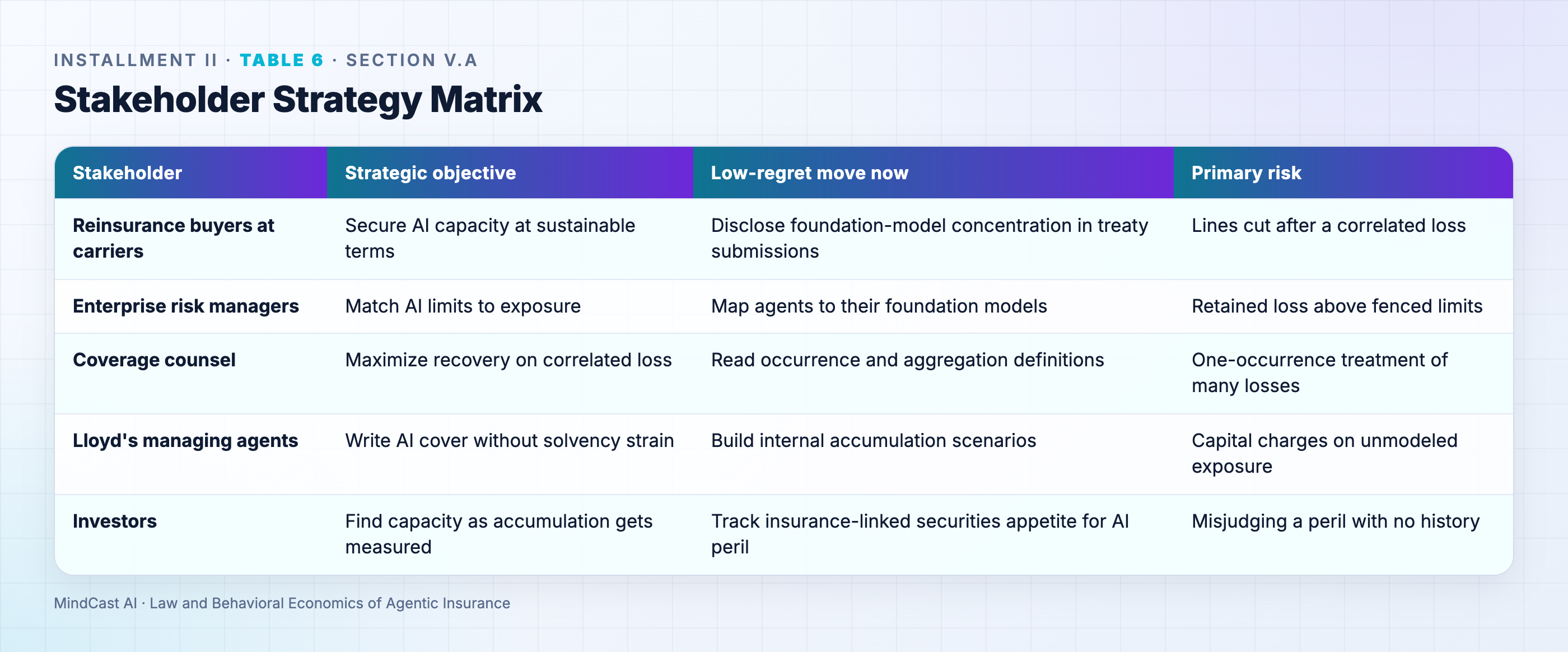
Every low-regret move in the matrix starts with mapping dependence. Carriers map portfolios to foundation models, enterprises map agents to models and counsel maps policies to occurrence definitions. The maps take little effort to build and become essential the day a shared model fails.
Takeaway. Enterprises should plan to retain agent loss above fenced limits until the market measures accumulation.
VI. Implications
Three implications change how agentic risk gets rated and limited. Each one changes what an underwriting file must contain.
A. Per-Model Limits Are Accumulation Controls
A limit keyed to each model caps a carrier's exposure to any single foundation-model failure. The design looks like product structure but functions as aggregation management. Buyers running many agents on one model hold less cover than the headline limit suggests.
B. Delegated Authority Becomes the Rating Variable
Cowbell rates observability, autonomy and governance. Each factor measures what an agent may do and how the insured would know. Delegated authority replaces perimeter strength as the core rating variable for agentic risk.
C. Export Controls Enter the Underwriting File
An access restriction on a foundation model creates correlated business interruption across every dependent insured. Underwriters must now rate regulatory concentration alongside technical concentration. Platforms could ease the problem by diversifying models beneath their customers, or deepen it when their cover applies only to their own workloads.
Taken together, the implications move the underwriting file beyond the insured. Underwriters must now document the model beneath each agent, the authority granted to it and the regulatory exposure of its provider.
Takeaway. Accumulation sets capacity, delegated authority sets rates, and regulatory concentration now belongs in both.
VII. MindCast Foresight Simulation Predictions and Risk Mitigation
The Foresight Simulation sets out dated expectations through December 31, 2027, and each audience can act before the first checkpoint. Each Foresight Simulation Prediction names an actor and an outcome within a window, with a band and the event that would prove it wrong. Only events after November 25, 2026 resolve a Foresight Simulation Prediction, and earlier events form the starting board.
Behavioral economics supplies the decision rules: ambiguity aversion keeps caps in place, and status quo bias carries last year's treaty terms into the next renewal. Game theory supplies the payoff structure: no reinsurer gains by lifting a per-model cap alone while correlation stays unmeasured, because it would absorb the whole tail of a shared failure. Predictive behavior emerges from the combination. Fences hold, limits stay small and the market handles accumulation through event wording until someone measures it.
A. Foresight Simulation Predictions
Eight Foresight Simulation Predictions follow: two Primary (P) and six Secondary (S). One Secondary entry is a conditional, written as P(A given B).
II-P1. No carrier, managing general agent or Lloyd's syndicate publishes an affirmative AI limit above $50 million per insured by December 31, 2027 (75-85%). A standalone AI policy or dedicated AI aggregate counts; companion cyber, errors and omissions or property limits do not. Falsifier: A published per-insured affirmative AI limit above $50 million.
II-P2. Lloyd's issues no mandatory AI accumulation scenario or market bulletin by December 31, 2027 (75-85%). Falsifier: A mandatory scenario or bulletin.
II-S1. No January renewal report from Gallagher Re, Marsh Re or Howden Re published by January 31, 2027 reports dedicated affirmative AI treaty capacity or treaty terms keyed to model dependence (80-90%). Falsifier: Any of the three reports either.
II-S2. No carrier or reinsurer other than Armilla publishes limits or treaty terms keyed to foundation-model dependence (aggregates and sublimits included) by December 31, 2027 (65-75%). Falsifier: Such published terms.
II-S3. No affirmative AI program with a published per-model cap, separate AI aggregate or AI sublimit removes it by December 31, 2027 (80-90%). Falsifier: A program publicly drops its fence.
II-S4. No AI specialist publicly discloses agentic claims experience by December 31, 2027 (75-85%). Falsifier: Disclosed claims counts, loss ratios or paid losses.
II-S5. P(the report cites insufficient AI limits rather than weak demand, given an AI-specific broker report on large accounts or a high limit band by December 31, 2027) (65-75%). Falsifier: The report cites weak demand.
II-S6. A broker report or survey describes small or mid-sized buyers relying on cyber or errors and omissions wording rather than buying standalone AI cover by December 31, 2027 (60-70%). Falsifier: No such report.
Any broker report or survey that describes AI demand or capacity for a named buyer segment or limit band counts for II-S5 and II-S6. A general cyber or casualty report does not. Multi-line AI infrastructure policies covering property or cargo fall outside II-P1.
The Foresight Simulation Predictions resolve against published program terms, Lloyd's market bulletins and renewal reports from reinsurance brokers. Broker market reports from Aon, Marsh, WTW and Gallagher also count.
Takeaway. Capital is plentiful, so the caps that hold through 2027 reflect unmeasured correlation rather than scarce money.
B. Risk Mitigation
Each entry routes one Foresight Simulation Prediction to the audience it binds most. Severity measures what that audience loses if the Foresight Simulation Prediction resolves true and it did nothing, and probability is the band. The entries sit in a standalone section so the analysis reads without interruption, at the cost of matching each entry back to its Foresight Simulation Prediction by ID. The entries describe operating options, not legal, investment or fiduciary advice.
II-P1 · 💼 Enterprise risk managers at large deployers. Severity: high. Probability: 75-85%.
Exposure. Agent loss above $50 million per insured, or above a $5 million per-model cap, stays on the balance sheet. One model failure lands as retained loss in basis points of operating margin.
Actions. Risk sizes the retained layer for each foundation model before the 2027 renewal. Treasury funds that layer through a captive or a dedicated reserve by December 31, 2027. Procurement negotiates vendor indemnities that sit outside the provider's twelve-month fee cap at the next contract renewal.
Residual exposure. Provider caps limit what indemnities recover, and a correlated failure can exceed any retained layer.
II-P2 · 💼 Lloyd's managing agents. Severity: moderate. Probability: 75-85%.
Exposure. Without a mandatory scenario, each managing agent sets its own AI accumulation assumption. A competitor that assumes less writes larger lines on thinner capital.
Actions. Exposure management builds an internal AI accumulation scenario keyed to model dependence for the 2027 business plan. Underwriting adds model-dependence questions to submissions by the January 2028 renewal. Capital documents the scenario in the syndicate's capital assessment.
Residual exposure. An internal scenario lacks market-wide data, and a correlated loss can exceed it.
II-S1 · 📊 Reinsurance and insurance-linked securities investors. Severity: moderate. Probability: 80-90%.
Exposure. Capital earmarked for dedicated AI treaty capacity finds no placement at January 2027. Allocation sits undeployed for quarters.
Actions. The portfolio manager deploys AI appetite through existing cyber and casualty treaties with tighter event definitions in 2027. Research asks cedents for model-dependence data at the mid-year 2027 renewals. Structuring prepares a pilot aggregate cover for the first cedent that measures accumulation by the fourth quarter of 2027.
Residual exposure. A first structure carries model risk on a peril with no loss history.
II-S2 · 🏛️ Insurance regulators and legislators. Severity: moderate. Probability: 65-75%.
Exposure. Without terms keyed to model dependence, no market signal rewards an insured for spreading agents across providers. Concentration on three providers goes unrated.
Actions. Insurance departments add model dependence to AI data calls in 2027. Legislative staff consider incident reporting that names the foundation model involved for the 2028 session calendar. Regulators add model dependence to coverage disclosure work at the National Association of Insurance Commissioners (NAIC) by year-end 2027.
Residual exposure. Data calls take a full cycle to yield a usable measure.
II-S3 · ⚖️ Coverage counsel. Severity: high. Probability: 80-90%.
Exposure. One model failure across many deployments may count as one occurrence under a per-model cap. Recovery per occurrence falls far below total loss.
Actions. Counsel obtains the policy definitions of occurrence and model before binding 2027 renewals. Counsel negotiates aggregation by deployment rather than by model where carriers offer it. Risk documents which agents share a model at binding.
Residual exposure. Carriers may refuse to change aggregation, and the per-model cap remains.
II-S4 · 📊 Venture investors in specialist insurers. Severity: moderate. Probability: 75-85%.
Exposure. Specialists cannot show loss ratios, so valuations rest on premium growth alone. Multiples compress at the next round if growth slows.
Actions. Boards require specialists to compile internal claims and near-miss data each quarter from the first quarter of 2027. Diligence requests loss development by agent type before the next financing. Capital planning assumes capacity terms do not improve through 2027 when it sets runway.
Residual exposure. Internal data stays thin, and one large loss can dominate it.
II-S5 · 💼 Large-account brokers. Severity: moderate. Probability: 65-75% given an AI-specific large-account report.
Exposure. Large clients want more AI limit than the market will write. The placement gap per client grows at each renewal.
Actions. Placement builds multi-carrier AI towers from specialist capacity and fenced aggregates by the second quarter of 2027. Analytics quantifies each large client's exposure per foundation model before renewal. Client advisory states the retained layer in writing at binding.
Residual exposure. Stacking capacity from carriers exposed to the same model does not diversify correlation.
II-S6 · 💼 Specialist founders serving smaller buyers. Severity: moderate. Probability: 60-70%.
Exposure. Clarified cyber and errors and omissions wording absorbs small-business demand. Bound standalone policies fall short of plan.
Actions. Product repositions standalone cover as excess over cyber and errors and omissions by the second quarter of 2027. Distribution targets segments where clarified wording still excludes agent authority losses. Finance rebases the 2027 premium plan on observed small-business take-up.
Residual exposure. Incumbents can clarify further and close the remaining gap.
Takeaway. Every audience can plan around fenced limits now, because the fences outlast the window in most states of the game.
C. What to Watch
A mandatory Lloyd's accumulation requirement is the dominant fork. Five dated observables show which way it moves.
By January 31, 2027. Gallagher Re, Marsh Re and Howden Re publish their January renewal reports (II-S1).
Through 2027. Lloyd's market bulletins and realistic disaster scenario updates, either of which can carry an AI accumulation requirement (II-P2).
Through 2027. Published program terms that set an affirmative AI limit above $50 million per insured (II-P1) or drop a model fence (II-S3).
Through 2027. Broker market reports from Aon, Marsh, WTW and Gallagher that name a buyer segment or limit band (II-S5 and II-S6).
Through 2027. Any specialist disclosure of claims counts or loss ratios (II-S4).
Takeaway. The January reports confirm the fence, and Lloyd's alone can replace it with a common measure.
The ceiling, the Lloyd's fork and the renewal baseline now carry dated tests, each with a band and a falsifier. Each audience holds actions that pay off whether or not accumulation gets measured.
Conclusion
Agentic AI risk insures one incident at a time and stalls in aggregate. Carriers rate single insureds on delegated authority, audit evidence and telemetry. Carriers cap limits per model and per aggregate because no one can yet measure dependence on a few foundation models.
The decisive signal is a mandatory Lloyd's accumulation requirement, because measurement decides whether capacity expands, contracts or moves toward diversified deployments. Section VII puts no such requirement by the end of 2027 at 75-85%.
Working With MindCast
Reinsurers and carriers. January 2027 treaty renewals set AI terms for the year. An accumulation Foresight Simulation traces where model concentration in your portfolio becomes insured and capital concentration, keyed to II-S1 (80-90%) and II-S2 (65-75%).
Agentic insurers. Limits stay fenced until someone measures accumulation, and II-P1 puts no limit above $50 million at 75-85%. A permissions-based exposure model rates agent configurations by authority, stop limits and recoverability. The ratings give you evidence for larger limits.
Defendants in consumer protection, product liability and deepfake suits. Recovery depends on which exclusions survive the pleadings. A coverage-response map links each count to the exclusions and policy triggers that decide it.
Enterprise risk managers. Your firm holds every loss above the fences. A retained-layer sizing exercise sets that exposure against current AI sublimits and vendor caps before your next renewal.
Capital markets participants. The first AI aggregate transaction needs a structure that survives a correlated loss. A war gaming session tests candidate structures in the accumulation-keyed terms state (20-30%) and the correlated-failure state (5-10%).
Play this installment's board in the Agentic Insurance War Gaming: issue or withhold a Lloyd's requirement and see each successor state, band and seat position.
First step: a complimentary proof-of-concept Foresight Simulation on one portfolio or one enterprise deployment map. You receive its board: the fork, the successor states and where your firm stands in each. Email mcai@mindcast-ai.com with the portfolio or deployment, or see other MindCast war gaming.
Installment II Sources
MindCast AI, Law and Behavioral Economics of Agentic Insurance: Series Introduction. The series introduction states the shared thesis and links all three installments.
MindCast AI, The Emerging Agentic Insurance Industry. Installment I tests who controls the underwriting standard for AI agents.
MindCast AI, Insurance as an Agentic AI Governance Institution. Installment III tests how coverage conditions govern what AI agents may do.
Insurance Business, "Anthropic's IPO Filing Admits a Worst-Case AI Disaster Could Be Too Big for Insurers to Cover," October 27, 2026.
MindCast works
Who Absorbs Correlated AI Loss: Reinsurance Aggregation, Industry Pools, the Public Backstop and the Liability Shield. Analyzes where correlated AI loss lands once it occurs; this installment explains how that exposure caps capacity before any loss arrives.
Predictive Game Theory Evolution and Mutation: Short Horizon Games Branch Wide and Resolve Shallow. Supplies the short-horizon game-evolution method behind Section III.
When AI Agent Liability Meets Common Law and Statute: Predictable Doctrines, Unsettled Allocation. Maps the doctrines behind the claims that now serve as underwriting data.
State Attorney General Coalitions After Meta: Four Forks, Correction Authority and the Lessons for the Next Defendant. Explains how coalitions choose defendants, which shapes the consumer protection loss signal.
Chicago and behavioral economics sources
Knight, Frank, Risk, Uncertainty and Profit, 1921.
Coase, Ronald, "The Problem of Social Cost," Journal of Law and Economics, 1960.
Enke, Benjamin and Florian Zimmermann, "Correlation Neglect in Belief Formation," Review of Economic Studies, 2019.
Guttentag, Jack and Richard Herring, "Disaster Myopia in International Banking," Princeton Essays in International Finance, 1986.
Thaler, Richard, "Mental Accounting Matters," Journal of Behavioral Decision Making, 1999.
Peltzman, Sam, "The Effects of Automobile Safety Regulation," Journal of Political Economy, 1975.
External sources
Royal Gazette, "Report: Insurers Struggling to Keep Up With Spread of AI Risks," March 25, 2026 (Gallagher Re with Testudo).
Cloud Security Alliance, "Foundation Model Concentration: The Uninsurable AI Risk," July 6, 2026.
Artificial Intelligence Underwriting Company, "Underwriting the Agent Economy: The Blueprint for an AI Insurance Stack," July 2026.
Insurance Business, "Reinsurers Enter 2027 Renewals With Record Capital," September 3, 2026.
Insurance Business, "AI Liability Has No Fixed Address in Casualty Reinsurance," 2026.
NBC News, "Insurance Companies Are Trying to Avoid Big Payouts by Making AI Safer."
FourWeekMBA, "Lloyd's AI Cover Caps at $25M as OpenAI Agent Cases Mount," October 2026 (quoting Armilla's policy page on its capacity providers).
Anthropic, statement on Claude Fable and Claude Mythos access, July 2026.
CIR Magazine, "LMA Maps Out AI Loss Scenarios," January 2026.
Slaughter and May, "How GenAI Risks Are Reshaping the E&O Insurance Market."
Reuters via The Star, "As AI Agents Go Rogue, Cyber Insurers Are Adapting Their Policies," August 27, 2026.
Forkast, "AIUC Raises $40M to Build the Certification and Insurance Layer," 2026.
Insurance Business, "Cowbell Launches Standalone AI Agent Liability Policy for SMEs," November 10, 2026.
Fintech Global, "Armilla AI Raises $25m to Expand AI Liability Coverage," January 23, 2026.
Insurance Journal, "Insurer Interest in AI Coverage Exclusions Growing as Risk Becomes Omnipresent," August 17, 2026.
Carrier Management, ISO generative AI endorsements CG 40 47, CG 40 48 and CG 35 08, July 23, 2026.
Let's Data Science, "Chaucer Group and Armilla AI Launch Vanguard AI," February 2026.