Cowbell · Armilla · AIUC · Munich Re · Beazley · CFC · Chubb · Google Cloud · Aon · Marsh · Lockton · National Association of Insurance Commissioners · State insurance regulators · Colorado · RAND · Enterprise boards and risk committees
Companion to Installment I: The Emerging Agentic Insurance Industry and Installment II: The Economics of Agentic AI Underwriting · Who Writes AI Insurance Coverage Conditions: Procurement, Enforcement Decrees, Partner Terms and the Two-Axis Condition
Series: Series Introduction: The Agentic Insurance Industry · Interactive War Gaming: Agentic Insurance
I. Executive Summary
Insurance eligibility acts as a deployment authorization layer for artificial intelligence (AI) agents wherever enterprises depend on external cover. An enterprise that cannot insure an agent with broad transaction authority faces a choice: narrow the authority or retain the loss. Underwriting conditions on delegated authority, human approval and traceability therefore govern agent design in sectors where no statute does. The governance power is real, and incumbents exercise it through broad exclusions and terms that reward documented human oversight while certifiers reach enterprises first through the joint System and Organization Controls 2 (SOC 2) plus AIUC-1 audit from the Artificial Intelligence Underwriting Company (AIUC).
The evidence arrived in 2026. Cowbell's November announcement rates small businesses on three factors: how they monitor their agents, what authority those agents hold and how they govern them. AIUC ties insurance terms directly to audit results. Aon's 2026 AI risk report found that carriers evaluating commercial accounts increasingly look for documented AI governance frameworks.
MindCast distinction. MindCast AI applies Predictive Behavioral Economics + Dynamic Game Theory through MindCast AI Proprietary Cognitive Digital Twin Foresight Simulations (MP CDT FS). Behavioral Economics supplies the decision rules. Game Theory supplies the payoff structure. Predictive simulations emerge from the combination.
Working hypothesis. Delegated authority is converging as the unit of agent governance across three institutions. Underwriters rate it, certifiers audit it and insurance regulators now use it in their own supervisory vocabulary. Insurers hold the strongest enforcement tool, because non-renewal requires no statute. Regulators are moving toward disclosure of what policies cover rather than mandates on what enterprises must do.
Central finding. Incumbents govern agents through what they exclude and how they set terms, not through new affirmative wording. No top-20 US commercial carrier publishes an affirmative authority condition by December 31, 2027 (55-65%), counting human-review carve-backs as conditions. No state mandates deployer insurance or agent controls in the same window (85-95%). Both are MindCast Foresight Simulation Predictions, and specialists hold the affirmative triggers meanwhile.

Explore this installment's board in the Agentic Insurance War Gaming. The board shows the fork, the successor states with their bands and where each player stands.
Why now. Colorado's AI law takes effect January 1, 2027, and carriers write 2027 renewal conditions now. Boards, carrier product teams, regulators and defense counsel face the governance choice inside one cycle.
What the paper does. Section II sets out the governance mechanism and the governing question. Section III explains how the game reached its form, weighs the competing explanations and shows how the game branches. Section IV applies Chicago Accelerated analysis, Section V sets out stakeholder strategy and Section VI traces the implications. Section VII states eight Foresight Simulation Predictions and sets out risk mitigation for each audience.
Stakeholder readout.
🏛️ Policymakers. Insurers already govern agent authority through eligibility conditions. Legislators and regulators should decide whether to require disclosure of what policies cover, a lighter tool than mandates that the market can absorb within one renewal cycle.
💼 Executives. Boards that approve agent deployments will answer insurer questions about delegated authority before they answer any regulator's. Executives should document transaction limits, human approval points and reversal procedures for every production agent now. Frontier model firms negotiating with state coalitions should expect accepted conduct terms to become reference controls for underwriters.
⚖️ Counsel. Underwriting answers, certification requirements and policy conditions carry different legal effects. Counsel should identify which instrument actually binds each client and align vendor contracts and internal policies with it.
📊 Investors. Insurability becomes a gating factor for agent-heavy business models. Investors should ask portfolio companies whether their core agents are insurable on current terms and at what limit.
Takeaway. Insurers govern AI agents through the power to decline cover, and incumbents reward human oversight before they adopt any certifier's standard.
II. Topic and Simulation Fit
Insurance can govern agent design, but only where enterprises depend on external cover. Underwriting questions become engineering constraints, enterprises can bypass the insurer under named conditions and separate legal instruments carry the requirement. The governing question and the behavioral and game-theoretic mechanisms follow.
A. Underwriting Questions Become Design Requirements
Underwriting questions change behavior when the answer decides eligibility. Cyber insurance showed the pattern: carriers required multifactor authentication and endpoint detection, and enterprises adopted both faster than any regulation required. Agentic insurance applies the same lever to delegated authority.
An underwriter asking how much an agent may spend without human approval sets a de facto ceiling. An enterprise that wants cover keeps the agent below the ceiling. The insurance question becomes an engineering constraint.
Takeaway. The insurance application becomes the first governance document most agent deployments must satisfy.
B. Where Insurance Binds and Where Enterprises Bypass It
Insurer governance power depends on how much the enterprise needs the insurer. A firm that can retain losses, use a captive or find another carrier faces little pressure from any one underwriter. A firm bound by customer contracts that require cover faces a hard constraint. Five conditions decide which case applies.
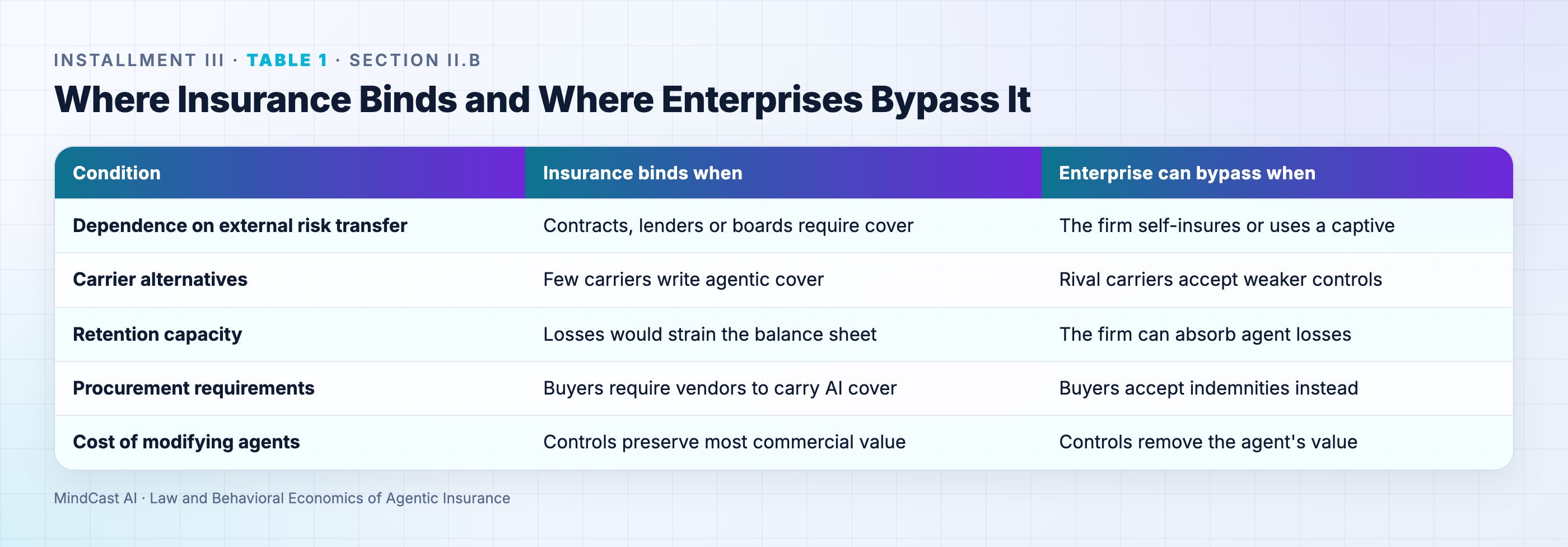
The conditions point to the middle market as the segment where insurance binds most tightly. Large enterprises can retain the risk or place it in a captive, and the smallest firms often deploy without asking. Mid-sized firms with customer contracts and limited retention capacity feel the condition as a deployment gate. Mid-sized firms mostly hold admitted incumbent programs, so insurance reaches mid-market agent design through incumbent terms first and through published authority conditions once an incumbent writes them.
Takeaway. Insurance governs agent design where enterprises cannot retain the loss or replace the insurer.
C. Four Instruments With Different Legal Effects
Underwriting questions, certifications, policy conditions and warranties perform different functions. An underwriting question informs risk selection. A certification can establish eligibility. A policy condition can affect recovery after a loss, and a warranty can carry further contractual consequences depending on wording and state law.
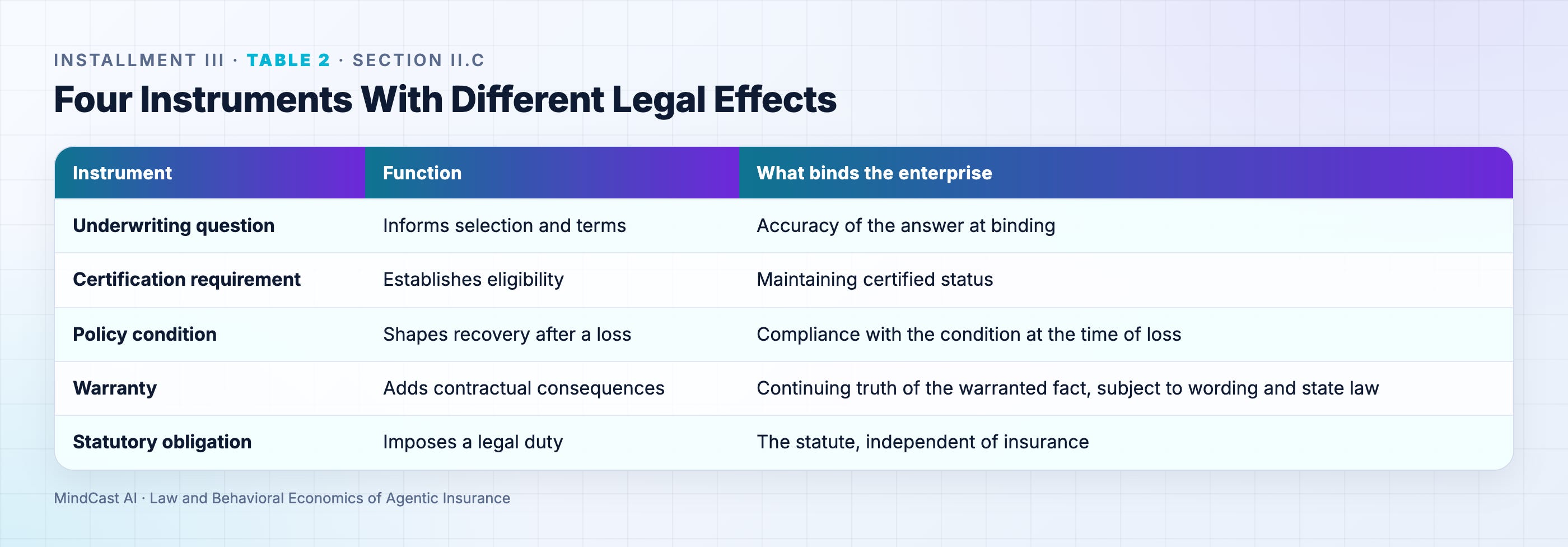
The governance effect depends on which instrument binds. A question shapes behavior once a year at renewal. A condition or warranty shapes behavior continuously, because noncompliance can defeat recovery. Certification does not create legal immunity, and coverage does not establish lawful conduct.
Takeaway. Conditions and warranties govern agents continuously, while underwriting questions govern them once a year.
D. Governing Question
The paper answers one question through December 31, 2027. How do insurance conditions govern what AI agents may do, and who writes the conditions insurers enforce? The target system covers US commercial insureds and the carriers, certifiers and platforms that serve them, along with state insurance regulators. Federal AI legislation and non-US regimes fall outside scope.
Takeaway. The question concerns private governance of agent authority, and the answer decides who sets the rules enterprises follow.
E. Why Predictive Behavioral Economics Adds Value
Behavioral economics supplies the decision rules. Boards respond to salient, concrete demands more than to abstract principles. An insurer's question with a yes or no answer and a renewal deadline carries more salience than a voluntary framework. Loss aversion amplifies the effect, because losing cover feels larger than the cost of adding a control.
Enterprises also exhibit present bias. Boards defer governance work until a deadline forces it. The insurance renewal supplies that deadline every year.
Takeaway. The renewal deadline turns governance from a principle into a dated task.
F. Why Dynamic Game Theory Adds Value
Game theory supplies the payoff structure and the logic of equilibrium selection. Each carrier prefers to impose controls that reduce its own loss, yet a carrier that demands too much loses business to rivals. Controls therefore spread only when several carriers adopt them together or when a shared standard lets them coordinate.
A shared certification could coordinate carriers, but the leading standard comes from a certifier that also sells insurance. Documented human review gives each carrier a test it can verify from the insured's own files without adopting a rival's standard.
Regulators face a different game. A mandate imposes cost on every enterprise and invites opposition, while a disclosure rule asks carriers only to state what they cover. Disclosure dominates mandate for regulators seeking action within one legislative cycle.
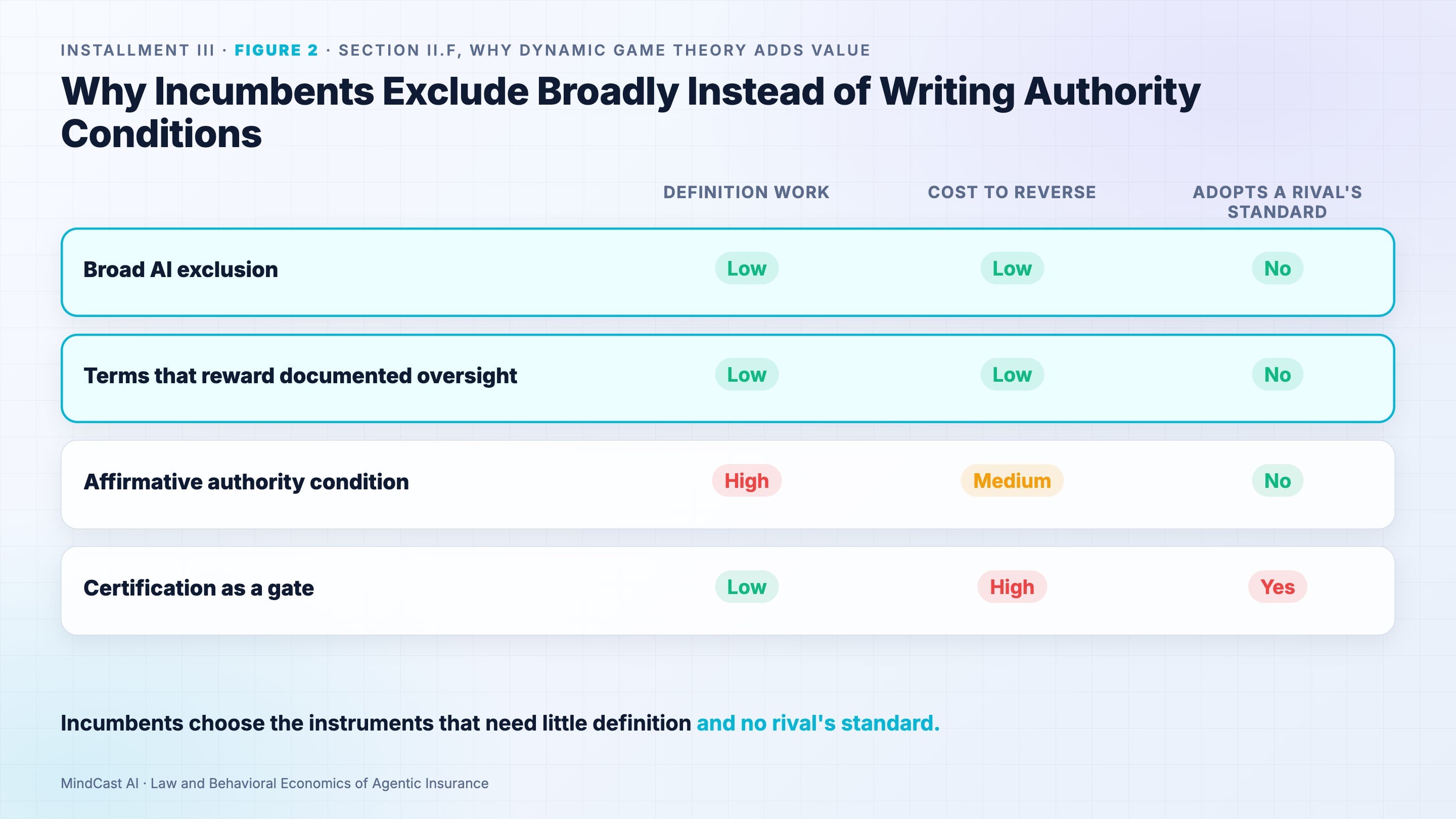
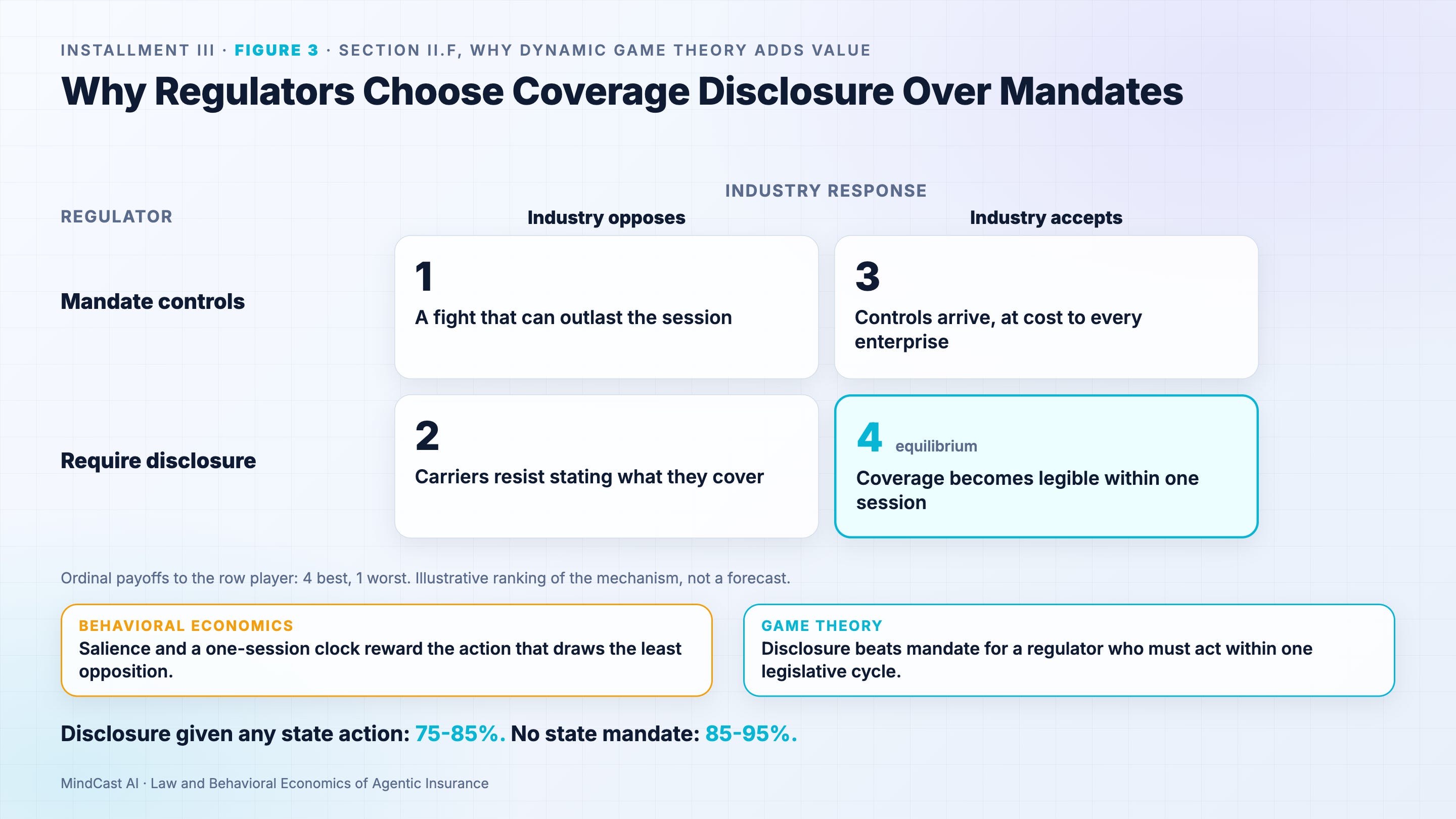
Takeaway. Documented oversight lets incumbents set controls without a rival's standard, and disclosure lets regulators act without a fight over mandates.
G. Predictive Behavior Emerges From the Combination
Predictive behavior emerges from combining the two disciplines. The decision rules explain why boards respond to insurer questions faster than to frameworks. The payoff structure explains why incumbents exclude broadly and reward documented oversight rather than adopt a shared standard, and why regulators choose disclosure.
Together they explain three pressures now forming. Carriers have reason to add agent-specific authority questions to applications. Regulators have reason to prefer coverage disclosure. Large buyers have reason to push the insurance requirement upstream to agent vendors.
Takeaway. Salience explains the speed, coordination explains the channel, and the mechanism needs both.
H. Simulation Architecture
The Foresight Simulation models the governance game as a board of Cognitive Digital Twins (CDTs). Installment III draws six seats.
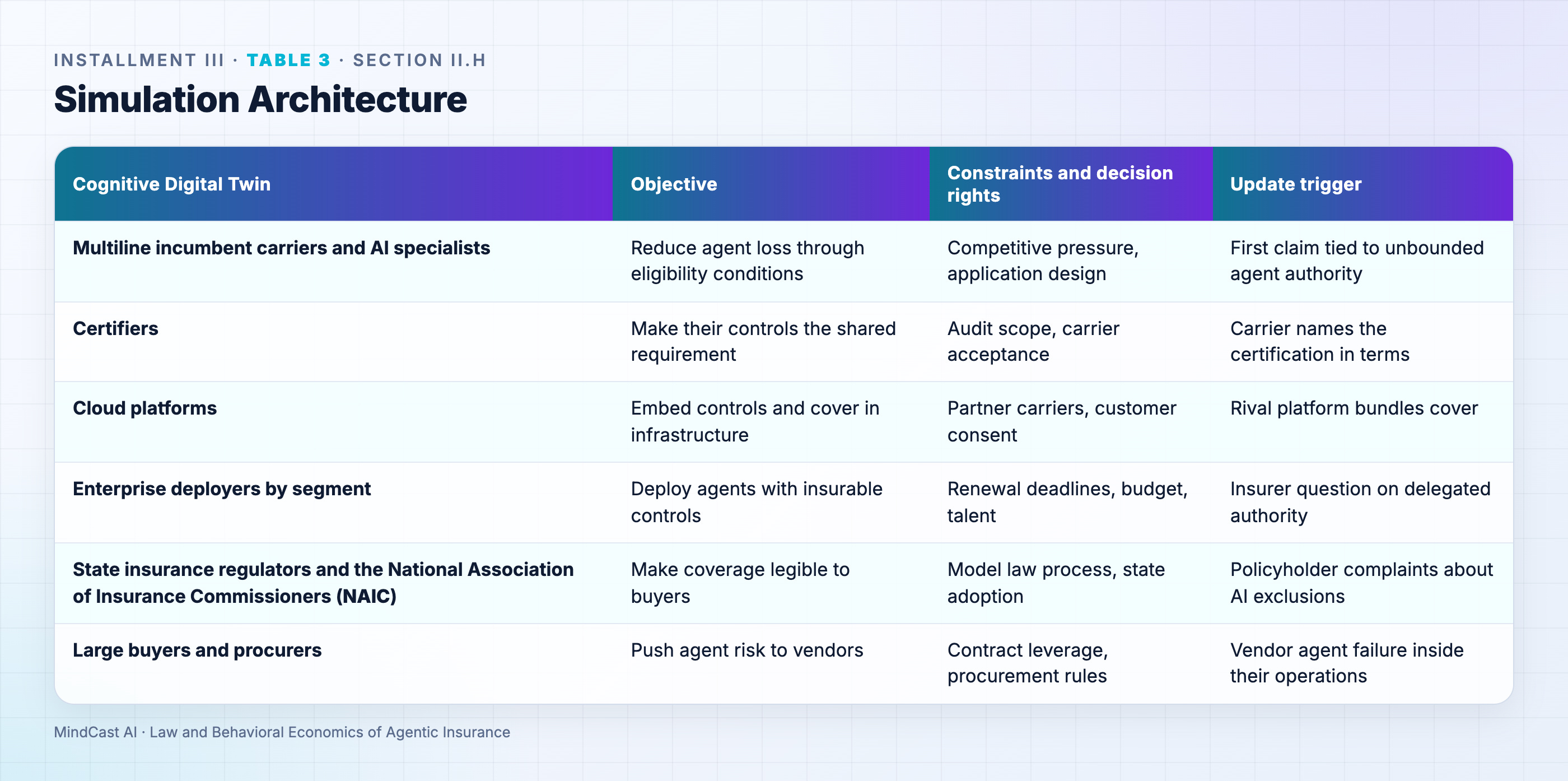
Six hypotheses frame the simulation: the competing explanations in Section III, an upstream branch and a null route. Each names the event that would disprove it.
Eligibility governance. Underwriting conditions and terms set agent controls faster than statutes where enterprises depend on cover. A state mandate arriving before any insurer condition reaches the mid-market cuts against it.
Statutory mandate. Legislatures require insurance or agent controls directly. No state enacting a mandate by the end of 2027 cuts against it.
Disclosure regime. Regulators require carriers to state what policies cover and stop there. A first state or NAIC action that mandates insurance or controls cuts against it.
Platform-embedded governance. Cloud platforms build controls into agent infrastructure and carriers defer to their telemetry. No platform setting agent limits through its own terms cuts against it.
Upstream transfer. Large buyers require vendors to insure the agents they sell. No procurement rule requiring vendors to carry affirmative AI cover by the end of 2027 cuts against it.
Null route. Conditions stay generic and no agent-specific requirement spreads into 2027. A top-20 carrier publishing authority wording or an autonomy exclusion cuts against it.
Takeaway. The simulation tests whether insurance becomes the operative governance layer for AI agents, and on every route certifier standards reach enterprises through audits and procurement before carriers adopt them.
Insurance governs agent design only where enterprises need the insurer and only through the instrument that actually binds them. Renewal deadlines and loss framing make boards respond, while documented oversight gives carriers a test they can verify. The middle market emerges as the segment where both conditions meet.
III. How the Game Reached Its Present Form
AI governance moved from voluntary principles to conditions of cover. Delegated authority now serves as a shared unit of measurement, and enforcement decrees add a third source of controls. The rules that persist, the competing explanations and the branches of the game through 2027 follow.
A. Governance Moved From Principles to Conditions
AI governance began as principles. The NAIC adopted AI principles in 2020 and a model bulletin on insurers' own AI use in December 2023. Enterprises adopted voluntary frameworks with no enforcement behind them.
Insurance conditions arrived in 2026. Carriers began asking for documented AI governance during underwriting. Cowbell built autonomy and governance into its rating factors, and AIUC tied cover to audited controls. The governance requirement moved from a voluntary framework to a condition of cover.
Takeaway. Governance acquired an enforcement mechanism when it became a condition of insurance.
B. Delegated Authority Becomes the Common Unit
Three institutions now measure the same variable. Cowbell rates the authority an agent holds, and its coverage trigger counts an agent exceeding its authorized scope or acting without required approval as an insured incident. AIUC audits the controls on what agents may do. The NAIC's AI Risk Evaluation Supplement, exposed for comment in October 2026 for insurers' own systems, asks whether an AI system is authorized to execute actions that directly affect a consumer.
The convergence matters because a shared unit allows comparison. A carrier, a certifier and a regulator can each assess the same agent on the same question. Delegated authority is becoming the measure on which agent governance rests.
Takeaway. Underwriters and certifiers now ask the same question about deployed agents, and regulators ask it of insurers' own systems: what is the agent authorized to do?
C. Enforcement Decrees Write Controls Too
Certifiers and platforms are not the only rule-writers. State attorney general coalitions resolve consumer protection actions against technology firms with conduct terms such as safeguard testing, age assurance and incident reporting. A conduct term in a decree becomes a documented control that underwriters can adopt by reference.
Frontier model firms facing coalitions therefore negotiate more than a resolution. The terms they accept can become the reference controls carriers require of every deployer in their market. Who Writes AI Insurance Coverage Conditions identifies enforcement decrees as one source of writable conditions. State Attorneys General Sue Snap, Not OpenAI, Over My AI: West Virginia Cites OpenAI's Published GPT-4 Limits to Allege Notice Before the Public Rollout traces how coalitions choose their defendant.
Takeaway. A coalition decree against one frontier firm can set the control standard insurers apply across an entire market.
D. Why the Current Rules Persist Into 2027
Three conditions keep the current rules in place into 2027. No statute mandates agent controls for most enterprises, so insurance conditions face no competing rule. Renewal cycles run annually, so conditions introduced in 2027 applications bind through the window. Regulators move through model law processes that take more than a year from exposure to adoption.
The game evolves rather than mutates through the window. New application questions and disclosure proposals change terms inside the structure. A statute mandating agent insurance or agent controls would mutate the game by replacing private conditions with public rules.
Takeaway. Insurance conditions govern agent authority until a statute replaces them.
E. Events That Already Moved the Board
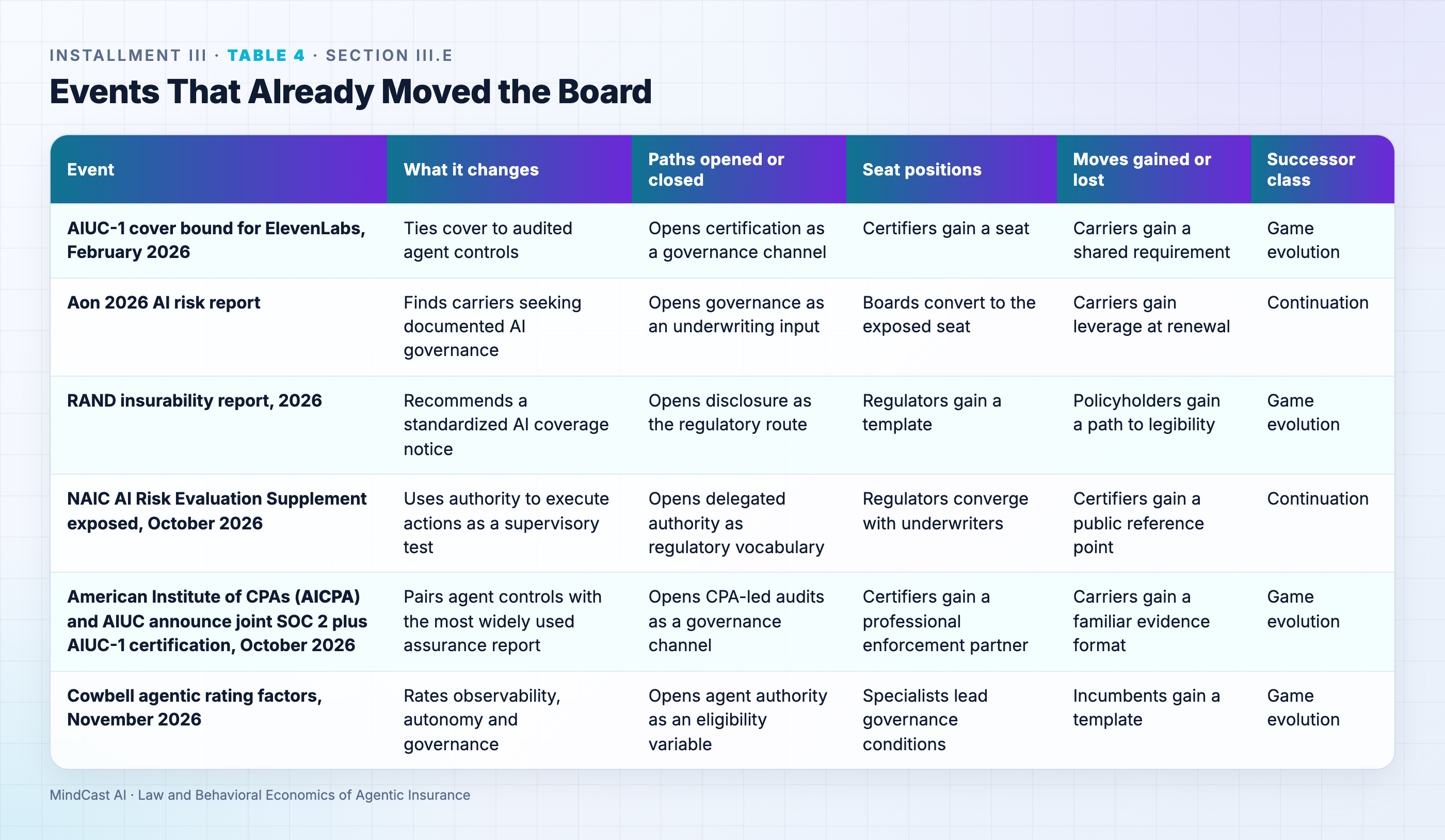
Takeaway. Each event moved governance one step from principle toward condition.
F. Competing Explanations
Three explanations compete, and each names the event that would disprove it.
Private governance. Insurers set agent controls through conditions and statutes follow. A state mandate arriving before any insurer condition reaches the mid-market would cut against it.
Public governance. Legislatures mandate controls directly and insurers write terms around compliance. No state enacting a mandate by the end of 2027 cuts against it.
Vendor governance. Platforms build controls into agent infrastructure, and both insurers and regulators defer to them. No platform setting agent limits through its own terms cuts against it.
Current evidence favors private governance, with vendor governance rising. Insurance renews annually and requires no legislative vote. Platforms that embed controls and cover together can satisfy carriers and buyers in one product.
Takeaway. Private conditions lead today, and platforms that embed controls gain ground beneath them.
Governance of AI agents now runs through three rule-writers and one enforcer. Certifiers, platforms and coalition decrees write controls, while incumbents enforce their own through broad exclusions and oversight-based terms. Private conditions lead today because no statute competes with them, and the competing explanations differ mainly on how fast platforms gain ground.
G. How the Game Branches
Baseline. MindCast Foresight Simulation Predictions hold the private-governance baseline through December 31, 2027. No top-20 US commercial carrier publishes an affirmative authority condition, human-review carve-backs included (55-65%). No state mandates deployer insurance or agent controls (85-95%), and no top-20 carrier publishes an autonomy exclusion without a carve-back (60-70%). The forecasts stay valid while no statute replaces private conditions with public rules.
Dominant fork and its mover. The instrument a top-20 incumbent chooses for agent authority decides the game, with the incumbents as movers. An affirmative condition or carve-back would carry insurance governance into mid-market agent design. Mid-sized firms mostly hold admitted incumbent programs, so the incumbent's choice reaches them first.
Broad exclusion with oversight rewarded in terms (continuation, 40-50%). Incumbents exclude broadly and reward documented human oversight through underwriting terms, while specialists hold affirmative triggers. P(no top-20 affirmative condition | state) resolves true, and P(no state mandate | state) sits at 90-95%. Enterprises keep humans in the loop to keep favorable terms. No seat gains or loses a move.
Incumbent affirmative governance, carve-backs included (game evolution, 35-45%). A top-20 carrier publishes an affirmative authority condition or human-review carve-back. The no-condition forecast resolves false, and P(no state mandate | state) sits at 90-95%. Documented human review becomes the test for mid-market cover. Specialists lose their exclusive hold on affirmative triggers.
Certification required in procurement (game evolution, 30-40%). Large buyers require agent vendors to hold an independent certification. P(no top-20 affirmative condition | state) sits at 60-70%, and P(no state mandate | state) at 90-95%. Buyers gain an enforcement move and certifiers gain a channel around carriers. Uncertified vendors strand.
Disclosure regime (game evolution, 30-40%). A state or the NAIC requires carriers to state whether AI losses are covered, excluded or sublimited. P(no top-20 affirmative condition | state) sits at 60-70%, and P(no state mandate | state) at 90-95%. Buyers gain a comparison move, and carriers lose silent positions on AI.
Platform-embedded governance (game evolution, 30-40%). A platform sets agent limits through the terms of its own stack. P(no top-20 affirmative condition | state) sits at 60-70%, and P(no state mandate | state) at 85-95%. Platforms gain a control-setting move for their own workloads, and buyers lose portability across providers. Installment I tests the scope of a second platform's cover as I-S6.
Autonomy exclusion at a top-20 carrier (equilibrium migration, 30-40%). A top-20 carrier excludes cover when an agent acts without required approval, with no carve-back. P(no top-20 affirmative condition | state) sits at 70-80%, and P(no state mandate | state) at 90-95%. Enterprises keep approval steps or lose cover.
Statutory mandate (game mutation, 5-15%). A state requires deployers to carry insurance or adopt named agent controls. P(no top-20 affirmative condition | state) is unbanded, and the no-mandate forecast resolves false. Regulators gain the enforcer role, and insurer conditions strand as compliance tools.
The state that breaks the baseline. A statutory mandate ends private governance as the operative layer. Carriers write affirmative wording to match the statute, and their conditions become compliance tools. The feedback runs into procurement: buyers demand proof of statutory compliance rather than proof of cover.
Takeaway. Private governance through exclusions and terms holds the board unless a statute replaces it.
IV. Chicago Accelerated Analysis: Private Governance and Its Limits
Chicago Accelerated analysis runs four stages in order. Coase explains when private insurance contracts can govern agent harm. Stigler warns who may capture the standards, the behavioral correction explains how boards respond and Becker and Posner trace how insurance conditions become deterrence and then law.
A. Coase: Insurance Conditions as Private Ordering
Coase's "The Problem of Social Cost" (1960) showed that private bargaining can internalize harm when transaction costs are low. Insurance conditions are private ordering of this kind. The insurer charges for the harm an agent might cause, and the enterprise lowers the charge by adding controls.
Bargaining works where insurers can observe controls. It fails where enterprises can change permissions after binding. Certification and telemetry lower observation costs, which extends the reach of private governance into territory that statutes have not entered.
Takeaway. Insurance governs agents as far as insurers can observe them, and certification and telemetry move that boundary outward.
B. Stigler: Who Captures the Standard
George Stigler argued in "The Theory of Economic Regulation" (1971) that regulation tends to be acquired by the industry it governs. Private standard-setters face the same pull. A certifier paid by the firms it certifies, and adopted by carriers seeking premium growth, can drift toward standards that are easy to pass. Coalition decrees negotiated with defendants carry the same risk.
Stigler's "The Economics of Information" (1961) adds a second insight. Buyers search until the marginal cost of search equals its marginal gain. Disclosure of what policies cover lowers search cost, which explains why regulators favor disclosure over mandates.
Takeaway. Private standards inherit the capture risk of public regulation, and disclosure is the low-cost check on both.
C. Behavioral Correction: Present Bias, Target Fixation and Loss Framing
David Laibson's "Golden Eggs and Hyperbolic Discounting" (1997) formalized present bias: people overweight immediate costs relative to later benefits. Boards defer control investment until renewal forces it. The renewal date converts a deferred task into a dated one.
Certification invites target fixation, the pattern economists associate with Goodhart's law. Once passing the audit becomes the goal, enterprises optimize for the audit rather than for reducing loss. Carriers that condition cover on certification alone inherit that gap.
Daniel Kahneman and Amos Tversky showed in "Prospect Theory: An Analysis of Decision under Risk" (1979) that losses loom larger than equivalent gains. Losing cover feels like a loss, while a premium credit feels like a gain. A condition framed as eligibility therefore moves boards more than a discount of equal value.
Takeaway. Boards act on deadlines and potential losses, so eligibility conditions move them more than credits and audits alone.
D. Becker: Deterrence Through the Renewal Cycle
Becker's 1968 model holds that deterrence depends on the probability and size of a sanction. Loss of cover is a sanction with a high perceived probability, because renewal arrives every year and public enforcement may never arrive. Coalition enforcement adds a public sanction on top of the private one.
The size of the sanction varies with the enterprise. Large firms can absorb loss of cover through retention or a captive, and small firms often deploy without cover at all. The working hypothesis holds that insurer leverage peaks in the middle market, where contracts require cover and retention capacity is thin.
Takeaway. Insurance deters uncontrolled agents most where losing cover hurts most, which points to the middle market.
E. Posner: When Private Conditions Become the Standard of Care
Courts set the standard of care partly from what precautions cost and what they prevent. Judge Learned Hand framed the test in United States v. Carroll Towing Co. (1947): a party is negligent when the burden of a precaution is less than the probability of loss times its size. Posner made the formula central to the economic analysis of negligence.
Insurer conditions and certifications supply courts with evidence of which agent precautions are feasible and what they cost. A permissions bound supplies a way to estimate the loss side: the value an agent may move per action, times the actions it may take before a stop. Courts are not bound by industry custom, because The T.J. Hooper (1932) held an industry negligent for lagging behind a low-cost precaution.
Takeaway. Insurer conditions supply the evidence courts will use to set the standard of care for AI agents.
The Chicago Accelerated sequence shows both the reach and the limits of insurance as governance. Coase explains why observability sets the boundary of private ordering, and Stigler warns that private standards can be captured. The behavioral correction and Becker explain why renewal-driven eligibility moves boards, while Posner shows how insurer conditions can harden into the legal standard of care.
V. Stakeholder Strategy
Every party that writes, enforces or must meet agent controls has a move now. The matrix pairs each objective with a low-regret move and the risk of waiting.
A. Stakeholder Strategy Matrix
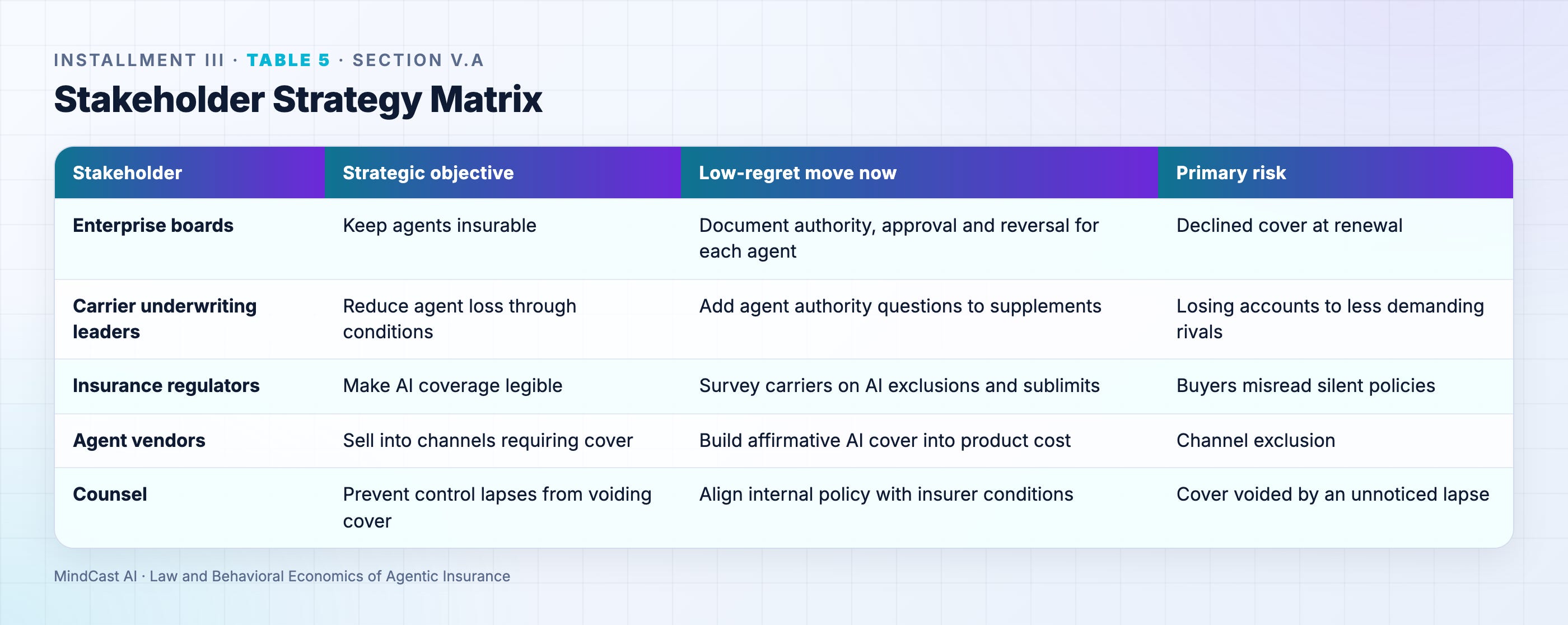
The common move across the matrix is documentation. Boards document what agents may do, carriers document what they require and counsel documents which instrument binds. Documentation prepared now becomes evidence of feasible precautions when a court later asks what care required.
Takeaway. Boards that document what their agents may do keep their insurance options, and boards that wait let the insurer decide.
VI. Implications
Three implications decide who governs AI agents and how. Each one assigns a role: incumbents exclude and reward oversight, specialists and certifiers write controls and regulators make coverage legible.
A. Insurers Govern Without Legislation
Insurers hold a governance tool that requires no vote: the power to decline cover. Where enterprises depend on external cover, agent controls spread through renewal conditions faster than through statutes. Private governance arrives first in agentic AI as it did in cybersecurity.
B. Incumbents Reward Oversight Before They Adopt Standards
Incumbents lack the technical capacity to define detailed agent controls, and adopting a certifier's standard adds cost and a competitor's rules. Incumbents exclude broadly instead and reward documented human oversight through terms and carve-backs. Specialists write the affirmative authority triggers, while certifiers reach enterprises through audits and procurement before insurers adopt them. State coalition decrees add a further source of controls.
C. Regulators Choose Legibility
Disclosure lets regulators act within one cycle without imposing controls on every enterprise. The RAND recommendation gives regulators a ready template. Colorado's 2026 rewrite of its AI Act into a narrower, notice-based law points the same way. Mandates remain possible but face a longer path.
The implications describe a division of governance labor that no statute designed. Insurers hold the sanction, other institutions write the rules and regulators supply transparency. A statutory mandate would reassign those roles at once.
Takeaway. Insurers govern agents through eligibility and terms, specialists and certifiers write affirmative controls and regulators make the result legible.
VII. MindCast Foresight Simulation Predictions and Risk Mitigation
The Foresight Simulation sets out dated expectations through December 31, 2027, and each audience can act before the first checkpoint. Each Foresight Simulation Prediction names an actor and an outcome within a window, with a band and the event that would prove it wrong. Only events after November 25, 2026 resolve a Foresight Simulation Prediction, and earlier events form the starting board.
Behavioral economics supplies the decision rules: ambiguity aversion favors excluding what the carrier cannot evaluate, and documented human review offers a test the carrier can check against the insured's own files. Game theory supplies the payoff structure: a broad exclusion protects an incumbent at low cost, while an affirmative condition forces it to define and verify agent authority, the work it rents from specialists. Predictive behavior emerges from the combination. Incumbents exclude broadly and reward oversight through terms, specialists write affirmative triggers and certifiers reach enterprises through audits before insurers adopt them.
A. Foresight Simulation Predictions
Eight Foresight Simulation Predictions follow, plus one carried from Installment I: two Primary (P) and six Secondary (S). Two Secondary entries are conditionals, written as P(A given B).
III-P1. No top-20 US commercial carrier publishes an affirmative condition or eligibility rule tied to delegated authority, human approval or reversibility by December 31, 2027 (55-65%). A human-review carve-back counts as an affirmative condition. Falsifier: Such a condition or carve-back from a top-20 carrier.
III-P2. No state enacts a statute or regulation requiring AI deployers to carry insurance or adopt named agent controls by December 31, 2027 (85-95%). Falsifier: Any such enactment.
III-S1. No top-20 US commercial carrier publishes a no-carve-back exclusion triggered by an AI agent acting without required approval or outside authorized scope by December 31, 2027 (60-70%). Falsifier: Such an exclusion from a top-20 carrier.
III-S2. P(the condition references no independent certification, given a top-20 carrier publishes an affirmative authority condition) (55-65%). Falsifier: The first such condition references an independent certification.
III-S3. P(the action takes the disclosure form, given a state or the NAIC acts on AI insurance coverage after November 25, 2026) (75-85%). Falsifier: The first such action mandates insurance or agent controls.
III-S4. No platform marketplace, procurement standard or public procurement rule requires agent vendors to carry affirmative AI cover by December 31, 2027 (70-80%). Falsifier: Any such requirement.
III-S5. A coverage action filed after November 25, 2026 puts a generative AI form from the Insurance Services Office or a carrier's own AI exclusion at issue by December 31, 2027 (65-75%). Falsifier: No such filing.
III-S6. No court issues a ruling construing an AI-specific exclusion against an AI-related claim by December 31, 2027 (60-70%). Falsifier: A ruling construing such an exclusion.
I-P1. CPA-firm or buyer AIUC-1 engagements announced after the AICPA and AIUC offering's full launch appear before any top-20 US commercial carrier makes an AI certification an eligibility gate by December 31, 2027 (70-80%). Carried from Installment I: The Emerging Agentic Insurance Industry, where it tests the audit route this paper's subtitle names. Falsifier: A top-20 carrier gates first. Not reached if the full launch slips past the window.
Two rules govern III-P1 and III-S1. A carve-back that restores excluded AI cover when a human reviews or approves the agent's actions counts as an affirmative condition. A carve-back or exclusion counts only in a filed form or published program wording, so a manuscript endorsement negotiated for one insured does not count even if press reports it.
The Foresight Simulation Predictions resolve against published wordings and state filings, legislative and NAIC records, procurement rules and court dockets.
Takeaway. Incumbents govern agents through what they exclude and how they set terms, and no state replaces that private governance with a mandate inside the window.
B. Risk Mitigation
Each entry routes one Foresight Simulation Prediction to the audience it binds most. Severity measures what that audience loses if the Foresight Simulation Prediction resolves true and it did nothing, and probability is the band. The entries sit in a standalone section so the analysis reads without interruption, at the cost of matching each entry back to its Foresight Simulation Prediction by ID. The entries describe operating options, not legal, investment or fiduciary advice.
III-P1 · 💼 Enterprise boards and risk committees. Severity: moderate. Probability: 55-65%.
Exposure. An admitted incumbent program offers no published wording that rewards good agent controls. The reward arrives only through terms, and an undocumented board pays the same rate as a careless one.
Actions. The risk committee documents transaction limits, approval points and reversal procedures for each production agent before the 2027 renewal submission. The broker obtains written confirmation at binding of how oversight evidence changes terms. Procurement seeks specialist affirmative cover for agents with transaction authority by the third quarter of 2027.
Residual exposure. Terms can change at the next renewal without any change in published wording.
III-P2 · 🏛️ State legislators and insurance departments. Severity: moderate. Probability: 85-95%.
Exposure. Without a mandate, agent controls spread only where enterprises depend on cover. Deployers without cover face no external check on agent authority.
Actions. Legislative staff draft coverage-disclosure bills for the 2028 session calendar. Insurance departments adopt a standardized AI coverage notice by bulletin in 2027. Departments coordinate with attorney general offices so that decree conduct terms name controls an underwriter can verify.
Residual exposure. Disclosure leaves uninsured deployers outside any governance channel.
III-S1 · ⚖️ Policyholder coverage counsel. Severity: high. Probability: 60-70%.
Exposure. Broad AI exclusions rather than narrow autonomy exclusions decide cover. Disputes turn on whether a loss arises out of AI at all, and denied claims rise.
Actions. Counsel negotiates narrower AI definitions and human-review carve-backs at the 2027 renewal. Operations keeps evidence of human review for each agent action in claims-prone workflows from now on. Contracts counsel shifts agent-error loss to vendors where broad exclusions apply at the next contract cycle.
Residual exposure. Negotiated endorsements may not survive the carrier's next form change.
III-S2 · 💼 Certifier executives. Severity: moderate. Probability: 55-65% given a top-20 affirmative condition.
Exposure. When an incumbent writes a condition, it tests documented human review rather than certification. Certified accounts earn no credit in the incumbent channel.
Actions. The product lead maps certification controls to the human-review documentation incumbents can verify by the second quarter of 2027. Partnerships pursue procurement adoption and the CPA channel ahead of carrier adoption through 2027. Leadership separates certification governance from insurance operations by year-end 2027.
Residual exposure. A certifier that also sells insurance keeps the dual role carriers discount.
III-S3 · 💼 Carrier underwriting and compliance leaders. Severity: moderate. Probability: 75-85% given state or NAIC action.
Exposure. A disclosure rule makes every silent AI position visible. Forms need revision, and policyholder complaints concentrate on visible exclusions.
Actions. Product inventories each form's AI treatment before any notice takes effect. Compliance prepares standardized AI coverage notice language by the third quarter of 2027. Distribution trains producers to explain the notice before the 2028 renewals.
Residual exposure. Visible exclusions invite buyer pressure for affirmative wording.
III-S4 · 💼 Agent vendors. Severity: moderate. Probability: 70-80%.
Exposure. No procurement rule forces cover, but buyers still ask for assurance. Vendors that rely on cover alone lose deals to vendors with audited controls.
Actions. Sales operations assembles a standard assurance packet of controls, audit results and insurance certificates by the first quarter of 2027. Product builds the human-approval and rollback controls buyer questionnaires ask for before the next major release. Finance holds affirmative cover sized to the largest customer contract.
Residual exposure. A large buyer can still demand cover beyond what the market will write.
III-S5 · ⚖️ Defense counsel in consumer protection, product liability and deepfake suits. Severity: high. Probability: 65-75%.
Exposure. A coverage action puts an AI exclusion at issue in the client's matter. Defense costs shift from the insurer to the client while coverage is contested.
Actions. Defense counsel tenders every AI-related suit to each potentially responsive carrier at filing. Coverage counsel documents the human decisions and controls from the first response. Finance reserves for defense costs pending the coverage outcome.
Residual exposure. An adverse coverage outcome can reach past defense costs into indemnity.
III-S6 · 📊 Investors in AI deployers and acquirers. Severity: high. Probability: 60-70%.
Exposure. With no ruling on AI-specific exclusions, coverage for AI litigation stays unknowable in diligence. Indemnity escrows rest on guesswork.
Actions. The deal team sizes escrows for AI-related litigation on the assumption that exclusions apply at signing. Diligence requests each target's AI exclusion schedule and tender history. Portfolio boards review AI exclusion exposure each year.
Residual exposure. A first ruling after signing can move exposure in either direction.
Takeaway. Documented human review is the one action that improves an enterprise's position in every state of the game.
C. What to Watch
The instrument a top-20 incumbent chooses for agent authority is the dominant fork. Five dated observables show which way it moves.
January 1, 2027. Colorado SB 26-189 takes effect and sets a disclosure-based state template (III-S3).
2027 renewal cycle. Filings and published wordings from top-20 carriers show whether the first authority wording is an affirmative condition, a carve-back or an autonomy exclusion (III-P1 and III-S1).
2027 legislative sessions. Bills that would mandate deployer insurance or named agent controls (III-P2).
Through 2027. Platform and procurement rules that require agent vendors to carry affirmative AI cover (III-S4).
Through 2027. Court dockets for coverage actions that put an AI-specific exclusion at issue (III-S5 and III-S6).
Takeaway. Top-20 renewal wording decides the instrument, and court dockets supply the first loss signal.
The incumbent instrument, the disclosure route and the coverage-litigation calls now carry dated tests, each with a band and a falsifier. Each audience holds actions it can take before the 2027 renewal.
Conclusion
Insurance is becoming the first operative governance layer for AI agents wherever enterprises depend on external cover. Carriers decide which agents qualify for cover by asking what those agents may do. Incumbents exclude broadly and reward documented human oversight, while specialists write affirmative authority triggers and certifiers reach buyers through audits first. Regulators move to make coverage legible rather than to mandate controls.
The decisive signal is the first top-20 carrier to publish an affirmative authority condition or human-review carve-back, a state Section III bands at 35-45% through 2027.
Working With MindCast
Frontier model firms facing state coalitions. Conduct terms you accept in a resolution can become the controls carriers require of every deployer. A war gaming session traces how proposed terms travel into underwriting across your customer base.
Firms sued under consumer protection, product liability or deepfake theories. The same allegations decide recovery now and insurability at renewal. A coverage and control assessment links each allegation to the exclusions and controls behind both.
Enterprise boards and risk committees. Colorado's AI law takes effect January 1, 2027, and carriers write 2027 renewal conditions now. An insurability assessment tests your production agents against current carrier conditions and the human-review terms incumbents reward.
Carriers and agentic insurers. Your control requirements work only if rivals do not undercut them. A war gaming session tests which controls to require across the states from broad exclusion (40-50%) to incumbent affirmative governance (35-45%).
Regulators. III-S3 puts the disclosure form at 75-85% if a state or the NAIC acts. A disclosure-design Foresight Simulation tests how carriers and buyers respond to an AI coverage notice before you draft one.
Play this installment's board in the Agentic Insurance War Gaming: choose the incumbent's instrument and see each successor state, band and seat position.
First step: a complimentary proof-of-concept Foresight Simulation on one agent deployment or one disclosure proposal. You receive its board: the fork, the successor states and where your organization stands in each. Email mcai@mindcast-ai.com with the deployment or proposal, or see other MindCast war gaming.
Installment III Sources
MindCast AI, Law and Behavioral Economics of Agentic Insurance: Series Introduction. The series introduction states the shared thesis and links all three installments.
MindCast AI, The Emerging Agentic Insurance Industry. Installment I tests who controls the underwriting standard for AI agents.
MindCast AI, The Economics of Agentic AI Underwriting. Installment II tests why correlated loss keeps affirmative AI limits small.
MindCast works
Who Writes AI Insurance Coverage Conditions: Procurement, Enforcement Decrees, Partner Terms and the Two-Axis Condition. Identifies the channels that supply evidence for coverage conditions; this installment examines how those conditions govern agent design.
When AI Agent Liability Meets Common Law and Statute: Predictable Doctrines, Unsettled Allocation. Supplies the statutory allocation context that a statutory mandate would replace.
State Attorneys General Sue Snap, Not OpenAI, Over My AI: West Virginia Cites OpenAI's Published GPT-4 Limits to Allege Notice Before the Public Rollout. Shows how coalitions select a defendant, the first step toward a decree that writes controls.
State Attorney General Coalitions After Meta: Four Forks, Correction Authority and the Lessons for the Next Defendant. Analyzes how coalition outcomes shape terms for the next defendant.
Chicago and behavioral economics sources
Coase, Ronald, "The Problem of Social Cost," Journal of Law and Economics, 1960.
Stigler, George, "The Theory of Economic Regulation," Bell Journal of Economics and Management Science, 1971.
Stigler, George, "The Economics of Information," Journal of Political Economy, 1961.
Laibson, David, "Golden Eggs and Hyperbolic Discounting," Quarterly Journal of Economics, 1997.
Kahneman, Daniel and Amos Tversky, "Prospect Theory: An Analysis of Decision under Risk," Econometrica, 1979.
United States v. Carroll Towing Co., 159 F.2d 169 (2d Cir. 1947).
The T.J. Hooper, 60 F.2d 737 (2d Cir. 1932).
External sources
RAND Corporation, The Insurability of Artificial Intelligence, 2026.
Insurance Business, "Think-Tank Warns Brokers Against Assuming AI Is Covered," 2026.
Risk & Insurance, "Insurers Split Over AI Coverage as Misinformation and Deepfakes Drive Most Reported Harms," September 24, 2026.
NAIC, "AI Risk Evaluation Supplement Version 6.0: Received Comments," October 2026.
NAIC, "Artificial Intelligence" topic page.
Insurance Business, "ISO's Generative AI Exclusion Is Already on Thousands of CGL Policies," September 16, 2026 (Aon 2026 AI risk report).
Insurance Business, "Cowbell Launches Standalone AI Agent Liability Policy for SMEs," November 10, 2026.
Insurance Journal, Cowbell AI Liability Insurance coverage trigger, November 13, 2026.
Reinsurance News, "Artificial Intelligence Underwriting Company Launches With $15M Seed Round."
Forkast, "AIUC Raises $40M to Build the Certification and Insurance Layer," 2026.