AIG · Chubb · Travelers · Berkshire Hathaway · W.R. Berkley · Liberty Mutual · Munich Re · HSB · Beazley · QBE · MSIG · CFC · Coalition · Chaucer · Armilla · Testudo · Cowbell · Mosaic · AIUC · Google Cloud · Verisk · Aon · Marsh · Gallagher · Lockton · USI · State insurance regulators
Companion to Agentic AI Liability and Insurance Exclusions: How Coverage Redirects Who Gets Sued · Who Writes AI Insurance Coverage Conditions: Procurement, Enforcement Decrees, Partner Terms and the Two-Axis Condition
Series: Law and Behavioral Economics of Agentic Insurance · Installment II: The Economics of Agentic AI Underwriting · Installment III: Insurance as an Agentic AI Governance Institution · Interactive War Gaming: Agentic Insurance
I. Executive Summary
The agentic insurance industry is forming around a contest for the underwriting standard, not around capital. Established carriers hold the capital and the distribution. Incumbents lack loss data on artificial intelligence (AI) agents, and the firms that hold substitute evidence now compete to define which agents qualify for cover. Whoever writes that standard decides the terms on which enterprises can deploy autonomous AI.
The market moved in mid-2025, when Verisk's Insurance Services Office (ISO) filed optional generative AI exclusions for commercial general liability with a January 2026 edition date. By mid-2026, trade press counted 2,369 generative AI exclusion filings in force across 49 states, with no admitted standalone product to replace the cover they removed. The count measures filings, not issued policies.
Specialists filled the gap first. Armilla writes affirmative AI liability as a Lloyd's coverholder. The Artificial Intelligence Underwriting Company (AIUC) ties cover to an audit standard. Cowbell announced a standalone policy for smaller firms that goes on sale in January 2027.
MindCast distinction. MindCast AI applies Predictive Behavioral Economics + Dynamic Game Theory through MindCast AI Proprietary Cognitive Digital Twin Foresight Simulations (MP CDT FS). Behavioral Economics supplies the decision rules. Game Theory supplies the payoff structure. Predictive simulations emerge from the combination.
Working hypothesis. Four assets confer power in agentic insurance: risk-bearing capital, customer distribution, underwriting intelligence and standard-setting authority. The same firm need not hold all four. Incumbents defend with exclusions and with affirmative wording that confirms existing cover without widening it. Specialists, certifiers and cloud platforms compete for the two assets incumbents lack, while incumbents can also buy or build them.
Central finding. The certification reaches buyers through audits they already commission before any large carrier makes it a condition of cover. The joint System and Organization Controls 2 (SOC 2) plus AIUC-1 offering from the American Institute of CPAs (AICPA) and AIUC rides inside the SOC 2 engagements enterprises already buy. MindCast Foresight Simulation Predictions put CPA-firm or buyer engagements ahead of any top-20 carrier gate at 70-80%. The same Foresight Simulation Predictions put no top-10 carrier or reinsurer acquiring a specialist by December 31, 2027 at 75-85%.

Explore this installment's board in the Agentic Insurance War Gaming. The board shows the fork, the successor states with their bands and where each player stands.
Why now. Cowbell's standalone policy goes on sale January 1, 2027 and the AICPA and AIUC offering heads for full launch. Carriers, specialists, certifiers and their investors set positions in the 2027 renewal and planning cycle.
What the paper does. Section II sets out the actors, the governing question and the simulation architecture. Section III explains how the game reached its present form, weighs the competing explanations and shows how the game branches. Section IV applies Chicago Accelerated analysis, Section V sets out stakeholder strategy and Section VI traces the implications. Section VII states eight Foresight Simulation Predictions and sets out risk mitigation for each audience.
Stakeholder readout.
🏛️ Policymakers. State regulators approve exclusions faster than admitted replacement products reach the market. Insurance departments should decide whether an AI certification can serve as an underwriting criterion in filed forms before carriers present the question form by form.
💼 Executives. Carrier product leaders face a build, buy or partner choice for underwriting intelligence in the 2027 planning cycle. Enterprise risk managers should identify which certification or telemetry evidence their insurers will accept before the next renewal.
⚖️ Counsel. An exclusion that turns on any connection to AI shifts disputes toward how a loss is characterized. Coverage counsel should map each client's AI use to the exact trigger language in every line before a claim arrives.
📊 Investors. Venture and private equity investors in specialist AI insurers back underwriting intelligence, not balance sheets. They should value each specialist on who controls the standard it underwrites against, because an acquisition or an exclusive capacity deal resets that control.
Takeaway. Incumbents keep the capital, but the standard that decides who qualifies for cover is still unclaimed.
II. Topic and Simulation Fit
Established carriers adapt line by line, and the gap they leave defines the contest. A firm-by-firm map shows who excludes, who clarifies and who partners. The governing question, the two disciplines that answer it and the Cognitive Digital Twins that carry them follow.
A. Three Strategies Run at Once
Established carriers pursue three strategies at the same time. Exclusion comes first and starts at the top of the tower: insurers filed about 40% of generative AI exclusions under umbrella and excess lines in the first four months of 2026. W.R. Berkley introduced an absolute AI exclusion across directors and officers, errors and omissions and fiduciary products. Berkley and Chubb had filed to adopt ISO forms or proprietary equivalents by April, as had Travelers, Berkshire Hathaway and AIG.
Affirmative wording comes second. CFC committed in June 2026 to affirmative AI language across seven core products, and Beazley confirmed affirmative AI wording in cyber and technology errors and omissions in September. The insurers frame the wording as confirming existing scope rather than expanding it. QBE's global head of cyber described AI as a risk amplifier rather than a new peril.
Partnership comes third. Chaucer and Armilla launched Vanguard AI in February 2026 with a separate $25 million AI aggregate built to protect cyber capacity. Munich Re backs Mosaic through aiSure and distributes HSB's AI liability cover through partner insurers. The facts above come from filings, announcements and trade reporting; the mechanisms that follow are MindCast's analysis.
Takeaway. Incumbents exclude at the top, clarify in the middle and partner at the edge, often inside the same insurance group.
B. How Established Carriers Are Adapting Their Products
Each established carrier now sits in at least one adaptation column, and several sit in more than one. The matrix maps named moves from filings, announcements and trade reporting. Carrier product leaders can read it as a competitor map and specialists can read it as a partner map.
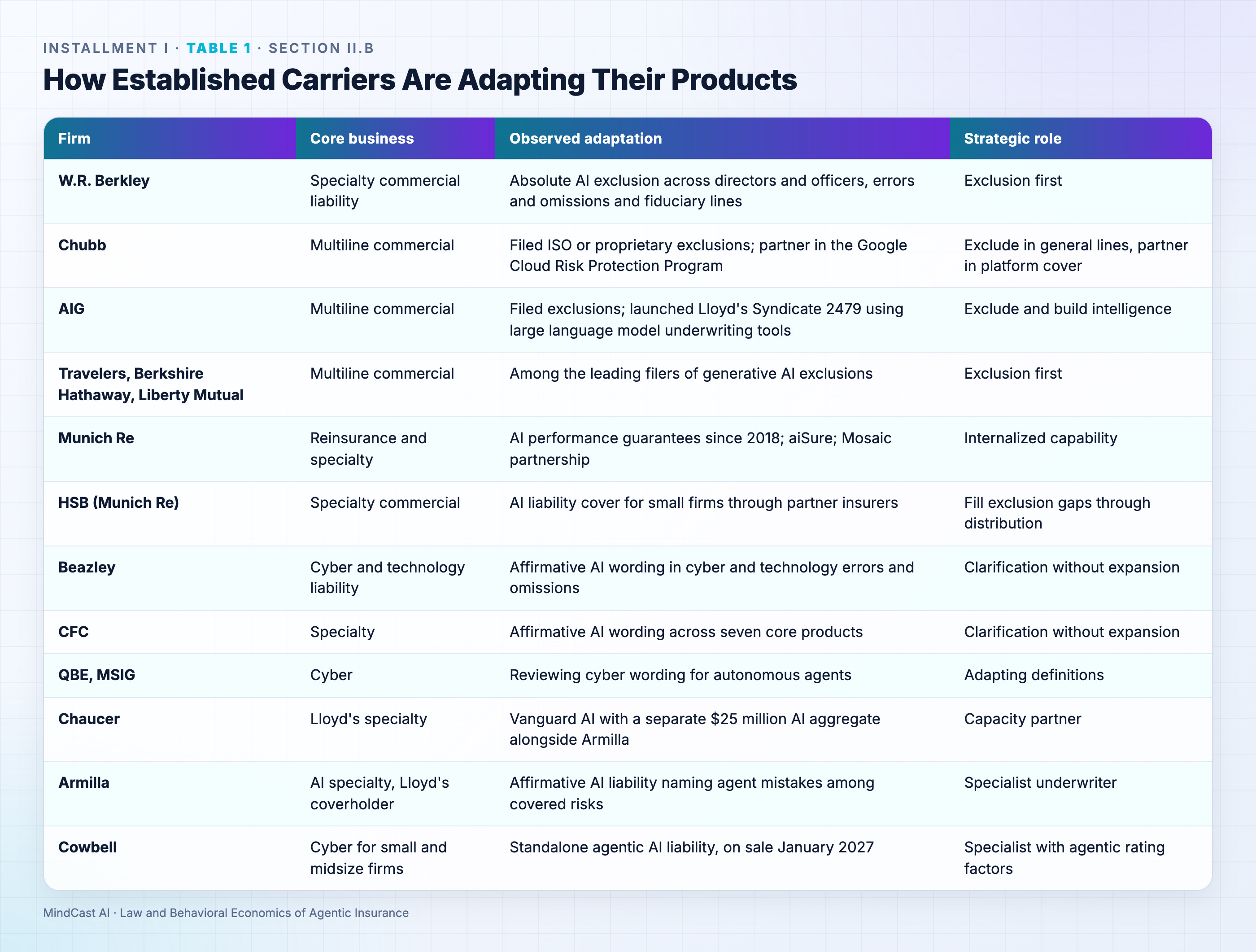
Chubb shows how one group can occupy two columns. It filed exclusions for general liability while backing affirmative cover inside the Google Cloud program. AIG shows the build route: it filed exclusions and launched a Lloyd's syndicate that applies large language model tools to underwriting.
Chubb's chief executive described the same sequence on the company's October 21, 2026 earnings call. Evan Greenberg expects the industry to manage AI liability through coverage clarifications, then exclusions and eventually separate AI liability covers. He added that model certification standards could emerge as an underwriting basis.
Takeaway. Established carriers adapt line by line, so a single group can exclude, clarify and partner at once.
C. Governing Question
The paper answers one question through December 31, 2027. Who controls the underwriting standard for agentic AI risk, and does control of the standard pull capital and distribution along with it? The target system covers the US commercial market and the Lloyd's market as it serves US insureds. Non-US regulation and the merits of any coverage dispute fall outside scope.
Takeaway. The question concerns control of the eligibility standard, and the answer decides who keeps the margin on agentic risk.
D. Why Predictive Behavioral Economics Adds Value
Behavioral economics supplies the decision rules: loss aversion, ambiguity aversion and salience. Underwriters facing a risk with no claims history exhibit ambiguity aversion, so they exclude first and learn later. Salient losses such as hallucinated refund policies and defamation suits set the reference point, while correlated failure across many insureds stays abstract.
Enterprise buyers anchor on the policies they already hold. Most do not read the endorsement schedule at renewal, so an exclusion can sit on a policy for a year before a claim reveals it. Bounded attention on both sides keeps silent AI exposure alive longer than either side would choose with full information.
Takeaway. Ambiguity aversion explains why incumbents exclude, and buyer inattention explains why the gap stays open.
E. Why Dynamic Game Theory Adds Value
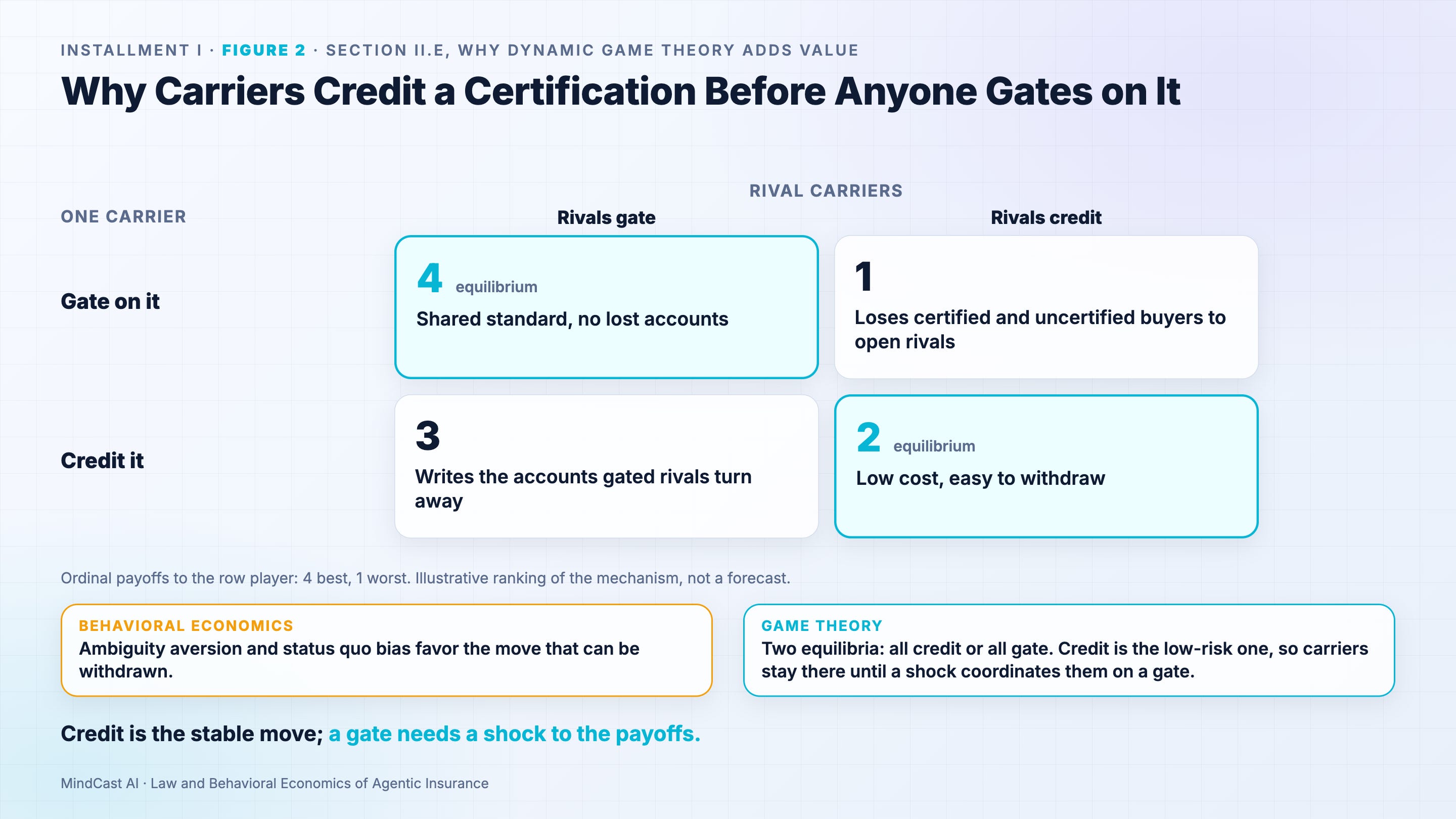
Game theory supplies the payoff structure and the logic of equilibrium selection. Each carrier prefers that a rival absorb the cost of learning agentic risk, so exclusion is the dominant first move. Once specialists prove they can underwrite, each incumbent faces a second choice: buy the capability, rent it through a capacity deal or build it. The first acquisition resets the payoff for every rival, because the remaining specialists become scarcer and costlier.
Standard setting adds a coordination game. A certification gains value as more carriers accept it. Tipping depends on adopter share and distribution reach. It also depends on buyer switching costs, rival standards and reinsurer acceptance.
A carrier that writes its own standard instead keeps control but forfeits the network value. Adoption by a few carriers can prove viability without starting a self-sustaining transition.
Takeaway. Exclusion dominates first, and the first acquisition or shared standard resets every rival's options.
F. Predictive Behavior Emerges From the Combination
Predictive behavior emerges from combining the two disciplines. Behavioral economics explains why incumbents delay and why buyers fail to notice. Game theory explains why the first shared standard or the first acquisition ends the delay for everyone at once.
Together they explain the two routes incumbents face. Carriers that cannot build loss data quickly accept substitute evidence from certifiers or platforms. Carriers that want to own that evidence buy it.
Takeaway. Behavior explains the delay, payoffs explain the break, and the mechanism needs both.
G. Simulation Architecture
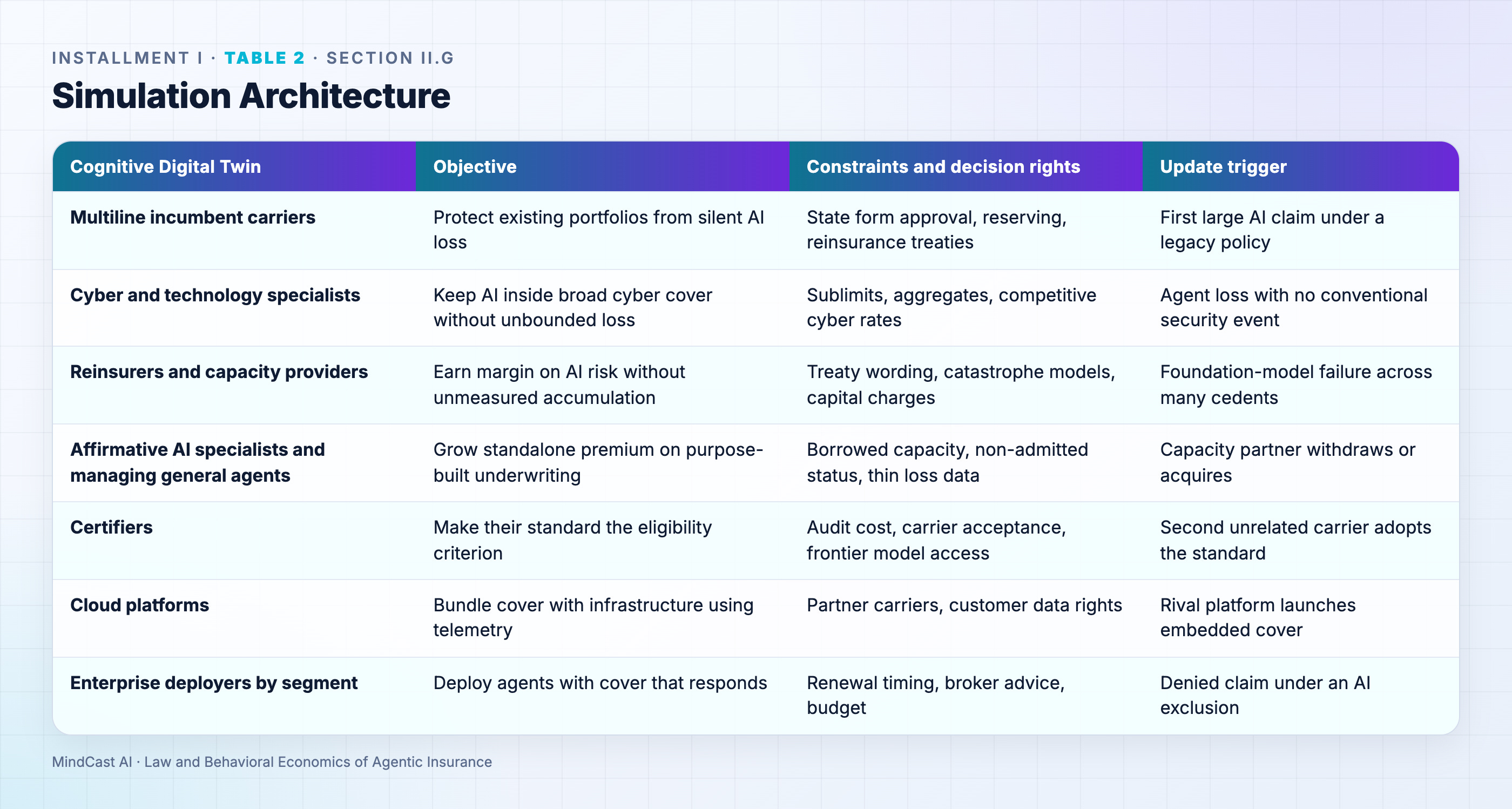
The Foresight Simulation models the market as a board of Cognitive Digital Twins (CDTs). Installment I draws seven seats. Each carries an objective, the constraints that bound it and the trigger that makes it update.
Five hypotheses frame the simulation: one for each competing explanation in Section III, a baseline reading and a null route. Each names the event that would disprove it.
Incumbent internalization. Carriers buy or build underwriting intelligence and keep the standard. No top-10 carrier or reinsurer acquiring a specialist by the end of 2027 cuts against it.
Certifier standard. One independent certification becomes the eligibility criterion across unrelated carriers. No unrelated carrier naming AIUC-1 by the end of 2027 cuts against it.
Platform capture. Cloud providers bundle cover with telemetry and bypass both. No second provider launching embedded cover by the end of 2027 cuts against it.
Coexistence by segment (baseline reading). Specialists lead among small firms, partnerships dominate the mid-market and incumbents adapt for large accounts. A single route taking the standard across all three segments cuts against it.
Null route. Exclusions and silent cover persist, and no standard forms into 2027. An unrelated carrier naming a certification, or a second platform launch, cuts against it.
Intelligence substitution, the idea that audit and runtime evidence replace missing loss data, underlies every route rather than competing with them.
Takeaway. The simulation tests three routes to the underwriting standard, a segmented baseline and a null route.
The board is now defined. Established carriers exclude, clarify and partner. Specialists, certifiers and platforms bid for the underwriting standard. Behavioral economics explains why incumbents delay, game theory explains why one shared standard or acquisition can end the delay, and seven Cognitive Digital Twins carry both into the Foresight Simulation.
III. How the Game Reached Its Present Form
The agentic insurance game has already run twice, and a third contest over the underwriting standard is forming. Two games, the rules that hold them in place, the events that moved each seat and the competing explanations set up how the game branches through 2027.
A. Two Games Have Run and a Third Is Forming
The first game, conventional risk transfer, held until mid-2025. Insurers covered AI exposure silently inside existing lines because their policies never mentioned it. Munich Re was the exception: it has guaranteed AI model performance since 2018 and built the capability in-house.
The second game is agentic exposure segmentation. It began when ISO filed its generative AI exclusions in July 2025, and carriers started adopting them the next month. Insurers now separate autonomous AI exposure from conventional risk through exclusions, affirmative wording and fenced limits. Game 2 is the strongest documented current development.
The third game, competition for underwriting authority, is forming. Carrier-led, certifier-led and platform-led trajectories contest who writes the eligibility standard. The evidence does not yet show an industry-wide game mutation.
Takeaway. Silent cover gave way to segmentation in mid-2025, and the contest for the standard is the next game.
B. Why the Current Rules Persist Into 2027
Three conditions keep the rules of Game 2 in place into 2027. State form approval moves slowly, so the exclusions filed since mid-2025 bind policies through their 2027 terms. Agentic AI has generated few filed claims, so no loss event forces carriers to reopen terms mid-cycle. Specialists depend on borrowed capacity, so they cannot displace incumbents without a capital partner.
Game 2 evolves rather than mutates through the window. A shared certification standard or a large acquisition changes positions inside the existing structure. A correlated foundation-model failure would mutate the game, because it would force every carrier to reassess accumulation at once.
Takeaway. Filed forms and borrowed capacity hold the current game in place until a shared standard or a correlated loss breaks it.
C. Events That Already Moved the Board
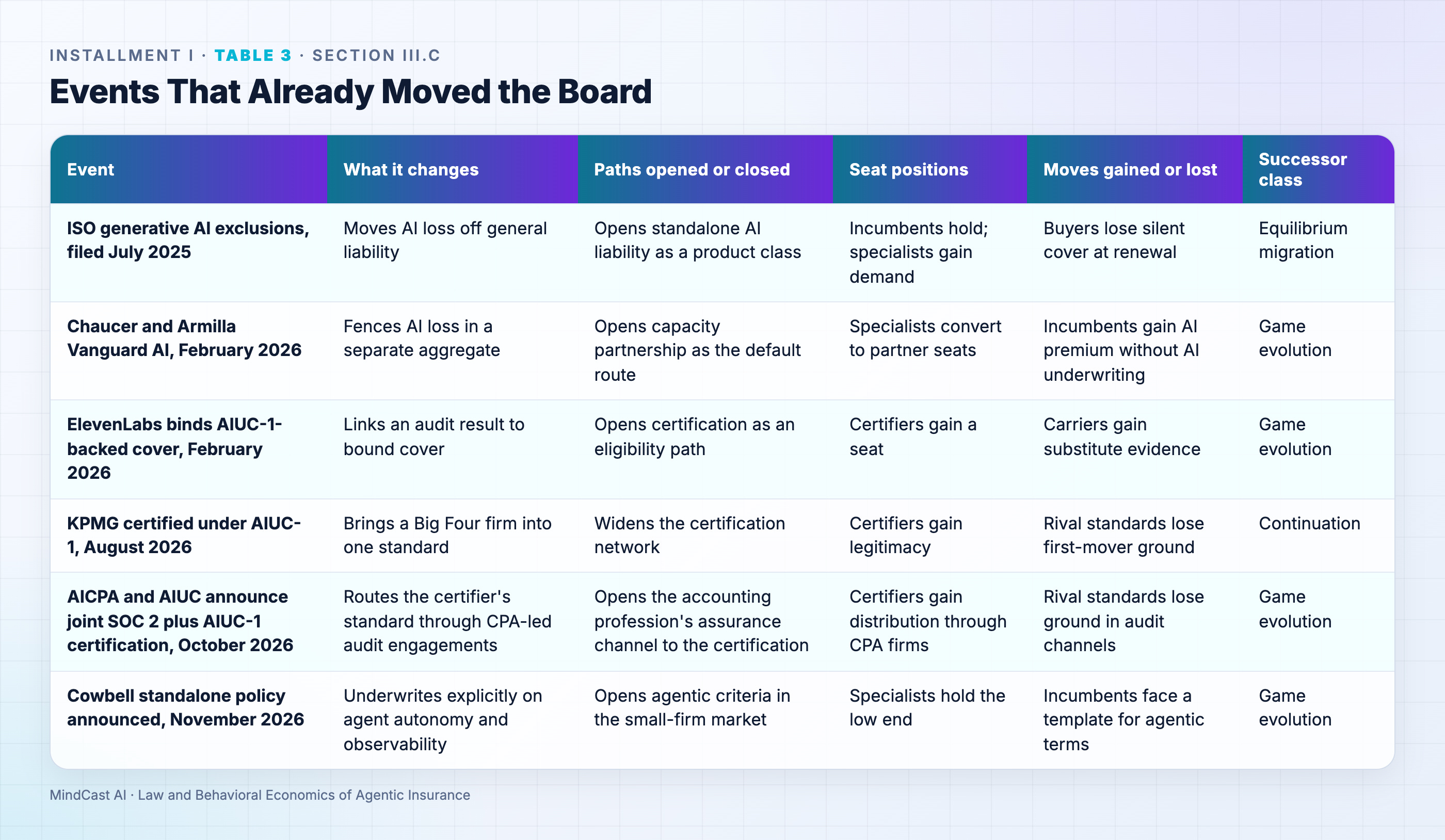
Takeaway. Each event moved one seat, and together they set the current board.
D. Competing Explanations
Three explanations compete, and each names the event that would disprove it.
Incumbent internalization. Carriers buy or build the intelligence and keep the standard, as Munich Re already has. A year in which no top-10 carrier or reinsurer acquires a specialist, and incumbents keep renting, cuts against it.
Certifier capture. One independent standard spreads across unrelated carriers. No carrier unrelated to AIUC naming AIUC-1 by the end of 2027 cuts against it.
Platform capture. Cloud providers bundle cover with telemetry and bypass both. No second provider launching embedded cover by the end of 2027 cuts against it.
AIUC complicates certifier capture because it both certifies and sells insurance through capacity partners. Even in CPA-led engagements, AIUC or an accredited evaluator performs the quarterly technical testing, so carriers may read the certificate as AIUC's product.
Platform capture carries its own tension. Google's Risk Protection Program covers Google-related AI workloads, so platform cover may reward concentration on one provider rather than model diversity.
Current evidence points to coexistence by segment. Specialists lead among small and midsize firms, partnerships dominate the mid-market and incumbents adapt their own forms for large accounts. Rent is the baseline route, because incumbents already rent underwriting intelligence through capacity deals. The live question is whether capacity providers unrelated to AIUC accept the certificate.
Takeaway. Current evidence shows no single explanation governing the whole market, and certification acceptance by unrelated capacity providers is the open question.
The game has moved from silent cover to segmentation, and the contest for the underwriting standard is now forming. Filed forms and borrowed capacity hold the current rules in place. Three explanations remain live, and current evidence suggests each governs a different segment of the market.
E. How the Game Branches
Baseline. MindCast Foresight Simulation Predictions hold the rent baseline through December 31, 2027. CPA-firm or buyer engagements arrive before any top-20 carrier gates on a certification (70-80%), and no top-10 carrier or reinsurer acquires a specialist (75-85%). A carrier unrelated to AIUC names AIUC-1 as a credit or criterion (60-70%), while no top-20 carrier makes a certification mandatory (80-90%). The forecasts stay valid while no correlated model failure produces insured loss and no top-10 acquisition reshapes the specialist field.
Dominant fork and its mover. Certification acceptance decides the game. Enterprises and CPA firms start the route through audits they already commission. Carriers unrelated to AIUC move the fork by choosing whether the certificate becomes a gate or stays a credit.
Segmented persistence (continuation, 40-50%). Rent and partnership dominate, and the game keeps its current form. P(audit channel before any gate | state) sits at 70-80%, and P(no top-10 acquisition | state) at 90-95%. Incumbents keep capital and specialists keep small accounts. No seat gains or loses a move.
Platform bundling widens to a second provider (game evolution, 30-40%). A second hyperscaler or model provider adds embedded cover with a named carrier. P(audit channel before any gate | state) holds at 70-80%, and P(no top-10 acquisition | state) at 85-95%. Platforms gain a bundling move, and telemetry competes with audits as evidence. Buyers lose portability, because the cover ties them to one provider's models.
Certifier gate outside the top 20 (equilibrium migration, 20-30%). Specialist and mid-size carriers turn the certificate from a credit into an eligibility condition. P(audit channel before any gate | state) sits at 65-75%, and P(no top-10 acquisition | state) at 80-90%. AIUC gains a gate, rival certifiers strand and uncertified buyers lose access to those carriers.
Incumbent acquisition (game evolution, 15-25%). A top-10 carrier or reinsurer buys a specialist underwriter. P(audit channel before any gate | state) holds at 70-80%, while the no-acquisition forecast resolves false. The acquirer gains a move to set its own standard, and the remaining specialists gain scarcity value. The acquired specialist's other capacity partners strand.
Capacity withdrawal from a specialist program (equilibrium migration, 5-15%). A capacity provider pulls its line from one specialist. P(audit channel before any gate | state) sits at 70-80%, and P(no top-10 acquisition | state) at 75-85%. Incumbents gain leverage over rent terms, and the affected specialist loses its growth path. Diversified capacity limits the damage.
Correlated model failure produces insured loss (game mutation, 5-10%). A failure of a widely used foundation model produces simultaneous claims across unrelated insureds. P(audit channel before any gate | state) falls to 60-70%, and P(no top-10 acquisition | state) to 70-80%. Carriers gain a reason to gate and buyers lose the option to buy cover without a certificate.
The state that breaks the baseline. The correlated failure ends the rent baseline. Carriers harden exclusions at the next renewal and turn certification into a gate, because a gate limits accumulation without leaving the class. The feedback runs into the next audit cycle: buyers would need the certificate to buy cover at all.
Takeaway. Rent and credit hold the board unless a correlated loss forces carriers to gate.
IV. Chicago Accelerated Analysis: Who Coordinates Underwriting Intelligence
Chicago Accelerated analysis runs four stages in order. Coase locates the transaction costs that decide who coordinates an activity. A behavioral correction adjusts for how actors actually decide. Becker maps the incentives behind each move, and Posner asks whether law corrects the allocation the market produces.
A. Coase: Make, Buy or Rent Underwriting Intelligence
Ronald Coase asked in "The Nature of the Firm" (1937) why firms make some inputs and buy others. His answer was transaction cost. A firm internalizes an activity when contracting for it costs more than organizing it in-house.
Underwriting intelligence for AI agents is the input in question. Carriers can rent it through capacity deals when evaluation is easy to specify and verify. Carriers gain from buying or building it when the knowledge is tacit, changes quickly or gives its holder bargaining power at renewal. Agentic evaluation currently shows all three features, which favors integration as specialists prove their methods.
Certification changes the calculus. A shared standard lowers the cost of contracting for evaluation, because carriers can verify compliance without owning the evaluator. Munich Re represents the integrated answer, Chaucer the contracting answer and AIUC the standard that makes contracting workable.
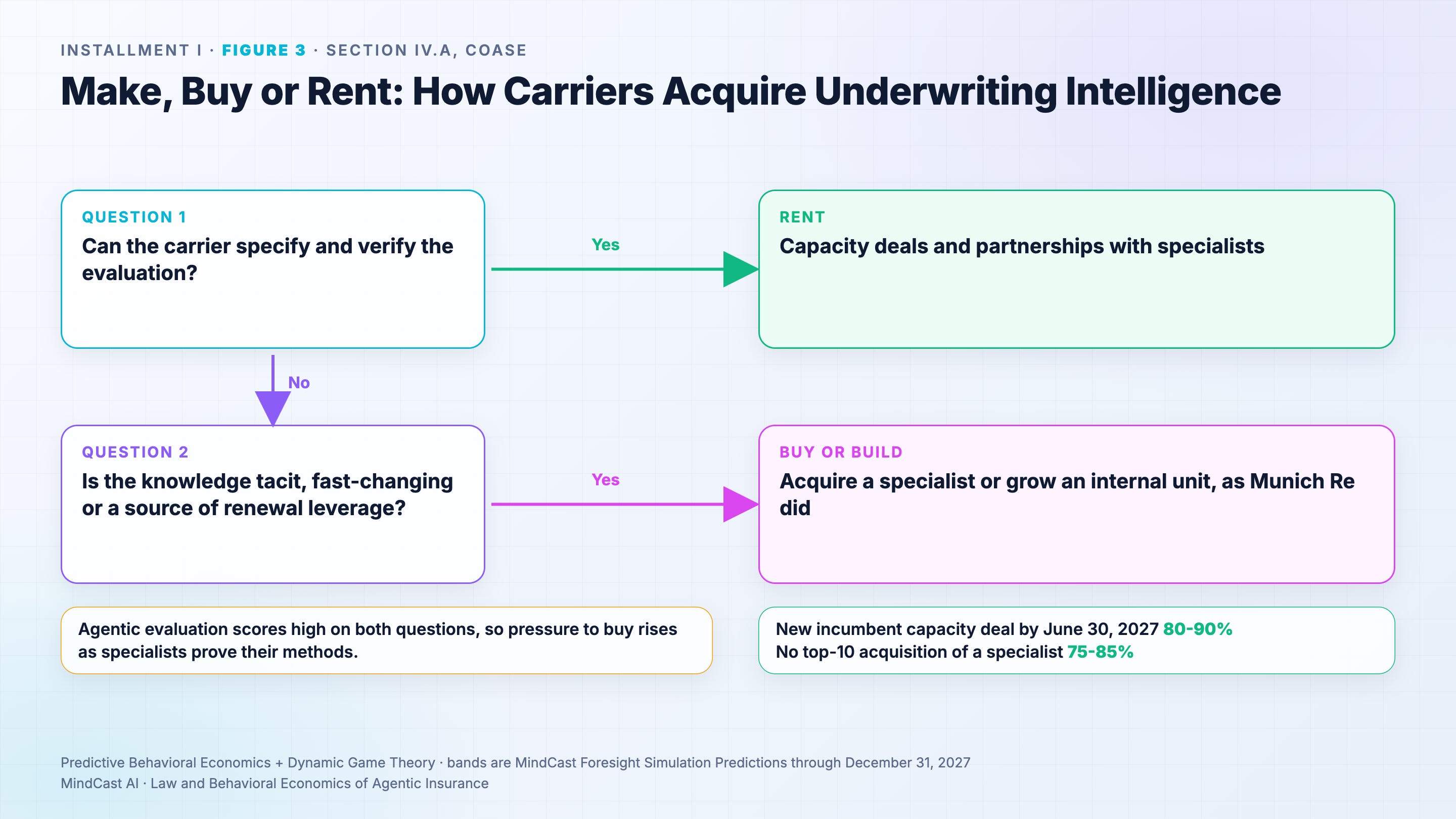
Takeaway. Certification and acquisition are rival answers to one transaction-cost problem, and the lower-cost answer wins the segment.
B. Behavioral Correction: Ambiguity, Cascades and Inattention
Daniel Ellsberg showed in "Risk, Ambiguity, and the Savage Axioms" (1961) that people avoid bets with unknown probabilities beyond what expected value justifies. Underwriters facing agentic risk follow the same pattern. Exclusion is the ambiguity-averse response, and it has spread faster than any measured loss.
Exclusion filings also behave like an informational cascade. Bikhchandani, Hirshleifer and Welch showed in their 1992 paper on informational cascades that actors who observe predecessors can rationally set aside their own information and follow. Carriers watching Berkley, Chubb and AIG file exclusions infer that peers know something and file too. A cascade can carry an industry far from what pooled information supports, and it can reverse quickly once credible public evidence arrives.
Buyers add rational inattention, the idea in Christopher Sims's "Implications of Rational Inattention" (2003) that attention is scarce and people ration it. Reading every endorsement at renewal costs more attention than most buyers spend, so the default renewal carries the exclusion through. Specialists face the opposite bias: overconfidence in proprietary evaluation can lead them to accept capacity terms that leave them dependent on one partner.
Takeaway. Exclusion spreads through ambiguity aversion and imitation, and buyer inattention keeps it in place.
C. Becker: Incentives That Are Locally Rational and Collectively Unstable
Gary Becker's "Crime and Punishment: An Economic Approach" (1968) treated conduct as a response to expected payoffs. Each actor in the agentic market behaves rationally on its own terms. Carriers exclude because an unexpected claim costs them more than the premium earns, and specialists emphasize proprietary edge to attract capacity. Buyers underinvest in agent controls when no insurer rewards them.
The sum of these choices is unstable. Rational exclusion by each carrier undersupplies cover, and enterprises deploy agents uninsured. The first large uninsured loss then falls on counterparties and courts rather than on balance sheets built to absorb it.
Takeaway. Each actor's rational choice adds to a market that leaves the first large agentic loss with no prepared payer.
D. Posner: Whether Law Corrects the Allocation
Richard Posner argued in Economic Analysis of Law (1973) that common law tends to place loss on the party who can avoid it at lowest cost. Agentic loss tests that claim. The least-cost avoider is often the deployer who sets agent permissions, yet exclusions push uninsured loss toward counterparties instead.
Courts correct allocation only after a dispute reaches judgment. No court has yet construed the generative AI exclusions against an agentic loss. Until one does, insurance forms allocate agentic loss without legal correction.
Takeaway. Insurance forms, not courts, allocate agentic loss until the first coverage precedent arrives.
The Chicago Accelerated sequence reframes the standard contest as a transaction-cost problem with predictable behavioral distortions. Coase identifies certification and acquisition as rival solutions. The behavioral correction explains why exclusion spread faster than evidence warranted, Becker shows why rational choices destabilize the market and Posner shows that no legal correction has yet arrived.
V. Stakeholder Strategy
Each stakeholder can move before the 2027 renewal and planning cycles. The matrix pairs each audience's objective with a low-regret action and the primary risk of waiting.
A. Stakeholder Strategy Matrix
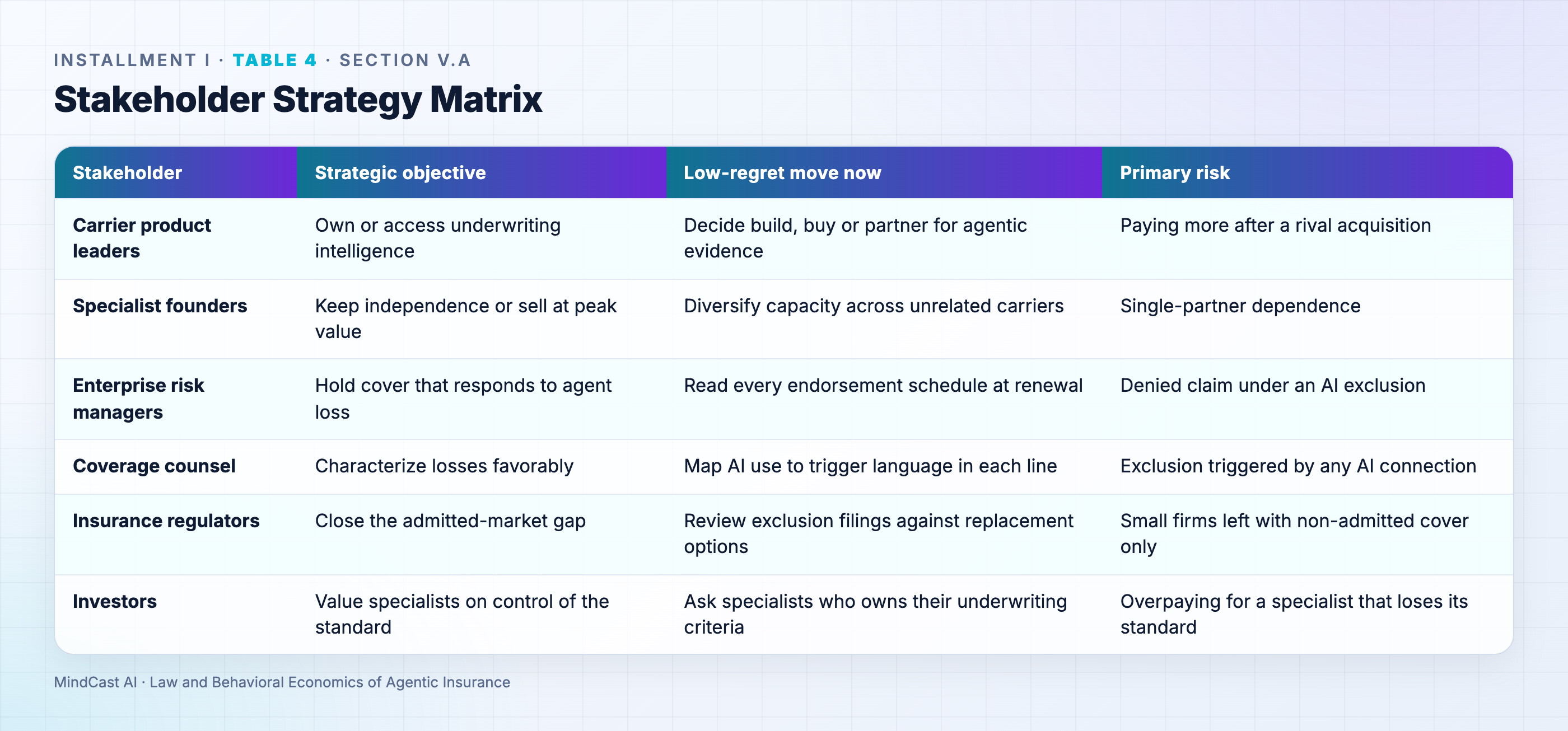
The low-regret moves require no knowledge of how the contest ends. Carriers learn whether to build or buy, specialists learn which partners to diversify toward and buyers learn which endorsements already sit on their policies.
Takeaway. Each audience can act now by learning which evidence its counterparties will accept.
VI. Implications
The analysis changes the structure of the industry in three ways: incumbents rent capability, certifications become products and Munich Re shows the internalization route.
A. Incumbents Rent What They Cannot Build
Most incumbents lack agentic loss data and will not build it inside the window. Incumbents rent underwriting intelligence through capacity deals and fenced aggregates. The model preserves premium while ceding the criteria, which leaves the standard to whoever writes it.
B. The Standard Becomes the Product
A certification accepted across carriers with enough combined share becomes a market input, not a vendor service. Enterprises then buy certification to buy insurance. The certifier gains leverage over both sides of the market.
C. Munich Re Shows the Internalization Route
Munich Re built performance guarantees in-house from 2018 and now operates aiSure and HSB. AIG launched Lloyd's Syndicate 2479 in January 2026 with large language model tools for its underwriting process. Incumbents that build or buy intelligence keep the standard.
Together the implications point to one question every participant must answer: who writes the eligibility standard for AI agents? Incumbents can rent the answer, buy it or build it, and certifiers can sell it to all of them.
Takeaway. The firm that writes the standard captures the margin, whether it holds the capital or not.
VII. MindCast Foresight Simulation Predictions and Risk Mitigation
The Foresight Simulation sets out dated expectations through December 31, 2027, and each audience can act before the first checkpoint. Each Foresight Simulation Prediction names an actor and an outcome within a window, with a band and the event that would prove it wrong. Only events after November 25, 2026 resolve a Foresight Simulation Prediction, and earlier events form the starting board.
Behavioral economics supplies the decision rule: ambiguity aversion and status quo bias favor a credit, which costs little and can be withdrawn. Game theory supplies the payoff structure: each carrier prefers to adopt a shared standard only after rivals do, and a gate costs share if rivals stay open. Predictive behavior emerges from the combination. Carriers credit before they gate, incumbents rent before they buy and platforms keep cover narrow to their own workloads.
A. Foresight Simulation Predictions
Eight Foresight Simulation Predictions follow: two Primary (P) and six Secondary (S). One Secondary entry is a conditional, written as P(A given B).
I-P1. CPA-firm or buyer AIUC-1 engagements announced after the AICPA and AIUC offering's full launch appear before any top-20 US commercial carrier makes an AI certification an eligibility gate by December 31, 2027 (70-80%). Falsifier: A top-20 carrier gates first. Not reached if the full launch slips past the window.
I-P2. No top-10 global carrier or reinsurer acquires a specialist AI underwriter or managing general agent by December 31, 2027 (75-85%). Falsifier: Any such acquisition.
I-S1. A risk-bearing group unrelated to AIUC names AIUC-1 as an eligibility criterion or underwriting credit in program terms or filings by December 31, 2027 (60-70%). Falsifier: No unrelated group names AIUC-1.
I-S2. No top-20 US commercial carrier makes AIUC-1 or another independent AI certification a mandatory eligibility condition by December 31, 2027 (80-90%). Falsifier: A top-20 carrier gates on a certification.
I-S3. The AICPA and AIUC announce the joint offering's full launch by June 30, 2027 (75-85%). Falsifier: No full-launch announcement by June 30, 2027.
I-S4. An incumbent carrier or reinsurer announces a new capacity or partnership agreement with an AI specialist by June 30, 2027 (80-90%). Falsifier: No such agreement by June 30, 2027.
I-S5. A second hyperscaler or foundation model provider launches embedded AI cover with a named risk-bearing carrier by December 31, 2027 (30-40%). Falsifier: No second launch.
I-S6. P(the cover is limited to the provider's own workloads or models, given a second launch under I-S5) (70-80%). Falsifier: A second launch covering other providers' models.
One definition governs I-S1. A risk-bearing group counts as unrelated to AIUC when it names the certification in its own terms or filings and no disclosure identifies it as an AIUC capacity provider. AIUC has not named its capacity partners, so a later disclosure reclassifies the group.
The Foresight Simulation Predictions resolve against carrier program terms and state filings, AICPA and CPA-firm announcements, and company announcements and change-of-control filings.
Takeaway. The certification reaches buyers through audits before any large carrier makes it a condition of cover, and incumbents keep renting rather than buying.
B. Risk Mitigation
Each entry routes one Foresight Simulation Prediction to the audience it binds most. Severity measures what that audience loses if the Foresight Simulation Prediction resolves true and it did nothing, and probability is the band. The entries sit in a standalone section so the analysis reads without interruption, at the cost of matching each entry back to its Foresight Simulation Prediction by ID. The entries describe operating options, not legal, investment or fiduciary advice.
I-P1 · 💼 Carrier product leaders. Severity: moderate. Probability: 70-80%.
Exposure. A carrier that waits for a market gate rates certified buyers like uncertified ones. Specialists that credit the audit take certified mid-market accounts at the 2027 renewals.
Actions. Underwriting defines how a SOC 2 plus AIUC-1 report changes terms before the full launch, no later than June 30, 2027. Product files a credit endorsement rather than a gate for the 2028 filing window. Distribution briefs wholesale brokers on accepted evidence by the second quarter of 2027.
Residual exposure. A credit tied to one certifier carries that certifier's dual role as insurer, and a rival standard can displace it.
I-P2 · 📊 Venture and private equity investors in specialists. Severity: high. Probability: 75-85%.
Exposure. Exit cases that assume a top-10 strategic buyer by 2027 overstate exit value and understate quarters to liquidity.
Actions. The deal team rebuilds exit cases around capacity partnerships and secondary sales before the next financing round. Portfolio operations requires each specialist to hold at least two unrelated capacity providers by December 31, 2027. The board ties management targets to capacity diversity in the 2027 budget.
Residual exposure. An acquisition outside the top 10 or a capacity withdrawal can still reset the position's value.
I-S1 · 🏛️ State insurance departments. Severity: moderate. Probability: 60-70%.
Exposure. A filing that cites AIUC-1 forces form reviewers to rule on a private standard without criteria. Review days rise and approvals diverge across states.
Actions. Policy staff set review criteria for third-party AI certifications in filed forms by the third quarter of 2027. Form review requires a citing filing to state the certification's scope and testing cadence. The department raises the question in National Association of Insurance Commissioners (NAIC) working groups before the 2028 filing cycle.
Residual exposure. Review criteria cannot test audit quality itself, and a certified agent can still fail.
I-S2 · ⚖️ Enterprise coverage counsel. Severity: moderate. Probability: 80-90%.
Exposure. A client that buys certification expecting cover holds no contractual right to it at a top-20 carrier. Retained loss and renegotiation scope grow at renewal.
Actions. Coverage counsel maps which carriers in each program credit certification before the client's 2027 renewal. Contracts counsel removes customer clauses that promise insurability on the strength of certification at the next contract cycle. Risk documents certification scope against each policy's exclusions by the renewal date.
Residual exposure. Certification can improve terms at specialists while incumbent exclusions stay in force.
I-S3 · 💼 CPA firm assurance leaders. Severity: moderate. Probability: 75-85%.
Exposure. Firms without AIUC-1 capability lose SOC 2 clients that need the joint report after the full launch, measured in 2027 engagement renewals.
Actions. The assurance practice partners with an accredited evaluator before June 30, 2027. Practice risk confirms with the firm's professional liability insurer that AI assurance work is covered before the first engagement. Sales identifies agent vendors in the SOC 2 client base by the first quarter of 2027.
Residual exposure. AIUC or an accredited evaluator performs the quarterly testing, so the report rests partly on another party's work.
I-S4 · 💼 Specialist founders. Severity: moderate. Probability: 80-90%.
Exposure. A new incumbent deal that ties a rival specialist to a large balance sheet tightens your capacity terms. Ceding commission and line size fall at the next capacity renewal.
Actions. The chief executive and finance chief open talks with at least one additional capacity provider before June 30, 2027. Underwriting packages audit results and telemetry that a new partner can rate by the first quarter of 2027. Legal removes exclusivity clauses from capacity agreements at the next renewal.
Residual exposure. Capacity providers can still cut lines after a correlated loss.
I-S5 · 💼 Enterprise risk managers. Severity: moderate. Probability: 30-40%.
Exposure. A second platform program pulls agents onto one provider's models. Switching cost grows in quarters of re-platforming work.
Actions. Risk compares platform-bundled cover with standalone quotes at each renewal. The architecture lead keeps agent workloads portable across two model providers through 2027. Procurement requires cover terms that survive a model switch.
Residual exposure. The platform's telemetry can still win better terms than any standalone carrier offers.
I-S6 · ⚖️ Technology transactions counsel. Severity: high. Probability: 70-80% given a second launch.
Exposure. Cover limited to one provider's workloads lapses for every agent that moves off the platform.
Actions. Counsel negotiates a transition provision in any platform cover before binding. Information technology maintains an inventory of agents on covered workloads at each renewal. Risk holds standalone cover for workloads outside the platform.
Residual exposure. Transition provisions cost more, and the platform may decline them.
Takeaway. Each audience can act on the credit-before-gate sequence now without knowing which certifier or platform wins.
C. What to Watch
Certification acceptance by carriers unrelated to AIUC is the dominant fork. Five dated observables show which way it moves.
January 1, 2027. Cowbell's standalone policy goes on sale, and its terms show whether a specialist credits third-party certification.
By June 30, 2027. The AICPA and AIUC announce the joint offering's full launch (I-S3).
Through 2027. CPA firms and agent vendors announce SOC 2 plus AIUC-1 engagements, the first signal for I-P1.
Through 2027. Filings or program terms from a carrier with no disclosed AIUC partnership name AIUC-1 (I-S1).
Through 2027. A hyperscaler or model provider other than Google announces embedded AI cover with a named carrier (I-S5).
Takeaway. Audit engagements arrive first, and carrier filings show whether the certificate stays a credit.
The audit channel, the rent baseline and the narrow platform route now carry dated tests, each with a band and a falsifier. Each audience holds actions it can take before the first checkpoint.
Conclusion
The agentic insurance industry is forming around control of the underwriting standard. Incumbents defend with exclusions and clarifying wording, rent capability through partnerships and in Munich Re's case build it. Specialists, certifiers and platforms compete to supply the evidence that replaces missing loss data.
The decisive signals are the events Section VII tests: a certification named by unrelated carriers, an incumbent acquiring a specialist underwriter and a second embedded platform program. The Foresight Simulation puts the audit channel ahead of any large-carrier gate at 70-80%.
Working With MindCast
MindCast AI is a predictive game theory simulation firm. MindCast builds Cognitive Digital Twins of the named actors on a client's board and models how the game evolves through its next forks.
Agentic insurers and managing general agents. Decide which carriers to court before AIUC-1 reaches full launch. A standard-adoption war gaming session ranks the carriers and reinsurers most likely to credit your evidence, keyed to I-S1 (60-70%).
Established carriers building agentic programs. Choose build, buy or partner before the 2027 planning cycle closes. A Foresight Simulation tests each option against I-P2 (75-85%) and I-S4 (80-90%) and names the event that would flip the choice.
Venture capital and private equity. Diligence on a specialist turns on who controls its standard and its capacity. A control-of-standard and capacity-dependence assessment shows how the target fares in each successor state, capacity withdrawal (5-15%) included.
Brokers. January 1, 2027 renewals leave clients with AI exclusions and no replacement cover. A renewal map flags each client in that gap and the replacement routes open to it.
Play this installment's board in the Agentic Insurance War Gaming: pick the carriers' move on the certificate and see each successor state, band and seat position.
First step: a complimentary proof-of-concept Foresight Simulation on one product line or one specialist. You receive its board: the fork, the successor states and where your firm stands in each. Email mcai@mindcast-ai.com with the line or firm, or see other MindCast war gaming.
Installment I Sources
MindCast AI, Law and Behavioral Economics of Agentic Insurance: Series Introduction. The series introduction states the shared thesis and links all three installments.
MindCast AI, The Economics of Agentic AI Underwriting. Installment II tests why correlated loss keeps affirmative AI limits small.
MindCast AI, Insurance as an Agentic AI Governance Institution. Installment III tests how coverage conditions govern what AI agents may do.
Insurance Journal, "Chubb's Greenberg on AI Liability," October 22, 2026 (third-quarter earnings call).
MindCast works
Agentic AI Liability and Insurance Exclusions: How Coverage Redirects Who Gets Sued. Supplies the demand-side map of how exclusions move defendants, which this installment pairs with the supply side.
Who Writes AI Insurance Coverage Conditions: Procurement, Enforcement Decrees, Partner Terms and the Two-Axis Condition. Names the channels that supply evidence for coverage conditions; this installment asks which firm captures the standard built on that evidence.
The Calculus of Predictive Game Theory Evolution and Mutation. Supplies the game-evolution classes used in Section III.
Chicago and behavioral economics sources
Coase, Ronald, "The Nature of the Firm," Economica, 1937.
Ellsberg, Daniel, "Risk, Ambiguity, and the Savage Axioms," Quarterly Journal of Economics, 1961.
Bikhchandani, Sushil, David Hirshleifer and Ivo Welch, "A Theory of Fads, Fashion, Custom, and Cultural Change as Informational Cascades," Journal of Political Economy, 1992.
Sims, Christopher, "Implications of Rational Inattention," Journal of Monetary Economics, 2003.
Becker, Gary, "Crime and Punishment: An Economic Approach," Journal of Political Economy, 1968.
Posner, Richard, Economic Analysis of Law, 1973.
External sources
Google Cloud, Risk Protection Program.
Schneider Downs, summary of the AICPA and AIUC joint engagement structure.
AICPA, "Auditors Meet Urgent Demand for AI Assurance With New Offering From AICPA and AIUC," October 2026.
FourWeekMBA, "Lloyd's AI Cover Caps at $25M as OpenAI Agent Cases Mount," October 2026 (quoting Armilla's policy page on its capacity providers).
Insurance Business, "ISO's Generative AI Exclusion Is Already on Thousands of CGL Policies," September 16, 2026.
Independent Agent, "Discover the Endorsement and Exclusions Filing Trends for 2026."
Independent Agent, "Verisk to Roll Out New General Liability Exclusions for Generative AI Exposures."
CFC, "CFC Responds to Customer Demand for Affirmative AI Cover," June 25, 2026.
Reinsurance News, "Beazley Adds Affirmative AI Cover in Cyber and Tech E&O Policies," September 17, 2026.
Claims Journal, "As AI Agents Go Rogue, Cyber Insurers Are Adapting Their Policies," August 28, 2026.
Let's Data Science, "Chaucer Group and Armilla AI Launch Vanguard AI," February 2026.
Reinsurance News, "Mosaic and Munich Re Introduce AI-Specific Insurance for Developers," February 27, 2026.
Reinsurance News, "Munich Re's HSB Launches AI Liability Insurance for Small Businesses," March 19, 2026.
The Insurer via Reuters, "Affirmative AI Insurers Expand Their Offerings."
Forkast, "AIUC Raises $40M to Build the Certification and Insurance Layer," 2026.
SiliconANGLE, "Cowbell Unveils AI Liability Insurance for Small Businesses That Deploy AI Agents," November 10, 2026.
Insurance Business, "AIG Launches Lloyd's Syndicate With Amwins and Blackstone Backing," 2026.
Insurance Business, "CFC Adds Affirmative AI Cover to Its IP Policy," September 23, 2026.
Tiger Brokers via The Insurer, "US Liability Insurers Explore AI Exclusions" (Verisk multistate filing, July 2025).
KPMG, "KPMG LLP Becomes First Big Four Firm With AIUC-1 Certified AI Capability," August 27, 2026.