
Related works: Meta on Trial for Teen Social Media Harm — Twenty-Nine States, One Judge, and the Future of Platform Design Liability
I. Executive Summary
Settlements execute liability maps faster than judgments. Meta proved the point on August 26, 2026.
The thesis follows directly. Meta agreed to pay up to $16.68 billion and accept binding design changes across the settling jurisdictions, ending the Oakland trial eight days after opening statements. The terms sort along the separability line MindCast mapped six days earlier: the states reached deeply into control surfaces and the usage envelope while the core recommendation engine stayed commercially operable. No verdict issued, yet the same map is visible in the negotiated outcome.
The August 20 paper registered twelve MindCast Foresight Simulation Predictions with probability bands, resolution dates and falsifiers, generated by the MindCast AI Proprietary Cognitive Digital Twin Foresight Simulation (MP CDT FS) engine.
The settlement produces a clear validation record. Within the twelve-entry August 20 registry, ACT-III.6 validates: MindCast predicted a minors-facing modification before a liability ruling with core architecture preserved, and the settlement delivered that structure with broader control-surface intervention than forecast.
ACT-III.3 is substance-confirmed but its liability condition was extinguished; ACT-III.9 remains consistent with the predicted feature-class ordering. Four entries were mooted by settlement and five remain open.
Separately, the December 2025 forecast produced two validated calls and one strongly supported call, while the exposure prediction validated at 1.2% of Meta’s own $1.4 trillion reference figure. The simulation did not price a mid-trial settlement, a registry gap addressed in Section V.
Behavioral economics supplies the decision rules and salience effects. Dynamic predictive game theory supplies the payoff structure and equilibrium selection. Predictive behavior emerges from the combination.
The paper assesses all twelve registry entries against the settlement. Sections II and III state the settlement record, validate the numerical exposure call and assess the evidence supporting the anchor mechanism. Sections IV through VI assess all twelve entries, state the registry gap with its corrective disposition rules, and close with the structural outlook and the forward prediction.
Stakeholder callouts:
🏛️ Policymakers — A bipartisan coalition of 51 attorneys general just accomplished what no federal agency has attempted and no Congress has enacted: a binding, near-national change to how a major platform designs its product for minors. Two-hour default daily limits, overnight blackouts only a parent can lift, age assurance that detects users under 18 and children under 13, and an independent compliance auditor all arrived through litigation rather than legislation. The practical lesson runs in two directions. Treat the multistate coalition as the operative regulator of platform design going forward, and treat the settlement’s remedy set as the bargaining floor for any future enforcement or statute — no platform can credibly argue that terms Meta already accepted are unworkable.
💼 Executives — Meta’s lawyers just published a map of where they believe liability actually lives, and they did it with $16.68 billion behind the signature. The company conceded governance over time limits, curfews, feed choice, autoplay settings and age verification, while keeping its recommendation and optimization engine fully operable. Those concessions mark the negotiated risk frontier: the features a sophisticated defendant concluded were not worth defending at trial. Any executive running an engagement product should score their own control surfaces against that conceded set now, because the next enforcer will open negotiations from it.
⚖️ Counsel — The settlement remedies sort precisely along the line New Mexico’s judgment drew three weeks earlier: courts and now consent decrees reach features separable from content presentation (time limits, notifications, defaults, age gates), while features entangled with editorial presentation (algorithmic recommendation itself) remain defended ground. Categorical Section 230 positions no longer end these cases — the Ninth Circuit’s defense-not-immunity holding survives as binding precedent, and the settlement extinguished the appeal that could have revisited it. Build defense and compliance strategy feature by feature on separability analysis, because feature-level exposure is what the completed proceedings now price.
📊 Investors — The exit priced at 1.2% of the $1.4 trillion figure Meta itself filed and roughly 8% of the states’ $200 billion estimate, and shares rose 4.4% in premarket trading on the news. The market treated a sixteen-billion-dollar payment with binding product restrictions as relief, which tells you the headline exposure numbers in platform litigation systematically overstate operative risk. Snap’s 8% same-day decline tells you the complement: repricing now travels to platforms no complaint has named, through the matching mechanism and the settlement template. Price platform litigation off the feature-level liability map — which features are reachable, what remedies attach to them, what a settlement floor looks like — rather than the headline number alone.
II. What Settled — The Record
The settlement record sets the facts every assessment below resolves against. Meta Platforms agreed on August 26 to pay a maximum $16.68 billion resolving twenty-nine states’ claims. Reuters reported the terms in “Meta Reaches $16.68 Billion Settlement Over Social Media Harms to Children” (2026). The states alleged that Meta designed Facebook and Instagram to addict children, misled consumers about safety and improperly collected children’s personal data.
Headline totals differ by scope, so the scorecard fixes its accounting up front. Court papers and Reuters carry $16.68 billion for the principal multistate settlement, which twenty-nine states tried and which resolves the claims of 51 attorneys general per California’s release.
Several state offices describe the resolution at up to $17.1 billion including the Cambridge Analytica payment. Meta’s approximately $18 billion figure spans a 52-attorney-general arrangement including Texas’s separate $1 billion resolution, paid in annual installments over ten years with participating states receiving roughly 70%.
The deal arrived mid-trial in People of the State of California, et al. v. Meta Platforms, Inc., No. 4:23-cv-05448-YGR (N.D. Cal.), within MDL No. 3047.
Structural terms, per the court papers:
A default two-hour combined daily limit and a midnight-to-6 a.m. blackout that only a parent can lift, plus muted notifications during school hours, for users under 18
A teen-selectable non-personalized chronological feed with a parental lock, autoplay governed as a protective setting and mandated pauses during extended sessions
Robust age assurance detecting users under 18 and children under 13, plus enhanced restrictions on minors’ access to age-restricted content
Expanded parental supervision tools and an independent compliance auditor with expansive information access
An injunction barring further false or misleading statements about safety features
All parties waive appellate rights upon entry of final judgment; the proposed settlement requires court approval through entry of a consent judgment
Meta denies wrongdoing
Read the terms as three layers. Layer one is the core optimization and recommendation engine, which remains commercially operable. Layer two is the user and parent control surface, where the states acquired governance rights including feed choice and setting locks.
Layer three is the time and access envelope, now bounded by defaults, curfews and mandated pauses. The states reached deeply into layers two and three while leaving layer one running, a more precise separability sort than a binary touched-versus-untouched read.
Approval remains pending as of publication on August 26. Rogers declined to enter the consent judgment at the morning hearing and suspended the case while she completes her review. The San Francisco Standard, “Meta Reaches $17.1B Settlement in Oakland Teen Safety Trial” (2026), reports her remark that “it’s good to make sure that I take a closer look.”
One clause carries game-theoretic weight. Meta conditioned roughly $5.3 billion of the payment on YouTube and TikTok each paying the same sum and adopting the same usage limits and age-assurance measures, per The Irish Times, “Meta to Pay Up to $16.7bn to Settle Children’s Social Media Harm Case” (2026). The clause converts a bilateral settlement into an industry coordination device: Meta priced rival participation into its own penalty and turned its concession into a sector-wide standard bid.
The settlement also resolved Cambridge Analytica-era privacy claims by California and three other jurisdictions, allocating $459.3 million to them. Meta shares rose 4.4% in premarket trading.
III. The Exposure Call Validated, the Anchor Mechanism Supported by the Exit Price
Section III of the August 20 paper identified the $1.4 trillion figure as a defendant-filed instrument that “makes any eventual judgment look restrained by comparison.” Read the ratios:

The settlement resolved at 1.2% of Meta’s $1.4 trillion reference figure and 8.3% of the states’ approximately $200 billion estimate. The premarket gain of 4.4% faded to about 1% by early afternoon, an initial reaction consistent with relief but not isolating any anchoring effect.
Meta filed the anchor as appellate groundwork for a judgment scenario, and the figure instead framed the negotiated exit. The exit therefore validates the exposure call while providing directional, not causal, support for the anchoring hypothesis.
Contact mcai@mindcast-ai.com to partner with us on Predictive Game Theory AI in Law and Behavioral Economics. We specialize in predictive simulations for Complex Litigation, Innovation Economics, Geopolitical Risk Intelligence and Legacy Innovation. See more about MindCast series at our new website MindCast Corporate.
To test our predictive simulation AI system, in 2026 we simulated the Super Bowl and the World Cup. See 🏈 Super Bowl LX — AI Simulation vs. Reality | ⚽ The 2026 World Cup Final Simulation Validation
To deep dive on MindCast works upload the URL of this publication into any LLM (preferably Google AI mode) and prompt ‘reconstruct MindCast framework with three degrees of cited sub links.’ See Live-Fire Game Theory Simulators, Runtime Predictive Infrastructure, MindCast Foresight Prediction Simulations, Synthesizing Behavioral Economics + Game Theory.
Working With MindCast
MindCast runs two service lines on one method. Litigation foresight intelligence assesses proceedings, settlements and remedies against the feature-level liability map. Design exposure intelligence maps the control surfaces beneath them: time and access envelopes, feed governance and age assurance, the seams where product design ends and enforcement exposure begins.
⚖️ Platform counsel and product leaders can commission a control-surface exposure audit against the settlement benchmark: named features scored on the separability model, per-feature exposure keyed to the terms Meta accepted, and a modification sequence timed to the enforcement windows the registry projects. Snap, TikTok and YouTube face the sharpest version of the question, because the matching mechanism and Core Industry Member designation price their adoption decision in advance.
📊 Investors and lenders can commission a litigation-repricing screen across a named portfolio: which holdings sit within reach of a surviving claim class, which remedy class each proceeding is most likely to produce, and what the settlement floor does to positioning and exit assumptions. Snap’s 8% decline on announcement day shows the repricing arriving before any complaint names the company.
🏛️ State attorney general offices and legislative staff can commission a doctrine-migration assessment: where feature-level design theories arrive next, keyed to the settlement’s remedy menu, the New Mexico template and the pleading architecture the completed proceedings supply.
🤖 AI companion and agentic-product builders can commission a pre-enforcement architecture review scored against the sorting rule, because the AI carve-out means their exposure arrives through separate or analogical enforcement rather than automatic extension.
The Simulation Predictions in this paper are the litigation line applied to the control-surface layer now pricing across social media and AI. Every engagement above runs on the same methodology, with dated falsifiable outputs. Contact mcai@mindcast-ai.com.
IV. The Registry Scorecard — All Twelve Entries Assessed
Event forecasts resolve against the public record, and the settlement is now the controlling record event.
Validated
ACT-III.6 — Pre-Ruling Modification (68–72%). VALIDATED — architecture preserved, control-surface intervention broader than predicted. The Simulation Prediction called a further minors-facing safety-framed modification before the liability ruling with core engagement architecture preserved. The settlement imposed extensive design modifications before any liability ruling while leaving the core optimization architecture commercially operable, and the intervention reached further into engagement controls than the entry described. The specified resolution source anticipated a liability ruling; settlement extinguished that event, so the assessment rests on the prediction’s substantive condition.
December 2025 structural forecast — TWO CALLS VALIDATED, ONE STRONGLY SUPPORTED. The trial-timing call validated: design claims reached trial in summer 2026, with opening statements on August 18. The modification-profile call validated: Meta conceded substantial minors-facing control-surface and usage-envelope restrictions while preserving its core optimization architecture, and the settlement terms restate the December profile with dollar amounts attached. The evidentiary-pressure call is strongly supported rather than validated, because the compelled documentary record preceded an exit eight days into trial while no party has attributed the exit to it on the record.
Exposure call — VALIDATED; anchor mechanism — SUPPORTED. Section III above.
Substance Confirmed, Condition Extinguished
ACT-III.3 — Remedy Architecture (74–78%, conditional). CONDITION EXTINGUISHED; SUBSTANCE CONFIRMED BY CONSENT. The Simulation Prediction called at least one binding design-based remedy, conditional on liability. Liability never triggered, so the entry does not score. The substance nonetheless exists across the settling jurisdictions: binding time-spent protections and age defaults travel in the proposed consent judgment rather than a contested injunction.
ACT-III.9 — Feature-Class Ordering (70–80%, interpretive). CONSISTENT; SETTLEMENT SOURCE EXTINGUISHED. The Simulation Prediction ranked time-spent-restriction features first in liability and remedial viability. The consent remedy centers on time-spent architecture: daily caps and nighttime blocks lead the structural terms, matching the predicted ordering. The specified resolution source was a liability ruling and remedial order together; neither will issue, so the entry cannot formally score. A negotiated remedy reveals the parties’ bargaining priorities, while only a merits ruling could establish judicial ordering.
Mooted — Resolution Events Extinguished
ACT-III.1 — Liability on Design (79–82%). MOOTED. No liability ruling will issue.
ACT-III.2 — The Instruction Boundary (63–67%). MOOTED. The trial ended before jury instructions, so Rogers will adopt no Section 230 instruction in the proceeding. The conduct-versus-content line remains unwritten in operative courtroom language, a doctrinal cost of settlement the states accepted.
ACT-III.4 — Advisory-Jury Divergence (56–60%). MOOTED. No advisory verdict, no final determination, no divergence to measure.
ACT-III.8 — Appellate Activation (89–91%, conditional). MOOTED — PERMANENT UPON ENTRY. The appeal waiver extinguishes the condition once the consent judgment enters, so the entry can never trigger after approval completes.
Open — Horizons Unchanged, Probabilities Under Review
ACT-III.5 — Doctrinal Portability (71–75%; resolves August 20, 2027). OPEN, weakened at the federal layer. No Rogers ruling means no federal merits holding to harden the sort into portable doctrine. The template now travels on three doctrinal anchors plus the settlement’s persuasive weight: New Mexico’s entered judgment, the Massachusetts SJC holding and the Ninth Circuit’s defense-not-immunity opinion. Landing surfaces remain abundant across thousands of MDL personal-injury cases, roughly thirty state-court actions and Tennessee’s ongoing Nashville trial against Meta.
ACT-III.7 — AI Remedy Migration (62–66%; resolves August 20, 2028). OPEN — AI carve-out makes migration non-automatic. The settlement supplies a negotiated benchmark of time limits, curfews and age assurance. The agreement expressly excludes AI-primary products from its new-entrant definition. Any qualifying migration therefore must occur through separate or analogical enforcement, and Kentucky’s action against Character Technologies already targets the same control surfaces.
ACT-III.10 — Architecture-First Remedy (76–79%, conditional on ACT-III.7). OPEN.
ACT-III.11 — State Enforcement Diffusion (68–72%; resolves August 20, 2028). OPEN, strengthened. The settlement lowers every successor action’s cost: pleading architecture, an evidentiary record in the admitted-exhibits repository and a remedy menu with Meta’s signature on it. The matching clause adds a second accelerant, because Meta itself now demands that YouTube and TikTok adopt the same limits.
ACT-III.12 — The Control-Surface Map (80–90%, interpretive; resolves August 20, 2028). OPEN, reinforced. The settlement sorts features along the separability line without any court compelling the sort, evidence the map governs behavior even off the bench. Formal resolution still requires the decisional record through 2028.
Takeaway: the settlement validates ACT-III.6 and confirms the substance of ACT-III.3 without satisfying its condition. It remains consistent with ACT-III.9, moots four entries and leaves five open.
V. The Registry Gap and the Disposition Rules
The August 20 registry did not price a mid-trial settlement. The register covered twelve event and interpretive outcomes across the full trial cycle, and settlement was the one outcome class capable of mooting four entries simultaneously.
Meta’s second-quarter Form 10-Q had already disclosed a pre-verdict settlement on the bellwether track, so the signal existed and went unpriced.
Two rules now govern every active MindCast litigation registry, effective with this publication:
Disposition Rule 1 — Settlement pricing. Every registry attached to an active proceeding carries a settlement-probability entry with a dated window, priced in the same simulation run as the merits entries. Mid-trial settlement is a modal outcome of high-exposure litigation rather than an exogenous shock.
Disposition Rule 2 — Condition extinguishment. Every conditional entry states its disposition when the condition is extinguished rather than unmet: mooted, transferred to a successor event, or scored on substance with the mechanism disclosed. ACT-III.3 and ACT-III.8 resolve under the transitional application of the rule.
Takeaway: the next registry prices the exit ramp alongside the merits.
VI. Structural Outlook — What the Settlement Changes
The settlement extends the control-surface framework through negotiated remedies rather than adjudicated doctrine. Meta paid up to $16.68 billion and accepted governance over its control surfaces and usage envelope while keeping the optimization engine running. The concession pattern maps the negotiated risk frontier.
Multistate enforcement scaled. A coalition spanning 51 attorneys general extracted a near-national product-architecture change no federal agency has attempted and no Congress has enacted. The coalition converted litigation posture into binding design change, demonstrating that multistate enforcement can operate at near-national scale.
The settlement extends the core remedy architecture across the settling jurisdictions and creates a matching mechanism tied to YouTube and TikTok. New Mexico ordered the template in one state and the consent terms now carry it much further. The matching clause puts $5.3 billion behind industry adoption, providing subsequent enforcers a bargaining floor Meta already accepted.
The market reaction extended to rival platforms, with Snap shares falling more than 8% after the announcement. The agreement identifies Snap, TikTok and YouTube as Core Industry Members, while the $5.3 billion payment contingency specifically turns on YouTube and TikTok adopting specified protections.
Tennessee’s trial against Meta continues in Nashville. Thousands of MDL personal-injury and school-district claims remain pending against Meta, TikTok, Snap and YouTube.
The settlement also leaves an important Section 230 consequence. The Ninth Circuit’s published August 10 opinion remains binding circuit precedent absent vacatur or later overruling: Section 230 supplies a defense to liability rather than immunity from suit. Settlement eliminates a merits ruling from Rogers in this proceeding but leaves that appellate framework available in subsequent platform-design cases.
The settlement also creates a potential analogical benchmark for AI engagement products. The same variable-ratio reinforcement mechanism can operate in those products, and states could measure them against control surfaces Meta conceded were tradeable in 2026.
Forward Prediction — AI Remedy Migration. By August 20, 2028, at least one enforcement action or court order against an AI companion or agentic engagement product will reference or materially replicate the settlement’s control-surface remedies. Qualifying measures include time or session limits, nighttime or usage restrictions and age assurance. Because the settlement expressly excludes AI-primary products, qualifying migration must occur through separate or analogical enforcement. Falsifier: no qualifying action or order by August 20, 2028. A probability band issues with the next MP CDT FS run.
Appendix A — Scorecard Summary Table
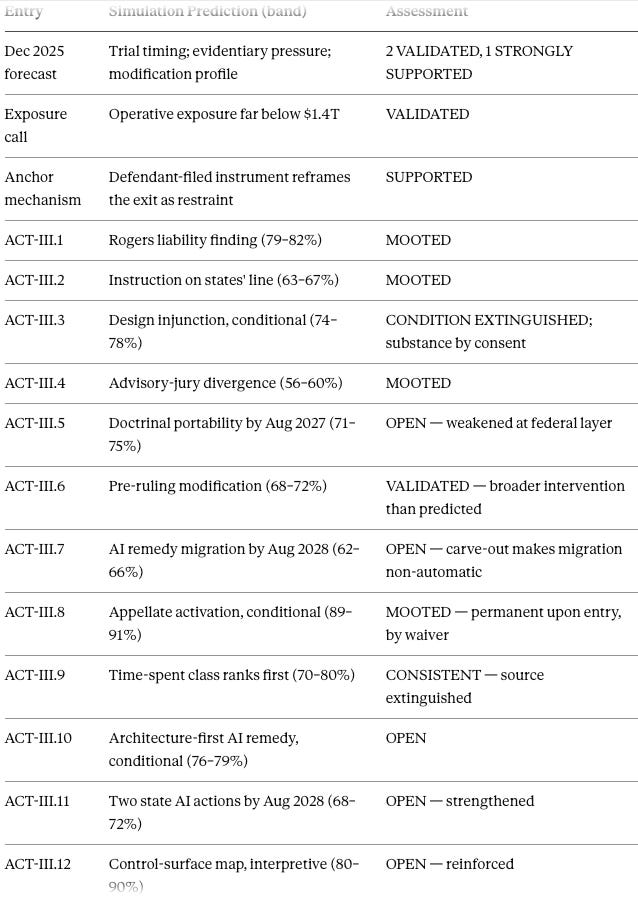
Registry status: 1 validated; 1 substance confirmed with condition extinguished; 1 consistent interpretive; 4 mooted; 5 open.
Appendix B — Sources
MindCast works:
MCAI Cultural Innovation Vision: Meta on Trial for Teen Social Media Harm — Twenty-Nine States, One Judge, and the Future of Platform Design Liability (Aug. 20, 2026). The paper registered the twelve Simulation Predictions this scorecard assesses, six days before the settlement.
Settlement record:
Settlement Agreement and Proposed Consent Judgment, People of the State of California, et al. v. Meta Platforms, Inc., No. 4:23-cv-05448-YGR, Dkt. 572-1 (N.D. Cal. filed Aug. 26, 2026). The primary instrument carrying the control-surface provisions, the Core Industry Member contingency and the express AI carve-out, hosted by the California Attorney General.
Reuters, “Meta Reaches $16.68 Billion Settlement Over Social Media Harms to Children” (Aug. 26, 2026), via U.S. News syndication.
Reuters, “Meta Reaches $18 Billion of Settlements Over Children’s Social Media Addiction” (Aug. 26, 2026), via The Spokesman-Review syndication.
CNBC, “Meta Settles Social Media Addiction Case with California, Other States for $16.7 Billion” (Aug. 26, 2026). Carries the Texas separate resolution, the $17.1 billion state characterization and the Snap share decline.
The Irish Times, “Meta to Pay Up to $16.7bn to Settle Children’s Social Media Harm Case” (Aug. 26, 2026). Carries the $5.3 billion YouTube/TikTok matching clause.
The San Francisco Standard, “Meta Reaches $17.1B Settlement in Oakland Teen Safety Trial” (Aug. 26, 2026). Reports the hearing at which Rogers declined immediate approval and suspended the case pending review.
California Department of Justice, “Attorney General Bonta Secures Transformative $17 Billion Settlement with Meta” (Aug. 26, 2026). States the 51-attorney-general coalition and the consent-judgment approval requirement.
Doctrinal anchors:
TechCrunch, “New Mexico Court Orders Meta to Pay Additional $567M in Child Safety Case” (Aug. 7, 2026). Details the ordered remedies including hidden like counts, notification curfews and monthly usage caps.
Ninth Circuit published opinion, People of the State of California v. Meta Platforms, Inc. (9th Cir. Aug. 10, 2026). Holds Section 230 supplies a defense to liability rather than immunity from suit.
Commonwealth v. Meta Platforms, Inc., SJC-13747 (Mass. Apr. 10, 2026). Unanimous holding that Section 230 does not bar design-conduct claims.
AI migration record:
Kentucky Office of the Attorney General, “AG Coleman Sues AI Chatbot Company for Preying on Children” (Jan. 8, 2026). The first state enforcement action against an AI chatbot company.