
Companion paper: How Mozart Predicts Game Mutation in Predictive Behavioral Economics + Dynamic Game Theory(2026)
Thesis. Strategic contests change when an actor able to attach consequences writes a contested valuation into enforceable terms, not when the valuation spreads. At publication, MindCast’s simulation finds that change in one of five live controversies, alongside grid costs: large-load cost allocation tariffs for AI data centers.
Why now. The Commodity Futures Trading Commission’s October 9 rules, the Supreme Court petition against Kalshi, six grid-operator filings due November 16 and Washington’s new listing statute all reach decision points within six months. Policymakers, executives, counsel and investors face classification choices before those decisions bind.
I. Executive Summary
Nietzsche Makes Valuation Change Tangible
Friedrich Nietzsche’s On the Genealogy of Morality (1887) separates the origin of an institution from the purpose it later serves. Each new authority that takes over an institution reinterprets it for its own ends. The institution keeps its form while its purpose changes. In game-theory terms, the strategy set holds while the payoffs change.
On October 9, 2026, the Commodity Futures Trading Commission (CFTC) issued two classifications in one day. An interim final rule confirmed the agency’s existing position that casino-style gambling products, including sportsbook wagers, are not swaps. A proposed rule would bring event contracts on sports, politics, culture and weather under the agency’s swap definition. The Supreme Court was still deciding whether to hear New Jersey’s case against Kalshi, a platform that sells contracts paying out on whether an event occurs.
Core insight. A strategic game can change through its valuations as well as its rules. Valuation means the legitimacy, classification and social reward actors attach to a move. A changed valuation can move payoffs with no rule change at all. The CFTC confirmed one classification and proposed another, and neither has yet changed what any platform earns.
Thesis. Strategic actors can change a game by changing the valuations that govern its rewards. Consequential adoption by a regulator, a court, a counterparty or a buyer matters more than breadth of circulation. Authorities facing a valuation contest adopt one interpretation, reject the challenge or split the conduct into categories. The game that emerges therefore differs from the one its initiator sought.
Three mechanisms. Valuation reversal arrives from below, when dispersed actors organize around the opposite valuation. Authoritative reinterpretation arrives from above, when an authority assigns an existing instrument a new purpose. Obligation through exchange arrives from the side, when counterparties write a valuation into contract and coverage terms.
What distinguishes the MindCast approach. MindCast AI applies Predictive Behavioral Economics + Dynamic Game Theory through MindCast AI Proprietary Cognitive Digital Twin Foresight Simulations (MP CDT FS). Behavioral Economics supplies the decision rules. Game Theory supplies the payoff structure. Predictive simulations emerge from the combination.
Behavioral economics explains how framing changes choices among options that do not change. Amos Tversky and Daniel Kahneman showed in “The Framing of Decisions and the Psychology of Choice” (1981) that the same option draws different choices under different descriptions. Game theory adds the payoff consequence once a new description reaches a regulator, a contract or a buyer. Cognitive Digital Twins (CDTs) model each actor’s installed valuations from its public conduct.
The gap the companion fills. The Mozart paper explains what a game mutation looks like and when it binds, where a game mutation is a change in a contest’s rules, players or payoffs. The companion explains when changed valuations move a game’s rewards and when they only follow changes in law or technology. Six MindCast frameworks explain how contests behave, and the Mozart paper explains how their games change.
How Mozart Predicts Game Mutation in Predictive Behavioral Economics + Dynamic Game Theory (2026) separates new games from new tactics. The companion explains the valuation causes behind its three mechanisms.
Chicago School Accelerated: The Integrated Modernized Framework of Chicago Law and Behavioral Economics(2025) explains why rules move toward whoever values them most. The companion asks how that value gets assigned in the first place.
The Dual Nash-Stigler Equilibrium Architecture (2026) defines when strategy and inquiry come to rest. The companion tests when a valuation comes to rest.
Dynamic Predictive Game Theory Meets the Era of AI: Operationalizing Fudenberg’s Research Agenda with Cognitive Digital Twins (2026) defines Adaptive Coherence Equilibrium (ACE), which tracks actors that persist through change. The companion tracks institutions that persist under new interpreters.
The Computational Era Operationalizes Cybernetics and Predictive Game Theory (2026) identifies when feedback breaks a model. The companion identifies valuation feedback that breaks a model without any change in the rules.
Chicago’s Randal Picker Was Simulating Law and Economics Before AI (2026) shows populations migrating between equilibria. The companion asks when a migration reflects a changed valuation.
MindCast Foresight Prediction Simulations, Synthesizing Behavioral Economics + Game Theory (2026) makes the transition between states the object of forecasting. The companion applies that object to transitions between valuations.
Nietzsche Vision. MindCast introduces Nietzsche Predictive Behavioral Economics + Dynamic Game Theory Vision (Nietzsche Vision). The function forecasts why, through whom and how lastingly the valuations governing a strategic game change. Mozart Vision, introduced in the companion paper, forecasts whether that change produces a new game.
What the companion does. The companion follows the five controversies of the Mozart paper, opening with Kalshi and the brokerage Compass. Each case receives a Mozart reading and a Nietzsche reading. Each installment of Mozart-Nietzsche Predictive Dynamic Economics now applies both functions, and each asks one Mozart question and one Nietzsche question. MindCast’s simulation of both functions finds valuation-driven change in one controversy and issues nine MindCast Foresight Simulation Predictions.
Why the Genealogy. Five works competed for the lead. The Genealogy faced The Gay Science and Beyond Good and Evil, along with Daybreak (1881) and Twilight of the Idols (1889). The Genealogy won because its three essays supply the three questions the companion needs.
The First Essay explains valuation reversal. The Second Essay explains reinterpretation by a new authority, and the Third explains why an old valuation persists until a rival exists. Each essay therefore maps to one installment.
How the shortlist maps to the five controversies. Each column tests one feature tied to a controversy’s valuation contest. 🟢 Green means the work supplies the mechanism in full, 🟡 yellow a partial version and 🔴 red no version. The ratings reflect how directly each work supplies the mechanism, not its weight in Nietzsche’s thought.
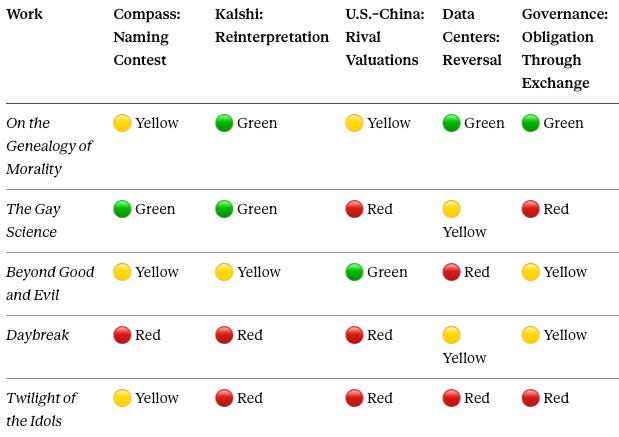
The Genealogy earns three greens, the most of any work. The Gay Science turns green where a contest turns on a name, as Compass and Kalshi do. Beyond Good and Evil turns green where rival valuations coexist across jurisdictions, as in U.S.–China AI competition.
Two functions, three installments. MindCast’s Mozart’s Mirror: How K. 491 Reflects Romantic Complexity and the Architecture of Intelligence (2025) reads K. 491 as three movements joined by one argument. The reading supplies the three-part design of the series. The Genealogy is three essays joined by one argument, and each essay supplies one installment’s Nietzsche lens.
Stakeholder callouts.
🏛️ Policymakers: A definition can change payoffs before a rule binds. Draft definitions as if they were the rule.
💼 Executives: The classification your business depends on is a strategic asset. Identify who can make the rival classification operative.
⚖️ Counsel: Separate the actor who opened a contest from the authority that will decide it. Brief the interpreter, not the initiator.
📊 Investors: A carve-out tells you which side each category of conduct went to. Read the categories before the headline.
Takeaway. Mozart shows an identity persisting while the structure around it changes. Nietzsche shows a form persisting while its purpose changes, and the series now forecasts both.
II. Nietzsche in Game Theory Terms
Nietzsche’s work on valuation translates into four game-theory claims and one reading of Mozart. Each pairs with a claim in the Mozart paper. Together they explain how payoffs change without a change in the rules.
Revaluation Can Change Payoffs Inside a Fixed Strategy Set
A game in the classical sense fixes the players, the available moves and the payoffs. John von Neumann and Oskar Morgenstern built that object in Theory of Games and Economic Behavior (1944). The First Essay of the Genealogydescribes a revaluation in which the same conduct keeps its place in a contest while its moral evaluation reverses.
A changed evaluation does not change returns by itself. Nietzsche Vision separates three consequences: changed subjective valuation, changed social reward and changed strategic payoff. A revaluation becomes a payoff change only when it reaches social rewards and then a channel that carries consequences.
The Mozart paper treats variation inside a stable form as strategic adaptation. Revaluation is a different kind of change, in which the moves stay the same and what each move earns can change. A boycott, a downgrade or a lost contract marks the point where a judgment has become a payoff.
Takeaway. Revaluation can change what a move earns without changing which moves exist, once it travels from judgment to reward to payoff.
Names Work as Focal Points
The Gay Science §58 holds that what things are called carries more weight than what they are, because names and appearances shape how people treat them. Thomas Schelling showed in The Strategy of Conflict (1960) that players coordinate on shared expectations when formal rules leave the outcome open. A shared classification is such an expectation.
A shared name coordinates expectations, and enforcement turns expectations into consequences. Once a regulator, court or counterparty attaches consequences to calling an event contract a derivative or a bet, participants plan around that classification. Naming alone decides no legal or economic outcome.
The Mozart paper uses Schelling’s focal point to explain broken conventions in K. 491. The companion applies the same logic to classification. A contested name is a contested focal point.
Takeaway. Whoever fixes the name shapes the expectations participants coordinate on, and an enforcing authority decides what the name carries.
Form Survives While Purpose Changes
The Second Essay §12 of the Genealogy argues that the cause of an institution’s origin and its later purpose can lie worlds apart. Each new authority that takes the institution over reinterprets it. The Mozart paper inverts the image: Mozart’s identity persists while the structure around it changes.
ACE measures the actor that stays coherent through change. Nietzsche Vision tracks the institution that keeps its form under new interpreters. Event contracts, listing rules and model access have each kept their form in 2026 while authorities contested their purpose.
Takeaway. The Mozart paper follows the actor that persists, and the companion follows the institution that persists.
Nietzsche Read Mozart as the Close of an Older Taste
Beyond Good and Evil (1886) §245 treats Mozart as the last expression of an older European taste. Nietzsche places Beethoven at the transition and Romanticism after it. His subject is a change in what audiences valued, not a change in musical form.
The Mozart paper and Nietzsche read the same composer through different lenses. The Mozart paper finds an identity that persists while the structure of K. 491 changes. Nietzsche finds a valuation regime that lapsed while Mozart’s music stayed the same.
The two readings show the series’ division of labor in one case. Mozart Vision asks what changed in the structure. Nietzsche Vision asks what changed in the valuation of an unchanged object.
Takeaway. One composer illustrates both functions: structure changing under a stable identity, and valuation changing around a stable work.
Valuations Reach Payoffs Through Five Channels
A valuation changes payoffs only when it reaches a channel and changes a decision, a demand, an obligation or a cost there. The five channels are reputation, coalition formation and contract eligibility, plus consumer demand and regulatory legitimacy. Reaching a channel is not enough, because a reputation can shift or a regulator can speak without any actor paying or earning differently.
The channel test separates Nietzsche Vision from accounts of how narratives spread. A framing can spread widely without reaching any channel. A single authority can adopt a framing and move a channel at once.
What the translation means for each audience.
🏛️ Policymakers: A definition changes payoffs only when an enforcing body attaches consequences to it.
💼 Executives: Broad support for a classification protects a business only after an authority adopts it.
⚖️ Counsel: The channel a valuation reaches decides whether it creates exposure.
📊 Investors: Adoption by an enforcing body signals a payoff change, and wide spread of a framing does not.
Takeaway. Spread is not consequence, and the channel test measures consequence.
III. Valuation Mutation Theory Explains What Changes a Game’s Rewards
Valuation mutation theory classifies how valuations change and when the change reaches payoffs. The theory sits beside the Mozart paper’s game mutation theory. A changed valuation still has to pass the Mozart tests before it counts as a new game.
Six Valuation States Separate Reframing From Transmission
Every contested valuation sits in one of six states.
Reframing: the rhetoric changes and nothing else does.
Contested: rival coalitions hold competing valuations, and no authority has acted.
Non-binding adoption: an authority states the valuation in a text that changes no obligation.
Binding adoption: an authority makes the valuation enforceable before payoffs move.
Transmitted: payoffs change through at least one channel.
Failed or reversed: an adopted valuation was withdrawn or lost.
The first five states describe current status, and the sixth describes history. A valuation can fail after non-binding adoption, binding adoption or transmission. A reversed valuation therefore carries its last status and its reversal together.
Takeaway. Most valuation contests sit in the first three states, and only the fifth changes what a strategist earns.
Transmitted Valuations Still Face the Mozart Test
The Mozart paper requires structural change and durability before a development counts as a new game. A transmitted valuation passes the structural stage only when it changes feasible strategies, players, authority or payoffs. Durability applies unchanged.
Valuation change and game mutation can therefore come apart. A valuation can move payoffs while the game holds. Nietzsche Vision forecasts the valuation change, and Mozart Vision decides whether it produces a new game.
Takeaway. A transmitted valuation is a candidate cause of mutation, not proof of one.
Three Valuation Mechanisms Run Beside the Mozart Mechanisms
The Mozart paper names three mechanisms of game mutation: institutional clock speed, endogenous adaptation and constraint migration. Nietzsche Vision names three mechanisms of valuation change, sorted by the direction from which the new valuation arrives. Any Nietzsche mechanism can drive any Mozart mechanism, so the table pairs them for comparison rather than identity.
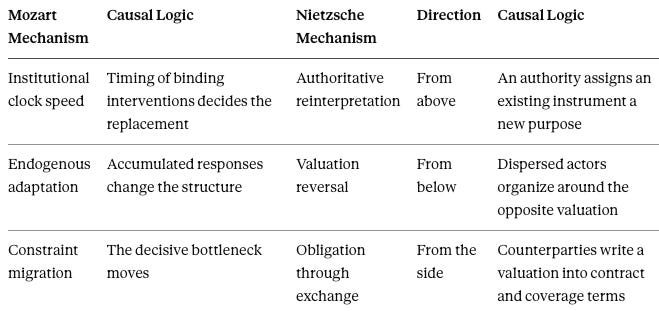
The mechanism names the process that started the valuation change, and the interpreter names the actor that made it consequential. A bottom-up reversal can end in top-down adoption, as in AI data centers. Keeping the two apart stops one case from carrying contradictory labels.
Takeaway. Mozart asks what moved the structure, and Nietzsche asks who moved the valuation and from which direction.
The Initiator and the Interpreter Are Separate Forecasts
The actor who opens a valuation contest rarely decides it. Compass opened the contest over private listings. Washington’s legislature and the Northwest Multiple Listing Service (NWMLS) set the operative terms.
Ronald Coase and George Stigler explain why concentrated actors usually win rule changes. Concentrated actors organize at lower cost than dispersed ones. William Riker called winning by changing the terms of a contest heresthetics.
Dispersed actors overcome that disadvantage when the contest runs through a venue that requires their consent. Tribal governments hold compact rights in the prediction-market dispute. Counties hold land-use authority over data centers.
Takeaway. Forecast the interpreter, and forecast dispersed actors to win where their consent is required.
Authorities Adopt, Reject, Partition or Defer Interpretation
An authority facing a valuation contest has four responses. The authority adopts one interpretation whole, rejects the challenge and keeps the existing classification, or partitions the conduct. Partition splits contested conduct into categories and gives each rival valuation its own category. The fourth response adopts a valuation while leaving its terms undefined, which passes the operative interpretation to an agency or a court.
Carve-outs appear in four of the five controversies at publication. The CFTC split casino-style products, including sportsbook wagers, from other event contracts. NWMLS kept mandatory submission and added a 21-day First Look window, and state large-load tariffs separate new large loads from ordinary demand. The Department of Commerceconditioned model access on institutional trust.
The four carve-outs arise through different institutions: an agency rule, a private agreement, state tariff orders and an executive restriction. Carve-outs also arise from administrative drafting and bargaining. A carve-out alone does not establish a valuation contest.
Partition counts as a valuation outcome only when evidence shows the competing valuations shaped the categories an authority adopted. The evidence lies in the decision itself. Comment files, legislative findings, agreement recitals and stated reasons either answer each side’s valuation or do not. At publication the CFTC’s stated rationale cites the limits of its authority, so the Kalshi carve-out does not yet meet the test.
Takeaway. Partition is a candidate response to authoritative reinterpretation, and the evidence of each decision shows whether valuation shaped it.
Valuations Count as Causes Only When They Lead
A valuation and a payoff change can move together for four reasons. The valuation can lead, with the payoff following. A statute, a technology or an actuarial finding can move conduct first, with the valuation adopted afterward to justify it. Both can contribute, or one upstream event can move both.
Nietzsche Vision credits valuation only when it leads or makes a distinct joint contribution after controls for incentives and constraints. Chronology alone never assigns credit. Twilight of the Idols (1889) names the error of confusing cause with consequence, and the companion applies that discipline to every case.
Takeaway. A valuation that follows the incentive explains the politics, not the outcome.
Old Valuations Persist Through Reproduction or the Absence of a Rival
The Third Essay of the Genealogy explains why the ascetic ideal endured. Institutions actively reproduced the ideal because it gave suffering a meaning, and no rival ideal had formed to replace it. Daybreak §9 adds that custom commands obedience because it is old, not because it is useful.
The two routes call for different strategies. A valuation that institutions actively reproduce falls only when those institutions change or lose authority. A valuation that persists for lack of a rival falls once a rival organizes and an interpreter adopts it.
The Mozart paper names persistence of the existing game as a fourth explanation in every controversy. Nietzsche Vision adds the valuation reading and asks which route sustains the old valuation. The answer decides whether an opponent of the old valuation should build a rival coalition or target the institutions that reproduce it.
What the theory means for each audience.
🏛️ Policymakers: The reasons stated in a carve-out decision show whether valuation shaped the categories.
💼 Executives: The firm that opens a contest rarely decides it, so the interpreter is the actor to model.
⚖️ Counsel: Undefined statutory terms move the decisive interpretation to agencies and courts.
📊 Investors: A valuation that institutions reproduce falls only when those institutions change, which sets the horizon for a position against it.
Takeaway. An old valuation falls only when its reproducing institutions weaken or a rival reaches an interpreter.
IV. Five Live Controversies Test Valuation Mutation
The five controversies of the Mozart paper supply the test. Each case keeps the Mozart paper’s facts, adds a Nietzsche reading and names the rival explanation the causal test must rule out. AI data centers show the one valuation-driven change at publication, with valuation and grid costs acting together. Kalshi shows an agency adopting classifications that have not yet moved payoffs.
Kalshi Faces an Agency That Confirmed One Classification and Proposed Another
Kalshi’s prediction-market contest is moving toward one venue. New Jersey petitioned the Supreme Court on September 2, 2026, in No. 26-299. Kalshi’s response is due November 9.
Eleven amicus briefs followed between September 22 and October 9. On October 9 the CFTC issued an interim final rule and a proposed rule.
The Mozart Vision reading. The CFTC moved faster than the Court. Institutional clock speed governs, because the agency changed the questions the Court must weigh while review was pending. The petition before the Court now raises a question the agency has already begun to answer. The change remains anticipated rather than realized, because the event-contract classification is still a proposal.
The Nietzsche Vision reading. In Nietzsche’s terms, a new authority reinterpreted an existing instrument, as the Second Essay §12 describes. In game-theory terms, the agency split the conduct across two instruments of different force. In behavioral terms, the carve-out handed both sides an argument, because states read it as a concession and Kalshi reads it as a principled line.
The two instruments carry different consequences. The interim rule binds on Federal Register publication and codifies the agency’s existing position that casino-style products, including sportsbook wagers, are not swaps. The proposed rule binds no one until a final rule issues, so the swap classification of event contracts remains a stated position. Platform payoffs move only when a final rule binds or the Court acts.
Rival explanation. Agency jurisdiction-seeking explains the rules without any change in how event contracts are valued. The agency’s rationale of clarifying the limits of its authority supports the rival at publication. The test is whether the comment file and final definitions answer the coalitions’ valuations or the agency’s statutory reach alone.
What the two readings show. The agency adopted a valuation that has not yet changed what platforms earn, so the game change remains anticipated. A binding final rule would make the change enforceable. Whether valuation caused that rule would remain a separate question.
Compass Opened a Naming Contest That Others Will Decide
Compass’s nationwide campaign against multiple listing services (MLSs) repeats one playbook: private listings, a public deadline, a threatened antitrust suit and a negotiated rule change. Washington replaced private rules with public law through SSB 6091, which passed 49–0 and 92–1 and took effect as Chapter 57, Laws of 2026. Compass and NWMLS reached an agreement on August 31, 2026. The California Regional Multiple Listing Service sued Compass first in New York on October 5 and included Compass’s September 8 demand letter in its complaint.
SSB 6091 requires concurrent marketing to the public and all brokers, with an exception only for owner or occupant safety. The statute sets no time window and leaves its key terms undefined, as its author intended. Compass says its programs comply, and NWMLS countersued Compass in April 2026.
The Mozart Vision reading. Endogenous adaptation governs, because each MLS contest taught the next target how to answer the playbook. Washington’s statute changed the form. Each later target entered its contest holding the filings of the earlier ones.
The Nietzsche Vision reading. In Nietzsche’s terms, Compass and the MLSs contest the name of the same conduct: seller choice or exclusion, as The Gay Science §58 predicts. In game-theory terms, the August 31 agreement split the conduct, keeping mandatory submission while allowing private marketing for 21 days. In behavioral terms, the window gives later boards a ready compromise to anchor on.
Rival explanation. Commercial leverage explains each agreement without any change in valuation. The test separates bargaining from valuation. Copies of the window by MLSs that face no Compass suit would show a valuation spreading through contract eligibility.
What the two readings show. Washington’s statute adopted the public-marketing valuation NWMLS held before the law, and the rules changed. Compass’s conduct has not, because the undefined terms leave the operative interpretation to the Department of Licensing and the courts. The case shows a legal change without a demonstrated change in market conduct.
Washington and Beijing Value Distillation Differently
U.S.–China AI competition runs through hardware, model access, runtime extraction and corpus acquisition. On June 12 Commerce blocked foreign access to two frontier models and lifted the restriction on June 30. On September 8 joint advisory AA26-251A named six Chinese AI firms in distillation campaigns against U.S. frontier models.
The Mozart Vision reading. New players joined the game as private enforcers and brokers. Each restriction moved capability transfer toward the next channel no rule names. Regulators anchor on the objects they already control, such as named models and chips.
The Nietzsche Vision reading. In Nietzsche’s terms, Beyond Good and Evil §260 describes two moralities that coexist and judge the same act oppositely according to the evaluator’s position. The bridge to AI competition is positional, because the jurisdiction holding frontier capability values distillation as extraction while the jurisdiction acquiring it values distillation as standard research practice. In game-theory terms, the advisory moved distillation from research technique toward extraction in an official text that binds no one. In behavioral terms, the advisory adopted a valuation frontier labs had already written into their terms, since OpenAI’s terms have barred using outputs to build competing models since at least December 2023.
Rival explanation. Security incentives drive the restrictions, with the extraction label adopted afterward. Private contracts carried the valuation first, so the open test is whether any binding instrument adopts it.
What the two readings show. The valuation sits in private contracts and a non-binding official text. Neither the rules of the contest nor what its players earn has changed.
Artificial Intelligence Data Centers Face a Contest Over Who Bears the Cost
AI data center development moved its binding constraint from power to permission. On August 3, 2026, Texas Governor Greg Abbott ordered an audit of data centers in the Electric Reliability Council of Texas (ERCOT) interconnection queue. On September 21 he directed the state environmental agency to issue no data center permits until the grid and water audits finish.
The Federal Energy Regulatory Commission (FERC) ordered six grid operators on June 18, 2026, to justify or reform their large-load tariffs. The order names cost-shifting protections among the reforms, and the operators’ filings are due by November 16. A 50-state survey dated October 9 lists 33 states with approved large-load cost allocation tariffs.
The Mozart Vision reading. Constraint migration governs, because relieving the power constraint moved scarcity to permission. Developers who secured power still need permission from the utility, the state and the county. Solving one constraint exposed the next without replacing the governing game.
The Nietzsche Vision reading. In Nietzsche’s terms, ratepayers and counties contest the valuation of data centers as development assets and press the reverse valuation of public burden, as the First Essay describes. In game-theory terms, approved cost allocation tariffs have written a burden valuation into contract terms by assigning upgrade costs and collateral to large loads. In behavioral terms, opposition gains force because the burden is local and visible while the benefit is diffuse.
Rival explanation. Grid reliability and ordinary cost recovery explain the tariffs without any public revaluation. Customer-protection language alone cannot separate the two, because cost allocation produces the same language. Valuation earns causal credit only where consumer protection shifted costs beyond a comparable engineering and cost-recovery baseline. Texas’s permit halt remains the strongest grid-first instance, because the Governor tied it to grid and water audits.
What the two readings show. The simulation classifies AI data centers as the one valuation-driven game change at publication, with valuation and grid costs acting together. The classification rests on the simulation’s reading of the tariff decisions, not on an independent demonstration that valuation caused them. If grid-cost recovery alone explains the tariffs, the case reads as a structural change instead.
Artificial Intelligence Governance Turns on Who Grants Trust
MindCast forecasts that AI governance will turn from a cost of doing business into a condition of market access. MindCast’s The Duty to Foresee (2026) argues that pre-deployment simulation is moving toward a standard of care. The argument supplies the governance case’s doctrinal frame. Commerce’s June restriction conditioned model access on institutional trust for 18 days.
The Mozart Vision reading. Contracts and insurers may supply the governance terms the law has not written, as performers supply the cadenza in K. 491. In No. 20 (K. 466), one outside party’s cadenzas became the standard most performers play. Governance may follow the same path, with one counterparty’s terms becoming the standard.
The Nietzsche Vision reading. In Nietzsche’s terms, the Second Essay traces obligation back to dealings between creditors and debtors. Applying that history to insurance and contract terms is the companion’s economic extension, not Nietzsche’s theory of governance. In game-theory terms, counterparties with leverage could write the governance duty into contract and coverage terms. In behavioral terms, firms treat governance as compliance cost until a counterparty makes it a condition of doing business.
The evidence so far shows the authority mechanism, not the counterparty mechanism. Commerce adopted a trust valuation and reversed it within 18 days.
No carrier has yet offered coverage conditioned on AI controls. The industry’s forms body has moved the other way: Verisk’s optional generative AI exclusions for general liability carry a January 2026 edition date. The forms are optional, and which carriers have attached them to policies is not yet documented. Where carriers do attach them, coverage is withdrawn rather than offered on conditions, and the exclusions follow actuarial uncertainty rather than a shift in legitimacy.
Rival explanation. Loss experience drives insurer terms independent of any shift in legitimacy. The test is whether the first coverage conditions cite controls as a matter of trust or as a matter of loss history. Loss-based terms would show insurers acting on loss data rather than on a changed valuation.
What the two readings show. The governance rules have not changed, and no contract yet makes governance controls a condition of doing business. Coverage availability changes wherever a carrier attaches the exclusions, because they withdraw general liability coverage for generative AI exposure. Withdrawal of coverage and coverage conditioned on controls are different events, and only the second would show the lateral mechanism.
What the controversies mean for each audience.
🏛️ Policymakers: A definition issued during a pending case reshapes what the court decides, as the CFTC’s October 9 rules show.
💼 Executives: A statute can adopt a valuation without changing a rival’s conduct, as Washington’s listing law shows.
⚖️ Counsel: Private contract terms carried the extraction valuation before the official advisory, so contracts are the earlier signal.
📊 Investors: A 50-state survey counts 33 states with approved large-load tariffs, so cost responsibility is a project input rather than a forecast.
Takeaway. Every controversy carries a valuation contest, and the companion separates the cases where valuation leads from the cases where it follows.
V. Each Installment Applies Both Vision Functions
Each installment of Mozart-Nietzsche Predictive Dynamic Economics carries one Mozart Vision question and one Nietzsche Vision question. The installments keep their lead cases. Each Genealogy essay supplies one installment’s Nietzsche lens.
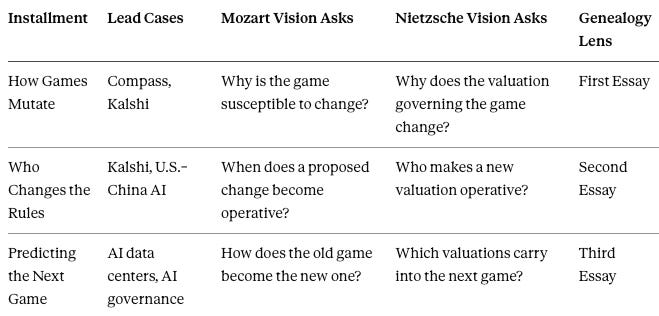
How Games Mutate Tests Why Valuations Change
How Games Mutate explains the forces that push contests to rewrite their rules. The Nietzsche question asks why the valuation governing the game changes. Compass carries the test, because Washington’s statute changed the rules without yet changing Compass’s conduct. The installment separates the valuation contest from the commercial leverage that could explain the same outcomes.
Who Changes the Rules Tests Who Makes a Valuation Operative
Who Changes the Rules identifies which institutions hold binding authority and how fast they move. The Nietzsche question asks who makes a new valuation operative and how the authority responds. Kalshi carries the test, because the CFTC issued a binding exclusion and a non-binding proposal while the Court weighed review. The installment also asks whether any binding instrument adopts the extraction valuation private contracts already carry.
Predicting the Next Game Tests Which Valuations Carry Forward
Predicting the Next Game forecasts the replacement game in each controversy. The Nietzsche question asks which valuations carry into the next game, reverse or lapse. AI data centers carry the one valuation-driven change, and AI governance carries the open question of whether insurers and contracts will set governance terms. The installment issues Simulation Predictions on both the game and its valuations.
What the installments mean for each audience.
🏛️ Policymakers: Each installment tests a rule’s timing and a valuation’s transmission as separate questions.
💼 Executives: The Compass installment shows a rule change that left a rival’s conduct intact.
⚖️ Counsel: The Kalshi installment shows two instruments of different legal force issued on one day.
📊 Investors: The data center installment shows cost responsibility already written into tariffs.
Takeaway. Mozart Vision forecasts the change of the game, and Nietzsche Vision forecasts the change in what the game rewards.
VI. Dated Events and Simulation Predictions Show Which Valuations Move First
The five controversies reach dated decision points over the next six months. Each event below carries one observable that separates valuation-driven change from change caused by law, technology or material constraints.
October 19, 2026. The Texas Commission on Environmental Quality reports its compliance with the permit halt to the Governor’s Office. The observable is whether the report ties the halt to grid and water findings or to ratepayer cost.
November 9, 2026. Kalshi’s response to New Jersey’s petition is due. The observable is whether the brief and its amici frame event contracts as derivatives or as gambling.
November 16, 2026. Six grid operators file large-load tariff responses to FERC’s June 18 orders. The observable is whether they propose cost-shifting protections specific to large loads.
Late 2026. The CFTC’s interim final rule takes effect on Federal Register publication, and comments on both actions close 30 days later. The observable is the definitional language the final text adopts.
Late 2026. Compass has said it will file its own suit against the California Regional Multiple Listing Service. The observable is whether its pleadings lead with consumer choice or with exclusion.
February 2027 and the 2027 sessions. California’s bill deadline and data center bills in Oregon and other states arrive. The observable is whether bill findings adopt ratepayer-protection or development framing.
The dominant fork. The Supreme Court takes up No. 26-299, asks the Solicitor General for the federal government’s views or denies review. Each path decides which classification of event contracts governs prediction markets next. The fork is a valuation contest as much as a jurisdictional one.
MindCast Foresight Simulation Predictions
MindCast issues nine Simulation Predictions: three primary and six secondary. P marks a Primary Simulation Prediction and S a Secondary Simulation Prediction. P-1 and S-5 are conditional, and each is void if its condition fails to occur within its window.
The set tests three components of the model:
Interpretation: S-1 and S-2.
Institutional adoption: P-1, S-4 and S-5.
Consequential transmission: P-2, P-3, S-3 and S-6.
P-1. The CFTC’s final event-contract rule keeps the casino-style exclusion and defines at least one class of event contracts as swaps (80-88%, given a final rule by June 30, 2027). Falsifier: a final rule by that date brings casino-style products inside the swap definition or defines no event contracts as swaps.
P-2. At least four of the six grid operators propose large-load cost-shifting protections by November 30, 2026 (78-86%). Falsifier: fewer than four operators file proposals adding such terms by that date. A filing that defends existing tariffs does not count.
P-3. Washington’s Department of Licensing takes no public disciplinary action under SSB 6091 against Compass or a Compass-affiliated broker through June 30, 2027 (72-82%). Falsifier: a public disciplinary order or statement of charges under SSB 6091 naming Compass or an affiliated broker by that date.
S-1. Kalshi’s brief in opposition distinguishes its event contracts from the excluded casino-style products by November 30, 2026 (82-90%). Falsifier: no brief by that date, or a brief that draws no such distinction.
S-2. A state, tribe or gaming association argues by January 31, 2027 that the casino-style exclusion supports treating sports event contracts as gambling (80-88%). Falsifier: no such argument in any Supreme Court filing, CFTC comment or court filing by that date.
S-3. No MLS outside Washington adopts a time-limited private-marketing window modeled on the NWMLS terms without a pending Compass demand by June 30, 2027 (65-75%). Falsifier: such a rule adopted by that date.
S-4. Commerce adds at least one of the six advisory-named firms to the Entity List citing distillation or extraction by June 30, 2027 (22-32%). Falsifier: no such listing by that date.
S-5. Texas’s action ending or confining its data center permit halt includes a cost-allocation or ratepayer-protection condition (60-70%, given that Texas ends or confines the halt by March 31, 2027). Falsifier: an action whose conditions are limited to water reporting or grid participation.
S-6. At least one of the ten largest U.S. commercial property and casualty carriers announces affirmative AI liability coverage conditioned on documented governance controls by June 30, 2027 (45-55%). Falsifier: no such announcement by that date.
Takeaway. The next six months supply the first observable tests of whether adopted valuations transmit, and the nine Simulation Predictions resolve against dockets, filings and agency databases.
VII. Each Audience Can Act on Its Exposure Before the Simulation Predictions Resolve
The nine Simulation Predictions carry exposures for each audience. Each entry below names the exposure in a unit the audience controls and rates severity apart from the band. Each also assigns actions with owners and deadlines and states what exposure remains. The entries sit in one table so the decision options stay in one place, at the cost of separating them from each prediction’s text.
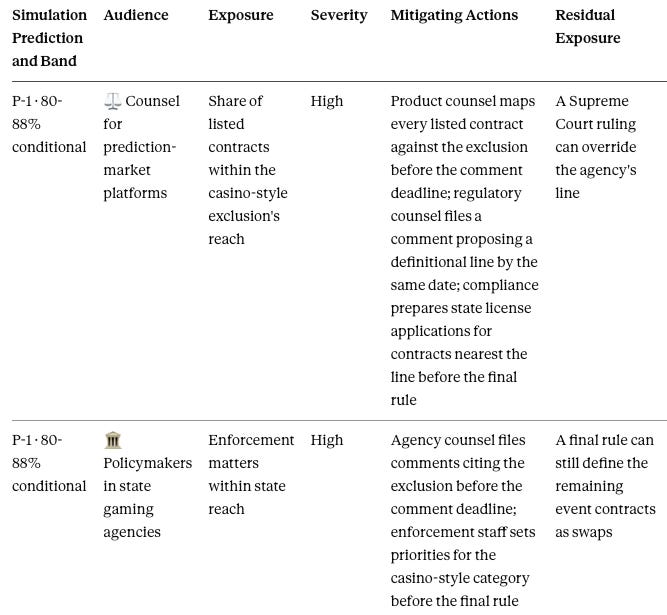
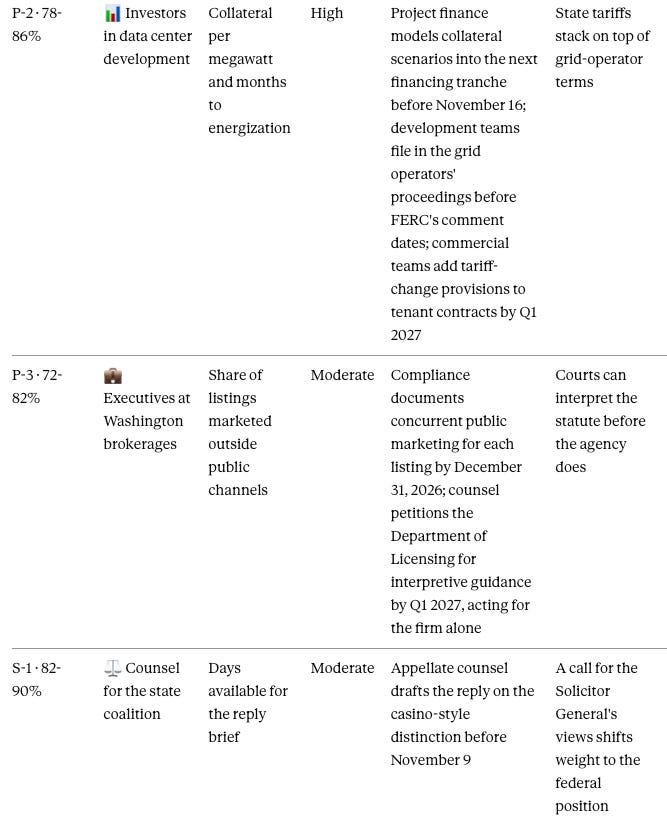
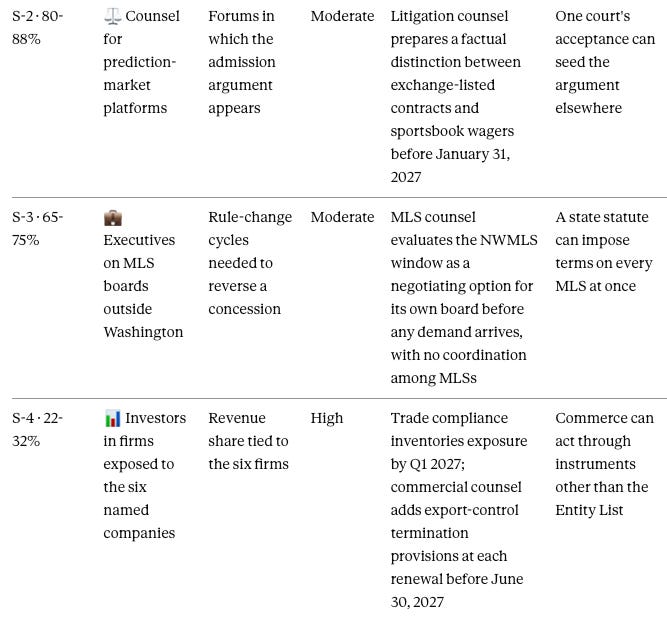
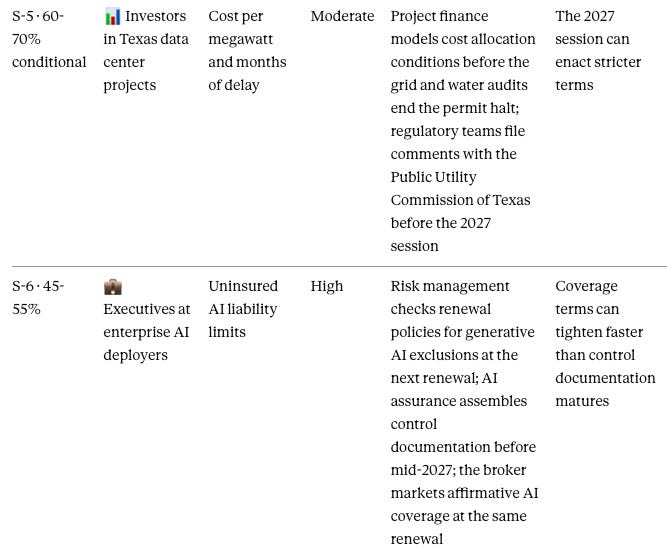
The entries are decision options under the Simulation Predictions, not legal, investment or fiduciary advice.
Takeaway. Each audience can act now on the exposure its Simulation Prediction names, and no action removes that exposure entirely.
VIII. Consequential Adoption, Not Spread, Decides Which Valuations Change the Game
On October 9, 2026, the CFTC confirmed one classification and proposed another while the Supreme Court weighed review. Neither instrument has yet changed what a platform earns. The companion’s thesis turns on that gap between adoption and transmission.
Across five controversies, valuation reached payoffs only where an authority wrote it into enforceable cost terms. A 50-state survey lists 33 states that have done so for AI data centers, where the simulation finds valuation and grid costs acting together. The valuation awaits transmission or followed the structure in the other four controversies: Kalshi, Compass, U.S.–China AI competition and AI governance.
The nine Simulation Predictions test the thesis where it can fail. P-1 resolves when the CFTC issues a final rule, and P-2 resolves against the six grid operators’ November filings. P-3 resolves against Washington’s licensing actions through June 30, 2027.
Takeaway. Consequential adoption is the event to watch, and the Simulation Predictions name the authorities and the dates.
Working With MindCast
MindCast AI applies the series’ method to a client’s strategic contest. An engagement answers the questions both functions ask: why the client’s game and its valuations could change, who can make the change operative and what the replacement game will reward. Each output pairs a structural reading with a valuation reading.
An engagement delivers three outputs.
Actor and Valuation Map. The actors, institutions and binding constraints in the client’s contest, with each actor modeled as a Cognitive Digital Twin and each valuation commitment identified.
Simulation Predictions. One for each plausible path, paired with the dated events that show which path is unfolding.
Strategy and Classification Test. The client’s options run against each replacement game, along with the classification the client’s position depends on and the authority that could change it.
The five controversies show who engages and what they test.
🏛️ Policymakers test how a definition or carve-out will move the affected population before drafting closes.
💼 Executives test whether the classification their business depends on can survive a rival coalition.
⚖️ Counsel test litigation and regulatory paths under each authority response: adopt, reject, partition or defer interpretation.
📊 Investors identify which valuation each authority will adopt before capital commits.
Commissioning offers follow the Simulation Predictions. Platforms and state agencies test the P-1, S-1 and S-2 paths, and brokerages and MLS boards test P-3 and S-3. Developers and lenders test P-2 and S-5, deployers and carriers test S-6, and firms exposed to the named AI companies test S-4.
Takeaway. MindCast tests a client’s position against the valuations that may govern its game before an authority adopts them. Engagements begin at mindcast-ai.com.
Appendix. Sources
Nietzsche Works
Friedrich Nietzsche, On the Genealogy of Morality (1887), trans. Walter Kaufmann and R. J. Hollingdale. The First Essay supplies valuation reversal. The Second Essay §12 and §§4–8 supply reinterpretation and obligation through exchange, and the Third Essay supplies persistence.
Friedrich Nietzsche, The Gay Science (1882; expanded 1887), trans. Walter Kaufmann. Section 58 supplies the claim that names govern expectations.
Friedrich Nietzsche, Beyond Good and Evil (1886), trans. Walter Kaufmann. Section 260 supplies rival valuations held side by side, and Section 245 supplies Nietzsche’s reading of Mozart.
Friedrich Nietzsche, Daybreak (1881), trans. R. J. Hollingdale. Section 9 supplies persistence through custom.
Friedrich Nietzsche, Twilight of the Idols (1889), trans. Walter Kaufmann. “The Four Great Errors” supplies the discipline separating cause from consequence.
MindCast Frameworks
How Mozart Predicts Game Mutation in Predictive Behavioral Economics + Dynamic Game Theory (October 2026). Supplies the game mutation theory, the five controversies and Mozart Vision.
Chicago School Accelerated: The Integrated Modernized Framework of Chicago Law and Behavioral Economics(December 2025). Supplies the Coase and Becker logic for why rules move toward whoever values them most.
The Dual Nash-Stigler Equilibrium Architecture (January 2026). Supplies the closure conditions against which valuation persistence is tested.
Dynamic Predictive Game Theory Meets the Era of AI: Operationalizing Fudenberg’s Research Agenda with Cognitive Digital Twins (July 2026). Defines Adaptive Coherence Equilibrium, the actor-side counterpart to institutional reinterpretation.
The Computational Era Operationalizes Cybernetics and Predictive Game Theory (May 2026). Supplies the conditions under which feedback breaks a model’s predictions.
Chicago’s Randal Picker Was Simulating Law and Economics Before AI (August 2026). Supplies equilibrium migration across populations inside a stable game.
MindCast Foresight Prediction Simulations, Synthesizing Behavioral Economics + Game Theory (August 2026). Makes the transition itself the forecast object.
Mozart’s Mirror: How K. 491 Reflects Romantic Complexity and the Architecture of Intelligence (June 2025). Supplies the three-part design the installments follow.
The Duty to Foresee (June 2026). Supplies the AI governance argument that simulation is becoming a standard of care.
Scholarship
John von Neumann and Oskar Morgenstern, Theory of Games and Economic Behavior (1944). Defines the fixed game against which revaluation is measured.
Thomas Schelling, The Strategy of Conflict (1960). Supplies the focal-point logic applied to contested names.
William Riker, The Art of Political Manipulation (1986). Supplies heresthetics, winning by changing the terms of a contest.
Amos Tversky and Daniel Kahneman, “The Framing of Decisions and the Psychology of Choice,” Science (1981). Supplies the framing effect behind valuation contests.
Primary Sources for Operative Facts
Supreme Court of the United States. Docket No. 26-299, Flaherty v. KalshiEX, LLC. Petition and response deadline.
Commodity Futures Trading Commission. Release No. 9309-26, October 9, 2026. Interim final rule codifying the casino-style exclusion.
Commodity Futures Trading Commission. Release No. 9310-26, October 9, 2026. Proposed rule defining event contracts as swaps.
Washington State Legislature. Final Bill Report, SSB 6091, 2026. Statutory text and vote counts.
Real Estate News. “Washington’s new private listings law purposefully vague”, June 11, 2026. Undefined terms, Compass’s compliance claim and the NWMLS countersuit.
Real Estate News. “CRMLS files suit against Compass over listing rules”, October 5, 2026. CRMLS’s New York filing.
Grid industry coverage. “All Six Grid Operators Ask FERC for 90 More Days on Large-Load Rules”, 2026. FERC’s June 18 show-cause orders and the November 16 deadline.
Greenberg Traurig. “Large Load Data Center Electric Cost Allocation Tariffs: 50-State Survey”, October 9, 2026. State tariff approvals.
Pennsylvania Public Utility Commission. “PUC Acts to Protect Ratepayers, Guide Data Center Growth With New Large Load Tariff Framework”, April 30, 2026. Ratepayer-protection framing of large-load cost terms.
Troutman Pepper Locke. “Governor Abbott Directs TCEQ to Halt All Data Center Permits Pending ERCOT/TWDB Audits”, September 22, 2026. Texas audit and permit halt.
Axios. “Trump admin blocks foreign access to Anthropic’s most powerful AI”, June 12, 2026. Commerce’s June restriction.
Cloud Security Alliance. “CISA Advisory: China’s Industrial-Scale AI Distillation Campaign”, September 18, 2026. Summary of advisory AA26-251A.
Independent Insurance Agents & Brokers of America. “Verisk to Roll Out New General Liability Exclusions for Generative AI Exposures”. Generative AI exclusion endorsements.
OpenAI. Terms of Use. Provision barring use of output to develop competing models.