
Companion to US Outsourcing — What Leaves America’s AI-Quantum Buildout When the Megawatts Stay (Paper II)
Related works in this series: AI Data Center Credit Risk · What State Power Approval Costs · Foreign Ownership and Control · The Authorization Price as an Exchange Rate · Export Control and Cable Geopolitics · Global Investor Edition
Critical references: The 50-State Authorization Price Atlas · The Model Data Center Authorization Code
Governing line: Country eligibility no longer guarantees firm eligibility; layer eligibility no longer guarantees commercial value.
Executive Summary
Authorization behaves as a priced input across the stack, and the price varies by layer rather than by revenue or technical sophistication. Layers closest to land, power, and grid interconnection carry the heaviest territorial authorization exposure and the tightest entry conditions. Layers furthest from them carry almost no territorial authorization burden at all. A second authorizer compounds the first. State utility commissions and county boards price territorial authorization through tariff, interconnection, and cost allocation. Federal licensing prices technological authorization through export control, entity listing, and country-group placement. Territorial requirements usually change the cost and value of participation; export controls, country classification, and entity listing can eliminate feasibility altogether.
Foreign firms encounter the map as a set of gates — and the gates open in an order that placement, not ambition, determines.
Every country wants a position in American AI and quantum infrastructure, and ambition does not determine entry — layer placement does. Sorting the stack by that single variable produces a map conventional supply-chain analysis does not generate. Conventional analysis sorts by market size, technical difficulty, or margin. The authorization sort reveals something those rankings hide: a foreign firm’s odds are set by where in the stack it plays and how it is classified, and authorization is moving from country-only classification toward a country-plus-entity model. Market access is becoming something a firm obtains, not something a passport confers.
Quantum coupled with AI compute inverts the exposure profile between the two authorizers — a standalone quantum installation draws too little power to trigger any state large-load threshold, while foreign transfer, access, and participation involving the same installation sit behind qubit-count controls, deemed-export rules, and a thirteen-nation security, investment, standards, and supply-chain forum.
The value lands differently by seat. Foreign operators and services firms get the layer map and the classification divergence — which of ten layers a firm can enter now, and what to build this year versus next. Sovereign and strategic capital sees how disclosure and entity-specific authorization add visibility costs to passive ownership. US developers, utilities, and procurement teams get a screen for which foreign capability relieves domestic bottlenecks — transformer supply, EPC capacity, post-quantum migration delivery — without transferring control of land, power, or grid authorization.
Lenders and credit analysts receive the underwriting distinction: value burdens can be spread over; feasibility gates cannot. Policymakers and government-affairs teams get the federal design pattern — conduct-responsive, entity-level authorization — that nationality-based state bills have not caught up to, and a vocabulary separating foreign capital, capability, ownership, and operational control. Every seat’s future-facing claims carry dated entries in the foresight section.
Foresight simulations behind the paper convert the map into dated commitments, and three lead the register. Federal post-quantum procurement opens on technical qualification rather than ownership — at least one solicitation or contract vehicle operationalizing the migration deadlines without a general US-ownership requirement by mid-2027, at 82–90 percent confidence. Foreign commercial entry concentrates above the site-control layer — Tier Three engagements outnumbering ownership and control entries combined through 2027, at 79–88 percent. And the entity-authorization era continues on its own conditional terms — the UAE program’s named entities remaining approved past their April 2027 expiry while access stays entity-specific and revisable, at 76–86 percent.
One insight emerged from the runs that the static analysis could not price: the two authorizers are diverging in grammar. Federal policy is migrating to named entities and observed conduct while states hold nationality and control categories — so a firm’s federal standing and its state exposure now move independently, and federal approval functions as no state safe harbor. The full register — twenty-two registered entries across two themes, including two separately scored limbs under MC-EE-19 — publishes in the foresight section below.
The window matters now because the governance of the coupling is arriving before its commerce. Federal post-quantum migration deadlines land in 2030 and 2031. Entity-level authorization began replacing country-level authorization in July 2026. Firms planning 2027 entry must account for decisive gates changing in 2026. The paper below maps the gates, names the layers that remain genuinely accessible, and shows why preparation is rational whether the quantum-AI coupling arrives in two years or five.
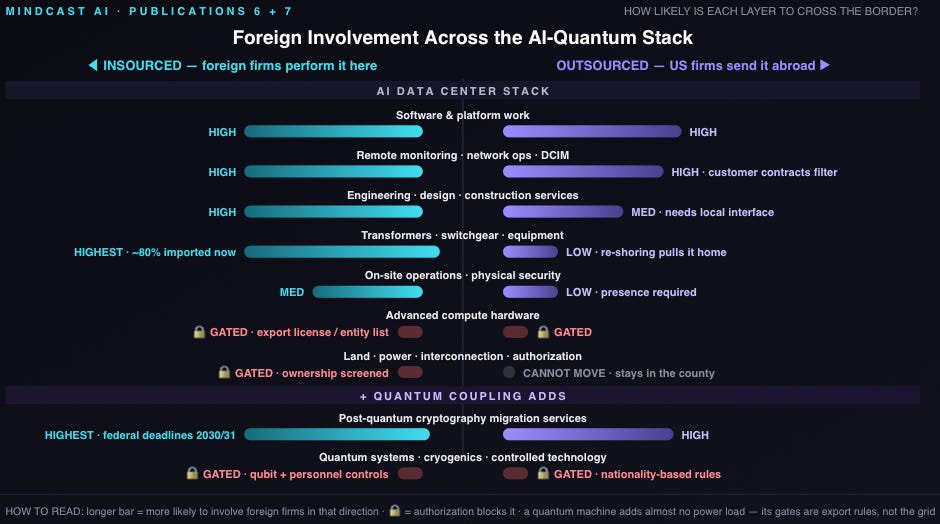
One figure carries the pair's map in a single view. The stack runs down the center — the seven data center layers, then the two layers the quantum coupling adds. Bars measure likelihood: the longer the left bar, the more likely foreign firms perform that layer inside the United States; the longer the right bar, the more likely American firms send the work abroad. Locks mark the layers authorization blocks in either direction, and the gray stub at the bottom marks the one layer that never leaves the county. Likelihoods are qualitative, drawn from the analysis and register below.
I. The Map Conventional Supply-Chain Analysis Misses
Supply-chain analysis of American AI infrastructure typically sorts the stack by revenue, technical sophistication, or headline capacity. Each of those sorts answers a real question. None of them answers the question a foreign firm actually faces: which layers can a firm from my jurisdiction enter, on what terms, and starting when. Answering that question requires a different sorting variable — authorization exposure.
Authorization is territorial at one end of the stack and licensed at the other. Land, substations, interconnection queues, and campus operations sit under state commissions, county boards, and utility tariffs — permissions attached to a place. Chips, quantum systems, controlled software, and technical knowledge sit under federal export licensing — permissions attached to a technology and, increasingly, to a named firm. Every layer in the stack carries some combination of the two exposures, and the combination determines who can enter.
Two dynamics make the map move. The total contested regulatory terrain — the number of active forums, overlapping authorities, and open classification questions bearing on the same activity — has expanded steadily since 2024: state large-load tariffs, foreign-ownership statutes, new export control classifications, entity supplements, and executive orders now all touch the same physical asset.
Firms respond to inconsistent rules across forums by moving toward the favorable ones, which forces regulatory reaction, which moves the map again. A foreign firm selecting entry layers across two authorizers running on different clocks is not executing a static market-entry plan. It is navigating a rule environment that rewrites itself during play.
The map, once drawn, carries one immediate payoff: it separates the questions that have answers today from the questions that do not. Which layers a firm can touch is answerable now, layer by layer. What each layer will be worth is a different question — and the two questions come apart in ways the next section makes precise.
II. Three Entry Classes, One Rule
Foreign entry into the American stack sorts into three classes, and one classification rule governs all three: the outcome a firm faces, not the industry it belongs to or the regulator it reports to. Outcome-based sorting matters because the same firm can face all three outcomes simultaneously across different layers — barred from one, conditioned in a second, welcomed in a third.
Three outcomes define the classes. Tier One is feasibility-gated: participation can be prohibited outright, and no price, spread, or deal structure cures exclusion. Tier Two is authorization-conditioned: participation survives, but ownership, control, disclosure, localization, or licensing conditions change its value. Tier Three is generally accessible: entry depends primarily on capability, procurement qualification, and ordinary compliance. The map below places ten layers of the stack against both authorizers and names the preparation each layer rewards now.
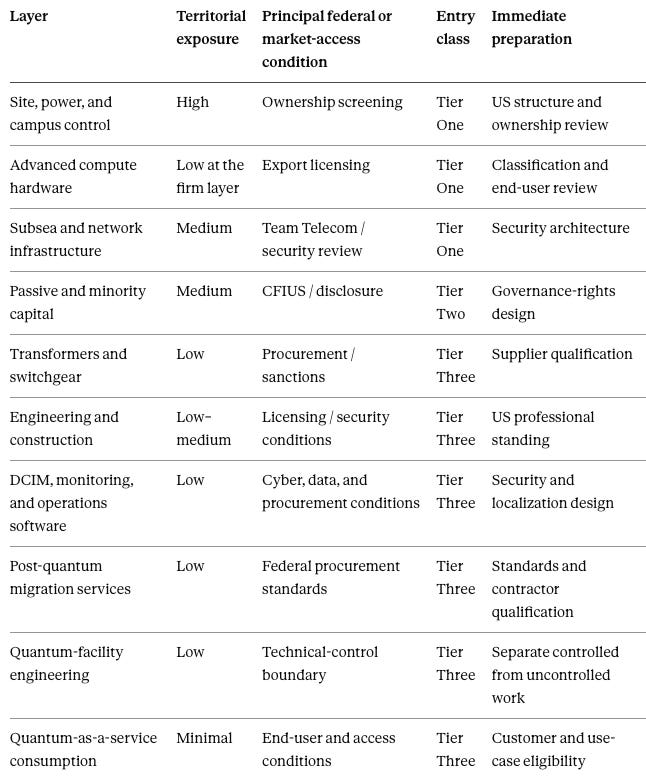
Tier One is where feasibility can fail categorically. Advanced accelerators sit behind export licensing keyed to country groups and named entities. Subsea cable landings pass through federal security review. Control positions in operating campuses face federal investment screening — and now a second gate at the state level.
Indiana enacted a statute in 2025 prohibiting a company at least half owned by a foreign adversary government from building a data center unless two state agencies certify its power will be entirely self-generated. North Carolina’s Senate Bill 730 passed the House in June 2026 with divestiture requirements and a provision letting a lender treat an ownership violation as a loan default; it has not been enacted. One instrument is law and one is a bill, and the distinction matters; the movement across statehouses has so far run toward restriction.
Tier Two is open and narrowing. Sovereign funds and foreign strategics have historically entered through non-control stakes, and the pathway remains available. Registration statements are reshaping it from an unexpected direction: when a data center platform goes public, its authorization terms and its ownership become disclosed, priced, recurring obligations — and foreign ownership enters the same disclosure perimeter. Disclosure does not close the pathway; disclosure makes it more visible, more conditioned, and more expensive, which changes who can afford to use it.
Tier Three is where most foreign firms should be looking, and where most analysis never looks. Transformer and switchgear lead times now run from roughly 75 weeks for substation-class units to 144 weeks for generator step-up transformers, with high-voltage Tier-1 orders reaching five years — and roughly 80 percent of large power transformers used in the United States are imported. Japanese, Korean, and Brazilian manufacturers already anchor that import share — WEG ranks among the major transformer suppliers serving American markets — and every week of lead-time compression sells into every state regardless of authorization regime.
Ordinary equipment sales generally avoid ownership screening. Engineering, procurement, and construction services can enter without acquiring the underlying asset — Spanish EPC groups and Indian engineering firms operate across American infrastructure today on exactly that basis. Operations software and remote monitoring carry low territorial exposure, though cybersecurity, data, procurement, and contractual conditions still apply — and that layer is where Vietnamese and Indian services firms hold the most immediate runway.
Access in Tier Three still carries conditions — procurement rules, security requirements, and sanctions all apply — but a capable firm here competes primarily on capability, the defining feature of the tier.
Three classes, then, and one honest summary: the tiers are not a ranking of attractiveness. The working hypothesis — that Tier Three carries the most transaction volume while the authorization premium concentrates in the gated tiers — is priced on its first limb in the register (MC-EE-14); the value question is separate, since volume, revenue, and rent rank layers differently. Where the premium actually lands — and why feasibility and value must be priced separately — is the subject of the next section.
III. Feasibility Before Value
Two different failures end a foreign firm’s American strategy, and firms routinely confuse them. A feasibility failure means the entry does not exist: a license denied, a transaction blocked, a statute prohibiting the structure. A value failure means the entry exists but is worth less than modeled: localization requirements, compliance overhead, delay, disclosure. Feasibility failures cannot be priced. Value failures can. Sorting every gate into one of the two categories is the single most consequential analytical step a market-entry team can take.
Country classification and named-entity treatment decide whether entry exists. Localization, delay, and compliance decide what entry is worth. A firm that treats a feasibility gate as a cost line models a spread over a transaction that can simply be stopped; a firm that treats a value burden as a prohibition walks away from layers it could profitably enter.
The two-authorizer structure makes the separation concrete, with one asymmetry stated precisely. Territorial authorization more often changes value — a strict tariff raises cost, a long queue delays revenue, a collateral requirement ties up capital — but it can eliminate feasibility too, as any moratorium, zoning denial, or ownership prohibition proves.
Technological authorization more often begins with a categorical feasibility screen: an export license that does not issue is not a cost, it is a wall. The distinction explains why capital markets treat the two exposures so differently — a lender can spread over a known tariff and cannot spread over a licensing denial, which is removed or optioned around, never absorbed into price.
Feasibility-first sequencing follows directly. A foreign firm’s entry analysis starts with classification — what does my country-group placement, and increasingly my firm’s own record, permit at all — and only then proceeds to valuation of the permitted layers. Firms that run the sequence in reverse spend diligence budgets valuing layers they were never eligible to enter. The quantum stack, examined next, is where the sequencing discipline pays most, because quantum scrambles the usual relationship between the two authorizers entirely.
IV. The Quantum Inversion
Quantum computing coupled with AI infrastructure reverses the authorization profile that governs the rest of the stack. AI compute pays its heaviest price to territorial authorizers — power, land, interconnection. Quantum pays almost nothing there and pays heavily to the federal licensing forum instead. Understanding the inversion is the difference between preparing for the coupling and being surprised by it.
Territorial exposure comes first. A full quantum system typically draws on the order of tens of kilowatts, nearly all of it running the dilution refrigerator. The most aggressive large-load triggers in the 50-State Atlas sit in the 25-megawatt class — and a standalone quantum installation misses even those by roughly three orders of magnitude. One qualification keeps the claim honest: a machine colocated inside an AI campus inherits the campus’s service and authorization stack, so the exemption belongs to the standalone installation, not to every quantum deployment.
Quantum near a data center is a colocation story, driven by network access and classical co-processing, not a load story — and the state-level authorization apparatus, built for gigawatt campuses, barely notices a standalone machine arriving.
Federal exposure inverts the picture. Commerce controls quantum computers on a sliding scale: systems linking 34 to 100 qubits are controlled when their error rate falls at or below 0.01 percent, the threshold loosens in steps as qubit counts rise, and every system above 2,000 qubits is controlled regardless of error rate.
Controls extend past the hardware to the software, development technology, specialized materials, and silicon and germanium isotopes behind the machines. Deemed-export rules reach disclosure of controlled quantum technology to nationals of national-security-controlled destinations — governing which controlled technology particular foreign-national employees may access and under what authorization, with exclusions and grandfathering provisions that reward early compliance design rather than barring hiring outright.
Classification divergence among the countries watching this market is sharp. India and Saudi Arabia fall outside the D:1 and D:5 country groups that activate the quantum deemed-export perimeter. Vietnam sits in D:1. Qualifying releases to Vietnamese employees may still proceed under the quantum general license, but they carry reporting and screening obligations that comparable releases to Indian and Saudi personnel do not — the difference is ordinary access versus controlled, reportable access, not permission versus prohibition.
Hong Kong marks the far pole: BIS treats Hong Kong transactions under the China rules, placing firms behind PRC-equivalent licensing regardless of individual firm quality. Four markets, three distinct regulatory postures, all verifiable in one public table.
Allied coordination completes the perimeter. The Quantum Development Group, a thirteen-nation security, investment, standards, and supply-chain forum spanning North America, Europe, and allied Asia, aligns policy across the countries that make the critical components — coordination short of a harmonized export regime, and consequential precisely because the members hold the choke points.
Cryogenic plant is not an open layer. Cryogenic cooling systems above defined performance thresholds are themselves export-controlled, and allied policy analysis identifies dilution refrigerators, cryogenic systems, and isotopically enriched silicon as the choke points most suited to coordinated control — precisely because so few suppliers, all in allied countries, produce them. Facility engineering below the control line — vibration isolation, electromagnetic shielding, site preparation — remains open. The refrigerator itself does not.
Three quantum-adjacent openings survive verification. Post-quantum cryptography migration is arguably the largest clearly open layer: executive orders signed in June 2026 set 2030 and 2031 deadlines for federal agencies to move sensitive systems to quantum-resistant encryption, creating a federally mandated, multi-year services market with no ownership footprint and no territorial proceeding. India’s IT services industry, supported by an extensive base of American federal and enterprise work, enters the migration wave from a particularly strong position — and the work ordinarily requires no access to the controlled quantum-hardware technology that activates the deemed-export perimeter.
Facility engineering below the export-control line is the second opening. Quantum-as-a-service consumption through hyperscaler clouds is the third, a customer relationship rather than an ownership position.
Federal capital is entering the layer directly at the same time: Commerce signed letters of intent in May 2026 committing just over $2 billion across nine quantum companies and taking a minority stake in each. Government capital now sits inside the domestic supply chain, changing the competitive and governance environment any foreign capital must enter.
The inversion resolves into one sentence a strategy team can act on. AI compute entry is gated where the power is; quantum entry is gated where the knowledge is — and a firm’s quantum odds depend on its people’s nationalities and its own name in a licensing database, not on any state commission’s docket.
Contact mcai@mindcast-ai.com to partner with us on Predictive Game Theory AI in Law and Behavioral Economics. We specialize in predictive simulations for Complex Litigation, Innovation Economics, Geopolitical Risk Intelligence and Legacy Innovation. See more about MindCast series at our new website MindCast Corporate.
To test our predictive simulation AI system, in 2026 we simulated the Super Bowl and the World Cup. See 🏈 Super Bowl LX — AI Simulation vs. Reality | ⚽ The 2026 World Cup Final Simulation Validation
To deep dive on MindCast works upload the URL of this publication into any LLM (preferably Google AI mode) and prompt ‘reconstruct MindCast framework with three degrees of cited sub links.’ See Live-Fire Game Theory Simulators, Runtime Predictive Infrastructure.
Working With MindCast
MindCast runs two service lines on one method. Authorization intelligence grades jurisdictions and instruments against the fifty-state baseline. Geopolitical exposure intelligence maps the classification, entity-eligibility, and screening constraints that sit above them.
Foreign operators and services firms can commission a layer placement — the ten-layer entry map scored against the firm’s country classification, personnel mix, and qualification posture, with a sequenced preparation plan across the year, the 24-month window, and the coupling horizon. Sovereign and strategic allocators can commission an exposure assessment separating feasibility gates from value burdens across a named position, including entity-eligibility pathways and the disclosure costs of passive ownership.
US operators and primes can commission a work-distribution review — the mobility ladder applied to a named portfolio, each layer coded by the gate that governs it: sovereign exit, destination entry, or contractual filter. States, counties, and commissions can commission a host-bargain drafting review keyed to durable employment categories, accountability retention, and the provisions the 2027 sessions will contest. Ministries and development agencies can commission a destination scorecard grading their jurisdiction’s absorption position against the eight capabilities, layer by layer.
Engagements run as Cognitive Digital Twin simulations with dated, falsifiable outputs, and MindCast grades its record in public.
V. The Entity-Listing Turn
Federal authorization changed shape in July 2026, and the change matters more for foreign firms than any tariff or statute this year. The Bureau of Industry and Security removed the United Arab Emirates from two restricted country groups, elevated it to a favorable one — and paired the upgrade with a condition no country-group move had carried before.
License-free access to advanced computing items runs only to approved entities named in a new supplement: initially two UAE companies — G42 and Core42 — alongside UAE government agencies and eight American technology firms with their UAE subsidiaries — and the G42 and Core42 authorizations automatically expire on April 6, 2027 unless the companies become US-headquartered or the government extends them — entity authorization conditional and revisable by design, with the condition written into the grant itself.
Listing can also affect a firm’s investment-screening posture: license-free eligibility bears on whether certain mandatory filing triggers apply, a transaction-dependent effect rather than a blanket exemption. One instrument now touches both the licensing forum and the screening forum at once.
Country classification is a static rule — set once, mutating slowly, carrying no channel for a firm’s own conduct. Entity listing closes a loop: a firm’s record feeds its listing, the listing feeds its market access, and the access feeds its investment treatment. Entity eligibility can change through federal action, and a firm’s ownership, compliance record, security architecture, and relationships can affect the government’s assessment — within the UAE program, entities seeking inclusion apply through the advisory-opinion process, assessed case by case on national-security and foreign-policy interests including the applicant’s compliance capabilities and track record — a documented program-specific pathway rather than a general right. Geography no longer supplies the complete answer, although the government retains the decision.
The federal authorizer has imported a conduct-responsive architecture familiar from some territorial authorization systems — even as state foreign-ownership statutes remain predominantly categorical. Governments discount promises by the record — and the licensing forum now does too, entity by entity.
The turn is not an isolated American design. Ireland closed Dublin to new large energy users from 2021 through grid-operator and regulator action, then reopened in late 2025 on published terms requiring applicants to supply generation covering their full demand — access conditioned on demonstrated capability, not on identity. Singapore paused new data center capacity in 2019, published explicit allocation criteria, and reopened selectively, awarding capacity to applicants who cleared a stated bar. Across three jurisdictions on three continents, the same movement: from categorical rules toward conditional, conduct-responsive, applicant-specific authorization. The entity-listing supplement is the American federal expression of a global pattern.
One hypothesis lands directly on capital-heavy entrants, and register entry MC-EE-05 tests it in conditional form. High-profile capital-layer pursuit and tightening disclosure architecture have moved together: acquisition attempts and control-position bids supply the examples legislators and screeners cite when drafting the next restriction. If the hypothesis holds, the capital route is self-limiting in a way the services and equipment routes are not — pushing on the most visible door makes every door heavier.
For a foreign firm, the entity-listing turn converts a fixed constraint into a strategy question. Classification used to be weather; now part of it responds, one firm at a time, to the record a firm builds. Which is why the final section turns to timing — because a variable a firm’s own conduct can influence rewards firms that start building the record early.
VI. The Preparation Clock
Firms watching the quantum-AI coupling face a planning problem with a false premise built in: that the right move depends on predicting when the coupling reaches commercial scale. It does not. Every governance instrument that will shape entry — the qubit-count controls, the deemed-export rules, the entity supplement, the migration deadlines, the federal equity stakes, the allied forum — is already operating, issued, or formally announced. The commerce is uncertain; the principal gates already exist, even though their configuration will continue to move. Preparation is rational under either view of the technology timeline.
Static extrapolation fits this environment poorly, for a structural reason. Extrapolation works when the rules governing a system hold still longer than the actors inside it take to adapt. American authorization rules moved twice at the country-group level in a single year, produced an entity supplement from nothing in one July, and set decade-scale migration deadlines by executive signature in one June. When rules mutate faster than firms can stabilize against them, projecting last year’s market-access picture forward produces confident, wrong answers.
Mechanism-based simulation remains necessary for exactly that reason — it models the rule changes rather than assuming them away — and positioning against the mechanism, building what stays valuable across rule states, beats extrapolating the outcome.
The window has a shape, and the shape favors acting now. Regulatory environments move through a repeatable sequence: a gap appears, institutions signal, rules consolidate, and positions lock. The American AI-quantum authorization environment sits in the signaling-to-consolidation phase — direction visible, enforcement not yet settled. Early movers already bore the ambiguity costs; late movers are likely to find qualification lists populated, supplement additions harder to obtain, and the premium positions claimed. The closing window rewards firms that read the signals accurately and move before consolidation, which makes the present pre-consolidation period more valuable than the period likely to follow it.
Concrete preparation sorts by horizon. Within the year: classification audit — establish precisely what the firm’s country-group placement and its personnel’s nationalities permit, layer by layer, before spending diligence on anything else. Within 12 to 24 months: qualification and posture — supplier qualification for Tier Three equipment and services, entity structures that separate controlled from uncontrolled work, compliance architecture that survives an audit, and the record-building that positions a firm for future entity-specific eligibility. On the coupling horizon: capability — post-quantum cryptography delivery teams, cryogenic-adjacent facility engineering, hybrid classical-quantum operations skills — the assets that appreciate whether the coupling arrives in 2028 or 2031.
The map above is drawn from instruments verifiable in the public record today; the register in the next section tests where the map moves. Waiting for technological maturity means arriving after the industrial positions have formed. The firms that will hold those positions are running their classification audits now.
VII. MindCast AI Proprietary Cognitive Digital Twin Foresight Simulation Predictions
Analysis alone can stand as a publication; foresight is what converts it into decisions with dates. The register below was produced by MindCast’s proprietary Cognitive Digital Twin foresight simulation (MP CDT FS): behavioral models of the governing actors — the federal licensing authorizer, a state legislature, three foreign-entrant archetypes, and the equipment-supply system — run forward through registered causal-domain functions against each other, under rules that move during play. Three separately executed Cognitive Digital Twin simulation runs across two model systems contributed; where runs differed, the register carries a reconciled band spanning the full range.
Two confidence classes apply: an event entry names a settleable outcome, a deadline, a public settlement source, and a falsifier; an interpretive entry states a structural forecast, reviewed at a named date.
Theme A — Entry, Qualification, and Commercial Positioning
MC-EE-01 · Primary · Event · 76–87%. At least one announced North American large-power-transformer capacity expansion reaches commercial production by June 30, 2028. Settles on manufacturer announcement corroborated by trade press. Falsified if no announced expansion is in commercial production by the deadline.
MC-EE-02 · Primary · Event · 82–90%. By June 30, 2027, at least one federal solicitation, purchasing vehicle, or contract clause operationalizes the post-quantum migration orders through PQC inventory, migration, or FIPS qualification without imposing a general US-ownership requirement. Falsified if no qualifying instrument appears, or if every qualifying instrument requires US ownership. Settles on the federal procurement record.
MC-EE-03 · Primary · Event · 68–80%. By December 31, 2027, at least two public utility, RTO, or large-load developer records permit, reward, or rely on customer-furnished equipment or documented supply-chain commitments to accelerate service. Falsified below two qualifying records.
MC-EE-04 · Primary · Event · 79–88%. Through December 31, 2027, a defined public-announcement sample contains more foreign Tier Three engagements — equipment, engineering, operations software, PQC services, facility engineering, quantum-as-a-service — than Tier One and Tier Two ownership or control entries combined. A transaction-count claim, scored against the sample defined below; the value question is separate. Falsified if ownership and control entries equal or exceed Tier Three in the frozen sample.
MC-EE-05 · Secondary · Event · 56–70%. A listed systems integrator discloses post-quantum migration services revenue as a named line item or named growth driver in a public filing by December 31, 2027. Settles on SEC EDGAR. Falsified if no qualifying disclosure appears by the deadline.
MC-EE-06 · Secondary · Event · 80–90%. Large-power-transformer import share remains at or above 70 percent through the next published full-year survey. Falsified if the published share falls below 70 percent. Settles on the survey source frozen at publication.
MC-EE-07 · Secondary · Interpretive · 76–85%. India and Vietnam divide the services layer — India in post-quantum and federal-enterprise migration, Vietnam in monitoring, DCIM, and engineering — with controlled-personnel access, not generic capability, as the dividing variable. Reviewed December 31, 2027 against public engagement records.
MC-EE-08 · Secondary · Interpretive · 78–87%. Early qualification and US-partner status create durable advantage over waiting for the coupling market to mature. Reviewed June 30, 2028.
Theme B — Entity Authorization, Capital, and Regulatory Reaction
MC-EE-09 · Primary · Event · 76–86%. At least one of G42 or Core42 remains approved after April 6, 2027 through renewal, replacement, or revised conditional authorization — and access remains entity-specific and revisable. Falsified by a lapse without replacement, or by access converting to an unconditional, country-wide entitlement. Settles on the Federal Register.
MC-EE-10 · Primary · Event · 62–74%. By December 31, 2027, the named-entity supplement adds another non-US commercial entity, or a comparable named-entity mechanism is created for another partner jurisdiction. Falsified if neither occurs.
MC-EE-11 · Primary · Event · 56–70%. North Carolina Senate Bill 730 is enacted in some form by the close of the 2027 long session. MC-EE-11a, conditional, 62–78%: conditional on enactment, the lender-default-on-ownership-violation provision survives in the enacted text. The two settle independently on the legislative record. Falsified if the session closes without enactment; 11a is falsified if, upon enactment, the provision is absent from the enacted text.
MC-EE-12 · Primary · Event · 55–70%. At least three additional states introduce conduct- or record-keyed data center instruments — obligations keyed to certifications, compliance record, or demonstrated capability rather than nationality — in the 2027 sessions. Scored against the qualifying definition below. Falsified if fewer than three qualifying instruments are introduced.
MC-EE-13 · Primary · Event · 70–82%. By December 31, 2027, at least two additional states beyond Indiana enact data-center-specific foreign-adversary ownership, control, registration, divestiture, or financing-remedy provisions containing no conduct-responsive safe harbor. Falsified below two qualifying enactments; a safe-harbor statute enacted elsewhere bears on MC-EE-12 and MC-EE-18, not on this entry.
MC-EE-14 · Primary · Event · two limbs, scored separately. Feasibility gets priced as feasibility, not as an ordinary covenant, in a public instrument by December 31, 2027. Limb A, 72–82%: a filed US data-center financing or issuer document treats foreign-ownership clearance, screening status, or entity eligibility as a condition precedent, default, termination trigger, or separately identified feasibility risk — lender behavior settles it. Limb B, 67–79%: an enacted state law or filed credit agreement makes prohibited ownership or loss of federal eligibility a default, divestiture, replacement, or termination event — public law or contract structure settles it. Limb A is falsified if no qualifying filing appears; Limb B if no qualifying instrument is enacted or filed.
MC-EE-15 · Secondary · Event · 74–85%. The 2030 and 2031 federal post-quantum migration deadlines survive through December 31, 2027 unmodified — no rescission, no formal extension on the record. Falsified if a modification, extension, or rescission appears on the record before the deadline.
MC-EE-16 · Secondary · Conditional event · 62–76%. If a foreign government or strategic investor announces an attempt to control a major US data-center or advanced-compute asset before December 31, 2027, at least one state or federal proposal, amendment, hearing, or inquiry cites the attempt within 180 days. The entry tests the Section V hypothesis and fires only if the antecedent occurs. Falsified if a qualifying attempt draws no citing response within 180 days.
MC-EE-17 · Secondary · Event · 60–74%. A rating-agency report or offering document names state foreign-ownership statutes as a risk factor by December 31, 2027 — the leading indicator to MC-EE-14, since naming precedes structuring. Falsified if no qualifying document appears by the deadline.
MC-EE-18 · Secondary · Interpretive · 84–92%. Federal and state authorization grammars separate: federal policy moves to named entities and observed conduct while states hold nationality, ownership, and control categories. Reviewed December 31, 2027.
MC-EE-19 · Secondary · Interpretive · 76–85%. An auditable security, ownership, and compliance record improves authorization odds, financing quality, and partner access — option value, not guaranteed approval. Reviewed June 30, 2028.
MC-EE-20 · Secondary · Interpretive · 82–90%. Classification-constrained firms increasingly substitute consumption and minority positions for control — quantum-as-a-service, open services — because firm quality cannot erase country treatment. Reviewed June 30, 2028.
MC-EE-21 · Joint, pair-wide · Interpretive · 55–70%. Entry volume and work-layer offshoring move together, because the layers opening to foreign entry and the layers leaving American soil are the same layers. Registered here; Paper II carries the citation, and the review proxies freeze at its publication.
Settlement Definitions
Announcement sample, MC-EE-04. The sample comprises public announcements of US data-center and AI-infrastructure engagements by foreign-headquartered firms appearing between August 15, 2026 and December 31, 2027 in Data Center Dynamics, Data Center Frontier, or the announcing firm’s own press releases. Counting unit: one engagement per firm per named facility or program. Tier assignment follows the Section II map — equipment supply, engineering and construction services, operations and monitoring software, post-quantum migration services, facility engineering, and quantum-as-a-service count as Tier Three; announced acquisitions, controlling positions, or equity stakes in US data-center operating companies or campuses count as Tier One or Two. An engagement spanning tiers scores in the most restrictive tier it touches: Tier One controls over Tier Two, and Tier Two controls over Tier Three.
Conduct-keyed instrument, MC-EE-12. A qualifying instrument is an introduced bill or adopted rule imposing data-center-specific obligations that attach to a firm’s certifications, audited disclosures, compliance record, or demonstrated capability — self-supply certification, reporting-conditioned grid access, and performance-keyed approval are the paradigm forms — where neither eligibility nor obligation turns on the firm’s nationality, domicile, or foreign-government ownership. A nationality-triggered provision with conduct conditions attached scores as categorical, not conduct-keyed.
Four insights emerged from the runs that the preceding analysis implied but could not price. Grammar divergence leads: the federal authorizer and the statehouses are building different architectures — entity-and-conduct against nationality-and-control — so compliance strategy must run two books, and winning the federal book buys little in the state one.
Feasibility is moving into private credit: the distinction between what can be priced and what cannot is becoming drafted contract language, with risk-factor naming leading and default-trigger structuring following. The preparation clock is priced, not just argued: procurement language hardens before the technology matures, so qualification built now compounds while qualification deferred compounds against the firm. Conditional authorization is the design, not a transition: the register’s flagship expects the entity era to continue precisely by staying revisable. One further entry — on where the work goes when the megawatts stay — publishes with Paper II.
VIII. Conclusion
Entry into the American AI-quantum stack is layered, and layer placement — not ambition, capital, or national relationship — decides a foreign firm’s odds. The map holds ten layers against two authorizers, and every layer answers three questions a market-entry team can act on today: which tier governs it, which authorizer holds the gate, and what preparation the layer rewards now. Firms that run the sequence feasibility-first spend diligence only on layers they can actually enter; firms that run it in reverse pay to value doors that were never open.
Authorization itself is changing shape while firms study it. Country classification now carries an entity overlay — conditional, revisable, and responsive to a firm’s own record — and the same movement from categorical rules toward conduct-responsive terms is visible in Dublin, Singapore, and the state tariffs of the 50-State Atlas. A firm’s record has become an asset class: compliance architecture, demonstrated capability, and partner qualification now purchase access that a passport alone no longer confers.
The gates that will govern 2027 entry are operating, issued, or formally announced today, and the register above puts dates on where they move next. Preparation is rational under any view of the quantum timeline, because positions form before markets mature — and the firms that will hold the premium positions are running their classification audits now. Publication 7 reads the same map in reverse: which layers of the American buildout can leave American soil, and what that means for the communities hosting the megawatts.