

Companion to US Insourcing — Where Foreign Firms Can Enter America’s AI-Quantum Stack (Paper I)
Related works in this series: US Insourcing: Where Foreign Firms Can Enter America’s AI-Quantum Stack · AI Data Center Credit Risk · What State Power Approval Costs · Foreign Ownership and Control · The Authorization Price as an Exchange Rate · Export Control and Cable Geopolitics
Critical references: The 50-State Authorization Price Atlas · Ship the Workload, Not the Power
Governing line: Energized megawatts do not move offshore. Man-hours, expertise, intellectual property, and parts of operational control can.
Executive Summary
Authorization behaves as a priced input across the stack, and the price varies by layer rather than by revenue or technical sophistication. Layers closest to land, power, and grid interconnection carry the heaviest territorial authorization exposure and the tightest entry conditions. Layers furthest from them carry almost no territorial authorization burden at all. A second authorizer compounds the first. State utility commissions and county boards price territorial authorization through tariff, interconnection, and cost allocation. Federal licensing prices technological authorization through export control, entity listing, and country-group placement. Territorial requirements usually change the cost and value of participation; export controls, country classification, and entity listing can eliminate feasibility altogether.
American firms encounter the same map as a set of exits — and the layers most easily exported are the ones host communities are told to count as benefits.
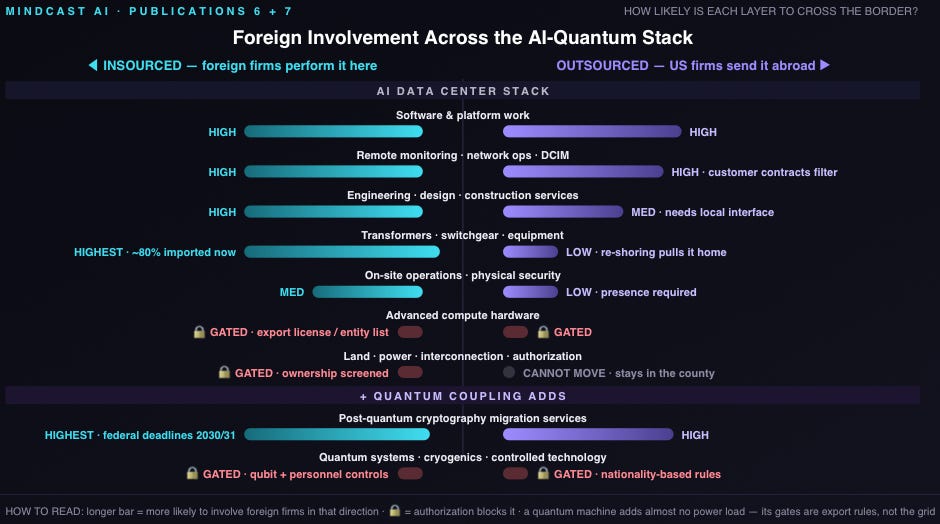
Major data center approvals are routinely sold partly as jobs announcements, and the jobs and the megawatts obey different laws of motion — the difference is the subject of this paper. Reading the map in reverse extends a claim this corpus put on the record in September 2025: computing work moves toward available power and consent, and the workload travels more easily than the power does. Energized megawatts do not move, and most latency-bound American serving capacity remains domestic — while man-hours, expertise, and components cross borders more readily. A campus is the least mobile object in the industry; the work surrounding it is among the most mobile, and many benefits announcements blur the two.
The exit has authorizers of its own. Cross-border work must clear two sovereign gates — a United States exit gate built from export controls, entity treatment, and security conditions, and a destination entry gate built from localization rules, data law, and procurement standing — and, for many engagements, a contractual filter customers write themselves. The gates run on different clocks, with neither government controlling the flow alone. Quantum-adjacent work sharpens the boundary: disclosure of controlled quantum technology to nationals of national-security-controlled destinations triggers the same federal requirement whether the engineer sits abroad or in an American office, so the exit rules reach hiring, not just offshoring.
The value lands differently by seat. State legislators and host-county officials get the honest employment question — durability rather than volume — and the ledger separating jobs that stay in the county from jobs that only visit it. Economic developers get the accountable authorization functions competitors cannot perform remotely — the professions bound to the forum they serve. US firms distributing work internationally get the two-gate compliance perimeter and the layer-by-layer mobility map. Foreign services firms get the demand side of the entry map published as Publication 6 — what American firms are structurally positioned to send is what capable entrants are positioned to receive.
Utility commissions and regional grid stakeholders get the counterparty question the mobility ladder raises: whether the entity holding a fifteen-year power obligation still controls the operations layer in year four, and which conditions keep accountability onshore when the monitoring is not.
Foresight simulations behind the pair price the direction: United States physical capacity stays domestic while engineering, monitoring, and migration work internationalize — and equipment sourcing remains substantially international despite new domestic production — at 84–91 percent interpretive confidence — with the co-movement of entry and exit registered as its own testable claim. Supply-chain entries published with Publication 6 carry the counter-current: re-shored transformer production reaching commercial output by mid-2028 at 76–87 percent, while import share holds above 70 percent.
The window matters for the same reason it mattered on the entry side. Thirty-plus legislatures write data center terms in 2027, and packages that count temporary construction employment as permanent benefit overstate what communities retain. The paper below maps which work stays, which work leaves, who authorizes the exit, and what a host community can actually anchor.
One figure carries the pair's map in a single view. The stack runs down the center — the seven data center layers, then the two layers the quantum coupling adds. Bars measure likelihood: the longer the left bar, the more likely foreign firms perform that layer inside the United States; the longer the right bar, the more likely American firms send the work abroad. Locks mark the layers authorization blocks in either direction, and the gray stub at the bottom marks the one layer that never leaves the county. Likelihoods are qualitative, drawn from the analysis and register below.
I. The Employment-Mobility Mismatch
Data center bargains trade megawatts, water, and land for jobs, tax base, and investment. One side of that trade is immobile by physics and law; the other side is mobile to a degree no approval hearing measures. Understanding the mismatch is the difference between a package that anchors benefit and a package that announces it.
Construction sets the pattern. A hyperscale campus draws between one thousand and ten thousand workers during buildout and employs roughly fifty to four hundred people in long-term operations — on the order of 0.2 to 0.3 permanent staff per megawatt at hyperscale. In Virginia, the country’s most mature market, data centers generate approximately one permanent job per thirteen million dollars invested, against roughly one job per hundred thirty-seven thousand dollars in the wider economy. Capital intensity is the industry’s defining ratio, and it runs opposite to employment intensity.
Evidence on local effects sharpened in August 2026, when the Brookings study of data center labor markets was revised on a doubled sample — roughly 1,500 facilities, with 52 announced-but-canceled projects as controls. The revised estimates put the typical market’s gain at roughly one hundred to two hundred jobs, concentrated in data processing employment (up fifty-six percent) and telecommunications (up forty-three percent), with local wages essentially unchanged and home prices two to five percent higher. Facility type, not concentration alone, drives the differences. Host markets capture real but modest employment, real housing-cost effects, and little wage growth — a ledger a benefits announcement rarely itemizes.
Mobility compounds the volume question. Construction labor leaves when the buildout ends. Many network-operations and monitoring functions are remotely operable from multiple qualified jurisdictions with secure connectivity. Much software work never requires local presence. Operator staffing already shows the pattern at scale: Equinix reported 13,716 employees worldwide at year-end 2025, with more than half outside the Americas and forty-four percent in engineering and operations — globally distributed operating labor attached to locally fixed facilities. The layer permanently bound to the county — land, substation, interconnection — is among the least employment-intensive layers in the stack.
One clarification prevents a false fight. The corpus position that interstate substitution dominates international substitution stands: latency-bound American serving capacity stays domestic, and a repriced state loses capacity to the state next door, not to Johor. Capacity and work are different objects — energized megawatts relocate between American states while man-hours can leave the country — and both movements can be true at once, which is precisely what the rest of this paper prices.
II. The Layer-Mobility Ladder
Work in the AI infrastructure stack sorts into four mobility classes, and the sorting variable is the same one that governed the entry map: how tightly a layer binds to territorial authorization. A layer that must sit where the campus sits cannot leave. A layer that touches the campus through a screen can.
The ladder below places the stack’s principal work-layers against what binds each one and who decides whether it moves.
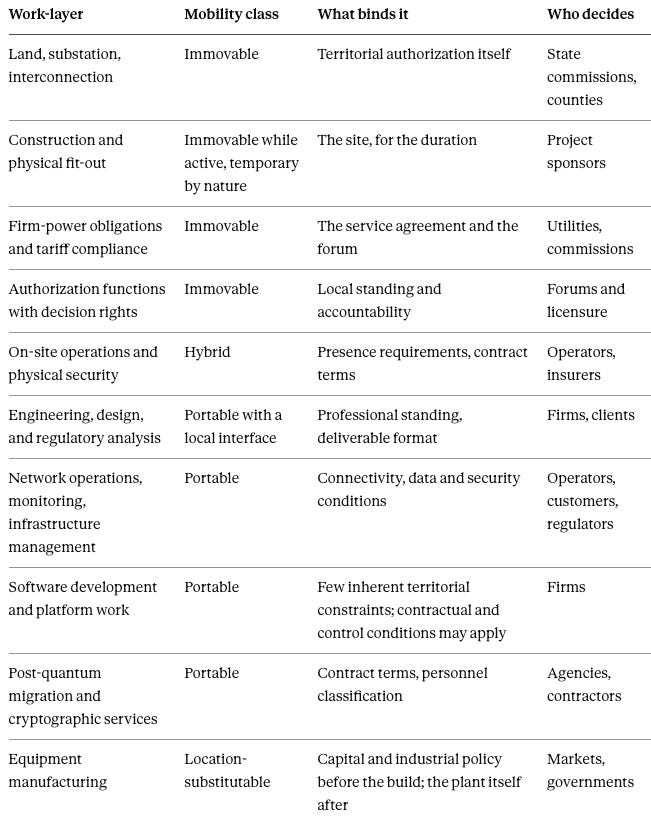
Four readings follow from the ladder. The immovable rows are where a host community’s leverage lives, because their core obligations cannot be relocated. The portable rows are where cost pressure operates, because more of their work is exposed to cross-border competition. The hybrid and interface rows are where policy actually has choices — presence requirements, accountability conditions, and contract terms decide how much of those layers stays local, and no physics forces the answer either way. The location-substitutable class is its own logic: manufacturing capacity can be sited in competing jurisdictions before it exists, but an operating plant is as fixed as a substation — which is why industrial policy fights over factories before groundbreaking and almost never after.
Equipment deserves its own sentence, because the ladder’s bottom row inverts the usual anxiety. Production location was substituted abroad decades ago — roughly eighty percent of large power transformers used in the United States are imported — and the live question runs the other direction, toward where the next tranche of capacity gets built. Section V takes it up.
III. Who Authorizes the Exit
Portable work does not simply leave; it exits through gates. Cross-border work must clear two sovereign gates and, for many engagements, a contractual filter — and mapping all three is what separates a mobility analysis from a compliance accident.
The United States holds the exit gate. Export controls on advanced computing and quantum technology, entity treatment, security conditions in federal contracts, and data obligations decide which work may be performed abroad and by whom. The destination holds the entry gate: localization rules, data law, professional licensure, and procurement standing decide which work may be received. The two gates run on different clocks under different criteria — the structure this corpus has modeled before, in the advanced-chip trade, where neither side of a two-gate game controls the transaction.
Deemed-export rules collapse the geography most managers assume. Disclosure of controlled quantum technology to a national of a national-security-controlled destination triggers the federal requirement wherever the disclosure happens — in an offshore delivery center or in a Bellevue office. Offshoring quantum-adjacent work is therefore not a cost decision with a compliance step attached; personnel classification is the decision. Publication 6 mapped the divergence: Indian and Saudi nationality alone does not activate the quantum reporting regime, releases to Vietnamese personnel proceed under a general license with reporting and screening obligations, and Hong Kong-linked staffing sits behind treatment equivalent to the China rules.
Ordinary infrastructure work faces a lighter federal gate but a thickening contractual one. Federal customers impose citizenship and clearance conditions on sensitive systems work. Utilities and large customers increasingly write data-residency, security-audit, and incident-response terms that function as private localization rules. A monitoring contract can impose more restrictive operating conditions than generally applicable law — and unlike a statute, it renegotiates every term.
The gates produce the section’s practical rule: sort every portable layer by which gate governs it before pricing the move. Work gated only by contract terms moves when the contract allows. Work gated by personnel classification moves only with the right people. Work gated by federal condition may not move at all — and discovering which is which after the delivery center is staffed is the expensive order of operations.
IV. The Destination Scorecard
Receiving jurisdictions compete for the portable layers the way American states compete for campuses, and the competition rewards the same thing: credible capability against stated criteria. A scorecard makes the criteria explicit.
Eight capabilities decide whether a destination can absorb infrastructure work at scale. Talent depth in the relevant disciplines. Delivery reliability across time zones and outages. Language and documentation fluency for regulated deliverables. Time-zone position relative to American operations windows. Legal certainty in contract enforcement and intellectual property. Cybersecurity posture that survives a customer audit. Supplier depth beneath the prime contractor. And, for the coupling horizon, quantum-adjacent specialization — post-quantum cryptography delivery, cryogenic-adjacent engineering, hybrid operations skills.
Publication 6 named the positions from the entry side, and the demand side mirrors them — which is why the two papers describe two ends of one transaction.
Positions differ by region without needing a ranking. South Asia competes through services scale and post-quantum migration capacity; Southeast Asia through monitoring, infrastructure management, and engineering delivery; Latin America through time-zone-aligned nearshore operations; Japan, Korea, and Brazil through equipment capability; and Europe through regulated engineering, cybersecurity, and high-assurance compliance. Each position maps to specific ladder rows, and each reader can locate the rows that reward its capabilities.
Grading named destinations against the scorecard is deliberately outside this paper. The criteria are public because the framework is public; the placement — which jurisdiction scores where, for which layer, against which competitors — is analysis a firm or ministry commissions against its own position. A scorecard states what matters. A score decides what to do.
Contact mcai@mindcast-ai.com to partner with us on Predictive Game Theory AI in Law and Behavioral Economics. We specialize in predictive simulations for Complex Litigation, Innovation Economics, Geopolitical Risk Intelligence and Legacy Innovation. See more about MindCast series at our new website MindCast Corporate.
To test our predictive simulation AI system, in 2026 we simulated the Super Bowl and the World Cup. See 🏈 Super Bowl LX — AI Simulation vs. Reality | ⚽ The 2026 World Cup Final Simulation Validation
To deep dive on MindCast works upload the URL of this publication into any LLM (preferably Google AI mode) and prompt ‘reconstruct MindCast framework with three degrees of cited sub links.’ See Live-Fire Game Theory Simulators, Runtime Predictive Infrastructure.
Working With MindCast
MindCast runs two service lines on one method. Authorization intelligence grades jurisdictions and instruments against the fifty-state baseline. Geopolitical exposure intelligence maps the classification, entity-eligibility, and screening constraints that sit above them.
Foreign operators and services firms can commission a layer placement — the ten-layer entry map scored against the firm’s country classification, personnel mix, and qualification posture, with a sequenced preparation plan across the year, the 24-month window, and the coupling horizon. Sovereign and strategic allocators can commission an exposure assessment separating feasibility gates from value burdens across a named position, including entity-eligibility pathways and the disclosure costs of passive ownership.
US operators and primes can commission a work-distribution review — the mobility ladder applied to a named portfolio, each layer coded by the gate that governs it: sovereign exit, destination entry, or contractual filter. States, counties, and commissions can commission a host-bargain drafting review keyed to durable employment categories, accountability retention, and the provisions the 2027 sessions will contest. Ministries and development agencies can commission a destination scorecard grading their jurisdiction’s absorption position against the eight capabilities, layer by layer.
Engagements run as Cognitive Digital Twin simulations with dated, falsifiable outputs, and MindCast grades its record in public.
V. What Resists Leaving
Mobility has two counter-currents, and both are strengthening. One is policy pulling physical production home. The other is a category of work that resists offshoring for a reason no incentive changes: authority and accountability remain territorial.
Re-shoring runs through the equipment rows. Roughly two billion dollars in announced North American transformer manufacturing expansion targets production in the 2028 window, against lead times that reached one hundred forty-four weeks for generator step-up units. Federal capital entered the quantum supply chain directly in May 2026 — just over two billion dollars in letters of intent across nine companies, with minority stakes in each. Tier Three splits under the two forces: physical equipment production is being pulled onshore while services drift out, and the split is one of the register entries published with Publication 6.
Authorization work is the deeper counter-current, and one distinction does the work. Functions carrying local standing, licensed representation, government access, or jurisdiction-specific accountability — the interconnection application signed before the commission, the tariff negotiation, the county hearing, the compliance certification — cannot be transferred to an unqualified offshore provider, because the forum-facing decision right is the product. The analysis surrounding those functions can move: queue modeling, regulatory research, filing preparation, and support work travel like any other portable layer. Distinguishing the function from its support layer is the section’s contribution: the accountable core is small relative to total project employment but unusually durable.
Host communities and states hold one more anchor, quieter than either. Every megawatt of load carries obligations that run to the local forum — clean-energy compliance burdens, curtailment terms, host agreements — and obligations create work that answers to the place. Washington’s clean-energy statute, which raises a host utility’s compliance burden directly with large new load, is the local instance of a national pattern: the more a state writes into its authorization terms, the more authorization labor it anchors.
Anchoring, then, is a policy output, not a market accident. The immovable rows of the ladder are fixed; the size of the accountable core around them is partly a drafting decision, which is why the final section turns to who captures the value.
VI. Who Captures the Value
Value in a mobile-work industry accrues to whoever holds the immobile complement. Land rents, authorization standing, firm-power rights, and the accountable professional core capture premium precisely because the layers around them can move. Communities and firms that understand which side of that line they hold negotiate differently from those that count announcements.
Legislative packages are where the understanding shows first. A package that counts temporary construction employment as permanent benefit overstates what the community retains. A package keyed to durable categories — permanent operations staffing, locally anchored authorization work, property tax base, host payments — prices what actually stays. Thirty-plus legislatures write data center terms in 2027; the drafting difference between announcing benefit and anchoring it is the difference this paper exists to make legible.
Firms distributing work face the mirror decision. Cost arbitrage on the portable rows is real and available; so is the compliance perimeter of Section III and the counterparty scrutiny of the accountability rows. Distribution strategy that starts from the mobility ladder — which layers, through which gates, with which personnel — captures the arbitrage without acquiring the enforcement action.
Foreign services firms reading this paper from the receiving side hold the third position. What American firms are structurally positioned to send is the demand map; the scorecard of Section IV is the qualification list; and the entry gates were mapped in Publication 6. Two papers, one transaction, and the register below prices where it goes.
VII. MindCast AI Proprietary Cognitive Digital Twin Foresight Simulation Predictions
Foresight behind the pair was produced across separately executed Cognitive Digital Twin simulation runs on two model systems; the full ledger of thirty-plus entries publishes with the series, and Publication 6 carries the entry-side register. Paper II publishes the eight exit-side predictions released for it — organized by theme, primaries before secondaries, in numerical order — plus two inherited references. Settlement for the sampled-firm entries runs against a defined twenty-five-firm sample of United States operators, developers, equipment makers, and infrastructure contractors, published below.
Inherited references. MC-EE-22 (interpretive, 84–91%, review December 31, 2027): United States physical capacity stays domestic while engineering, monitoring, and migration work internationalize, and equipment sourcing remains substantially international despite new domestic production. MC-EE-21 (interpretive, 55–70%, parent proposition): entry volume and work-layer offshoring move together because the open layers are the same layers — registered with Publication 6, settled at event grade by MC-EX-08 below.
Theme A — Domestic Anchoring and the Host Bargain
MC-EX-01 · Primary · Event · 70–82%. At least three states enact or make effective data-center provisions that separately define, report, condition, claw back, or withdraw benefits using permanent or qualifying operations employment rather than construction counts. Introduced bills, vetoed bills, and local ordinances do not qualify. MC-EE-23 tracks introduction-stage activity; MC-EX-01 settles only on enactment. Settles: official session-law and administrative-code repositories, one instrument per state, by December 31, 2027. Falsified if: fewer than three qualifying instruments become enacted or effective.
MC-EX-02 · Primary · Event · 73–84%. At least five newly approved tariffs, utility or host agreements, or procurement records across at least three states retain a named United States accountable counterparty — operational contact, incident authority, change-of-control duty, or credit responsibility — while permitting remote performance of at least one supporting layer. Settles: filed tariffs, commission dockets, official host agreements, and public procurement records, both limbs in the same instrument, by December 31, 2027. Falsified if: fewer than five qualifying instruments exist, or qualifying instruments cover fewer than three states.
MC-EX-03 · Primary · Event · 79–88%. Through June 30, 2028, at least seventy percent of qualifying exit-side expansion events in the defined sample fall in the portable rows — engineering, software, remote monitoring and infrastructure management, or post-quantum migration — and no qualifying event transfers United States tariff, interconnection, or host-agreement decision rights to an offshore provider. The second limb tests this paper’s accountable-core claim directly. Settles: filings, official releases, and awarded-contract records for the defined sample, through June 30, 2028; job advertisements alone do not settle. Falsified if: portable-row events fall below seventy percent, or one qualifying event transfers a listed decision right abroad.
MC-EX-04 · Secondary · Event · 60–73%. At least two enacted state instruments, approved utility instruments, or public host agreements require disclosure or certification of the entity controlling remote operations, cybersecurity escalation, or incident response for a qualifying load. Settles: official state laws, commission dockets, tariffs, and executed public host agreements, by December 31, 2027; generic cybersecurity standards without control-identity disclosure do not qualify. Falsified if: fewer than two qualifying instruments become final.
Theme B — International Allocation and Control
MC-EX-05 · Primary · Event · 68–81%. At least four defined-sample firms disclose a new or expanded non-United States delivery center, staffing cluster, or managed-service arrangement tied to United States infrastructure engineering, monitoring, software, or cryptographic-migration work. Settles: filings, official releases, and awarded-contract records, by June 30, 2028; general global hiring without a United States-facing nexus does not qualify. Falsified if: fewer than four sampled firms make qualifying disclosures.
MC-EX-06 · Secondary · Event · 56–70%. The public record contains at least one qualifying United States-facing engagement in each of three regional lanes — South Asia in post-quantum or federal-enterprise migration, Southeast Asia in monitoring or engineering delivery, Latin America in time-zone-aligned operations. Settles: official buyer or provider announcements, filings, and government procurement awards, by June 30, 2028; regional expansion without the specified work-layer and United States-facing nexus does not qualify. Falsified if: any one regional lane lacks a qualifying engagement.
MC-EX-07 · Secondary · Event · 65–78%. At least two federal solicitations, acquisition instruments, or prime-contractor qualification records separate ordinary post-quantum services from access to controlled quantum technology and attach personnel screening or authorization to the controlled limb. Settles: federal acquisition repositories and filed prime-contractor qualification materials, by December 31, 2027. Falsified if: fewer than two records make both distinctions.
MC-EX-08 · Secondary · Event · 55–68%. Foreign-entry counts and United States exit-side work-allocation counts for 2027 both increase in at least two of three matched portable rows — engineering and design, remote monitoring and infrastructure management, post-quantum and software migration — with entry counted as a distinct foreign firm’s first qualifying engagement and exit counted as incremental United States-origin work allocated abroad by sampled firms — the event-grade settlement of the MC-EE-21 claim. Settles: both sides coded to the same rows against the 2026 baseline; qualifications without engagements and aggregate services-trade data do not settle. Falsified if: fewer than two matched rows show same-direction annual increases against the 2026 baseline.
Defined twenty-five-firm sample for the sampled-firm entries: Amazon, Microsoft, Alphabet, Meta, Oracle, CoreWeave, Equinix, Digital Realty, QTS, CyrusOne, Vantage Data Centers, Compass Datacenters, Switch, Aligned Data Centers, Applied Digital, Vertiv, AECOM, Jacobs Solutions, Fluor, Kyndryl, IBM, Cognizant, DXC Technology, Leidos, Booz Allen Hamilton — one count per firm per prediction unless a settlement rule counts work-layer events, with acquired firms retaining their defined-sample identity through the review window.
VIII. Conclusion
Work follows the open layers in both directions at once — foreign capability entering the American stack and American work reaching foreign capability are the same flow observed from two shores. Host communities hold the immobile complement and can enlarge the accountable core around it by drafting. Firms hold the portable layers and can move them only through two sovereign gates and the contractual filter their own customers write.
Host bargains improve the moment they price the right objects. Benefits keyed to durable employment categories, accountability retained by instrument, and the authorization functions no offshore provider can lawfully perform — those are the terms that anchor value, and the 2027 sessions will decide which statehouses learn to draft them. Packages that count temporary construction employment as permanent benefit overstate what communities retain; packages keyed to what stays capture what the megawatts actually buy.
Firms distributing work hold the mirror of the same decision. The mobility ladder tells them which layers move; the gates tell them how; the defined-sample entries above tell them what the public record will show by mid-2028. The bargain every 2027 statehouse writes will price one side of the flow. The registers across this pair price both.