


Washington state Governor Bob Ferguson and Attorney General Nick Brown’s joint January 26, 2026 announcement regarding federal immigration enforcement is not political theater—it is structural validation of the thesis presented in MCAI Lex Vision: Competitive Federalism as Market Infrastructure (January 27, 2026). This document is not a policy manifesto. It is a foresight validation showing how the Competitive Federalism framework activates when federal enforcement stabilizes into unconstitutional equilibrium.
Washington’s response to ICE/DHS conduct behaves like competitive enforcement market entry, not symbolic protest. The distinction matters: many states have issued statements condemning federal immigration tactics, but statements alone impose no operational cost. Washington is building infrastructure—statutes that create personal liability for federal agents, executive capacity that enables rapid response, and coalition litigation that forces judicial review. Infrastructure converts political opposition into enforceable friction.
MindCast AI Cognitive Digital Twin (CDT) foresight simulations confirm the structural diagnosis. Causal Signal Integrity registers High—meaning Washington’s response follows directly from federal action rather than partisan overreach; the causal link between federal constitutional departure and state enforcement activation is strong and traceable. Constraint Density registers Very High at the federal level, with Geodesic Availability Ratio Low for internal dissent pathways—in plain terms, federal agents operate inside a system where compliance is rewarded and defection is punished, leaving no internal route to constitutional correction.
Washington qualifies as a validation node because it satisfies the infrastructure requirement that distinguishes structural response from rhetorical response. Immigration enforcement is a stress-test domain: high discretion, diffuse victims, and strong executive incentives make it an ideal capture detector. Other states may condemn; Washington builds. The Ferguson-Brown announcement extends the MCAI publication series beyond antitrust, consumer protection, and housing into constitutional enforcement—confirming that competitive federalism operates as unified infrastructure across domains.
MindCast AI Foresight Predictions (12–18 months)
In plain terms: Washington’s posture produces localized dampening of high-visibility Fourth Amendment violations (fewer dramatic home raids) and accelerates procedural hardening (more warrants, better documentation, more careful partner screening). Federal tactics shift toward lower-salience methods—worksite enforcement, data requests, third-party reliance—rather than the high-visibility operations that triggered state response. Federal agencies do not self-correct absent sustained litigation and price pressure from states.
Primary Falsifiers
The model fails if: (i) no measurable tactic substitution occurs after Washington’s statutes and infrastructure take effect, (ii) DHS voluntarily corrects nationwide without external constraint from states or courts, or (iii) courts broadly preempt Washington’s friction statutes without reaching Fourth Amendment merits.
Why This Matters
Washington is not “defying” the federal government. It is doing something more unusual: treating constitutional enforcement like infrastructure. When federal agencies drift beyond constitutional limits, states can either complain—or they can change the cost of misconduct. Washington chose the latter, and that choice may reshape how federal power is checked in practice.
“Federalism isn’t about states versus Washington. It’s about what happens when enforcement itself becomes unaccountable.”
The next test will not be rhetoric—it will be whether other states follow Washington’s model.
For State Attorneys General
This foresight validation identifies when federal enforcement has exited constitutional bounds and predicts when state entry can impose legally defensible constraint. The framework clarifies (i) when Supremacy Clause defenses weaken, (ii) which statutory designs impose real operational cost, and (iii) how coalition litigation increases injunction probability without requiring federal cooperation. Competitive federalism reframes enforcement not as resistance, but as statutory duty when constitutional baselines fail.
MindCast AI is a predictive law and behavioral economics cognitive AI firm. Its core method uses Cognitive Digital Twins (CDTs)—computational models of institutions, agencies, markets, and actors that simulate how behavior settles once incentives, constraints, procedures, and information asymmetries interact. Rather than inferring intent or debating policy preferences, MindCast AI models how systems actually behave after equilibrium forms.
Each CDT routes through specialized Vision Functions that determine whether outcomes are governed by incentives, cognitive bias, institutional lock-in, or non-negotiable constraints. Foresight predictions emerge when simulations converge on stable outcome classes with defined failure conditions. MindCast AI specifies predictions in advance—along with explicit falsification criteria—so they can be tested against real-world events. When federal enforcement, markets, or institutions drift into captured or unstable equilibria, CDTs identify where correction can occur, who can supply it, and what form it will take.
I. The Constitutional Baseline: Supremacy Requires Enforcement, Not Deference
The constitutional analysis begins with a foundational principle from the Federalism Vision Statement: “silence does not create preemption.” Ferguson and Brown’s response addresses something more direct—federal enforcement that actively departs from constitutional constraints. Governor Ferguson denounced ICE agents entering homes “without judicial warrants,” identifying a DHS memo that authorizes Fourth Amendment violations. The federal government operates not in silence but in open contradiction of the supreme law it claims to enforce.
Under traditional deference frameworks, a state might treat immigration enforcement as exclusively federal. Under competitive federalism, Washington treats the Constitution itself as the superior market standard. The State enforces the Fourth Amendment where the federal executive branch refuses to—not filling a vacuum, but providing competitive enforcement of the same constitutional baseline the federal government has abandoned.
The Supremacy Clause operates correctly under competitive federalism: federal law controls where Congress has acted within constitutional bounds. Federal action outside those bounds carries no supremacy. State police power activates to restore constitutional market conditions. State friction statutes operate only when federal conduct departs from constitutional bounds; they do not regulate immigration status, admission, or removal decisions—domains where federal supremacy is uncontested.
Rights Translation
From a civil-rights perspective, competitive federalism translates abstract constitutional violations into enforceable remedies. When federal agents operate without warrants or impersonate local law enforcement, affected individuals face high barriers to relief—federal qualified immunity, limited discovery, and hostile procedural terrain. State friction statutes reduce those barriers by creating jurisdictional hooks, evidentiary clarity, and non-federal venues for accountability—without requiring courts to resolve immigration status or federal removal authority. State enforcement actions also unlock discovery pathways that individual plaintiffs cannot access alone. The framework strengthens rights enforcement without advancing nullification doctrine or immigration policy substitution.
Washington’s constitutional enforcement posture reflects structural necessity, not partisan overreach. The State enforces supreme law that federal agencies have abandoned, exercising concurrent sovereignty that the Constitution presumes.
Insight: Supremacy attaches to constitutional federal action. Unconstitutional federal action forfeits supremacy and invites state enforcement competition.
Contact mcai@mindcast-ai.com to partner with us on Law and Behavioral Economics foresight simulations. See recent projects: Washington’s Clean Energy Advantage, a Behavioral Innovation Strategy for the Energy Transition (Nov 2025), Synthesis in National Innovation Behavioral Economics and Strategic Behavioral Coordination (Dec 2025), MindCast AI Economics Frameworks (Jan 2026), Windermere and Compass, Two Philosophies of Real Estate (Jan 2026).
II. The Nash-Stigler Equilibrium: Why Federal Capture Locked and Cannot Self-Correct
Section I established that federal enforcement has departed from constitutional constraints. Section II explains why that departure stabilized and why internal correction cannot occur. Federal enforcement failure follows predictable equilibrium dynamics documented across the MCAI publication series—two diagnostic layers explain why capture emerges and why it locks into place. CDT foresight simulations quantify the lock:
System Coordination Integrity registers Low—the federal enforcement system has drifted out of alignment with its constitutional baseline and cannot realign without external pressure.
Exploitability Index registers High—diffuse victims bear rights costs while concentrated beneficiaries capture enforcement output.
Correction Feasibility is Moderate via courts and state friction but Low via internal reform—external pressure can force change, but the system will not fix itself.
Attorney General Brown characterized federal operations as “guided by the whims of the president—not the facts, not the courts, and certainly not the United States Constitution”—a direct identification of the Stigler capture mechanism. Ferguson’s acknowledgment that he “cannot stop ICE from deploying” confirms the geometric constraint that forecloses internal reform.
The Stigler Equilibrium explains why capture emerges: enforcement authority concentrated in a single federal gatekeeper, facing concentrated beneficiaries (executive political objectives) and diffuse victims (immigrant communities, constitutional norms), produces capture as equilibrium.
The Nash Equilibrium explains when enforcement terminates: individual federal agents face no incentive to defect from procedurally compliant execution of unconstitutional directives. Compliance is Nash-stable; constitutional objection is career-ending. Internal reform cannot overcome equilibrium-driven capture.
Capture has locked. Leadership changes and doctrinal shifts cannot overcome structural incentives from inside the system. The federal constraint geometry is non-navigable. State enforcement provides the external shock that disrupts the equilibrium, not by blocking federal action, but by imposing countervailing enforcement costs.
Foresight Predictions (Nash-Stigler Layer):
No meaningful DHS self-correction absent injunction risk
WA coalition litigation increases injunction probability if paired with clean fact patterns
Spillover: other states copy friction statutes if courts uphold WA posture
Clean fact patterns involving warrantless entry and impersonation materially increase preliminary injunction odds.
Federal enforcement has stabilized at unconstitutional equilibrium. Internal reform pathways are closed. State enforcement supplies the only available disruption mechanism.
Insight: Captured enforcement cannot self-correct. External competitive pressure—state enforcement entry—is the only equilibrium-breaking force available.
III. State Statutes as Market Infrastructure: Pricing Captured Enforcement Out of the Market
Section II demonstrated that federal capture has locked and cannot self-correct. Section III explains how Washington imposes external correction through market mechanisms. Enforcement operates as a market with identifiable supply, demand, and pricing dynamics. Landes and Posner’s economic theory of legislation established that legal rules function as outputs in a political market where interest groups demand favorable regulation and legislators supply it at a price. MindCast AI extends classical Landes-Posner by integrating behavioral economics and game theory—the same methodological synthesis applied across the publication series to antitrust capture, real estate consolidation, and crypto-ATM regulatory convergence. Washington’s legislative response operationalizes all three analytical layers simultaneously.
The Enforcement Market: Landes-Posner Framework
Enforcement resources are scarce, enforcement decisions allocate those resources, and allocation follows predictable supply-demand dynamics. Federal agencies supply enforcement output; regulated parties and affected communities demand it; political access functions as the price mechanism. When a single supplier monopolizes enforcement (DOJ, DHS), that supplier faces the same capture dynamics as any monopolist facing concentrated buyers and diffuse consumers—output contracts, price (political access cost) rises, and deadweight loss accumulates as constitutional violations go unremedied.
Behavioral Economics Integration
Classical Landes-Posner assumes rational optimization by all market participants. Chicago Accelerated integrates behavioral economics to explain why capture dynamics prove worse than rational-actor models predict. Federal agents operating under unconstitutional directives do not merely optimize career incentives—they exhibit authority bias (Milgram), in-group loyalty heuristics, and sunk-cost reasoning that entrench compliance beyond what pure cost-benefit calculation would produce.
The DHS memo authorizing warrantless entry functions as an installed cognitive grammar—a decision template that agents follow because defection carries asymmetric personal cost (career termination) while compliance carries institutional cover (”following directives”). Constitutional objection does not emerge endogenously because the choice architecture within captured agencies makes compliance the path of least cognitive resistance.
Victims of enforcement overreach face status quo bias, learned helplessness, and the cognitive tax of navigating bureaucratic resistance—suppressing demand for remediation below rational levels. Behavioral constraints explain the stickiness of captured equilibria: rational agents might defect when costs exceed benefits, but behaviorally constrained agents remain locked in suboptimal equilibria longer.
Game Theory Integration
Federal enforcement and state counter-enforcement interact as a repeated game with observable moves. Washington’s legislative package changes the payoff matrix directly. Before SB 5855 and HB 2165, federal agents faced low personal cost for constitutional violations—anonymity protected identity, impersonation enabled access, and no state-level liability attached. After passage, each warrantless entry in Washington carries prosecution risk, each covered face violates state law, and each fake badge constitutes a criminal offense. Washington restructured the game to make unconstitutional federal strategy a dominated move—not by blocking federal action, but by ensuring that action triggers countervailing state enforcement.
State enforcement entry must supply not only competitive enforcement output but also salience shocks—high-visibility actions (press conferences, National Guard discussions, coalition litigation) that disrupt behavioral inertia sustaining federal capture while simultaneously signaling credible commitment in the repeated game.
Pricing Mechanisms
Competitive federalism requires building actual infrastructure to impose costs on captured enforcement. Washington executes through legislation that functions as regulatory friction:
SB 5855 prohibits law enforcement from covering their faces—stripping federal agents of operational anonymity and raising personal liability exposure for constitutional violations.
SB 5876 / HB 2165 criminalizes possession of police insignia by non-officers. CNN documented more ICE impersonations in 2025 than the prior four presidential terms combined. The statute prices impersonation strategy out of the Washington market.
The Immigrant Worker Protection Act (HB 2105 / SB 5852) requires employers to notify employees when the federal government requests employment eligibility information, ensuring data sharing occurs only under judicial warrant or subpoena. The Act breaks the federal monopoly on enforcement data—a captured node cannot corrupt the entire network when states control information access points.
Washington’s statutes are not defensive gestures but market constraints that raise the operational cost of unconstitutional federal strategy. Washington does not nullify federal law; it enforces constitutional limits that federal agencies have exceeded, using pricing mechanisms that make continued violation prohibitively expensive.
Foresight Predictions (Strategic Behavioral Coordination, 0–6 months): Strategic Behavioral Coordination (SBC) models how actors adjust tactics in repeated interactions when payoffs change. SBC predicts:
Fewer high-visibility home entries in WA
More employer/data requests; more reliance on third parties
Local agencies tighten participation rules to reduce reputational/legal exposure
Washington’s legislative package constitutes market entry into enforcement supply. Price theory, behavioral economics, and game theory converge to explain why state statutes function as competitive infrastructure rather than symbolic protest.
Insight: Enforcement is a market. State legislation restructures prices, payoffs, and cognitive defaults to make unconstitutional federal action a dominated strategy.
IV. Executive Infrastructure Buildout: Enforcement Capacity as State Investment
Section III documented Washington’s legislative market entry. Section IV examines the executive capacity required to operationalize that entry. Legislative authority alone cannot impose enforcement costs—executive infrastructure converts statutory authority into operational reality. Ferguson’s announcement included infrastructure expansion beyond statutory changes, signaling sustained commitment rather than reactive posturing.
CDT foresight simulations confirm the asymmetry using Institutional Cognitive Plasticity (ICP) metrics—measures of how quickly institutions can learn, adapt, and shed failing tactics. Washington’s Update Velocity registers High: the state moved from announcement to statute to cabinet reorganization within weeks. Washington’s Adaptive Throughput registers High: cross-agency cabinet integration enables coordinated response. DHS Legacy Inertia registers High: procedural rigidity and chain-of-command culture slow adaptation. DHS Pruning Efficiency registers Low–Moderate: the agency is slow to abandon tactics that generate legal exposure. Washington adapts faster than DHS—an asymmetry that favors localized constraint success. The executive buildout matches patterns documented across the MCAI publication series in antitrust, consumer protection, and housing domains.
Ferguson announced four categories of executive-branch expansion:
Cabinet integration: The Chief of the Office of Refugee and Immigrant Assistance now attends cabinet meetings, ensuring cross-agency coordination for rapid response.
Dedicated policy capacity: A new senior advisor position focuses specifically on immigrant and refugee policy issues.
Military readiness: Ferguson met with Adjutant General Gent Welsh to discuss National Guard deployment scenarios.
Coalition architecture: Statewide coordination with local and federal partners includes joint litigation with King County and Seattle.
Ferguson’s executive-branch expansion constitutes enforcement infrastructure buildout—the state investing in capacity to absorb enforcement demand that federal capture displaced. The pattern matches exactly what the Federalism Vision Statement documents in antitrust (State AG offices expanding competition divisions), consumer protection (state-level crypto-ATM regulation), and housing (legislative response to federal merger review failures).
Foresight Predictions (Institutional Cognitive Plasticity, 6–12 months):
WA operationalizes enforcement capacity (hotline, response teams, interagency protocols)
DHS delays formal policy edits; instead issues informal “tone down” guidance
Competitive federalism requires both legislative authority and executive capacity. Washington builds both simultaneously, demonstrating that state enforcement activation follows infrastructure logic rather than political impulse.
Insight: Enforcement infrastructure is capital investment. States build capacity to absorb demand that federal capture has displaced, following predictable throughput-constraint logic.
V. Cross-Domain Validation: The Unified Framework
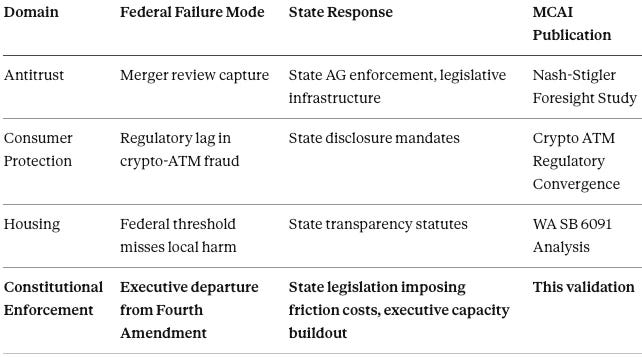
Sections I–IV analyzed Washington’s response as a single case. Section V positions that case within the broader MCAI publication series to confirm cross-domain consistency. Ferguson and Brown’s announcement validates competitive federalism beyond antitrust, consumer protection, and housing.
CDT foresight simulations using Lex Vision—the regulatory and legal constraint layer—confirm the pattern:
Enforcement Competition Index registers Rising—more states are entering enforcement markets that federal agencies have abandoned or corrupted.
Supremacy Boundary Integrity registers Contested but Defensible—federal preemption arguments weaken when federal conduct itself departs from constitutional bounds.
Injunction Probability registers Moderate baseline, increasing with clean facts and repeated violations—courts are more likely to intervene when states document specific constitutional departures rather than policy disagreements.
The same structural dynamics—concentrated federal authority, capture equilibrium, diffuse harm accumulation, state enforcement activation—appear across all four domains. Immigration enforcement is not sui generis; it validates the same equilibrium architecture.
Why Federal Inaction Necessitates State Crypto-ATM Consumer Protection (Jan 2026)
Washington’s SB 6091 and Private Real Estate Market Control, Post Compass-Anywhere Consolidation Developments (Jan 2026)
Structural dynamics remain identical across domains: concentrated federal authority stabilizes into capture; diffuse harm accumulates; states activate enforcement infrastructure; competitive federalism restores market (or constitutional) integrity.
Foresight Predictions (Lex/Regulatory Vision, 9–18 months):
One or more judicial constraints (injunctions, consent orders, procedural modifications)
Federal tactics concentrate in lower-friction states; WA becomes a high-cost theater
Copycat state packages emerge if WA survives early challenges
Constitutional enforcement follows the same competitive federalism logic documented in economic regulation. The framework is domain-general; validation is cross-domain.
Insight: Competitive federalism is not sector-specific policy. It is constitutional infrastructure that activates predictably when federal enforcement monopoly stabilizes into capture—regardless of domain.
VI. Falsification Conditions
Section V established cross-domain validation. Section VI specifies the conditions under which the competitive federalism model would fail. Predictive frameworks demand testable failure modes—specifying falsification criteria distinguishes predictive analysis from post-hoc rationalization. Four conditions would challenge the model if observed:
Pricing mechanisms fail to impose operational friction: If warrantless entries in Washington continue at pre-legislation rates, and no prosecutions occur under HB 2165, the “market constraint” mechanism is not functioning.
Other states facing similar federal geometry do not activate: The model predicts state enforcement response follows structural necessity, not partisan alignment. If Republican-governed states facing equivalent federal constitutional violations do not build parallel enforcement infrastructure, the partisan-independent prediction fails.
Federal self-correction occurs: If internal DOJ or DHS reform terminates unconstitutional enforcement without external state pressure, the Nash-Stigler “lock” diagnosis is incorrect.
Coalition litigation fails to produce judicial constraint: If coordinated state litigation (Washington, King County, Seattle) does not generate injunctive relief or force federal procedural modification, the “enforcement competition” model overstates state leverage.
Falsification conditions operationalize the framework’s predictive claims. Observable outcomes over the coming months will validate or challenge the competitive federalism thesis. Each condition permits ongoing testing as events develop.
Insight: Predictive frameworks require falsifiability. Competitive federalism specifies testable failure modes—not to hedge, but to permit genuine validation.
VII. Conclusion: Market Correction, Not Rebellion
Governor Ferguson and Attorney General Brown are not engaging in nullification or defiance. They are engaging in market correction—the constitutional system routing enforcement to venues not yet captured when the federal chokepoint hardens into unconstitutional operation. Washington’s response follows structural necessity documented across antitrust, consumer protection, housing, and now constitutional enforcement domains.
The Federalism Vision Statement’s core claim holds: free markets—and free constitutional orders—require enforcement structured to resist capture. Monopolized enforcement authority demands competitive re-entry through federalism. Washington State operationalizes that structural necessity through legislative pricing mechanisms, executive capacity buildout, and coalition litigation architecture.
Competitive federalism is not a policy preference. It is the constitutional condition that allows ordered liberty to exist by ensuring enforcement itself remains contestable.
Insight: Federalism is not federal-state conflict. Federalism is market infrastructure that preserves enforcement competition when any single venue stabilizes into capture.