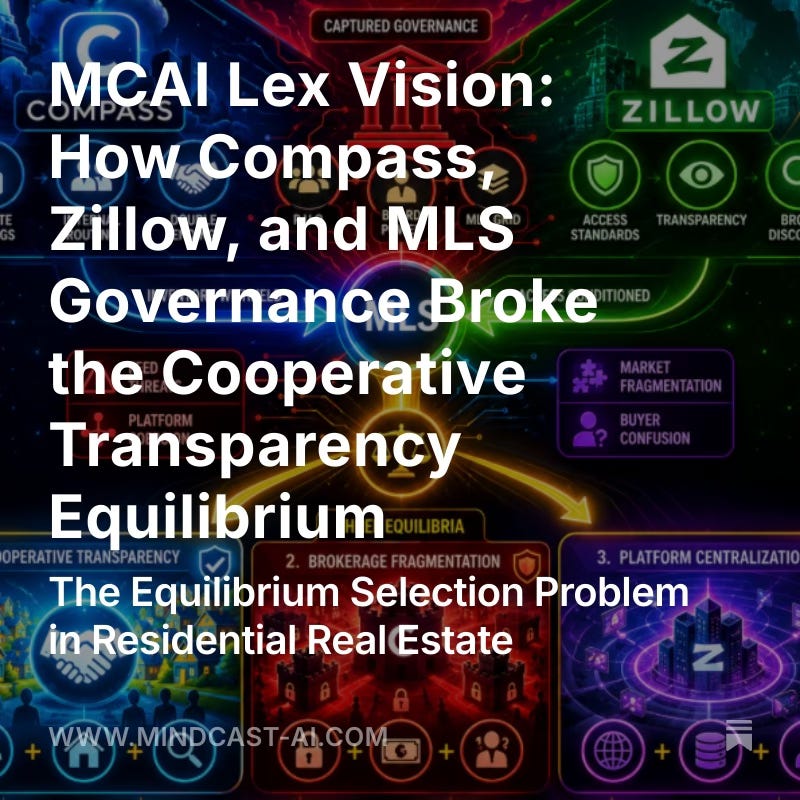

MindCast MLS Equilibrium series: The Collapse of Compass's Local Narrative, How the Zillow Complaint Reframes Compass v. NWMLS as a National Coordination Case | The Skillman Moment as Analytical Rosetta Stone of the MindCast MLS Equilibrium Series
Executive Summary
Zillow’s May 12, 2026 federal antitrust complaint frames the current resident real estate market conflict as a coordinated effort to use MLS infrastructure power to protect private-listing networks from competitive pressure. Zillow Group, Inc. v. Midwest Real Estate Data LLC, No. 1:26-cv-05451 (N.D. Ill. filed May 12, 2026).
Residential real estate operated for decades under a cooperative transparency equilibrium in which brokerages, MLSs, and consumer platforms all benefited from broad listing visibility, shared inventory distribution, and high market liquidity.
The equilibrium began destabilizing after Compass launched its 3-Phase Marketing Strategy in November 2024, introducing a brokerage-scale incentive to selectively withhold inventory and internalize buyer routing. Zillow responded in April 2025 with Listing Access Standards designed to prevent private-listing systems from free-riding on Zillow’s distribution infrastructure. The conflict escalated when MRED revised its feed rules in October 2025 after Compass outreach to MLSs nationwide, allegedly threatening feed termination against platforms that suppressed Compass private listings. The resulting conflict converted MLS infrastructure from neutral coordination architecture into the primary mechanism through which competing market participants attempted to shape equilibrium selection.
Conventional analysis treats the dispute as a platform-versus-platform leverage conflict with apparent symmetry between the parties. The Nash-Stigler framework dissolves that symmetry by distinguishing capture-enabled defection from unilateral defection. Compass’s strategy depends on captured private regulation at MRED — Preferred Unit Owner governance access, board seat concentration, and infrastructure-layer overlap through MLS Grid. Zillow’s strategy operates without equivalent capture infrastructure and functions as a unilateral display policy on Zillow’s own platform.
Beneath the litigation sits a deeper equilibrium-selection problem. Residential real estate now occupies an unstable position between three possible market architectures: a return to cooperative transparency, a transition into brokerage-controlled inventory fragmentation, or a consolidation into platform-centered visibility governance. The outcome will determine not only how homes are marketed, but which institutions control residential real-estate information architecture in the United States.
I. Governing Insight
The Zillow v. MRED-Compass litigation does not primarily concern private listings. The litigation concerns equilibrium selection — which market architecture will govern residential real estate over the next decade.
Residential real estate historically operated under a stable cooperative equilibrium in which brokerages contributed listings to shared MLS infrastructure, portals aggregated broad inventory visibility, buyers searched across open inventory pools, and market liquidity benefited from widespread information distribution. Each participant benefited more from maintaining the shared-information system than from defecting from it. The system remained stable because no major participant possessed sufficient incentive or scale to profit meaningfully from sustained inventory withholding. Compass’s post-2024 strategy altered those incentives.
The analytically important question is not whether each defection from cooperation was rational for the defecting party. Each defection was rational. The analytically important question is which defections required captured institutional infrastructure to operate and which defections operated unilaterally. That distinction determines whether the resulting equilibrium reflects competitive selection among rival strategies or coordinated coercion that forecloses competitive alternatives.
The Nash-Stigler framework applied through the remainder of this analysis separates the two categories. Nash equilibrium governs behavioral settlement — the conditions under which strategic agents converge on outcomes where no party can improve unilaterally. Stigler equilibrium governs informational and institutional sufficiency — the conditions under which captured regulation distorts the search and enforcement environment so that nominally competitive outcomes reflect coercion rather than genuine market selection. See MindCast: The Dual Nash-Stigler Equilibrium Architecture — Behavioral Settlement and Inquiry Sufficiency as Runtime Constraints. The Pseudo-Equilibrium Detection logic established in the Nash-Stigler architecture is the analytical tool that distinguishes captured outcomes from genuine settlements. The Compass-MRED coordination is the operational case study for that detection logic at federal scale.
Understanding the analytical stakes requires understanding the cooperative equilibrium that the three defections destabilized. The next section develops the institutional baseline before tracking each defection in sequence.
II. The Cooperative Transparency Equilibrium
The modern MLS system evolved around a simple economic principle: broad information distribution increases market liquidity. Decades of real-estate practice operationalized the principle through cooperative listing infrastructure that benefited brokerages, portals, and consumers simultaneously.
MLS systems historically solved four major coordination problems at once. First, MLS infrastructure reduced search costs by allowing buyers to discover available inventory efficiently without maintaining direct relationships with every brokerage in a region. Second, MLS systems improved seller exposure through broad distribution that increased the probability of multiple bids, faster transactions, and accurate price discovery. Third, MLS systems lowered competitive barriers for smaller brokerages because access to inventory did not depend primarily on brokerage size. Fourth, MLS infrastructure stabilized market trust by giving all participants a common understanding of where listings would appear, how listings would be distributed, and how inventory visibility functioned.
The system produced a cooperative equilibrium in which brokerages shared inventory, portals aggregated visibility, consumers searched broadly, and MLSs governed distribution standards. The equilibrium persisted because no participant could easily improve its payoff by defecting unilaterally.
The MLS system functioned as coordination infrastructure in the technical sense developed in the Chicago School Accelerated framework — a shared focal point that permitted buyers, sellers, brokers, and portals to converge on transactions without requiring direct bilateral negotiation across the entire market. See MindCast: Chicago School Accelerated — The Integrated, Modernized Framework of Chicago Law and Behavioral Economics . Coordination costs in this market are not reducible to transaction costs. Even with zero friction in any individual bilateral negotiation, market efficiency depends on the coordination architecture that allows parties to find each other, agree on what is being negotiated, and trust the signaling environment. The MLS system supplied that architecture for decades, and conditions changed only after brokerage concentration accelerated.
III. The First Defection: Compass and the Economics of Inventory Scarcity
Compass launched its 3-Phase Marketing Strategy in November 2024 and introduced a new equilibrium path into the market. The strategy operationalized a different competitive proposition — selective visibility as a brokerage leverage tool rather than broad visibility as a market-efficiency mechanism.
Under the strategy, listings first entered Compass Private Exclusives, inventory visibility remained selectively restricted, buyer access increasingly depended on Compass affiliation, and Compass increased the probability of internal routing and double-ended transactions. The strategy created economic value precisely because inventory became artificially scarce during the highest-demand period of the listing lifecycle.
Traditional MLS cooperation assumes that broad visibility increases market efficiency. The Compass architecture introduced an alternative proposition: selective visibility increases brokerage leverage. Once brokerage scale became sufficiently large — particularly after the Anywhere acquisition closed January 9, 2026 and moved Compass’s Chicago unit share from 10.7% to 35% — selective inventory control became economically rational at national scale. The equilibrium destabilized because Compass discovered a potentially superior payoff structure through controlled inventory fragmentation.
The Becker prong of the Chicago School Accelerated framework operates here in real time. Becker’s insight extended into the Compass context predicts that rational actors will attack coordination architecture when expected returns from fragmentation exceed expected returns from efficiency competition. The Compass 3PM strategy is not malice — it is optimization under a payoff structure that rewards opacity over service quality. See MindCast: MCAI Economics Vision: Chicago School Accelerated — The Integrated, Modernized Framework of Chicago Law and Behavioral Economics — Why Coase, Becker, and Posner Form a Single Analytical System (mindcast-ai.com/p/chicago-school-accelerated). The Compass litigation complex serves as the proof case for the Becker prong in the framework.
The transactional mechanism that makes the strategy profitable operates through double-ending. Under traditional MLS transparency conditions, listings become broadly visible, buyer agents compete across brokerages, and transaction routing remains relatively distributed. Private-listing systems alter the routing structure — selective visibility increases the probability that buyers engage directly with the inventory-holding brokerage, transactions remain internal, and the brokerage captures both sides of the commission structure.
The economic incentives compound recursively. Once a brokerage controls both inventory visibility and buyer access, higher internal transaction capture produces stronger recruiting incentives, greater brokerage scale, more private inventory, and additional routing leverage. The system creates positive feedback loops that favor larger brokerages over smaller competitors. Traditional MLS transparency partially suppresses the loops because broad inventory visibility disperses buyer participation across competing brokerages. Private exclusives reverse the distributional structure, and the resulting equilibrium increasingly rewards inventory concentration itself.
The Zillow complaint documents the quantitative evidence. Compass’s internal data shows off-MLS sales double-end 72% more frequently than on-market transactions (31% versus 18%). A consumer watchdog analysis of 1,000 consecutive recent home sales across five major U.S. markets found that over 20% of Compass transactions were double-ended in each market studied. The routing economics are not theoretical — they are operationally measurable and significant in magnitude.
The critical structural feature of the First Defection is that the strategy required institutional cooperation to operate profitably. Compass’s Phase 1 withholding depends on Phase 3 MLS distribution and portal display to realize value when private marketing fails. Without downstream cooperation from MLSs and portals, the 3PM strategy cannot recover the listings that fail to sell privately. The defection is therefore not unilateral — it requires the continued participation of the institutions Compass simultaneously attempts to circumvent. The dependency creates the incentive for Compass to seek captured cooperation through governance access rather than to operate independently of MLS and portal infrastructure. The portal-side response to that dependency arrived in April 2025.
Contact mcai@mindcast-ai.com to partner with us on Predictive Game Theory in Law and Behavioral Economics. To deep dive on MindCast work in Cognitive AI upload the URL of this publication into any LLM and prompt ‘parse MindCast framework with three degrees of cited sub links.’ See Live-Fire Game Theory Simulators, Runtime Predictive Infrastructure.
Recent projects: The Routing Layer Is the Antitrust Trigger. CPI Antitrust Chronicle, April 2026, published the MindCast structural argument — and it reframes where AI infrastructure enforcement should originate.
IV. The Second Defection: Zillow Rejects the Free-Rider Equilibrium
Zillow adopted its Listing Access Standards in April 2025 and constituted the second major equilibrium defection. The Standards refused downstream visibility benefits to listings previously withheld in private networks, raising the cost of selective inventory marketing.
Zillow concluded that private-listing systems benefited from early inventory exclusivity, buyer capture, and internal brokerage routing, while still later exploiting Zillow’s national visibility infrastructure once listings failed to sell privately. The Listing Access Standards attempted to alter the incentive structure by refusing downstream visibility benefits for listings selectively withheld from the broader market. Zillow’s strategy functioned as an equilibrium intervention mechanism — the company imposed a cost on selective inventory withholding while preserving broad-distribution incentives.
Zillow did not merely defend transparency as a normative value. Zillow defended transparency because Zillow’s aggregation model depends on broad inventory availability, centralized discovery, and large-scale consumer search behavior. The company’s economic incentives aligned with preserving open listing distribution.
The critical structural feature of this defection is that it operated unilaterally. The Listing Access Standards are a display policy on Zillow’s own platform and do not require captured cooperation from any institution. Other portals retain full strategic freedom to adopt different display policies — Redfin signed a partnership with Compass in 2026 to display private listings, which represents the inverse strategic choice. The market sorts portals by their display policies, and consumers choose accordingly. Zillow’s defection from cooperative transparency is structurally analogous to Compass’s defection on the brokerage side, but Zillow’s defection operates without the captured-regulation infrastructure that Compass’s defection requires.
The asymmetry matters for the equilibrium analysis. Two unilateral defections can produce competitive equilibrium selection — each party offers a different strategy, the market sorts participants by preference, and the resulting distribution reflects revealed competitive choices. One unilateral defection paired with one capture-enabled defection produces a different outcome. The capture-enabled party can use institutional infrastructure to coerce the unilateral party into abandoning its strategy, foreclosing the competitive selection process that two unilateral defections would generate. Compass executed that coercion through MRED beginning in October 2025.
V. The Third Defection: MLS Infrastructure Becomes Enforcement Architecture
The Zillow complaint alleges that the equilibrium conflict escalated dramatically after Compass outreach to MLSs nationwide in October 2025. MRED then converted its rule architecture into an enforcement mechanism designed to coerce Zillow into abandoning the Standards.
According to the complaint, MRED revised its feed rules, threatened Zillow’s access to listing feeds, coordinated with MLS Grid infrastructure, and later participated in broader national partnerships involving Realtracs and CLAW. The dispute ceased being merely a question of brokerage strategy versus portal policy. The conflict became infrastructure enforcement versus competing market architecture.
The third defection is the analytically decisive event because it operationalizes the asymmetry between the first two defections. MRED has no independent business reason to threaten Zillow’s feed access — Zillow distributes MRED listings free to tens of millions of consumers, which is exactly MRED’s stated institutional purpose as an MLS facilitating broad listing distribution. The Revised Rules and termination threats are most consistent with MRED acting as Compass’s instrument rather than as an independent MLS pursuing its institutional mission.
The complaint’s allegation in paragraph 109 — that MRED is “acting against its own interests by prioritizing Compass’s private listings business model over MRED’s fundamental purpose” — is the Stigler capture diagnosis stated in operational terms. See MindCast: MCAI Economics Vision: The Dual Nash-Stigler Equilibrium Architecture — Behavioral Settlement and Inquiry Sufficiency as Runtime Constraints (mindcast-ai.com/p/nash-stigler-equilibria). The structural conditions that produced this outcome appear throughout the complaint: Compass’s status as MRED’s largest fee-paying customer, Preferred Unit Owner governance access multiplied through post-Anywhere subsidiary accumulation at Coldwell Banker and Corcoran, three Compass-affiliated board seats with regional vice president Fran Broude serving fourteen of sixteen years, and the second-order infrastructure overlap through MRED CEO Rebecca Jensen’s concurrent role as MLS Grid Board Chair.
The structural conditions at MRED converted cooperative transparency infrastructure into a captured enforcement mechanism. The capture pattern then propagated to MLSs with similar structural conditions — Realtracs and CLAW adopted parallel rule changes within seven weeks of the MRED Revised Rules taking effect. The capture pattern did not propagate to MLSs with distributed governance and absent infrastructure overlap, including NWMLS in the Pacific Northwest. The differential propagation pattern operates as the empirical signature that distinguishes capture-enabled defection from unilateral defection. Unilateral strategies do not require structural preconditions to operate, while capture-enabled strategies require specific governance architectures that either permit or resist accommodation.
VI. Why MRED and NWMLS Diverged
The Zillow filing indirectly clarifies why Northwest Multiple Listing Service diverged from MRED despite Compass pressure campaigns occurring nationally. Governance architecture rather than regional culture explains the differential outcome between the two MLSs.
MRED and NWMLS exhibit materially different governance geometry. According to Zillow’s allegations, MRED contained concentrated brokerage influence, Preferred Unit Owner governance structures, multiple Compass-affiliated board seats, and significant dependence on Compass-generated transaction volume. The structural conditions at MRED potentially increased institutional susceptibility to capture dynamics. NWMLS exhibits different structural conditions — the Pacific Northwest market historically maintained more distributed brokerage concentration, broader governance participation, and less dependence on any single dominant brokerage actor.
The resulting divergence matters analytically. The Compass-NWMLS litigation initially appeared local, but the Zillow filing reframes the dispute as part of a broader national equilibrium struggle over listing governance, inventory sequencing, and routing control. NWMLS now appears less like an isolated institutional outlier and more like a governance system that resisted broader equilibrium transition pressures.
The analytical claim is structural rather than attributional. NWMLS resistance is not adequately explained by Pacific Northwest exceptionalism or by institutional foresight about the national coordination pattern. The explanation lies in governance architecture. NWMLS membership distributed across Windermere, John L. Scott, Coldwell Banker Bain, Compass, and other participants does not produce the dominant-broker concentration that MRED’s Preferred Unit Owner structure permitted Compass to accumulate. Without the structural preconditions, capture cannot operate regardless of how aggressively Compass pursues partnership outreach.
The structural argument exposes a separate problem with how Compass has publicly framed its private-listings strategy. The framings that function inside Compass’s commercial environment do not survive contact with the structural evidence the Zillow complaint introduces.
VII. The Skillman Moment at Federal Scale
The Skillman Moment analytical pattern, established in earlier MindCast publications, describes the failure mode in which Compass narratives function inside Compass’s commercial environment but do not export to external regulatory or institutional contexts. Moya Skillman’s Puget Sound Business Journal quote misapplying Reffkin’s MLS-targeted “seller choice” framing to SSB 6091 — a state licensing statute — illustrated the pattern at the state policy level. The May 12 filing confirms the Skillman Moment at federal scale.
Compass’s public framing of its private-listings strategy emphasizes seller choice, marketing flexibility, and innovation against legacy restrictions. Within Compass’s communications environment, the framings cohere. The framings did not export when the Zillow complaint surfaced documentary evidence of the national coordination pattern. The same Compass that argued NWMLS rules should yield to seller-choice considerations was demanding that MRED, Realtracs, CLAW, and Hive MLS adopt identity-protective feed rules that override portal display policies. The “choice” framing functioned only when Compass was the disadvantaged party seeking accommodation. When Compass became the dominant party shaping rules through MLS governance access, the framing inverted to enforced uniformity.
The Skillman Moment pattern predicts that Compass narratives will fail to export across institutional contexts. The May 12 filing confirms the pattern at federal scale by documenting that Compass’s regional-dispute narrative cannot accommodate the national coordination evidence the complaint introduces. The narrative did not survive contact with the evidentiary record assembled by Zillow’s litigation team.
The confirmation strengthens the Skillman Moment as an analytical category. The pattern is not specific to state policy contexts or to particular Compass spokespeople. The pattern is structural — Compass’s narrative architecture cannot survive translation across institutional contexts because the framings depend on environment-specific commercial logic that does not generalize.
The structural argument and the narrative critique together establish what the May 12 filing documents. The remaining analytical question concerns where the market goes from here.
VIII. The Three Available Equilibria
The residential real-estate market now occupies an unstable position between three possible equilibrium states. Each equilibrium produces distinct consequences for liquidity, competition, and consumer welfare.
1. Cooperative Transparency Equilibrium
Under this equilibrium, listings broadly enter shared MLS systems, portals compete on user experience and innovation, brokerages compete primarily on service quality, and informational asymmetry remains relatively constrained. Cooperative transparency largely describes the pre-2024 equilibrium and produces the broadest consumer welfare gains through liquid markets, faster transactions, and accurate price discovery.
2. Brokerage-Controlled Fragmentation Equilibrium
Under this equilibrium, large brokerages increasingly internalize inventory, buyer access depends on brokerage affiliation, private exclusives proliferate, and routing control becomes a primary competitive mechanism. Liquidity declines as inventory fragmentation rises, and consumer welfare degrades through reduced market visibility and elevated transaction costs. Compass’s strategy points toward this equilibrium, supported by captured MLS infrastructure that prevents portal-side resistance from foreclosing the Phase 3 distribution channel on which the strategy depends.
3. Platform-Centered Visibility Equilibrium
Under this equilibrium, platforms such as Zillow increasingly control discovery, pre-MLS distribution shifts toward platform-managed systems, MLS sequencing weakens, and portals become quasi-essential information infrastructure. Visibility remains broad, but governance centralizes under large aggregation platforms. Zillow Preview suggests movement toward this equilibrium, with consumer welfare consequences that depend on whether platform governance produces competitive innovation or concentrated rent extraction.
The equilibrium-selection question is not simply which strategy each party prefers. The deeper question concerns the institutional infrastructure itself. MLS governance, feed access rules, and portal display policies determine which equilibrium the market occupies. The analytical issue is whether that infrastructure operates through competitive selection among rival strategies or through captured coordination that forecloses competitive alternatives. Competitive selection produces durable markets. Captured coordination produces durable cartels.
Understanding why the market reached the unstable position between three equilibria requires examining the feedback dynamics that drove the conflict to its current state.
IX. The Cybernetic Structure of the Conflict
The equilibrium conflict exhibits classic cybernetic feedback dynamics. Reinforcing loops between Compass brokerage scale, MLS governance capture, and inventory routing concentration accelerate without internal damping mechanisms until external intervention becomes necessary.
Compass’s brokerage concentration produced stronger routing control, greater inventory exclusivity value, and stronger recruiting incentives. The compounding dynamics increased brokerage scale further, which then increased governance influence, partnership leverage, and market coordination capability. The resulting system generated reinforcing positive feedback loops that fed back into the original concentration vector.
Zillow’s Listing Access Standards introduced variance into the system by attempting to reduce the downstream value of private inventory withholding. MLS feed enforcement then functioned as a damping response attempting to stabilize the private-listing equilibrium against external competitive pressure. Viewed through the cybernetic framework, the litigation resembles less a conventional policy disagreement and more a control-system conflict over market-information governance. The institutional struggle concerns who controls visibility, who controls sequencing, and who controls the economic value generated by discovery itself.
The cybernetic framing also explains why the litigation arrived when it did. Feedback loops with insufficient damping eventually produce instability. The Compass-MRED capture infrastructure generated reinforcing loops that accelerated through the post-Anywhere period without internal damping mechanisms. Internal market mechanisms proved insufficient, and external intervention became the only available response. Zillow’s Listing Access Standards supplied the first damping signal, and federal antitrust litigation supplied the second.
The Posner prong of the integrated framework operates at the institutional level. Posner’s efficiency-through-selection mechanism assumes that legal institutions observe the full causal loop of harm and update doctrine accordingly. The mechanism fails when feedback is delayed, fragmented, or adversarially manipulated. The Compass-MRED conflict produced all three conditions: coordination capture dispersed harm, incentive exploitation fragmented the evidentiary record, and enforcement lag delayed institutional response until federal litigation became the only available correction mechanism. Residential real estate became a wicked learning environment, and the Zillow filing is the system’s first effective damping response.
X. Why the Case Matters Beyond the Parties
The Zillow litigation matters because equilibrium-selection disputes produce durable market structure. Judicial outcomes in the federal antitrust case will shape the operating architecture of residential real estate for the next decade and beyond.
The eventual outcome will likely determine how listings are sequenced, whether MLSs remain central infrastructure, how buyer-routing economics evolve, and whether residential real estate prioritizes inventory openness, brokerage exclusivity, or platform centralization. The case resembles earlier infrastructure conflicts involving telecommunications interconnection, search-platform dominance, cloud-platform dependency, and API governance disputes. The central issue is no longer whether private listings should exist. The central issue is which institutions control residential real-estate information flow, and through what mechanisms — competitive selection or captured coordination.
The full Chicago School Accelerated framework applies to this case because all three prongs operate simultaneously. The Coase prong identifies MLS systems as coordination infrastructure that supplies focal points, trust density, and narrative alignment beyond what bilateral transaction-cost analysis captures. The Becker prong identifies Compass’s 3PM strategy as predictable incentive exploitation under degraded coordination — a rational response to a payoff structure where opacity outperforms service competition. The Posner prong identifies the wicked-learning-environment conditions under which institutional correction stalls: harm is dispersed across multiple jurisdictions and forums, feedback to courts is delayed by years, and doctrine remains siloed across antitrust, consumer protection, and state licensing frameworks.
The integrated framework predicts a structural sequence: coordination capture, then incentive exploitation, then enforcement lag. The Zillow filing is the empirical manifestation of all three prongs operating simultaneously in a single market.
The framework also generates specific predictions about what happens next. The next section sets out the falsifiable claims that distinguish the cooperative-transparency, brokerage-fragmentation, and platform-visibility trajectories.
XI. Forward Prediction and Falsification
The framework generates several falsifiable predictions about which equilibrium the market will occupy. Observable events over the next twelve to twenty-four months will determine whether judicial intervention, capture replication, or platform consolidation drives the equilibrium outcome.
Three conditional pathways frame the prediction space. If courts reject identity-protective feed rules and constrain coordinated MLS enforcement behavior, the market likely trends back toward cooperative transparency equilibrium over the next 12–24 months — the capture infrastructure that supports brokerage-controlled fragmentation requires sustained institutional cooperation, which judicial intervention can disrupt. If courts permit MLS-supported private-listing protection systems to expand nationally, brokerage-controlled fragmentation will accelerate, particularly in luxury markets with high concentration, and the capture replication pattern documented at MRED, Realtracs, and CLAW would continue propagating to MLSs with similar structural conditions. If Zillow successfully expands Zillow Preview and direct broker distribution while MLS authority weakens, the industry may transition toward platform-centered visibility governance, with each portal-MLS conflict that resolves in favor of portal authority shifting equilibrium gravity toward platform centralization.
The structural-conditions framework generates a more specific falsifiable prediction. Capture replication should propagate to MLSs with concentrated dominant-broker fee contribution, Preferred Unit Owner or equivalent governance access, and infrastructure-layer overlap. Capture replication should resist propagation to MLSs with distributed membership, absent dominant-broker concentration, and independent technology infrastructure. The pattern should be observable over the next twelve months as additional MLSs respond to Compass partnership outreach.
Three falsification conditions would weaken the framework materially. The strongest falsification condition would be large-scale expansion of private listings nationwide combined with sustained MLS authority, stable open inventory visibility, and no measurable increase in routing concentration or market fragmentation. The second falsification condition would be NWMLS adoption of rule changes consistent with the MRED pattern under Compass pressure, combined with successful federal-level Compass arguments that identity-protective feed rules are procompetitive — the outcome would indicate that the structural-conditions framework misidentified the resistance mechanism and that the capture-enabled versus unilateral defection distinction does not generalize. The third falsification condition would be Compass abandonment of the national coordination strategy in favor of unilateral platform development, with Compass building its own discovery infrastructure that does not depend on MLS or third-party portal cooperation — the outcome would indicate Compass’s revealed assessment that capture-enabled coordination cannot sustain against antitrust scrutiny, and the equilibrium would then likely move toward platform-centered visibility governance rather than toward brokerage-controlled fragmentation.
Each falsification condition is observable through specific events over the next eighteen months. The framework’s predictive value depends on differential evidence rather than ambiguous outcomes compatible with multiple equilibrium trajectories.
Appendix: MindCast Analytical Foundations
The analysis in this publication rests on three MindCast analytical foundations developed in prior publications. The appendix below names each foundation, provides the citation link, and explains the analytical role each plays in Part I.
The Dual Nash-Stigler Equilibrium Architecture — Behavioral Settlement and Inquiry Sufficiency as Runtime Constraints
The Dual Nash-Stigler Equilibrium Architecture supplies the analytical framework that distinguishes capture-enabled defection from unilateral defection. Nash equilibrium governs behavioral settlement and identifies when strategic agents converge on outcomes where no party can improve unilaterally. Stigler equilibrium governs informational and institutional sufficiency and identifies when captured regulation distorts the search and enforcement environment so that nominally competitive outcomes reflect coercion rather than genuine market selection. The architecture’s Pseudo-Equilibrium Detection logic — flagging equilibria driven by information asymmetry, enforcement absence, or structural coercion — is the specific analytical tool that converts the Compass-MRED coordination from apparent platform-versus-platform symmetry into a documented capture pattern.
Chicago School Accelerated — The Integrated, Modernized Framework of Chicago Law and Behavioral Economics
The Chicago School Accelerated framework integrates Coase on coordination costs, Becker on incentive exploitation, and Posner on institutional learning failure into a single analytical system. The framework identifies the coordination-capture-to-incentive-exploitation-to-enforcement-lag sequence as the structural pattern that emerges when dominant actors attack coordination infrastructure under degraded institutional conditions. The Compass litigation complex is the published proof case for the Becker prong, with the MLS coordination capture supplying the Coase precondition and the wicked-learning-environment conditions supplying the Posner consequence — all three prongs operating simultaneously in the Zillow v. MRED-Compass federal complaint.
The Skillman Moment Analytical Category
Established in the MindCast Compass Behavioral Economics Series
The Skillman Moment names the analytical pattern in which Compass narratives function inside Compass’s commercial environment but fail to export to external regulatory or institutional contexts. The original Skillman Moment publication documented Moya Skillman’s Puget Sound Business Journal quote misapplying Reffkin’s MLS-targeted “seller choice” framing to SSB 6091 — a state licensing statute — illustrating the pattern at the state policy level. The May 12, 2026 Zillow federal filing confirms the Skillman Moment at federal scale by documenting that Compass’s regional-dispute narrative cannot accommodate the national coordination evidence the complaint introduces, establishing the pattern as structural rather than specific to particular spokespeople or policy contexts.