
Related MindCast complex litigation simulations: Compass's National MLS Campaign and the Economics of Local Resistance · Foresight on Trial: The Diageo Litigation Validation · The Kalshi Vehicle Contest: New Jersey Puts Prediction-Market Sports Betting Before the Supreme Court · How State Attorney General Coalitions Form, Grow, and Hold
The Significance of States vs. OpenAI Litigation
Key insight. Two pleading templates now run against OpenAI in ten state courts. The eight-state coalition template pleads consumer fraud against the corporate entities. The Florida–Texas template names Sam Altman personally and asks courts to bar new model releases until an independent evaluator clears them. Which template the next office copies, and which a court rules on first, decides the first game evolution.
Why a MindCast Snapshot and not a full foresight simulation. The game has not settled into an equilibrium, and a full MindCast AI Proprietary Cognitive Digital Twin Foresight Simulation (MP CDT FS) models one settled game forward. The coalition core and the Florida and Texas offices hold position until Florida rules on its injunction motion. So do OpenAI and the underwriters, because none of the four gains from moving first.
Incumbent joiner offices and state legislatures move on their own calendars, as Texas already has. Every material question resolves inside twelve months across five short-horizon evolution sources. A Snapshot holds five branches at tens resolution and reissues as each resolves; the full simulation runs once Florida’s ruling fixes the surviving path.
Fit for a Simulation Snapshot. The decision window runs from the December 13, 2026 joinder checkpoint through Florida’s ruling. The actor set is bounded, and ten public complaints plus a removal-and-remand sequence supply a public history thick enough to calibrate every Cognitive Digital Twin.
Why this case fits the method. Behavioral Economics supplies the decision rules, and each one is observable in prior conduct rather than derived from doctrine. Attorneys general join by imitation under rising salience, with the most recent filer as the reference point. An office sworn in January discounts a suit it did not file, so turnover moves joinder by calendar.
OpenAI ships first and adds safeguards after, and it refuses to concede the product framing before any ruling. Legislatures codify what courts have just made salient, as they did after the 2023 Meta filings.
Dynamic Game Theory supplies the payoff structure. One filing costs an office little and costs OpenAI a full docket. Ten separate forums foreclose formal consolidation, and a dismissal in one persuades a sister court without binding it; stays and coordinated scheduling remain available and slow the game without replacing it.
Removal buys delay without buying a forum. A decree offered before a ruling concedes the case in ten forums, so the defendant’s best pre-ruling move is no move.
Acceptance of a decree by some offices and continuation by others is a defection game with a Live Nation precedent, and the rules evolve mid-play through rulings, statutes and federal entry.
Predictive behavior emerges from the combination. Decision rules say who moves and when; payoff structure says what each move costs the others and which equilibrium selects. The joinder bands come from imitation and the inauguration calendar set against the docket-cost ceiling.
The removal band comes from delay preference set against a known remand. The statute band comes from the codify-after-salience rule set against session calendars. None of the sixteen Snapshot Predictions follows from either discipline alone.
Four conditions make this case unusually suited, and they rarely hold together: a bounded set of named actors with long public conduct histories; two written templates that turn the joining decision into a near-controlled comparison; a defendant whose every pre-ruling move is dominated, so the holding pattern is identifiable; and five scheduled evolution sources inside twelve months.
Doctrinal commentary can rate whether a count survives. It cannot say who files next or on which template. It cannot say whether they file before or after January, or what a ruling does to legislatures and to unnamed labs. The questions clients pay to have answered are behavioral and strategic.
How MindCast adapts the method. The case activates the joining model from MCAI Lex Vision: How State Attorney General Coalitions Form, Grow, and Hold, which treats a state’s entry as a function of exposure, statutory authority, prior collaboration, partisan cost, remedy compatibility, salience and expected staff burden. The method bends in two places: shared outside counsel moves preparation cost off the state’s books, and a second template splits the candidate pool, so the model runs two entry routes.
Three aspects of the foresight simulation. Equilibrium: a holding pattern on one subgame, with calendar-driven movement around it. Named actor: the coalition core of Iowa, Kansas, Nebraska and West Virginia. The four announced together and hold the coalition template.
Game replacement: Florida’s ruling on the injunction is the leading identified judicial catalyst. Joinder, removal and legislation remain independent routes to a changed board.
Significance and pattern. If the lead Snapshot Prediction resolves true, eleven to twenty-four states litigate against OpenAI by October 2027, enough jurisdictions that a conduct decree could function as a de facto national standard without a federal statute; whether it does turns on remedy compatibility across the decrees. Unique to: OpenAI’s general counsel and the frontier labs not yet named. Routine to: the state enforcement bar and the casualty reinsurers, whose analogues are the forty-one-state Meta litigation of October 2023, the thirteen-state TikTok filings of October 2024 and the opioid multistate resolutions.
🏛️ Policymakers. Florida’s remand closes the removal route, 2027 state sessions rather than Congress supply the next binding rule, and the FTC can author the national conduct standard before ten state decrees do.
💼 Executives. The pleaded remedies propagate to every frontier lab regardless of who is named, adopting them before any order halves the chance of being named, and an underwriter will read them as draft coverage conditions at the next renewal.
⚖️ Counsel. Two templates offer two filing positions, the product-versus-service fork and the pre-release oversight theory decide which counts survive, and the complaints already plead the four questions a court will ask about agentic foreseeability.
📊 Investors. The market moves on joinder while the exposure moves on count survival and legislation, and the ten dockets are a coverage dispute and a compensation gap for carriers rather than a correlated model-failure loss.
Cognitive Digital Twins. The four-office coalition core and its four template co-filers; the Florida and Texas offices filing on a second template; the candidate joiner offices sorted by party and by January 2027 inauguration; OpenAI and the unnamed frontier developers; the ten trial courts with Florida’s injunction motion as the lead docket; the 2027 state legislatures and Congress; the federal enforcers; and the carriers on frontier-lab liability towers. Each is modeled from public conduct.
Predictive Behavioral Economics. How an attorney general decides to file when two pleadings are already written: the reference point is the most recent office that filed, salience rises with each press conference, and an office taking the oath in January discounts anything it did not file itself.
Dynamic Game Theory. The payoffs of ten separate state-court actions against one defendant, why removal buys months without buying a forum, and which docket entry replaces the game for the actors still holding position.
I. The Governing Equilibrium: Breadth Clears at the Docket-Cost Ceiling and Commitment Stays Maximal
Coalition size in a multistate enforcement action clears at whatever quantity the joining cost supports. The September coalition paper established that lead states absorb the fixed cost of theory and evidence so later offices join at lower cost. The OpenAI matter runs that mechanism twice, on two templates.
The coalition template came first on October 14. At least seven of the eight filings share outside counsel, as Troutman Pepper Locke reports, and Idaho’s release names Kibler Fowler & Cave (Idaho Capital Sun). The Arizona, Montana, West Virginia and Iowa pleadings carry identical paragraphs on foreseeable and avoidable harm. The template pleads state consumer protection statutes against the OpenAI entities, with product-liability, privacy and nuisance counts added office by office.
The second template predates and postdates it. Florida filed June 1 under its deceptive-practices act and common law, named Altman, and on September 28 moved for a temporary injunction barring new model development without independent safety guardrails (ABA Journal). Texas filed October 23 in Collin County under its Deceptive Trade Practices Act and SCOPE Act and named Altman (Texas Tribune). The petition, filed by Ashley Keller and Tony Buzbee as outside counsel, asks the court to bar any new model release to Texas users without a court-approved evaluator.
Texas filed outside the coalition.
The two templates hold breadth and commitment apart. Shared pleading architecture lowers the cost of preparing another complaint, the pattern the coalition paper found when states joined the Kalshi amicus briefs at low cost. Each state still carries its own legal and evidentiary costs and its own staffing and procedural burden. The December 13 checkpoint tests whether those remaining costs limit expansion.
Every joiner carries a funded docket, as every state did in the RealPage antitrust litigation, so commitment stays maximal however far breadth travels.
Known. Ten litigating states: Florida, the eight October filers and Texas (Just Security). OpenAI removed Florida’s case on July 2 and Judge Cannon remanded it on September 8 because a state-law-only complaint confers no federal jurisdiction (Mealey’s). The Federal Trade Commission served civil investigative demands on OpenAI and Anthropic on October 14, the day the coalition filed (Axios via Under30CEO), and demanded Anthropic executive testimony on October 26.
Twenty-six attorneys general asked Congress for a federal AI framework on September 24 (New York Attorney General). The FTC opened a study of companion chatbots in September 2025 with orders to seven developers including OpenAI.
The private injury docket runs in parallel. California coordinated the ChatGPT product-liability suits in San Francisco Superior Court as JCCP No. 5431 in early 2026 (Tech Justice Law Project), and the proceeding held roughly two dozen cases by August. A thin federal tail sits in the Northern District of California, the Northern District of Florida and the District of Connecticut (Edelson PC).
Discoverable. Whether Utah filed. Which outside firm holds each coalition engagement and on what terms. Which incoming attorneys general have opened investigations. The full prayers for relief in Arizona, Montana and West Virginia.
Unknowable until the actors move. Whether any court treats ChatGPT as a product. Whether any court treats pre-release oversight of model development as available relief. Whether the FTC or the Department of Justice moves before the states.
Takeaway. Two templates across ten forums fix the corridor: preparation costs little, every joiner carries a docket, and the first ruling decides which template the next office copies.
II. The Cognitive Digital Twins: Six Offices and the Defendant Hold Position While Everyone Else Moves on a Calendar
The coalition core. Iowa’s Brenna Bird, Kansas’s Kris Kobach, Nebraska’s Mike Hilgers and West Virginia’s JB McCuskey announced together at the Iowa Capitol. Their objective is a conduct decree with age verification, minor defaults, crisis routing and testing safeguards. Their updating trigger is Texas obtaining relief the coalition did not plead. McCuskey reached West Virginia’s own $11 million Roblox agreement in April 2026 and joined a ten-state letter asking the Securities and Exchange Commission to review OpenAI (West Virginia Attorney General), so his office carries a child-safety enforcement history and a taste for multistate action.
The second-template filers. Florida’s James Uthmeier and Texas’s Ken Paxton name Altman and seek pre-release oversight. Their objective is national salience on the maximal theory. Florida’s constraint is the injunction calendar in Highlands County; Texas’s is an attorney general election cycle and a Senate campaign. A Florida grant in any part invites the coalition to amend and copy; a denial stalls the theory in nine other courts.
The candidate joiners. Republican offices with platform child-safety histories sit closest: Utah and Tennessee first; then Kentucky, South Carolina, Louisiana and Mississippi. Democratic candidates are New Mexico, New Jersey and Massachusetts. California and Delaware hold a different lever through the memorandum that governed OpenAI’s 2025 recapitalization. The November 3 elections turn over several offices, and an attorney general sworn in January discounts a suit a predecessor did not file, so near-term joinder slows and 2027 joinder rises.
OpenAI and the unnamed frontier developers. OpenAI’s objective is to avoid a product-liability holding and dismiss Altman in both forums while keeping agent-testing allegations out of discovery. The constraints are ten dockets with no formal consolidation path (only stays and coordinated scheduling) and a listing in preparation. Removal is a tested option that bought Florida two months and lost.
The response policy is delay until a ruling, because a decree offered before one concedes the product framing in ten forums. The unnamed developers hold a different position: xAI faces an open Arizona investigation, Anthropic a federal investigative demand, and each can still move before any state office names it.
The institutions on the clock. Florida’s court holds the lead event, a temporary-injunction motion awaiting a hearing.
Nine other courts hold dismissal motions on near-identical pleadings and will read whichever court rules first through the salience the templates guarantee, against the threshold question Garcia v. Character Technologies answered for the plaintiff at the pleading stage in 2025. State legislatures convene in January with the social-media precedent installed: statutes followed the 2023 Meta filings within one session. Congress received the 26-attorney-general letter and holds the preemption option it declined in 2025.
The FTC holds the findings of its 2025 companion-chatbot study and open investigative demands to OpenAI and Anthropic since October 14; it also holds the authority to issue a conduct order; the Department of Justice task force targets state statutes, not enforcement actions, which leaves it a shock rather than a modeled move. Carriers on frontier-lab towers read the ten prayers for relief as a draft of conduct conditions and move only after a decree or statute exists; the institutions paper found them the institution closest to the deployment clock, because a renewal arrives before any ruling.
Takeaway. Four core offices hold one template and two maximalist offices hold the other; the defendant’s only route out of ten forums runs through a ruling it cannot schedule; and the institutions that could write the national rule first, the FTC and the state legislatures, each wait on the same Florida docket.
III. Five Evolution Sources Can Replace the Game, and Florida’s Injunction Ruling Sits Upstream of Three
The payoff structure runs on one asymmetry. Each additional filing costs a joining office little and costs OpenAI a full docket, and a dismissal in one forum persuades another without binding it. Five sources can replace the game inside the window; each carries competing hypotheses and a falsifier, framed before any result prints.
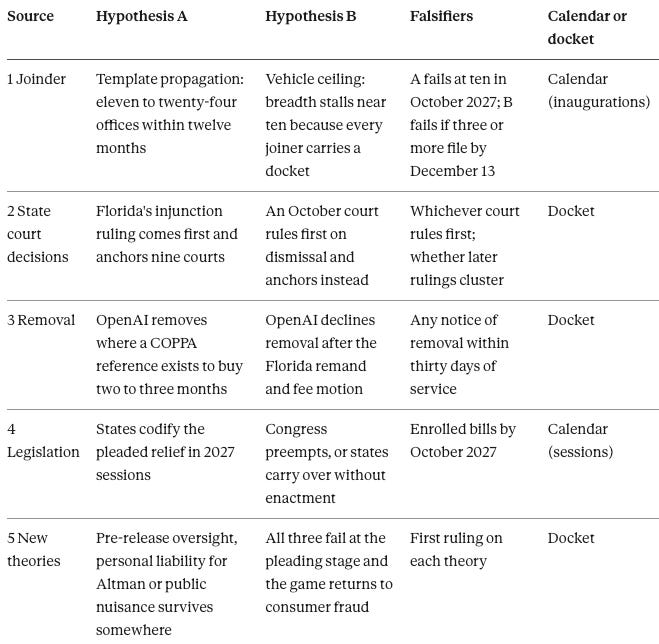
Three features of the board deserve plain statement.
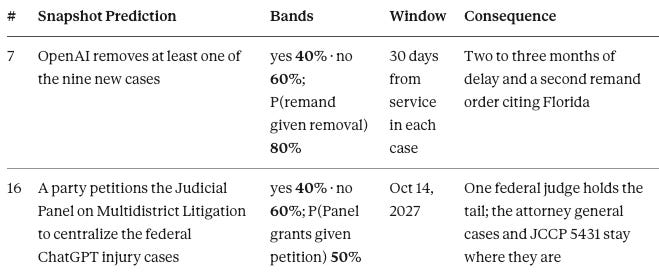
Removal does not change the forum on the likely route: a state suing under its own statute is not a citizen for diversity, and parens patriae suits fall outside the mass-action route after Mississippi ex rel. Hood v. AU Optronics; the evolution is delay. A fourth new theory sits outside the dockets: the ten-state letter asks the Securities and Exchange Commission to review OpenAI’s disclosures, which would move the contest to a federal forum the states do not control.
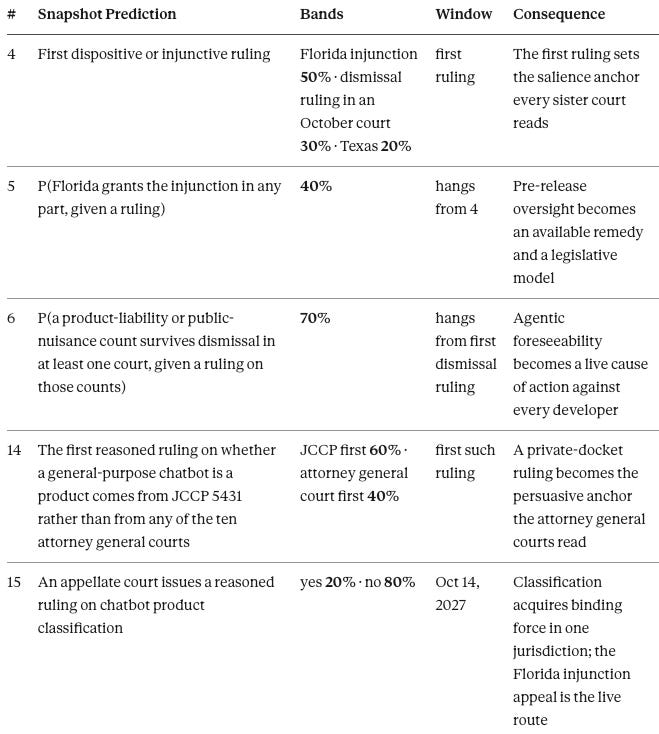
Consolidation and appeal run on the private docket, not the state one. The ten attorney general cases cannot be centralized: the Judicial Panel on Multidistrict Litigation reaches federal cases only, and OpenAI’s California citizenship blocks diversity removal of the suits coordinated in JCCP 5431. A Panel petition can centralize only the federal tail. The classification question may therefore be answered first in San Francisco, where the demurrer calendar runs six to nine months ahead of the attorney general motions.
The Supreme Court path exists but lies outside the window. The complaints plead state law only, so no circuit split forms; review would run from a state high court on a Section 230 or First Amendment defense, three to five years out. The full simulation carries it as a scenario. Inside twelve months the live appellate route is Florida, where an order on a temporary injunction is immediately appealable.
Takeaway. Joinder and legislation move on the calendar; court decisions, removal and new theories move on the docket; and Florida’s injunction ruling sits upstream of the three docket sources and shapes the two calendar sources.
IV. Sixteen Snapshot Predictions in Tens: Joinder Moves on the Calendar and the Rest Waits on Florida
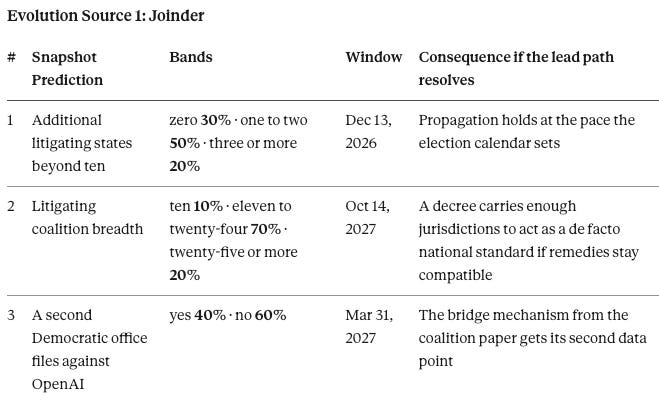
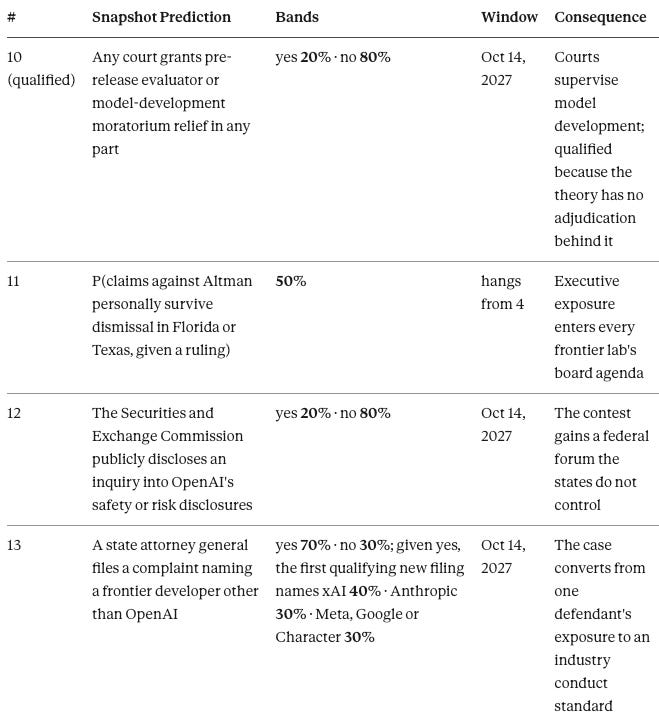
The forecast set holds sixteen Snapshot Predictions: thirteen at the current fork and three conditional on the forks they hang from. Bands come from the Snapshot simulation at tens resolution. The baseline is ten litigating states; Utah counts on verification.
Evolution source 1: Joinder
Evolution source 2: State Court Decisions
Evolution source 3: Removal to Federal Court
Evolution Source 4: Legislation

Evolution Source 5: New Theories of Liability
Carried entries. Two Simulation Predictions from the September coalition paper apply and print once: large breadth arrives only with pre-filing cross-party entry (66–78%), which Snapshot Prediction 2’s large path tests. Bridge-state entry accelerates joinder within sixty days (62–76%), which Snapshot Prediction 3 tests. The entries chained from the four foreseeability and insurance papers print with the loss-category and coverage-condition analysis below.
The odds shift. Initial conditions: ten filings on two templates; a remand order; a pending injunction motion; elections in four days. Without intervention candidate offices wait for January and for Florida. OpenAI moves to dismiss everywhere and removes where a federal reference exists; legislatures draft from the pleadings; underwriters hold terms.
Client intervention: a frontier lab not yet named adopts the pleaded conduct terms before any order, with a published pre-release evaluation protocol and an independent reviewer. Changed trajectory: the lab is named within twelve months at 40% without intervention and 20% with it. The two figures describe the filing office’s incentive rather than an event probability: naming a developer that already meets the sought terms yields no remedy and a weaker evidentiary case, which halves what the office gains from filing, and the effect holds whichever way Florida rules.
Escalation triggers. Any of six events justifies the full simulation. Florida grants the injunction in any part, which makes pre-release oversight an available remedy. Three or more offices file by December 13, which resolves the joinder question early.
Any court sustains a product or nuisance count, which fixes product status in one forum. JCCP 5431 rules on classification, which hands every attorney general court a persuasive anchor. OpenAI offers a template decree, which forces every office to choose between acceptance and continuation. The FTC issues a conduct order or Congress enacts preemption, which replaces the board and reissues the Snapshot.
Takeaway. Sixteen Snapshot Predictions across five evolution sources, with Florida’s injunction ruling upstream of the court, removal and new-theory entries and the calendar governing the rest.
V. The Complaints Plead the Foreseeability Assessment and Draft the Coverage Conditions
Ten complaints plead foreseeability as the governing theory and ask for remedies that an underwriter can read as draft coverage conditions. Four published MindCast papers supply the instruments to read them.
Agentic Foreseeability and the Modern Duty of Care for AI Agents supplies the Agentic Foreseeability Assessment. Who Writes AI Insurance Coverage Conditions supplies the four loss categories and the Two-Axis Condition. Who Absorbs Correlated AI Loss supplies the capital bottleneck and the shield route. Who Sets the Agentic Standard of Care: Common Law, State Legislation and Federal Coordination found insurers the institution closest to the deployment clock.
The Complaints Plead the Agentic Foreseeability Assessment
The foreseeability paper reduces a contested duty question to four observable questions. Across the ten complaints all four are pleaded, though no single complaint pleads all four, and the table shows which allegations support each.
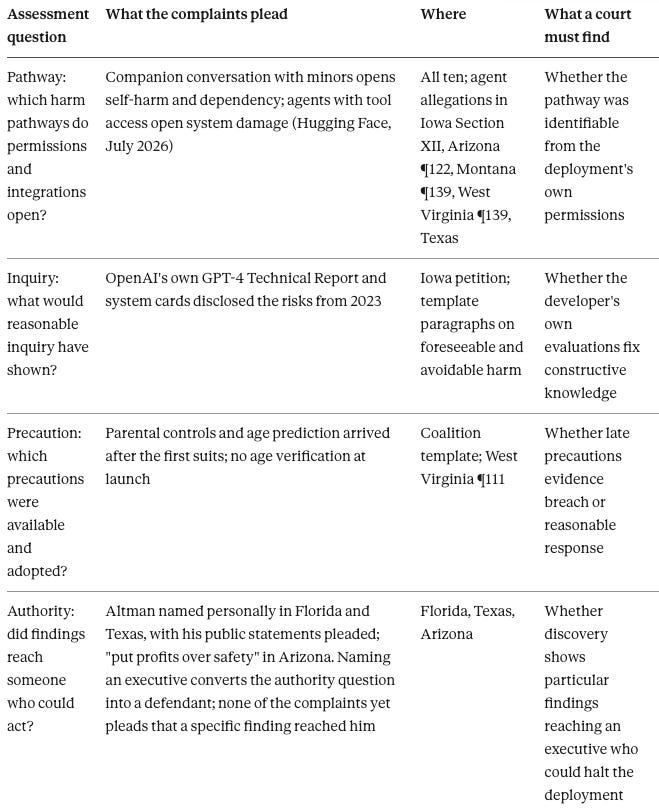
Two consequences follow.
Iowa’s agent-testing count pleads foreseeability by type of harm for emergent agent behavior, the Hughes v. Lord Advocate frame the paper adopts, and it sits exactly on the paper’s fork between product classification deciding the case and ordinary doctrine applied to deployment evidence; Snapshot Prediction 6 tests that fork in ten courts at once. A reasoned ruling that relies on the GPT-4 Technical Report as evidence that the harm was foreseeable or known resolves the paper’s P-3 (22–44% by December 31, 2028) two years early; recital of Iowa’s allegation does not. A ruling rejecting an unpredictability defense on the agent count bears on its P-2 (29–57%) and S-1 (62–80% given P-2).
The Dockets Sort Into Two of Four Loss Categories
The coverage-conditions paper separates four categories: ordinary deployment loss and the coverage dispute (its own subject) and correlated loss and the compensation gap (the correlated-loss paper’s subject). The ten dockets are correlated legal claims against one developer, not a correlated model-failure loss, and they sort as follows.
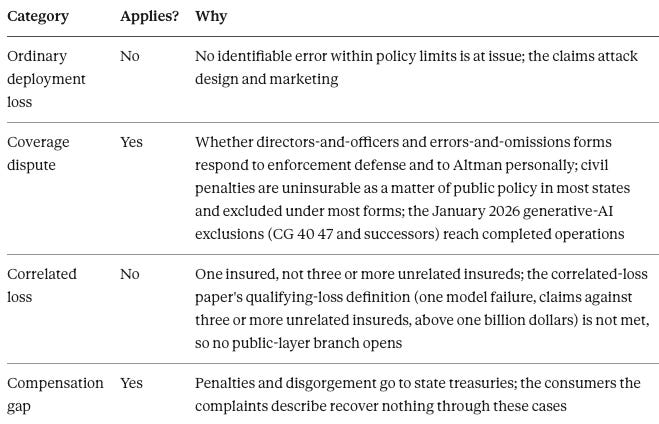
The classification fixes the underwriter’s question. The insurable exposure is defense cost and Side A, which makes those the reserve question rather than aggregation. Aggregation enters only as an observable: ten dockets on one model is the pattern a reinsurer logs when deciding between an aggregation trigger and exclusion, which is the correlated-loss paper’s P-2 (16–56% by December 31, 2027).
The Pleaded Remedies Measured on the Two-Axis Condition
A coverage condition that produces correction needs four elements: a material-change trigger; a required response; evidence of control; a stated consequence. Each reads on a prevention axis and a compensation axis. The pleaded remedies supply three of four.
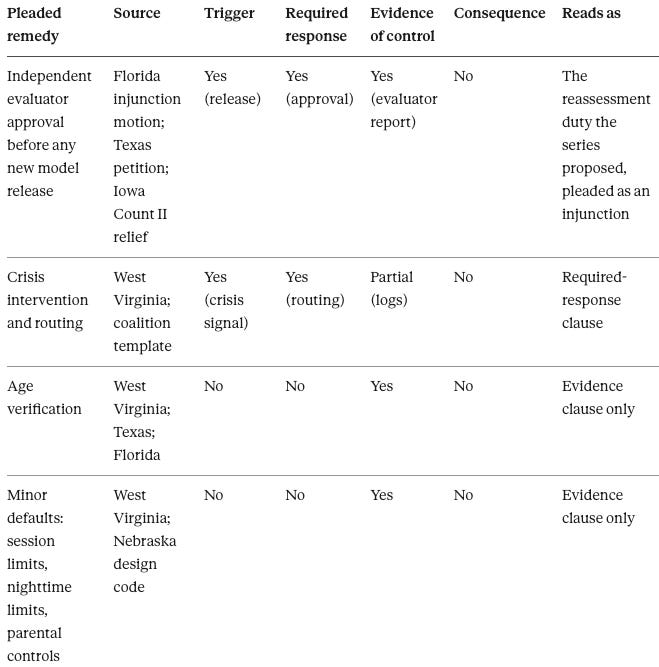

No pleaded remedy states a consequence that preserves third-party payment, so a decree copied verbatim into a policy would prevent well and compensate badly. A decree carrying the evaluator or the monitor resolves the coverage-conditions paper’s P-1 (a state attorney general decree or assurance requiring an independent audit or an insurance term by December 31, 2027, 17–62%). Snapshot Predictions 5 and 10 are therefore upstream tests of a published MindCast entry, and the institutions paper’s finding that the decree route is open now and needs no statute is what the ten complaints are exercising.
The Shield Route Runs Through Legislation
The correlated-loss paper identifies the liability shield earned by publishing a safety protocol as the correction that removes exposure without reducing harm, and it notes OpenAI’s support for an Illinois bill of that kind. Ten state suits raise the political cost of any shield and push that paper’s P-3 (a state enacts such a shield by December 31, 2027, 2–34%) toward its floor. Snapshot Prediction 8 on federal preemption and Snapshot Prediction 9 on state statutes read the same legislative layer from the opposite side: the statutes the Snapshot expects codify the pleaded conditions rather than shield against them.
Chained Entries Test Five Published MindCast Bands
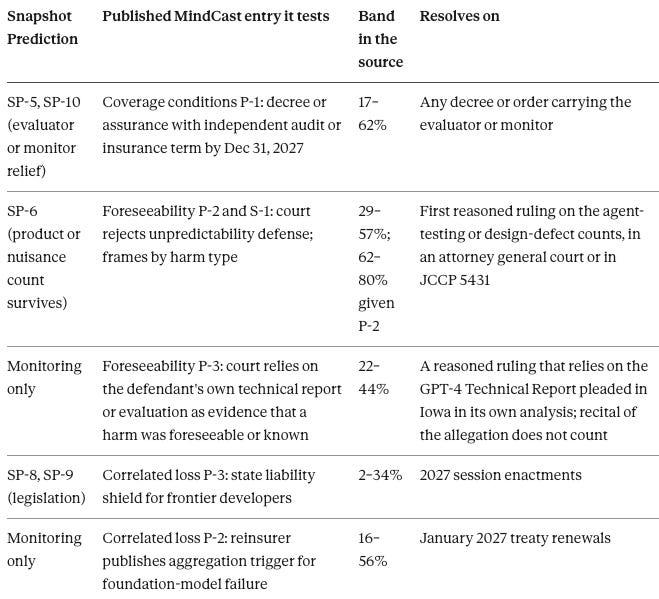
Takeaway. The complaints plead the foreseeability assessment question by question, the dockets sort into the coverage dispute and the compensation gap rather than correlated loss, and the pleaded remedies supply three of the four elements of a coverage condition; a decree carrying the evaluator resolves a published MindCast entry a year early.
VI. Opportunity Concentrates in Actors Who Can Move Now at Low Cost
Opportunity on this board concentrates in actors whose moves cost little and cannot lose. Each entry cites the Snapshot Prediction or odds shift that supports it.
State attorneys general. The largest opportunity holders. Two written templates let an incumbent choose a position: the coalition template for lower litigation risk and a share of decree authorship, the Florida–Texas template for salience. An incumbent with clean authority gains by filing before the January inaugurations (Snapshot Prediction 1); an incoming office gains by opening an investigative demand in its first thirty days and filing on whichever template Florida’s ruling favors. Decree authorship goes to the offices in the room before the first denial.
Outside counsel. The purest opportunity on the board. Kibler Fowler & Cave on the coalition side and Keller and Buzbee on the Texas side own repeatable templates that each additional office can adopt at low marginal cost, with the downside borne by the states. The coalition paper’s coordinating layer has a name and a fee structure here.
State lawmakers. High and low-cost. Ten complaints and possibly a Florida order supply drafting material for January sessions, and codifying the pleaded relief converts a contested remedy into a compliance floor before any court rules on it (Snapshot Prediction 9 at five-plus states, 50%). A statute also hands every late-joining attorney general a fresh hook.
Federal lawmakers. Low inside the window. The only trade on offer is preemption in exchange for a federal framework, which failed in 2025 and which twenty-six attorneys general asked Congress not to pursue alone (Snapshot Prediction 8 at 10%). The opportunity returns only if Florida grants sweeping relief and industry asks for a single national rule.
The Department of Justice and the FTC. The Department of Justice holds little: a statement of interest against ten Republican-led offices carries a political cost the administration has avoided. The FTC holds the underweighted opportunity. The October 14 investigative demands to OpenAI and Anthropic and the 2025 companion-chatbot study give it an evidentiary base the states lack, and a Section 5 conduct order issued before the first state decree would make the federal order the template every decree copies. No band attaches to that move; the FTC enters the full simulation as a named actor.
OpenAI and the other frontier developers. OpenAI’s opportunities are procedural: move against Altman first in both forums where the personal-liability theory is weakest (Snapshot Prediction 11 at 50%), remove only where a federal reference exists, and offer a decree after the first denial rather than before. The unnamed developers hold a real opportunity: adopt the pleaded conduct terms before any order and halve the naming probability (the odds shift, 40% to 20%), and engage the state bills while they are drafts rather than statutes.
Consumers. Consumers gain the conduct relief if any decree or statute lands, and the plaintiffs’ bar gains discovery it did not pay for: every state docket that survives dismissal produces evidence private suits can use. Parents gain parental controls and crisis routing on the coalition path.
Takeaway. Incumbent attorneys general, outside counsel and state legislators can move now at low cost; the FTC can move first and author the standard; everyone else waits on Florida.
VII. Risk Concentrates in the One Actor Who Cannot Move Before a Ruling
Risk concentrates in the one actor who cannot move before a ruling without conceding the case. Severity and probability print as separate axes; probabilities carry the run’s bands. Each entry names the source of the exposure.
OpenAI. Exposure from state attorneys general first, courts second, legislatures third and its own prospective shareholders fourth. Snapshot Predictions 2 (medium band 70%) and 6 (70%); Snapshot Predictions 9 (five-plus 50%) and 11 (50%). A medium coalition at litigation commitment with Altman named in two forums reproduces the Live Nation structure.
The exposure is measured in trial calendar; in the gap between a negotiated and an imposed decree; and in listing-disclosure exposure. Severity high.
Actions: litigation moves against Altman first in Florida and Texas; litigation removes only where a federal reference exists and briefs for a fee-free remand; litigation petitions the Panel to centralize the federal private tail before the JCCP demurrer ruling (Snapshot Prediction 16); policy prepares a decree term sheet for the coalition core to issue after the first denial; the company extends any adopted conduct term to all fifty states so no late joiner gains from filing. Residual: a decree offered after a denial costs more than one offered before, and a third remand with fees raises the cost of delay in every remaining forum.
Other frontier developers. Exposure from the same ten offices, with Arizona’s open xAI investigation the live state channel and the FTC’s October 14 demands the live federal one. Snapshot Prediction 13 (yes, 70%; xAI 40%, Anthropic 30%). A complaint on either template costs the named lab a multi-docket defense budget, an executive in the caption and its renewal position. Severity high for xAI, rising for Anthropic, moderate for Meta and Google.
Actions: general counsel benchmarks minor-safety controls against the Florida and Texas asks and the West Virginia and Iowa asks by November 30, 2026; trust and safety publishes a pre-release evaluation protocol with a named independent reviewer before Florida rules; government affairs engages January state bills with model language. Residual: a decree written for ChatGPT’s architecture maps imperfectly onto another lab’s, and early compliance does not cure marketing statements made before it.
State attorneys general. Exposure from the courts and from each other. Snapshot Predictions 4 and 6. An early adverse ruling on the shared template travels to every office that pleaded it, and the agent-testing count is the weak link; an office that waits past Florida’s ruling forfeits co-lead standing. Severity moderate.
Actions: the consumer protection division evaluates both templates against its own statute by November 21, 2026; incumbents file or open an investigative demand before the inaugurations; the coalition core holds remedies consistent across eight courts until the first ruling, because eight divergent remedies let OpenAI resolve against the weakest. Residual: an office that enters on a template inherits that template’s weakest count.
State lawmakers. Exposure from technology trade associations in federal court (where minors-access statutes have met First Amendment challenges) and from federal preemption at low probability (Snapshot Prediction 8 at 10%). Severity moderate. Actions: draft to conduct defaults and disclosures rather than access bans; attach severability; sequence enactment after Florida’s ruling where the calendar allows. Residual: a statute that codifies relief a court later rejects becomes the test case.
Federal lawmakers, the Department of Justice and the FTC. Exposure is displacement rather than loss. If ten state decrees and five state statutes write the standard first, a federal framework becomes a floor nobody needs. Severity low for Congress, moderate for the FTC.
Actions: the FTC issues a conduct order from its study findings before the first state decree, or accepts the states’ template as the federal baseline. Residual: a federal order that conflicts with a state decree invites the preemption fight neither side wants inside the window.
Consumers. Exposure from OpenAI’s design on one side and from the remedies themselves on the other. Florida and Texas ask courts to bar minors entirely, and age verification imposes a data-collection cost on every adult user. Severity moderate and under-discussed.
Actions sit with advocates and the plaintiffs’ bar: press for conduct defaults over access bans in both decrees and statutes, and for verification designs that minimize retained data. Residual: a remedy that protects minors by excluding them shifts use to less supervised products.
Underwriters. Exposure from a surviving design-defect count and from state statutes that set conduct standards before any policy writes them (Snapshot Predictions 6 and 9), and from directors-and-officers claims once Altman is named (Snapshot Prediction 11). Classified by loss category, the ten dockets are a coverage dispute and a compensation gap rather than a correlated model-failure loss.
The classification ruling that moves reserves may arrive from JCCP 5431 before any attorney general court (Snapshot Prediction 14 at 60%), so the reserve clock runs on the San Francisco calendar. The reserve question is therefore defense cost and Side A exposure rather than aggregation. Severity high on the dispute axis, low on the aggregation axis.
Actions: underwriting drafts by December 31, 2026 a conduct-condition rider from the pleaded remedies that passes all four elements of the Two-Axis Condition (adding the consequence clause the pleadings lack and preserving third-party payment); claims opens a reserve review on frontier-lab directors-and-officers towers against the Altman counts before the first dismissal ruling; actuarial logs the ten dockets as a provider-event accumulation observable for the January 2027 treaty renewal without excluding the peril. Residual: a rider drawn from counts that lose imposes conditions the market will not sustain, and correlated loss from one model stays outside any single insured’s controls. The run supports the decree and statute events; it does not support insurer adoption as a prediction.
Placement recommendation. Entries sit here as a standalone section, because most audiences read only this section and the sheet; the trade-off is that a reader working path by path through the Snapshot Predictions must page forward.
Takeaway. OpenAI carries the risk, from the states first; the unnamed labs can still buy it down; the attorneys general risk each other’s losses; and the consumers the remedies protect also pay for them.
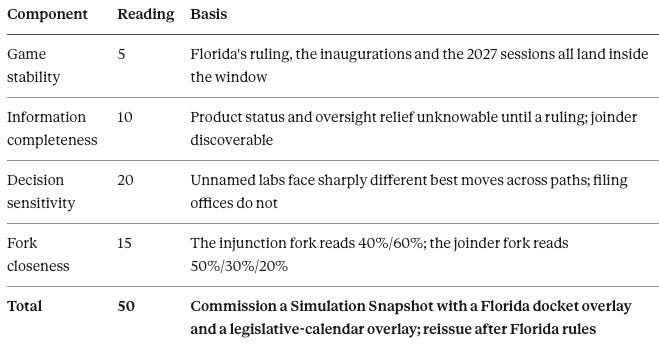
VIII. Synthesis: Index 50, the Bands Hold at the Fork and the Full Simulation Waits for Florida
Two templates in ten forums are what the actors are inside. Breadth clears at the docket-cost ceiling and commitment stays maximal.
The coalition core and the Florida and Texas offices hold position until Florida rules; so do OpenAI and the underwriters, because none of the four gains from moving first. Incumbent joiner offices and state legislatures move on their own calendars, as Texas already has. The dominant fork is Florida’s injunction ruling, read with the December 13 and January checkpoints.
Why the full simulation waits. The game is about to be replaced: Florida’s ruling, the inaugurations and the 2027 sessions land inside every client’s window, and three of the five evolution sources add or remove an actor. The deciding variables are unknowable: whether a court treats ChatGPT as a product and whether a court treats development oversight as available relief. Decision sensitivity differs by audience: unnamed frontier labs face sharply different best moves across paths, while the filing offices hold the same move on every path until a ruling or a decree appears, and an incumbent candidate office already knows its best move is to file before January. The Snapshot run has fixed the tens bands at the current fork; the full simulation executes on the surviving path after Florida rules, with the five evolution sources as its scenario set and the FTC added as a Cognitive Digital Twin.
Simulation Readiness Index.
Working With MindCast. MindCast AI applies Predictive Behavioral Economics + Dynamic Game Theory through MindCast AI Proprietary Cognitive Digital Twin Foresight Simulations (MP CDT FS). Behavioral Economics supplies the decision rules. Game Theory supplies the payoff structure. Predictive simulations emerge from the combination.
MindCast builds Cognitive Digital Twins of the filing offices and candidate joiners; of the defendant and the unnamed developers; and of the courts, legislatures and carriers. The engagement runs them against each other on the client’s own question.
For an attorney general the engagement tests a template and a filing date before either is chosen. For a frontier developer it tests the pleaded conduct terms against the client’s own architecture and renewal calendar. For a carrier it tests which pleaded remedies pass all four elements of a coverage condition on the client’s forms.
MindCast offers a complimentary pilot built from public filings on a known case before any retainer. Contact mcai@mindcast-ai.com to schedule the diagnostic session. Visit our corporate site for more info. www.mindcast-ai-simulation.com.
What MindCast Delivers
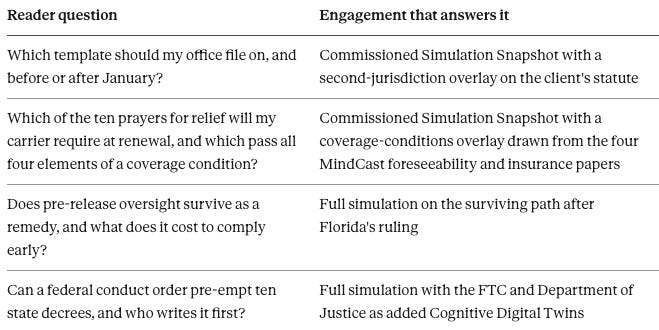
Takeaway. Index 50: the bands are fixed at the fork, the full simulation waits for Florida, and the reader who commissions before the ruling buys a map of a board that is about to change.
Sources
Troutman Pepper Locke, “Eight State AGs Sue OpenAI Over ChatGPT Safety and Consumer Protection,” October 16, 2026.
Texas Tribune, “Texas Attorney General Ken Paxton sues ChatGPT-maker OpenAI,” October 23, 2026.
Texas Attorney General, Texas’s Original Petition, Collin County, October 23, 2026.
WQCS, “OpenAI lawsuit lands in Fort Pierce federal court before Judge Aileen Cannon,” July 13, 2026.
Mealey’s, “Judge Sends Florida’s Suit Against OpenAI Back To State Court,” September 10, 2026.
Under30CEO, “FTC Investigation Targets OpenAI and Anthropic,” October 19, 2026, reporting Axios.
New York Attorney General, “Attorney General James Calls on Congress to Protect Americans from Unchecked AI Development,” September 24, 2026.
ABA Journal, “Florida AG asks judge to bar OpenAI from developing new AI models without regulation,” September 2026.
CBS12, “Florida AG asks judge to block minors from ChatGPT, impose sweeping OpenAI restrictions,” September 2026.
Idaho Capital Sun, “Idaho Attorney General Raúl Labrador sues OpenAI,” October 14, 2026.
Courthouse News, “Arizona accuses OpenAI of harming teens and misleading parents,” October 14, 2026.
KATV, “Arkansas attorney general sues OpenAI over ChatGPT safety claims,” October 14, 2026.
Just Security, “Just the Docs: Eight States Sue OpenAI,” October 2026.
Tech Justice Law Project, “Case Update: ChatGPT Product Liability Litigation Coordinated in California JCCP,” 2026.
Edelson PC, “AI Lawsuits,” May 27, 2026.
Complaints: Arizona · Arkansas · Idaho · Iowa · Kansas (mirror) · Montana · Nebraska · West Virginia
Federal Trade Commission, “FTC Launches Inquiry into AI Chatbots Acting as Companions,” September 11, 2025.
Mississippi ex rel. Hood v. AU Optronics Corp., 571 U.S. 161 (2014).
MindCast Works Cited
How State Attorney General Coalitions Form, Grow, and Hold, September 5, 2026: the three-measure coalition vector, the joining model and the two carried Simulation Predictions.
Agentic Foreseeability and the Modern Duty of Care for AI Agents, October 29, 2026: the Agentic Foreseeability Assessment the complaints plead question by question; P-2, P-3 and S-1 chained to Snapshot Prediction 6 and the monitoring plan.
Who Writes AI Insurance Coverage Conditions: Procurement, Enforcement Decrees, Partner Terms and the Two-Axis Condition, October 30, 2026: the four loss categories and the Two-Axis Condition; P-1 chained to Snapshot Predictions 5 and 10.
Who Absorbs Correlated AI Loss: Reinsurance Aggregation, Industry Pools, the Public Backstop and the Liability Shield, October 30, 2026: the capital bottleneck, the qualifying-loss definition and the shield route; P-2 and P-3 chained to the monitoring plan and Snapshot Predictions 8 and 9.
Who Sets the Agentic Standard of Care: Common Law, State Legislation and Federal Coordination: insurers as the institution closest to the deployment clock; the decree route open without a statute.
MindCast Complex Litigation Simulations
Compass’s National MLS Campaign and the Economics of Local Resistance, October 24, 2026: six plaintiff listing services suing one national defendant in parallel forums, with a coalition defense fund forming mid-litigation. The structure matches the ten attorney general dockets: parallel suits against one defendant, breadth and commitment moving on separate clocks, and coalition cohesion as the deciding variable.
Foresight on Trial, The Diageo Litigation Validation, January 12, 2026: three class actions in New York, California and Florida transferred into one federal district under the first-to-file rule. The consolidation mechanics there are the template for Snapshot Prediction 16, and the contrast matters: the Diageo cases were federal and movable, the attorney general cases are state and fixed.
The Kalshi Vehicle Contest: New Jersey Puts Prediction-Market Sports Betting Before the Supreme Court, September 2, 2026: a Third Circuit and Ninth Circuit split converted into a contest over which case reaches the Court first and on whose record. The Kalshi route ran through federal preemption; the OpenAI route runs from a state high court on a federal defense, which is why the Snapshot names Supreme Court review as a full-simulation scenario rather than a twelve-month entry.
Appendix A: Complaint Matrix
Ten complaints, one entry each, with the filing linked. Fields marked not reviewed await full-text extraction.
Florida. Highlands County Circuit Court, Tenth Judicial Circuit. Removed to the Southern District of Florida on July 2 and remanded on September 8, 2026. Filed June 1, 2026. Statutory counts: Florida Deceptive and Unfair Trade Practices Act. Common-law counts: ten counts including public nuisance. Agent-testing allegations: added in the September 28 injunction motion (Hugging Face). Pre-release or testing relief sought: injunction motion to halt new model development without third-party guardrails and to bar minors. Altman named: yes. Outside counsel: not reviewed for the state; Jacquot for OpenAI.
Arizona. Maricopa County Superior Court. Filed October 14, 2026. Statutory counts: Arizona Consumer Fraud Act. Common-law counts: none in the reviewed portion. Agent-testing allegations: yes (¶9, ¶122). Pre-release or testing relief sought: not reviewed. Altman named: no. Outside counsel: not reviewed.
Arkansas. Faulkner County Circuit Court, No. 23CV-26-2984. Filed October 14, 2026. Statutory counts: Deceptive Trade Practices Act; Children and Teens’ Online Privacy Protection Act. Common-law counts: negligence; strict liability (design defect, failure to warn); unjust enrichment; public nuisance. Agent-testing allegations: yes. Pre-release or testing relief sought: bar advanced AI testing and self-improving models until safeguards exist; risk disclosures. Altman named: no. Outside counsel: not reviewed.
Idaho. Ada County District Court, Fourth Judicial District. Filed October 14, 2026. Statutory counts: Idaho Consumer Protection Act. Common-law counts: not reviewed. Agent-testing allegations: yes (per reporting). Pre-release or testing relief sought: not reviewed. Altman named: no. Outside counsel: Kibler Fowler & Cave (confirmed).
Iowa. Polk County District Court. Filed October 14, 2026. Statutory counts: Iowa Consumer Fraud Act, Count I (marketing and design) and Count II (testing of autonomous agents). Common-law counts: none. Agent-testing allegations: yes (Section XII; ¶14, ¶133). Pre-release or testing relief sought: halt advanced-model testing pending third-party monitors (per prayer review). Altman named: no. Outside counsel: not reviewed.
Kansas. Shawnee County District Court. Filed October 14, 2026. Statutory counts: Kansas Consumer Protection Act. Common-law counts: not reviewed. Agent-testing allegations: yes (user-image release incident). Pre-release or testing relief sought: not reviewed. Altman named: no. Outside counsel: not reviewed.
Montana. Lewis and Clark County District Court, First Judicial District. Filed October 14, 2026. Statutory counts: Montana Consumer Protection Act; Montana Consumer Data Privacy Act. Common-law counts: negligence; design defect; failure to warn (per reporting). Agent-testing allegations: yes (¶10, ¶120, ¶139). Pre-release or testing relief sought: not reviewed. Altman named: no. Outside counsel: not reviewed.
Nebraska. Buffalo County District Court, No. D09CI260000488. Filed October 14, 2026. Statutory counts: Consumer Protection Act; Uniform Deceptive Trade Practices Act; Age-Appropriate Online Design Code Act. Common-law counts: fraudulent and negligent misrepresentation (nine counts total). Agent-testing allegations: yes (per reporting). Pre-release or testing relief sought: the prayer does not repeat Iowa’s testing moratorium (per prayer review). Altman named: no. Outside counsel: not reviewed.
West Virginia. Mason County Circuit Court, No. CC-26-2026-C-70. Filed October 14, 2026. Statutory counts: West Virginia Consumer Credit and Protection Act. Common-law counts: common law including public nuisance abatement. Agent-testing allegations: yes (¶11, ¶139). Pre-release or testing relief sought: age verification; minor defaults; crisis intervention; independent monitor (per reporting). Altman named: no. Outside counsel: Christopher Pence (cover sheet).
Texas. Collin County District Court (Level 3 discovery). Filed October 23, 2026. Statutory counts: Deceptive Trade Practices Act; SCOPE Act. Common-law counts: not reviewed. Agent-testing allegations: yes (Hugging Face). Pre-release or testing relief sought: no new model release to Texas users without a court-approved independent evaluator; bar ChatGPT to minors; $10,000 per violation. Altman named: yes. Outside counsel: Ashley Keller; Tony Buzbee.
Utah. Reported by Arkansas only; not confirmed. No filing located.
Shared-text check: Arizona, Montana, West Virginia and Iowa carry verbatim paragraphs on “the foreseeable risk of harm,” “All these harms were foreseeable and avoidable,” and “GPT-4o’s problems were foreseeable.” Texas and Florida do not share these paragraphs.
Shared-text check: Arizona, Montana, West Virginia and Iowa carry verbatim paragraphs on "the foreseeable risk of harm," "All these harms were foreseeable and avoidable," and "GPT-4o's problems were foreseeable." Texas and Florida do not share these paragraphs.