


AI deployers · Foundation model developers · Congress · Department of Justice · California · Texas · Washington · Colorado · State attorneys general · Insurers and underwriters
Companion to Agentic Foreseeability and the Modern Duty of Care for AI Agents.
Foresight-to-Duty Conversion Series Introduction: Meta Foresight-to-Duty Conversion Across Privacy, Child Safety and Scam Ads · Meta and Bank of America Foresight-to-Duty Conversion: Revenue-Funded Versus Cost-Funded Deferral · Consent Order Remedies at Meta, Boeing, Starling and Wells Fargo: Verified Correction Versus Recurrence
Related Works: Bank of America $1.2 Billion Money Laundering Penalty and the Compliance System That Knew Too Much · The Foresight-to-Duty Conversion — Measured Governance Debt Becomes Evidence When Institutions Keep the Gap They Found
Foundational Works: The Duty to Foresee, AI Deployment Readiness as Prospective Governance, and the Arrival of Agentic Duty of Care · AI Governance Equilibrium · Decision Modeling and Foresight Simulation
Executive Summary
Several institutions already shape the duty of care for AI agents, and each moves on a different clock. California’s legislature removed the defense that an AI system “autonomously caused the harm,” and Texas shields violations found through testing within its own AI statute. Courts in San Francisco are hearing the first coordinated injury claims against a chatbot developer, and congressional sponsors introduced the FRONTIER Act in July 2026 to preempt state rules on frontier-model development. The question is which arrangement gets a reliable finding to someone who can require correction before harm occurs.
Thesis: Preserve common-law accountability while lawmakers establish the evidence and intervention duties that make accountability practical. Existing negligence and product-liability rules already govern agent harms, but their application stays uncertain until courts apply them to agent facts. Legislation can set effective dates and explicit duties, and agencies can update technical requirements without a new statute. A combined arrangement corrects soonest when each part feeds findings to the people who can act on them.
Two clocks set the stakes. The legal clock runs from a court ruling or an enacted duty, and nobody can schedule when a suitable case will produce precedent. The deployment clock runs from each permission change, new evidence or incident, and it runs every quarter. A duty to reassess should follow the deployment clock: deployers should revisit a deployment after material changes and risk signals, alongside any scheduled review.
What distinguishes the MindCast approach: Agentic Foreseeability and the Modern Duty of Care for AI Agents set out what a deployer should have foreseen. The present paper compares which institutions can turn that expectation into effective precautions, using Neil Komesar’s comparative method from Imperfect Alternatives (1994). Each allocation is treated as a hypothesis and tested against the same deployment and harm pathways. One simulated result shows the method’s edge: Washington’s technology lobby gains more by opposing a liability bill than by bargaining for a shield, whatever support leadership gives the bill.
MindCast AI applies Predictive Behavioral Economics + Dynamic Game Theory through MindCast AI Proprietary Cognitive Digital Twin Foresight Simulations (MP CDT FS). Behavioral Economics supplies the decision rules. Game Theory supplies the payoff structure. Predictive simulations emerge from the combination.
Game mutation is the part of the simulation that matters most here. The rules governing every institution change the moment one of them adopts the reassessment duty, because the first adopter sets the term the others copy or resist. A reasoned adverse trial ruling mutates the court game by making resolution before appeal the dominant move for every repeat defendant. A federal preemption statute mutates the whole board by removing the state and tort moves at once, and the simulation treats that mutation as the main threat rather than the base case.
What the paper does: The paper maps the institutions that already shape the agent duty and separates delayed precedent from absent duty. The paper introduces the two clocks and compares five institutions on correction speed, information, participation costs and capture. The paper then examines the development-deployment boundary in federal preemption. The paper closes with the Institutional Correction Test, five Simulation Predictions and a Risk Mitigation Layer.
Simulation Prediction highlights: The forecast set holds five MindCast Foresight Simulation Predictions: three primary and two secondary. Washington is the near-term test of legislative activity: a bill imposing or extending product liability to AI systems is introduced by March 31, 2027 (59-90%). Enactment from the 2027 regular session is the harder test of performance (3-23% given introduction), and federal displacement of state deployment rules or tort remedies by 2028 is unlikely (1-9%).
🏛️ Policymakers: A safe harbor that rewards filed tests relocates responsibility, while one that rewards answered findings produces correction. Delegated rulemaking can keep technical requirements current without a new statute.
💼 Executives: State rules and existing tort law will govern deployments for years. The reassessment duty that matters runs on your release calendar, not on any court’s.
⚖️ Counsel: Existing negligence and product rules already apply to agent harms, so the uncertainty concerns how courts apply them rather than whether a duty exists. The FRONTIER Act preserves generally applicable law but does not say whether common-law claims resting on development conduct survive.
📊 Investors: Regulatory exposure will track the states where customers sit and the reassessment discipline each portfolio company keeps. Neither depends on Congress acting.
I Several Institutions Already Shape the Agent Duty
The duty of care for AI agents is already being shaped in several places at once. Each institution has taken the piece it can reach, and none has claimed the whole.
State legislatures have written defenses and safe harbors. California Civil Code section 1714.46 took effect on January 1, 2026 and bars anyone who developed, modified or used an AI system from arguing that the system autonomously caused the harm. Texas’s Responsible Artificial Intelligence Governance Act shields a person who discovers a violation through testing or good-faith audits, but only within that statute’s own enforcement scheme.
Courts are applying existing law to the first agent facts. The coordinated ChatGPT product liability cases in San Francisco Superior Court will produce early rulings on whether an AI developer’s output is a product and whether its harms were foreseeable. Federal actors have moved on two tracks: Representatives Obernolte and Trahan introduced the FRONTIER Act (H.R. 9925) on July 23, 2026, and the executive branch created a Justice Department task force to challenge state AI laws.
State attorneys general can reach an AI product under existing consumer-protection law without a new statute, which puts enforcement on a shorter clock than legislation. Agencies and insurers fill the remaining gaps. Colorado’s replacement AI statute directs the Attorney General to complete implementing rules by January 1, 2027, and Verisk’s generative AI exclusions reach policyholders at their next renewal. The division of labor exists in practice, and its performance is the open question.
⚖️ Counsel: A deployment already answers to at least three rule-writers, so a liability review that checks one of them is incomplete.
Takeaway: Six actors shape pieces of the agent duty: courts and state legislatures, agencies and Congress, insurers and state attorneys general. The question is which arrangement produces correction soonest.
II Existing Law Already Governs, but Its Application Stays Uncertain
Agent harms do not fall into a legal void. Negligence asks whether a deployer exercised reasonable care, and product-liability law asks whether a design created foreseeable risks a reasonable alternative would have reduced. Both doctrines apply to agents today.
The uncertainty concerns application. Courts have not yet decided whether a chatbot is a product in a final judgment, how foreseeability applies to emergent agent behavior or what a reasonable pre-release inquiry requires. Installment IV forecast that a trial court rejects the unpredictability defense in a reasoned ruling by the end of 2028 at 29-57%, and appellate guidance is unlikely before the end of 2029.
Delayed precedent therefore means uncertain application of existing standards rather than an absent duty. A deployer who waits for an appellate ruling before reassessing an agent is not waiting for the duty to arrive. The duty already applies, and the deployer is choosing to learn its terms in litigation.
Tort litigation also produces information no other institution generates. The Supreme Court in Wyeth v. Levine (2009) observed that “state tort suits uncover unknown drug hazards and provide incentives for drug manufacturers” to disclose them. Discovery in agent cases will surface evaluation files and incident logs that no regulator now collects.
💼 Executives: Waiting for appellate guidance leaves the duty in force and its terms unlearned.
Takeaway: The common law already supplies the agent duty, and its slowness lies in application rather than in existence.
III Two Clocks Decide Whether Any Institution Is Fast Enough
Every institution runs on a legal clock. A statute takes effect on a date, an agency rule completes on a schedule and a court rules when a suitable case reaches decision. Early resolutions can stop the court clock entirely, as the January 2026 resolution of the Character.AI cases did before any appellate review.
Deployments run on a second clock. A deployer grants a new permission, an evaluation surfaces new evidence or an incident reveals a pathway, often several times a quarter. Each event changes what a reasonable inquiry would reveal.
The mismatch sets the design problem. A standard that updates only on the legal clock will lag every deployment by years. A duty to reassess tied to the deployment clock closes the gap: a deployer revisits the deployment after each material permission change, new evidence or risk signal, alongside any scheduled review.
Any institution can adopt the reassessment duty. Courts can treat it as evidence of reasonable care, legislatures can write it into a safe harbor and agencies can define material changes by rule. Insurers can make it a coverage condition, which moves it onto the deployment clock fastest.
💼 Executives: The reassessment duty will reach a deployer through whichever institution adopts it first, so release calendars should carry it now.
Takeaway: The reassessment duty ties the legal standard to the deployment clock, and any institution can adopt it.
IV Comparative Institutional Analysis Tests Each Allocation
Komesar’s method starts from a plain observation: every institution is imperfect, so the useful question is which imperfection costs least for a given task. Guido Calabresi’s A Common Law for the Age of Statutes (1982) adds that statutes age and courts end up adapting them. Agent capabilities change quarterly, so the aging problem is acute.
Four criteria compare the institutions for agent harms. Correction speed measures how many deployment cycles pass before a finding reaches someone who can require a fix. Information quality measures whether the institution sees specific facts or general patterns. Participation costs measure who can afford to engage, and capture measures who can weaken the rule once it exists.
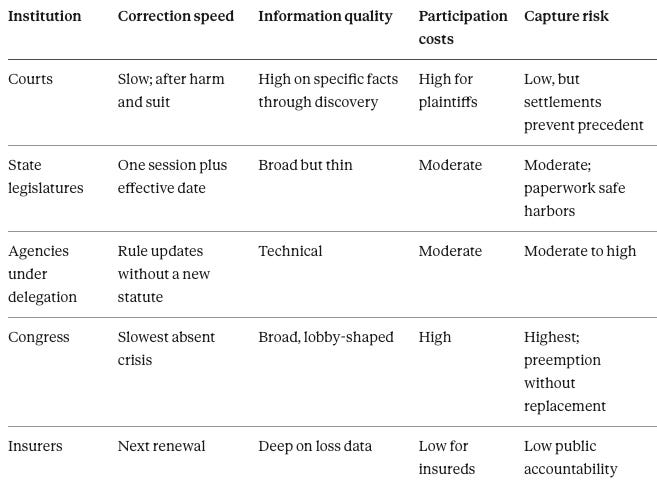
The boundaries between institutions are not sharp. Legislatures can write adaptable duties and delegate updates to agencies, and courts develop defenses and evidentiary rules of their own. The allocation is a hypothesis about which arrangement performs best, not a fixed division.
🏛️ Policymakers: Choosing an institution means choosing its failure mode, and the table names each one.
Takeaway: Comparing imperfect institutions on correction speed, information, participation and capture shows each one’s strength and its characteristic way of failing.
V Courts Adapt to Facts but Speak After Harm
Courts handle moving targets well. Cardozo warned in Pokora v. Wabash Railway (1934) that “standards of prudent conduct are declared at times by courts, but they are taken over from the facts of life.” Hughes v. Lord Advocate (1963) lets courts hold a defendant to a foreseeable type of harm without demanding foresight of the mechanism.
Courts speak only after harm and suit. Plaintiffs sue over harms that are vivid and large, such as a teenager’s death, while diffuse agent losses spread across thousands of customers rarely reach a courtroom. Behavioral economics predicts the skew: salient harms produce litigation, so courts will apply the duty first to the most vivid harms and last to the most common ones.
Early resolutions compound the delay. Defendants resolve cases before adverse precedent when the payoff from avoiding a ruling exceeds the cost of resolution, as game theory predicts and the Character.AI cases showed. Each resolution keeps the application of existing law uncertain for the next deployer.
The simulation identifies settlement as the binding constraint on the court clock. A repeat-player defendant weighs one case’s cost against the precedent’s cost across its whole docket, so resolution before review dominates in most simulated cases once a trial court issues an adverse reasoned ruling. Settlement narrows appellate access, and the cases that reach review are the ones defendants chose not to resolve.
⚖️ Counsel: Trial rulings will shape the duty for years before any appellate court speaks, so each one carries more weight than its precedential status suggests.
Takeaway: Courts supply the most adaptive standard and the richest information, but they apply it only after harm and only when parties choose to litigate to judgment.
VI Legislatures Set Effective Dates but Can Reward Paperwork
Legislation offers what courts cannot: an effective date and an explicit duty. California’s autonomy-defense bar applied from a fixed day to every case, without waiting for a plaintiff. Holmes’s fixed rule in Baltimore & Ohio Railroad v. Goodman (1927) failed because conduct at railroad crossings varies, while a rule about which defenses exist does not share that defect.
Washington is the next test. The Attorney General’s AI Task Force issued its final report on July 1, 2026, and four of its recommendations had been enacted in whole or in part. Senate Majority Leader Jamie Pedersen said in October that lawmakers remain “a little bit light on specific proposals.”
Rep. Clyde Shavers has named AI product liability his top priority for the 2027 session. An August draft reportedlyoffered “a rebuttable liability shield if they document risk testing, disclose known risks,” with an 18-month regulatory sandbox. The October account of his plans mentions neither feature.
Legislatures carry two risks. Nine or more states enacted chatbot safety laws in 2026, a year of widely reported harms to minors, while diffuse agent harms drew no comparable response. Game theory adds the second risk: a shield conditioned on documented testing pays for files, so the shield relocates responsibility unless it also requires that findings reached someone with authority and produced a response.
The simulation finds that Washington’s technology lobby gains more by opposing the bill than by bargaining for a shield, however much support leadership gives the bill. Whether a testing shield appears therefore depends on the sponsor’s own drafting choice. The pre-filed text will show which design Washington chose.
Delegation can offset the aging problem. A statute can set the duty and let an agency define material changes and acceptable testing, as Colorado’s rulemaking mandate and Washington’s earlier sandbox draft both contemplate. The trade-off is rulemaking delay and the litigation that follows new rules.
🏛️ Policymakers: The condition attached to a shield decides whether the state buys correction or paperwork.
Takeaway: Legislatures can set the reassessment duty on a fixed date, and the design question is whether the duty rewards correction or documentation.
VII Federal Coordination Can Unify Evidence Duties or Remove Remedies
Uniformity is the federal case. An agent deployed in 50 states can face 50 sets of defenses and safe harbors, and divergence imposes real costs on firms that cannot route agent actions by state. Federal law could also set shared evidence requirements for risks that cross state lines.
Congress has so far declined to displace state law. The Senate voted 99-1 on July 1, 2025 to strip a state AI moratorium from the reconciliation bill. Executive Order 14365 of December 11, 2025 then created a Justice Department AI Litigation Task Force. The FRONTIER Act sits with the Energy and Commerce Committee, and Chairman Brett Guthrie said on September 16, 2026: “I’m not going to say that the bill is going to move.”
The bill lapses when the 119th Congress ends on January 3, 2027, so enactment requires reintroduction. The November 3, 2026 midterm elections will decide which party’s chair receives the reintroduced bill.
The development-deployment boundary needs analysis rather than assurance. The bill’s section-by-section summarypreempts new state obligations on frontier developers for catastrophic-risk transparency, third-party auditing and incident reporting. Section 9 preserves generally applicable laws, deployment rules for deployers and users, laws protecting minors and state procurement rules. The summary does not say whether a common-law claim resting on development conduct, such as pre-release testing, counts as generally applicable law.
The bill also creates federal stop authority. Section 8 lets the Commerce Secretary suspend or restrict development, deployment or internal use of a frontier model on a written finding of imminent catastrophic risk. The provision names a federal recipient with authority to halt, which the Institutional Correction Test treats as reach.
Wyeth tests the stakes. The Court relied on the premise that tort suits complement a federal regulator that already reviews drug labels. Agents have no federal pre-market review, so preempting tort remedies would remove the main information channel before any replacement exists.
⚖️ Counsel: A claim against a developer that rests on pre-release testing sits in the zone the bill’s text leaves unresolved.
Takeaway: Federal coordination could unify evidence duties and supply stop authority, but preemption that reaches development-based tort claims would remove remedies before a federal standard replaced them.
VIII Insurers Move First but Write Narrow Terms
Insurers set terms at every renewal. An exclusion or an audit condition reaches a deployer within a year, faster than any statute or ruling. In practice, insurers write the first enforceable term most deployers meet.
The terms are narrow. An exclusion removes coverage without saying what conduct would restore it, and an audit condition protects the insurer’s loss ratio rather than third parties. Some agent risks exceed what any carrier will write, and for those the renewal channel does not exist. Installment IV showed that underwriting communications are potential notice evidence, not proof of foreseeability.
Public rules shape private terms. A state reassessment duty gives underwriters a condition to require, and a court ruling that relies on a defendant’s own evaluations raises claim severity. The public layer decides whether private terms converge on correction or on exclusion.
📊 Investors: Coverage terms arrive before any rule, so an exclusion at renewal is the first observable change in a portfolio company’s liability position.
Takeaway: Insurers run closest to the deployment clock, and public rules decide whether their terms reward correction.
IX The Institutional Correction Test
The preceding analysis reduces to four questions about any proposed allocation of the agent duty. Each question measures performance against the same deployment and harm pathway. Lawmakers, counsel and deployers can apply the test before a rule is drafted.
Question 1 · Reach: Does the arrangement move a reliable finding to someone who can require correction? Observable: whether the rule names a recipient with authority to fund, gate or halt.
Question 2 · Speed: How many deployment-clock cycles pass before that happens? Observable: release cadence against the rule’s effective date, ruling timeline or renewal cycle.
Question 3 · Information: Who generates the evidence, and at what participation cost? Observable: whether findings come from discovery, mandated testing, agency reporting or underwriting.
Question 4 · Capture: Who can weaken the rule, and does the rule produce correction or only relocate responsibility? Observable: whether a safe harbor requires a response or accepts a filed test.
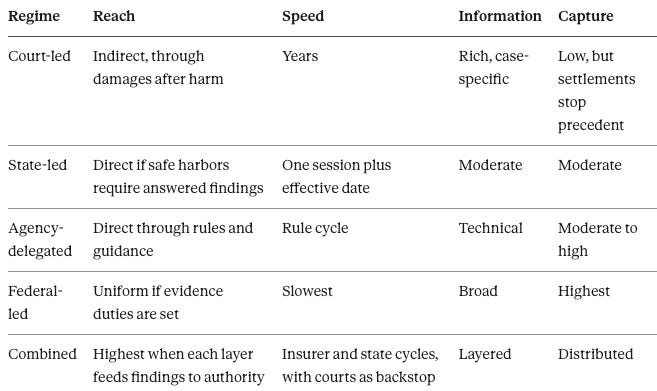
The assessments in the table are MindCast’s analytical judgments for a single deployment pathway, not Simulation Predictions. The twelve-CDT run tested the three arenas named in the Simulation Predictions section: Congress, the Washington Legislature and the courts. A commissioned run extends the table with simulated responses for the client’s own deployment.
A separate analysis of deployer, insurer and enforcer incentives points the same way. Rules that reward answered findings produced correction more often, under the costs examined, than rules that reward filed tests or remove remedies. The result illustrates the capture question and is not a Simulation Prediction.
🏛️ Policymakers: Run the four questions before drafting, because a rule that fails on reach cannot be rescued by speed.
Takeaway: The Institutional Correction Test asks which arrangement produces earlier correction and which merely relocates responsibility.
X Five Explanations Compete for Who Will Set the Agent Standard
Five readings compete for how the agent standard will be set. Each has its own falsifier, and the Simulation Predictions test them.
Hypothesis A · Court-led: Courts set the standard through negligence and product cases, and legislatures defer. Falsifier: two or more additional states enact agent-specific defenses, safe harbors or reassessment duties by 2028.
Hypothesis B · State-led: State legislatures write comprehensive agent statutes that displace common-law development. Falsifier: state statutes remain confined to defenses, safe harbors and disclosure.
Hypothesis C · Agency-delegated: Legislatures set general duties and agencies write the operative technical requirements. Falsifier: no state delegates agent testing or reassessment standards to an agency by 2028.
Hypothesis D · Federal-led: Congress or federal courts displace state deployment rules or tort remedies by 2028. Falsifier: no such displacement by 2028.
Hypothesis E · Combined: Courts apply existing law, states set defenses and safe harbors, agencies update technical terms and insurers enforce conditions first. Falsifier: one institution displaces another’s role by 2028.
The forecast rests on Hypothesis E, with Hypothesis C as its most likely extension. Hypothesis D is the main threat, and the FRONTIER Act’s savings clauses make that threat narrow on their face.
📊 Investors: A combined arrangement means no single rule change resets exposure; the state footprint does.
Takeaway: The evidence favors a combined arrangement, and the forecasts test whether any institution breaks out of its role.
XI MindCast Simulation Predictions
Holmes defined law in “The Path of the Law” (1897) as “the prophecies of what the courts will do in fact.” The Simulation Predictions below apply that definition to the institutions that set the agent standard.
The simulation plays twelve Cognitive Digital Twins (CDTs) against each other in three arenas: Congress, the Washington Legislature and the courts. Game theory supplies the payoff structure through sequential veto chains, lobbying games and a resolve-or-appeal game between repeat-player defendants and plaintiffs. Behavioral economics supplies the decision rules: bounded rationality in each choice, a reference point that favors inaction and salience shocks after vivid harms. Predictive behavior emerges from the combination.
The forecast set holds five Simulation Predictions: three Primary Simulation Predictions (P) and two Secondary Simulation Predictions (S). S-2 is conditional and prints as P(A given B). Validated outcomes to date: none. No entry in the series has reached its deadline, so the forecast set shows no hit and no miss.
P-1 · Congress enacts a statute expressly preempting state AI deployment rules or state tort remedies for AI harm by December 31, 2028 (1-9%)
Preemption limited to development-stage rules does not count. Mechanism: a moratorium rider on a must-pass bill carries nearly all of the probability, because a standalone broad bill has no Senate path. Falsifier: no such enactment by the deadline.
P-2 · A bill imposing or extending product liability to AI systems is introduced in the Washington Legislature by March 31, 2027 (59-90%)
A bill offering only disclosure duties does not count. Mechanism: the sponsor’s stated priority drives introduction, while agenda crowding from data centers and the budget drives the alternative route. Falsifier: no qualifying bill introduced by the deadline.
P-3 · Congress enacts a statute preempting state frontier-model catastrophic-risk transparency, auditing or incident-reporting laws by December 31, 2028 (3-10%)
The FRONTIER Act counts. A broader statute or moratorium counts only if its text reaches those subjects. Mechanism: committee reluctance and presidential ambivalence toward audits form the binding vetoes, and the simulation roughly doubles the bill’s chance under a Democratic House. Falsifier: no such enactment by the deadline.
S-1 · A state or federal appellate court issues a reasoned ruling on foreseeability or superseding cause for AI output or agent action by December 31, 2029 (9-15%)
Unpublished orders without reasons do not count. Mechanism: settlement after adverse trial rulings narrows appellate access. Falsifier: no such appellate ruling by the deadline.
S-2 · Given P-2, a bill imposing or extending product liability to AI systems passes the Washington Legislature in the 2027 regular session and becomes law with or without a signature by the gubernatorial action deadline (3-23% given P-2)
No P-2 bill leaves the entry unresolved. Mechanism: industry opposition dominates bargaining, and leadership holds bills that lack stakeholder agreement. Falsifier: no qualifying bill passes during the 2027 regular session, or no qualifying bill becomes law by the applicable gubernatorial action deadline.
P-2 measures legislative activity. The other four entries measure institutional performance. Introduction shows that an institution is moving, and only enactment or a ruling shows that it has acted.
Three questions remain open hypotheses without bands. The first is whether Washington’s introduced text conditions a liability shield or sandbox on documented risk testing. The second is whether a second state pairs an autonomy-defense bar with a testing safe harbor by 2028. The third is whether a federal court enjoins a state AI statute by 2028, since the only live challenge awaits a motion deferred until Colorado completes its rules.
Takeaway: The forecasts expect Washington to move but not to enact in 2027, Congress to leave deployment and tort law alone and appellate courts to stay silent through 2029.
XII Risk Mitigation Layer
Each entry below states exposure in a unit the stakeholder controls, with severity and probability stated separately. Actions are unilateral, and each names an owner and a deadline tied to the forecast checkpoints.
Multistate deployers · P-1 (1-9%): Severity: high. Exposure: compliance built for a federal rule that does not arrive, measured in states whose defenses and safe harbors the deployment ignores.
Action 1: map each agent deployment to the states where its users sit and the defenses and safe harbors each recognizes. Owner: AI governance counsel. Deadline: June 30, 2027.
Action 2: adopt a reassessment trigger for each material permission change and risk signal. Owner: head of AI platform. Deadline: the next production release.
Residual: states that enact conflicting rules after the mapping require a second pass.
Washington legislators and staff · P-2 (59-90%), S-2 (3-23% given P-2): Severity: moderate. Exposure: a liability bill that adds a shield conditioned on documented testing alone rewards files rather than fixes, measured in sessions before amendment.
Action 1: if the bill includes a shield, condition it on findings that reached someone with authority to gate the agent and produced a response. Owner: bill sponsor and committee counsel. Deadline: before policy-committee action in the 2027 session.
Action 2: include a reassessment duty tied to material permission changes and delegate its technical definition to the Washington Department of Commerce. Owner: committee counsel. Deadline: same session.
Residual: delegated rules take time to adopt and may face challenge.
Federal policymakers · P-3 (3-10%): Severity: moderate. Exposure: a frontier preemption statute that courts read to reach development-based tort claims, measured in remedies removed without replacement.
Action 1: state expressly whether common-law tort claims fall within the savings clause for generally applicable law. Owner: committee staff. Deadline: before markup of the reintroduced bill in the 120th Congress.
Action 2: pair any preemption with a federal evidence duty that replaces what it displaces. Owner: committee staff. Deadline: same.
Residual: courts may read preemption more broadly than the text.
General counsel · S-1 (9-15%): Severity: high. Exposure: application of existing law resolved only at trial level for years, measured in matters litigated without binding appellate guidance.
Action 1: update internal harm-pathway inventories after each trial-level ruling in forums where the company deploys agents. Owner: litigation counsel. Deadline: each ruling.
Action 2: build the appellate record on the type-of-harm question in any case the company litigates. Owner: litigation counsel. Deadline: at trial.
Residual: inconsistent trial rulings across forums persist until an appellate court speaks.
Insurers and underwriters · P-2 (59-90%), S-2 (3-23% given P-2): Severity: moderate. Exposure: coverage terms written against rules that change mid-term, measured in renewal cycles before the policy and the governing duty align.
Action 1: tie any AI coverage condition to a material-change trigger rather than to a named statute or test. Owner: product underwriting lead. Deadline: the next policy form filing.
Action 2: require the insured to name the person who receives evaluation findings and can halt the agent. Owner: underwriting counsel. Deadline: same form.
Residual: risks no carrier will write stay with the deployer or the consumer regardless of policy terms.
Investors · P-1 (1-9%): Severity: moderate. Exposure: portfolio companies valued as if a federal rule will govern, measured in states of operation without a liability model.
Action 1: require a state-by-state liability map and a reassessment discipline in diligence for AI deployers. Owner: the investment committee. Deadline: the next new investment.
Action 2: treat safe-harbor eligibility as a governance indicator. Owner: the stewardship lead. Deadline: before the 2027 proxy season.
Residual: state rules can change faster than portfolio reviews.
Each action moves the standard onto the deployment clock.
Takeaway: Mitigation means building for the strictest state in the footprint and reassessing on the release calendar.
Conclusion
Several institutions already shape the agent duty, and existing law already governs agent harms. The uncertainty lies in how courts will apply that law and whether legislatures will add duties that move findings to people who can act. Washington’s 2027 session will show whether a state can do so without rewarding paperwork.
Timing decides the outcome. A reassessment duty tied to material changes puts the standard on the deployment clock, and a combined arrangement applies it soonest.
The series now runs from measurement to institutions. Installments I through III showed what happens when an institution knows and defers. Installment IV set what a deployer should foresee, and Installment V asks which arrangement turns that expectation into correction.
What to Watch
The first fork falls on November 3, 2026, when the midterm elections set which party chairs Energy and Commerce. Washington bills can be pre-filed from December 2026, and the FRONTIER Act lapses on January 3, 2027. Three Washington checkpoints follow: March 31, 2027 for introduction and April 25 for adjournment, then the gubernatorial action deadline for late-session bills in mid-May. The final checkpoints fall on December 31 of 2028 and 2029.
Each signal maps to an entry. Washington introduction resolves P-2 and activates S-2, which then resolves at adjournment without passage or when a passed bill becomes law or fails by the action deadline. Enactment of frontier preemption resolves P-3, any enacted displacement of deployment rules or tort remedies resolves P-1 and the first appellate ruling on AI foreseeability resolves S-1.
Working With MindCast
Published analysis can compare institutions in general. Published analysis cannot tell a specific deployer, legislator or insurer which arrangement would correct a given deployment’s harm pathways soonest. The series introduction sets out where the answers sit: deployment footprints, testing files, approval chains and the rules each deployment meets.
MindCast builds Cognitive Digital Twins (CDTs) of the institutions that govern a client’s deployments, from legislatures and courts to agencies and insurers. The engagement simulates competing provisions and institutional responses against the same deployment and harm pathways. Each regime is measured on its incentives to investigate, disclose and correct, and on how it insures and compensates.
For deployers and counsel, the output shows which regime would reach their deployment first and what reassessment discipline satisfies all of them. For legislative staff, the output tests a draft safe harbor or reassessment duty against the same deployment before markup, showing whether it produces correction or only relocates responsibility. Insurers can commission the same model to see which public rules their coverage conditions should track.
Commissioned work delivers three outputs. The first is a regime comparison for the client’s deployment. The second is a set of scenarios for federal preemption with and without tort coverage, and the third is a set of monitoring thresholds keyed to P-1, P-2 and S-2.
MindCast offers a complimentary pilot built from public filings and backtested on a known case before any retainer. No engagement proceeds without a named decision to resolve. Contact mcai@mindcast-ai.com or visit www.mindcast-ai-simulation.com to schedule the diagnostic session.
Sources
MindCast Works
Agentic Foreseeability and the Modern Duty of Care for AI Agents. Sets the standard of foresight whose institutional authorship the present paper tests.
Foresight-to-Duty Conversion in AI Governance, Series Introduction. Sets the series question and the commissioning offer.
Consent Order Remedies at Meta, Boeing, Starling and Wells Fargo — Verified Correction Versus Recurrence. Shows why testing-only safe harbors produce documentation rather than correction.
The Duty to Foresee: AI Deployment Readiness as Prospective Governance, and the Arrival of Agentic Duty of Care. Supplies the Agentic Hand Formula behind the foresight standard.
Primary Sources
California Civil Code section 1714.46 (AB 316, Chapter 672, Statutes of 2025). Bars the autonomy defense.
Wyeth v. Levine, 555 U.S. 555 (2009). Tort suits as a source of hazard information alongside federal regulation.
Pokora v. Wabash Railway Co., 292 U.S. 98 (1934). Standards of prudent conduct drawn from the facts of life.
Baltimore & Ohio Railroad Co. v. Goodman, 275 U.S. 66 (1927). Holmes’s fixed rule of care.
Obernolte, Trahan Introduce Bipartisan FRONTIER Act to Strengthen Oversight, Office of Rep. Jay Obernolte (July 23, 2026). Official introduction of H.R. 9925.
FRONTIER Act Section-by-Section, Office of Rep. Jay Obernolte (2026). Describes the Section 9 preemption and savings clauses and the Section 8 stop authority.
Washington State AI Task Force Releases Final Report, Washington Attorney General’s Office (July 1, 2026). Official release of the Task Force report.
Secondary Sources
Neil K. Komesar, Imperfect Alternatives: Choosing Institutions in Law, Economics, and Public Policy (University of Chicago Press, 1994). Supplies the comparative institutional method.
Guido Calabresi, A Common Law for the Age of Statutes (Harvard University Press, 1982). Explains why courts adapt aging statutes.
Oliver Wendell Holmes Jr., The Path of the Law, 10 Harvard Law Review 457 (1897). Defines law as prediction of what courts will do.
Suzanne Smalley, Key Lawmaker Suggests Action on AI Safety Legislation Will Wait Until 2027, The Record (September 16, 2026). Reports the chairman’s position on the FRONTIER Act.
Washington State Leaders Weigh State AI Guardrails as Congress Remains Stuck, The Seattle Times via The Chronicle (October 15, 2026). Reports Rep. Shavers’s 2027 priorities and leadership’s caution.
Senate Votes 99-1 to Remove AI Moratorium, Reason (2025). Reports the July 2025 vote.
President Trump Signs Executive Order Challenging State AI Laws, Paul Hastings (2025). Describes Executive Order 14365.
Colorado AI Law in Flux: Comprehensive Replacement Bill Signed, JD Supra (2026). Reports Colorado’s replacement statute and its rulemaking mandate.
DOJ Joins xAI in Lawsuit Challenging Colorado AI Act, Jenner & Block (2026). Reports the deferred injunction motion.
Washington State AI Task Force Final Report: Status of 11 Policy Recommendations, PIA Western Alliance (2026). Reports the August Shavers draft.
U.S. AI Law: 2026 Midyear State Update, Privacy World (2026). Reports the 2026 chatbot-law wave.
TRAIGA: Key Provisions of Texas’ New Artificial Intelligence Governance Act, Greenberg Traurig (2025). Describes Texas’s testing defense within its statute.
California Court Decision on AI Products Liability Litigation, National Law Review (2026). Describes the coordinated ChatGPT cases.
Don Jergler, Insurer Interest in AI Coverage Exclusions Growing as Risk Becomes Omnipresent, Insurance Journal (2026). Reports the generative AI exclusions.