
Compass, Inc. · Compass International Holdings · Anywhere Real Estate · Northwest Multiple Listing Service · California Regional Multiple Listing Service · Arizona Regional Multiple Listing Service · BridgeMLS · Canopy MLS · REcolorado · Hive MLS · Doorify MLS · MRED · Realtracs · The MLS/CLAW · Bright MLS · Council of Multiple Listing Services · National Association of Realtors · Southern District of New York
Companion work. Compass Invoked Its Washington Lawsuit Against Six MLSs, They Answered Together in New York.(October 22, 2026) reports the six-MLS filing and forecasts the responses to it: Compass’s forum choice and coalition durability and additional joiners and the partner-rule question. This present paper derives the economics those forecasts rest on: why national scale moved local boards one at a time and why one pleading reversed that sequence, and the comparison each board runs between joint defense and its alternatives. It carries the main paper’s P-2, P-3 and S-2 forward and adds four entries on financing, enforcement and offers that the main paper left unforecast. The main paper supplies the filing and the forecast slate; the companion supplies the mechanism and each board’s decision rule.
Related works. Mandatory MLS Submission Is the Rule NAR, Washington, and the NWMLS Settlement All Left Standing, and Compass v. CRMLS Is the Suit That Tests It (October 17, 2026) supplies the legal status of the submission rule. The Compass–NWMLS Settlement Changed the Private Governor After Washington Changed the Governing Law(September 1, 2026) supplies the First Look terms used here as the measure of what a seller-rights bargain contains.
Thesis. National brokerage scale changes a local cooperative’s bargaining position through sequence, not through size. Compass gains when it negotiates with one board at a time and loses that gain when boards negotiate together or finance a defense together. Partnerships and litigation grow at the same time because a partnership trades distribution rights the cooperative can grant under its rules, and the litigation seeks a withholding right the cooperative cannot grant without changing what it produces.
Why now. Four listing services took Compass inventory and subsidies between April and May 2026, seven listing services are litigating against Compass’s demand, and an industry fund with roughly $1 million in reported commitments is not yet accepting contributions as of October 23. Readers who treat the counts as a tally misread them. Boards deciding on a Compass offer and investors valuing Compass’s campaign need the rights each count concerns and the alternatives each board holds.
I. Executive Summary
Compass’s commercial expansion and listing-service resistance to its rule demands grow together, and the pattern is not a contradiction. A partnership gives Compass a distribution channel and subsidized agent memberships under the cooperative’s existing rules. The litigation seeks a different right: freedom to market a listing publicly while withholding it from the cooperative’s members, which is the right six listing services sued on October 21, 2026 to deny.
A board can grant the first right under its rules. None of the four partnership announcements reports a grant of the second, and the partners’ operative submission rules remain unverified.
National brokerage scale changes a local cooperative’s bargaining position through sequence rather than size. Compass reuses one legal theory and one letter across targets, and each cooperative that answers alone bears its own defense cost in full. Six boards filing one complaint in October 2026 placed the demand before one court in one proceeding, and reusable defense work became a potential cost advantage for the boards as well.
A board’s choice rests on a comparison rather than a tally. A board continues joint defense when its expected net value exceeds the best feasible alternative: defending alone, accepting a Compass offer conditioned on leaving, or amending its tier. Three quantities enter the comparison: the value of Compass’s distribution offer and its conditions, the cost selective withholding imposes on the database, and the resources available to defend the rule. An industry fund with roughly $1 million in reported commitments is the first documented shared financing beyond the pleading itself, and it changes the third quantity without changing any board’s preference about Compass.
Resistance reaches Compass’s economics through two separate channels. Litigation expense is a cost Compass has elected to pay in three dockets and a fine program. Damage to the expansion strategy would require resistance to reach the benefits Compass already captures under existing rules, and no evidence at cutoff shows it has. Ranking individual boards by dependence on Compass and explaining why particular boards chose differently remain outside what the evidence supports.
MindCast AI applies Predictive Behavioral Economics + Dynamic Game Theory through MindCast AI Proprietary Cognitive Digital Twin Foresight Simulations (MP CDT FS). Behavioral Economics supplies the decision rules. Game Theory supplies the payoff structure. Predictive simulations emerge from the combination.
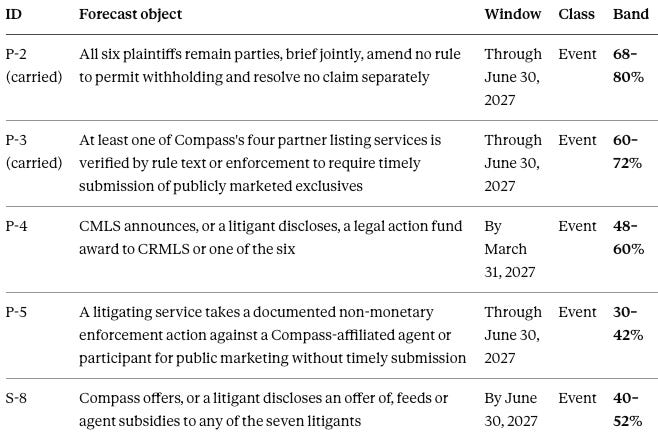
The companion carries three MindCast Foresight Simulation Predictions from the six-MLS paper and issues four of its own, seven in all: four Primary (P) and three Secondary (S), numbered to continue the series’ prediction set. MindCast testified on the private-listing mechanism before the Washington State legislature in January 2026 and made an amicus submission in Compass v. NWMLS.
Simulation Prediction Highlights
📊 Investors. Value the distribution channel and the withholding benefit as separate line items; the first runs on existing rules and the second has no documented instance in any partnership announcement or docket. Litigation spend is a disclosed-cost question for the Q3 10-Q; strategy damage is a question no filing has yet answered.
💼 Executives. Partnership growth evidences distribution and recruitment and says nothing about the withholding right. Net recruitment at the legacy Anywhere brands, phased-listing transaction capture and partner renewals are the disclosures that would show the campaign paying, and none is public at cutoff.
🗂 MLS Leaders. A Compass partnership offer and a Compass rule demand are separate negotiations with separate terms; the six terms in Section III.D decide whether an offer improves the cooperative or weakens reciprocal access, and the comparison in Section III.E decides whether to continue a joint defense.
⚖️ Counsel. The fine-reimbursement program weakens the cooperative’s monetary deterrent against Compass agents without removing its enforcement authority. P-5 carries whether any litigant uses what remains, and each use supplies Compass a pleadable injury.
🏛️ Policymakers. The right Compass seeks through litigation is the right a broker-conduct statute on showing access and buyer representation regulates directly. The seller-welfare evidence is contested in both directions, which leaves incidence on non-Compass members as the established fact.
Section II states the three tracks and the governing question. Section III derives the economics in five parts: the scale asymmetry on both sides of the table; the cooperative’s production function and the fine program; Compass’s three benefits and the channels through which resistance reaches them; rights as the unit of bargaining, the ceiling NAR policy sets, and where pressure moves next; the comparison that decides continuation and the cost of dividing a coalition. Section IV carries the Simulation Predictions; Section V states strategy and risk mitigation by audience; Section VI connects the economics to coalition growth and the early-2027 interaction with state legislation and shareholder consequences, followed by monitoring and the conclusion.
II. Three Tracks Advance at Once Because They Trade Different Rights
Compass’s campaign against mandatory submission now runs on two tracks that the trade press reports as one story. The commercial track added MRED and Realtracs and The MLS/CLAW and Bright MLS as partners between April 24 and May 13 of 2026. Each partner carries Compass’s inventory and subsidizes Compass agent memberships.
The litigation track holds three federal dockets in which seven listing services defend their submission rules and Compass attacks one of them. A third track opened in mid-October: the Council of Multiple Listing Services (CMLS) announced a legal action fund to its member services.
The governing question is how national brokerage scale changes the bargaining position of a locally governed cooperative, and which rights each side can trade. The target system is the set of listing services that have received a Compass demand or a Compass partnership offer. The horizon runs through June 30, 2027. Four subjects lie outside scope: merits outcomes in any docket; the Anywhere merger’s accounting; state legislative sequencing; the selection question of why particular boards chose differently.
Behavioral Economics supplies three decision rules that narrative accounts underweight. A board’s reference point is a complete database, so a withheld listing counts as a loss to every member rather than as a neutral absence. Fines are salient to agents in a way that database completeness is not, which is why a program that reimburses fines can change agent behavior without changing any rule. Compass’s declared objective is seller choice, and its revealed objective in Washington was seller control over showings and offers inside a window, which is the term the plaintiffs have not offered.
Dynamic Game Theory supplies the payoff structure and the equilibrium selection. One-at-a-time bargaining is a sequential game in which Compass moves first against each board with a threat whose cost it has already paid. Joint filing moves six boards’ responses into one proceeding, so Compass addresses them together rather than in sequence. Partnership offers function as side payments that test whether a board values collective defense above individual terms, and Compass’s selective targeting of the narrowest-tier plaintiffs is the counter-move the structure predicts.
The simulation instantiated thirteen Cognitive Digital Twins (CDTs) and one aggregated unit: Compass; the six plaintiff boards; CRMLS as litigant and fund organizer; CMLS as financing intermediary; MRED as documented partner; Realtracs, The MLS/CLAW and Bright MLS as comparison units; and Compass-affiliated agents at company-owned brokerages as the fine-exposed unit. The companion forecasts no procedural event, so no court CDT was needed. The simulation held the six-MLS paper’s scenario routes fixed and issued four entries on the companion’s own observables.
The three tracks advance together because each trades a different right, and the sections that follow derive the economics of each trade before the Simulation Predictions test them.
📊 Investors. Three tracks mean three cost lines: subsidies on the commercial track, legal spend on the litigation track, and a financed opponent on the third. 🗂 MLS Leaders. A board sits on one or two of the three tracks by its own choice, and the choice on each is separate.
III. National Scale Meets Local Cooperatives on Rights, Not Size
Five mechanisms carry the argument, and each occupies one subsection. Sequence rather than size gave Compass its early advantage; the cooperative produces completeness and charges reciprocity; Compass captures two benefits under existing rules and litigates for a third; rights rather than days are the unit of bargaining; joint defense is a comparison each board makes, and dividing it costs Compass too.
III.A The Scale Asymmetry Works Through Sequence, and It Runs on One Side Only
A national brokerage and a local cooperative differ in size, and size alone does not explain Compass’s early advantage. Compass closed the Anywhere merger in January 2026 with roughly 83,000 brokerage agents and a franchise network above 126,000 (complaint ¶56). The six plaintiffs range from about 3,500 subscribers at BridgeMLS to about 36,500 at ARMLS (¶¶10–15). Compass’s share of any one cooperative’s listings is nonetheless local and varies by market, and MRED is the only service where a source documents Compass as the largest customer.
Sequence converted size into leverage. Compass wrote one legal theory and one demand letter in Washington, then sent near-identical letters to six boards (¶7). Each additional letter reused that work, while each board answering alone faced the cost of its own antitrust defense. NWMLS paid that cost for sixteen months and ended with an agreement that kept its rule.
The asymmetry runs on reuse: Compass’s work carried across targets while each board’s work did not. The six-MLS filing gave the boards reusable work of their own by pooling one pleading and placing all six before one court. Compass now faces six boards through one proceeding, and whether the pooled work lowers any board’s spending below a solo defense is unmeasured.
The coalition runs on one side of the table. Six listing services filed jointly; CRMLS litigates separately. The trade group forming a fund counts 236 member services with more than 1.7 million subscribers. No second national brokerage has joined Compass’s suit or matched its fine program or publicly endorsed its demand.
Compass’s own network is divided by the program’s terms. The October 16 release covers agents at company-owned brokerages (Coldwell Banker Realty and Compass and Sotheby’s International Realty) and does not cover the franchise network. Franchise members belong to the cooperatives Compass is suing and in some territories sit on their boards. The brokerage-side coalition has one member, and no source documents a second.
The plaintiffs’ countermove attacked sequence, not size, and Compass’s scale is not matched by scale on its own side of the dispute.
📊 Investors. Compass is the only national brokerage paying for this campaign; a second brokerage joining would be the first sign the cost is shared. 🗂 MLS Leaders. Franchise-network members of the board’s own cooperative are the constituency Compass’s program excludes.
III.B The Cooperative Produces Completeness and Charges Reciprocity
A listing service produces one good: a database that every member can rely on to contain every publicly marketed property in its territory. Completeness is the value, because a buyer broker who must search three places to find every available home serves the buyer worse than one who searches one. The complaint pleads the mechanism at ¶3: any publicly marketed property must enter the service so it reaches every member.
Reciprocity is the cost of entry. A brokerage receives every other member’s listings because it contributes its own, and the bargain holds because no member can take the database without feeding it. Selective withholding by a large participant breaks the bargain in one direction: the participant keeps access to everyone else’s inventory while removing its own from theirs (¶¶4 and 52 and 76 and 80). The complaint calls the behavior free riding, and the economic term is accurate.
Withholding is a tax on every other member, and the tax falls hardest on members least able to answer it. A one-person brokerage gains access to the same inventory as the largest firm through the cooperative (¶73), and loses the most when the largest firm removes its inventory. Buyer brokers compete on skill and cost rather than on holding a particular listing (¶77), and a withheld listing converts that competition into a question of which firm the buyer signed with. Boards therefore treat withholding as a loss to the membership rather than as a neutral product choice, which is the reference point that explains their resistance.
Enforcement is the cooperative’s instrument, and fines are its monetary form. A fine on an agent who markets off-service is the cooperative’s way of charging for the tax. Compass’s October 16 program pays CRMLS fines for agents at its company-owned brokerages who market outside CRMLS at a client’s written direction. The fines can reach $2,500 per instance, and the agent must assign the claim against CRMLS to Compass.
The program shifts the charge from the agent to Compass and weakens the fine’s deterrent effect on covered agents, and it does not remove enforcement. Compass’s own release acknowledges that agents may face suspension or expulsion under CRMLS rules and does not say the program covers either, and the plaintiffs plead penalty policies of their own (¶55). The cooperative keeps its enforcement authority and whatever non-monetary remedies its rules provide. S-2 tests whether the program reaches a plaintiff territory, and P-5 tests whether any litigant uses the authority the program leaves in place.
The cooperative’s product is completeness, its charge is reciprocity, and its instrument is enforcement in two forms. Compass’s program weakens the monetary form for its own agents and leaves the other in place.
⚖️ Counsel. Non-monetary enforcement against a covered agent during the litigation hands Compass an injury to plead, which keeps P-5 below even odds. 🗂 MLS Leaders. The instrument that remains is the one to document now, before the program arrives.
III.C Compass Captures Two Benefits Under Existing Rules and Litigates for a Third
Compass’s statements describe three benefits from phased marketing. Broader distribution of its inventory is the first. Recruitment and retention of agents who want a phased-marketing option is the second. Capture of the buyer side of transactions on listings held outside the cooperative is the third.
The first two benefits can coexist with mandatory submission. Distribution requires a feed into the cooperative and visibility to its members, which is what the four partners granted. Recruitment requires a phased-marketing tier that agents can offer sellers, and every plaintiff already provides one (¶¶44–50). ARMLS and BridgeMLS and Hive offer thirty days; Canopy offers twenty-one; Doorify offers fourteen; REcolorado offers seven.
Compass’s subsidies for the first 100,000 agents at each partner buy membership and feeds, and nothing in the four announcements reports a change to any partner’s submission rule. Other contractual rights in those arrangements (access tiers, distribution terms, enforcement carve-outs) could each require a rule change of their own. Each is tested separately. P-3 tests one proposition: whether any partner’s operative rule requires timely submission.
Withholding from members can strengthen buyer-side capture, and earlier attention and showing access and representation arrangements can preserve part of the advantage after submission. The advantage is largest where a buyer cannot find the listing through another member. Mandatory submission with member visibility narrows the advantage without eliminating it, and no partnership announcement reports an exception to submission. The partners’ operative rules are unverified, the litigation seeks the exception, and no docket has yet produced it.
Resistance reaches Compass’s economics through six channels, sorted here into cost and strategy. Legal spending in three dockets and fine reimbursement with no disclosed cap and subsidies for up to 100,000 agents per partner with no disclosed amount are costs Compass has elected to pay. Management attention is a cost no filing measures. Each is litigation expense, and none shows damage to the strategy.
Strategy damage would appear in three places and has not. Inventory access is unchanged, because every partner carries Compass inventory and every plaintiff accepts it on submission. Recruitment and retention would show damage if agents at the legacy Anywhere brands left over the campaign, and no attrition figure is public. Transaction capture on phased listings would show damage if the third benefit were the one Compass’s return depends on, which What the Private-Listing Economics Add to Magloire v. Compass, the Securities Act Case Already Pending Over the Anywhere Merger(October 17, 2026) advanced as a hypothesis and no filing has confirmed.
Evidence that the strategy works despite resistance would be specific. Net recruitment at Coldwell Banker Realty and Sotheby’s International Realty after the merger; disclosed transaction capture on phased listings; partnership renewals at the four partners when subsidy terms end; no transparency statute passing in 2027 outside Washington; a resolution in any docket on terms Compass can afford. Litigation volume measures none of these and counts as cost until one of the five appears.
📊 Investors. Partnership growth evidences the first two benefits and says nothing about the third; a model that values the campaign as one line item treats four partnerships as progress toward a withholding right their announcements do not report. 💼 Compass executives. The five contrary signals above are the ones that would show the campaign paying; none is public at cutoff.
III.D Rights Are the Unit of Bargaining, and Realtor Association Policy Sets the Ceiling
Every negotiation between Compass and a listing service concerns six rights: submission; member visibility; public advertising; portal distribution; seller control of showings; seller control of offers. Duration of any window is a seventh term that means nothing without the six. A thirty-day tier that leaves showing control undocumented offers a seller less than a twenty-one-day tier that assigns it to her.
The Compass–NWMLS agreement is the proof. First Look kept submission and member visibility and permitted public advertising. It let the seller opt out of portal distribution and gave the seller control over showings and offers for up to twenty-one days. Compass called the result “fully realized,” having accepted every right the cooperative needed to keep producing completeness and obtained the seller-control rights that the plaintiff tiers leave undocumented.
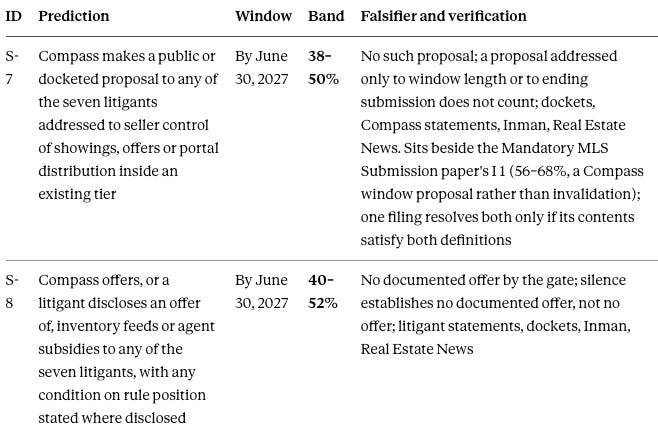
The plaintiffs plead windows and submission, and the six-MLS paper’s marketing-rights table shows that no plaintiff tier documents seller-controlled showings or offers. Compass’s demand letters asked for the end of submission, which is the one right whose surrender changes what the cooperative produces. A Compass proposal addressed to showing and offer control inside an existing tier would ask for rights the cooperative can grant, and no such proposal is documented outside Washington. S-7 tests whether one appears.
The middle ground between Compass and the cooperatives already has a published ceiling. The National Association of Realtors (NAR) adopted Multiple Listing Options for Sellers on March 25, 2025 with implementation by September 30, 2025. The policy permits delayed-marketing exempt listings that stay visible to MLS participants while IDX and syndication are held for a period each MLS sets. It keeps Clear Cooperation’s one-business-day filing requirement and leaves local mandatory submission deadlines in place.
Every plaintiff tier sits inside that ceiling, so the concession Compass seeks is one NAR policy would have to change, and NAR moves from bystander to constraint for every NAR-affiliated board. REcolorado, which pleads no NAR affiliation (¶39), is the control case: it holds the narrowest tier of the six without NAR’s policy requiring it.
When one route closes, pressure moves to the next contested right. Seven boards plead submission as fixed. The contest therefore moves to showings and offers and portal distribution inside the window, and to the portal layer beneath the cooperative.
Zillow’s listing standards and the Zillow v. MRED litigation are private enforcement of visibility that no MLS rule controls, and the complaint pleads a reported $1,000 payment program to remove listings from third-party sites (¶25). Portal display is the one right whose enforcement already sits outside the cooperative, which places the next contest there rather than at another complaint over submission.
The seller-welfare evidence does not decide the dispute. Compass’s own 2024 data show pre-marketed listings sold for 1.9% to 3.9% more. Zillow’s two-year study shows pocket listings sold for $4,975 less on average. Bright MLS found no effect on closing price and 37 more days to sell for office exclusives.
A University of Georgia working paper found a pre-2020 premium that disappeared after Clear Cooperation (RISMedia, April 21, 2026). The contested question is the seller’s return. The established question is incidence: whatever the seller gains or loses, the withholding tax falls on members who did not choose it.
A board evaluating a Compass partnership controls six terms that map onto the six rights. Inventory completeness asks whether the feed carries every Compass listing or only permission-cleared ones. Timeliness asks whether listings enter within the board’s one-business-day rule or on Compass’s phased schedule. Member access and seller permissions and subsidy terms and retained enforcement authority complete the list, and each term separates an arrangement that improves the cooperative from one that weakens reciprocal access.
🗂 MLS Leaders. The six terms are the board’s checklist, and NAR’s policy is the ceiling any NAR-affiliated board can concede within. 🏛️ Policymakers. Showing access and buyer representation are the rights a conduct statute regulates, and they are the rights the contest moves to when submission holds.
III.E Joint Defense Is a Comparison, and Dividing It Has a Cost Too
Countervailing organization among independent boards follows the cost function MindCast derived for state enforcement coalitions. The derivation appears in How State Attorney General Coalitions Form, Grow, and Hold (September 5, 2026) and supplies the lead and bridge and joiner roles and the join-cost condition.
A lead absorbs the fixed cost of legal theory and evidence. Each additional board joins when its share of the pooled cost falls below its expected loss from facing the demand alone. Compass’s identical letters to one deadline supplied the common threat, and one law firm drafting one pleading supplied the pooled fixed cost.
Shared financing beyond the pleading is now documented, and it passes through four stages. CMLS announced a legal action fund on its website in mid-October, and The Real Deal reported on October 22 that contributors were finalizing commitments above $1 million with grant applications expected within weeks; RISMedia reported on October 23 that CMLS confirmed commitments nearing $1 million and had not yet begun formally accepting contributions. Proposed contributions and available grants and awards and disbursements are distinct stages, and the fund stands at the first.
CMLS states that the fund serves matters of significance to the industry rather than one organization and that contributors will not influence case selection or receive preferential access. The fund’s effect on any board’s decision follows documented availability and eligibility and timing and conditions. A credible accessible commitment can enter a board’s expected defense cost before an award arrives.
Financing changes what a board can afford without changing what it prefers. A board that would have accommodated Compass because it could not fund a defense may now defend; a board that prefers Compass’s terms will take them whatever the fund offers. Observed accommodation therefore cannot by itself distinguish commercial preference from a binding budget constraint, and P-4 tests only whether financing is disclosed to a litigant, not whether it caused resistance.
Financing can also support a separate defense. A board may leave the common litigation and keep its submission rule through its own case or its own counsel, so the number of services defending submission and the number litigating together can move in different directions. Rule resistance and litigation cohesion are separate measures: P-2 carries cohesion among the six, and no entry carries the count of services defending submission on their own.
A board continues joint defense while its expected net value exceeds the best feasible alternative. The alternatives are defending alone, accepting a Compass offer conditioned on leaving, or amending its tier. The comparison weighs the board’s expected loss from selective withholding and its share of pooled cost against the value of any offer and the cost of a solo defense, and every input is board-specific and non-public for every plaintiff. P-2 tests the aggregate: whether all six hold through the first merits phase.
Dividing a coalition costs less than defeating it only when the side payment is smaller than the litigation it displaces, and the payment has its own cost. A differentiated offer to one board changes that board’s alternatives and tests the other five, which is why Compass’s commercial responses aim at the commitment fork, the point at which any one board can amend its tier or resolve its own case without the other five. The offer also reveals the value of Compass’s own demand: the inventory and subsidies it gives one board to leave are what the other five learn their rule is worth to Compass.
REcolorado and Hive MLS plead the narrowest tiers (¶¶48–49) and carry the selective-suit exposure most directly. S-8 tests whether an offer to any litigant becomes documented, and silence establishes no documented offer rather than no offer.
Coalition entry and coalition durability are separate questions with separate observables. Entry follows the join-cost condition and moves with common triggers: a fund award, a related-case order, a ruling in any docket. Durability follows each board’s comparison and moves with private offers. The six-MLS paper’s S-1 (52–64%) carries entry; P-2 carries durability; neither paper forecasts which board exits first, because the inputs are private.
The comparison also explains why partnership and litigation coexist. A partner that grants Compass feeds and subsidies under its existing rules has not left any coalition, because it never faced the demand the coalition resists. Whether Compass offered any plaintiff feeds or subsidies is undocumented, so no plaintiff is shown to have refused Compass’s inventory. The two groups traded different rights, and the sorting of institutions into groups is the selection question the evidence cannot yet answer.
📊 Investors. P-4 (48–60%) is the first observable on whether the plaintiffs’ defense is financed beyond their own budgets. Usable financing can strengthen a board’s ability to defend submission; its effect on coalition cohesion and Compass’s bargaining costs depends on grant terms and the board’s alternatives. 🗂 MLS Leaders. The board’s own comparison needs four documents no plaintiff has published: inventory share, fee arrangement, adoption history and exit terms.
IV. Simulation Predictions: Financing, Enforcement and Offers Are the Observables
The companion carries three Simulation Predictions from the six-MLS paper’s run of October 22, 2026 and issues four from its own simulation, seven in all. Prediction date and data cutoff for the new entries: October 23, 2026. New entries continue the series numbering so the two papers share one prediction set.
The series’ validated entries to date stand beside the open ones. Two resolved true on Compass’s October 16 complaint: P 2 (77–90%) and S 3 (58–74%) of California Private Listing Law After Washington SSB 6091, Broker Conduct Rules for Listing Visibility, Showing Access and Buyer Representation (October 2, 2026). One resolved as a miss when Compass sued CRMLS in California rather than counterclaiming in New York: S 1 (66–76%) of Compass Runs the Same MLS Playbook Against CRMLS That It Ran Against NWMLS, CRMLS Broke It by Suing First in New York (October 6, 2026).
Synthesis and Scenario Structure
The dominant mechanism is a board’s comparison of joint defense with its best feasible alternative, moved by shared financing and side offers without any change in the board’s preference about Compass. The active regime is the six-MLS paper’s: three parallel federal actions with the partnership channel operating beside them, now with prospective industry financing and a fine program confined to CRMLS territory.
Continuation is conditional rather than fixed. While financing stays prospective and offers stay private, boards hold rules and brief jointly and Compass pays fines where cited and extends terms selectively. Non-monetary enforcement stays in reserve on both sides because its use invites the other’s next claim. A usable grant can move a board toward a separate defense that keeps submission, and a large enough targeted offer can move a board toward accommodation whatever the fund supplies, so no single configuration holds across the inputs the simulation varied.
The companion adopts the six-MLS paper’s four scenario routes unchanged: base 52–62%; secondary 22–30%; tail A 8–14%; tail B 4–8%. Four events would change the regime: a disclosed fund award to a litigant; a documented Compass side offer to a litigant; a documented non-monetary enforcement action against a Compass-affiliated agent; a rights-based Compass proposal.
Carried Primary Entries
P-2 · The coalition holds through the first merits phase (68–80%). All six plaintiffs remain parties to No. 1:26-cv-09253 and file joint substantive briefing through June 30, 2027, with no plaintiff amending its rules to permit public marketing of an exclusive listing without timely submission and no plaintiff resolving its own claims separately. The entry tests Section III.E: whether joint defense remains each board’s best alternative under Compass’s commercial responses.
Falsifier for P-2: a docketed exit or separate resolution by any of the six, or a published amendment permitting withholding; no substantive briefing due by the gate is insufficient evidence. Verification: the Southern District docket and each plaintiff’s published rules.
P-3 · At least one partner is verified as requiring submission (60–72%). At least one of the four partners is verified by operative rule text or an enforcement action to require timely submission of publicly marketed exclusive listings by June 30, 2027. The entry tests Section III.C: whether the partnership channel runs under submission rules.
Falsifier for P-3: verified terms or enforcement showing every one of the four permits withholding; no rule text obtained and no enforcement reported for any of the four is insufficient evidence. Verification: each partner’s published rules; reported citations or hearings.
Primary Simulation Predictions
P-4 · Disclosed industry financing reaches a litigant (48–60%). CMLS announces a legal action fund award to CRMLS or one of the six by March 31, 2027, or that litigant discloses it. The entry establishes disclosed financing and does not establish that financing caused resistance.
Falsifier for P-4: no announced or disclosed award to any of the seven by March 31, 2027 resolves as a miss, including an award that remains private and the case in which applications never open. Inability to access the named verification sources leaves the outcome unresolved. Verification: CMLS releases; litigant statements; the two federal dockets; Inman and Real Estate News.
Mechanism for P-4: the seven litigants are the only matters of significance within the fund’s stated scope at cutoff, so eligibility is likely to reach them once criteria exist. Three frictions bound the band below: governance and antitrust review still in development; the organizer’s stated posture that litigation is a last resort; the disclosure requirement, since an award a litigant receives but does not disclose resolves as a miss.
P-5 · A litigant uses non-monetary enforcement against a Compass-affiliated agent or participant (30–42%). At least one of the seven litigating services takes a documented non-monetary enforcement action against a Compass-affiliated agent or participant for public marketing without timely submission by June 30, 2027. Suspension and expulsion and feed restriction and participant-level sanction each qualify. The entry establishes that non-monetary authority is used and does not establish a deterrent effect on conduct.
Falsifier for P-5: no such action documented at any of the seven by the gate; a published policy change with no action resolves as a miss; an action under pre-existing authority counts. Verification: service notices and member communications; dockets and party statements; Inman and Real Estate News.
Mechanism for P-5: fine reimbursement weakens the monetary deterrent, and both the plaintiffs’ penalty policies (¶55) and Compass’s release acknowledge non-monetary consequences. The band sits below even odds because each litigant is a declaratory plaintiff seeking a ruling that its rules are lawful, and a suspension or expulsion of a Compass agent during that litigation supplies Compass a concrete injury to plead. A ruling upholding the rule, or a repeat offender, is the trigger that releases the instrument.
Secondary Simulation Predictions
S-2 is carried from the six-MLS paper; S-7 and S-8 are new.
S-2 · Compass extends fine reimbursement to a plaintiff territory (58–70%). Compass announces fine reimbursement and claim assignment for agents cited by at least one of the six plaintiffs by December 31, 2026. The entry tests Section III.B: whether Compass weakens a second cooperative’s monetary deterrent.
Falsifier for S-2: no announcement, and published program terms stay limited to CRMLS territory. Verification: Compass releases and three named trade outlets (Inman, HousingWire, Real Estate News).
Questions the Companion Does Not Forecast
Which prior characteristics explain an institution’s commercial arrangement and rule position; which board exits first; Compass’s optimal response; the financial savings from joint litigation; the causal effect of financing on resistance. Each is unforecast because inventory shares and board compositions are documented for MRED alone, no fee term or grant award is public, and private offers stay unobserved until a party discloses one. One contingent watch condition: if P-4 resolves true and the award carries a rule-alignment condition, the financing branch splits into independent-governance funding and harmonized-rule funding, and a new entry issues on the award terms. P-3 remains the most evidence-sensitive carried entry, and P-4 the most procedure-sensitive new one, since a CMLS decision to keep awards confidential would move it to a miss on disclosure alone.
Seven entries test the companion’s economics on observables the parties will produce: a disclosed award; a documented enforcement action; a public proposal; a documented offer; continued joint briefing; a verified partner rule; a program extension. None requires knowledge of any board’s motive.
Working With MindCast
The published derivation stops where a board’s own numbers begin. A board’s Compass-plus-Anywhere inventory share and its fee arrangement with coalition counsel and its adoption history for the submission rule and the rights its tiers assign are the inputs to the comparison in Section III.E, and none is public for most institutions.
MindCast builds an organization-specific Cognitive Digital Twin from those inputs and reruns the two choices, commercial arrangement and rule position, against Compass’s commercial responses and the commitment fork. The same build serves a brokerage weighing a partnership with a listing service against the cost of its agents’ fines, or an investor modeling the distribution channel and the withholding benefit as separate line items.
Commissioned scope adds complete probability distributions and organization-specific calibration and the full scenario tree across the three dockets. It adds decision thresholds keyed to Compass’s response in the six-MLS action and to CMLS’s eligibility terms, and a monitoring dashboard on the signals in the protocol below. The bounded next step is a diagnostic session placing one institution’s six terms against its best feasible alternative. Contact mcai@mindcast-ai.comor visit MindCast Corporate.
V. Each Audience Holds One Decision the Economics Change
Each audience holds one decision the derivation changes. Each entry below states the exposure in a unit the audience controls and the owned actions with deadlines and the exposure that remains. Severity and probability appear as separate axes.
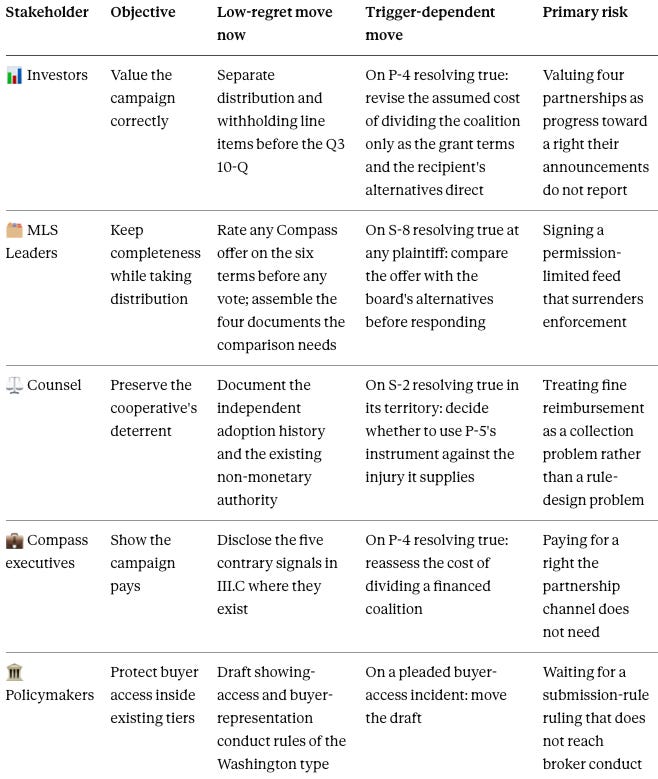
P-2 (68–80%) · 🗂 MLS Leaders. Exposure: a board that has not assembled its inventory share and fee arrangement and adoption history and exit terms faces a differentiated Compass offer with no basis to compare the offer with its alternatives, and faces a selective suit with no independent-adoption file. Severity · Probability: High · Moderate.
Mitigation for P-2: assemble the four documents before Compass’s response in the six-MLS action (board · Compass’s responsive deadline in No. 1:26-cv-09253); rate any Compass offer on the six terms before any vote (board · on receipt); state the board’s exit terms to its members before any offer arrives (board · next regular meeting). Residual: an offer conditioned on separate resolution that the six terms do not reach.
P-3 (60–72%) · 📊 Investors; 🗂 MLS Leaders. Exposure for an investor: a model that values the distribution channel as if it required rule relief overstates the campaign’s dependence on litigation by the channel’s full contribution. Exposure for a board: a partnership taken on MRED’s model without verifying the partner’s rule leaves the board’s own rule position undefined to its members. Severity · Probability: Medium · Moderate.
Mitigation for P-3: treat the four partnerships as rule-neutral until rule text or enforcement says otherwise (analyst · now); obtain the partner’s operative rule text before signing (board · before any vote). Residual: a partner whose rule text is silent and whose enforcement is unobserved.
P-4 (48–60%) · 📊 Investors; 💼 Compass executives. Exposure for an investor: a model that assumes each plaintiff self-finances misses what usable financing does. Financing can strengthen a board’s ability to defend submission, and its effect on coalition cohesion and Compass’s bargaining costs depends on grant terms and the board’s alternatives. Exposure for Compass: a financed board can sustain a defense of submission inside or outside the coalition, so the cost of each commercial response in Section III.E depends on the same two inputs. Severity · Probability: Medium · Moderate.
Mitigation for P-4: model defense financing as a conditional cost reduction with four stages, and move it only on documented availability or award (analyst · on CMLS eligibility notice); read the Q3 10-Q for any change in litigation reserve language (analyst · on filing). Residual: an award kept confidential by CMLS governance, which the model cannot see and the entry treats as a miss.
P-5 (30–42%) · ⚖️ Counsel; 🗂 MLS Leaders. Exposure: a litigant that uses suspension or expulsion against a Compass agent during a declaratory action supplies Compass a pleadable injury; a litigant that never uses it holds a two-tier membership in which covered agents face a smaller penalty than the rest. Severity · Probability: High · Moderate-low.
Mitigation for P-5: document the existing non-monetary authority and its procedural prerequisites now (counsel · before December 31, 2026); decide the board’s enforcement posture against covered agents before the first citation rather than after (board · same); where enforcement is used, confine it to conduct the rule text plainly reaches (counsel · at each action). Residual: a participant-level remedy that invites a new Compass claim and must be designed inside the cooperative’s documented authority.
S-2 (58–70%) · ⚖️ Counsel; 🗂 MLS Leaders. Exposure: a cooperative whose fines Compass reimburses holds a weakened monetary deterrent against covered agents. Severity · Probability: High · Moderate-high.
Mitigation for S-2: publish the enforcement posture to members so the instrument’s reach is known before the program arrives (board · before December 31, 2026); count citations against covered agents separately so the program’s effect on conduct is measurable (staff · monthly). Residual: conduct that shifts to covered agents whom the program protects, which no mitigation inside the cooperative reaches.
S-8 (40–52%) · 🗂 MLS Leaders. Exposure: a board that receives a conditional Compass offer without having stated its alternatives to its members decides under pressure and reveals its reservation terms to the other five. Severity · Probability: Medium · Moderate.
Mitigation for S-8: adopt a board policy that any Compass offer is disclosed to the coalition’s counsel before response (board · now); rate the offer on the six terms and against the alternatives in writing before any vote (board · on receipt). Residual: an offer whose conditions Compass keeps private, which the board can rate but the coalition cannot see.
Each audience’s low-regret move is available now from public documents, and each trigger-dependent move waits on one entry. Placement is a standalone section so the synthesis in Section VI stays separate from mitigation.
VI. Resistance Propagates Through Financing, Legislation and Disclosure, Not Through Headcount
The economics in Section III answer three questions investors and listing-service boards asked when the six-MLS filing landed, and each answer traces to an entry in Section IV or to the six-MLS paper’s set. None of the three adds a banded entry here; the two that need one belong to the next paper in the series.
Coalition growth and strategic geography. Additional joiners come from a defined pool: services that hold a Compass letter and have not filed, services whose rules match the pleaded tiers, and services whose territories carry enough Compass-plus-Anywhere inventory to expect a letter. Two have refused publicly without filing, and Compass has stated an intention to sue one of them, Unlock MLS.
Each candidate’s entry follows the join-cost condition in Section III.E. Three common triggers move several at once rather than one at a time: a disclosed fund award (P-4); a related-case or coordination order in New York (the six-MLS paper’s S-3 at 60–72%); a ruling in any docket. Joining decisions are therefore correlated, and a count forecast conditions on the trigger that fires first.
Number is the wrong measure of coalition weight on its own. MRED carries Compass as its largest customer and matters more to Compass’s distribution than several small boards together. A joiner in a territory where Compass-plus-Anywhere inventory is concentrated raises Compass’s cost more than a joiner where it is thin.
The six-MLS paper’s S-1 (52–64%) carries the first additional joiner by March 31, 2027. A count range and an inventory-weighted candidate pool require the local inventory data no source yet supplies, and the next paper in the series carries them once the data exist.
The early-2027 interaction. Compass’s response in the six-MLS action and the opening of 2027 legislative sessions in the four plaintiff states and New York fall in the same quarter. In the CRMLS action Compass has written to the court seeking a move to California and a conference before a motion to dismiss what it calls an anticipatory action (RISMedia, October 23, 2026). The same letter states that Compass “has not decided whether to file any other cases” and asks several listing services to preserve communications. The six-MLS action awaits Compass’s first response.
A broker-conduct statute changes the value of the rights Compass litigates for, and the direction depends on its text. A statute requiring concurrent public marketing or showing access or buyer-representation disclosure inside any phased tier reduces what a court-won withholding right would be worth in that state. A statute could instead encourage a rights-based bargain or strengthen a cooperative’s enforcement authority or narrow the sanctions it may impose, and enactment alone fixes none of these. Compass could win the submission question and still face conduct rules that reach the third benefit directly, which is the interaction investors model and the reason the policymaker callouts point to conduct rules rather than to the submission rule.
Compass’s reading of Washington has three candidate interpretations, and the companion treats “learned the wrong lesson” as one of them rather than as a finding. Under the first, Compass misread First Look as a template for ending submission when it was a bargain inside submission. Under the second, Compass understands the limit and finds continued pressure commercially worthwhile for the first two benefits, whatever happens to the third. Under the third, Washington’s statute and NWMLS’s member-owned structure limited what could transfer, and Compass is testing whether other states and cooperatives differ.
Compass’s first substantive filing in the six-MLS action will help distinguish the three interpretations; its requested relief and subsequent proposals and responses to legislation will determine which explanation gains support. A rights-based or window proposal (S-7, I 1) adds support to the second; a filing seeking invalidation alone is consistent with the first or the third; a statute passing in a plaintiff state before any ruling tests the third.
Investor and shareholder consequences. Recurring defense costs and operating restrictions connect to the Anywhere merger through the assumptions the merger return rested on, and the connection runs through disclosure rather than through litigation volume. The Magloire paper advanced the hypothesis that the merger’s expected return depended on buyer-side capture, a litigation campaign to keep that channel open, and opposition to state transparency laws. Each new docket is a cost of that campaign; none by itself shows that an earlier representation was inaccurate or that a risk was known and undisclosed.
Evidence that would illuminate earlier knowledge is specific. A Q3 10-Q or fiscal 2026 10-K that adds MLS litigation or fine reimbursement or partnership subsidies as risk factors or cost items after an offering document that did not is the first; internal projections of phased-listing transaction capture produced in any docket are the second; a Compass statement tying the campaign’s return to the third benefit is the third. Investors keep the two questions apart as litigation expense and strategy damage: litigation expense is measured on filing, and a shareholder claim is strengthened only by what the filings and discovery show Compass knew.
Falsifier consequences, stated as observables. If P-2 fails through a docketed exit, the exiting board’s terms become the first public input to the selection question. If P-4 fails, no disclosed financing reached a litigant by the gate; whether undisclosed financing did is unobserved.
If P-5 fails, no litigant documented a non-monetary enforcement action by the gate; the cause is unobserved and the fine program’s effect on conduct is measurable only through citation counts. If P-3 fails through verified waivers at all four partners, the partnership channel includes the withholding right and the companion’s central distinction narrows to the litigating boards.
📊 Investors. Track two counts, services defending submission and services litigating together, because financing can raise the first without raising the second; the 2027 interaction is a model input whose direction each bill’s text sets. 🗂 MLS Leaders. Rule decisions stay independent and litigation stays coordinated; a joiner’s weight is its territory’s Compass inventory, not its headcount. ⚖️ Counsel. Compass’s response in the six-MLS action is the next evidence on which NWMLS interpretation Compass’s conduct supports; its reported letter in the CRMLS action contests that forum and says nothing yet about rights. 🏛️ Policymakers. A conduct statute reaches the third benefit whatever the courts decide on submission, and the session calendar runs ahead of the docket.
Resistance propagates through three channels the companion can observe, financing and legislation and disclosure, and through none of them does headcount alone carry the weight. The next paper in the series carries the count and the legislative sequence once the data exist.
Monitoring: Nine Signals Resolve the Entries
The dominant fork is whether disclosed financing or a differentiated Compass offer reaches a litigant first, and P-4 and S-8 carry its two sides. Each signal below resolves one entry or supplies one input the companion leaves open, with its source and cadence. Four signals are new since the main paper: the CMLS award, the non-monetary enforcement action, the documented partnership offer and the second-brokerage signal.
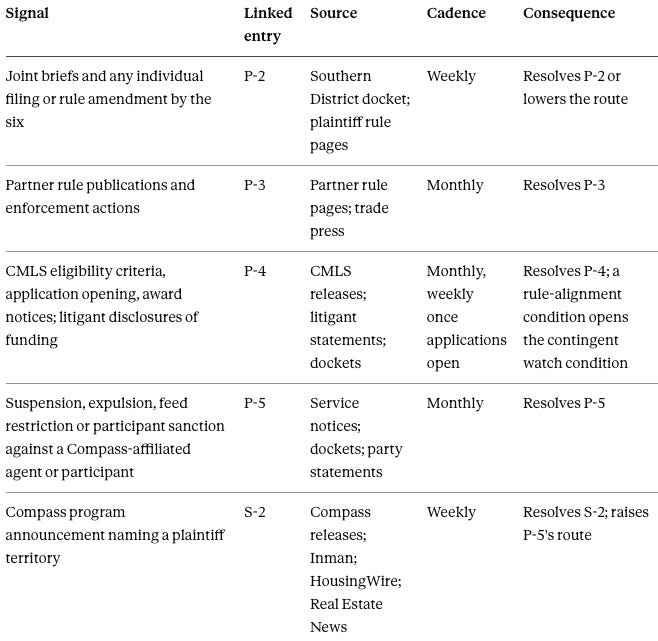
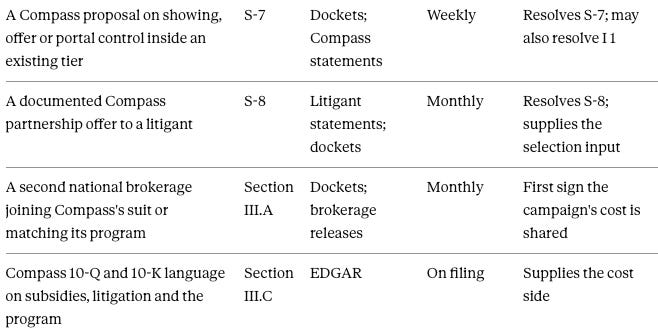
Any change to a band or window publishes as a revision note when it would alter stakeholder action. Weekly signals sit on the dockets and monthly signals on rule pages and releases, so a board or an analyst can run the protocol from public sources alone.
Conclusion
National brokerage scale changed the bargaining position of local cooperatives through sequence, and the six-MLS filing changed the sequence. Compass’s reusable work now meets reusable work on the other side, the plaintiffs’ defense cost is pooled rather than borne alone, and an industry fund may finance it. Size did not move; the order of play and the budget constraint did.
Partnerships and litigation coexist because they trade different rights. A cooperative can grant distribution and member access under its rules, and four did. It cannot grant member-invisibility without ceasing to produce completeness, and no announcement reports that any has.
Investors separate the two benefits in their models and separate litigation expense from strategy damage. Boards separate the two negotiations in their votes and compare joint defense with their alternatives. The decisive signals are Compass’s first substantive filing in the six-MLS action and CMLS’s first award.
Appendix A · Selected MindCast Works
Frameworks and methods. How State Attorney General Coalitions Form, Grow, and Hold (September 5, 2026) · the join-cost model Section III.E applies.
Companion work. Compass Invoked Its Washington Lawsuit Against Six MLSs, They Answered Together in New York.(October 22, 2026) · the main paper: the filing, the forecast slate and the source of the three carried Simulation Predictions.
Prior simulations and validations. California Private Listing Law After Washington SSB 6091, Broker Conduct Rules for Listing Visibility, Showing Access and Buyer Representation (October 2, 2026) · two entries validated on Compass’s October 16 complaint. Compass Runs the Same MLS Playbook Against CRMLS That It Ran Against NWMLS, CRMLS Broke It by Suing First in New York (October 6, 2026) · one entry resolved as a miss on Compass’s California filing. Mandatory MLS Submission Is the Rule NAR, Washington, and the NWMLS Settlement All Left Standing, and Compass v. CRMLS Is the Suit That Tests It (October 17, 2026) · the legal status of the submission rule and I 1. What the Private-Listing Economics Add to Magloire v. Compass, the Securities Act Case Already Pending Over the Anywhere Merger(October 17, 2026) · the merger-return hypothesis the three-benefit decomposition sorts.
Related analysis. The Compass–NWMLS Settlement Changed the Private Governor After Washington Changed the Governing Law (September 1, 2026) · the First Look terms. From Inventory Control to Attention Control, The Compass Commission-Consolidation Model After First Look (September 4, 2026) · the buyer-capture mechanism behind the third benefit.
Appendix B · External Sources
Court filings. Complaint, Arizona Regional Multiple Listing Service, Inc. et al. v. Compass, Inc., No. 1:26-cv-09253 (S.D.N.Y. Oct. 21, 2026), Dkt. No. 1 (paragraph cites in text); Robinson Bradshaw, “Six Major MLS Organizations Sue Compass to Protect Equal Access to Home Listings” (PR Newswire, Oct. 22, 2026). Complaint, Compass, Inc. et al. v. California Regional Multiple Listing Service, Inc., No. 5:26-cv-06121 (C.D. Cal. Oct. 16, 2026), Dkt. No. 1 (copy hosted by BAM). Complaint, Zillow Group, Inc. v. Midwest Real Estate Data LLC, No. 1:26-cv-05451 (N.D. Ill. May 12, 2026), Dkt. No. 1 (copy hosted by Ars Technica).
Compass statements. Compass, “Compass Sues Nation’s Second Largest MLS to Give Homeowners the Freedom to Publicly Market Their Own Homes on Their Own Terms” (Oct. 16, 2026). The release names the parent as Compass International Holdings; the complaint names Compass, Inc. (¶16).
Defense financing and Compass’s CRMLS-action letter. The Real Deal (Janani Jana), “Council of MLS steps up with $1M+ legal defense fund” (republished by Yahoo Finance, Oct. 22, 2026). Council of MLSs, “CMLS Exploring Legal Action Fund to Support the MLS Community” (councilofmls.org, Oct. 2026). Real Estate News (Andrea V. Brambila), “CMLS forming $1M-plus legal action fund after Compass threats” (Oct. 23, 2026). RISMedia (Jesse Williams), “The Morning After: Compass Hedges on Future Lawsuits; CMLS Preps Legal Defense Fund” (Oct. 23, 2026).
Industry policy. National Association of Realtors, “NAR Introduces New MLS Policy to Expand Choice for Consumers” (Mar. 25, 2025).
Seller-welfare studies, as summarized. RISMedia, “Do Research, Pre-Marketing Studies Say? Pricing, Policy, Privacy” (Apr. 21, 2026), summarizing Compass’s 2024 internal study, Zillow’s two-year pocket-listing study, Bright MLS’s six-month office-exclusive study, Redfin’s modeling study and Darren K. Hayunga’s University of Georgia working paper.
Partnership announcements. MRED, “MRED Expands Its Private Listing Network to All Brokers Nationwide” (GlobeNewswire, Apr. 24, 2026). Real Estate News, “Realtracs opens MLS service nationally” (Apr. 30, 2026). Real Estate News, “The MLS/CLAW partners with Compass, revises its IDX policy” (May 6, 2026). RISMedia, “Bright MLS Announces Nationwide Partnership with Compass” (May 13, 2026).
Allegations summarized from court filings are pleaded claims, not findings.