


I. Background: Three Parallel Diageo Litigations
In 2025, Diageo North America became the target of three putative class actions alleging that its Casamigos and Don Julio tequila products were falsely marketed as “100% agave” while allegedly containing non‑agave alcohol. Although filed in different jurisdictions and under different statutory theories, all three actions rested on the same factual core: consumer deception based on labeling, supported by carbon‑isotope testing and industry‑corruption narratives.
1. New York (Pusateri v. Diageo)
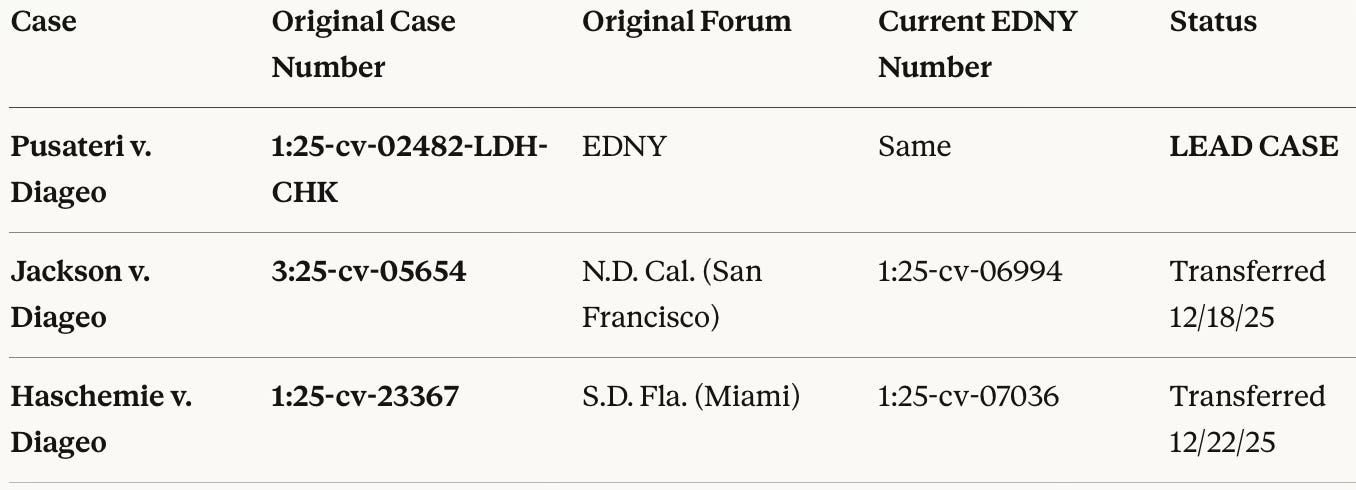
The first‑filed action was brought in the Eastern District of New York. It asserted state consumer‑protection and unjust‑enrichment claims on behalf of New York and New Jersey purchasers. The theory emphasized misleading labeling, price‑premium injury, and regulatory non‑compliance, supported by media reports and laboratory testing allegations.
2. California (Jackson v. Diageo)
The California action expanded the theory dramatically. In addition to consumer‑protection claims, it added a nationwide RICO theory alleging an “association‑in‑fact enterprise” involving Diageo, its Mexican affiliates, and the Tequila Regulatory Council. The pleading reframed the dispute from consumer mislabeling to systemic racketeering, seeking treble damages and nationwide relief.
3. Florida (Haschemie v. Diageo)
The Florida action replicated the New York factual narrative but broadened the proposed classes and asserted claims under multiple states’ laws. Like California, it attempted to expand geographic scope and pressure through scale rather than new factual development.
Despite surface differences, the three cases shared the same alleged misrepresentation, the same testing narrative, overlapping counsel, and closely sequenced filing timelines.
II. MindCast AI Publications and Ex‑Ante Foresight
Before these cases converged procedurally, MindCast AI published a series of foresight analyses and amicus briefs examining the litigation architecture rather than the ultimate merits. These publications did not predict who would “win.” Instead, they modeled how courts, defendants, and plaintiffs’ counsel predictably respond when scientific uncertainty intersects with regulatory certification, parallel filings attempt to fragment judicial review, and escalation (including RICO) is used as procedural leverage.
MindCast AI Publication 1: Brief of MindCast AI LLC as Amicus Curiae on Systematic Procedural Gaming In Scientific Litigation Targeting Diageo. Published: July 23, 2025 | Forum: EDNY
This publication forecast that Diageo’s primary defense would not be factual refutation alone, but institutional framing: invoking regulatory certification (CRT and TTB label approval) to trigger safe‑harbor doctrines, while attacking plaintiffs’ testing as disconnected from actual purchases.
MindCast AI Publication 2: Brief of MindCast AI LLC as Amicus Curiae On Systematic Litigation Pattern Engineering and Cross Jurisdictional Coercion Targeting Diageo. Published: July 23, 2025 | Forum: N.D. Cal. (Jackson v. Diageo)
This analysis predicted that courts would resist venue fragmentation by applying the first‑to‑file rule, consolidating the cases into a single forum to avoid inconsistent treatment of the same scientific allegations. It further predicted that RICO escalation would be neutralized procedurally rather than litigated on the merits.
MindCast AI Publication 3: Evidence Before Allegation in Diageo, How Courts Can Prevent Reputational Harm and Legal Overreach in Science-Based Lawsuits. Published: May 2025 (pre-litigation simulation)
This foresight simulation anticipated that plaintiffs would attack the integrity of the regulatory process itself, reframing certification bodies as compromised, and that scientific testing would become the central evidentiary battleground—long before discovery.
All three publications were released months before the decisive procedural developments.
Contact mcai@mindcast-ai.com to partner with us on foresight simulation in complex litigation. See recent publications: The Chicago School Accelerated, Posner and the Economics of Efficient Liability Allocation, Why Behavioral Economics Transforms the Lowest-Cost Avoider Calculus in AI Hallucinations (Dec 2025), Compass–Anywhere, When Scale Becomes Liability, Modernized Framework of Chicago Law and Behavioral Economics, Anchored in Coordination-Cost Economics (Jan 2026), Private Equity, NIL, Antitrust, and the Firm-Formation Phase of College Athletics, Capital Reorganization Under Regulatory Stasis (Jan 2026).
III. Foresight Validation Exhibits
How to Read the Validation Tables
Validation is defined here as correct anticipation of institutional response pathways, not agreement with any party’s factual or legal position.
The following tables document ex-ante foresight predictions published by MindCast AI and the subsequent litigation conduct that independently confirmed those predictions. Validation here does not depend on final merits rulings or judicial outcomes. Instead, it tracks institutional response patterns—defense strategy, procedural posture, and rhetorical framing—observable prior to discovery and dispositive adjudication.
Each “Foresight Simulation” entry reflects a modeled institutional behavior published before the corresponding litigation action occurred. Each “Litigation Artifact” cites a concrete filing, order, or quotation that confirms the modeled response.
MindCast AI Publication 1: Brief of MindCast AI LLC as Amicus Curiae on Systematic Procedural Gaming In Scientific Litigation Targeting Diageo.
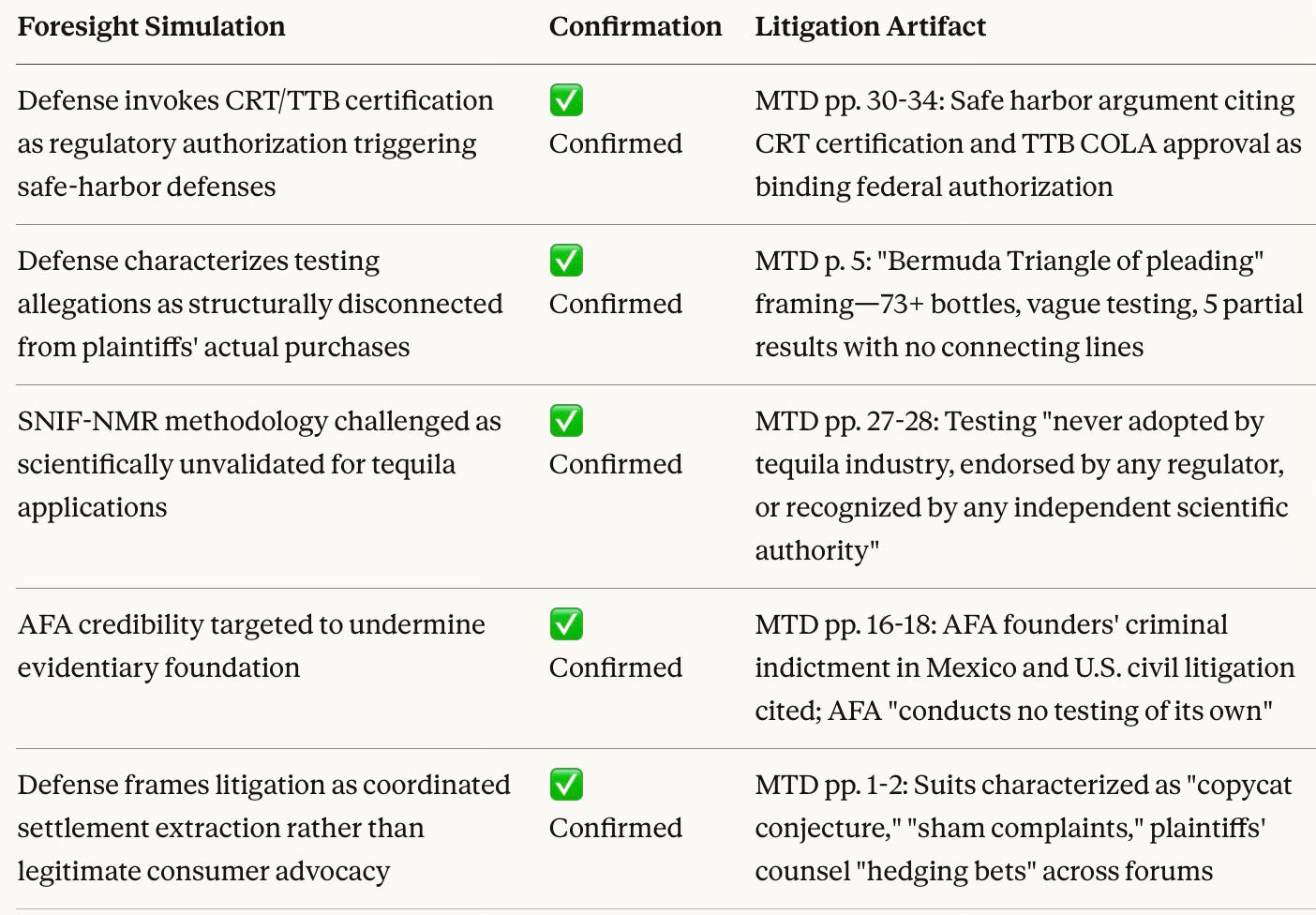
MindCast AI Publication 2: Brief of MindCast AI LLC as Amicus Curiae On Systematic Litigation Pattern Engineering and Cross Jurisdictional Coercion Targeting Diageo. Published: July 23, 2025 | Forum: N.D. Cal. (Jackson v. Diageo)
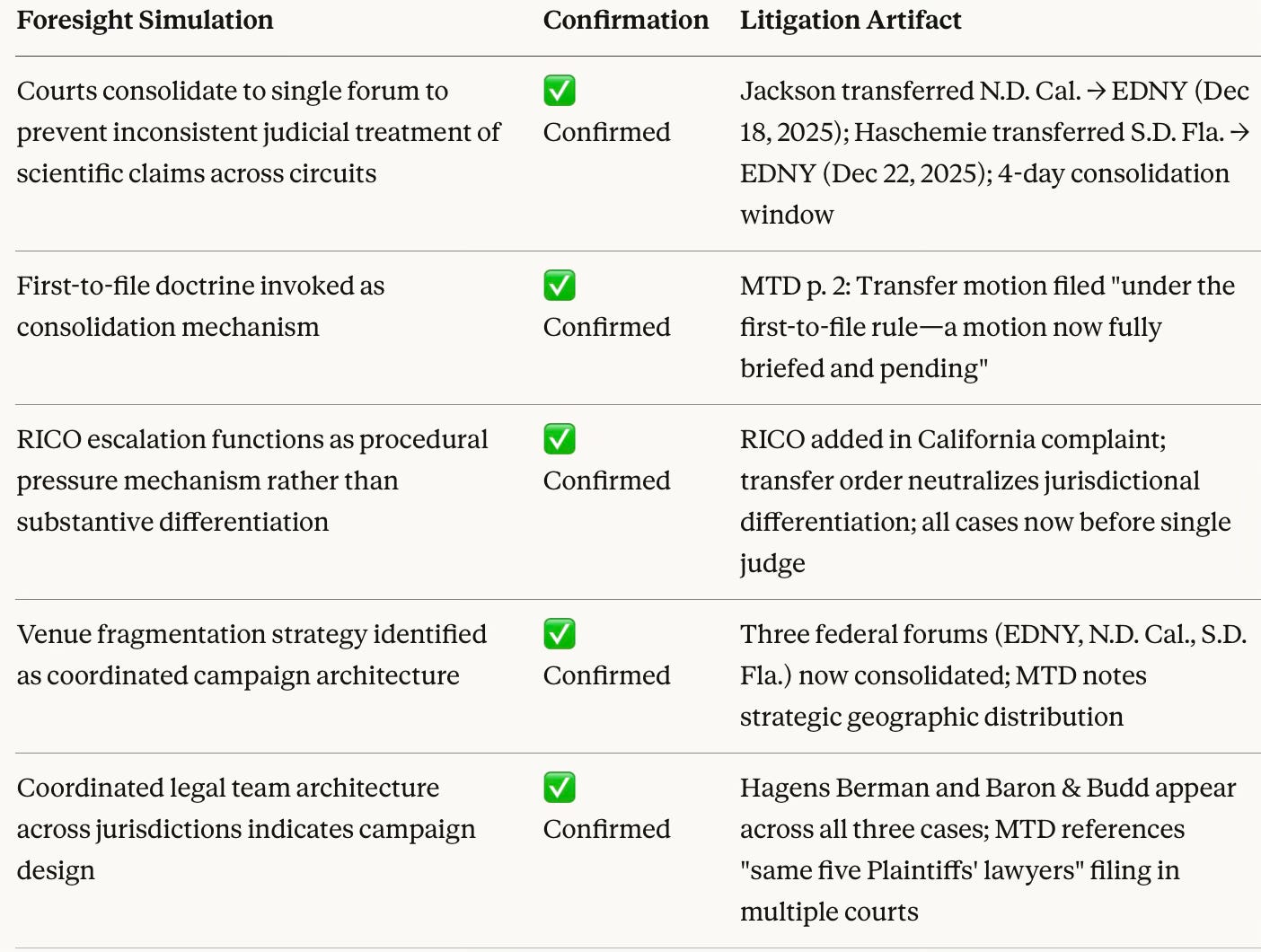
MindCast AI Publication 3: Evidence Before Allegation in Diageo, How Courts Can Prevent Reputational Harm and Legal Overreach in Science-Based Lawsuits. Published: May 2025 (pre-litigation simulation)
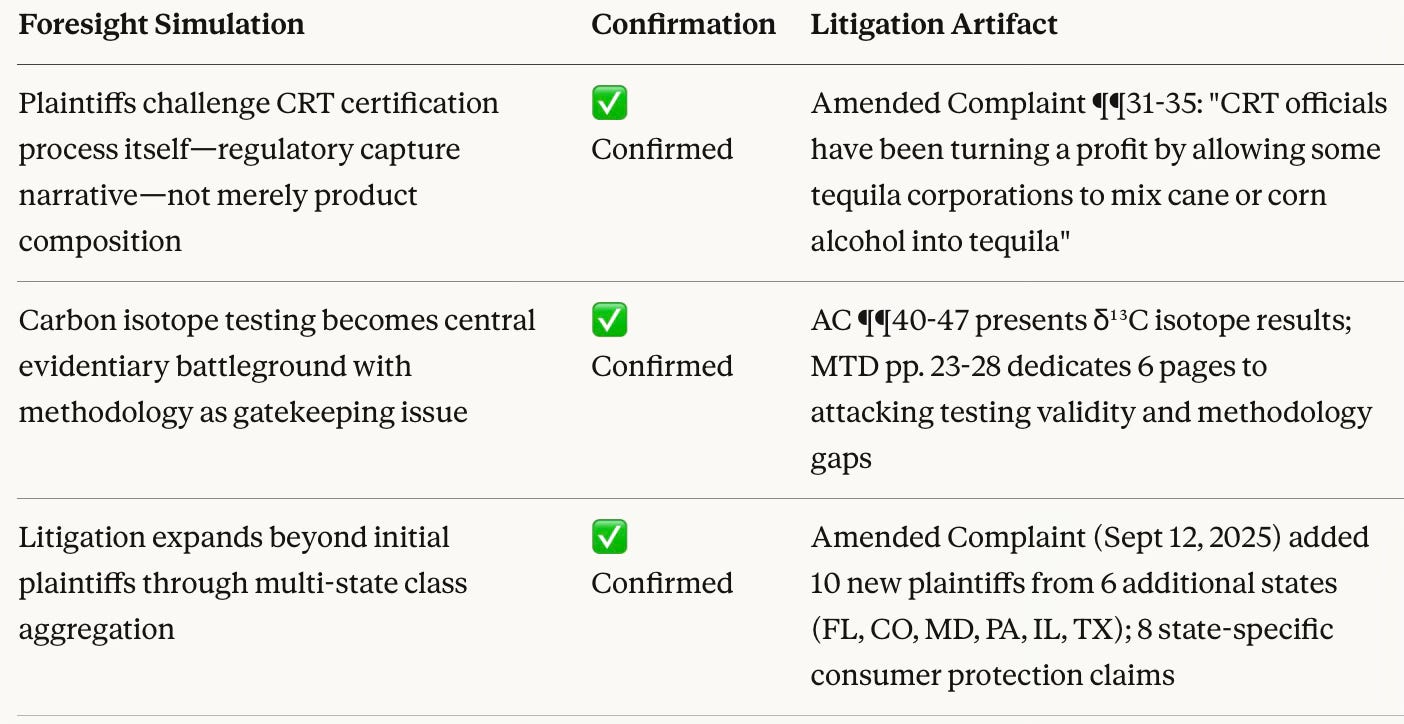
Three-Axis Foresight Coherence (Independent Validation)
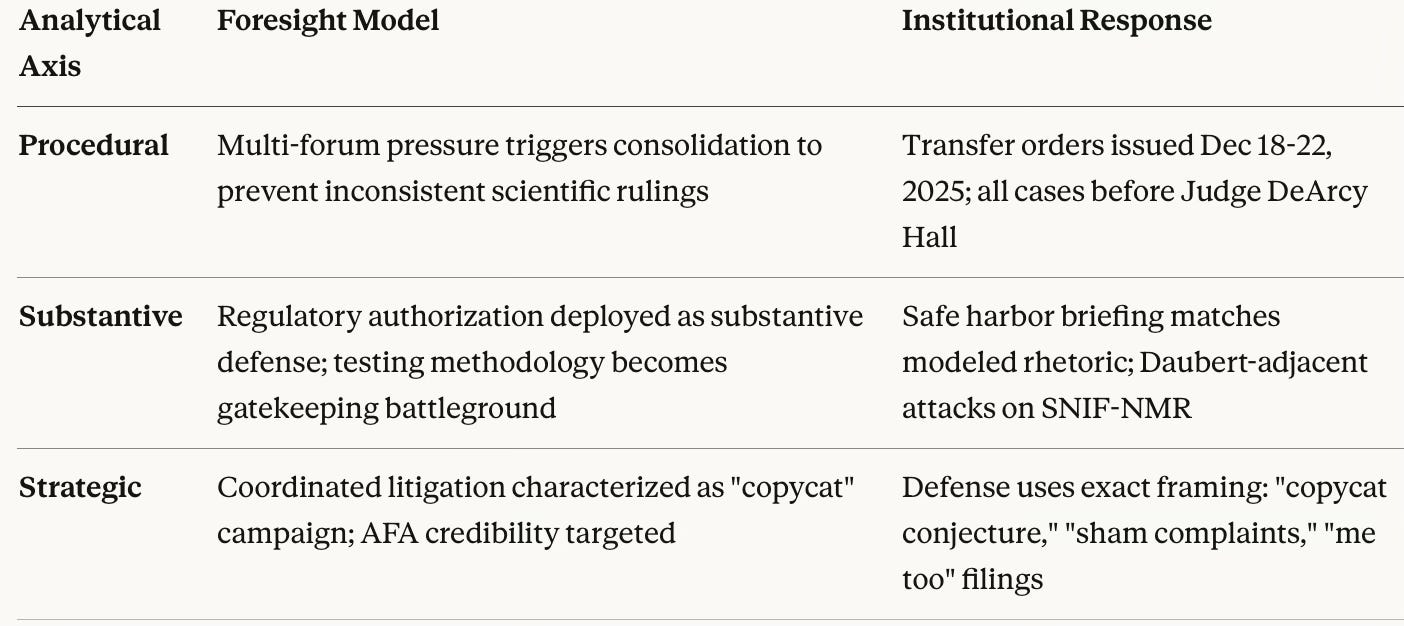
Each axis was modeled independently, using different inputs and analytical lenses, yet converged on the same institutional responses once litigation unfolded.
Methodological Significance
Three independent analytical pathways converged on identical institutional dynamics. Each pathway was modeled before the corresponding litigation response occurred. This demonstrates foresight coherence—the structural alignment between simulated institutional behavior and actual litigation conduct.
The Diageo litigation therefore functions as a live-fire test of foresight accuracy, not a retrospective narrative exercise.
What Was Validated (At the System Level)
Across three independent publications, MindCast AI modeled how courts and defendants respond when science-based allegations collide with regulatory certification and multi-forum pressure. The validation is not that any single argument prevailed, but that the same institutional dynamics emerged repeatedly: consolidation over fragmentation, regulatory authorization as a threshold defense, and methodological gatekeeping as a substitute for merits discovery.
These behaviors were not inferred after the fact. They were published in advance and confirmed through subsequent filings and orders within a four-to-five-month window.
IV. Procedural Developments: Consolidation into the Eastern District of New York
Between December 18 and December 23, 2025, the courts resolved the parallel‑forum experiment decisively:
The Northern District of California transferred Jackson to the Eastern District of New York under the first‑to‑file rule.
The Southern District of Florida transferred Haschemie to the Eastern District of New York on the same grounds.
Both transferred cases were formally designated as related to the New York action.
As a result, all three litigations were procedurally collapsed into a single forum, with Pusateri as the lead case. The California RICO escalation and the Florida class expansion did not create independent procedural tracks. No discovery proceeded in the non‑lead cases, and no merits rulings were issued outside EDNY.
The outcome reflects a familiar institutional instinct: when identical factual and scientific questions are presented in multiple courts, consolidation precedes adjudication.
Although plaintiffs amended their pleadings to expand class scope, elevate scientific detail, and introduce systemic-corruption and RICO theories, those amendments did not alter the underlying factual nucleus or prevent procedural consolidation.
Notably, no court reached the merits of the scientific allegations in the non-lead cases, and no discovery proceeded outside EDNY. The litigation architecture resolved before factual adjudication began.
V. Validated MindCast AI Foresight
The Diageo litigation provides a rare, clean validation set for MindCast AI’s foresight methodology. Key predictions were confirmed not by final judgments, but by observable institutional behavior.
1. Procedural Axis: Forum Convergence
MindCast AI predicted that courts would apply the first‑to‑file rule to prevent fragmented adjudication of scientific claims. Validation occurred when both California and Florida actions were transferred and subordinated to the New York case.
2. Substantive Axis: Regulatory Shield Deployment
MindCast AI predicted that Diageo would rely on regulatory certification and label approval as a threshold defense, reframing the dispute as an attack on authorized regulatory determinations rather than a factual question of adulteration. Diageo’s motion‑to‑dismiss briefing adopted precisely that posture, emphasizing certification, authorization, and safe‑harbor doctrines.
3. Strategic Axis: Neutralization of Escalation
MindCast AI predicted that RICO escalation would be treated as a procedural pressure tactic rather than a merits‑driven differentiation. The transfer orders expressly rejected RICO as a basis for separate treatment, folding those allegations back into the same factual nucleus as the consumer‑protection claims.
Importantly, these validations occurred within months of publication and before discovery, underscoring that the foresight concerned institutional response patterns, not ex post rationalization.
Each validated prediction was published weeks to months before the corresponding procedural or strategic response occurred, preserving ex-ante integrity.
VI. Why This Validation Matters
Most legal commentary explains outcomes after the fact. MindCast AI’s Diageo work demonstrates something different: the ability to anticipate how litigation systems behave under predictable stressors—scientific uncertainty, regulatory authority, and coordinated filing strategies.
The Diageo consolidation shows that procedure often resolves structural disputes before facts are tested, regulatory certification functions as an epistemic gatekeeper, and courts prioritize coherence over forum experimentation when identical scientific claims are at issue.
These dynamics were identified and published in advance. Their subsequent confirmation provides one of the clearest real‑world validations of MindCast AI’s foresight framework to date.
VII. Additional Validations from the 2025 MindCast AI Review
The Diageo litigation is best understood not as an isolated validation, but as an application-specific instance of a foresight framework already confirmed across enforcement, infrastructure, and federal-state governance domains.
MindCast AI’s foresight framework was independently validated across multiple high‑stakes domains in 2025, well before and separate from the Diageo litigation. These validations demonstrate not merely directional accuracy, but architectural accuracy—correctly identifying the specific corridors, specifications, actors, and institutional fault lines through which outcomes emerged.
First, in export‑control enforcement, MindCast AI published Foresight Analysis in Illegal GPU Export Pathways (Nov 2025), identifying Malaysia and Thailand as high‑probability transshipment corridors for restricted GPU exports. Seven days later, the Department of Justice unsealed indictments confirming those precise pathways. All four specific corridor and mechanism predictions were confirmed, validating the model’s ability to anticipate enforcement geography and evasion mechanics with actionable lead time.
Second, in AI infrastructure and capital‑physics coupling, MindCast AI released a trilogy of foresight simulations in October 2025 modeling quantum‑AI data‑center constraints, capital flows, and policy coordination. The Quantum-Coupled AI Data Center Campus, The Physics Nobel Prize That Became an Asset Class, MindCast AI’s NVIDIA NVQLink Validation (Oct 2025). These simulations predicted the technical specifications and strategic function of NVIDIA’s forthcoming NVQLink architecture. When NVIDIA announced NVQLink on October 28, 2025, every predicted metric—bandwidth class, interconnect role, and deployment logic—matched or exceeded the model’s forecasts, confirming multi‑month lead‑time accuracy across five of five technical dimensions.
Third, in AI Computing Is Now Federal Infrastructure (Nov 2025), MindCast AI’s 5 analysis of the Department of Energy’s Section 403 directive forecast that large‑load AI interconnection would trigger federal‑state jurisdictional conflict, with FERC asserting authority over fragmented state regimes. Within approximately three months, the Wall Street Journal reported the exact institutional confrontation predicted, including resistance by state regulators and the framing of the move as an unprecedented federal power consolidation. All six structural predictions—actors, timing, legal posture, and resistance dynamics—were confirmed or actively materializing.
Together, these prior validations establish that MindCast AI’s Cognitive Digital Twin methodology consistently delivers foresight at the level that matters most: not headlines, but mechanisms—how power, regulation, capital, and institutions actually move.
VII. Conclusion
The Diageo litigation remains pending before Judge DeArcy Hall. Discovery has not commenced. No merits ruling has issued. The factual question—whether Casamigos and Don Julio contain non-agave alcohol—remains unadjudicated.
But MindCast AI’s foresight was never about that question.
The foresight simulations published in May and July 2025 modeled how institutions respond when scientific uncertainty collides with regulatory certification, when parallel filings attempt to fragment judicial oversight, and when escalation tactics seek leverage through procedural pressure rather than factual development.
Every modeled response occurred:
Consolidation over fragmentation. Three federal forums collapsed into one within a four-day window.
Regulatory authorization as threshold defense. Diageo’s motion to dismiss deployed safe-harbor doctrine exactly as simulated.
Methodological gatekeeping before merits discovery. The scientific validity of SNIF-NMR testing became the central battleground—before any factual record was developed.
Rhetorical framing of coordinated litigation. The defense characterized plaintiffs’ campaign as “copycat conjecture” and “sham complaints”—language the foresight model anticipated.
These are not post-hoc rationalizations. They are documented, time-stamped institutional behaviors that confirm the structural accuracy of MindCast AI’s Cognitive Digital Twin methodology.
The validation extends beyond Diageo. Across export-control enforcement, AI infrastructure policy, and federal energy jurisdiction, MindCast AI’s 2025 foresight simulations demonstrated the same pattern: architectural accuracy months before institutional responses materialized.
This is what foresight means. Not predicting headlines. Not forecasting verdicts. Modeling how systems behave under pressure—and being right about the mechanisms before they move.
The Diageo litigation will eventually resolve on its merits. But the foresight question has already been answered.
MindCast AI did not predict the verdict. It predicted the system. And the system behaved exactly as modeled.